brake light FIAT DOBLO COMBI 2017 2.G Owner's Manual
[x] Cancel search | Manufacturer: FIAT, Model Year: 2017, Model line: DOBLO COMBI, Model: FIAT DOBLO COMBI 2017 2.GPages: 300, PDF Size: 24.91 MB
Page 170 of 300
126)Use your hazard lights, warning
triangle, etc. to show that your vehicle is
stationary according to the regulations
in force. Passengers should get out of the
vehicle, particularly if it is heavily loaded,
and wait for the wheel to be changed away
from the traffic. If you are on a slope or
uneven surface, place wedges or other
suitable objects under the wheels to secure
the vehicle. Have the wheel repaired and
refitted as soon as possible. Do not apply
grease to the bolt threads before
assembly: they might spontaneously
unscrew.
127)Use the jack only to replace wheels
on the vehicle with which it is supplied
or on other vehicles of the same model.
Never use the jack for other purposes,
such as lifting other models. Never use the
jack to carry out repairs under the vehicle.
Incorrect positioning of the jack may cause
the lifted vehicle to fall. Do not use the
jack for loads higher than those shown on
the label.
128)Incorrect hub cap assembly may
cause it to come off when the vehicle is
moving. Never tamper with the inflation
valve. Never introduce tools of any kind
between rim and tyre. Check tyre and
spare wheel pressures regularly, referring to
the values shown in the "Technical
specifications" section.FIX&GO AUTOMATIC
KIT
129) 130)
28)
DESCRIPTION
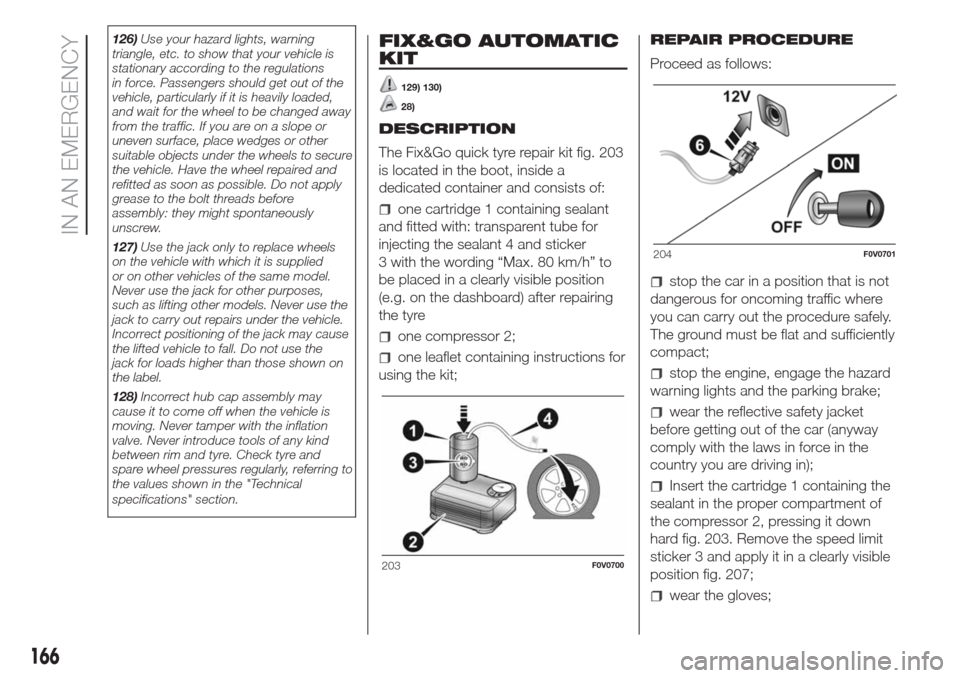
The Fix&Go quick tyre repair kit fig. 203
is located in the boot, inside a
dedicated container and consists of:
one cartridge 1 containing sealant
and fitted with: transparent tube for
injecting the sealant 4 and sticker
3 with the wording “Max. 80 km/h” to
be placed in a clearly visible position
(e.g. on the dashboard) after repairing
the tyre
one compressor 2;
one leaflet containing instructions for
using the kit;REPAIR PROCEDURE
Proceed as follows:
stop the car in a position that is not
dangerous for oncoming traffic where
you can carry out the procedure safely.
The ground must be flat and sufficiently
compact;
stop the engine, engage the hazard
warning lights and the parking brake;
wear the reflective safety jacket
before getting out of the car (anyway
comply with the laws in force in the
country you are driving in);
Insert the cartridge 1 containing the
sealant in the proper compartment of
the compressor 2, pressing it down
hard fig. 203. Remove the speed limit
sticker 3 and apply it in a clearly visible
position fig. 207;
wear the gloves;
203F0V0700
204F0V0701
166
IN AN EMERGENCY
Page 173 of 300
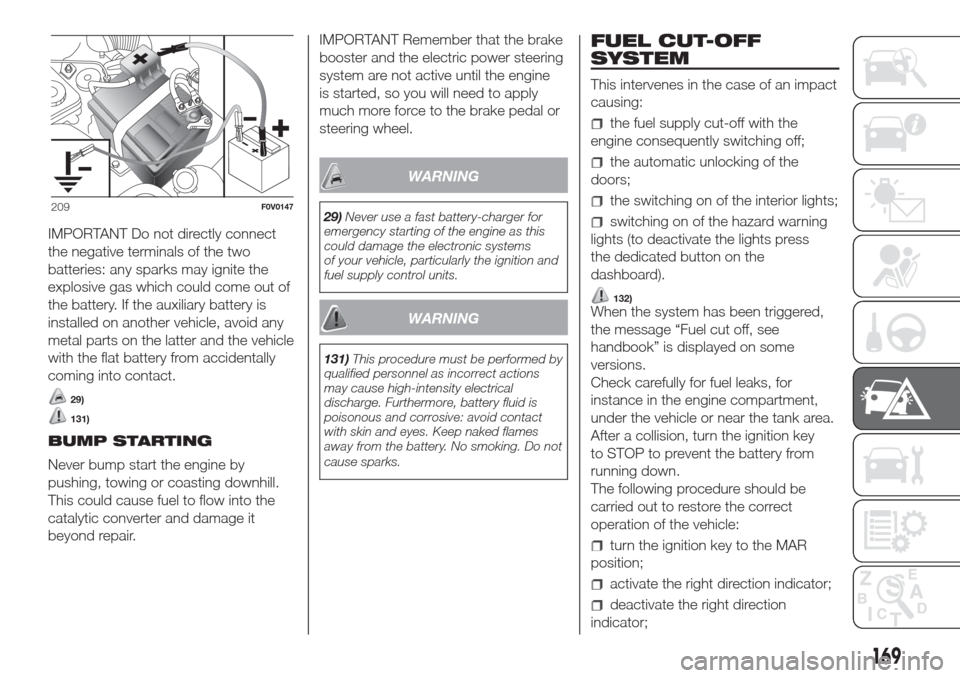
IMPORTANT Do not directly connect
the negative terminals of the two
batteries: any sparks may ignite the
explosive gas which could come out of
the battery. If the auxiliary battery is
installed on another vehicle, avoid any
metal parts on the latter and the vehicle
with the flat battery from accidentally
coming into contact.
29)
131)
BUMP STARTING
Never bump start the engine by
pushing, towing or coasting downhill.
This could cause fuel to flow into the
catalytic converter and damage it
beyond repair.IMPORTANT Remember that the brake
booster and the electric power steering
system are not active until the engine
is started, so you will need to apply
much more force to the brake pedal or
steering wheel.
WARNING
29)Never use a fast battery-charger for
emergency starting of the engine as this
could damage the electronic systems
of your vehicle, particularly the ignition and
fuel supply control units.
WARNING
131)This procedure must be performed by
qualified personnel as incorrect actions
may cause high-intensity electrical
discharge. Furthermore, battery fluid is
poisonous and corrosive: avoid contact
with skin and eyes. Keep naked flames
away from the battery. No smoking. Do not
cause sparks.
FUEL CUT-OFF
SYSTEM
This intervenes in the case of an impact
causing:
the fuel supply cut-off with the
engine consequently switching off;
the automatic unlocking of the
doors;
the switching on of the interior lights;
switching on of the hazard warning
lights (to deactivate the lights press
the dedicated button on the
dashboard).
132)When the system has been triggered,
the message “Fuel cut off, see
handbook” is displayed on some
versions.
Check carefully for fuel leaks, for
instance in the engine compartment,
under the vehicle or near the tank area.
After a collision, turn the ignition key
to STOP to prevent the battery from
running down.
The following procedure should be
carried out to restore the correct
operation of the vehicle:
turn the ignition key to the MAR
position;
activate the right direction indicator;
deactivate the right direction
indicator;
209F0V0147
169
Page 179 of 300
SERVICE SCHEDULE
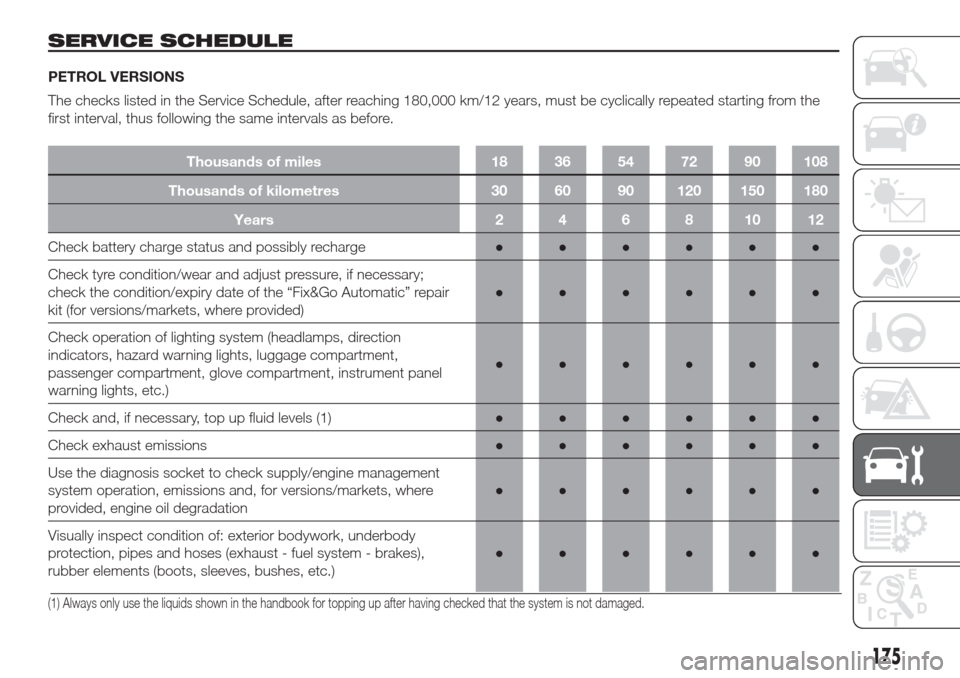
PETROL VERSIONS
The checks listed in the Service Schedule, after reaching 180,000 km/12 years, must be cyclically repeated starting from the
first interval, thus following the same intervals as before.
Thousands of miles 18 36 54 72 90 108
Thousands of kilometres 30 60 90 120 150 180
Years 2 4 6 8 10 12
Check battery charge status and possibly recharge●●●●●●
Check tyre condition/wear and adjust pressure, if necessary;
check the condition/expiry date of the “Fix&Go Automatic” repair
kit (for versions/markets, where provided)●●●●●●
Check operation of lighting system (headlamps, direction
indicators, hazard warning lights, luggage compartment,
passenger compartment, glove compartment, instrument panel
warning lights, etc.)●●●●●●
Check and, if necessary, top up fluid levels (1)●●●●●●
Check exhaust emissions●●●●●●
Use the diagnosis socket to check supply/engine management
system operation, emissions and, for versions/markets, where
provided, engine oil degradation●●●●●●
Visually inspect condition of: exterior bodywork, underbody
protection, pipes and hoses (exhaust - fuel system - brakes),
rubber elements (boots, sleeves, bushes, etc.)●●●●●●
(1) Always only use the liquids shown in the handbook for topping up after having checked that the system is not damaged.
175
Page 182 of 300
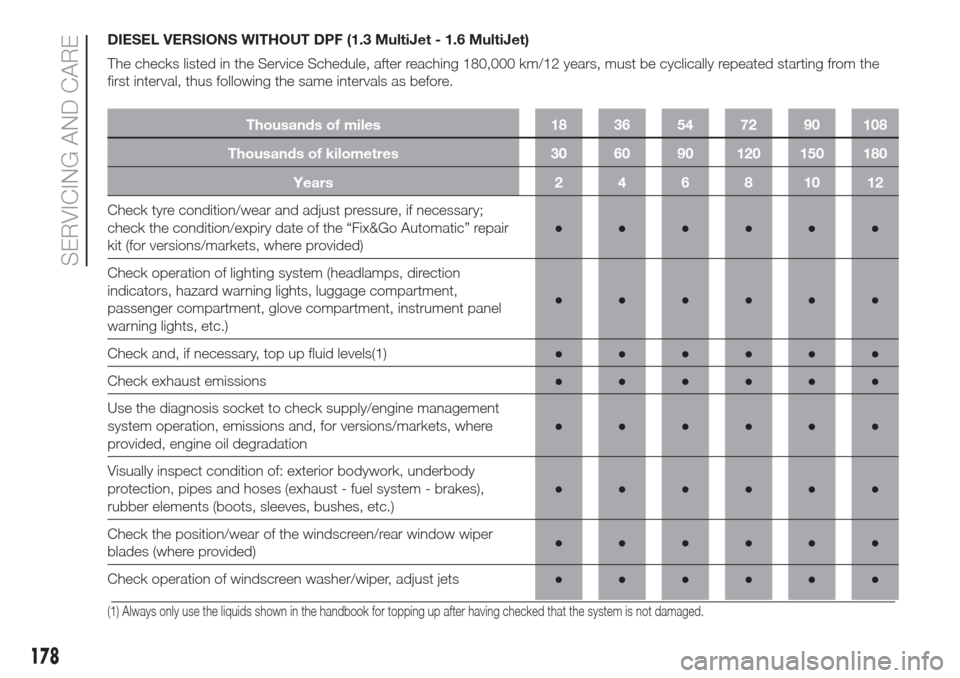
DIESEL VERSIONS WITHOUT DPF (1.3 MultiJet - 1.6 MultiJet)
The checks listed in the Service Schedule, after reaching 180,000 km/12 years, must be cyclically repeated starting from the
first interval, thus following the same intervals as before.
Thousands of miles 18 36 54 72 90 108
Thousands of kilometres 30 60 90 120 150 180
Years 2 4 6 8 10 12
Check tyre condition/wear and adjust pressure, if necessary;
check the condition/expiry date of the “Fix&Go Automatic” repair
kit (for versions/markets, where provided)●●●●●●
Check operation of lighting system (headlamps, direction
indicators, hazard warning lights, luggage compartment,
passenger compartment, glove compartment, instrument panel
warning lights, etc.)●●●●●●
Check and, if necessary, top up fluid levels(1)●●●●●●
Check exhaust emissions●●●●●●
Use the diagnosis socket to check supply/engine management
system operation, emissions and, for versions/markets, where
provided, engine oil degradation●●●●●●
Visually inspect condition of: exterior bodywork, underbody
protection, pipes and hoses (exhaust - fuel system - brakes),
rubber elements (boots, sleeves, bushes, etc.)●●●●●●
Check the position/wear of the windscreen/rear window wiper
blades (where provided)●●●●●●
Check operation of windscreen washer/wiper, adjust jets●●●●●●
(1) Always only use the liquids shown in the handbook for topping up after having checked that the system is not damaged.
178
SERVICING AND CARE
Page 184 of 300
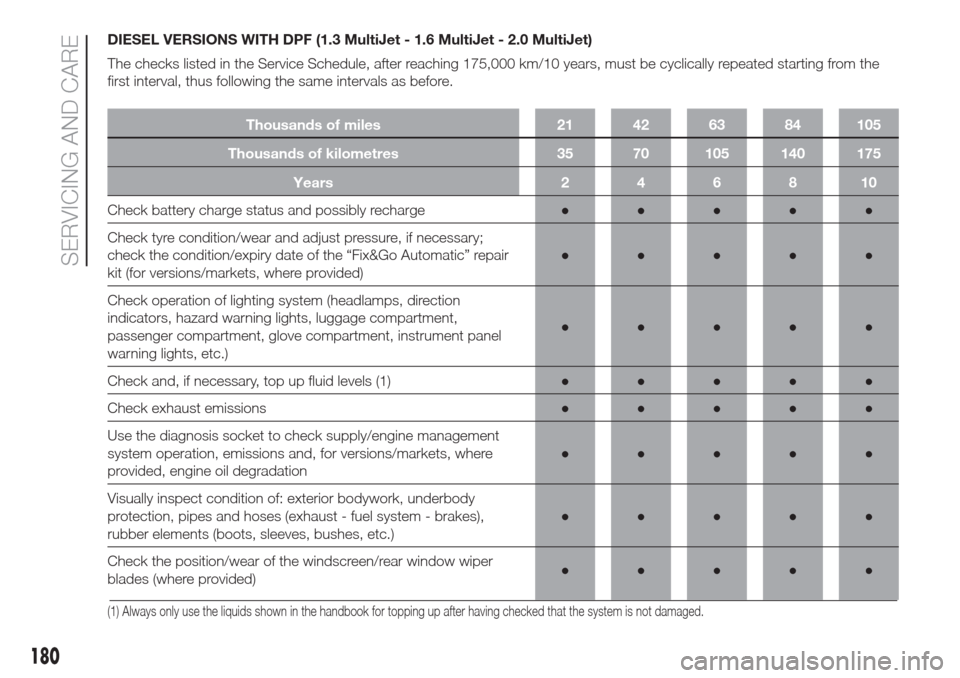
DIESEL VERSIONS WITH DPF (1.3 MultiJet - 1.6 MultiJet - 2.0 MultiJet)
The checks listed in the Service Schedule, after reaching 175,000 km/10 years, must be cyclically repeated starting from the
first interval, thus following the same intervals as before.
Thousands of miles 21 42 63 84 105
Thousands of kilometres 35 70 105 140 175
Years246810
Check battery charge status and possibly recharge●●●●●
Check tyre condition/wear and adjust pressure, if necessary;
check the condition/expiry date of the “Fix&Go Automatic” repair
kit (for versions/markets, where provided)●●●●●
Check operation of lighting system (headlamps, direction
indicators, hazard warning lights, luggage compartment,
passenger compartment, glove compartment, instrument panel
warning lights, etc.)●●●●●
Check and, if necessary, top up fluid levels (1)●●●●●
Check exhaust emissions●●●●●
Use the diagnosis socket to check supply/engine management
system operation, emissions and, for versions/markets, where
provided, engine oil degradation●●●●●
Visually inspect condition of: exterior bodywork, underbody
protection, pipes and hoses (exhaust - fuel system - brakes),
rubber elements (boots, sleeves, bushes, etc.)●●●●●
Check the position/wear of the windscreen/rear window wiper
blades (where provided)●●●●●
(1) Always only use the liquids shown in the handbook for topping up after having checked that the system is not damaged.
180
SERVICING AND CARE
Page 185 of 300

Thousands of miles 21 42 63 84 105
Thousands of kilometres 35 70 105 140 175
Years246810
Check operation of windscreen washer/wiper, adjust jets●●●●●
Check cleanliness of bonnet locks, and cleanliness and lubrication
of linkages●●●●●
Check cleanliness of sliding side door lower guides (or every 6
months)●●●●●
Check handbrake lever travel and adjust, if necessary●●●●●
Check condition and wear of front disc brake pads and operation
of pad wear indicator●●●●●
Check rear drum brake lining condition and wear●●
Visually inspect conditions of the accessory drive belt(s)●●
Check manual gearbox oil (version 1.3 Multijet)●
Change engine oil and replace oil filter (versions with DPF)(2)
Replace toothed timing belt (1.6 Multijet — 2.0 Multijet versions)(3)
(2) The actual frequency for changing the oil and replacing the engine oil filter depends on the vehicle usage conditions and is signalled by the warning light or
message (where provided) on the instrument panel (see "Warning lights and messages" chapter). In any case, it must never exceed 24 months. Change engine
oil and filter every 12 months if the vehicle is driven mainly in towns.
(3) Areas that are not dusty: recommended maximum distance 105,000 km. The belt must be replaced every 6 years, regardless of distance travelled. — Dusty
areas and/or demanding use of the vehicle (cold climates, town use, long periods of idling): advised maximum mileage 60,000 km. The belt must be replaced
every 4 years, regardless of distance travelled.
181
Page 187 of 300
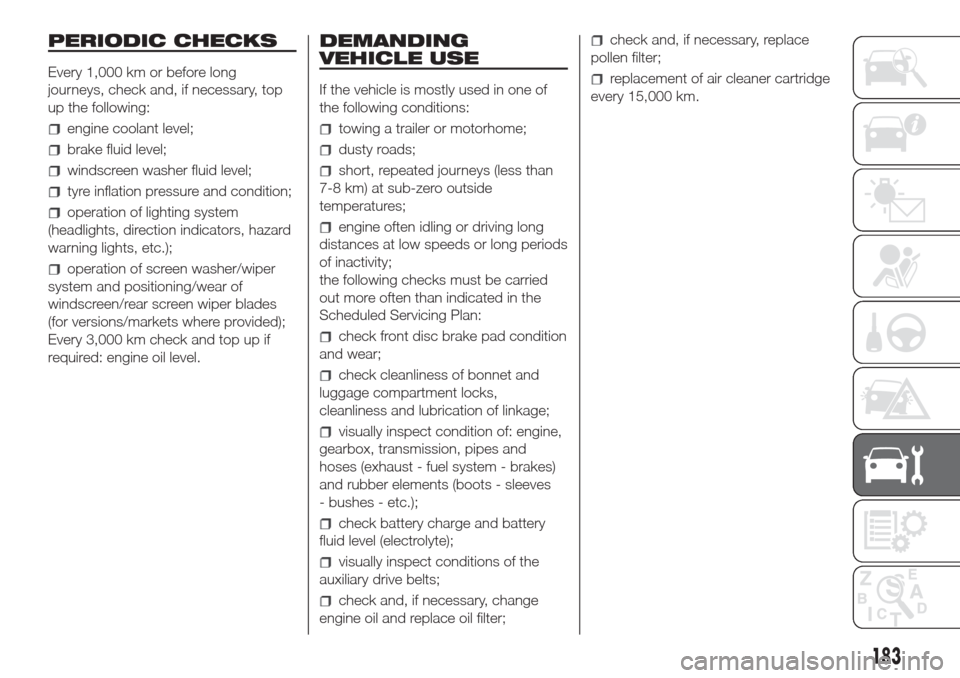
PERIODIC CHECKS
Every 1,000 km or before long
journeys, check and, if necessary, top
up the following:
engine coolant level;
brake fluid level;
windscreen washer fluid level;
tyre inflation pressure and condition;
operation of lighting system
(headlights, direction indicators, hazard
warning lights, etc.);
operation of screen washer/wiper
system and positioning/wear of
windscreen/rear screen wiper blades
(for versions/markets where provided);
Every 3,000 km check and top up if
required: engine oil level.
DEMANDING
VEHICLE USE
If the vehicle is mostly used in one of
the following conditions:
towing a trailer or motorhome;
dusty roads;
short, repeated journeys (less than
7-8 km) at sub-zero outside
temperatures;
engine often idling or driving long
distances at low speeds or long periods
of inactivity;
the following checks must be carried
out more often than indicated in the
Scheduled Servicing Plan:
check front disc brake pad condition
and wear;
check cleanliness of bonnet and
luggage compartment locks,
cleanliness and lubrication of linkage;
visually inspect condition of: engine,
gearbox, transmission, pipes and
hoses (exhaust - fuel system - brakes)
and rubber elements (boots - sleeves
- bushes - etc.);
check battery charge and battery
fluid level (electrolyte);
visually inspect conditions of the
auxiliary drive belts;
check and, if necessary, change
engine oil and replace oil filter;
check and, if necessary, replace
pollen filter;
replacement of air cleaner cartridge
every 15,000 km.
183
Page 204 of 300

RUBBER HOSES
As far as the maintenance of the brake
system and fuel supply system rubber
hoses is concerned, follow the
"Scheduled Servicing Plan" in this
chapter carefully.
Ozone, high temperatures and
prolonged lack of fluid in the system
may cause hardening and cracking of
the hoses, with possible leaks. Careful
checking is therefore necessary.
PROLONGED
VEHICLE INACTIVITY
If the vehicle needs to be off the road
for longer than one month, the following
precautions must be taken:
park the vehicle indoors in a dry
and, if possible, well-ventilated place;
engage a gear and check that
the handbrake is not engaged;
disconnect the negative terminal
from the battery pole (see paragraph
“Vehicle inactivity” in the "Dashboard
and controls" chapter) and check
the charge conditions (see paragraph
“Battery” in the “Care and
maintenance” chapter);
clean and protect the painted parts
using protective wax;
clean and protect the shiny metal
parts using special compounds
available commercially;
sprinkle talcum powder on the
windscreen and rear window wiper
rubber blades and lift them off the
glass;
slightly open the windows;
cover the vehicle with a piece of
fabric or perforated plastic sheet. Do
not use compact plastic tarpaulins,
which prevent humidity from
evaporating from the surface of the
vehicle;
inflate tyres to +0.5 bar above the
standard specified pressure and check
it at intervals;
do not drain the engine cooling
system.
200
SERVICING AND CARE
Page 207 of 300
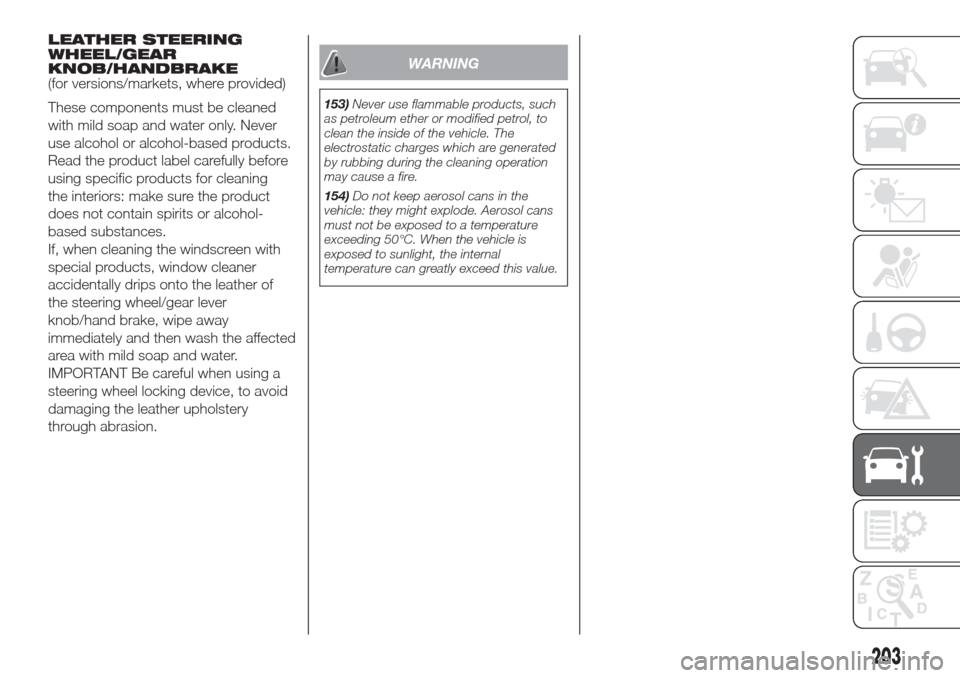
LEATHER STEERING
WHEEL/GEAR
KNOB/HANDBRAKE
(for versions/markets, where provided)
These components must be cleaned
with mild soap and water only. Never
use alcohol or alcohol-based products.
Read the product label carefully before
using specific products for cleaning
the interiors: make sure the product
does not contain spirits or alcohol-
based substances.
If, when cleaning the windscreen with
special products, window cleaner
accidentally drips onto the leather of
the steering wheel/gear lever
knob/hand brake, wipe away
immediately and then wash the affected
area with mild soap and water.
IMPORTANT Be careful when using a
steering wheel locking device, to avoid
damaging the leather upholstery
through abrasion.
WARNING
153)Never use flammable products, such
as petroleum ether or modified petrol, to
clean the inside of the vehicle. The
electrostatic charges which are generated
by rubbing during the cleaning operation
may cause a fire.
154)Do not keep aerosol cans in the
vehicle: they might explode. Aerosol cans
must not be exposed to a temperature
exceeding 50°C. When the vehicle is
exposed to sunlight, the internal
temperature can greatly exceed this value.
203
Page 259 of 300
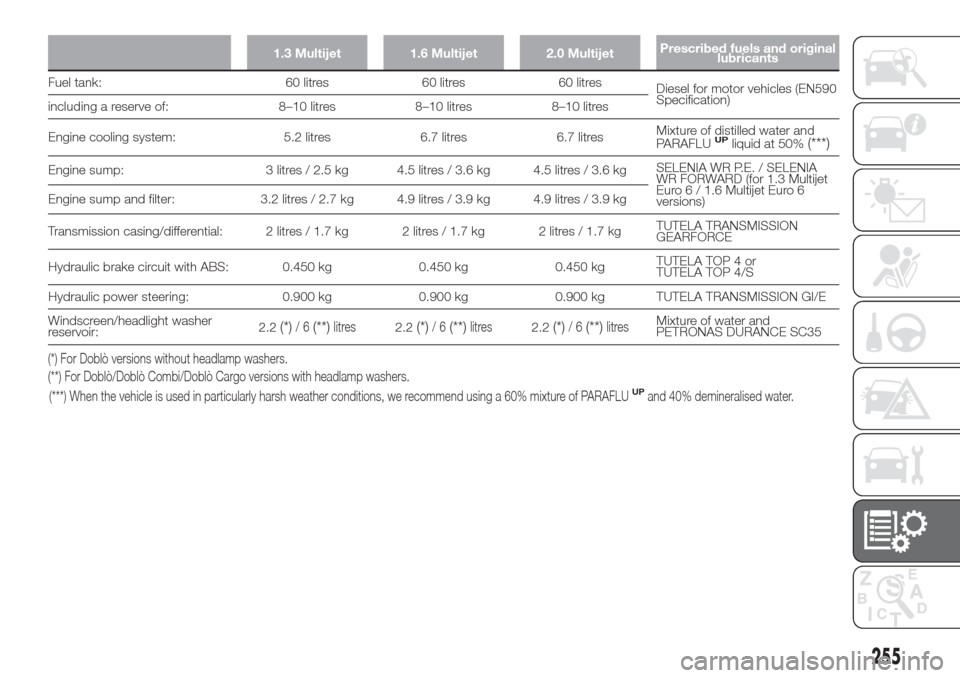
1.3 Multijet 1.6 Multijet 2.0 MultijetPrescribed fuels and original
lubricants
Fuel tank: 60 litres 60 litres 60 litres
Diesel for motor vehicles (EN590
Specification)
including a reserve of: 8–10 litres 8–10 litres 8–10 litres
Engine cooling system: 5.2 litres 6.7 litres 6.7 litresMixture of distilled water and
PARAFLU
UPliquid at 50%(***)
Engine sump: 3 litres / 2.5 kg 4.5 litres / 3.6 kg 4.5 litres / 3.6 kgSELENIA WR P.E. / SELENIA
WR FORWARD (for 1.3 Multijet
Euro 6 / 1.6 Multijet Euro 6
versions) Engine sump and filter: 3.2 litres / 2.7 kg 4.9 litres / 3.9 kg 4.9 litres / 3.9 kg
Transmission casing/differential: 2 litres / 1.7 kg 2 litres / 1.7 kg 2 litres / 1.7 kgTUTELA TRANSMISSION
GEARFORCE
Hydraulic brake circuit with ABS: 0.450 kg 0.450 kg 0.450 kgTUTELA TOP 4 or
TUTELA TOP 4/S
Hydraulic power steering: 0.900 kg 0.900 kg 0.900 kg TUTELA TRANSMISSION GI/E
Windscreen/headlight washer
reservoir:2.2
(*)/6(**)litres2.2(*)/6(**)litres2.2(*)/6(**)litresMixture of water and
PETRONAS DURANCE SC35
(***) When the vehicle is used in particularly harsh weather conditions, we recommend using a 60% mixture of PARAFLUUPand 40% demineralised water. (*) For Doblò versions without headlamp washers.
(**) For Doblò/Doblò Combi/Doblò Cargo versions with headlamp washers.
255