ABS FIAT DOBLO COMBI 2017 2.G Owners Manual
[x] Cancel search | Manufacturer: FIAT, Model Year: 2017, Model line: DOBLO COMBI, Model: FIAT DOBLO COMBI 2017 2.GPages: 300, PDF Size: 24.91 MB
Page 7 of 300
USE OF THE OWNER HANDBOOK
OPERATING INSTRUCTIONS
Each time direction instructions (left/right or forwards/backwards) about the vehicle are given, these must be intended as
regarding an occupant in the driver's seat. Special cases not complying with this rule will be specified as appropriate in the text.
The figures in the Owner Handbook are provided by way of example only: this might imply that some details of the image do
not correspond to the actual arrangement of your vehicle. In addition, the Handbook has been conceived considering vehicles
with steering wheel on the left side; it is therefore possible that on vehicles with steering wheel on the right side, the position
or construction of some controls is not exactly mirror-like with respect to the figure.
To identify the chapter with the information needed you can consult the index at the end of this Owner Handbook.
Chapters can be rapidly identified with dedicated graphic tabs, at the side of each odd page. A few pages further there is a key
for getting to know the chapter order and the relevant symbols in the tabs. There is in any case a textual indication of the
current chapter at the side of each even page.
WARNINGS AND PRECAUTIONS
While reading this Owner Handbook you will find a series ofWARNINGSto prevent procedures that could damage your
vehicle.
There are alsoPRECAUTIONSthat must be carefully followed to prevent incorrect use of the components of the vehicle,
which could cause accidents or injuries.
Therefore allWARNINGSandPRECAUTIONSmust always be carefully followed.
WARNINGSandPRECAUTIONSare recalled in the text with the following symbols:
personal safety;
vehicle integrity;
environmental protection.
NOTE These symbols, when necessary, are indicated besides the title or at the end of the line and are followed by a number.
That number recalls the corresponding warning at the end of the relevant section.
Page 21 of 300
7)It is absolutely forbidden to carry out any
after-market operation involving steering
system or steering column modifications
(e.g.: installation of anti-theft device) that
could badly affect performance and safety,
cause the lapse of warranty and also
result in non-compliance of the vehicle with
type approval requirements.SYMBOLS
Some vehicle components have
coloured labels whose symbols indicate
precautions to be observed when
using this component. Under the
bonnet there is also a label that
summarises all the symbols.
THE FIAT CODE
SYSTEM
IN BRIEF
This is an electrical engine locking
system which increases protection
against attempted theft of the vehicle.
It is automatically activated when
the ignition key is removed.
Each key contains an electronic
device which modulates the signal
emitted during ignition by an antenna
built into the ignition device. The
signal, which changes each time the
engine is started, is the “password”,
by means of which the control unit
recognises the key and enables
starting.
1)
Operation
Each time the vehicle is started turning
the ignition key toMAR, the Fiat CODE
system control unit sends a recognition
code to the Powertrain Control Module
to deactivate the inhibitor.
The acknowledgement code is sent
only if the Fiat CODE system control
unit has recognised the code
transmitted from the key.
17
Page 31 of 300
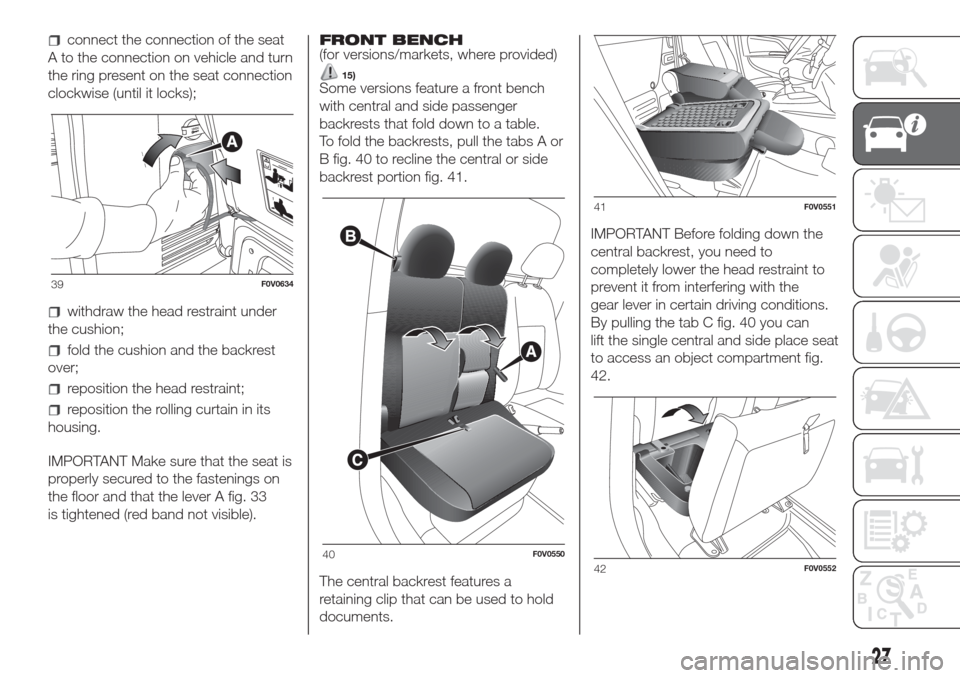
connect the connection of the seat
A to the connection on vehicle and turn
the ring present on the seat connection
clockwise (until it locks);
withdraw the head restraint under
the cushion;
fold the cushion and the backrest
over;
reposition the head restraint;
reposition the rolling curtain in its
housing.
IMPORTANT Make sure that the seat is
properly secured to the fastenings on
the floor and that the lever A fig. 33
is tightened (red band not visible).FRONT BENCH
(for versions/markets, where provided)
15)Some versions feature a front bench
with central and side passenger
backrests that fold down to a table.
To fold the backrests, pull the tabs A or
B fig. 40 to recline the central or side
backrest portion fig. 41.
The central backrest features a
retaining clip that can be used to hold
documents.IMPORTANT Before folding down the
central backrest, you need to
completely lower the head restraint to
prevent it from interfering with the
gear lever in certain driving conditions.
By pulling the tab C fig. 40 you can
lift the single central and side place seat
to access an object compartment fig.
42.
39F0V0634
40F0V0550
41F0V0551
42F0V0552
27
Page 64 of 300
WARNING
35)If you are travelling in areas with few
filling stations and you want to transport
fuel in a spare tank, comply with the law by
using only an approved, suitably secured
tank. However, the risks of fire in the case
of collision increase anyway.
36)Never exceed the maximum allowed
load in the boot, see the “Technical
specifications” chapter. Also make sure
that the objects you place in the boot have
been properly secured, to avoid them
from being thrown forward consequent to
sudden braking and injuring your
passengers.
37)If you are travelling in areas with few
filling stations and you want to transport
fuel in a spare tank, comply with the law by
using only an approved, suitably secured
tank. Anyway, by doing so, you increase
the risk of fire in the event of an accident
with your vehicle.38)Never exceed the maximum allowed
load in the boot (see the "Technical
specifications" chapter). Also make sure
that the objects you place in the boot have
been properly secured, to avoid them
from being thrown forward consequent to
sudden braking and injuring your
passengers.
39)You must not use the folded rear seat
to carry luggage. The load could be thrown
forward into the backrest of the front
seats, seriously injuring the occupants.
40)Make sure that the objects are
positioned carefully and fixed to the hooks
on the floor to prevent them being flung
forwards in the event of sharp braking and
causing injury to the passengers.
WARNING
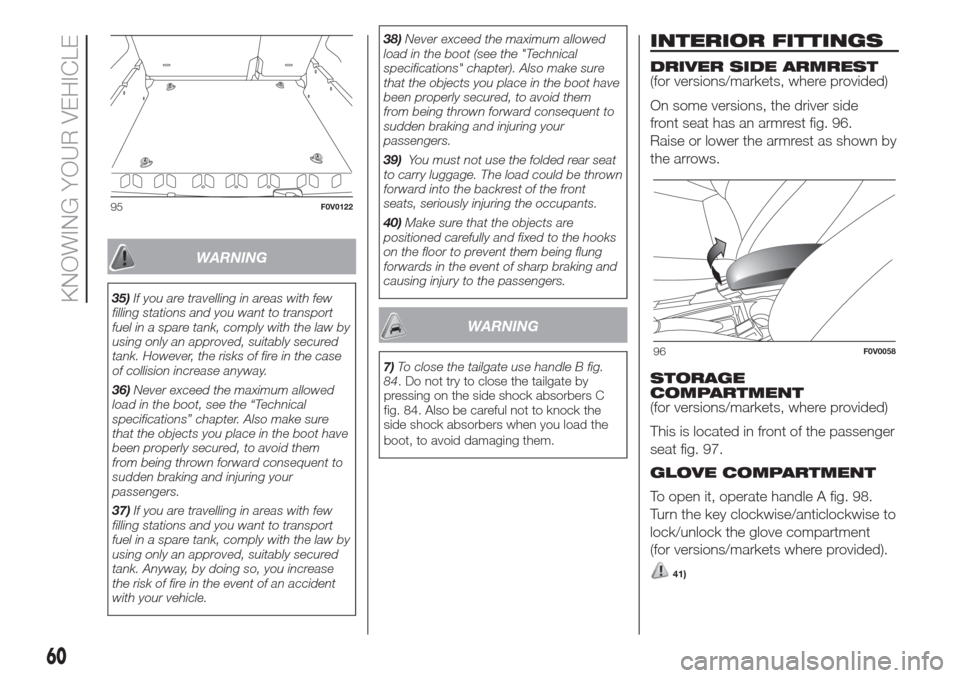
7)To close the tailgate use handle B fig.
84. Do not try to close the tailgate by
pressing on the side shock absorbers C
fig. 84. Also be careful not to knock the
side shock absorbers when you load the
boot, to avoid damaging them.
INTERIOR FITTINGS
DRIVER SIDE ARMREST
(for versions/markets, where provided)
On some versions, the driver side
front seat has an armrest fig. 96.
Raise or lower the armrest as shown by
the arrows.
STORAGE
COMPARTMENT
(for versions/markets, where provided)
This is located in front of the passenger
seat fig. 97.
GLOVE COMPARTMENT
To open it, operate handle A fig. 98.
Turn the key clockwise/anticlockwise to
lock/unlock the glove compartment
(for versions/markets where provided).
41)
95F0V0122
96F0V0058
60
KNOWING YOUR VEHICLE
Page 70 of 300
no. 2 rear speakers (on the side of
the parcel shelf) (for versions/markets,
where provided);
radio housing;
aerial lead:
aerial.
SOUND SYSTEM
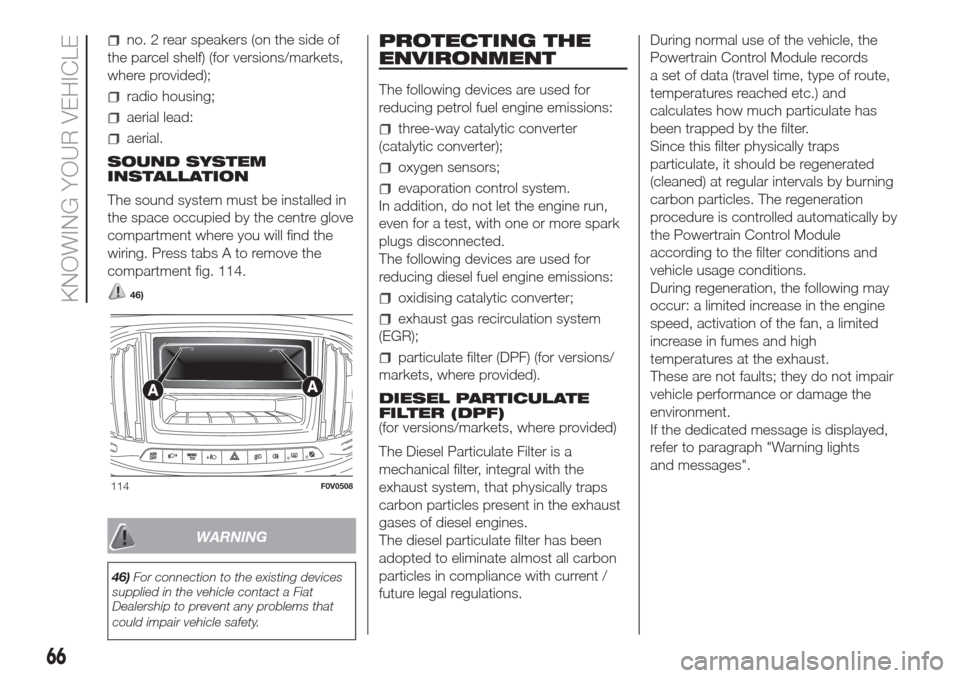
INSTALLATION
The sound system must be installed in
the space occupied by the centre glove
compartment where you will find the
wiring. Press tabs A to remove the
compartment fig. 114.
46)
WARNING
46)For connection to the existing devices
supplied in the vehicle contact a Fiat
Dealership to prevent any problems that
could impair vehicle safety.
PROTECTING THE
ENVIRONMENT
The following devices are used for
reducing petrol fuel engine emissions:
three-way catalytic converter
(catalytic converter);
oxygen sensors;
evaporation control system.
In addition, do not let the engine run,
even for a test, with one or more spark
plugs disconnected.
The following devices are used for
reducing diesel fuel engine emissions:
oxidising catalytic converter;
exhaust gas recirculation system
(EGR);
particulate filter (DPF) (for versions/
markets, where provided).
DIESEL PARTICULATE
FILTER (DPF)
(for versions/markets, where provided)
The Diesel Particulate Filter is a
mechanical filter, integral with the
exhaust system, that physically traps
carbon particles present in the exhaust
gases of diesel engines.
The diesel particulate filter has been
adopted to eliminate almost all carbon
particles in compliance with current /
future legal regulations.During normal use of the vehicle, the
Powertrain Control Module records
a set of data (travel time, type of route,
temperatures reached etc.) and
calculates how much particulate has
been trapped by the filter.
Since this filter physically traps
particulate, it should be regenerated
(cleaned) at regular intervals by burning
carbon particles. The regeneration
procedure is controlled automatically by
the Powertrain Control Module
according to the filter conditions and
vehicle usage conditions.
During regeneration, the following may
occur: a limited increase in the engine
speed, activation of the fan, a limited
increase in fumes and high
temperatures at the exhaust.
These are not faults; they do not impair
vehicle performance or damage the
environment.
If the dedicated message is displayed,
refer to paragraph "Warning lights
and messages".
114F0V0508
66
KNOWING YOUR VEHICLE
Page 71 of 300
KNOWING THE INSTRUMENT PANEL
This section of the booklet gives you all
the information you need to
understand, interpret and use the
instrument panel correctly.CONTROL PANEL AND
ON-BOARD INSTRUMENTS ........... 68
DIGITAL DISPLAY............................ 70
MULTIFUNCTION DISPLAY ............. 73
TRIP COMPUTER ........................... 80
EOBD SYSTEM............................... 82
WARNING LIGHTS AND
MESSAGES .................................... 83
- LOW BRAKE FLUID/HANDBRAKE
APPLIED ............................................ 83
- EBD FAILURE .................................. 84
- AIR BAG FAILURE ............................ 84
- SEAT BELTS REMINDER .................. 85
- ENGINE COOLANT TEMPERATURE
TOO HIGH .......................................... 85
- LOW BATTERY CHARGE ................. 86
- LOW ENGINE OIL PRESSURE ......... 87
-DECAYED ENGINE OIL ..................... 87
-LOW ENGINE OIL LEVEL .................. 87
-DOORS OPEN .................................. 88
- EOBD/INJECTION SYSTEM
FAILURE ............................................. 89
- ABS FAILURE ................................... 90
-FUEL RESERVE ................................ 90
- GLOW PLUG PREHEATING/GLOW
PLUG PREHEATING FAILURE ............ 91
- WATER IN DIESEL FILTER ................ 91
-VEHICLE PROTECTION SYSTEM
FAILURE - FIAT CODE ........................ 92
- REAR FOG LIGHTS .......................... 92
-GENERAL FAILURE WARNING ......... 92
-DPF (PARTICULATE FILTER)
CLEANING UNDERWAY ..................... 93
-BRAKE PAD WEAR ........................... 94
-ASR SYSTEM DEACTIVATED ............ 94- TRACTION PLUS SYSTEM
ACTIVATION ....................................... 95
- TPMS ............................................... 95
-PARKING SENSOR FAILURE ............ 96
-START&STOP SYSTEM FAILURE ...... 96
- DIPPED BEAM HEADLIGHTS .......... 97
- FOLLOW ME HOME ........................ 97
- LEFT DIRECTION INDICATOR .......... 97
- RIGHT DIRECTION INDICATOR ....... 97
-FOG LIGHTS ..................................... 98
- CRUISE CONTROL .......................... 98
- MAIN BEAM HEADLIGHTS .............. 98
67
Page 94 of 300
Warning lights on
panelWhat it means What to do
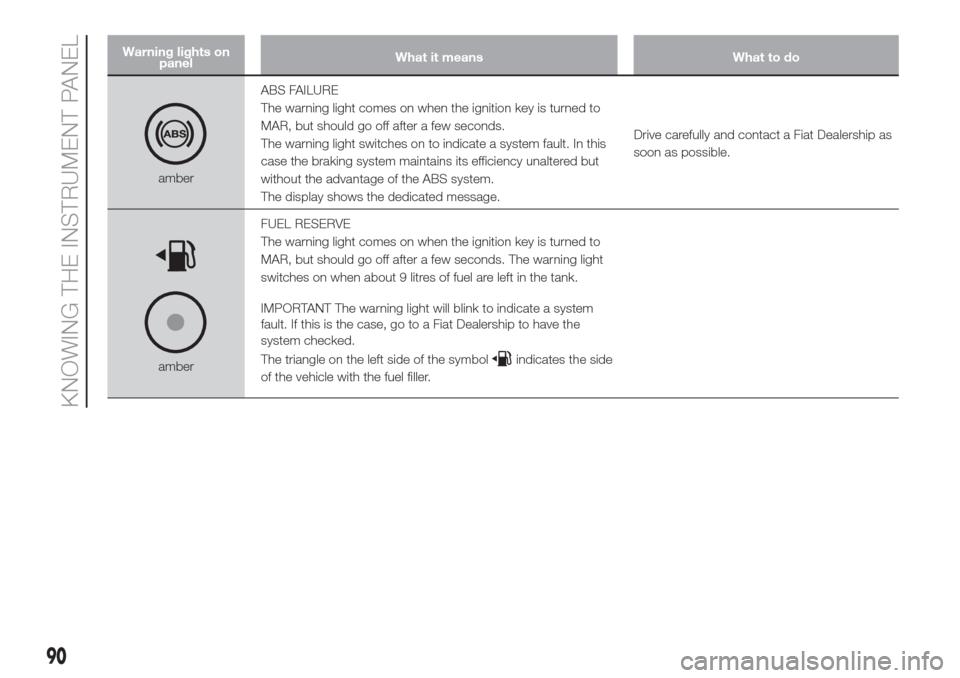
amberABS FAILURE
The warning light comes on when the ignition key is turned to
MAR, but should go off after a few seconds.
The warning light switches on to indicate a system fault. In this
case the braking system maintains its efficiency unaltered but
without the advantage of the ABS system.
The display shows the dedicated message.Drive carefully and contact a Fiat Dealership as
soon as possible.
amberFUEL RESERVE
The warning light comes on when the ignition key is turned to
MAR, but should go off after a few seconds. The warning light
switches on when about 9 litres of fuel are left in the tank.
IMPORTANT The warning light will blink to indicate a system
fault. If this is the case, go to a Fiat Dealership to have the
system checked.
The triangle on the left side of the symbolindicates the side
of the vehicle with the fuel filler.
90
KNOWING THE INSTRUMENT PANEL
Page 103 of 300
SAFETY
The chapter that you are about to read
is very important: it describes the
safety systems with which the car is
equipped and provides instructions on
how to use them correctly.ACTIVE SAFETY SYSTEMS ............100
ABS SYSTEM .................................100
ESC (ELECTRONIC STABILITY
CONTROL) SYSTEM .......................101
OCCUPANT PROTECTION
SYSTEMS .......................................104
SEAT BELTS ...................................104
SBR SYSTEM .................................106
PRE-TENSIONERS .........................107
CARRYING CHILDREN SAFELY ......109
ISOFIX CHILD RESTRAINT
SYSTEM SETUP .............................113
FRONT AIRBAGS............................119
SIDE BAGS ....................................124
99
Page 104 of 300
ACTIVE SAFETY
SYSTEMS
The vehicle has the following active
safety systems:
ABS;
EBD system;
Brake Assist system;
ESC system;
ASR system;
Hill Holder system;
MSR system;
For the operation of the systems, see
the following pages.
ABS SYSTEM
This is an integral part of the braking
system, which prevents one or more
wheels from locking and slipping
regardless of the road surface
conditions and braking intensity,
ensuring control of the vehicle even
during emergency braking.
The EBD system (Electronic Braking
Force Distribution) completes the
system allowing the brake force to be
distributed between the front and
rear wheels.
IMPORTANT To get the maximum
efficiency of the braking system,
a bedding-in period of about 500 km is
needed: during this period it is better
to avoid sharp, repeated and prolonged
braking.
SYSTEM INTERVENTION
The driver can feel that the ABS has
come into action because the brake
pedal pulsates slightly and the system
gets noisier: it means that the vehicle
speed should be altered to suit the type
of road surface.
53) 54) 55)
FAULT INDICATIONS
ABS fault
ABS failure is indicated by the
warning light on the instrument
panel coming on (together with the
appropriate message on the
multifunction display on some versions)
(see “Warning lights and messages”).
In this case, the braking system will still
be effective, although without the
extra capacity offered by the ABS.
Drive carefully to the nearest Fiat
Dealership to have the system
checked.
EBD failure
ABS failure is indicated by the
and
warning lights on the instrument
panel coming on (together with the
appropriate message on the
multifunction display on some versions)
(see “Warning lights and messages”).
In this case, the rear wheels may
suddenly lock and the vehicle may
swerve when braking sharply. Drive
carefully to the nearest Fiat Dealership
to have the system checked.
56)
100
SAFETY
Page 105 of 300
BRAKE ASSIST
(integrated ESP
emergency braking
assistance)
(for versions/markets, where provided)
This system (which cannot be
deactivated) recognises emergency
braking conditions according to the
speed of operation of the brake pedal
and provides an additional hydraulic
braking pressure to support that
provided by the driver. This allows
faster and more powerful operation of
the braking system.
Brake Assist is deactivated on the
versions equipped with ESP, in the
event of ESC system failure (indicated
by the
warning light coming on
together with a message in the
multifunction display, where provided).
WARNING
53)When the ABS cuts in and you feel the
brake pedal pulsating, do not remove
your foot, but keep the pedal pushed
down; in doing so you, will stop in the
shortest distance possible under the road
conditions at the time.
54)If the ABS system intervenes, this
indicates that the traction of the tyres on
the road is nearing its limit. You must slow
down to a speed compatible with the
available traction.55)The ABS gets the most from the
available grip, but it cannot improve it; you
should therefore take every care when
driving on slippery surfaces and not take
unnecessary risks.
56)If only the
instrument panel
warning light comes on (with a message in
the multifunction display on some
versions), stop the vehicle immediately and
contact the nearest Fiat Dealership. Any
loss of fluid will affect the brake system
functionality, both conventional and
ant-lock wheels.
ESC (Electronic
Stability Control)
SYSTEM
(for versions/markets, where provided)
IN BRIEF
This is an electronic system that
controls vehicle stability in the event
of tyre grip loss, helping to maintain
directional control.
The ESC system is therefore
particularly useful when grip
conditions of road surfaces change.
The MSR system (adjustment of
the engine braking torque during gear
changes) and the HBA system
(automatic increase in the braking
pressure during emergency braking)
are present with ESC, ASR and
Hill Holder systems (for
versions/markets where provided).
SYSTEM INTERVENTION
This is signalled by the flashing of the
warning light in the instrument panel,
to inform the driver that the vehicle is
in critical stability and grip conditions.
101