fuel FIAT DOBLO COMBI 2017 2.G Owners Manual
[x] Cancel search | Manufacturer: FIAT, Model Year: 2017, Model line: DOBLO COMBI, Model: FIAT DOBLO COMBI 2017 2.GPages: 300, PDF Size: 24.91 MB
Page 6 of 300
VERY IMPORTANT
REFUELLING
Petrol engines: only refuel with unleaded petrol with octane rating (RON) not less than 95 in compliance with the European specification
EN228.Diesel engines: only refuel with diesel fuel conforming to the European specification EN590. The use of other products or mixtures
may damage the engine beyond repair and consequently invalidate the warranty, due to the damage caused.
STARTING THE ENGINE
Petrol engines: make sure that the handbrake is engaged; set the gear lever to neutral; fully depress the clutch pedal without pressing the
accelerator, then turn the ignition key to AVV and release it as soon as the engine has started.Diesel engines: turn the ignition key to MAR
and wait for the
andwarning lights to switch off. Then turn the ignition key to AVV and release it as soon as the engine has started.
PARKING ON FLAMMABLE MATERIAL
The catalytic converter develops high temperatures during operation. Do not park on grass, dry leaves, pine needles or other flammable
material: fire hazard.
RESPECTING THE ENVIRONMENT
The vehicle is fitted with a system that allows continuous diagnosis of the emission-related components in order to help protect the
environment.
ELECTRICAL ACCESSORIES
If, after buying the vehicle, you decide to add electrical accessories (with the risk of gradually draining the battery), visit a Fiat Dealership. They
can calculate the overall electrical requirement and check that the vehicle's electrical system can support the required load.
SCHEDULED SERVICING
Correct maintenance enables the vehicle to perfectly maintain performance and safety characteristics, its environmental friendliness and low
running costs over time.
Page 18 of 300
THE KEYS
KEY WITHOUT REMOTE
CONTROL
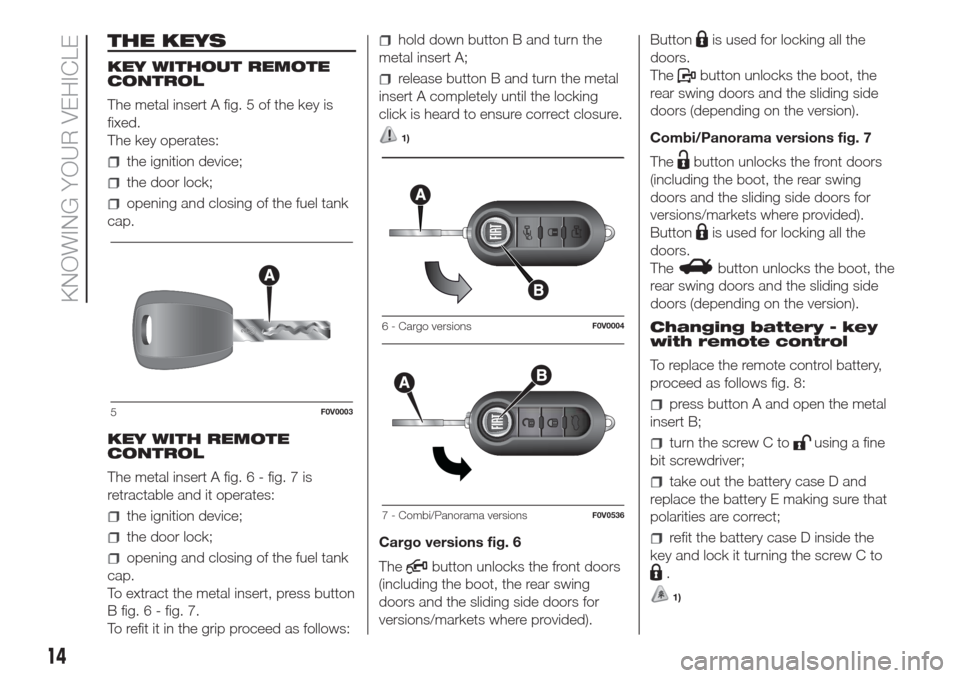
The metal insert A fig. 5 of the key is
fixed.
The key operates:
the ignition device;
the door lock;
opening and closing of the fuel tank
cap.
KEY WITH REMOTE
CONTROL
The metal insert A fig.6-fig.7is
retractable and it operates:
the ignition device;
the door lock;
opening and closing of the fuel tank
cap.
To extract the metal insert, press button
B fig. 6 - fig. 7.
To refit it in the grip proceed as follows:
hold down button B and turn the
metal insert A;
release button B and turn the metal
insert A completely until the locking
click is heard to ensure correct closure.
1)
Cargo versions fig. 6
The
button unlocks the front doors
(including the boot, the rear swing
doors and the sliding side doors for
versions/markets where provided).Button
is used for locking all the
doors.
The
button unlocks the boot, the
rear swing doors and the sliding side
doors (depending on the version).
Combi/Panorama versions fig. 7
The
button unlocks the front doors
(including the boot, the rear swing
doors and the sliding side doors for
versions/markets where provided).
Button
is used for locking all the
doors.
The
button unlocks the boot, the
rear swing doors and the sliding side
doors (depending on the version).
Changing battery - key
with remote control
To replace the remote control battery,
proceed as follows fig. 8:
press button A and open the metal
insert B;
turn the screw C tousing a fine
bit screwdriver;
take out the battery case D and
replace the battery E making sure that
polarities are correct;
refit the battery case D inside the
key and lock it turning the screw C to
.
1)
5F0V0003
6 - Cargo versionsF0V0004
7 - Combi/Panorama versionsF0V0536
14
KNOWING YOUR VEHICLE
Page 26 of 300
WARNING
8)Before opening a door, ensure that you
can do it in conditions of safety.
9)You must not open the left-hand sliding
side door with the fuel cap open while
refuelling. Check that the fuel cap is closed
while opening/closing the sliding side
door to avoid damage.10)If you are parked on a slope, do not
leave the sliding door locked in the open
position. An involuntary impact could
unhook the door, causing it to move.
11)Before leaving the vehicle parked with
the sliding doors open, always check
that they are locked into place.
12)Always use this device when carrying
children.
13)The spring-loaded system was
designed for optimum usage. Accidental
knocks or a strong gust of wind may
release the springs, forcing the doors to
close.
14)When closing, shut the right hand door
fully before you close the left hand door.
Never shut the two doors at the same time.
WARNING
2)Make sure that the left sliding side door
is all closed before refuelling to prevent
damage to the door and to the sliding
locking system with fuel filler cap open,
activated during refuelling.
SEATS
DRIVER’S SEAT
(for Cargo versions, where provided)
15)
Longitudinal adjustment
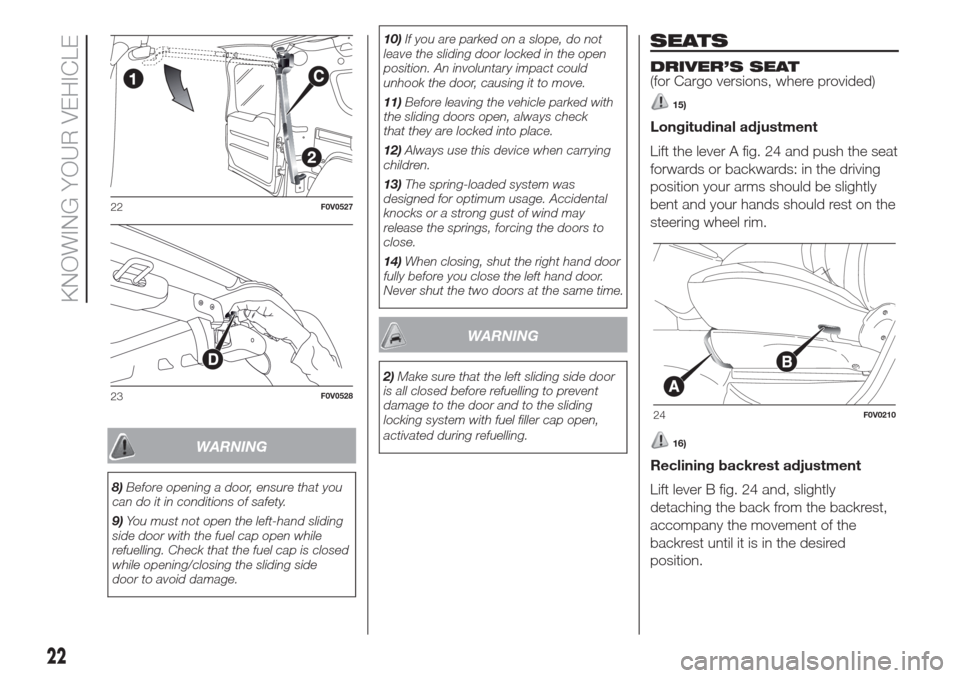
Lift the lever A fig. 24 and push the seat
forwards or backwards: in the driving
position your arms should be slightly
bent and your hands should rest on the
steering wheel rim.
16)
Reclining backrest adjustment
Lift lever B fig. 24 and, slightly
detaching the back from the backrest,
accompany the movement of the
backrest until it is in the desired
position.
22F0V0527
23F0V0528
24F0V0210
22
KNOWING YOUR VEHICLE
Page 64 of 300
WARNING
35)If you are travelling in areas with few
filling stations and you want to transport
fuel in a spare tank, comply with the law by
using only an approved, suitably secured
tank. However, the risks of fire in the case
of collision increase anyway.
36)Never exceed the maximum allowed
load in the boot, see the “Technical
specifications” chapter. Also make sure
that the objects you place in the boot have
been properly secured, to avoid them
from being thrown forward consequent to
sudden braking and injuring your
passengers.
37)If you are travelling in areas with few
filling stations and you want to transport
fuel in a spare tank, comply with the law by
using only an approved, suitably secured
tank. Anyway, by doing so, you increase
the risk of fire in the event of an accident
with your vehicle.38)Never exceed the maximum allowed
load in the boot (see the "Technical
specifications" chapter). Also make sure
that the objects you place in the boot have
been properly secured, to avoid them
from being thrown forward consequent to
sudden braking and injuring your
passengers.
39)You must not use the folded rear seat
to carry luggage. The load could be thrown
forward into the backrest of the front
seats, seriously injuring the occupants.
40)Make sure that the objects are
positioned carefully and fixed to the hooks
on the floor to prevent them being flung
forwards in the event of sharp braking and
causing injury to the passengers.
WARNING
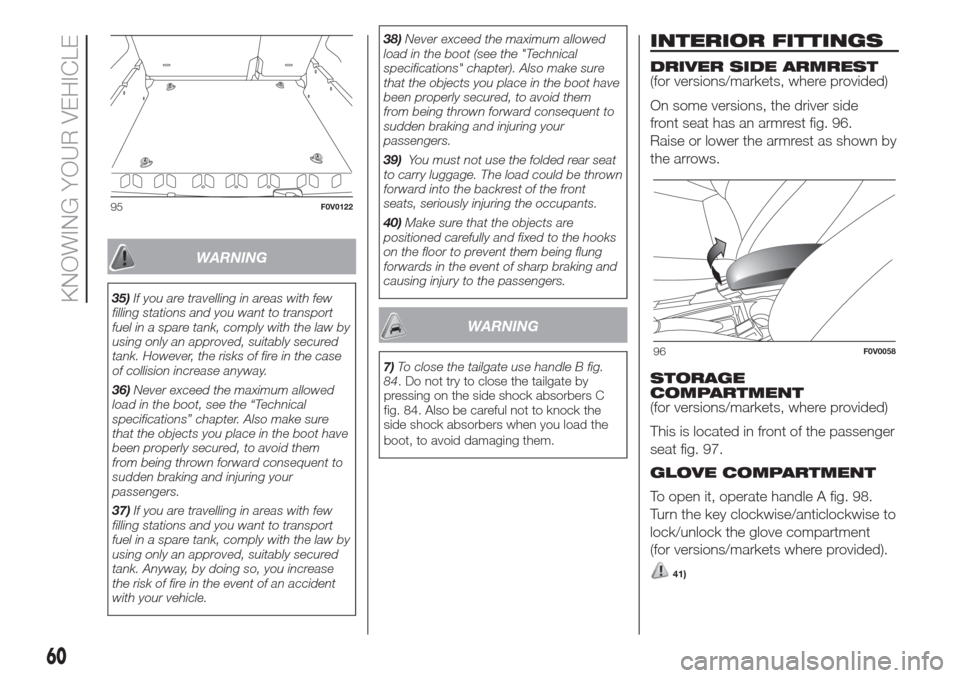
7)To close the tailgate use handle B fig.
84. Do not try to close the tailgate by
pressing on the side shock absorbers C
fig. 84. Also be careful not to knock the
side shock absorbers when you load the
boot, to avoid damaging them.
INTERIOR FITTINGS
DRIVER SIDE ARMREST
(for versions/markets, where provided)
On some versions, the driver side
front seat has an armrest fig. 96.
Raise or lower the armrest as shown by
the arrows.
STORAGE
COMPARTMENT
(for versions/markets, where provided)
This is located in front of the passenger
seat fig. 97.
GLOVE COMPARTMENT
To open it, operate handle A fig. 98.
Turn the key clockwise/anticlockwise to
lock/unlock the glove compartment
(for versions/markets where provided).
41)
95F0V0122
96F0V0058
60
KNOWING YOUR VEHICLE
Page 70 of 300
no. 2 rear speakers (on the side of
the parcel shelf) (for versions/markets,
where provided);
radio housing;
aerial lead:
aerial.
SOUND SYSTEM
INSTALLATION
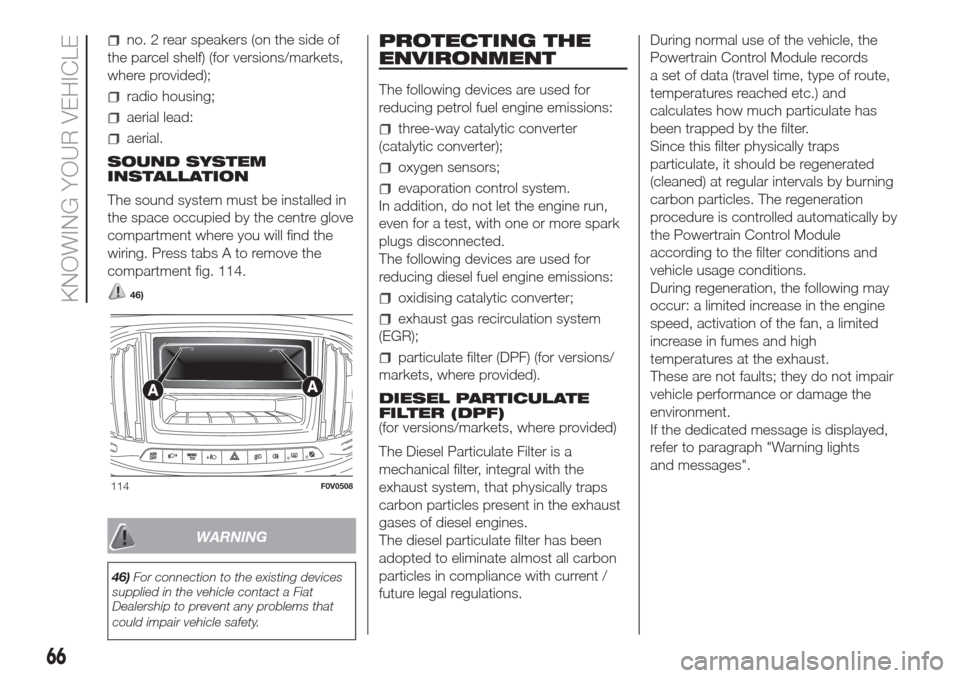
The sound system must be installed in
the space occupied by the centre glove
compartment where you will find the
wiring. Press tabs A to remove the
compartment fig. 114.
46)
WARNING
46)For connection to the existing devices
supplied in the vehicle contact a Fiat
Dealership to prevent any problems that
could impair vehicle safety.
PROTECTING THE
ENVIRONMENT
The following devices are used for
reducing petrol fuel engine emissions:
three-way catalytic converter
(catalytic converter);
oxygen sensors;
evaporation control system.
In addition, do not let the engine run,
even for a test, with one or more spark
plugs disconnected.
The following devices are used for
reducing diesel fuel engine emissions:
oxidising catalytic converter;
exhaust gas recirculation system
(EGR);
particulate filter (DPF) (for versions/
markets, where provided).
DIESEL PARTICULATE
FILTER (DPF)
(for versions/markets, where provided)
The Diesel Particulate Filter is a
mechanical filter, integral with the
exhaust system, that physically traps
carbon particles present in the exhaust
gases of diesel engines.
The diesel particulate filter has been
adopted to eliminate almost all carbon
particles in compliance with current /
future legal regulations.During normal use of the vehicle, the
Powertrain Control Module records
a set of data (travel time, type of route,
temperatures reached etc.) and
calculates how much particulate has
been trapped by the filter.
Since this filter physically traps
particulate, it should be regenerated
(cleaned) at regular intervals by burning
carbon particles. The regeneration
procedure is controlled automatically by
the Powertrain Control Module
according to the filter conditions and
vehicle usage conditions.
During regeneration, the following may
occur: a limited increase in the engine
speed, activation of the fan, a limited
increase in fumes and high
temperatures at the exhaust.
These are not faults; they do not impair
vehicle performance or damage the
environment.
If the dedicated message is displayed,
refer to paragraph "Warning lights
and messages".
114F0V0508
66
KNOWING YOUR VEHICLE
Page 71 of 300
KNOWING THE INSTRUMENT PANEL
This section of the booklet gives you all
the information you need to
understand, interpret and use the
instrument panel correctly.CONTROL PANEL AND
ON-BOARD INSTRUMENTS ........... 68
DIGITAL DISPLAY............................ 70
MULTIFUNCTION DISPLAY ............. 73
TRIP COMPUTER ........................... 80
EOBD SYSTEM............................... 82
WARNING LIGHTS AND
MESSAGES .................................... 83
- LOW BRAKE FLUID/HANDBRAKE
APPLIED ............................................ 83
- EBD FAILURE .................................. 84
- AIR BAG FAILURE ............................ 84
- SEAT BELTS REMINDER .................. 85
- ENGINE COOLANT TEMPERATURE
TOO HIGH .......................................... 85
- LOW BATTERY CHARGE ................. 86
- LOW ENGINE OIL PRESSURE ......... 87
-DECAYED ENGINE OIL ..................... 87
-LOW ENGINE OIL LEVEL .................. 87
-DOORS OPEN .................................. 88
- EOBD/INJECTION SYSTEM
FAILURE ............................................. 89
- ABS FAILURE ................................... 90
-FUEL RESERVE ................................ 90
- GLOW PLUG PREHEATING/GLOW
PLUG PREHEATING FAILURE ............ 91
- WATER IN DIESEL FILTER ................ 91
-VEHICLE PROTECTION SYSTEM
FAILURE - FIAT CODE ........................ 92
- REAR FOG LIGHTS .......................... 92
-GENERAL FAILURE WARNING ......... 92
-DPF (PARTICULATE FILTER)
CLEANING UNDERWAY ..................... 93
-BRAKE PAD WEAR ........................... 94
-ASR SYSTEM DEACTIVATED ............ 94- TRACTION PLUS SYSTEM
ACTIVATION ....................................... 95
- TPMS ............................................... 95
-PARKING SENSOR FAILURE ............ 96
-START&STOP SYSTEM FAILURE ...... 96
- DIPPED BEAM HEADLIGHTS .......... 97
- FOLLOW ME HOME ........................ 97
- LEFT DIRECTION INDICATOR .......... 97
- RIGHT DIRECTION INDICATOR ....... 97
-FOG LIGHTS ..................................... 98
- CRUISE CONTROL .......................... 98
- MAIN BEAM HEADLIGHTS .............. 98
67
Page 72 of 300
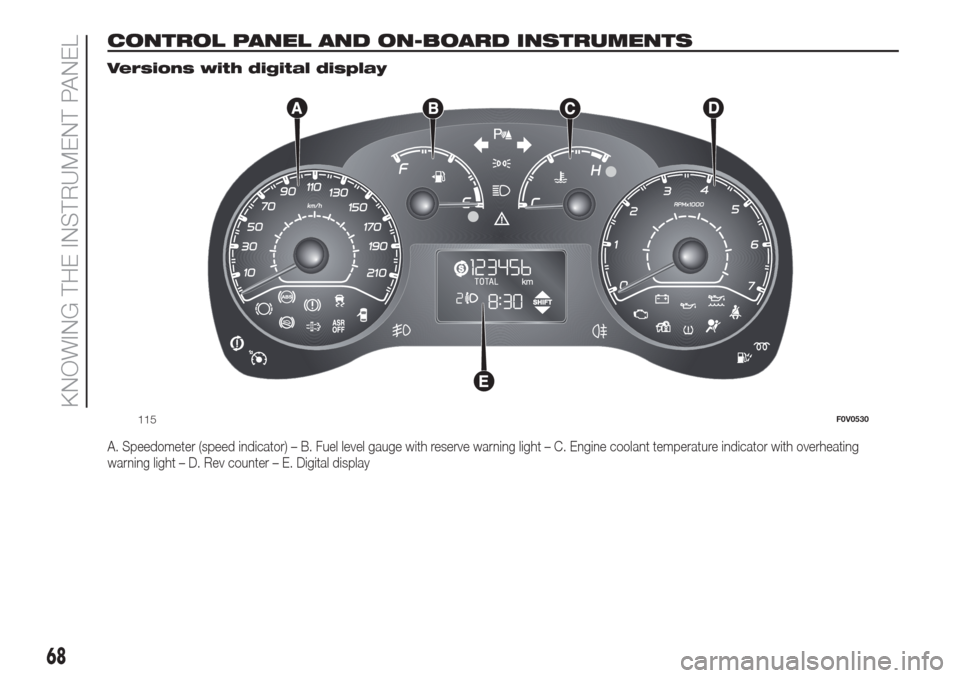
CONTROL PANEL AND ON-BOARD INSTRUMENTS.
Versions with digital display
A. Speedometer (speed indicator) – B. Fuel level gauge with reserve warning light – C. Engine coolant temperature indicator with overheating
warning light – D. Rev counter – E. Digital display
115F0V0530
68
KNOWING THE INSTRUMENT PANEL
Page 73 of 300
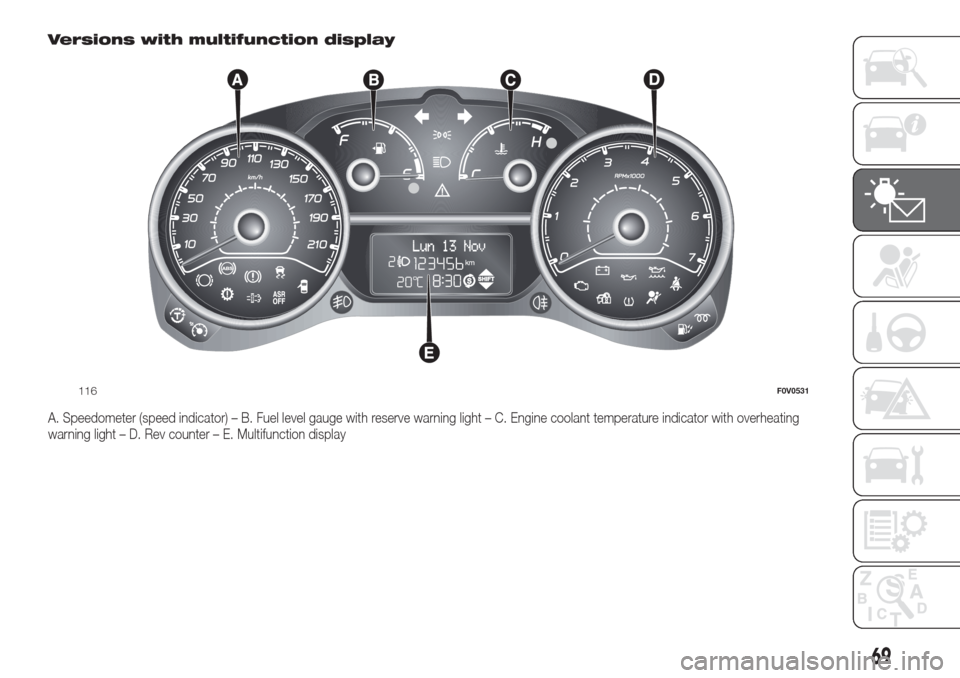
Versions with multifunction display
A. Speedometer (speed indicator) – B. Fuel level gauge with reserve warning light – C. Engine coolant temperature indicator with overheating
warning light – D. Rev counter – E. Multifunction display
116F0V0531
69
Page 74 of 300
SPEEDOMETER
This shows the speed at which the
vehicle is travelling.
REV COUNTER
The rev counter shows the engine rpm.
IMPORTANT The electronic injection
control system gradually shuts off
the flow of fuel when the engine
is “over-revving” resulting in a gradual
loss of engine power.
When the engine is idling, the rev
counter may indicate a gradual or
sudden increase of the speed.
This behaviour is standard as it takes
place during the activation of the
climate control system or the fan. It
should not be considered as a fault. In
such cases, a slight increase in engine
idle speed helps to sustain the battery
charge.
FUEL LEVEL GAUGE
This shows the amount of fuel left in the
fuel tank.
E tank empty.
F tank full (see the instructions provided
in the “Vehicle refuelling” paragraph).
The warning light on the gauge comes
on to indicate that approximately 8-10
litres of fuel are left in the tank.
Do not travel with the fuel tank almost
empty: any gaps in fuel supply could
damage the catalytic converter.IMPORTANT The needle will point to E
and warning light A will flash to indicate
a fault in the system. Contact a Fiat
Dealership to have the system
checked.
ENGINE COOLANT
TEMPERATURE
INDICATOR
This shows the temperature of the
engine coolant fluid and starts working
when the fluid temperature exceeds
approx. 50°C.
In normal usage, the needle should
hover around the middle of the scale.
C Low engine coolant temperature.
H High engine coolant temperature.
The warning light on the gauge may
light up (and a message on the
multifunction display may appear on
certain versions) to indicate that the
coolant fluid temperature is too high; in
this case, stop the engine and contact
a Fiat Dealership.
10)
WARNING
10)If the needle for the engine coolant
temperature reaches the red area, stop the
engine immediately and contact a Fiat
Dealership.
DIGITAL DISPLAY
STANDARD SCREEN
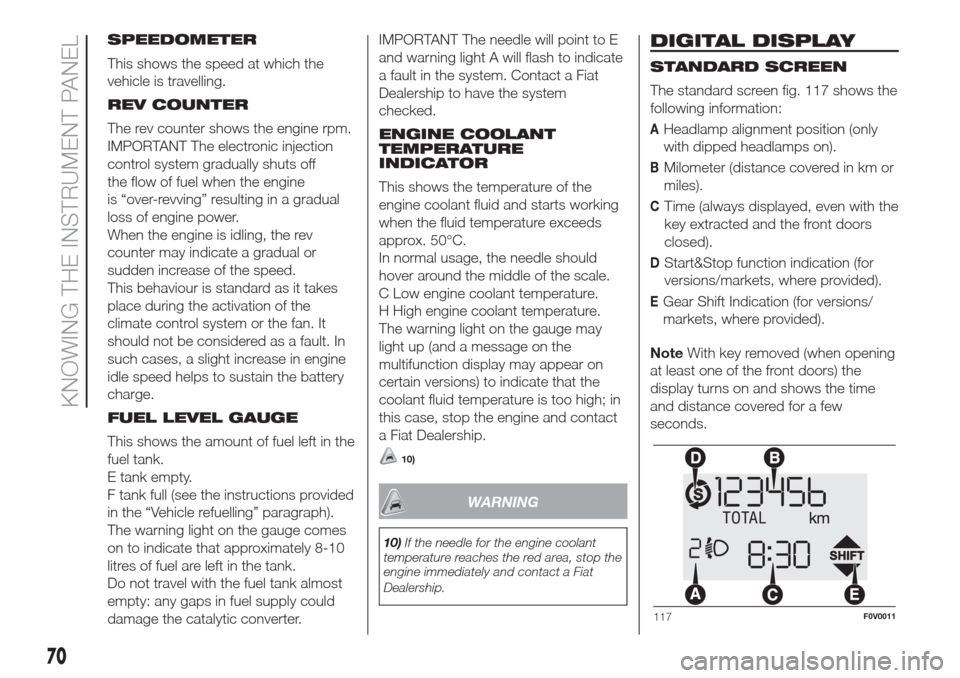
The standard screen fig. 117 shows the
following information:
AHeadlamp alignment position (only
with dipped headlamps on).
BMilometer (distance covered in km or
miles).
CTime (always displayed, even with the
key extracted and the front doors
closed).
DStart&Stop function indication (for
versions/markets, where provided).
EGear Shift Indication (for versions/
markets, where provided).
NoteWith key removed (when opening
at least one of the front doors) the
display turns on and shows the time
and distance covered for a few
seconds.
117F0V0011
70
KNOWING THE INSTRUMENT PANEL
Page 81 of 300
See radio (audio
information repetition)
(for versions/markets, where provided)
With this function the display shows
information about the radio.
– Radio: selected radio station
frequency or RDS message, automatic
tuning activation or AutoSTore;
– Audio CD, MP3 CDs: track number;
To show the sound system information
on the display (On) or clear it (Off),
proceed as follows:
– briefly press theMENU
button,
making the display flash On or Off
depending on the previous setting;
– press the
orbutton to select;
– press theMENU
button briefly to
return to the menu screen or hold the
button down to return to the standard
screen without storing.
Autoclose (Automatic
central locking with the
vehicle moving)
(for versions/markets, where provided)
When activated (On), this function locks
the doors automatically when the
vehicle speed exceeds 20 km/h.
Proceed as follows to activate or
deactivate this function:
– press theMENU
button briefly to
display a submenu;
– press theMENU
button briefly to
make the display flash On or Off
according to the previous setting;– press the
orbutton to select;
– press theMENU
button briefly to
return to the submenu screen or hold
the button down to return to the main
menu screen without saving;
– hold theMENU
button down
again to return to the standard screen
or to the main menu according to
where you are in the menu.
Unit of measurement
(Setting the unit of
measurement)
With this function is possible to set the
unit of measurement in three
submenus: “Distance”, “Consumption”
and “Temperature”.
To set the required unit of measurement
proceed as follows:
– briefly press theMENU
button to
display the three submenus;
– press the
orbutton to navigate
through the three submenus;
– select the required option and then
pressMENU
briefly;
– if selecting the "Distance" submenu:
briefly press theMENU
button and
the display will show "km" or "mi"
depending on the previous setting;
– press the
orbutton to select;when you select the “Consumption”
submenu: briefly pressing theMENU
button makes “km/l”, “l/100km” or
“mpg” appear on the display,
depending on the previous setting;
If the set distance unit of measurement
is "km", the fuel consumption unit will
be displayed in km/l or l/100 km.
If the set distance unit of measurement
is "mi" the fuel consumption unit will
be displayed in "mpg".
– press the
orbutton to select;
– if selecting the "Temperature"
submenu: briefly press the
MENU
button and the display will
show "°C" or "°F" depending on the
previous setting;
– press the
orbutton to select;
When you have made the required
settings, press theMENU
button
briefly to go back to the submenu
screen or hold the button down to go
back to the main menu screen without
saving.
– hold theMENU
button down
again to return to the standard screen
or to the main menu according to
where you are in the menu.
77