interior lights FIAT DOBLO COMBI 2017 2.G Owners Manual
[x] Cancel search | Manufacturer: FIAT, Model Year: 2017, Model line: DOBLO COMBI, Model: FIAT DOBLO COMBI 2017 2.GPages: 300, PDF Size: 24.91 MB
Page 15 of 300
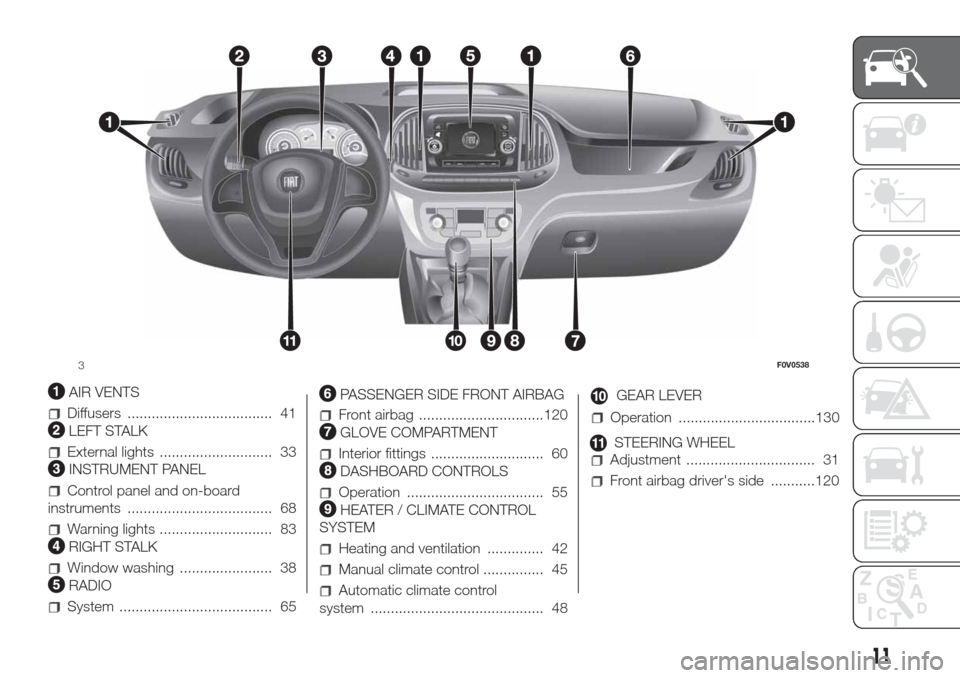
AIR VENTS
Diffusers .................................... 41
LEFT STALK
External lights ............................ 33
INSTRUMENT PANEL
Control panel and on-board
instruments .................................... 68
Warning lights ............................ 83
RIGHT STALK
Window washing ....................... 38
RADIO
System ...................................... 65
PASSENGER SIDE FRONT AIRBAG
Front airbag ...............................120
GLOVE COMPARTMENT
Interior fittings ............................ 60
DASHBOARD CONTROLS
Operation .................................. 55
HEATER / CLIMATE CONTROL
SYSTEM
Heating and ventilation .............. 42
Manual climate control ............... 45
Automatic climate control
system ........................................... 48
GEAR LEVER
Operation ..................................130
STEERING WHEEL
Adjustment ................................ 31
Front airbag driver's side ...........120
3F0V0538
11
Page 17 of 300
KNOWING YOUR VEHICLE
In-depth knowledge of your new vehicle
starts here.
The booklet that you are reading simply
and directly explains how it is made
and how it works.
That’s why we advise you to read it
seated comfortably on board, so that
you can see what is described here for
yourself.THE KEYS....................................... 14
IGNITION DEVICE ........................... 16
SYMBOLS ...................................... 17
THE FIAT CODE SYSTEM ............... 17
DOORS ........................................... 18
SEATS ............................................ 22
PARTITIONS ................................... 28
HEAD RESTRAINTS ........................ 30
STEERING WHEEL ......................... 31
REAR VIEW MIRRORS .................... 32
EXTERNAL LIGHTS......................... 33
INTERIOR LIGHTS .......................... 35
WINDSCREEN/REAR WINDOW
WIPER ............................................ 38
HEATING AND VENTILATION
SYSTEM ......................................... 40
DIFFUSERS..................................... 41
HEATING AND VENTILATION.......... 42
MANUAL CLIMATE CONTROL
SYSTEM ......................................... 45
AUTOMATIC CLIMATE CONTROL
SYSTEM ......................................... 48
WINDOW WINDERS ....................... 53
CONTROLS .................................... 55
BONNET ......................................... 56
BOOT ............................................. 57
INTERIOR FITTINGS ....................... 60
ROOF RACK/SKI RACK .................. 64HEADLIGHTS.................................. 64
RADIO............................................. 65
PROTECTING THE
ENVIRONMENT .............................. 66
13
Page 39 of 300
WARNING
27)The daytime running lights are an
alternative to the dipped beam headlights
for driving during the daytime in countries
where it is compulsory to have lights on
during the day, and they are also permitted
in those countries where this is not
obligatory. Daytime running lights cannot
replace dipped beam headlights when
driving at night or through tunnels. The use
of daytime running lights is governed by
the highway code of the country in which
you are driving. Comply with legal
requirements.
INTERIOR LIGHTS
FRONT ROOF LIGHT WITH
MOVABLE LENS
The light fades up or reaches full
brightness immediately if pushed at the
sides.
On the Doblò Cargo versions, it is only
connected to the front doors.
On the Doblò/Doblò Combi people
carrier versions, it is connected to the
front doors and the sliding side doors.
FRONT ROOF LIGHT WITH
SPOT LIGHTS
(for versions/markets, where provided)
On the Doblò Cargo versions, it is
only connected to the front doors.
On the Doblò/Doblò Combi people
carrier versions, it is connected to the
front doors and the sliding side doors.
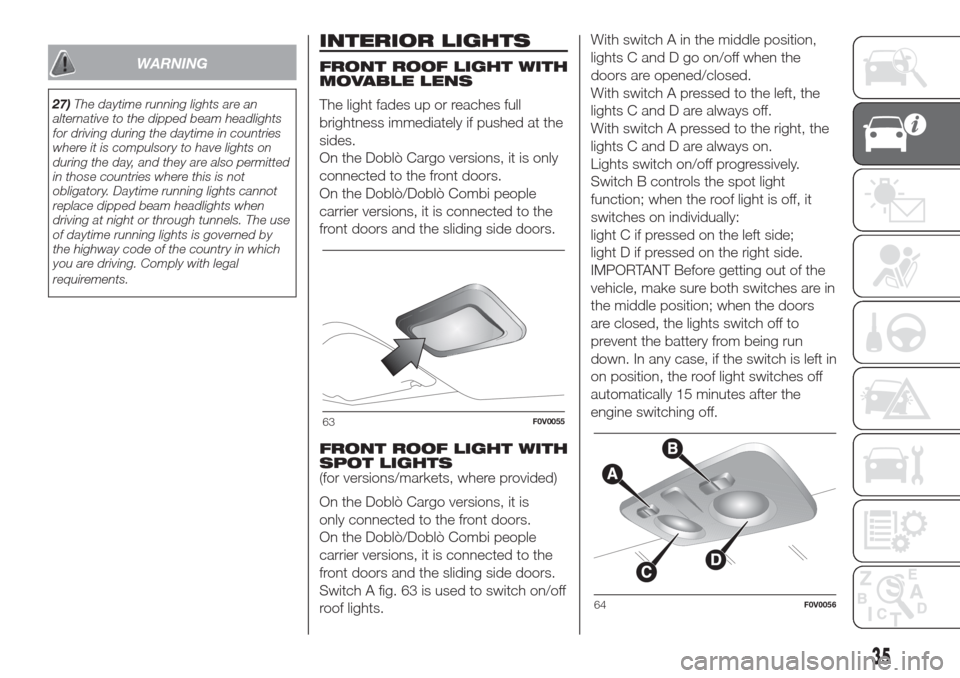
Switch A fig. 63 is used to switch on/off
roof lights.With switch A in the middle position,
lights C and D go on/off when the
doors are opened/closed.
With switch A pressed to the left, the
lights C and D are always off.
With switch A pressed to the right, the
lights C and D are always on.
Lights switch on/off progressively.
Switch B controls the spot light
function; when the roof light is off, it
switches on individually:
light C if pressed on the left side;
light D if pressed on the right side.
IMPORTANT Before getting out of the
vehicle, make sure both switches are in
the middle position; when the doors
are closed, the lights switch off to
prevent the battery from being run
down. In any case, if the switch is left in
on position, the roof light switches off
automatically 15 minutes after the
engine switching off.
63F0V0055
64F0V0056
35
Page 78 of 300
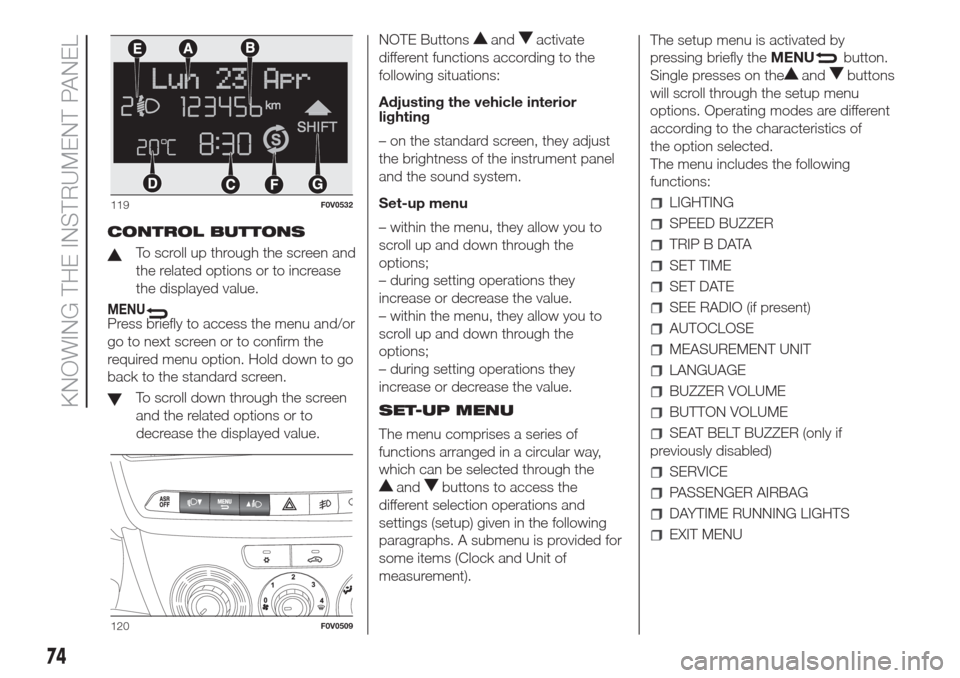
CONTROL BUTTONS
To scroll up through the screen and
the related options or to increase
the displayed value.
MENUPress briefly to access the menu and/or
go to next screen or to confirm the
required menu option. Hold down to go
back to the standard screen.
To scroll down through the screen
and the related options or to
decrease the displayed value.NOTE Buttons
andactivate
different functions according to the
following situations:
Adjusting the vehicle interior
lighting
– on the standard screen, they adjust
the brightness of the instrument panel
and the sound system.
Set-up menu
– within the menu, they allow you to
scroll up and down through the
options;
– during setting operations they
increase or decrease the value.
– within the menu, they allow you to
scroll up and down through the
options;
– during setting operations they
increase or decrease the value.
SET-UP MENU
The menu comprises a series of
functions arranged in a circular way,
which can be selected through the
andbuttons to access the
different selection operations and
settings (setup) given in the following
paragraphs. A submenu is provided for
some items (Clock and Unit of
measurement).The setup menu is activated by
pressing briefly theMENU
button.
Single presses on the
andbuttons
will scroll through the setup menu
options. Operating modes are different
according to the characteristics of
the option selected.
The menu includes the following
functions:
LIGHTING
SPEED BUZZER
TRIP B DATA
SET TIME
SET DATE
SEE RADIO (if present)
AUTOCLOSE
MEASUREMENT UNIT
LANGUAGE
BUZZER VOLUME
BUTTON VOLUME
SEAT BELT BUZZER (only if
previously disabled)
SERVICE
PASSENGER AIRBAG
DAYTIME RUNNING LIGHTS
EXIT MENU
119F0V0532
120F0V0509
74
KNOWING THE INSTRUMENT PANEL
Page 79 of 300
Selecting an option from the main
menu without a submenu:
– briefly press theMENU
button to
select the main menu option to be
set;
– press the
orbuttons (with single
presses) to select the new setting;
– briefly press theMENU
button to
store the new setting and to go back
to the same main menu option selected
previously.
Selecting an option from the main
menu with a submenu:
– briefly press theMENU
button to
display the first submenu option;
– press buttons
or(with single
presses) to scroll through all the
submenu options;
– briefly press theMENU
button to
select the displayed submenu option
and to open the relevant setup menu;
– press buttons
or(with single
presses) to select the new setting
for this submenu option;
– briefly press theMENU
button to
store the new setting and to go back
to the same submenu option selected
previously.Adjusting the vehicle
interior lighting
This function is available, with the
dipped headlamps on and at night, to
adjust the brightness of the instrument
panel, buttons, sound system display
and automatic climate control display.
During the daytime, and with the
dipped headlamps on, the instrument
panel, buttons and sound system
and automatic climate control displays
are set to maximum brightness.
Proceed as follows to adjust the
brightness:
– press theMENU
button briefly to
make the display flash the previously
stored level;
– press button
andto set the
required brightness level;
– press theMENU
button briefly to
return to the menu screen or hold the
button down to return to the standard
screen without storing.
Speed warning (Speed
limit)
This function enables setting of the
vehicle speed limit (km/h or mph).
When this limit is exceeded the driver is
immediately alerted (see section
“Warning lights and messages”).
To set the desired speed limit, proceed
as follows:– briefly press theMENU
button:
the display will show the words (Speed
Beep);
– press the
orbutton to select
speed limit activation (On) or
deactivation (Off);
– if the function is on, press the
or
buttons to select the required speed
limit and then pressMENU
to
confirm;
NOTE The speed may be set anywhere
between 30 and 200 km/h or 20 and
125 mph, depending on the previously
chosen unit (see “Setting the unit of
measurement (Unit)”). The setting will
increase/decrease by 5 units each time
button
/is pressed. Hold down
the
/button to automatically
increase/decrease the setting rapidly.
Complete the adjustment with single
presses of the button when you
approach the desired value.
– press theMENU
button briefly to
return to the menu screen or hold the
button down to return to the standard
screen without storing.
To cancel the setting, proceed as
follows:
– briefly press buttonMENU
, (On)
will flash on the display;
– press button
, (Off) will flash on the
display;
75
Page 151 of 300
IN AN EMERGENCY
A punctured tyre or a burnt-out bulb?
At times, a problem may interfere
with our journey.
The pages on emergencies can help
you to deal with critical situations
independently and with calm.
In an emergency we recommend that
you call the freephone number found in
the Warranty Booklet.
It is also possible to call the 00 800
3428 0000 freephone number to
search the nearest Fiat Dealership.HAZARD WARNING LIGHTS...........148
REPLACING A BULB ......................148
REPLACING AN EXTERIOR BULB ..151
REPLACING AN INTERIOR BULB ...155
REPLACING FUSES........................157
CHANGING A WHEEL ....................162
FIX&GO AUTOMATIC KIT ................166
EMERGENCY STARTING ................168
FUEL CUT-OFF SYSTEM ................169
LIFTING THE VEHICLE....................170
TOWING THE VEHICLE ..................170
147
Page 159 of 300
REPLACING AN
INTERIOR BULB
For the type of bulb and power rating,
see "Changing a bulb".
FRONT ROOF LIGHT
Roof light with movable lens
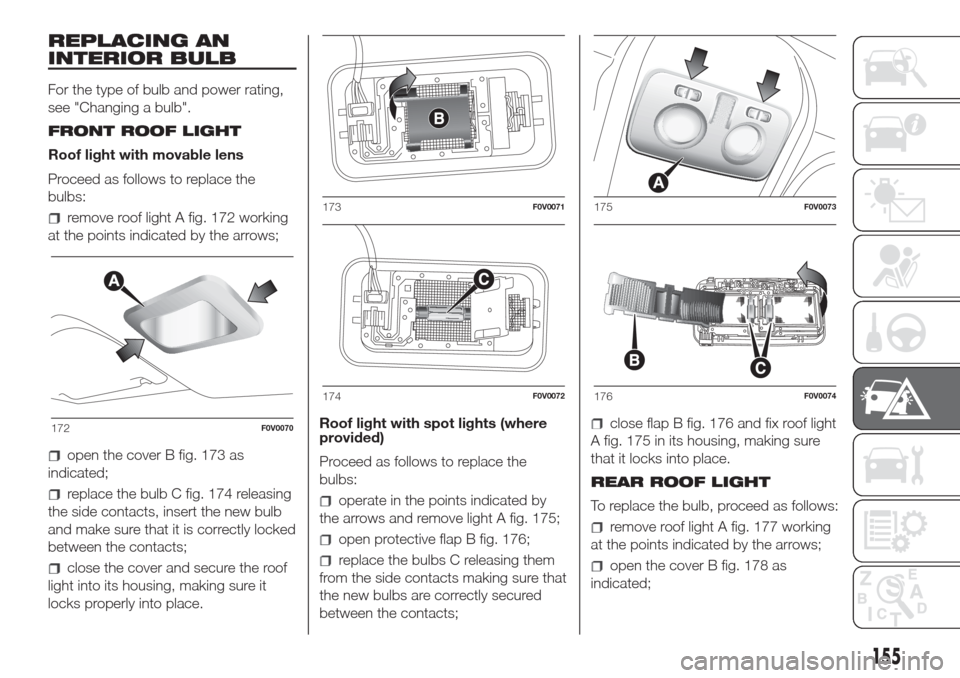
Proceed as follows to replace the
bulbs:
remove roof light A fig. 172 working
at the points indicated by the arrows;
open the cover B fig. 173 as
indicated;
replace the bulb C fig. 174 releasing
the side contacts, insert the new bulb
and make sure that it is correctly locked
between the contacts;
close the cover and secure the roof
light into its housing, making sure it
locks properly into place.Roof light with spot lights (where
provided)
Proceed as follows to replace the
bulbs:
operate in the points indicated by
the arrows and remove light A fig. 175;
open protective flap B fig. 176;
replace the bulbs C releasing them
from the side contacts making sure that
the new bulbs are correctly secured
between the contacts;
close flap B fig. 176 and fix roof light
A fig. 175 in its housing, making sure
that it locks into place.
REAR ROOF LIGHT
To replace the bulb, proceed as follows:
remove roof light A fig. 177 working
at the points indicated by the arrows;
open the cover B fig. 178 as
indicated;
172F0V0070
173F0V0071
174F0V0072
175F0V0073
176F0V0074
155
Page 173 of 300
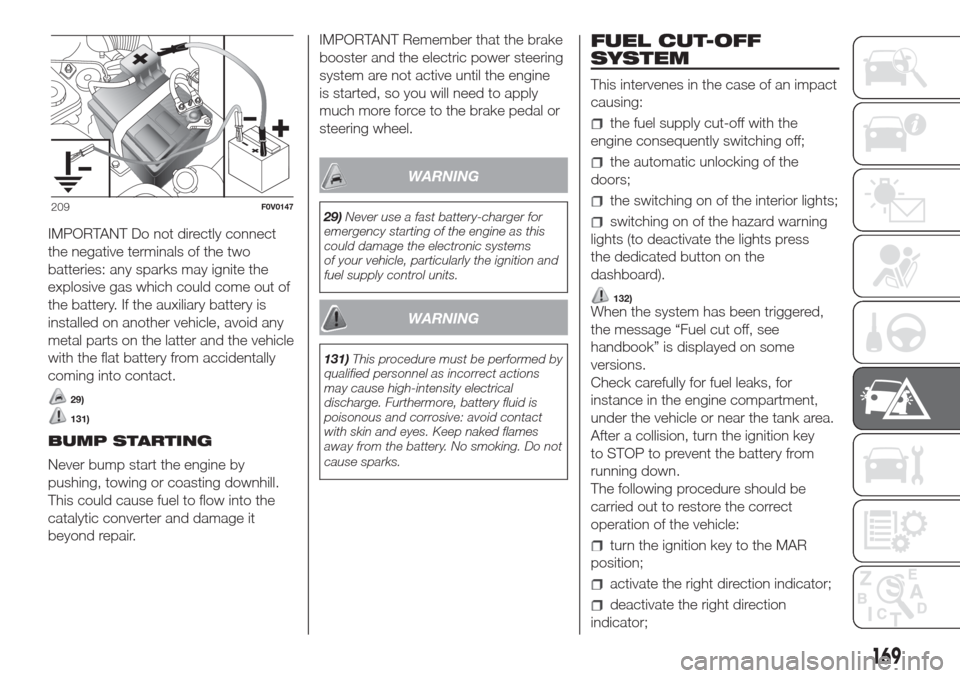
IMPORTANT Do not directly connect
the negative terminals of the two
batteries: any sparks may ignite the
explosive gas which could come out of
the battery. If the auxiliary battery is
installed on another vehicle, avoid any
metal parts on the latter and the vehicle
with the flat battery from accidentally
coming into contact.
29)
131)
BUMP STARTING
Never bump start the engine by
pushing, towing or coasting downhill.
This could cause fuel to flow into the
catalytic converter and damage it
beyond repair.IMPORTANT Remember that the brake
booster and the electric power steering
system are not active until the engine
is started, so you will need to apply
much more force to the brake pedal or
steering wheel.
WARNING
29)Never use a fast battery-charger for
emergency starting of the engine as this
could damage the electronic systems
of your vehicle, particularly the ignition and
fuel supply control units.
WARNING
131)This procedure must be performed by
qualified personnel as incorrect actions
may cause high-intensity electrical
discharge. Furthermore, battery fluid is
poisonous and corrosive: avoid contact
with skin and eyes. Keep naked flames
away from the battery. No smoking. Do not
cause sparks.
FUEL CUT-OFF
SYSTEM
This intervenes in the case of an impact
causing:
the fuel supply cut-off with the
engine consequently switching off;
the automatic unlocking of the
doors;
the switching on of the interior lights;
switching on of the hazard warning
lights (to deactivate the lights press
the dedicated button on the
dashboard).
132)When the system has been triggered,
the message “Fuel cut off, see
handbook” is displayed on some
versions.
Check carefully for fuel leaks, for
instance in the engine compartment,
under the vehicle or near the tank area.
After a collision, turn the ignition key
to STOP to prevent the battery from
running down.
The following procedure should be
carried out to restore the correct
operation of the vehicle:
turn the ignition key to the MAR
position;
activate the right direction indicator;
deactivate the right direction
indicator;
209F0V0147
169
Page 206 of 300
Exterior plastic parts should be cleaned
in the same way as the rest of the
vehicle. Where possible, do not park
the vehicle under trees; the resinous
substances released by many species
give the paint a dull appearance and
increase the possibility of corrosion.
IMPORTANT Bird droppings should be
washed off immediately and thoroughly
as the acid they contain is particularly
aggressive.
7)
Windows
To clean glasses, use specific cleaning
products. Use clean cloths to avoid
scratching the glass or damaging the
transparency.
IMPORTANT Wipe the inside surface of
the rear window gently with a cloth in
the direction of the filaments to avoid
damaging the heater coils.
Engine compartment
At the end of each winter, thoroughly
wash the engine compartment, taking
care to avoid spraying the water jet
directly onto the electronic control units
and the relay/fuse box on the left side
of the engine compartment (driving
direction). Have this operation
performed at a specialised workshop.IMPORTANT The washing should take
place with the engine cold and the
ignition key in the STOP position. After
the washing operation, make sure
that the various protections (e.g. rubber
caps and guards) have not been
removed or damaged.
Headlights
IMPORTANT Never use aromatic
substances (e.g. petrol) or ketones (e.g.
acetone) for cleaning the plastic lenses
of the front headlights.
WARNING
39)Some car washes with old-style blades
and/or in a poor state of repair can
damage the paintwork, facilitating the
formation of lines that give the paint
a dull/misty appearance, especially on dark
colours. If this happens, lightly polish the
paintwork with appropriate products.
WARNING
7)Detergents cause water pollution. The
vehicle should be washed in areas
equipped for collecting and purifying the
liquid used in the washing process.
INTERIORS
Regularly check that water is not
trapped under the mats (due to water
dripping off shoes, umbrellas, etc.),
as this could cause oxidation of the
sheet metal.
153) 154)
SEATS AND FABRIC
PARTS
Remove dust with a soft brush or a
vacuum cleaner. It is advisable to use a
moist brush on velvet upholstery.
Rub the seats with a sponge moistened
with a solution of water and mild soap.
PLASTIC PARTS
It is advisable to clean interior parts with
a moist cloth and a solution of water
and non-abrasive mild soap. Use
specific products for cleaning plastic,
without solvents and specifically
designed to prevent damage to the
appearance and colour of the treated
parts, to remove grease and tough
stains.
IMPORTANT Do not use alcohol,
petrols or their derivatives to clean the
instrument panel glass.
202
SERVICING AND CARE
Page 296 of 300
Handbrake
.................................... 129
Hazard warning lights..................... 148
Head restraints............................... 30
Headlight washers ......................... 39
Headlights...................................... 64
Heating and ventilation ................... 40
Hill Holder system .......................... 102
Identification data
.......................... 206
Ignition device ................................ 16
Important notes.............................. 125
Inflation pressure ............................ 219
Installing electrical/electronic
devices ........................................ 5
Interior fittings ................................ 60
Interior lights .................................. 35
Interior mirror ................................. 32
Interiors .......................................... 202
Isofix child restraint system
setup ........................................... 113
Jump starting
................................ 168
Lifting the vehicle
.......................... 170
Load limiters .................................. 107
Luggage compartment light ........... 36
Main beam headlights
.................. 34
Manual climate control system ....... 45
Manual deactivation of
passenger side front airbag and
side bag for chest/head
protection .................................... 120MSR system .................................. 103
Multifunction display....................... 73
– Control buttons ......................... 74
– Set-up menu ............................. 74
Number plate lights (for
hatchback versions)
..................... 154
Number plate lights (for versions
with wing doors)........................... 154
Occupant protection systems
....... 104
Parking
......................................... 129
Parking sensors ............................. 139
Partitions........................................ 28
Passenger’s side front airbag ......... 120
Performance .................................. 259
Periodic checks ............................. 183
Plastic parts ................................... 202
Power Socket ................................ 61
Power steering fluid........................ 193
Practical advice for reducing fuel
consumption and harmful
emissions ..................................... 143
Pre-tensioners................................ 107
Prescriptions for vehicle at end
of life ........................................... 284
Procedure for diesel versions ......... 128
Procedure for petrol versions.......... 128
Prolonged vehicle inactivity............. 200
Protecting the environment ............ 66
Protection against atmospheric
agents.......................................... 201
Radio (setup)
................................ 65
Radio transmitters and mobile
phones......................................... 6
Rear doors ..................................... 20
Rear fog lights ................................ 55
Rear light clusters .......................... 152
Rear roof light ................................ 155
Rear view mirrors ........................... 32
Rear window washer...................... 39
Rear window wiper ........................ 38
Recharging the battery ................... 196
Refuelling ....................................... 254
Refuelling the vehicle ...................... 141
Replacing a bulb ............................ 148
Replacing an exterior bulb .............. 151
Replacing an interior bulb ............... 155
Replacing fuses.............................. 157
Replacing the battery ..................... 195
Rim Protector................................. 216
Rims and tyres ............................... 215
Roof rack ....................................... 64
Rubber hoses ................................ 200
Saving fuel
.................................... 143
SBR system ................................... 106
Scheduled servicing ....................... 174
Seat belts....................................... 104
Seat belts maintenance .................. 108
Seat with storage compartment ..... 62
Seats ............................................. 22
INDEX