seat adjustment FIAT DOBLO COMBI 2017 2.G Owners Manual
[x] Cancel search | Manufacturer: FIAT, Model Year: 2017, Model line: DOBLO COMBI, Model: FIAT DOBLO COMBI 2017 2.GPages: 300, PDF Size: 24.91 MB
Page 16 of 300
.
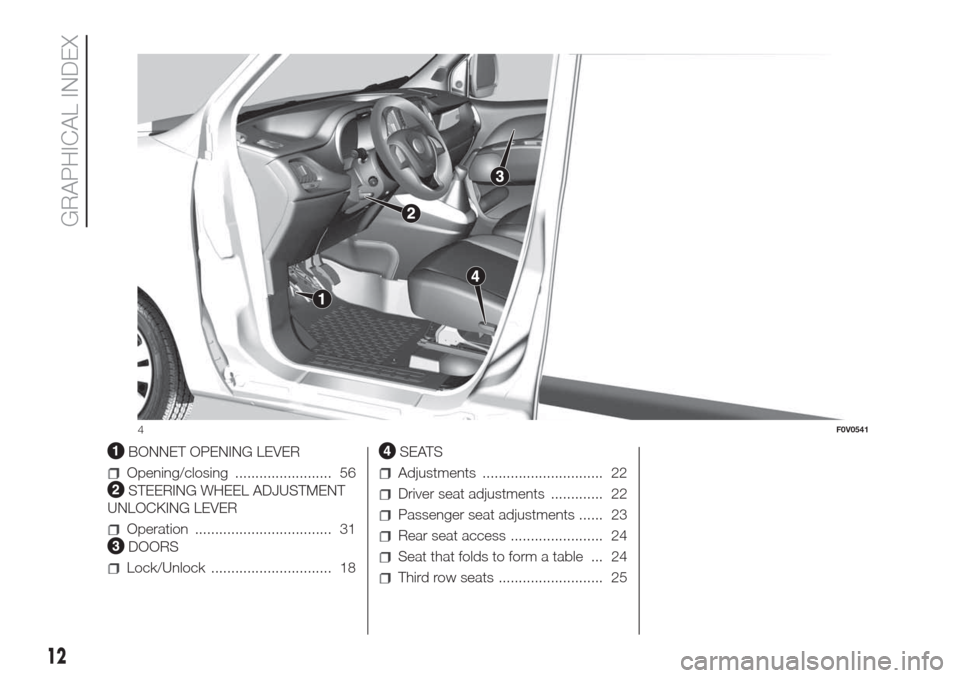
BONNET OPENING LEVER
Opening/closing ........................ 56
STEERING WHEEL ADJUSTMENT
UNLOCKING LEVER
Operation .................................. 31
DOORS
Lock/Unlock .............................. 18
SEATS
Adjustments .............................. 22
Driver seat adjustments ............. 22
Passenger seat adjustments ...... 23
Rear seat access ....................... 24
Seat that folds to form a table ... 24
Third row seats .......................... 25
4F0V0541
12
GRAPHICAL INDEX
Page 26 of 300
WARNING
8)Before opening a door, ensure that you
can do it in conditions of safety.
9)You must not open the left-hand sliding
side door with the fuel cap open while
refuelling. Check that the fuel cap is closed
while opening/closing the sliding side
door to avoid damage.10)If you are parked on a slope, do not
leave the sliding door locked in the open
position. An involuntary impact could
unhook the door, causing it to move.
11)Before leaving the vehicle parked with
the sliding doors open, always check
that they are locked into place.
12)Always use this device when carrying
children.
13)The spring-loaded system was
designed for optimum usage. Accidental
knocks or a strong gust of wind may
release the springs, forcing the doors to
close.
14)When closing, shut the right hand door
fully before you close the left hand door.
Never shut the two doors at the same time.
WARNING
2)Make sure that the left sliding side door
is all closed before refuelling to prevent
damage to the door and to the sliding
locking system with fuel filler cap open,
activated during refuelling.
SEATS
DRIVER’S SEAT
(for Cargo versions, where provided)
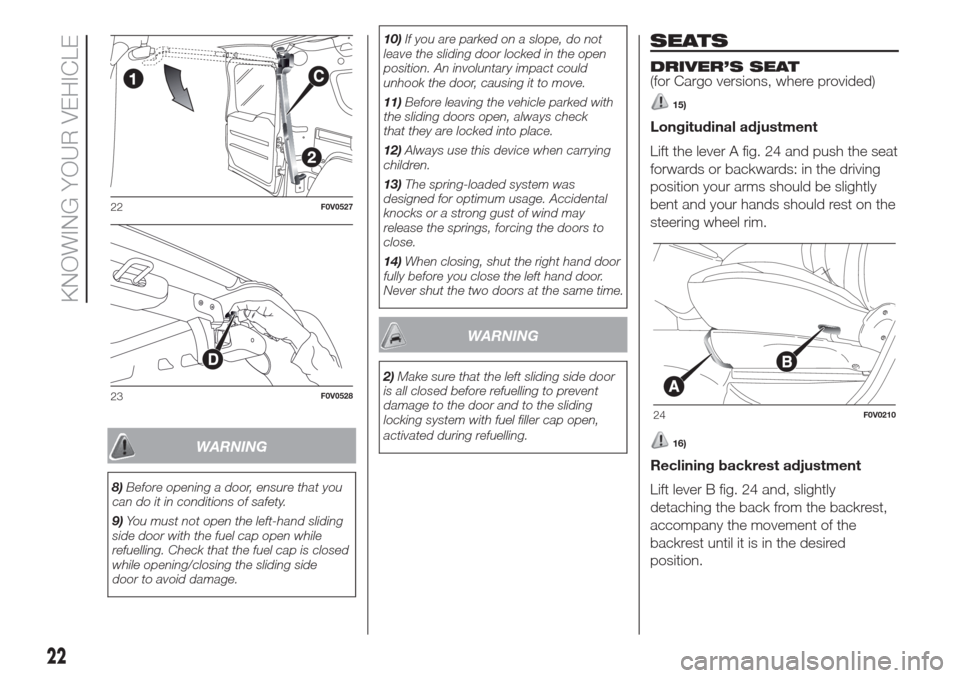
15)
Longitudinal adjustment
Lift the lever A fig. 24 and push the seat
forwards or backwards: in the driving
position your arms should be slightly
bent and your hands should rest on the
steering wheel rim.
16)
Reclining backrest adjustment
Lift lever B fig. 24 and, slightly
detaching the back from the backrest,
accompany the movement of the
backrest until it is in the desired
position.
22F0V0527
23F0V0528
24F0V0210
22
KNOWING YOUR VEHICLE
Page 27 of 300
DRIVER’S SEAT
(for Doblò/Doblò Combi/Cargo
versions, where provided)
15)
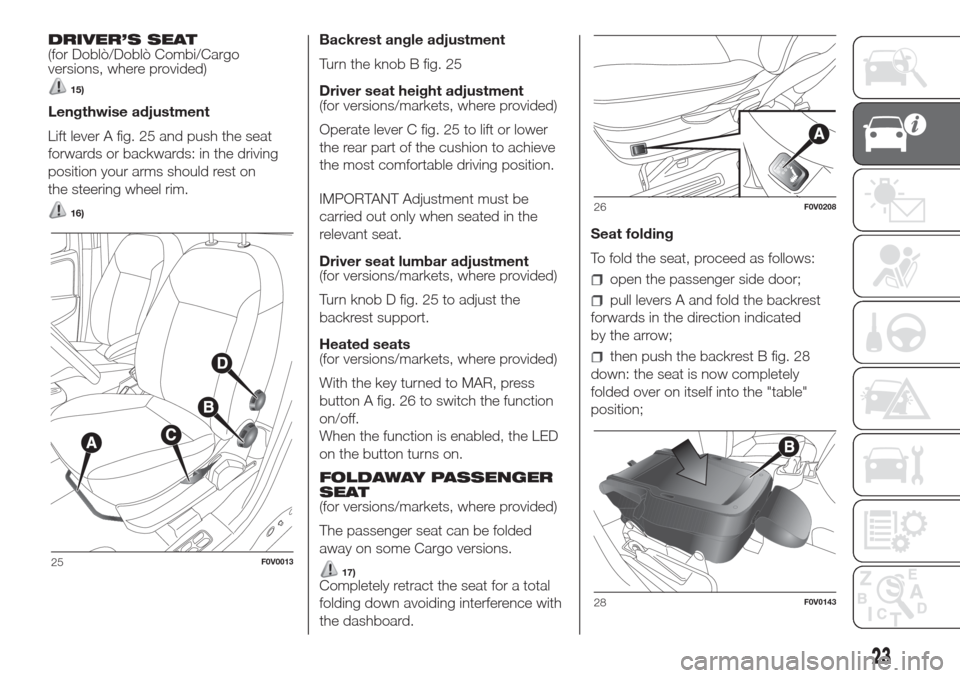
Lengthwise adjustment
Lift lever A fig. 25 and push the seat
forwards or backwards: in the driving
position your arms should rest on
the steering wheel rim.
16)
Backrest angle adjustment
Turn the knob B fig. 25
Driver seat height adjustment
(for versions/markets, where provided)
Operate lever C fig. 25 to lift or lower
the rear part of the cushion to achieve
the most comfortable driving position.
IMPORTANT Adjustment must be
carried out only when seated in the
relevant seat.
Driver seat lumbar adjustment
(for versions/markets, where provided)
Turn knob D fig. 25 to adjust the
backrest support.
Heated seats
(for versions/markets, where provided)
With the key turned to MAR, press
button A fig. 26 to switch the function
on/off.
When the function is enabled, the LED
on the button turns on.
FOLDAWAY PASSENGER
SEAT
(for versions/markets, where provided)
The passenger seat can be folded
away on some Cargo versions.
17)Completely retract the seat for a total
folding down avoiding interference with
the dashboard.Seat folding
To fold the seat, proceed as follows:
open the passenger side door;
pull levers A and fold the backrest
forwards in the direction indicated
by the arrow;
then push the backrest B fig. 28
down: the seat is now completely
folded over on itself into the "table"
position;
25F0V0013
26F0V0208
28F0V0143
23
Page 32 of 300
WARNING
15)All adjustments must be made with the
vehicle stationary.
16)After releasing the adjustment lever,
always check that the seat is locked on the
guides by trying to move it back and forth.
If it is not locked, the seat may move
unexpectedly and make you lose control of
the vehicle.
17)Close the dashboard console before
folding the retractable front passenger seat
to avoid damage.
18)When the passenger seat is folded
away, the space created cannot be used
for loading. When the vehicle is in motion,
you are therefore advised to remove or
secure any objects that might interfere with
the driver.
19)If there is no partition between the cab
and the load compartment, tall objects
or packages may take up part of the
passenger area. Make sure that these
items are well secured by using the
available hooks and that they cannot
interfere with the driver.
20)Close the dashboard console before
folding the front passenger seat to form
a table to avoid damage.
21)While travelling, before using the third
row seats, make sure that the second
row seats are in running position and well
anchored (see the specific label fig. 36.
PARTITIONS
FIXED PANEL PARTITION
(for versions/markets, where provided)
Separates the passenger area from
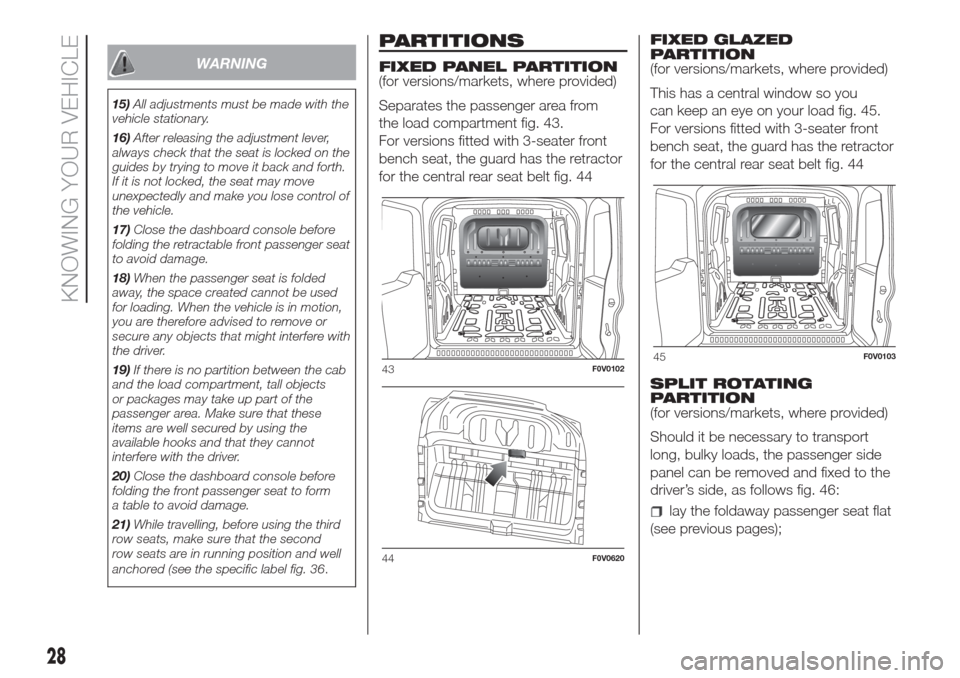
the load compartment fig. 43.
For versions fitted with 3-seater front
bench seat, the guard has the retractor
for the central rear seat belt fig. 44FIXED GLAZED
PARTITION
(for versions/markets, where provided)
This has a central window so you
can keep an eye on your load fig. 45.
For versions fitted with 3-seater front
bench seat, the guard has the retractor
for the central rear seat belt fig. 44
SPLIT ROTATING
PARTITION
(for versions/markets, where provided)
Should it be necessary to transport
long, bulky loads, the passenger side
panel can be removed and fixed to the
driver’s side, as follows fig. 46:
lay the foldaway passenger seat flat
(see previous pages);
43F0V0102
44F0V0620
45F0V0103
28
KNOWING YOUR VEHICLE
Page 34 of 300
HEAD RESTRAINTS
FRONT
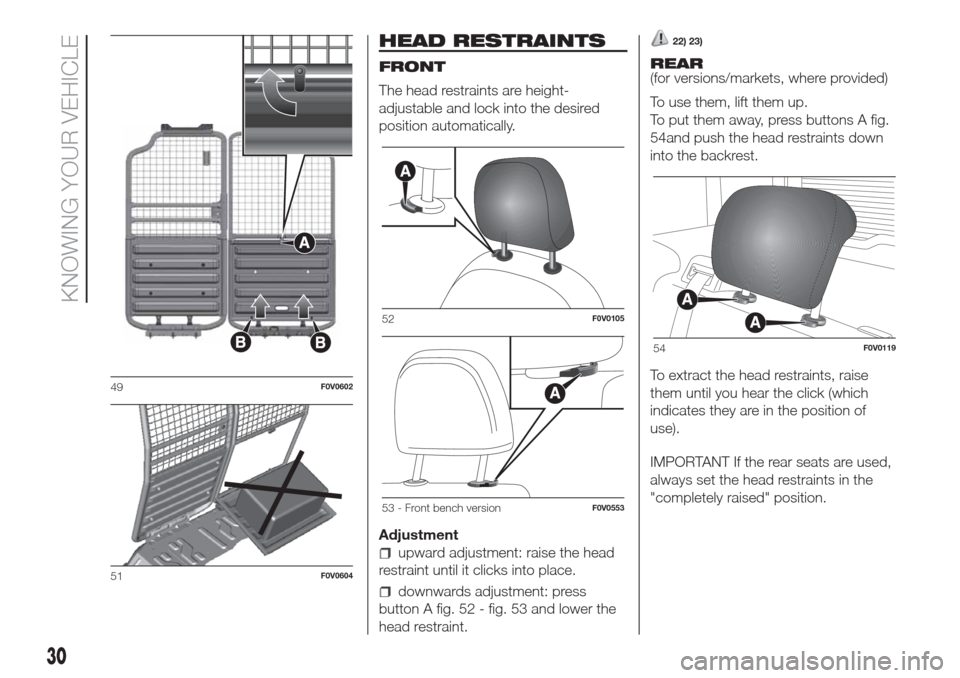
The head restraints are height-
adjustable and lock into the desired
position automatically.
Adjustment
upward adjustment: raise the head
restraint until it clicks into place.
downwards adjustment: press
button A fig. 52 - fig. 53 and lower the
head restraint.
22) 23)
REAR
(for versions/markets, where provided)
To use them, lift them up.
To put them away, press buttons A fig.
54and push the head restraints down
into the backrest.
To extract the head restraints, raise
them until you hear the click (which
indicates they are in the position of
use).
IMPORTANT If the rear seats are used,
always set the head restraints in the
"completely raised" position.
49F0V0602
51F0V0604
52F0V0105
53 - Front bench versionF0V0553
54F0V0119
30
KNOWING YOUR VEHICLE
Page 50 of 300
PASSENGER
COMPARTMENT HEATING
Proceed as follows:
turn knob A to the red section;
turn knob B to the required speed;
turn knob C to:
to warm the feet and demist the
windscreen at the same time
warms the feet and keeps the face
cool (bi-level function)
to warm the feet of those in the front
and rear seats.
to turn off internal air recirculation
(button E LED off).
FAST FRONT WINDOW
DEMISTING/DEFROSTING
Proceed as follows:
press the button
turn knob A fully to the right;
turn knob B to;
turn knob C to;
to turn off internal air recirculation
(button E LED off).
After demisting/defrosting, operate the
controls to maintain optimum visibility
conditions.Window demisting
In the event of considerable external
moisture and/or rain and/or large
differences in temperature inside and
outside the passenger compartment,
perform the following preventive
window demisting procedure:
press the button
to turn off internal air recirculation
(button E LED off);
turn knob A to the red section;
turn knob B to the second speed
level;
turn knob C toor to; switch
off air recirculation if the windows
start misting up (LED on button E off).
The climate control system is very
useful for demisting the windows more
quickly: just carry out the above
procedure and activate the system by
pressing button
.
HEATED REAR WINDOW
AND DOOR MIRRORS
DEMISTING/DEFROSTING
(for versions/markets, where provided)
Press button F
to activate this
function: when the function is on, the
LED on button F
will light up.
This function is timed and will turn off
automatically after 20 minutes. Press
the F
button again to turn the
function off in advance.IMPORTANT Do not apply stickers on
the inside of the rear window over
the heating filaments to avoid damage.
FAN SPEED
ADJUSTMENT
To ventilate the passenger
compartment well, proceed as follows:
fully open the central and side air
diffusers;
turn knob A to the blue section;
turn knob B to the required speed;
turn knob C to
to turn off internal air recirculation
(button E LED off).
INTERNAL AIR
RECIRCULATION
ACTIVATION
Press button E: when the function is
on, the button LED lights up.
It is advisable to switch the internal air
recirculation on while standing in
queues or in tunnels to prevent the
introduction of polluted air. Do not use
the function for a long time, particularly
if there are many passengers on board,
to prevent the windows from misting
up.
46
KNOWING YOUR VEHICLE
Page 68 of 300
ROOF RACK/SKI
RACK
44) 45)
8) 9)
FASTENERS
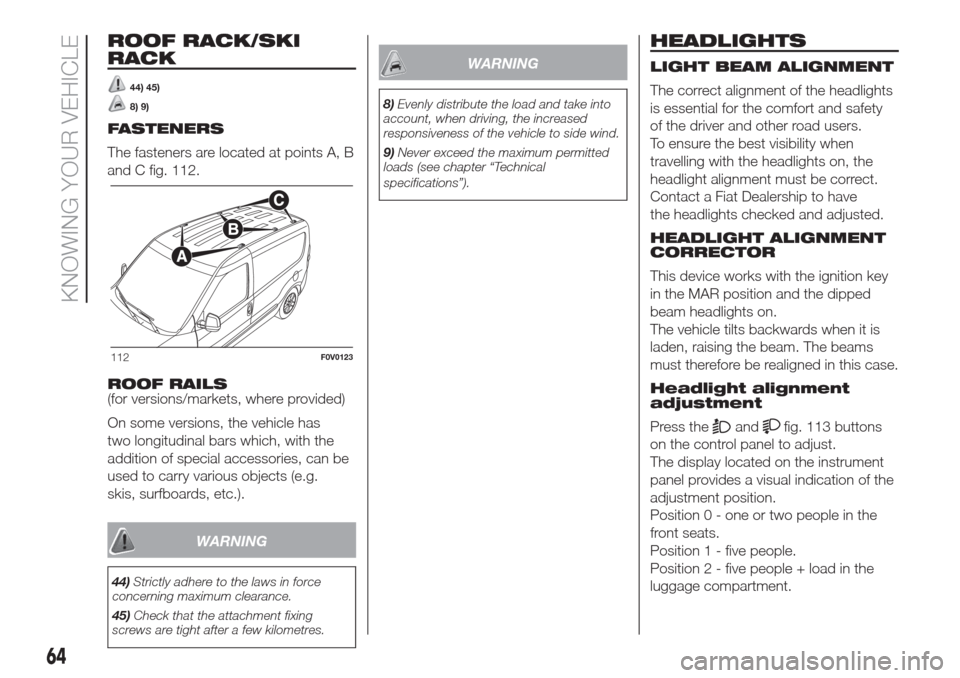
The fasteners are located at points A, B
and C fig. 112.
ROOF RAILS
(for versions/markets, where provided)
On some versions, the vehicle has
two longitudinal bars which, with the
addition of special accessories, can be
used to carry various objects (e.g.
skis, surfboards, etc.).
WARNING
44)Strictly adhere to the laws in force
concerning maximum clearance.
45)Check that the attachment fixing
screws are tight after a few kilometres.
WARNING
8)Evenly distribute the load and take into
account, when driving, the increased
responsiveness of the vehicle to side wind.
9)Never exceed the maximum permitted
loads (see chapter “Technical
specifications”).
HEADLIGHTS
LIGHT BEAM ALIGNMENT
The correct alignment of the headlights
is essential for the comfort and safety
of the driver and other road users.
To ensure the best visibility when
travelling with the headlights on, the
headlight alignment must be correct.
Contact a Fiat Dealership to have
the headlights checked and adjusted.
HEADLIGHT ALIGNMENT
CORRECTOR
This device works with the ignition key
in the MAR position and the dipped
beam headlights on.
The vehicle tilts backwards when it is
laden, raising the beam. The beams
must therefore be realigned in this case.
Headlight alignment
adjustment
Press the
andfig. 113 buttons
on the control panel to adjust.
The display located on the instrument
panel provides a visual indication of the
adjustment position.
Position 0 - one or two people in the
front seats.
Position 1 - five people.
Position 2 - five people + load in the
luggage compartment.
112F0V0123
64
KNOWING YOUR VEHICLE
Page 109 of 300
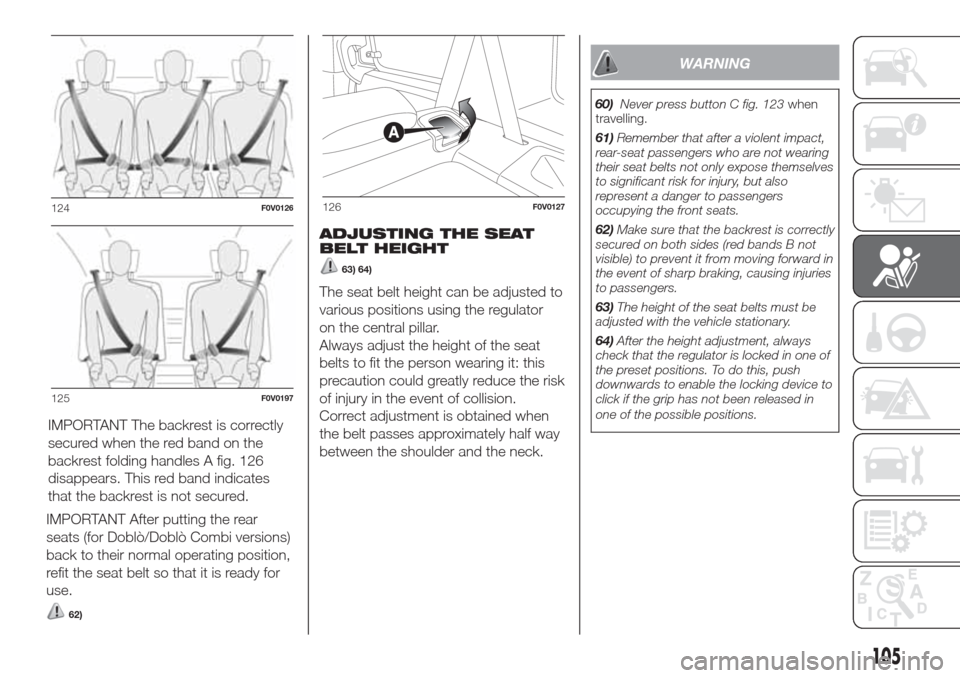
IMPORTANT The backrest is correctly
secured when the red band on the
backrest folding handles A fig. 126
disappears. This red band indicates
that the backrest is not secured.
IMPORTANT After putting the rear
seats (for Doblò/Doblò Combi versions)
back to their normal operating position,
refit the seat belt so that it is ready for
use.
62)
ADJUSTING THE SEAT
BELT HEIGHT
63) 64)
The seat belt height can be adjusted to
various positions using the regulator
on the central pillar.
Always adjust the height of the seat
belts to fit the person wearing it: this
precaution could greatly reduce the risk
of injury in the event of collision.
Correct adjustment is obtained when
the belt passes approximately half way
between the shoulder and the neck.
WARNING
60)Never press button C fig. 123when
travelling.
61)Remember that after a violent impact,
rear-seat passengers who are not wearing
their seat belts not only expose themselves
to significant risk for injury, but also
represent a danger to passengers
occupying the front seats.
62)Make sure that the backrest is correctly
secured on both sides (red bands B not
visible) to prevent it from moving forward in
the event of sharp braking, causing injuries
to passengers.
63)The height of the seat belts must be
adjusted with the vehicle stationary.
64)After the height adjustment, always
check that the regulator is locked in one of
the preset positions. To do this, push
downwards to enable the locking device to
click if the grip has not been released in
one of the possible positions.
124F0V0126
125F0V0197
126F0V0127
105
Page 122 of 300
Below is a summary of
the main safety rules to
be followed when
carrying children:
install the child restraint systems on
the rear seat, which is the most
protected position in the event of an
accident;
if you need to deactivate the
passenger airbag, always check that it
is actually deactivated by checking
that the
warning light is on
constantly either alone or in the SBR
(according to the version, where
provided);
carefully follow the instructions that
came with the child restraint system,
which the manufacturer must supply by
law. Keep the instructions in the vehicle
along with the other papers and this
handbook. Do not install second-hand
child restraint systems without
instructions;
always check that the seat belt is
well fastened by pulling on it;
only one child is to be strapped into
each restraint system; never carry
two children using one child restraint
system;
always check that seat belts do not
rest on the child’s neck;
while travelling, do not let the child
sit incorrectly or release the belts;
never carry children on your lap,
even newborns. No-one can hold
a child in the case of a crash.
if the car has been involved in a road
accident, replace the child restraint
system with a new one. In addition, and
depending on the type of child restraint
system installed, replace the Isofix
anchorages or the seat belt with which
the child restraint system was
connected.
The rear head restraint can be
removed if needed to install a child
restraint system. The head restraint
must always be present in the vehicle
and fitted if the seat is used by an adult
passenger or a child sitting in a restraint
system without backrest.
72) 73) 74) 75) 76) 77) 78) 79) 79)
WARNING
71)Fit the child restraint system only when
the vehicle is stationary. The child restraint
system is correctly fixed to the setup
brackets when you hear the click. Follow
the instructions for assembly, disassembly
and positioning that the Manufacturer
must supply with the child restraint system.
72)When there is an active passenger
airbag, DO NOT install rearward facing
child restraint systems on the front seat.
Always deactivate the passenger airbag
when a rear facing child restraint system is
installed on the front passenger seat.73)On the sun visor there is a label with
suitable symbols reminding the user that it
is compulsory to deactivate the airbag if
a rearward facing child restraint system is
fitted. Always comply with the instructions
on the passenger side sun visor (see the
"Airbags" paragraph).
74)Do not move the front or rear seat if a
child is seated on it or on the dedicated
child restraint system.
75)Incorrect fitting of the child restraint
system may result in an inefficient
protection system. In the event of an
accident the child restraint system may
become loose and the child may be
injured, even fatally. When fitting a restraint
system for newborns or children, strictly
comply with the instructions provided
by the Manufacturer.
76)When the child restraint system is not
used, secure it with the seat belt or with
the ISOFIX anchorages, or remove it from
the car. Do not leave it unsecured inside
the passenger compartment. In this way, in
the event of sudden braking or an
accident, it will not cause injuries to the
occupants.
77)After installing a child restraint system,
do not move the seat: always remove
the child restraint system before making
any adjustment.
78)Always make sure that the diagonal
section of the seat belt does not pass
under the arms or behind the back of the
child. In the event of an accident the seat
belt will not be able to secure the child,
with the risk of injury, including fatal injury.
Therefore the child must always wear
the seat belt correctly.
118
SAFETY
Page 166 of 300
CHANGING A WHEEL
The vehicle is originally equipped with
the Fix&Go automatic quick tyre repair
kit (see instructions in the next section).
As an alternative, the vehicle may
have a normal-sized spare wheel.
Wheel changing and correct use of the
jack and spare wheel call for some
precautions, as listed below.
125) 126) 127) 128)
Note for one-way tyres
One-way tyres have a few arrows on
the side indicating the rotation direction.
If a wheel is changed (when punctured,
for example) the direction of the arrows
on the spare wheel tyre may not
coincide with the rotation direction of
the wheel to be replaced.
In these conditions, too, the tyre still
maintains its safety features.
Anyway, it is recommended to have the
wheel repaired and refitted as soon as
possible, as the best performance is
achieved when the rotation direction of
all tyres coincides with the one
indicated by the arrows.
Please note that:
the jack weight is 4 kg;
the jack requires no adjustment;
the jack cannot be repaired and in
the event of a fault it must be replaced
by another original one;
no tool other than its cranking
device may be fitted on the jack.
To change a wheel, proceed as follows:
stop the vehicle in a position that is
not dangerous for oncoming traffic
where you can change the wheel safely.
The ground should be flat if possible,
and sufficiently firm;
stop the engine and pull the
handbrake;
engage first gear or reverse;
wear the reflective safety jacket
(compulsory by law in certain countries)
before getting out of the vehicle;
indicate that the vehicle has broken
down using the devices required by
the law in the current country (e.g.
warning triangle, hazard lights, etc.);
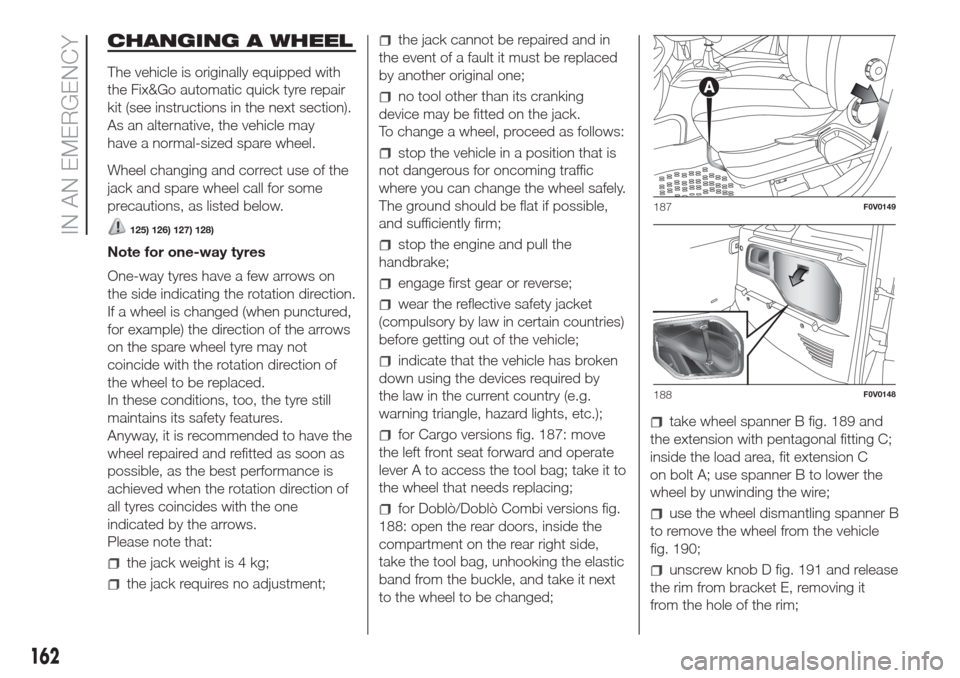
for Cargo versions fig. 187: move
the left front seat forward and operate
lever A to access the tool bag; take it to
the wheel that needs replacing;
for Doblò/Doblò Combi versions fig.
188: open the rear doors, inside the
compartment on the rear right side,
take the tool bag, unhooking the elastic
band from the buckle, and take it next
to the wheel to be changed;
take wheel spanner B fig. 189 and
the extension with pentagonal fitting C;
inside the load area, fit extension C
on bolt A; use spanner B to lower the
wheel by unwinding the wire;
use the wheel dismantling spanner B
to remove the wheel from the vehicle
fig. 190;
unscrew knob D fig. 191 and release
the rim from bracket E, removing it
from the hole of the rim;
187F0V0149
188F0V0148
162
IN AN EMERGENCY