ABS FIAT DOBLO COMBI 2018 Owner handbook (in English)
[x] Cancel search | Manufacturer: FIAT, Model Year: 2018, Model line: DOBLO COMBI, Model: FIAT DOBLO COMBI 2018Pages: 272, PDF Size: 23.75 MB
Page 80 of 272
BRAKE ASSIST
(emergency braking
assistance integrated in
ESC)
(for versions/markets, where provided)
This system (which cannot be
deactivated) recognises emergency
braking conditions according to the
speed of operation of the brake pedal
and provides an additional hydraulic
braking pressure to support that
provided by the driver. This allows
faster and more powerful operation of
the braking system.
Brake Assist is deactivated on the
versions equipped with ESP, in the
event of ESC system failure (indicated
by the
warning light coming on
together with a message in the
multifunction display, where provided).
WARNING
50)When the ABS cuts in and you feel the
brake pedal pulsating, do not remove
your foot, but keep the pedal pushed
down; in doing so you, will stop in the
shortest distance possible under the road
conditions at the time.
51)If the ABS system intervenes, this
indicates that the traction of the tyres on
the road is nearing its limit. You must slow
down to a speed compatible with the
available traction.52)The ABS gets the most from the
available grip, but it cannot improve it; you
should therefore take every care when
driving on slippery surfaces and not take
unnecessary risks.
53)If only the
instrument panel
warning light comes on (with a message in
the multifunction display on some
versions), stop the vehicle immediately and
contact the nearest Fiat Dealership. Any
loss of fluid will affect the brake system
functionality, both conventional and
ant-lock wheels.
ESC (Electronic
Stability Control)
SYSTEM
(for versions/markets, where provided)
IN BRIEF
This is an electronic system that
controls vehicle stability in the event
of tyre grip loss, helping to maintain
directional control.
The ESC system is therefore
particularly useful when grip
conditions of road surfaces change.
The MSR system (adjustment of
the engine braking torque during gear
changes) and the HBA system
(automatic increase in the braking
pressure during emergency braking)
are present with ESC, ASR and
Hill Holder systems (for
versions/markets where provided).
SYSTEM INTERVENTION
This is signalled by the flashing of the
warning light in the instrument panel,
to inform the driver that the vehicle is
in critical stability and grip conditions.
78
SAFETY
Page 91 of 272

PASSENGER SEAT COMPLIANCE WITH REGULATIONS ON UNIVERSAL CHILD
RESTRAINT SYSTEM USE
The Fiat Doblò (only for vehicles designed to carry people), (homologation M1) complies with the new European Directive
2000/3/EC which governs the arrangement possibilities for child restraint systems on the seats of the vehicle as shown in the
following table:
Group Weight groups Front passenger (*) Rear passenger
(1st row)Rear passenger
(2nd row)
Airbag enabled Airbag deactivated
Group 0, 0+ up to 13 kgXUUX
Group 1 9-18 kgXUUX
Group 2 15-25 kgUUU X
Group 3 22-36 kgUUU X
X= seat not suitable for children in this weight category
U= Suitable for child restraint systems in the "Universal" category, according to European Regulation EEC-R44 for the specified "Groups".
(*) IMPORTANT: NEVER fit rearward-facing child restraint systems on the front seat with an active passenger airbag. If you wish to fit a rearward-facing child seat in
the front passenger seat, first deactivate the relative airbag (see instructions in the paragraph (Supplementary protection system (SRS) – Airbag”)
WARNING
64)SERIOUS DANGER: When an active passenger airbag is fitted, DO NOT install rear facing child restraint systems on the front seat.
Deployment of the airbag in an accident could cause fatal injuries to the child regardless of the severity of the impact. It is advisable to always
carry children in a child restraint system on the rear seat, which is the most protected position in the event of a crash. Should it be absolutely
necessary to carry a child on the front seat in a rearward-facing child restraint system, the passenger front and side airbags (for versions/
markets, where provided) must be deactivated through the setup menu. Deactivation can be verified by checking operation of the
warning
light alone or in the SBR (according to versions, where provided). Move the passenger's seat as far back as possible to avoid contact
between the child restraint system and the dashboard.
65)The diagrams are indicative and provided for assembly purposes only. Fit the child restraint system according to the instructions, which
must be included.
66)Child restraint systems with Isofix attachments are available for a safe anchoring to the seat without using the car seat belts. Follow the
assembly instructions carefully.
89
Page 107 of 272
EMERGENCY START-UP
If the instrument panel warning light
stays on steadily, you can perform
an emergency start by using the code
on the CODE card (see the “In an
emergency” section).
22)
SWITCHING OFF THE
ENGINE
Turn the ignition key to STOP while the
engine is idling.
IMPORTANT After a long drive, you
should allow the engine to “catch
its breath” before turning it off by letting
it idle to allow the temperature in the
engine compartment to fall.
WARNING
91)It is dangerous to run the engine in
enclosed areas. The engine consumes
oxygen and engine exhaust contains
carbon dioxide, carbon monoxide and
other toxic gasses.
WARNING
18)It is advisable not to demand maximum
performance from your vehicle (e.g.
excessive accelerations, long distances at
top rpm, excessive intense braking, etc.)
as soon as the engine is started.19)When the engine is switched off never
leave the key turned to MAR-ON to prevent
useless current absorption from draining
the battery.
20)If the warning light
flashes for 60
seconds after starting or during an
extended towing period, this indicates an
anomaly in the glow plug preheating
system. Use the vehicle normally if the
engine starts, but contact a Fiat Dealership
as soon as possible.
21)If the engine fails to start with a gear
engaged, the potentially dangerous
situation due to the fact that the gearbox is
automatically placed in neutral will be
signalled by a buzzer.
22)Never bump start the engine by
pushing, towing or coasting downhill. This
could cause fuel to flow into the catalytic
converter and damage it beyond repair.
PARKING THE
VEHICLE
HANDBRAKE
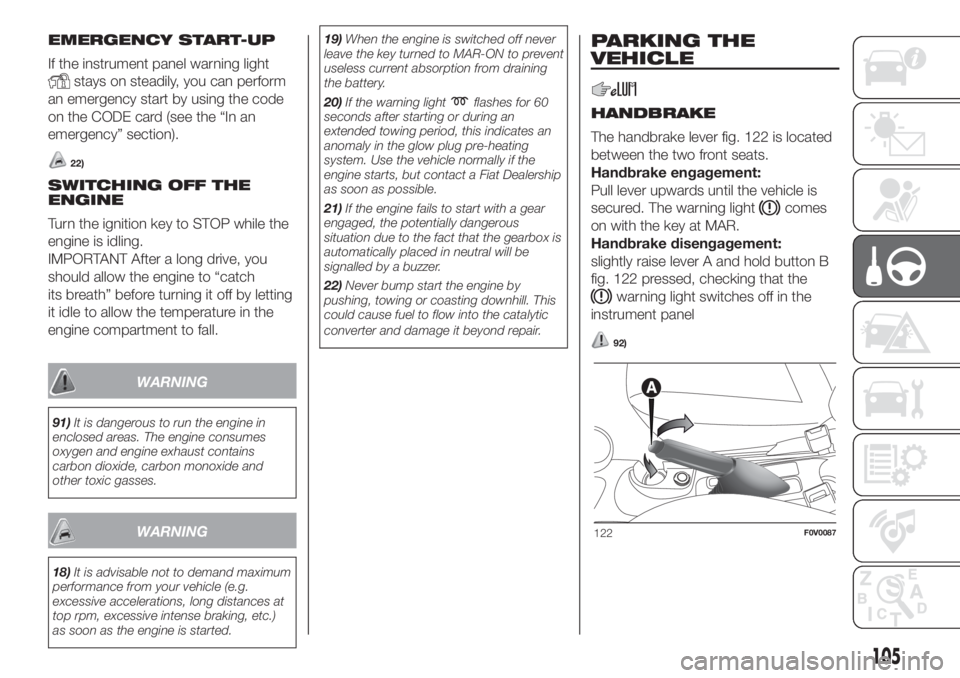
The handbrake lever fig. 122 is located
between the two front seats.
Handbrake engagement:
Pull lever upwards until the vehicle is
secured. The warning light
comes
on with the key at MAR.
Handbrake disengagement:
slightly raise lever A and hold button B
fig. 122 pressed, checking that the
warning light switches off in the
instrument panel
92)
122F0V0087
105
Page 117 of 272
by pressing the accelerator pedal (in
this case the system is not actually
turned off but the acceleration request
takes priority; the cruise control remains
activated, without the need to the
press button B fig. 133 to restore the
previous conditions once the
acceleration is over).
The device is automatically switched off
in the following cases:
if the ABS or ESC systems intervene
with the vehicle speed below the
set limit
in the event of system failure.
WARNING
110)When travelling with the device active,
never move the gear lever to neutral.
111)In the event of device faults or failures,
turn the ring nut A to OFF and contact a
Fiat Dealership.
TRACTION PLUS
SYSTEM
(for versions/markets, where provided)
Traction Plus is a driving aid, useful
for setting off in poor grip conditions
(snow, ice, mud, etc.) which allows the
drive force to be distributed in the
best way over the front axle when one
wheel is slipping.
Traction Plus acts by braking the
wheels with poor grip (or those slipping
more than the others), thereby
transferring the drive force to those
which have greater grip on the ground.
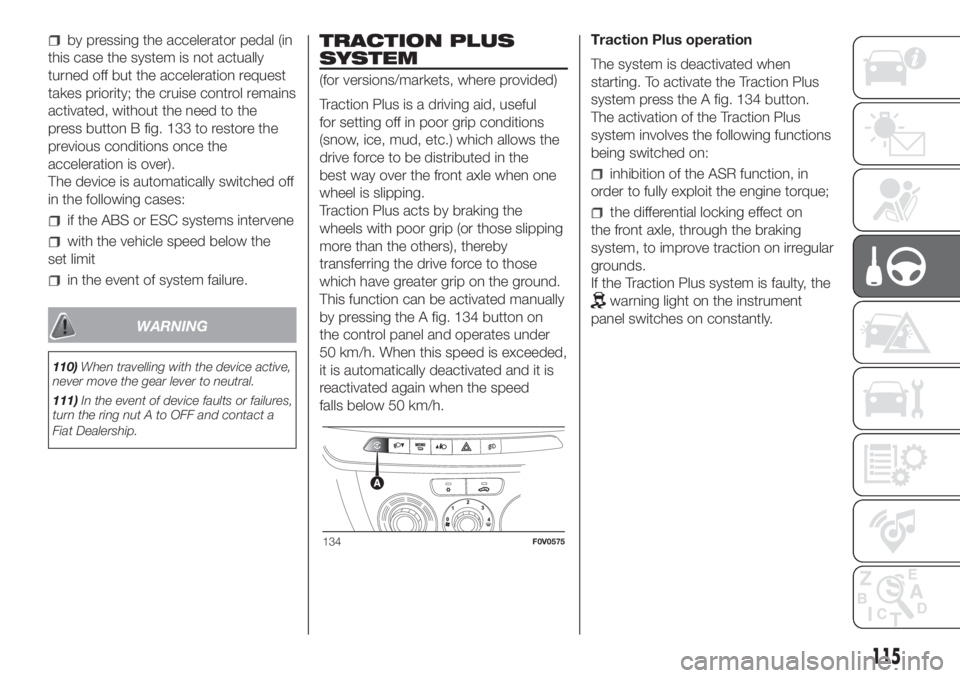
This function can be activated manually
by pressing the A fig. 134 button on
the control panel and operates under
50 km/h. When this speed is exceeded,
it is automatically deactivated and it is
reactivated again when the speed
falls below 50 km/h.Traction Plus operation
The system is deactivated when
starting. To activate the Traction Plus
system press the A fig. 134 button.
The activation of the Traction Plus
system involves the following functions
being switched on:
inhibition of the ASR function, in
order to fully exploit the engine torque;
the differential locking effect on
the front axle, through the braking
system, to improve traction on irregular
grounds.
If the Traction Plus system is faulty, the
warning light on the instrument
panel switches on constantly.
134F0V0575
115
Page 118 of 272
PARKING SENSORS
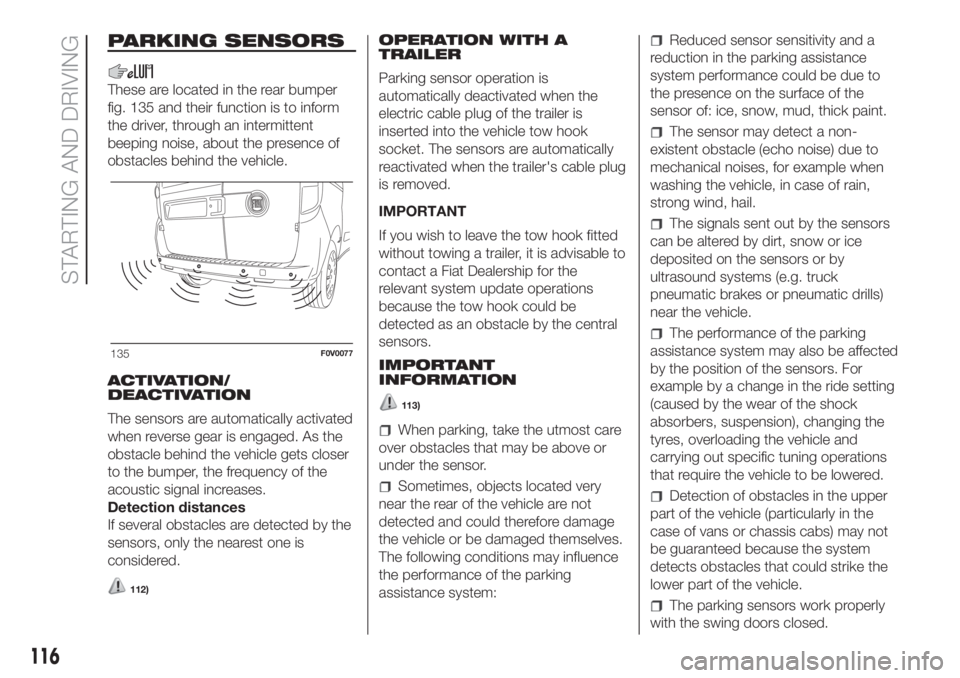
These are located in the rear bumper
fig. 135 and their function is to inform
the driver, through an intermittent
beeping noise, about the presence of
obstacles behind the vehicle.
ACTIVATION/
DEACTIVATION
The sensors are automatically activated
when reverse gear is engaged. As the
obstacle behind the vehicle gets closer
to the bumper, the frequency of the
acoustic signal increases.
Detection distances
If several obstacles are detected by the
sensors, only the nearest one is
considered.
112)
OPERATION WITH A
TRAILER
Parking sensor operation is
automatically deactivated when the
electric cable plug of the trailer is
inserted into the vehicle tow hook
socket. The sensors are automatically
reactivated when the trailer's cable plug
is removed.
IMPORTANT
If you wish to leave the tow hook fitted
without towing a trailer, it is advisable to
contact a Fiat Dealership for the
relevant system update operations
because the tow hook could be
detected as an obstacle by the central
sensors.
IMPORTANT
INFORMATION
113)
When parking, take the utmost care
over obstacles that may be above or
under the sensor.
Sometimes, objects located very
near the rear of the vehicle are not
detected and could therefore damage
the vehicle or be damaged themselves.
The following conditions may influence
the performance of the parking
assistance system:
Reduced sensor sensitivity and a
reduction in the parking assistance
system performance could be due to
the presence on the surface of the
sensor of: ice, snow, mud, thick paint.
The sensor may detect a non-
existent obstacle (echo noise) due to
mechanical noises, for example when
washing the vehicle, in case of rain,
strong wind, hail.
The signals sent out by the sensors
can be altered by dirt, snow or ice
deposited on the sensors or by
ultrasound systems (e.g. truck
pneumatic brakes or pneumatic drills)
near the vehicle.
The performance of the parking
assistance system may also be affected
by the position of the sensors. For
example by a change in the ride setting
(caused by the wear of the shock
absorbers, suspension), changing the
tyres, overloading the vehicle and
carrying out specific tuning operations
that require the vehicle to be lowered.
Detection of obstacles in the upper
part of the vehicle (particularly in the
case of vans or chassis cabs) may not
be guaranteed because the system
detects obstacles that could strike the
lower part of the vehicle.
The parking sensors work properly
with the swing doors closed.
135F0V0077
116
STARTING AND DRIVING
Page 120 of 272
Closing
1) Fit the cap (complete with key) and
turn it clockwise until it clicks once
or more.
2) Turn the key clockwise and extract it,
then close the flap.
The sealing may cause a slight pressure
increase in the tank. A little breathing
off, while slackening the cap is
absolutely normal.
29)
NATURAL POWER
VERSIONS
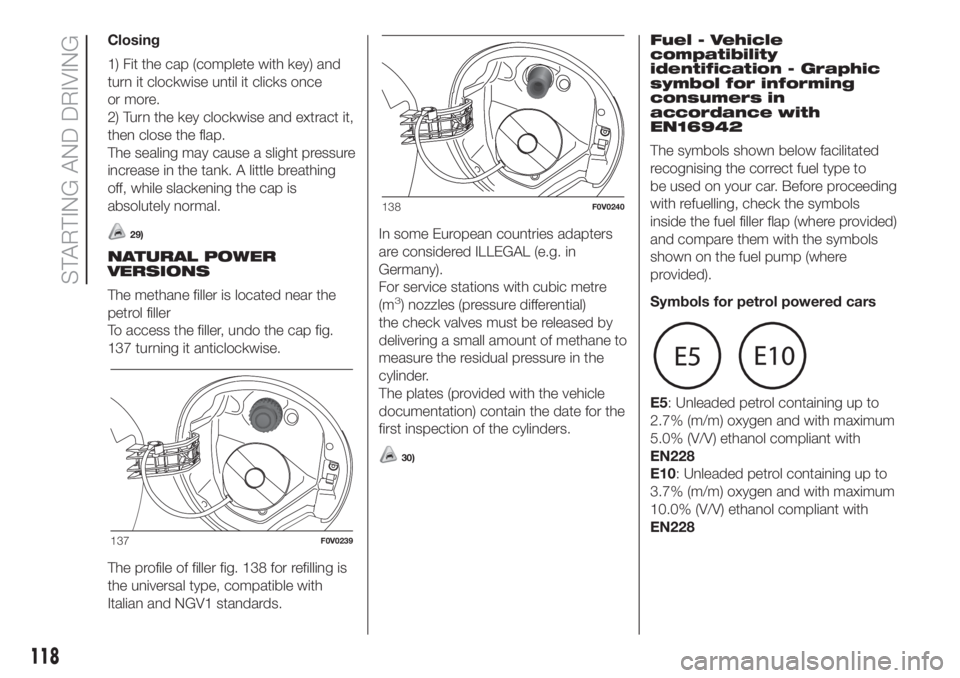
The methane filler is located near the
petrol filler
To access the filler, undo the cap fig.
137 turning it anticlockwise.
The profile of filler fig. 138 for refilling is
the universal type, compatible with
Italian and NGV1 standards.In some European countries adapters
are considered ILLEGAL (e.g. in
Germany).
For service stations with cubic metre
(m
3) nozzles (pressure differential)
the check valves must be released by
delivering a small amount of methane to
measure the residual pressure in the
cylinder.
The plates (provided with the vehicle
documentation) contain the date for the
first inspection of the cylinders.
30)
Fuel - Vehicle
compatibility
identification - Graphic
symbol for informing
consumers in
accordance with
EN16942
The symbols shown below facilitated
recognising the correct fuel type to
be used on your car. Before proceeding
with refuelling, check the symbols
inside the fuel filler flap (where provided)
and compare them with the symbols
shown on the fuel pump (where
provided).
Symbols for petrol powered cars
E5: Unleaded petrol containing up to
2.7% (m/m) oxygen and with maximum
5.0% (V/V) ethanol compliant with
EN228
E10: Unleaded petrol containing up to
3.7% (m/m) oxygen and with maximum
10.0% (V/V) ethanol compliant with
EN228
137F0V0239
138F0V0240
118
STARTING AND DRIVING
Page 122 of 272

WARNING
114)The ABS device with which the
vehicle is equipped will not control the
braking system of the trailer. Particular
caution is required on slippery roads.
115)Never modify the braking system of
the vehicle to control the trailer brake. The
trailer braking system must be fully
independent from the hydraulic system of
the vehicle.
120
STARTING AND DRIVING
To make sure that the maximum
towable weight is not exceeded (given
in the vehicle registration document)
account should be taken of the fully
laden trailer, including accessories and
luggage.
Do not exceed the speed limits specific
to each country you are driving in, in
the case of vehicles towing trailers.
In any case, the top speed must not
exceed 80 km/h.
114) 115)
Page 129 of 272
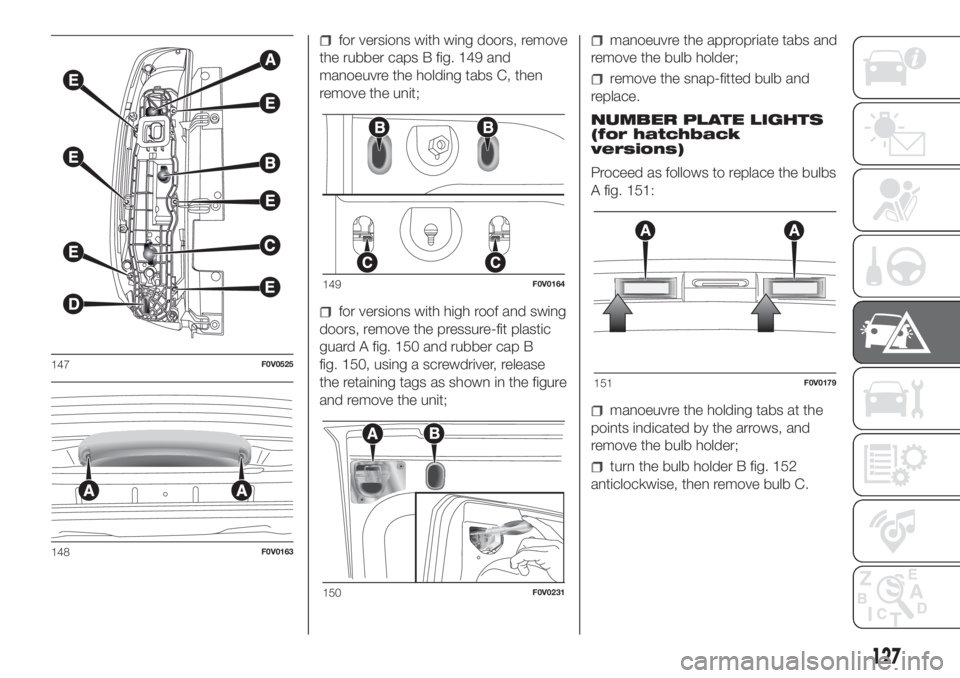
for versions with wing doors, remove
the rubber caps B fig. 149 and
manoeuvre the holding tabs C, then
remove the unit;
for versions with high roof and swing
doors, remove the pressure-fit plastic
guard A fig. 150 and rubber cap B
fig. 150, using a screwdriver, release
the retaining tags as shown in the figure
and remove the unit;
manoeuvre the appropriate tabs and
remove the bulb holder;
remove the snap-fitted bulb and
replace.
NUMBER PLATE LIGHTS
(for hatchback
versions)
Proceed as follows to replace the bulbs
A fig. 151:
manoeuvre the holding tabs at the
points indicated by the arrows, and
remove the bulb holder;
turn the bulb holder B fig. 152
anticlockwise, then remove bulb C.
147F0V0525
148F0V0163
149F0V0164
150F0V0231
151F0V0179
127
Page 130 of 272
NUMBER PLATE LIGHTS
(for versions with wing
doors)
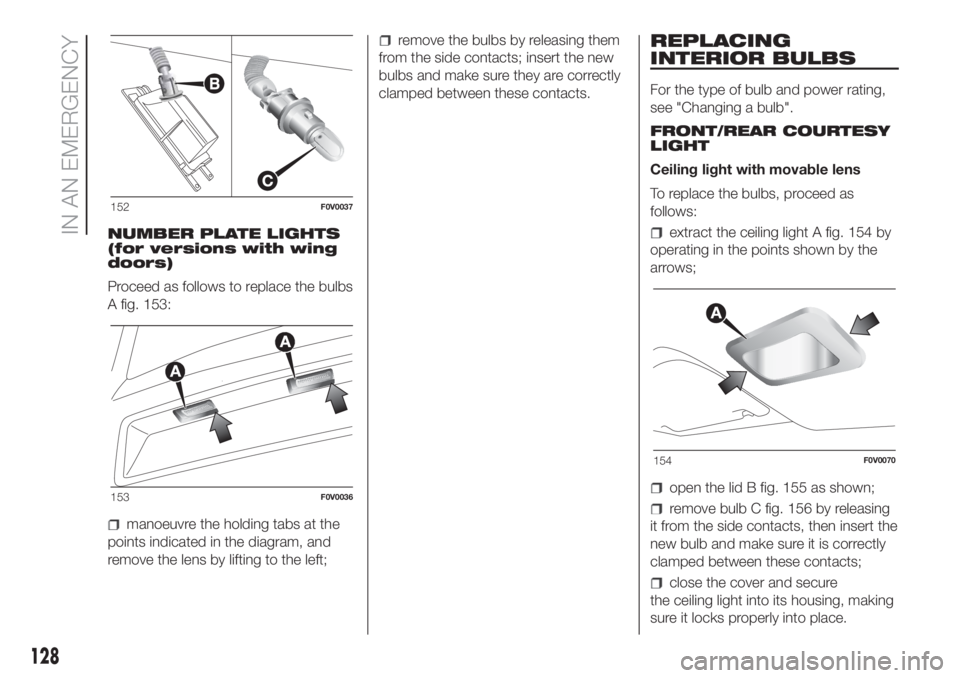
Proceed as follows to replace the bulbs
A fig. 153:
manoeuvre the holding tabs at the
points indicated in the diagram, and
remove the lens by lifting to the left;
remove the bulbs by releasing them
from the side contacts; insert the new
bulbs and make sure they are correctly
clamped between these contacts.REPLACING
INTERIOR BULBS
For the type of bulb and power rating,
see "Changing a bulb".
FRONT/REAR COURTESY
LIGHT
Ceiling light with movable lens
To replace the bulbs, proceed as
follows:
extract the ceiling light A fig. 154 by
operating in the points shown by the
arrows;
open the lid B fig. 155 as shown;
remove bulb C fig. 156 by releasing
it from the side contacts, then insert the
new bulb and make sure it is correctly
clamped between these contacts;
close the cover and secure
the ceiling light into its housing, making
sure it locks properly into place.
152F0V0037
153F0V0036
154F0V0070
128
IN AN EMERGENCY
Page 167 of 272

NB Carefully clean the reservoir cap E
and surrounding surfaces.
Take great care to ensure that
impurities do not enter the reservoir
when the cap is opened.
Always use a funnel with a built-in filter
with a mesh of 0.12 mm or less.
IMPORTANT Brake fluid absorbs
moisture. For this reason, if the vehicle
is mainly used in areas with a high
degree of atmospheric humidity, the
fluid should be replaced at more
frequent intervals than specified in the
“Service Schedule”.
43)
136) 137)
POWER STEERING FLUID
Check that the oil level with the vehicle
on flat ground and the engine cold is
between the MIN and MAX marks
on the reservoir body G fig. 190 - fig.
191 - fig. 192 - fig. 193 - fig. 194 - fig.
195 - fig. 196 - fig. 197 - fig. 198.
The level may exceed the MAX mark
when the oil is hot.
If topping up is required, make sure the
oil you use has the same specifications
as that already in the system.
138)
4)
44)
COMFORT-MATIC AND
DUALOGIC™
TRANSMISSION
HYDRAULIC SYSTEM
FLUID
To check the transmission oil level and
to check/change the clutch hydraulic
system fluid, go to a Fiat Dealership.
5)
WARNING
132)Never smoke while working in the
engine compartment: gas and inflammable
vapours may be present, with the risk of
fire.
133)When the engine is hot, take care
when working inside the engine
compartment to avoid burns. Remember
that when the engine is hot, the fan may
operate: danger of injury. Scarves, ties and
other loose clothing might be pulled by
moving parts.
134)The cooling system is pressurised. If
necessary, only replace the plug with
another original or the operation of the
system may be adversely affected. Do not
remove the reservoir plug when the engine
is hot: you risk scalding yourself.135)Do not travel with the windscreen
washer fluid reservoir empty: the
windscreen washer is essential for
improving visibility. Some commercial
windscreen washer additives are
flammable. The engine compartment
contains hot components which may set it
on fire.
136)Brake fluid is poisonous and highly
corrosive. In the event of accidental
contact, immediately wash the affected
parts with water and mild soap. Then rinse
thoroughly. Call a doctor immediately if
swallowed.
137)The symbol
, on the brake fluid
container indicates if a brake fluid is
synthetic or mineralbased. Using
a mineral-type fluid will damage the special
rubber seals of the braking system beyond
repair.
138)Prevent power steering fluid from
coming into contact with hot engine parts:
it is flammable.
WARNING
40)When topping up, take care not to mix
up the various types of fluids: they are
not compatible with each other and could
seriously damage the vehicle.
41)Do not add oil with specifications other
than those of the oil already existing in
the engine.
165