Handbrake FIAT DOBLO PANORAMA 2016 2.G User Guide
[x] Cancel search | Manufacturer: FIAT, Model Year: 2016, Model line: DOBLO PANORAMA, Model: FIAT DOBLO PANORAMA 2016 2.GPages: 323, PDF Size: 25.46 MB
Page 175 of 323
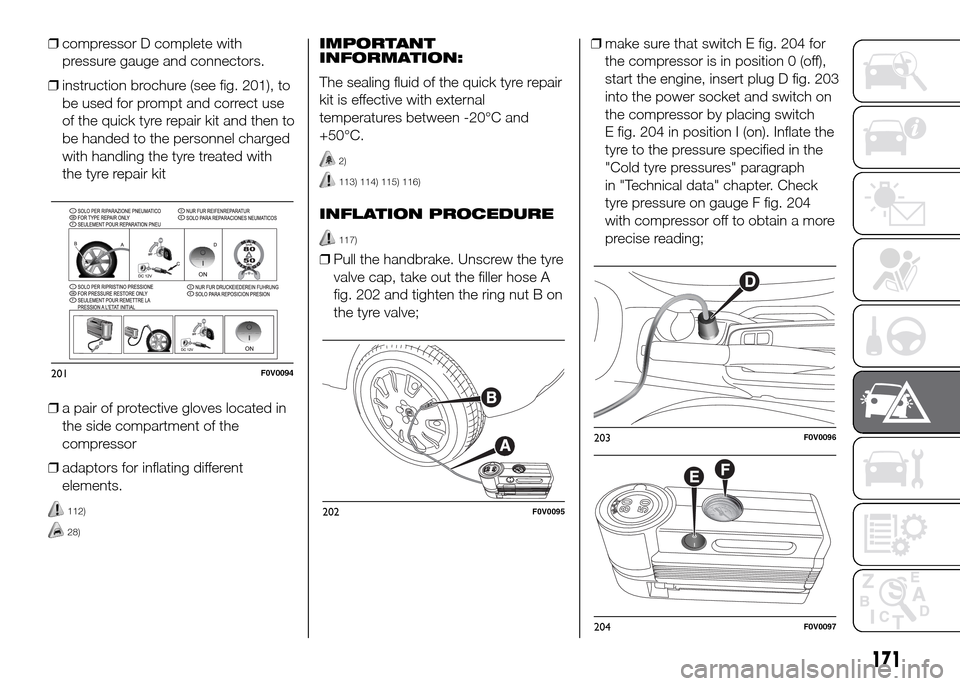
❒compressor D complete with
pressure gauge and connectors.
❒instruction brochure (see fig. 201), to
be used for prompt and correct use
of the quick tyre repair kit and then to
be handed to the personnel charged
with handling the tyre treated with
the tyre repair kit
❒a pair of protective gloves located in
the side compartment of the
compressor
❒adaptors for inflating different
elements.
112)
28)
IMPORTANT
INFORMATION:
The sealing fluid of the quick tyre repair
kit is effective with external
temperatures between -20°C and
+50°C.
2)
113) 114) 115) 116)
INFLATION PROCEDURE
117)
❒Pull the handbrake. Unscrew the tyre
valve cap, take out the filler hose A
fig. 202 and tighten the ring nut B on
the tyre valve;❒make sure that switch E fig. 204 for
the compressor is in position 0 (off),
start the engine, insert plug D fig. 203
into the power socket and switch on
the compressor by placing switch
E fig. 204 in position I (on). Inflate the
tyre to the pressure specified in the
"Cold tyre pressures" paragraph
in "Technical data" chapter. Check
tyre pressure on gauge F fig. 204
with compressor off to obtain a more
precise reading;
201F0V0094
202F0V0095
203F0V0096
204F0V0097
171
Page 176 of 323
❒if after 5 minutes it is still impossible
to reach at least 1.5 bar, disengage
the compressor from the valve and
power socket, then move the vehicle
forwards by approx. 10 metres in
order to distribute the sealant inside
the tyre evenly, then repeat the
inflation operation;
❒if after this operation it is still
impossible after 5 minutes to reach at
least 1.8 bar, do not start driving
since the tyre is excessively damaged
and the quick tyre repair kit cannot
guarantee proper hold, contact a Fiat
Dealership;
❒if reaching the tyre pressure specified
in paragraph “Inflation pressure” in
chapter “Technical Data”, start driving
immediately;
118) 119) 120)
❒after having driven for about 10
minutes, stop and recheck the tyre
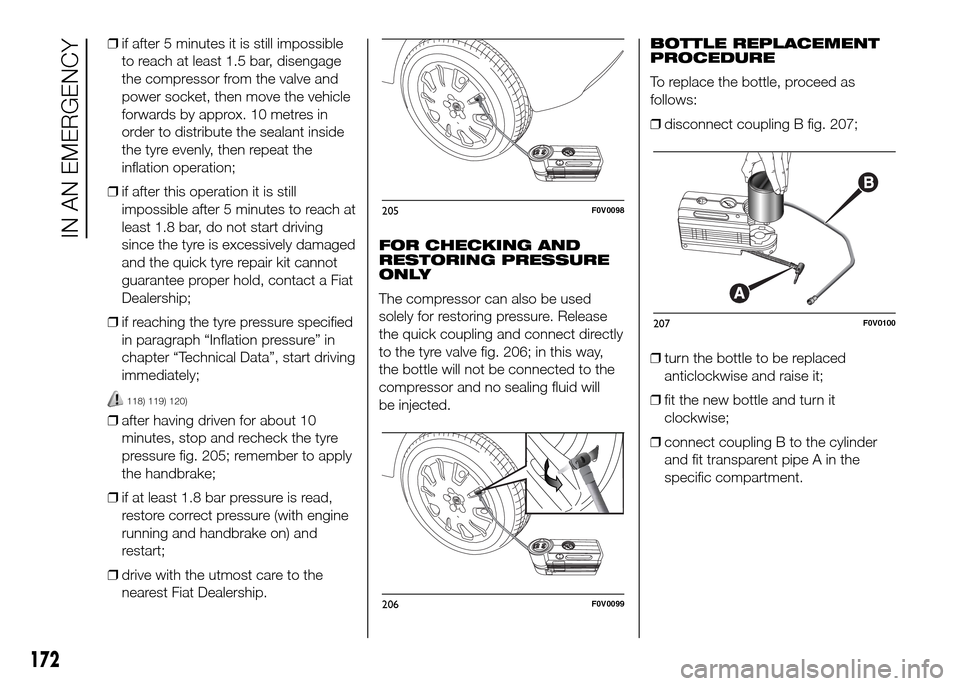
pressure fig. 205; remember to apply
the handbrake;
❒if at least 1.8 bar pressure is read,
restore correct pressure (with engine
running and handbrake on) and
restart;
❒drive with the utmost care to the
nearest Fiat Dealership.FOR CHECKING AND
RESTORING PRESSURE
ONLY
The compressor can also be used
solely for restoring pressure. Release
the quick coupling and connect directly
to the tyre valve fig. 206; in this way,
the bottle will not be connected to the
compressor and no sealing fluid will
be injected.BOTTLE REPLACEMENT
PROCEDURE
To replace the bottle, proceed as
follows:
❒disconnect coupling B fig. 207;
❒turn the bottle to be replaced
anticlockwise and raise it;
❒fit the new bottle and turn it
clockwise;
❒connect coupling B to the cylinder
and fit transparent pipe A in the
specific compartment.
205F0V0098
206F0V0099
207F0V0100
172
IN AN EMERGENCY
Page 186 of 323
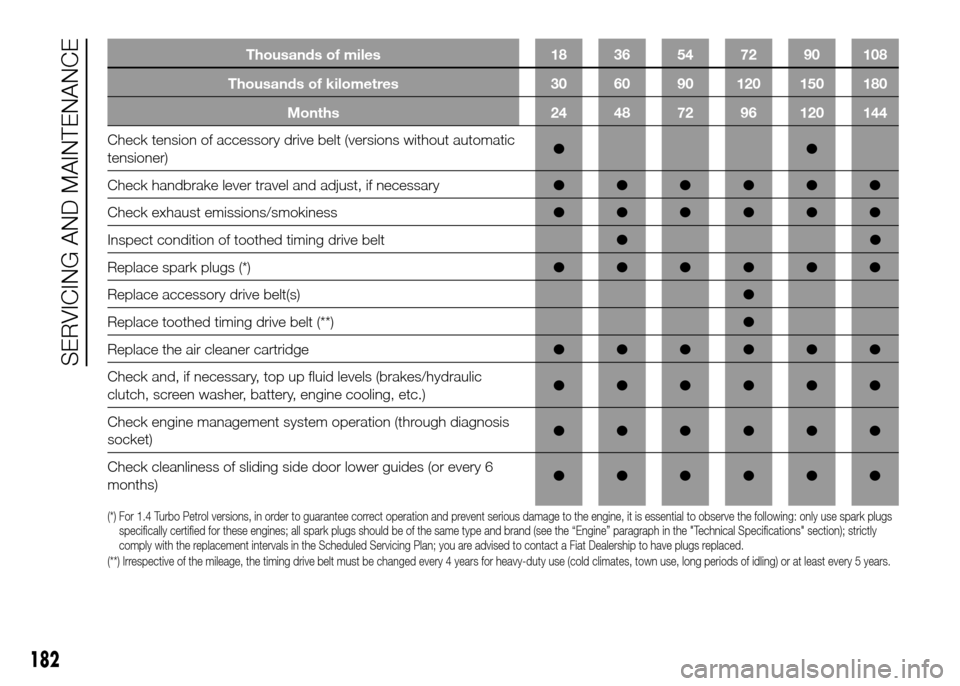
Thousands of miles 18 36 54 72 90 108
Thousands of kilometres 30 60 90 120 150 180
Months 24 48 72 96 120 144
Check tension of accessory drive belt (versions without automatic
tensioner)●●
Check handbrake lever travel and adjust, if necessary●●●●●●
Check exhaust emissions/smokiness●●●●●●
Inspect condition of toothed timing drive belt●●
Replace spark plugs (*)●●●●●●
Replace accessory drive belt(s)●
Replace toothed timing drive belt (**)●
Replace the air cleaner cartridge●●●●●●
Check and, if necessary, top up fluid levels (brakes/hydraulic
clutch, screen washer, battery, engine cooling, etc.)●●●●●●
Check engine management system operation (through diagnosis
socket)●●●●●●
Check cleanliness of sliding side door lower guides (or every 6
months)●●●●●●
(*) For 1.4 Turbo Petrol versions, in order to guarantee correct operation and prevent serious damage to the engine, it is essential to observe the following: only use spark plugs
specifically certified for these engines; all spark plugs should be of the same type and brand (see the “Engine” paragraph in the "Technical Specifications" section); strictly
comply with the replacement intervals in the Scheduled Servicing Plan; you are advised to contact a Fiat Dealership to have plugs replaced.
(**) Irrespective of the mileage, the timing drive belt must be changed every 4 years for heavy-duty use (cold climates, town use, long periods of idling) or at least every 5 years.
182
SERVICING AND MAINTENANCE
Page 189 of 323
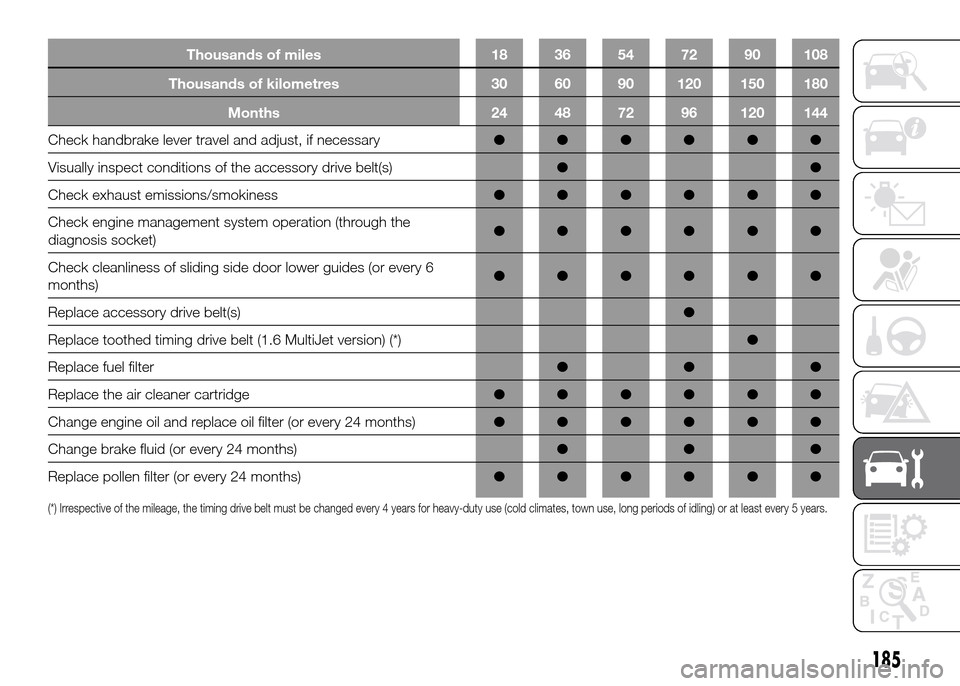
Thousands of miles 18 36 54 72 90 108
Thousands of kilometres 30 60 90 120 150 180
Months 24 48 72 96 120 144
Check handbrake lever travel and adjust, if necessary●●●●●●
Visually inspect conditions of the accessory drive belt(s)●●
Check exhaust emissions/smokiness●●●●●●
Check engine management system operation (through the
diagnosis socket)●●●●●●
Check cleanliness of sliding side door lower guides (or every 6
months)●●●●●●
Replace accessory drive belt(s)●
Replace toothed timing drive belt (1.6 MultiJet version) (*)●
Replace fuel filter●●●
Replace the air cleaner cartridge●●●●●●
Change engine oil and replace oil filter (or every 24 months)●●●●●●
Change brake fluid (or every 24 months)●●●
Replace pollen filter (or every 24 months)●●●●●●
(*) Irrespective of the mileage, the timing drive belt must be changed every 4 years for heavy-duty use (cold climates, town use, long periods of idling) or at least every 5 years.
185
Page 191 of 323
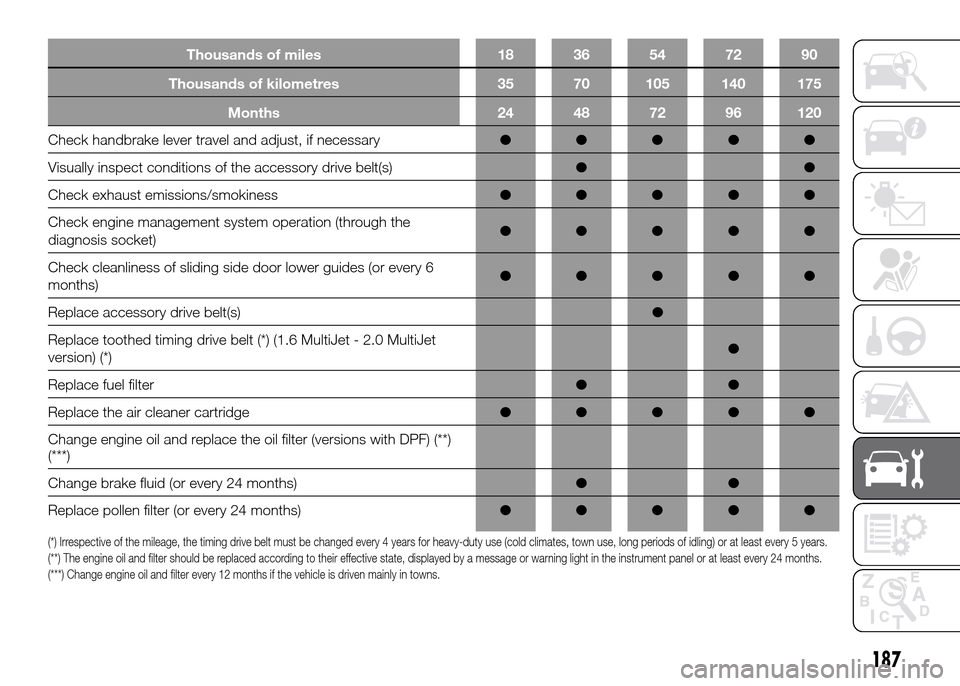
Thousands of miles 18 36 54 72 90
Thousands of kilometres 35 70 105 140 175
Months 24 48 72 96 120
Check handbrake lever travel and adjust, if necessary●●●●●
Visually inspect conditions of the accessory drive belt(s)●●
Check exhaust emissions/smokiness●●●●●
Check engine management system operation (through the
diagnosis socket)●●●●●
Check cleanliness of sliding side door lower guides (or every 6
months)●●●●●
Replace accessory drive belt(s)●
Replace toothed timing drive belt (*) (1.6 MultiJet - 2.0 MultiJet
version) (*)●
Replace fuel filter●●
Replace the air cleaner cartridge●●●●●
Change engine oil and replace the oil filter (versions with DPF) (**)
(***)
Change brake fluid (or every 24 months)●●
Replace pollen filter (or every 24 months)●●●●●
(*) Irrespective of the mileage, the timing drive belt must be changed every 4 years for heavy-duty use (cold climates, town use, long periods of idling) or at least every 5 years.
(**) The engine oil and filter should be replaced according to their effective state, displayed by a message or warning light in the instrument panel orat least every 24 months.
(***) Change engine oil and filter every 12 months if the vehicle is driven mainly in towns.
187
Page 210 of 323
PROLONGED
VEHICLE INACTIVITY
If the vehicle needs to be off the road
for longer than one month, the following
precautions must be taken:
❒park the vehicle indoors in a dry and,
if possible, well-ventilated place;
❒engage a gear and check that the
handbrake is not engaged;
❒disconnect the negative terminal from
the battery pole (see paragraph
“Vehicle inactivity” in the "Dashboard
and controls" chapter) and check
the charge conditions (see paragraph
“Battery” in the “Care and
maintenance” chapter);
❒clean and protect the painted parts
using protective wax;
❒clean and protect the shiny metal
parts using special compounds
available commercially;
❒sprinkle talcum powder on the
windscreen and rear window wiper
rubber blades and lift them off the
glass;
❒slightly open the windows;❒cover the vehicle with a piece of
fabric or perforated plastic sheet. Do
not use compact plastic tarpaulins,
which prevent humidity from
evaporating from the surface of the
vehicle;
❒inflate tyres to +0.5 bar above the
standard specified pressure and
check it at intervals;
❒do not drain the engine cooling
system.
BODYWORK
PROTECTION AGAINST
ATMOSPHERIC AGENTS
The main causes of corrosion are the
following:
❒atmospheric pollution;
❒salty air and humidity (coastal areas,
or hot humid climates);
❒seasonal environmental conditions.
The abrasive action of wind-borne
atmospheric dust and sand, as well as
mud and gravel raised by other cars
is also not to be underestimated.
On your vehicle, Fiat has implemented
the best manufacturing technologies
to effectively protect the bodywork
against corrosion.
These include:
❒painting products and systems which
give the vehicle particular resistance
to corrosion and abrasion;
❒use of galvanised (or pretreated)
sheet metal, with high resistance
to corrosion;
❒spraying the underbody, engine
compartment, wheelhouse internal
parts and other parts with highly
protective wax products;
206
SERVICING AND MAINTENANCE
Page 213 of 323
LEATHER STEERING
WHEEL/GEAR
KNOB/HANDBRAKE
(for versions/markets, where provided)
These components must be cleaned
with mild soap and water only. Never
use alcohol or alcohol-based products.
Read the product label carefully before
using specific products for cleaning
the interiors: make sure the product
does not contain spirits or alcohol-
based substances.
If, when cleaning the windscreen with
special products, window cleaner
accidentally drips onto the leather of
the steering wheel/gear lever
knob/hand brake, wipe away
immediately and then wash the affected
area with mild soap and water.
IMPORTANT Be careful when using a
steering wheel locking device, to avoid
damaging the leather upholstery
through abrasion.
WARNING
143) Never use flammable products,
such as petroleum ether or
modified petrol, to clean the
inside of the vehicle. The
electrostatic charges which are
generated by rubbing during
the cleaning operation may cause
a fire.
144) Do not keep aerosol cans in the
vehicle: they might explode.
Aerosol cans must not be exposed
to a temperature exceeding 50°C.
When the vehicle is exposed to
sunlight, the internal temperature
can greatly exceed this value.
209
Page 319 of 323
INDEX
A
BS .............................................. 106
Accessories purchased by the
owner .......................................... 5
Active safety systems ..................... 106
Advice for preserving the
bodywork..................................... 207
Air cleaner/pollen filter .................... 198
Ashtray .......................................... 64
ASR system ................................... 109
Automatic climate control
system ......................................... 49
Battery .......................................... 199
Battery recharging.......................... 201
Blades ........................................... 202
Bodywork ...................................... 206
Bodywork paint identification
plate............................................. 212
Bodywork version .......................... 214
Bonnet ........................................... 57
Boot............................................... 58
Brake fluid ...................................... 196
Brakes
– specifications ............................ 221
Bump starting ................................ 174
Carrying children safely ................. 115
– child restraint systems ............... 120
Changing a wheel .......................... 166
Chassis marking ............................ 212Child restraint systems
(compliance for use) ..................... 117
Child safety device ......................... 20
Cigar lighter.................................... 64
CO2 emissions............................... 290
Control panel and on-board
instruments .................................. 72
Controls ......................................... 56
Cruise Control ................................ 141
Daytime running lights .................. 34
Dead lock ...................................... 15
Demanding vehicle use .................. 188
Diesel filter ..................................... 199
Diffusers ......................................... 42
Digital display ................................. 75
– Control buttons ......................... 75
– Set-up menu ............................. 75
Dimensions .................................... 231
Dipped headlights .................... 34-155
Direction indicators ................... 34-156
Door mirrors ................................... 32
Doors ............................................. 19
Draining condensation (MultiJet
versions) ...................................... 199
Driver side armrest ......................... 62
Driver's side front airbag ................ 122
Electric windows ........................... 55
– Initialisation................................ 56
Emergency starting ................ 131-174
Engine codes ................................. 214Engine compartment control unit
fuses ............................................ 161
Engine compartment...................... 189
Engine coolant ............................... 196
Engine
– technical specifications.............. 216
Engine marking .............................. 213
Engine oil ....................................... 196
EOBD system ................................ 87
ESC system ................................... 108
Exterior lights ................................. 34
Fastening the tow hook................. 176
Fiat CODE system.......................... 18
Fix&Go automatic quick tyre
repair kit ....................................... 170
Fluids and lubricants ...................... 266
Fog lights ................................. 56-156
Follow Me Home device ................. 35
Follow Me Home ............................ 35
Front airbags .................................. 121
Front bench ................................... 27
Front light clusters .......................... 155
Front roof light ................................ 158
Fuel consumption .......................... 270
Fuel cut-off system......................... 175
Fuses on compartment wired
casing .......................................... 162
Glove compartment ...................... 62
Handbrake.................................... 132