battery FIAT DOBLO PANORAMA 2016 2.G User Guide
[x] Cancel search | Manufacturer: FIAT, Model Year: 2016, Model line: DOBLO PANORAMA, Model: FIAT DOBLO PANORAMA 2016 2.GPages: 323, PDF Size: 25.46 MB
Page 90 of 323

Average speed
This value shows the vehicle's average
speed based on the overall time
elapsed since the start of the new
journey.
Trip time
Time elapsed since the start of the new
journey.
IMPORTANT If there is no information,
the Trip computer displays "----" in
place of the value. When normal
operating conditions are restored, the
counting of the various values is
resumed, without either zeroing the
values displayed prior to the problem,
or starting a new mission.
TRIP control button
The TRIP button is located at the end of
the right stalk fig. 121. With the ignition
key turned to MAR, this button allows
you to view the previously described
values and also zero them to begin
a new journey:
❒brief press to access the various
values displays;
❒long press to reset and then start a
new mission.New mission
This begins after a reset:
❒"manual" resetting by the user, by
pressing the relevant button;
❒“automatic” resetting, when the
distance travelled reaches 3,999.9
km or 9,999.9 km (depending on the
type of display) or when the travel
time reaches 99.59 (99 hours and 59
minutes);
❒after disconnection/reconnection of
the battery.
IMPORTANT The reset operation when
“Trip A” details are being displayed
only resets the information associated
with this function.IMPORTANT The reset operation when
“Trip B” details are being displayed
resets only the information associated
with this function.
Start of journey procedure
With the ignition key in the MAR
position, reset by pressing the TRIP
button and keeping it pressed for more
than 2 seconds.
Exit Trip
You can automatically exit the TRIP
function once all the values have been
displayed or by holding theMENU
button (*) down for more than 1
second.
(*) For versions/markets where
provided.
IMPORTANT
11) The “Trip B” function may be
disabled (see paragraph
“Activating Trip B”). "Range" and
"Instantaneous fuel consumption"
parameters cannot be reset.
121F0V0010
86
KNOWING THE INSTRUMENT PANEL
Page 95 of 323

Warning lights on
panelWhat it means What to do
ENGINE COOLANT TEMPERATURE
TOO HIGH
When the key is turned to MAR, the
warning light switches on but it should
switch off after a few seconds. The warning
light turns on when the engine is
overheated.
The display shows the dedicated message.When driving normally: stop the vehicle, switch off the
engine and check that the water level in the reservoir is
not below the MIN mark. If it is, wait for the engine to
cool down then slowly and carefully open the cap, top
up with coolant and check that the level is between the
MIN and MAX marks on the reservoir. Also check
visually for any fluid leaks. If, when restarting, the
warning light switches on again, contact a Fiat
Dealership.
If the vehicle is used under demanding conditions (e.g.
in high-performance driving): slow down and, if the
warning light stays on, stop the vehicle. Wait for 2 or 3
minutes with the engine running and slightly
accelerated to further favour the coolant circulation.
Then stop the engine. Check that the coolant level is
correct as described above.
IMPORTANT Over demanding routes, it is advisable to
keep the engine on and slightly accelerated for a few
minutes before switching it off.
redLOW BATTERY CHARGE
The warning light comes on when the
ignition key is turned to MAR, but it should
go out as soon as the engine has started
(with the engine running at idle speed a
brief delay before going out is acceptable).If the warning light stays on, contact a Fiat Dealership
immediately.
91
Page 135 of 323
❒do not demand full performance at
first. Wait until the engine coolant
temperature gauge starts moving.
EMERGENCY STARTING
If the instrument panel warning light
stays on steadily, you can perform
an emergency starting by using the
code on the CODE card (see the “In an
emergency” section).
20)
STOPPING THE ENGINE
Turn the ignition key to STOP while the
engine is idling.
IMPORTANT After a taxing drive, you
should allow the engine to “catch
its breath” before turning it off by letting
it idle to allow the temperature in the
engine compartment to fall.
IMPORTANT
17) It is advisable not to demand
maximum performance from
your vehicle (e.g. excessive
acceleration, long distances at
high speeds, excessively intense
braking, etc.) during the initial
period of use.
18) When the engine is off, do not
leave the key turned to MAR to
prevent unnecessary electrical
consumption from draining the
battery.
19) If the indicator flashes for 60
seconds after starting or
during an extended towing period,
this indicates a problem in the
glow plug preheating system.
Use the vehicle normally if the
engine starts, but contact a Fiat
Dealership as soon as possible.
20) Never start the engine by
pushing, towing or driving
downhill. This could cause fuel to
flow into the catalytic converter
and damage it beyond repair.
WARNING
78) It is dangerous to run the engine
in enclosed areas. The engine
takes in oxygen and releases
carbon dioxide, carbon monoxide
and other toxic gases.
131
Page 136 of 323
HANDBRAKE
The handbrake lever is located between
the front seats. Pull the lever upwards
to engage the handbrake and ensure
that the vehicle does not move. The
vehicle should be secured after several
clicks of the lever. If it is not, contact
a Fiat Dealership to have it adjusted.
79)
When the handbrake lever is engaged
and the ignition key is in MAR position,
the instrument panel warning light
will switch on.
Proceed as follows to release the
handbrake:
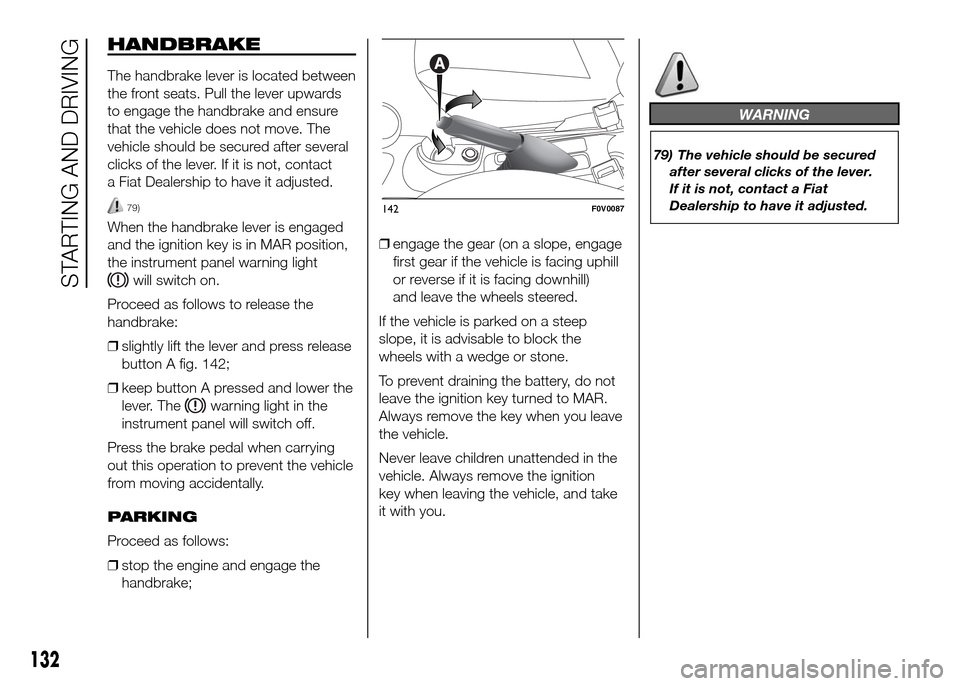
❒slightly lift the lever and press release
button A fig. 142;
❒keep button A pressed and lower the
lever. The
warning light in the
instrument panel will switch off.
Press the brake pedal when carrying
out this operation to prevent the vehicle
from moving accidentally.
PARKING
Proceed as follows:
❒stop the engine and engage the
handbrake;❒engage the gear (on a slope, engage
first gear if the vehicle is facing uphill
or reverse if it is facing downhill)
and leave the wheels steered.
If the vehicle is parked on a steep
slope, it is advisable to block the
wheels with a wedge or stone.
To prevent draining the battery, do not
leave the ignition key turned to MAR.
Always remove the key when you leave
the vehicle.
Never leave children unattended in the
vehicle. Always remove the ignition
key when leaving the vehicle, and take
it with you.
WARNING
79) The vehicle should be secured
after several clicks of the lever.
If it is not, contact a Fiat
Dealership to have it adjusted.
142F0V0087
132
STARTING AND DRIVING
Page 139 of 323
ENGINE STOPPING
FAILURE CONDITIONS
With the device activated, for reasons
of comfort, limiting emissions and
safety, the engine does not stop in
certain conditions, including:
❒engine still cold;
❒particularly cold external
temperatures, if the corresponding
indication is provided;
❒battery not sufficiently charged;
❒particulate filter regeneration in
progress (diesel engines only);
❒driver's door not shut;
❒driver's seat belt not fastened;
❒reverse gear engaged (for example,
for parking manoeuvres);
❒automatic climate control, if a
suitable thermal comfort level has not
yet been reached or MAX-DEF
function activation;
❒during the first period of use, to
initialise the system.
In the above cases, the warning light
flashes fig. 103 and, where available,
there is a message in the display.RESTARTING
CONDITIONS
For reasons of comfort, limiting harmful
emissions and safety purposes, the
power unit can restart automatically
without any action by the driver if
certain conditions are met, including:
❒battery not sufficiently charged;
❒reduced braking system vacuum
(e.g. if the brake pedal is pressed
repeatedly);
❒vehicle in motion (e.g. when driving
on roads with a gradient);
❒stopping the engine through the
Start&Stop system for more than
about three minutes.
❒automatic climate control system for
adjusting the thermal comfort level or
to enable MAX-DEF function.
With a gear engaged, the engine can
be automatically restarted only by
fully depressing the clutch pedal. The
driver is asked to perform this operation
through the warning light flashing in
the instrument panel fig. 103 and,
where provided, the message in the
display.N.B.: If you stall the engine, for example
by releasing off the clutch pedal quickly
when in gear, if the Start&Stop system
is activated, the engine can be
restarted by fully depressing the clutch
pedal or by putting the gear lever into
neutral.
N.B.: If the clutch is not depressed
when the three minutes have elapsed
since the engine was stopped, the
engine can only be restarted using the
key.
SAFETY FUNCTIONS
In engine cut-out conditions through
the Start&Stop system, if the driver
unfastens his/her seat belt and opens
the driver's door or the passenger door,
the engine can be restarted only by
using the key.
The driver is notified of this condition by
a buzzer, through the fig. 144 warning
light flashing in the instrument panel
and, where provided, by a message in
the display.
135
Page 140 of 323
"ENERGY SAVING"
FUNCTION
(for versions/markets, where provided)
If, after the engine has been
automatically restarted, the driver does
not take any action for a period of
about 3 minutes, the Start&Stop
system will definitively stop the engine
to avoid fuel consumption.
The engine can only be started using
the key in such cases. N.B.: In any
case, it is possible to keep the engine
running by deactivating the Start&Stop
system.
IRREGULAR OPERATION
In the case of malfunctions the
Start&Stop system is disabled.
The driver is informed of the problem by
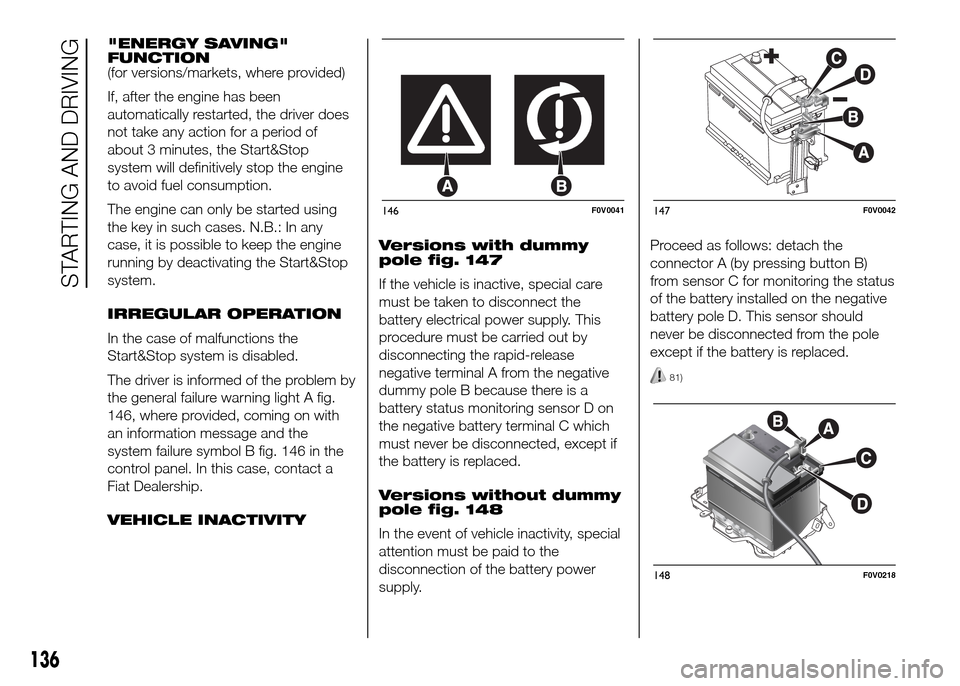
the general failure warning light A fig.
146, where provided, coming on with
an information message and the
system failure symbol B fig. 146 in the
control panel. In this case, contact a
Fiat Dealership.
VEHICLE INACTIVITYVersions with dummy
pole fig. 147
If the vehicle is inactive, special care
must be taken to disconnect the
battery electrical power supply. This
procedure must be carried out by
disconnecting the rapid-release
negative terminal A from the negative
dummy pole B because there is a
battery status monitoring sensor D on
the negative battery terminal C which
must never be disconnected, except if
the battery is replaced.
Versions without dummy
pole fig. 148
In the event of vehicle inactivity, special
attention must be paid to the
disconnection of the battery power
supply.Proceed as follows: detach the
connector A (by pressing button B)
from sensor C for monitoring the status
of the battery installed on the negative
battery pole D. This sensor should
never be disconnected from the pole
except if the battery is replaced.
81)
146F0V0041147F0V0042
148F0V0218
136
STARTING AND DRIVING
Page 141 of 323
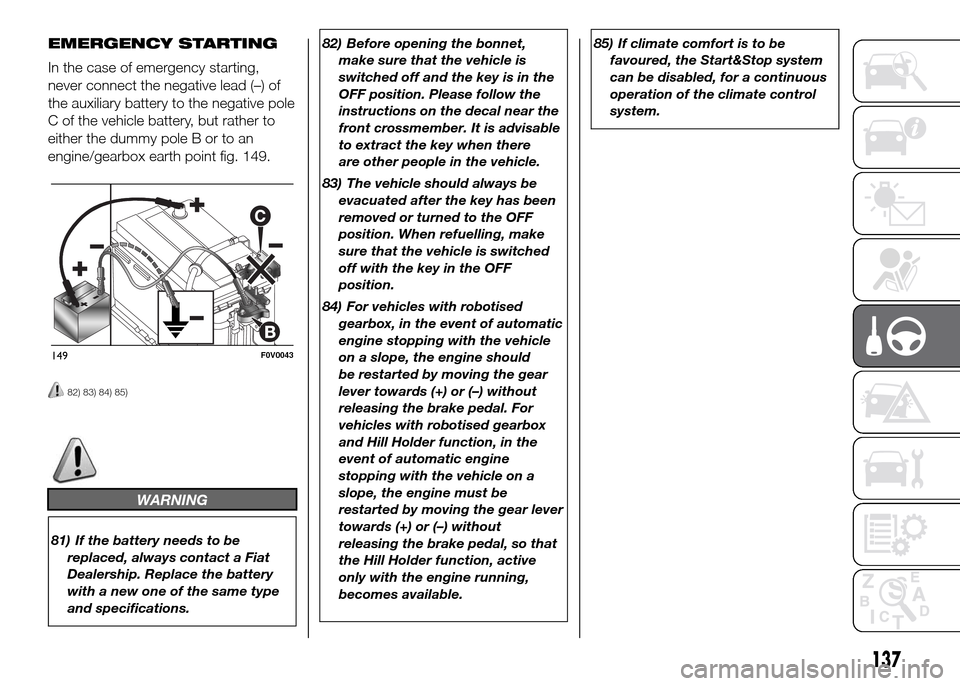
EMERGENCY STARTING
In the case of emergency starting,
never connect the negative lead (–) of
the auxiliary battery to the negative pole
C of the vehicle battery, but rather to
either the dummy pole B or to an
engine/gearbox earth point fig. 149.
82) 83) 84) 85)
WARNING
81) If the battery needs to be
replaced, always contact a Fiat
Dealership. Replace the battery
with a new one of the same type
and specifications.82) Before opening the bonnet,
make sure that the vehicle is
switched off and the key is in the
OFF position. Please follow the
instructions on the decal near the
front crossmember. It is advisable
to extract the key when there
are other people in the vehicle.
83) The vehicle should always be
evacuated after the key has been
removed or turned to the OFF
position. When refuelling, make
sure that the vehicle is switched
off with the key in the OFF
position.
84) For vehicles with robotised
gearbox, in the event of automatic
engine stopping with the vehicle
on a slope, the engine should
be restarted by moving the gear
lever towards (+) or (–) without
releasing the brake pedal. For
vehicles with robotised gearbox
and Hill Holder function, in the
event of automatic engine
stopping with the vehicle on a
slope, the engine must be
restarted by moving the gear lever
towards (+) or (–) without
releasing the brake pedal, so that
the Hill Holder function, active
only with the engine running,
becomes available.85) If climate comfort is to be
favoured, the Start&Stop system
can be disabled, for a continuous
operation of the climate control
system.
149F0V0043
137
Page 165 of 323
105) 106) 107)
To identify the protective fuse, see the
tables on the following pages.
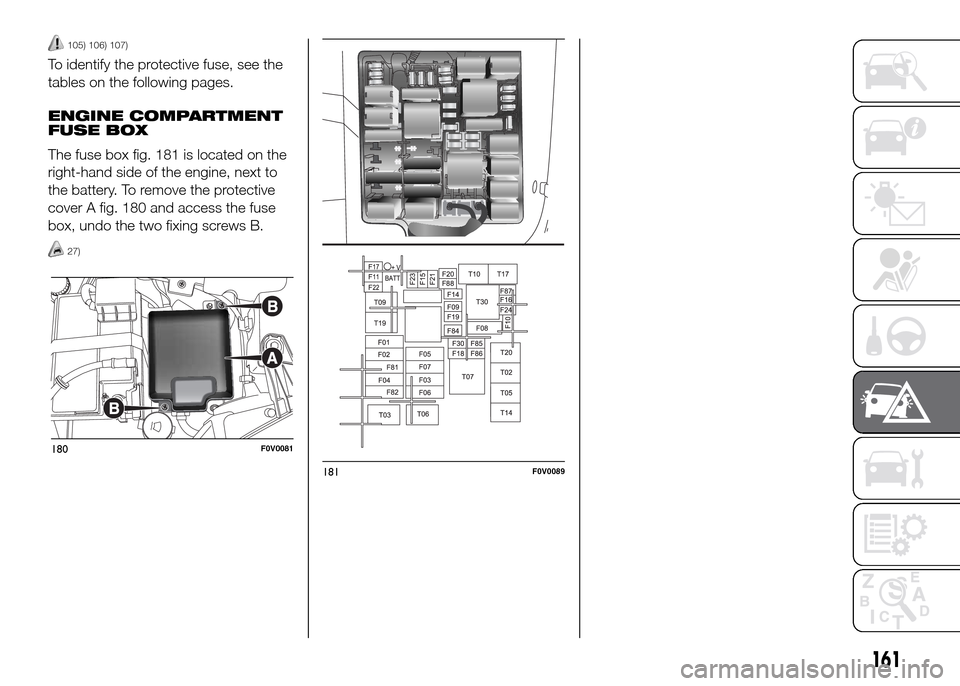
ENGINE COMPARTMENT
FUSE BOX
The fuse box fig. 181 is located on the
right-hand side of the engine, next to
the battery. To remove the protective
cover A fig. 180 and access the fuse
box, undo the two fixing screws B.
27)
180F0V0081
181F0V0089
161
Page 168 of 323

Passenger compartment fuse boxes
fig. 182 - fig. 183
DEVICE PROTECTED FUSE AMPERE
Door locking/unlocking motors, dead lock actuator motors, tailgate unlocking
motorF38 20
Supply + battery for EOBD diagnosis socket, radio, tyre pressure monitoring
control unitF36 10
Windscreen/rear window washer pump F43 15
Electric window motor on passenger-side front door F48 20
Left low beam, headlight corrector F13 7,5
Electric window motor on driver-side front door F47 20
164
IN AN EMERGENCY
Page 178 of 323
IMPORTANT
2) Do not dispose of the can or the
sealing fluid as household waste.
Have them disposed of in
compliance with national and
local regulations.
EMERGENCY
STARTING
Go to a Fiat Dealership immediately if
warning light
stays on constantly on
the instrument panel.
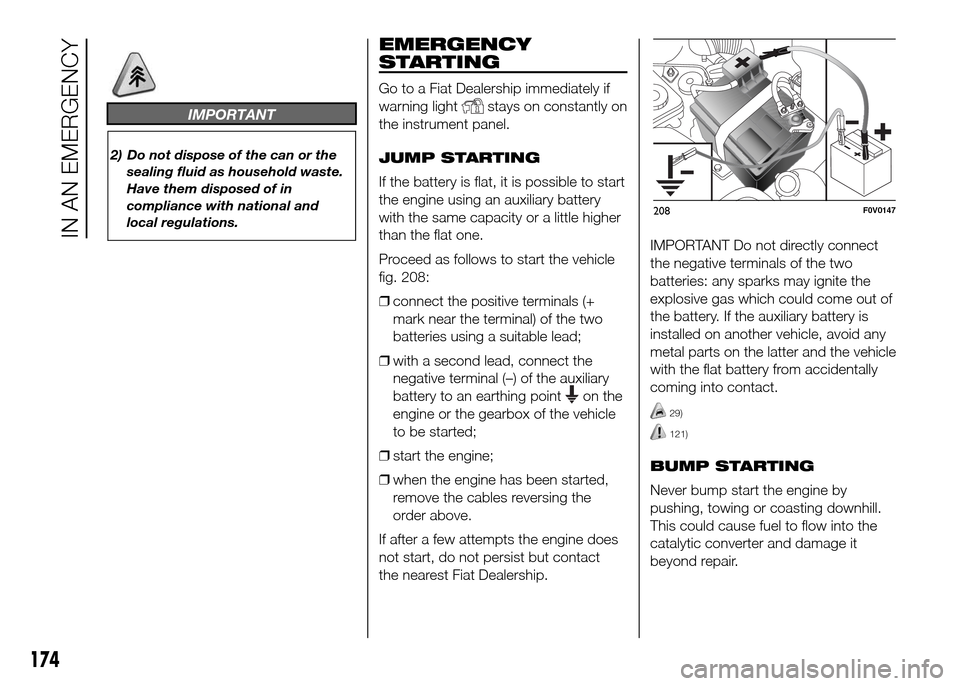
JUMP STARTING
If the battery is flat, it is possible to start
the engine using an auxiliary battery
with the same capacity or a little higher
than the flat one.
Proceed as follows to start the vehicle
fig. 208:
❒connect the positive terminals (+
mark near the terminal) of the two
batteries using a suitable lead;
❒with a second lead, connect the
negative terminal (–) of the auxiliary
battery to an earthing point
on the
engine or the gearbox of the vehicle
to be started;
❒start the engine;
❒when the engine has been started,
remove the cables reversing the
order above.
If after a few attempts the engine does
not start, do not persist but contact
the nearest Fiat Dealership.IMPORTANT Do not directly connect
the negative terminals of the two
batteries: any sparks may ignite the
explosive gas which could come out of
the battery. If the auxiliary battery is
installed on another vehicle, avoid any
metal parts on the latter and the vehicle
with the flat battery from accidentally
coming into contact.29)
121)
BUMP STARTING
Never bump start the engine by
pushing, towing or coasting downhill.
This could cause fuel to flow into the
catalytic converter and damage it
beyond repair.
208F0V0147
174
IN AN EMERGENCY