heating FIAT DOBLO PANORAMA 2016 2.G User Guide
[x] Cancel search | Manufacturer: FIAT, Model Year: 2016, Model line: DOBLO PANORAMA, Model: FIAT DOBLO PANORAMA 2016 2.GPages: 323, PDF Size: 25.46 MB
Page 58 of 323
❒switches on climate control
compressor when climatic conditions
are suitable;
❒sets air recirculation off;
❒sets maximum air temperature HI in
both areas;
❒sets the fan speed according to the
engine coolant temperature to limit
the flow of air that is not sufficiently
warm to demist the windows;
❒directs air flow to windscreen and
front side windows vents;
❒sets heated rear window on.
IMPORTANT The rapid demisting/
defrosting function for the windows
remains on for about 3 minutes from
when the engine coolant reaches the
appropriate temperature for a rapid
demisting of the windows.
When this function is active, the LED on
the corresponding button and the one
on the heated rear window button
switch on. The message FULL AUTO
goes off on the display.
You can only adjust the fan speed and
switch off the heated rear window
manually when this function is active.
To restore the previous operating
conditions, simply press button B, air
recirculation button G, compressor
button F or AUTO button A.Heated rear window and
door mirrors electric
control demisting/
defrosting button (L)
(for versions/markets, where provided)
Push this button to activate the
demisting/defrosting of the heated rear
window and electric door mirrors
When this function is active, the button
LED is on.
This function switches off automatically
after about 20 minutes or when you
push the button again, or when the
engine is turned off. It will not be
switched on automatically when the
engine is restarted.
IMPORTANT Do not affix decals to the
inside of the heated rear window over
the heating filaments, to avoid damage
that might cause them to stop working
properly.
Switching the system
OFF (E)
Press button E to switch the climate
control system off. The display will go
out.With the system off, the climate control
system conditions are as follows:
display off, temperature setting not
display, air recirculation on thereby
insulating the passenger compartment
from the outside (recirculation LED
on), climate control compressor off, fan
off. Press the AUTO button to switch
the climate control system back on
in full automatic mode.
54
KNOW YOUR VEHICLE
Page 75 of 323
KNOWING THE INSTRUMENT PANEL
This section of the booklet gives you all
the information you need to
understand, interpret and use the
instrument panel correctly.CONTROL PANEL AND
ON-BOARD INSTRUMENTS ........... 72
DIGITAL DISPLAY............................ 75
MULTIFUNCTION DISPLAY ............. 78
TRIP COMPUTER ........................... 85
EOBD SYSTEM............................... 87
WARNING LIGHTS AND
MESSAGES .................................... 88
- LOW BRAKE FLUID/HANDBRAKE
ENGAGED .......................................... 88
- EBD FAILURE .................................. 89
- AIRBAG FAILURE ............................. 89
- SEAT BELTS NOT FASTENED .......... 90
- ENGINE COOLANT TEMPERATURE
TOO HIGH .......................................... 91
- LOW BATTERY CHARGE ................. 91
- LOW ENGINE OIL PRESSURE ......... 92
-ENGINE OIL DETERIORATED ........... 92
-LOW ENGINE OIL LEVEL .................. 93
-INCOMPLETE DOOR LOCKING ........ 93
- INJECTION/EOBD SYSTEM
FAILURE ............................................. 94
- ABS FAILURE ................................... 95
-FUEL RESERVE ................................ 95
- GLOW PLUG PREHEATING/GLOW
PLUG PREHEATING FAILURE ............ 96
- WATER IN DIESEL FILTER ................ 96
-VEHICLE PROTECTION SYSTEM
FAILURE - FIAT CODE ........................ 97
- REAR FOG LIGHTS .......................... 97
-GENERIC FAILURE INDICATION ....... 97
-DPF (PARTICULATE FILTER)
CLEANING UNDERWAY ..................... 98
-WORN BRAKE PADS ........................ 99
-ASR SYSTEM DEACTIVATED ............ 99
- TRACTION PLUS SYSTEM
ACTIVATION ....................................... 100- TPMS ............................................... 100
-PARKING SENSOR FAILURE ............ 101
-START&STOP SYSTEM FAILURE ...... 101
- DIPPED BEAM HEADLIGHTS .......... 102
- FOLLOW ME HOME ........................ 102
- LEFT-HAND DIRECTION INDICATOR
............................................................ 103
- RIGHT-HAND DIRECTION
INDICATOR ........................................ 103
-FOG LIGHTS ..................................... 103
- CRUISE CONTROL .......................... 103
- MAIN BEAM HEADLIGHTS .............. 104
71
Page 76 of 323
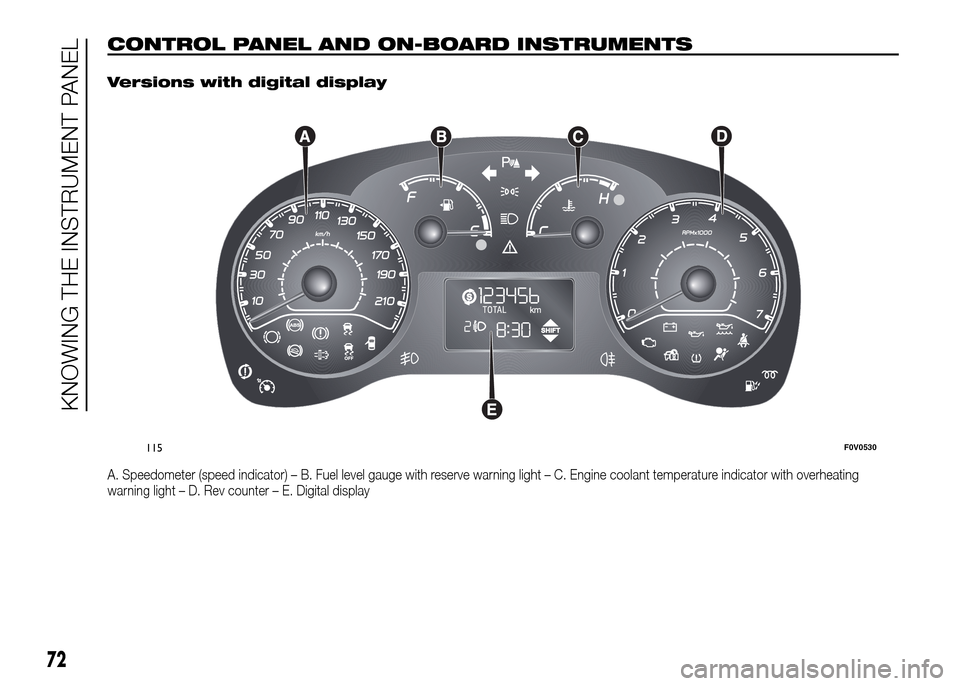
CONTROL PANEL AND ON-BOARD INSTRUMENTS.
Versions with digital display
A. Speedometer (speed indicator) – B. Fuel level gauge with reserve warning light – C. Engine coolant temperature indicator with overheating
warning light – D. Rev counter – E. Digital display
72
KNOWING THE INSTRUMENT PANEL
115F0V0530
Page 77 of 323
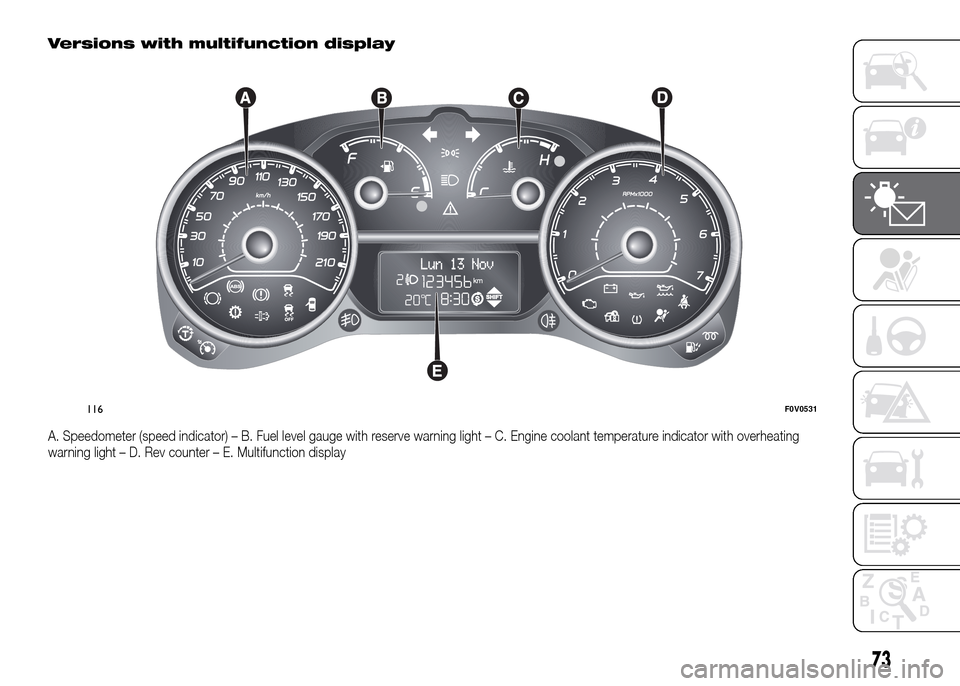
Versions with multifunction display
A. Speedometer (speed indicator) – B. Fuel level gauge with reserve warning light – C. Engine coolant temperature indicator with overheating
warning light – D. Rev counter – E. Multifunction display
73
116F0V0531
Page 100 of 323
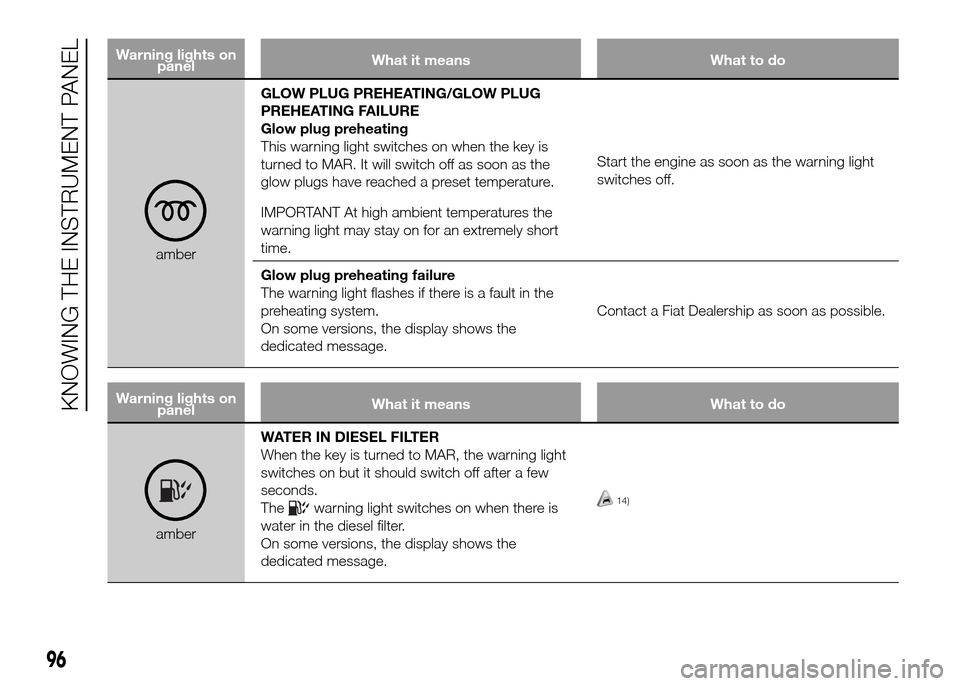
Warning lights on
panelWhat it means What to do
amberGLOW PLUG PREHEATING/GLOW PLUG
PREHEATING FAILURE
Glow plug preheating
This warning light switches on when the key is
turned to MAR. It will switch off as soon as the
glow plugs have reached a preset temperature.
IMPORTANT At high ambient temperatures the
warning light may stay on for an extremely short
time.Start the engine as soon as the warning light
switches off.
Glow plug preheating failure
The warning light flashes if there is a fault in the
preheating system.
On some versions, the display shows the
dedicated message.Contact a Fiat Dealership as soon as possible.
Warning lights on
panelWhat it means What to do
amberWATER IN DIESEL FILTER
When the key is turned to MAR, the warning light
switches on but it should switch off after a few
seconds.
The
warning light switches on when there is
water in the diesel filter.
On some versions, the display shows the
dedicated message.14)
96
KNOWING THE INSTRUMENT PANEL
Page 119 of 323
IMPORTANT
16) Operations which lead to knocks,
vibrations or localised heating
(over 100°C for a maximum of 6
hours) in the area around the
pretensioner may cause damage
or trigger it. This device is not
affected by vibrations caused by
irregularities of the road surface
or low obstacles such as kerbs,
etc. Contact a Fiat Dealership for
any assistance.
CARRYING
CHILDREN SAFELY
For optimal protection in the event of an
impact, all passengers must be seated
and wearing adequate restraint
systems.
This is even more important for
children.
This prescription is compulsory in all EU
countries according to EC Directive
2003/20/EC.
Compared with an adult, a child's head
is larger and heavier in proportion to
their body and the child's muscular and
bone structures are not fully developed.
Therefore, correct restraint systems
other than adult seat belts are
necessary to reduce as much as
possible the risk of injuries in the event
of an accident, braking or a sudden
manoeuvre.
Children must be seated safely and
comfortably.
As far as the characteristics of the child
restraint systems used allow, you are
advised to keep children in rearward
facing child restraint systems for as
long as possible, since this is the most
protected position in the event of an
impact.Several child restraint system types are
available; always choose the one most
suitable for the child.
When over 1.50 m in height, from the
point of view of restraint systems,
children are considered as adults and
wear seat belts normally.
In Europe child restraint systems are
classified, among other criteria, into five
weight groups:
Group Weight range
Group0 upto10kg
Group 0+ up to 13 kg
Group 1 9 - 18 kg
Group 2 15 - 25 kg
Group 3 22 - 36 kg
All restraint devices must bear the
certification data, together with the
control mark, on a label solidly fixed to
the child restraint system which must
never be removed.
Lineaccessori Fiat offers child restraint
systems for each weight group. These
devices are recommended having been
specifically designed for Fiat vehicles.
69)
115
Page 134 of 323
STARTING THE
ENGINE
The vehicle is fitted with an immobiliser:
if the engine fails to start, see the
paragraph on “The Fiat CODE system”
in the “Dashboard and controls”
section.
The engine may be noisier during the
first few seconds of operation,
especially after a long period of
inactivity. This is due to the hydraulic
tappets, the timing system chosen for
petrol engine versions to reduce the
number of servicing interventions, and
affects neither functionality nor reliability.
17) 18)
78)
PROCEDURE FOR
PETROL VERSIONS
Proceed as follows:
❒engage the handbrake;
❒put the gear lever into neutral;
❒fully depress the clutch pedal,
without touching the accelerator;
❒turn the ignition key to AVV and
release it as soon as the engine
starts.If the engine does not start at the first
attempt, return the ignition key to STOP
before repeating the starting procedure.
If, when the ignition key is on MAR,
the instrument panel warning light
remains on together with warning
light
, turn the key to STOP and
then back to MAR; if the warning light
remains on, try the other keys provided
with the vehicle. If you are still unable
to start the engine, perform the
emergency starting procedure (see
"Emergency starting" in the "In an
emergency" chapter) and contact a Fiat
Dealership.
PROCEDURE FOR DIESEL
VERSIONS
Proceed as follows:
❒engage the handbrake;
❒put the gear lever into neutral;
❒turn the ignition key to MAR: the
warning lights
andon
the instrument panel will turn on;
❒wait for the warning lights
and
to switch off. The hotter the
engine is, the quicker this will
happen;
❒fully depress the clutch pedal,
without touching the accelerator;❒turn the ignition key to AVV as soon
as warning light
switches off.
Waiting too long will waste the
heating work carried out by the glow
plugs.
Release the key as soon as the engine
starts.
IMPORTANT With the engine cold, the
accelerator pedal must be fully released
when you turn the ignition key to AVV.
If the engine does not start at the
first attempt, return the ignition key to
STOP before repeating the starting
procedure.
If, when the ignition key is at MAR the
warning light remains lit, turn the
key to STOP and then back to MAR; if
the warning light remains lit, try with the
other keys provided with the vehicle. If
you still cannot start the engine, contact
a Fiat Dealership.
19)
WARMING UP THE
ENGINE JUST AFTER IT
HAS STARTED
Proceed as follows:
❒drive off slowly, letting the engine turn
at medium revs. Do not accelerate
abruptly;
130
STARTING AND DRIVING
Page 135 of 323
❒do not demand full performance at
first. Wait until the engine coolant
temperature gauge starts moving.
EMERGENCY STARTING
If the instrument panel warning light
stays on steadily, you can perform
an emergency starting by using the
code on the CODE card (see the “In an
emergency” section).
20)
STOPPING THE ENGINE
Turn the ignition key to STOP while the
engine is idling.
IMPORTANT After a taxing drive, you
should allow the engine to “catch
its breath” before turning it off by letting
it idle to allow the temperature in the
engine compartment to fall.
IMPORTANT
17) It is advisable not to demand
maximum performance from
your vehicle (e.g. excessive
acceleration, long distances at
high speeds, excessively intense
braking, etc.) during the initial
period of use.
18) When the engine is off, do not
leave the key turned to MAR to
prevent unnecessary electrical
consumption from draining the
battery.
19) If the indicator flashes for 60
seconds after starting or
during an extended towing period,
this indicates a problem in the
glow plug preheating system.
Use the vehicle normally if the
engine starts, but contact a Fiat
Dealership as soon as possible.
20) Never start the engine by
pushing, towing or driving
downhill. This could cause fuel to
flow into the catalytic converter
and damage it beyond repair.
WARNING
78) It is dangerous to run the engine
in enclosed areas. The engine
takes in oxygen and releases
carbon dioxide, carbon monoxide
and other toxic gases.
131
Page 142 of 323
TPMS (Tyre
Pressure
Monitoring System)
(for versions/markets, where provided)
86) 87) 88) 89) 90) 91) 92) 93) 94)
DESCRIPTION
The tyre pressure monitoring system
(TPMS) warns the driver of low tyre
pressure on the basis of the cold
inflation pressure prescribed for the
vehicle.
Changes in outside temperature may
cause tyre pressure to vary. This means
that a decrease in the outside
temperature corresponds to a decrease
in the tyre pressure.
Tyre pressure must always be adjusted
according to the cold inflation pressure.
Cold tyre inflation pressure is the tyre
pressure after letting the vehicle stand
for at least three hours or a travel
shorter than 1.6 km after an interval of
three hours.
The cold tyre inflation pressure must
not exceed the maximum inflation
pressure value printed on the side of
the tyre.The tyre pressure also increases while
driving the vehicle: this is a normal
condition and does not require any
adjustment of the pressure.
NOTE
❒The TPMS does not replace the
normal tyre maintenance service and
does not indicate any fault in a tyre.
❒Therefore, the TPMS should not be
used as pressure switch while
adjusting the tyre inflation pressure.
❒Driving with insufficient tyre pressure
causes their overheating and can
result in tyre failure. The low inflation
pressure reduces fuel efficiency
and tyre tread life and may also affect
handling and braking performance
of the vehicle.
❒The TPMS does not replace the
correct tyre maintenance. It is up to
the driver to maintain the correct tyre
pressure level measuring it with a
suitable pressure switch. This is
necessary even if the decrease in the
inflation pressure value does not
cause the tyre pressure control
warning light to switch on.❒The TPMS warns the driver of any
condition of insufficient tyre pressure
If this drops below the insufficient
pressure limit for any reason including
low temperature and normal
pressure loss of the tyre.
❒The seasonal temperature changes
affect tyre pressure.
The TPMS uses wireless devices with
electronic sensors mounted on the
wheel rims to constantly monitor the
value of tyre pressure. The sensors
mounted on each wheel as part of the
valve stem transmit various information
of the tyres to the receiver module, in
order to calculate the pressure.
IMPORTANT Monitoring and
maintaining the correct pressure in all
four tyres are particularly important.
Tyre pressure
monitoring system low
pressure warning
The system warns the driver if one or
more tyres are flat by switching on
the warning light
on the instrument
panel (together with a warning message
and an acoustic signal).
138
STARTING AND DRIVING
Page 177 of 323
WARNING
112) Give the instruction booklet to
the tyre repair workshop
personnel.
113) Do not use the compressor for
more than 20 consecutive
minutes. Risk of overheating.
Tyres repaired with the quick tyre
repair kit must only be used
temporarily, as the kit is not
suitable for a definitive repair.
114) Punctures on the sides of the
tyre cannot be repaired. Do not
use the quick tyre repair kit if the
damage is due to running with flat
tyre.
115) If the wheel rim has been
damaged (bent so as to cause air
to leak), the wheel may not be
repaired. Do not remove foreign
bodies (screws or nails) from
the tyre.116) The bottle contains ethylene
glycol. It contains latex that might
cause allergic reactions. It is
harmful if swallowed. It is irritant
for the eyes. It may cause
sensitisation if inhaled or on
contact. Avoid contact with eyes,
skin and clothes. In the case of
contact, wash immediately with
plenty of water. In the event that it
is swallowed, do not induce
vomiting. Rinse out your mouth,
drink large quantities of water and
seek immediate medical attention.
Keep out of the reach of children.
The product must not be used
by asthmatics. Do not inhale the
vapours during insertion and
suction. Call a doctor immediately
if allergic reactions are noted.
Store the bottle in the specific
compartment, away from sources
of heat. The sealant has an expiry
date. Replace the bottle if the
sealant has expired.
117) Wear the protective gloves
provided together with the quick
tyre repair kit.118) affix the adhesive label in an
easy-to-see position for the driver
as a reminder that the tyre has
been treated with the quick tyre
repair kit. Drive carefully,
particularly on bends. Do not
exceed 80 km/h. Do not
accelerate or brake suddenly.
119) If the pressure has fallen below
1.8 bar, do not drive any further:
the automatic Fix&Go automatic
quick tyre repair kit cannot
guarantee the correct hold
because the tyre is too damaged.
Contact a Fiat Dealership.
120) Inform the Dealership that the
tyre has been repaired using the
quick tyre repair kit. Give the
booklet to the personnel charged
with handling the treated tyre.
IMPORTANT
28) Punctures caused by foreign
bodies can be repaired if the
damage does not exceed 4 mm on
the tread and on the shoulder of
the tyre.
173