steering FIAT DOBLO PANORAMA 2016 2.G User Guide
[x] Cancel search | Manufacturer: FIAT, Model Year: 2016, Model line: DOBLO PANORAMA, Model: FIAT DOBLO PANORAMA 2016 2.GPages: 323, PDF Size: 25.46 MB
Page 38 of 323
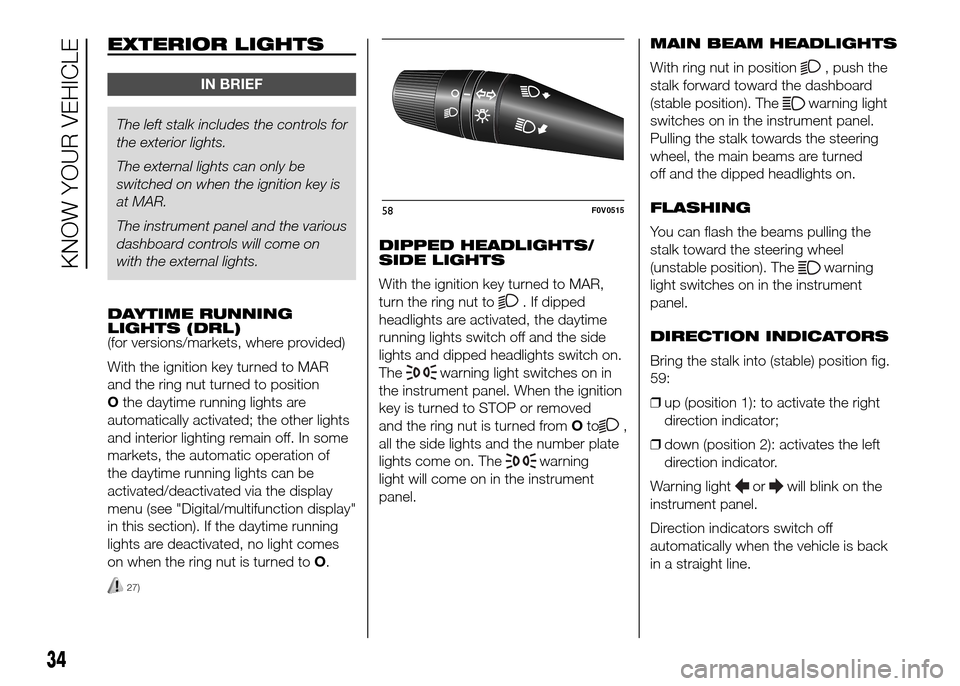
EXTERIOR LIGHTS
IN BRIEF
The left stalk includes the controls for
the exterior lights.
The external lights can only be
switched on when the ignition key is
at MAR.
The instrument panel and the various
dashboard controls will come on
with the external lights.
DAYTIME RUNNING
LIGHTS (DRL)
(for versions/markets, where provided)
With the ignition key turned to MAR
and the ring nut turned to position
Othe daytime running lights are
automatically activated; the other lights
and interior lighting remain off. In some
markets, the automatic operation of
the daytime running lights can be
activated/deactivated via the display
menu (see "Digital/multifunction display"
in this section). If the daytime running
lights are deactivated, no light comes
on when the ring nut is turned toO.
27)
DIPPED HEADLIGHTS/
SIDE LIGHTS
With the ignition key turned to MAR,
turn the ring nut to
. If dipped
headlights are activated, the daytime
running lights switch off and the side
lights and dipped headlights switch on.
The
warning light switches on in
the instrument panel. When the ignition
key is turned to STOP or removed
and the ring nut is turned fromOto
,
all the side lights and the number plate
lights come on. The
warning
light will come on in the instrument
panel.MAIN BEAM HEADLIGHTS
With ring nut in position
, push the
stalk forward toward the dashboard
(stable position). The
warning light
switches on in the instrument panel.
Pulling the stalk towards the steering
wheel, the main beams are turned
off and the dipped headlights on.
FLASHING
You can flash the beams pulling the
stalk toward the steering wheel
(unstable position). The
warning
light switches on in the instrument
panel.
DIRECTION INDICATORS
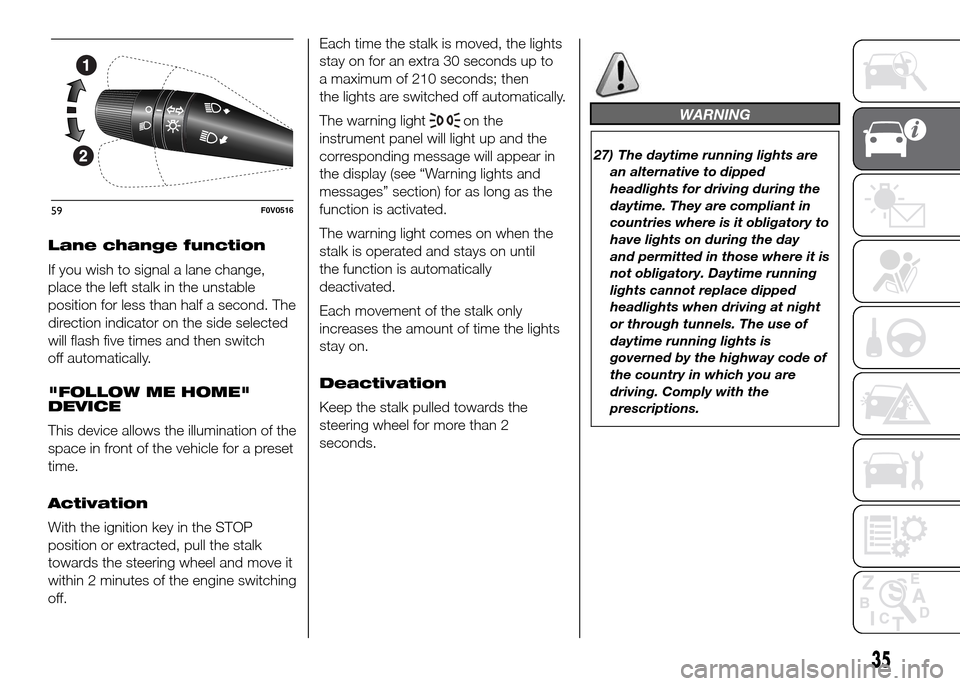
Bring the stalk into (stable) position fig.
59:
❒up (position 1): to activate the right
direction indicator;
❒down (position 2): activates the left
direction indicator.
Warning light
orwill blink on the
instrument panel.
Direction indicators switch off
automatically when the vehicle is back
in a straight line.
58F0V0515
34
KNOW YOUR VEHICLE
Page 39 of 323
Lane change function
If you wish to signal a lane change,
place the left stalk in the unstable
position for less than half a second. The
direction indicator on the side selected
will flash five times and then switch
off automatically.
"FOLLOW ME HOME"
DEVICE
This device allows the illumination of the
space in front of the vehicle for a preset
time.
Activation
With the ignition key in the STOP
position or extracted, pull the stalk
towards the steering wheel and move it
within 2 minutes of the engine switching
off.Each time the stalk is moved, the lights
stay on for an extra 30 seconds up to
a maximum of 210 seconds; then
the lights are switched off automatically.
The warning light
on the
instrument panel will light up and the
corresponding message will appear in
the display (see “Warning lights and
messages” section) for as long as the
function is activated.
The warning light comes on when the
stalk is operated and stays on until
the function is automatically
deactivated.
Each movement of the stalk only
increases the amount of time the lights
stay on.
Deactivation
Keep the stalk pulled towards the
steering wheel for more than 2
seconds.WARNING
27) The daytime running lights are
an alternative to dipped
headlights for driving during the
daytime. They are compliant in
countries where is it obligatory to
have lights on during the day
and permitted in those where it is
not obligatory. Daytime running
lights cannot replace dipped
headlights when driving at night
or through tunnels. The use of
daytime running lights is
governed by the highway code of
the country in which you are
driving. Comply with the
prescriptions.
59F0V0516
35
Page 43 of 323
Roof lights switching on
The front and rear roof lights come on
when one of the front doors or a sliding
side door is opened and they stay on
for 3 minutes if at least one of these
doors continues to remain open.
Roof lights switching off
The front and rear roof lights go out
immediately (with fading), if the key is in
the MAR position when all the front
doors and the sliding side doors are
closed.
The front and rear roof lights go out
after 10 secs. (with fading), if the key is
in the OFF position when all the front
doors and the sliding side doors are
closed.
WINDSCREEN/REAR
WINDOW WIPER
IN BRIEF
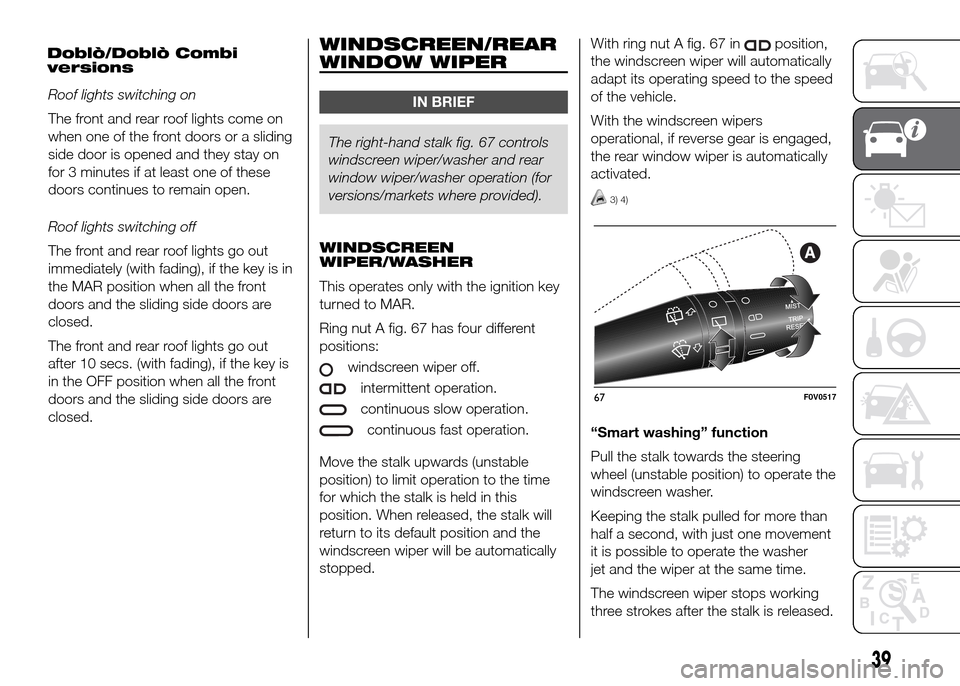
The right-hand stalk fig. 67 controls
windscreen wiper/washer and rear
window wiper/washer operation (for
versions/markets where provided).
WINDSCREEN
WIPER/WASHER
This operates only with the ignition key
turned to MAR.
Ring nut A fig. 67 has four different
positions:
windscreen wiper off.
intermittent operation.
continuous slow operation.
continuous fast operation.
Move the stalk upwards (unstable
position) to limit operation to the time
for which the stalk is held in this
position. When released, the stalk will
return to its default position and the
windscreen wiper will be automatically
stopped.With ring nut A fig. 67 in
position,
the windscreen wiper will automatically
adapt its operating speed to the speed
of the vehicle.
With the windscreen wipers
operational, if reverse gear is engaged,
the rear window wiper is automatically
activated.
3) 4)
“Smart washing” function
Pull the stalk towards the steering
wheel (unstable position) to operate the
windscreen washer.
Keeping the stalk pulled for more than
half a second, with just one movement
it is possible to operate the washer
jet and the wiper at the same time.
The windscreen wiper stops working
three strokes after the stalk is released.
67F0V0517
39
Doblò/Doblò Combi
versions
Page 125 of 323
Below is a summary of
the main safety rules to
be followed when
carrying children:
❒install the child restraint systems on
the rear seat, which is the most
protected position in the event of an
accident;
❒if you need to deactivate the
passenger airbag, always check that
the
warning light above the front
courtesy light is on constantly to
make sure that it has actually been
deactivated;
❒carefully follow the instructions that
came with the child restraint system,
which the manufacturer must supply
by law. Keep the instructions in the
vehicle along with the other papers
and this handbook. Do not install
second-hand child restraint systems
without instructions.
❒always check that the seat belt is well
fastened by pulling on it;
❒only one child is to be strapped into
each restraint system; never carry
two children using one child restraint
system;
❒always check that seat belts do not
rest on the child’s neck;
❒while travelling, do not let the child sit
incorrectly or release the belts;❒never carry children on your lap, even
newborns. No-one can hold a child in
the event of an accident.
❒in the event of an accident, replace
the child restraint system with a
new one.
73)
WARNING
72) Fit the child restraint system only
when the vehicle is stationary.
The child restraint system is
correctly fixed to the brackets
when you hear the click. Follow
the instructions for assembly,
disassembly and positioning that
the Manufacturer must supply
with the child restraint system.
73) When an active passenger
airbag is fitted, DO NOT install
rearward facing child restraint
systems on the front seat. Always
deactivate the passenger airbag
when a rearward facing child
restraint system is installed on the
front passenger seat.
FRONT AIRBAGS
The vehicle is fitted with front airbag for
the driver and, for versions/markets
where provided, front airbag for the
passenger.
FRONT AIRBAGS
The front driver/passenger airbags (for
versions/markets where provided)
have been designed to protect the
front-seat occupants in the event of
head-on crashes of medium-high
severity, by placing the bag between
the occupant and the steering wheel or
dashboard.
Non-activation in other types of crash
(side-on collisions, rear shunts,
roll-overs, etc.) is therefore not a sign of
system malfunction.
An electronic control unit will make the
bag inflate in the event of a frontal
impact.
The bag will inflate instantaneously
placing itself between the front
occupants' body and the structures
which could cause injury. It will deflate
immediately afterwards.
121
Page 126 of 323
Front driver/passenger airbags (for
versions/markets where provided) are
not a replacement for, but rather a
complement to, the seat belts, which
should be worn at all times as specified
by law in Europe and most non-
European countries.
In the event of an impact, those not
wearing a seat belt are projected
forwards, and may come into contact
with the bag which is still inflating.
The protection offered by the cushion is
compromised in such a case.
Front airbags may not activate in the
following situations:
❒frontal impacts against highly
deformable objects not involving the
front surface of the vehicle (e.g.
wing collision against guard rail, etc.);
❒vehicle wedging under other vehicles
or protective barriers (e.g. trucks or
guard rails);
they may not provide any additional
protection compared with seat belts, so
their activation would not be
appropriate. In these cases, non-
deployment does not indicate a system
malfunction.
74)
The driver's and passenger's front
airbags have been designed and
calibrated to protect front seat
occupants wearing seat belts.
At their maximum inflation, their volume
fills most of the space between the
steering wheel and the driver and
between the dashboard and the
passenger.
The airbags are not deployed in the
event of minor front collisions (for which
the restraining action of the seat belts
is sufficient). It is therefore always
necessary to wear seat belts.
DRIVER'S SIDE FRONT
AIRBAG
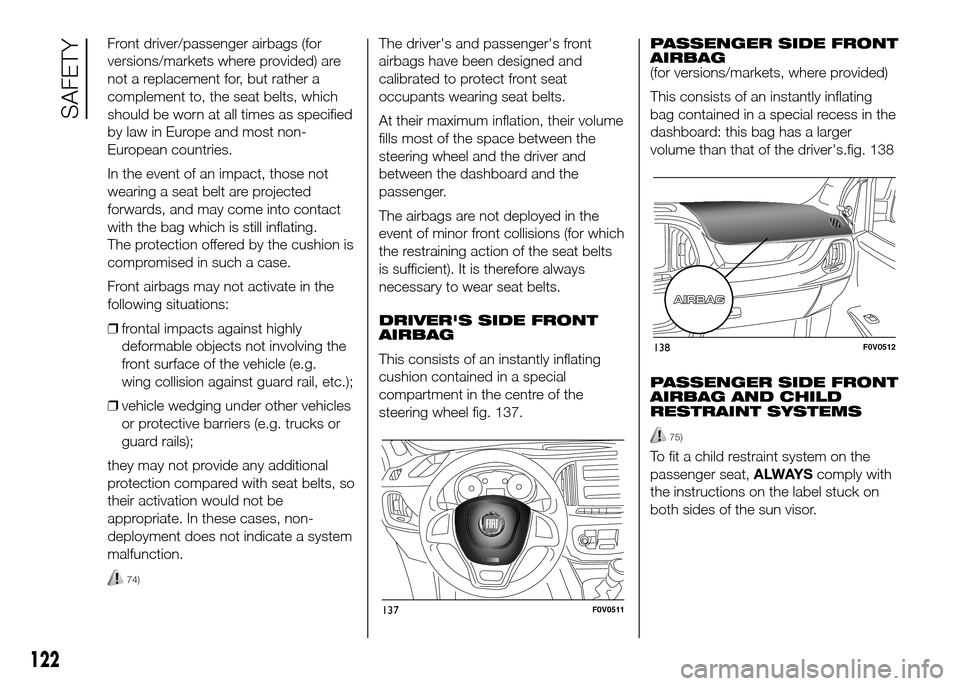
This consists of an instantly inflating
cushion contained in a special
compartment in the centre of the
steering wheel fig. 137.PASSENGER SIDE FRONT
AIRBAG
(for versions/markets, where provided)
This consists of an instantly inflating
bag contained in a special recess in the
dashboard: this bag has a larger
volume than that of the driver's.fig. 138
PASSENGER SIDE FRONT
AIRBAG AND CHILD
RESTRAINT SYSTEMS
75)
To fit a child restraint system on the
passenger seat,ALWAYScomply with
the instructions on the label stuck on
both sides of the sun visor.
137F0V0511
138F0V0512
122
SAFETY
Page 129 of 323
WARNING
74) Do not apply stickers or other objects to the steering wheel, the dashboard in the passenger side airbag area and
the seats. Never put objects (e.g. mobile phones) on the passenger side of the dashboard since they could interfere
with correct inflation of the passenger airbag and also cause serious injury to the passengers.
75) When an active passenger airbag is fitted, DO NOT install rearward facing child restraint systems on the front seat.
Deployment of the airbag in an accident could cause fatal injuries to the child regardless of the severity of the
impact. Therefore, always deactivate the passenger side airbag when a rearward facing child restraint system is
installed on the front passenger seat. The front passenger seat must also be positioned back as far as possible in
order to prevent the child restraint system from coming into contact with the dashboard. Immediately reactivate the
passenger airbag as soon as the child restraint system has been removed.
125
Page 144 of 323
IMPORTANT In all the above-mentioned
cases, it is advisable to check the
spare wheel tyre pressure before
starting driving.
NOTE If the tyres are replaced, driving
the vehicle for short stretches, some
time might be needed before the
system is restored.
IMPORTANT
WARNING
86) The TPMS is optimised for the
original tyres and wheels
provided. TPMS pressures and
alerts have been defined
according to the size of the tyres
mounted on the vehicle. Using
equipment with different size,
type or kind may cause irregular
system operation or sensor
damage. Non-original spare
wheels can damage the sensor.
Do not use tyre sealant or
balancing weights if the vehicle is
equipped with TPMS as these
may damage the sensors.87) If the system signals a pressure
decrease on a specific tyre, it is
recommended to check the
pressure on all four tyres.
88) TPMS does not relieve the driver
from the obligation to check the
tyre pressure every month; it is
not to be considered a replacing
system for maintenance or a
safety system.
89) Tyre pressure must be checked
with tyres cold. Should it become
necessary for whatever reason
to check pressure with warm
tyres, do not reduce pressure
even if it is higher than the
prescribed value, but repeat the
check when tyres are cold.
90) The TPMS cannot indicate
sudden tyre pressure drops (for
example when a tyre bursts).
In this case, stop the vehicle,
braking with caution and avoiding
abrupt steering.
91) The system only warns that the
tyre pressure is low: it is not able
to inflate them.
92) Insufficient tyre inflation
increases fuel consumption,
reduces the tread duration and
may affect the capacity to drive
safely.93) Always refit the valve stem cap
after inspecting or adjusting tyre
pressure. This prevents dampness
or dirt from entering the valve
stem and thus the pressure
control sensor from being
damaged.
94) The tyre repair kit (Fix&Go)
provided with the vehicle (for
versions/markets, where
provided) is compatible with the
TPMS sensors; using sealants not
equivalent with that in the original
kit may adversely affect its
operation. If sealants not
equivalent with the original one
are used, it is recommended to
have the TPMS sensor operation
checked by a qualified repair
centre.
140
STARTING AND DRIVING
Page 169 of 323
DEVICE PROTECTED FUSE AMPERE
Heated driver seat F1 10
Heated passenger seat F2 10
Cigar lighterF3 15
Third power socket on dashboard F4 20
Driver's side rear electric window F5 20
Passenger's side rear electric window F6 20
IMPORTANT
26) Never replace a blown fuse with metal wires or other material.
27) If you need to wash the engine compartment, take care not to directly hit the fuse box and the window wiper motors
with the water jet.
WARNING
105) If the replaced fuse blows again, contact a Fiat Dealership.
106) Never replace a fuse with another with a higher amp rating; DANGER OF FIRE. If a general protection fuse
(MEGA-FUSE, MIDI-FUSE) is activated, contact a Fiat Dealership. Before replacing a fuse, make sure that the ignition
key has been removed and that all the other services are switched off and/or disengaged.
107) Contact a Fiat Dealership if a safety system (airbags, brakes), engine system (engine, gearbox) or steering system
general protection fuse blows.
165
Page 179 of 323
IMPORTANT Remember that the brake
booster and the electric power steering
system are not active until the engine
is started, so you will need to apply
much more force to the brake pedal or
steering wheel.
IMPORTANT
29) Never use a fast battery-charger
for emergency starting of the
engine as this could damage the
electronic systems of your vehicle,
particularly the ignition and fuel
supply control units.
WARNING
121) This procedure must be
performed by qualified personnel
as incorrect actions may cause
high-intensity electrical discharge.
Furthermore, battery fluid is
poisonous and corrosive: avoid
contact with skin and eyes. Keep
naked flames away from the
battery. No smoking. Do not cause
sparks.
FUEL CUT-OFF
SYSTEM
This intervenes in the case of an impact
causing:
❒the fuel supply cut-off with the engine
consequently switching off;
❒the automatic unlocking of the doors;
❒the switching on of the interior lights;
❒switching on of the hazard warning
lights (to deactivate the lights press
the dedicated button on the
dashboard).
122)
When the system has been triggered,
the message “Fuel cut off, see
handbook” is displayed on some
versions.
Check carefully for fuel leaks, for
instance in the engine compartment,
under the vehicle or near the tank area.
After a collision, turn the ignition key
to STOP to prevent the battery from
running down.
The following procedure should be
carried out to restore the correct
operation of the vehicle:
❒turn the ignition key to the MAR
position;
❒activate the right direction indicator;
175
Page 181 of 323
WARNING
123) Before starting towing
operations, turn the ignition key to
MAR and then to STOP, without
extracting it. If the key is
extracted, the steering lock
engages automatically and it is
consequently impossible to steer
the wheels.
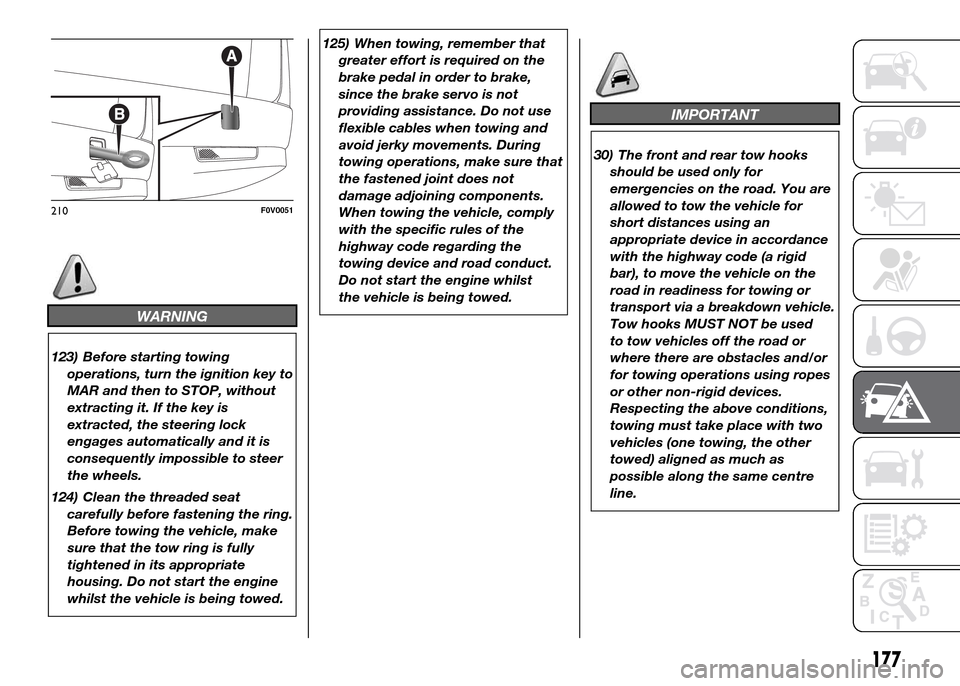
124) Clean the threaded seat
carefully before fastening the ring.
Before towing the vehicle, make
sure that the tow ring is fully
tightened in its appropriate
housing. Do not start the engine
whilst the vehicle is being towed.125) When towing, remember that
greater effort is required on the
brake pedal in order to brake,
since the brake servo is not
providing assistance. Do not use
flexible cables when towing and
avoid jerky movements. During
towing operations, make sure that
the fastened joint does not
damage adjoining components.
When towing the vehicle, comply
with the specific rules of the
highway code regarding the
towing device and road conduct.
Do not start the engine whilst
the vehicle is being towed.
IMPORTANT
30) The front and rear tow hooks
should be used only for
emergencies on the road. You are
allowed to tow the vehicle for
short distances using an
appropriate device in accordance
with the highway code (a rigid
bar), to move the vehicle on the
road in readiness for towing or
transport via a breakdown vehicle.
Tow hooks MUST NOT be used
to tow vehicles off the road or
where there are obstacles and/or
for towing operations using ropes
or other non-rigid devices.
Respecting the above conditions,
towing must take place with two
vehicles (one towing, the other
towed) aligned as much as
possible along the same centre
line.
210F0V0051
177