tow FIAT DOBLO PANORAMA 2016 2.G User Guide
[x] Cancel search | Manufacturer: FIAT, Model Year: 2016, Model line: DOBLO PANORAMA, Model: FIAT DOBLO PANORAMA 2016 2.GPages: 323, PDF Size: 25.46 MB
Page 133 of 323
STARTING AND DRIVING
Let’s get to the "heart" of the vehicle:
seeing how you can exploit all of its
potential to the full.
We’ll look at how to drive it safely in any
situation, so that it can be a welcome
companion, with our comfort and
our wallets in mind.STARTING THE ENGINE .................130
HANDBRAKE ..................................132
USING THE GEARBOX ...................133
START&STOP SYSTEM ..................134
TPMS (TYRE PRESSURE
MONITORING SYSTEM) .................138
SPEED BLOCK ...............................141
CRUISE CONTROL .........................141
TRACTION PLUS SYSTEM .............143
PARKING SENSORS.......................144
REFUELLING THE VEHICLE ...........146
SAVING FUEL .................................147
TOWING TRAILERS ........................149
SNOW TYRES ................................149
SNOW CHAINS...............................150
129
Page 135 of 323
❒do not demand full performance at
first. Wait until the engine coolant
temperature gauge starts moving.
EMERGENCY STARTING
If the instrument panel warning light
stays on steadily, you can perform
an emergency starting by using the
code on the CODE card (see the “In an
emergency” section).
20)
STOPPING THE ENGINE
Turn the ignition key to STOP while the
engine is idling.
IMPORTANT After a taxing drive, you
should allow the engine to “catch
its breath” before turning it off by letting
it idle to allow the temperature in the
engine compartment to fall.
IMPORTANT
17) It is advisable not to demand
maximum performance from
your vehicle (e.g. excessive
acceleration, long distances at
high speeds, excessively intense
braking, etc.) during the initial
period of use.
18) When the engine is off, do not
leave the key turned to MAR to
prevent unnecessary electrical
consumption from draining the
battery.
19) If the indicator flashes for 60
seconds after starting or
during an extended towing period,
this indicates a problem in the
glow plug preheating system.
Use the vehicle normally if the
engine starts, but contact a Fiat
Dealership as soon as possible.
20) Never start the engine by
pushing, towing or driving
downhill. This could cause fuel to
flow into the catalytic converter
and damage it beyond repair.
WARNING
78) It is dangerous to run the engine
in enclosed areas. The engine
takes in oxygen and releases
carbon dioxide, carbon monoxide
and other toxic gases.
131
Page 141 of 323
EMERGENCY STARTING
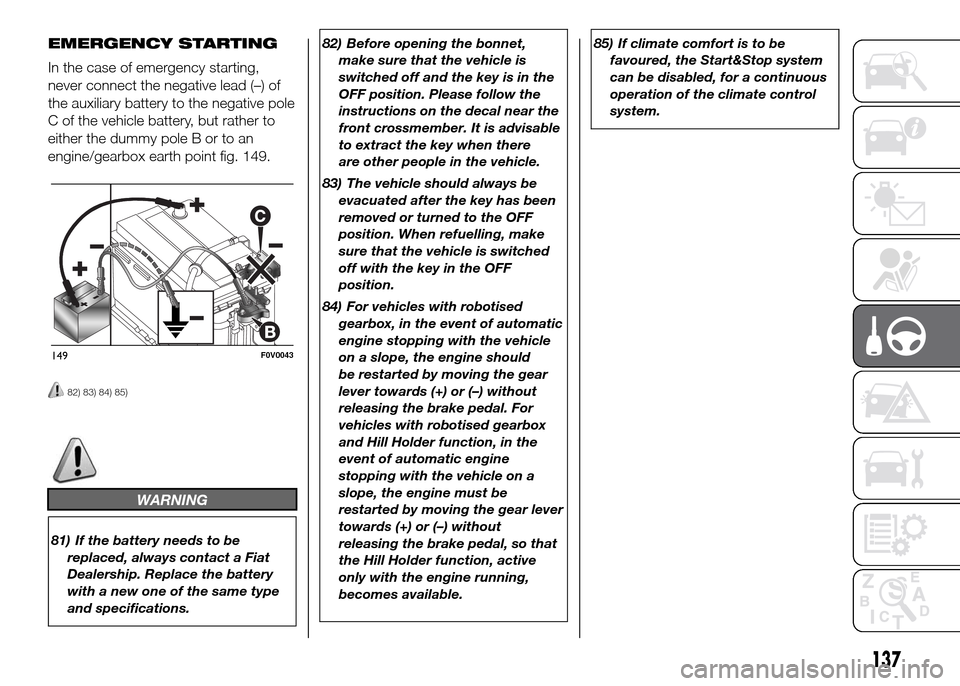
In the case of emergency starting,
never connect the negative lead (–) of
the auxiliary battery to the negative pole
C of the vehicle battery, but rather to
either the dummy pole B or to an
engine/gearbox earth point fig. 149.
82) 83) 84) 85)
WARNING
81) If the battery needs to be
replaced, always contact a Fiat
Dealership. Replace the battery
with a new one of the same type
and specifications.82) Before opening the bonnet,
make sure that the vehicle is
switched off and the key is in the
OFF position. Please follow the
instructions on the decal near the
front crossmember. It is advisable
to extract the key when there
are other people in the vehicle.
83) The vehicle should always be
evacuated after the key has been
removed or turned to the OFF
position. When refuelling, make
sure that the vehicle is switched
off with the key in the OFF
position.
84) For vehicles with robotised
gearbox, in the event of automatic
engine stopping with the vehicle
on a slope, the engine should
be restarted by moving the gear
lever towards (+) or (–) without
releasing the brake pedal. For
vehicles with robotised gearbox
and Hill Holder function, in the
event of automatic engine
stopping with the vehicle on a
slope, the engine must be
restarted by moving the gear lever
towards (+) or (–) without
releasing the brake pedal, so that
the Hill Holder function, active
only with the engine running,
becomes available.85) If climate comfort is to be
favoured, the Start&Stop system
can be disabled, for a continuous
operation of the climate control
system.
149F0V0043
137
Page 145 of 323
SPEED BLOCK
(for versions/markets, where provided)
The vehicle is equipped with a speed
limitation function that can be set at the
user's request to one of four predefined
values: 90, 100, 110, 130 km/h.
To activate/deactivate this function,
contact a Fiat Dealership.
Following the operation, a sticker will be
applied to the windscreen showing the
top speed setting.
IMPORTANT The speedometer could
indicate a higher maximum speed than
the effective one, set by the Dealership,
in accordance with the regulations in
force.
CRUISE CONTROL
(for versions/markets, where provided)
IN BRIEF
This is an electronic driving aid that
allows you to drive at a speed of
above 30 km/h on long and straight
dry roads (e.g. motorways) with
few driving changes at a preset
speed without having to press the
accelerator pedal. It is therefore not
recommended to use this device
on extra-urban roads with traffic. Do
not use it in town.
Activating the device
When the device is activated, warning
light
comes on together with the
relevant message in the instrument
panel (for versions/markets where
provided).
The speed adjustment function cannot
be activated in 1st or reverse gear; it
is advisable to activate the function
in 4th or higher gears.
When travelling downhill with the device
activated, the vehicle speed may
exceed the memorised one.
95) 96)
Storing vehicle speed
Proceed as follows:
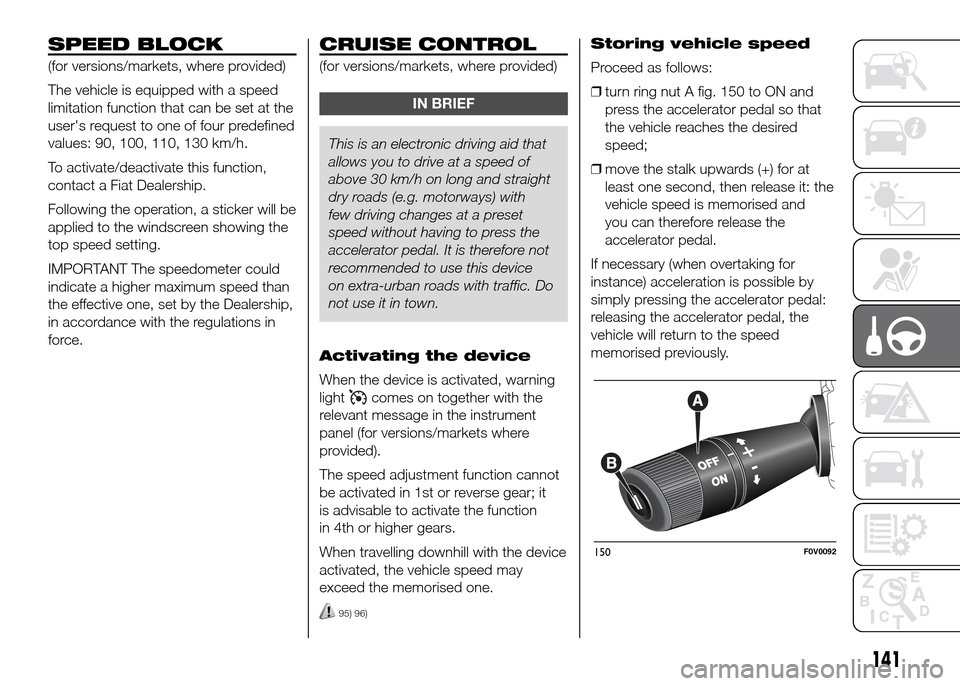
❒turn ring nut A fig. 150 to ON and
press the accelerator pedal so that
the vehicle reaches the desired
speed;
❒move the stalk upwards (+) for at
least one second, then release it: the
vehicle speed is memorised and
you can therefore release the
accelerator pedal.
If necessary (when overtaking for
instance) acceleration is possible by
simply pressing the accelerator pedal:
releasing the accelerator pedal, the
vehicle will return to the speed
memorised previously.
150F0V0092
141
Page 148 of 323
PARKING SENSORS
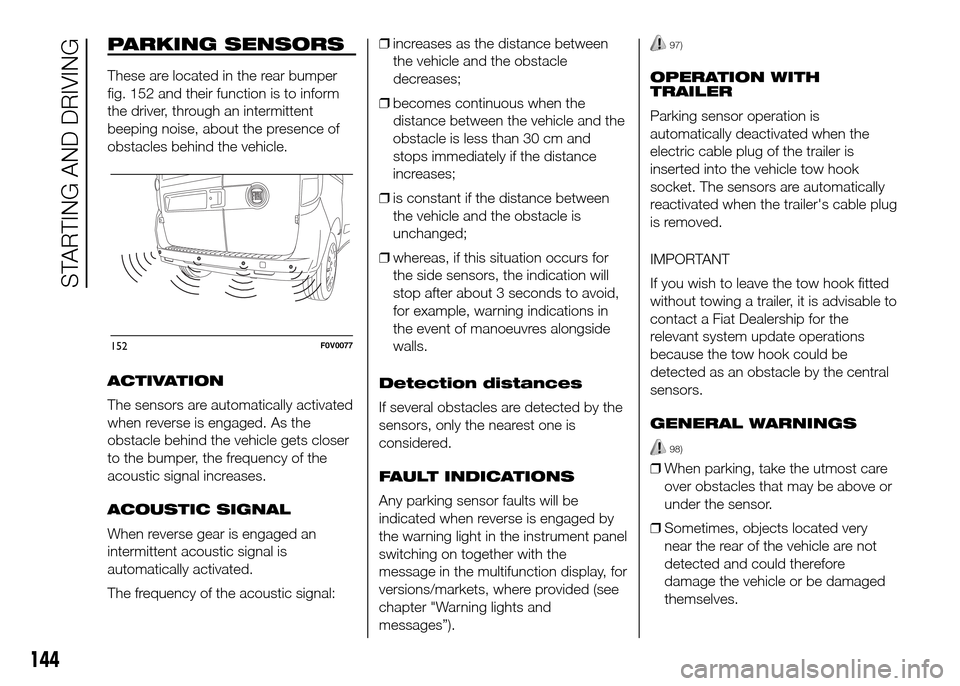
These are located in the rear bumper
fig. 152 and their function is to inform
the driver, through an intermittent
beeping noise, about the presence of
obstacles behind the vehicle.
ACTIVATION
The sensors are automatically activated
when reverse is engaged. As the
obstacle behind the vehicle gets closer
to the bumper, the frequency of the
acoustic signal increases.
ACOUSTIC SIGNAL
When reverse gear is engaged an
intermittent acoustic signal is
automatically activated.
The frequency of the acoustic signal:❒increases as the distance between
the vehicle and the obstacle
decreases;
❒becomes continuous when the
distance between the vehicle and the
obstacle is less than 30 cm and
stops immediately if the distance
increases;
❒is constant if the distance between
the vehicle and the obstacle is
unchanged;
❒whereas, if this situation occurs for
the side sensors, the indication will
stop after about 3 seconds to avoid,
for example, warning indications in
the event of manoeuvres alongside
walls.
Detection distances
If several obstacles are detected by the
sensors, only the nearest one is
considered.
FAULT INDICATIONS
Any parking sensor faults will be
indicated when reverse is engaged by
the warning light in the instrument panel
switching on together with the
message in the multifunction display, for
versions/markets, where provided (see
chapter "Warning lights and
messages”).
97)
OPERATION WITH
TRAILER
Parking sensor operation is
automatically deactivated when the
electric cable plug of the trailer is
inserted into the vehicle tow hook
socket. The sensors are automatically
reactivated when the trailer's cable plug
is removed.
IMPORTANT
If you wish to leave the tow hook fitted
without towing a trailer, it is advisable to
contact a Fiat Dealership for the
relevant system update operations
because the tow hook could be
detected as an obstacle by the central
sensors.
GENERAL WARNINGS
98)
❒When parking, take the utmost care
over obstacles that may be above or
under the sensor.
❒Sometimes, objects located very
near the rear of the vehicle are not
detected and could therefore
damage the vehicle or be damaged
themselves.
152F0V0077
144
STARTING AND DRIVING
Page 151 of 323
23)
IMPORTANT
22) For diesel engines, use only
diesel fuel for motor vehicles
in accordance with EN590
European specifications. The use
of other products or mixtures
may damage the engine beyond
repair and consequently invalidate
the warranty, due to the damage
caused. If you accidentally refuel
with another type of fuel, do not
start the engine, and drain the
tank. If the engine has run, even
for a very short time, you will need
to have the entire fuel supply
system emptied in addition to the
tank.
23) Do not bring naked flames or lit
cigarettes near the fuel tank filler:
fire risk. Keep your face away
from the fuel filler to prevent
breathing in harmful vapours.
SAVING FUEL
Some useful tips are given below for
fuel saving and reducing harmful
emissions of CO2 and other pollutants
(nitrogen oxides, unburnt
hydrocarbons, Particulate Matter (PM),
etc.).
PRACTICAL ADVICE FOR
REDUCING FUEL
CONSUMPTION AND
HARMFUL EMISSIONS
Vehicle conditions
❒Have checks and adjustments for
vehicle maintenancecarried out
in accordance with the “Scheduled
servicing plan”.
❒Checktyrepressure regularly, at
least once every four weeks.
Excessively low pressures will
increase consumption because
rolling resistance will be higher. In
addition, this wears the tyre more
quickly and impairs performance.
❒Only usesnow tyreswhen
the weather conditions make them
absolutely necessary. They increase
consumption and noise.❒Do not travel witha heavy load: the
weight of the vehicle (especially when
driving in town) and its geometry
greatly affect fuel consumption and
stability.
❒Removeroof racks or ski racks
after use. These accessories reduce
the vehicle's aerodynamic
penetration and have a negative
effect on fuel consumption.
❒When transporting particularly large
objects, use atrailerif possible.
❒Use the vehicle's air vents if possible:
travelling with the windows open
impairs aerodynamics.
❒Use electrical devices only for the
amount of time needed. The vehicle’s
heated rear window, additional
headlights, screen wipers and heater
fan require a considerable amount
of energy; this increases fuel
consumption (by up to +25% in an
urban cycle).
❒Air conditioning leads to higher fuel
consumption (on average up to
+30%). If the temperature outside is
not too extreme, try and use the
air vents.
147
Page 153 of 323
TOWING TRAILERS
IMPORTANT
The vehicle must be equipped with a
type-approved tow hook and adequate
electrical system to tow trailers.
Installation should be carried out by
specialised personnel who will issue the
required papers for travelling on roads.
Install any specific and/or additional
door mirrors as specified by the
Highway Code.
Remember that when towing a trailer,
steep hills are harder to climb, braking
spaces increase and overtaking takes
longer depending on the overall weight.
Engage a low gear when driving
downhill, rather than constantly using
the brake.
The weight of the trailer on the vehicle
tow hook will reduce the loading
capacity of the vehicle by the same
amount.
To make sure that the maximum
towable weight is not exceeded (given
in the vehicle registration document)
account should be taken of the fully
laden trailer, including accessories and
luggage.Do not exceed the speed limits specific
to each country you are driving in, in
the case of vehicles towing trailers.
In any case, the top speed must not
exceed 80 km/h.
99) 100)
WARNING
99) The ABS device with which the
vehicle is equipped will not
control the braking system of the
trailer. Particular caution is
required on slippery roads.
100) Never modify the braking
system of the vehicle to control
the trailer brake. The trailer
braking system must be fully
independent from the hydraulic
system of the vehicle.
SNOW TYRES
Fiat Dealerships will be happy to
provide advice concerning the most
suitable type of tyres for the customer's
requirements.
For the type of tyre to be used, inflation
pressures and the specifications of
snow tyres, follow the instructions given
in the "Wheels" paragraph of the
"Technical specifications" section.
The winter features of these tyres are
reduced considerably when the tread
depth is below 4 mm. Replace them in
this case.
Due to snow tyre characteristics, under
normal conditions of use or on long
motorway journeys, the performance of
these tyres is lower than that of
standard tyres. Limit performance
according to the use for which they
were approved.
IMPORTANT When using snow tyres
with a maximum speed index below the
one that can be reached by the vehicle
(increased by 5%), place a notice in
the passenger compartment, plainly in
view, which states the maximum speed
allowed by the snow tyres (as per EC
Directive).
149
Page 155 of 323
IN AN EMERGENCY
A punctured tyre or a burnt-out bulb?
At times, a problem may interfere
with our journey.
The pages on emergencies can help
you to deal with critical situations
independently and with calm.
In an emergency we recommend that
you call the freephone number found in
the Warranty Booklet.
It is also possible to call the 00 800
3428 0000 freephone number to
search the nearest Fiat Dealership.HAZARD WARNING LIGHTS...........152
REPLACING A BULB ......................152
REPLACING AN EXTERIOR BULB ..155
REPLACING AN INTERIOR BULB ...158
REPLACING FUSES........................160
CHANGING A WHEEL ....................166
FIX&GO AUTOMATIC QUICK TYRE
REPAIR KIT .....................................170
EMERGENCY STARTING ................174
FUEL CUT-OFF SYSTEM ................175
LIFTING THE VEHICLE....................176
TOWING THE VEHICLE ..................176
151
Page 178 of 323
IMPORTANT
2) Do not dispose of the can or the
sealing fluid as household waste.
Have them disposed of in
compliance with national and
local regulations.
EMERGENCY
STARTING
Go to a Fiat Dealership immediately if
warning light
stays on constantly on
the instrument panel.
JUMP STARTING
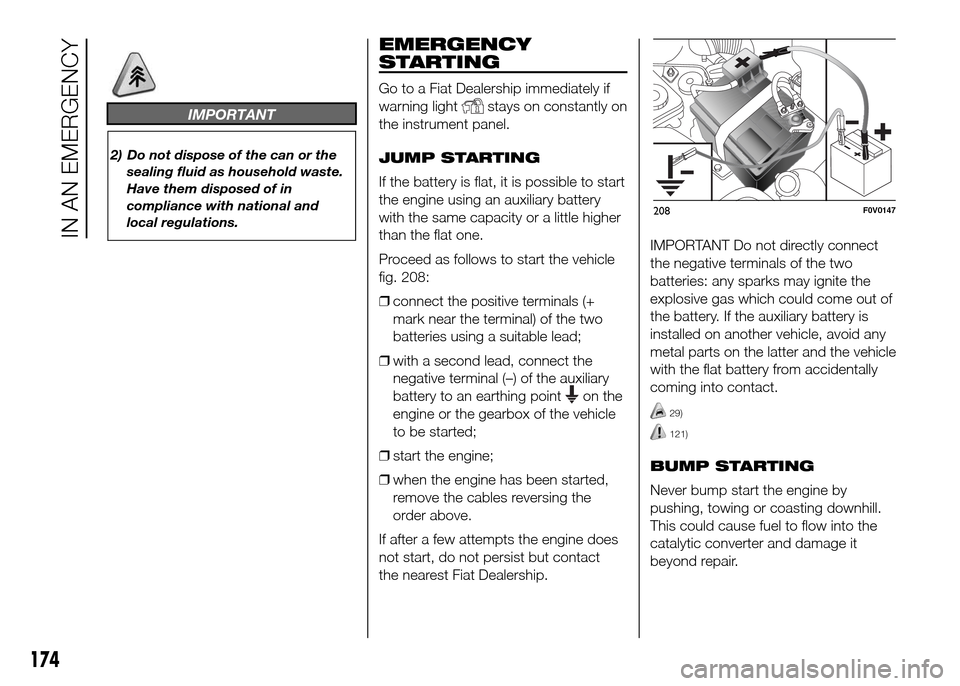
If the battery is flat, it is possible to start
the engine using an auxiliary battery
with the same capacity or a little higher
than the flat one.
Proceed as follows to start the vehicle
fig. 208:
❒connect the positive terminals (+
mark near the terminal) of the two
batteries using a suitable lead;
❒with a second lead, connect the
negative terminal (–) of the auxiliary
battery to an earthing point
on the
engine or the gearbox of the vehicle
to be started;
❒start the engine;
❒when the engine has been started,
remove the cables reversing the
order above.
If after a few attempts the engine does
not start, do not persist but contact
the nearest Fiat Dealership.IMPORTANT Do not directly connect
the negative terminals of the two
batteries: any sparks may ignite the
explosive gas which could come out of
the battery. If the auxiliary battery is
installed on another vehicle, avoid any
metal parts on the latter and the vehicle
with the flat battery from accidentally
coming into contact.29)
121)
BUMP STARTING
Never bump start the engine by
pushing, towing or coasting downhill.
This could cause fuel to flow into the
catalytic converter and damage it
beyond repair.
208F0V0147
174
IN AN EMERGENCY
Page 180 of 323
❒deactivate the right direction
indicator;
❒activate the left direction indicator;
❒deactivate the left direction indicator;
❒activate the right direction indicator;
❒deactivate the right direction
indicator;
❒activate the left direction indicator;
❒deactivate the left direction indicator;
❒turn the ignition key to the OFF
position.
WARNING
122) If, after an impact, you smell
fuel or notice leaks from the fuel
supply system, do not reactivate
the system to avoid the risk of fire.
LIFTING THE
VEHICLE
If the vehicle needs to be lifted, go to a
Fiat Dealership which is equipped
with the arm hoist or workshop lift.
TOWING THE
VEHICLE
The tow ring provided with the vehicle
is located in the tool box behind the left
seat backrest (Cargo versions) or in
the boot (Doblò / Doblò Combi
versions).
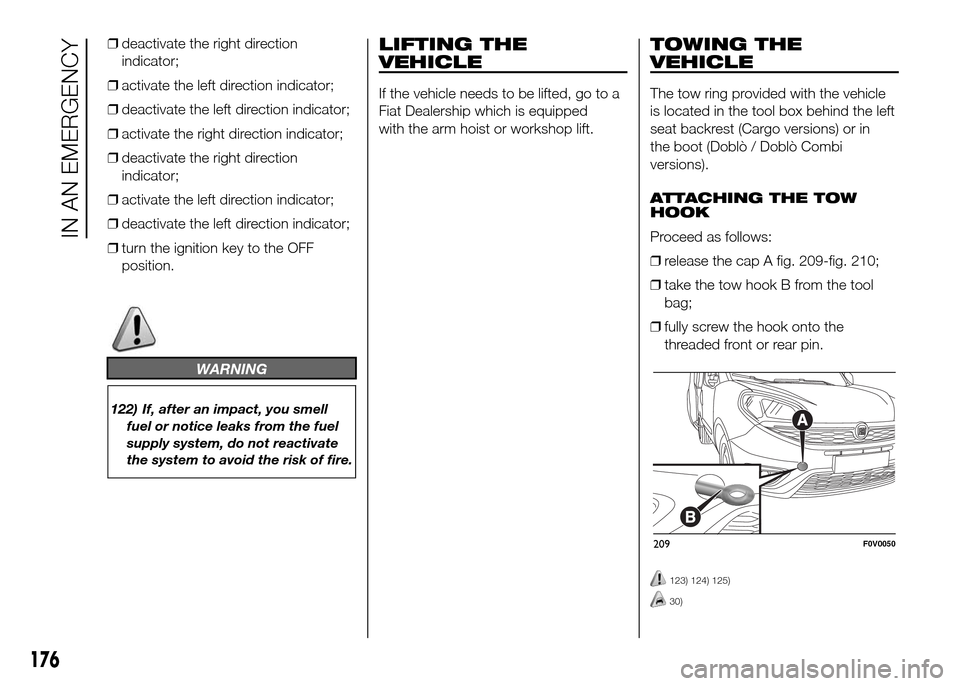
ATTACHING THE TOW
HOOK
Proceed as follows:
❒release the cap A fig. 209-fig. 210;
❒take the tow hook B from the tool
bag;
❒fully screw the hook onto the
threaded front or rear pin.
123) 124) 125)
30)
209F0V0050
176
IN AN EMERGENCY