ABS FIAT DOBLO PANORAMA 2016 2.G Owner's Manual
[x] Cancel search | Manufacturer: FIAT, Model Year: 2016, Model line: DOBLO PANORAMA, Model: FIAT DOBLO PANORAMA 2016 2.GPages: 323, PDF Size: 25.46 MB
Page 204 of 323
The battery is also more prone to the
risk of freezing (already at temperatures
of -10°C). Refer to the paragraph
"Vehicle inactivity" in "Starting and
driving" if the vehicle is left parked for a
long time.
If, after buying the vehicle, you want to
install electric accessories which require
permanent electric supply (alarm, etc.)
contact a Fiat Dealership whose
qualified personnel, in addition to
suggesting the most suitable devices
from the Lineaccessori Fiat, will
evaluate the overall electric absorption,
checking whether the vehicle's
electrical system is capable of
withstanding the load required, or
whether it should be integrated with a
more powerful battery.
Since some of these devices continue
to consume electricity even when
the engine is off, they gradually run
down the battery.
WARNING
133) Battery fluid is poisonous and
corrosive. Avoid contact with
skin and eyes. Keep naked flames
or possible sources of sparks
away from the battery: risk
of explosion or fire.
134) Using the battery when the fluid
is too low can damage it
irreparably and generate a risk of
explosion.
135) When performing any operation
on the battery or near it, always
protect your eyes with special
goggles.
IMPORTANT
37) Incorrect assembly of electrical
and electronic devices may cause
severe damage to your vehicle.
Contact a Fiat Dealership if you
want to install accessories
(alarms, radiophone, etc.): they
will suggest the most suitable
devices and advise you if a higher
capacity battery needs to be
installed.
38) If the vehicle needs to be off the
road for a long period under
conditions of intense cold, remove
the battery and take it to a
heated location, otherwise it may
freeze.
200
SERVICING AND MAINTENANCE
Page 205 of 323
IMPORTANT
5) Batteries contain substances
which are very dangerous for the
environment. To replace your
battery, we recommend
contacting your Fiat Dealership to
dispose of your old battery in full
respect of the environment and in
compliance with all applicable
laws and regulations.
BATTERY
RECHARGING
IMPORTANT The battery recharging
procedure is given as information only.
This operation should be performed
at a Fiat Dealership.
Charging should be slow at a low
ampere rating for approximately 24
hours. Charging for a long time may
damage the battery.
To recharge, proceed as follows:
IN THE ABSENCE OF THE
START&STOP SYSTEM
❒disconnect the terminal from the
negative battery pole;
❒connect the charger cables to the
battery terminals, observing the
poles;
❒turn on the charger;
❒when you have finished, turn the
charger off before disconnecting
it from the battery;
❒reconnect the negative battery
terminal.WITH START&STOP
SYSTEM
Versions with dummy pole fig. 218
❒disconnect the quick release negative
terminal A from the dummy negative
terminal B; this is because a battery
status monitoring sensor D is fitted
on the negative battery terminal
C and should never be disconnected
except for when the battery is
actually replaced;
❒connect the positive cable of the
charger to the positive pole of the
battery and the negative cable to the
dummy negative terminal B;
❒turn on the charger;
❒after the recharge, turn the charger
off before disconnecting it from the
battery;
218F0V0381
201
Page 226 of 323
SUSPENSION
Versions Front Rear
Front
independent wheel MacPherson typeMulti-link independent, coil springs,
telescopic shock absorbers and anti-roll bar
(according to version) Rear
222
TECHNICAL SPECIFICATIONS
Page 268 of 323
SUPPLIES
1.4 1.4 T-JETPrescribed fuels and
original lubricants
Fuel tank: 60 litres 60Unleaded petrol not less than
95 RON (EN 228
specification) including a reserve of: 8–10 litres 8-10
Engine cooling system: 5 litres 5.8 litresMixture of demineralised
water and 50% PARAFLU
UP
(***)
Engine sump: 2.35 litres/2kg 2.1kg
SELENIA K P.E.
Engine sump and filter: 2.7 litres / 2.3 kg 2.45 kg
Gearbox casing/differential: 1.76 litres / 1.5 kg 1.5 kgTUTELA TRANSMISSION
GEARFORCE
Hydraulic brake circuit with
ABS anti-lock device:0.450 kg 0.450 kg TUTELA TOP 4
Hydraulic power steering: 0.900 kg 0.900 kgTUTELA TRANSMISSION
GI/E
Windscreen / rear window
washer fluid reservoir (litres):2,2 (*)
/6(**)litres2,2 (*)/6(**)litres
Mixture of water and
TUTELA PROFESSIONAL
SC35
(***) When the vehicle is used in particularly harsh weather conditions, we recommend using a 60-40 mixture of PARAFLUUPand demineralised water.
(*) For Doblò versions without headlamp washers.
(**) For Doblò/Doblò Combi/Doblò Cargo versions with headlamp washers.
264
TECHNICAL SPECIFICATIONS
Page 269 of 323
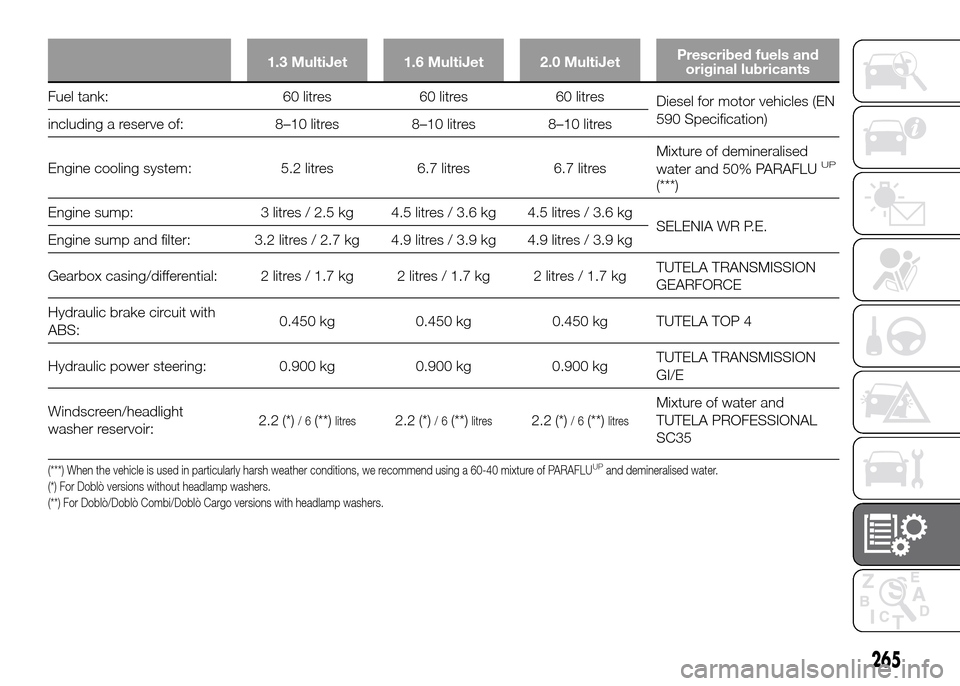
1.3 MultiJet 1.6 MultiJet 2.0 MultiJetPrescribed fuels and
original lubricants
Fuel tank: 60 litres 60 litres 60 litres
Diesel for motor vehicles (EN
590 Specification)
including a reserve of: 8–10 litres 8–10 litres 8–10 litres
Engine cooling system: 5.2 litres 6.7 litres 6.7 litresMixture of demineralised
water and 50% PARAFLU
UP
(***)
Engine sump: 3 litres / 2.5 kg 4.5 litres / 3.6 kg 4.5 litres / 3.6 kg
SELENIA WR P.E.
Engine sump and filter: 3.2 litres / 2.7 kg 4.9 litres / 3.9 kg 4.9 litres / 3.9 kg
Gearbox casing/differential: 2 litres / 1.7 kg 2 litres / 1.7 kg 2 litres / 1.7 kgTUTELA TRANSMISSION
GEARFORCE
Hydraulic brake circuit with
ABS:0.450 kg 0.450 kg 0.450 kg TUTELA TOP 4
Hydraulic power steering: 0.900 kg 0.900 kg 0.900 kgTUTELA TRANSMISSION
GI/E
Windscreen/headlight
washer reservoir:2.2 (*)
/6(**)litres2.2 (*)/6(**)litres2.2 (*)/6(**)litres
Mixture of water and
TUTELA PROFESSIONAL
SC35
(***) When the vehicle is used in particularly harsh weather conditions, we recommend using a 60-40 mixture of PARAFLUUPand demineralised water.
(*) For Doblò versions without headlamp washers.
(**) For Doblò/Doblò Combi/Doblò Cargo versions with headlamp washers.
265
Page 275 of 323
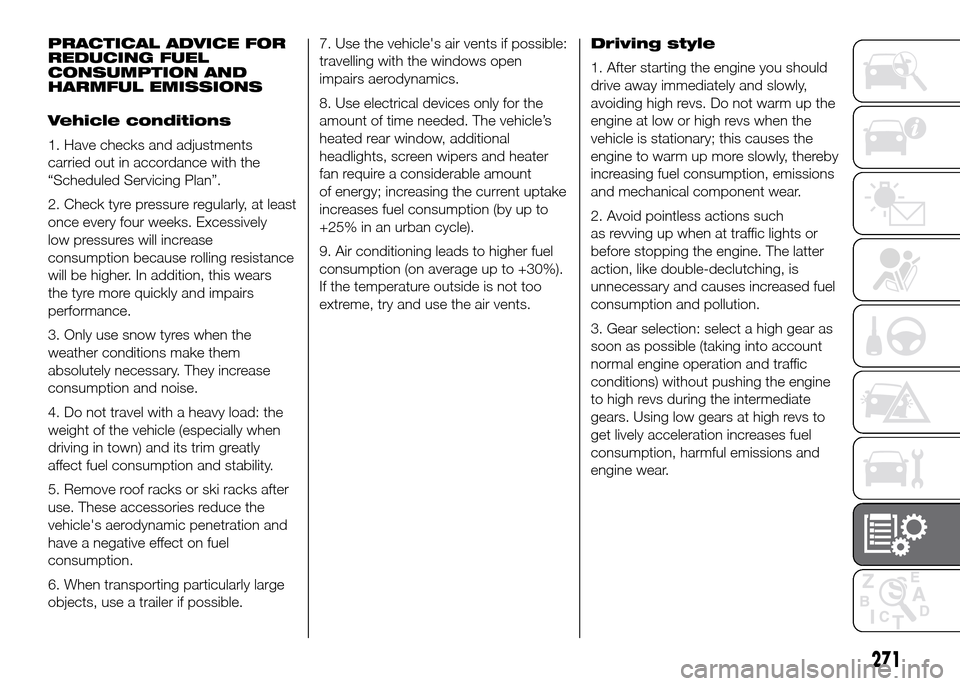
PRACTICAL ADVICE FOR
REDUCING FUEL
CONSUMPTION AND
HARMFUL EMISSIONS
Vehicle conditions
1. Have checks and adjustments
carried out in accordance with the
“Scheduled Servicing Plan”.
2. Check tyre pressure regularly, at least
once every four weeks. Excessively
low pressures will increase
consumption because rolling resistance
will be higher. In addition, this wears
the tyre more quickly and impairs
performance.
3. Only use snow tyres when the
weather conditions make them
absolutely necessary. They increase
consumption and noise.
4. Do not travel with a heavy load: the
weight of the vehicle (especially when
driving in town) and its trim greatly
affect fuel consumption and stability.
5. Remove roof racks or ski racks after
use. These accessories reduce the
vehicle's aerodynamic penetration and
have a negative effect on fuel
consumption.
6. When transporting particularly large
objects, use a trailer if possible.7. Use the vehicle's air vents if possible:
travelling with the windows open
impairs aerodynamics.
8. Use electrical devices only for the
amount of time needed. The vehicle’s
heated rear window, additional
headlights, screen wipers and heater
fan require a considerable amount
of energy; increasing the current uptake
increases fuel consumption (by up to
+25% in an urban cycle).
9. Air conditioning leads to higher fuel
consumption (on average up to +30%).
If the temperature outside is not too
extreme, try and use the air vents.Driving style
1. After starting the engine you should
drive away immediately and slowly,
avoiding high revs. Do not warm up the
engine at low or high revs when the
vehicle is stationary; this causes the
engine to warm up more slowly, thereby
increasing fuel consumption, emissions
and mechanical component wear.
2. Avoid pointless actions such
as revving up when at traffic lights or
before stopping the engine. The latter
action, like double-declutching, is
unnecessary and causes increased fuel
consumption and pollution.
3. Gear selection: select a high gear as
soon as possible (taking into account
normal engine operation and traffic
conditions) without pushing the engine
to high revs during the intermediate
gears. Using low gears at high revs to
get lively acceleration increases fuel
consumption, harmful emissions and
engine wear.
271