belt FIAT DOBLO PANORAMA 2016 2.G Owner's Manual
[x] Cancel search | Manufacturer: FIAT, Model Year: 2016, Model line: DOBLO PANORAMA, Model: FIAT DOBLO PANORAMA 2016 2.GPages: 323, PDF Size: 25.46 MB
Page 130 of 323

SIDE BAGS
(for versions/markets, where provided)
On some versions, the vehicle may
be fitted with driver and passenger front
side airbags for head and torso
protection.
Side bags protect occupants from
side-on crashes of medium/high
severity by placing the bag between the
occupant and the internal parts of the
side structure of the vehicle.
Non-activation of side bags in other
types of collisions (front collisions, rear
shunts, roll-overs, etc.) does not
indicate a system malfunction.
An electronic control unit causes the
bags to inflate in the event of a side
impact. The bags inflate
instantaneously placing themselves
between the occupants' bodies and the
structures which could cause injury.
They deflate immediately afterwards.
Side bags are not a replacement of, but
rather a complement to, seat belts,
which you are recommended to wear at
all times, as specified by law in Europe
and most non-European countries.For this reason, the seat belt must be
worn at all times. In the case of side-on
collisions, the seat belts hold occupants
in the correct position in relation to the
airbag and prevent them from being
thrown out of the vehicle by a very
violent collision.
SIDE BAGS
(for versions/markets, where provided)
It consists of an instantly inflating bag
housed in the front seat backrest fig.
141. It protects the pelvis, chest and
shoulder area of the passengers in the
event of side crashes of medium-high
severity.
IMPORTANT In the event of side
impact, you can obtain the best
protection from the system by
maintaining a correct position on the
seat, thereby allowing the side bag
to deploy correctly.
IMPORTANT Do not wash the seats
with water or pressurised steam (by
hand or at automatic seat washing
stations).IMPORTANT
INFORMATION
The front airbags and/or side bags
(where provided) may be deployed if
the vehicle is subject to heavy knocks
or accidents involving the underbody
area, such as for example violent
shocks against steps, kerbs or low
obstacles, or the vehicle falling into big
potholes or depressions in the road.
141F0V0026
126
SAFETY
Page 139 of 323
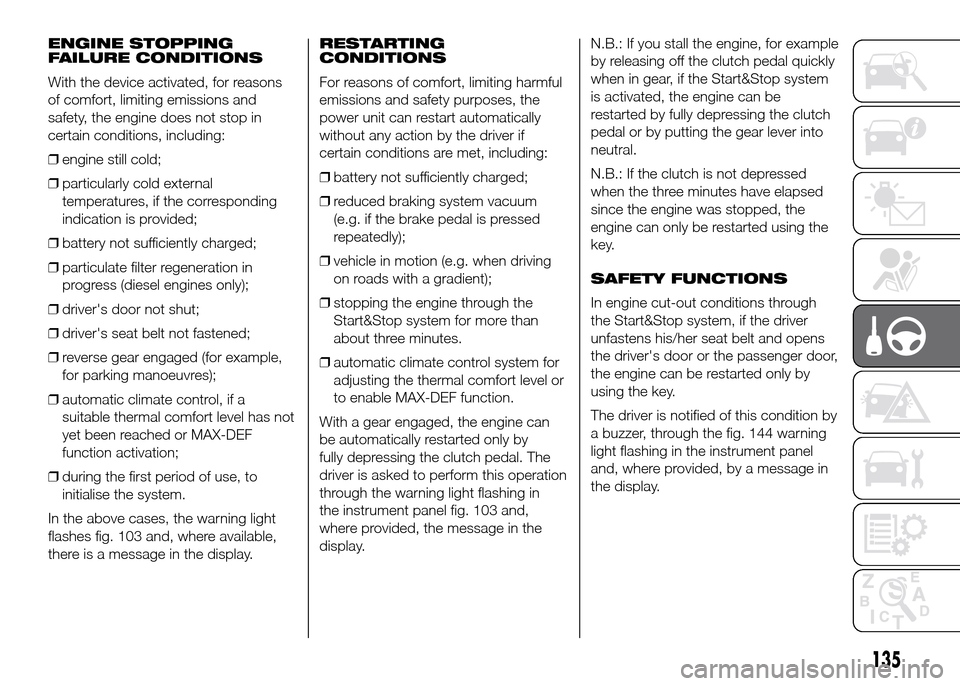
ENGINE STOPPING
FAILURE CONDITIONS
With the device activated, for reasons
of comfort, limiting emissions and
safety, the engine does not stop in
certain conditions, including:
❒engine still cold;
❒particularly cold external
temperatures, if the corresponding
indication is provided;
❒battery not sufficiently charged;
❒particulate filter regeneration in
progress (diesel engines only);
❒driver's door not shut;
❒driver's seat belt not fastened;
❒reverse gear engaged (for example,
for parking manoeuvres);
❒automatic climate control, if a
suitable thermal comfort level has not
yet been reached or MAX-DEF
function activation;
❒during the first period of use, to
initialise the system.
In the above cases, the warning light
flashes fig. 103 and, where available,
there is a message in the display.RESTARTING
CONDITIONS
For reasons of comfort, limiting harmful
emissions and safety purposes, the
power unit can restart automatically
without any action by the driver if
certain conditions are met, including:
❒battery not sufficiently charged;
❒reduced braking system vacuum
(e.g. if the brake pedal is pressed
repeatedly);
❒vehicle in motion (e.g. when driving
on roads with a gradient);
❒stopping the engine through the
Start&Stop system for more than
about three minutes.
❒automatic climate control system for
adjusting the thermal comfort level or
to enable MAX-DEF function.
With a gear engaged, the engine can
be automatically restarted only by
fully depressing the clutch pedal. The
driver is asked to perform this operation
through the warning light flashing in
the instrument panel fig. 103 and,
where provided, the message in the
display.N.B.: If you stall the engine, for example
by releasing off the clutch pedal quickly
when in gear, if the Start&Stop system
is activated, the engine can be
restarted by fully depressing the clutch
pedal or by putting the gear lever into
neutral.
N.B.: If the clutch is not depressed
when the three minutes have elapsed
since the engine was stopped, the
engine can only be restarted using the
key.
SAFETY FUNCTIONS
In engine cut-out conditions through
the Start&Stop system, if the driver
unfastens his/her seat belt and opens
the driver's door or the passenger door,
the engine can be restarted only by
using the key.
The driver is notified of this condition by
a buzzer, through the fig. 144 warning
light flashing in the instrument panel
and, where provided, by a message in
the display.
135
Page 185 of 323

SCHEDULED SERVICING PLAN
PETROL VERSIONS
Thousands of miles 18 36 54 72 90 108
Thousands of kilometres 30 60 90 120 150 180
Months 24 48 72 96 120 144
Check battery charge status and recharge if necessary●●●●●●
Check tyre conditions/wear and adjust pressure, if necessary●●●●●●
Check operation of lighting system (headlights, direction
indicators, hazard warning lights, luggage compartment,
passenger compartment, glove compartment, instrument panel
warning lights, etc.)●●●●●●
Check operation of the wiper/washer system and adjust jets, if
necessary●●●●●●
Check the position/wear of the windscreen/rear window wiper
blades●●●●●●
Check front disc brake pad condition and wear and operation of
brake pad wear indicator●●●●●●
Check rear drum brake lining condition and wear●●●
Visually inspect condition of: exterior bodywork, underbody
protection, pipes and hoses (exhaust - fuel system - brakes),
rubber elements (boots, sleeves, bushes, etc.)●●●●●●
Check cleanliness of bonnet and luggage compartment locks, as
well as cleanliness and lubrication of linkages●●●●●●
Visually inspect conditions of the accessory drive belt(s)●●
181
Page 186 of 323
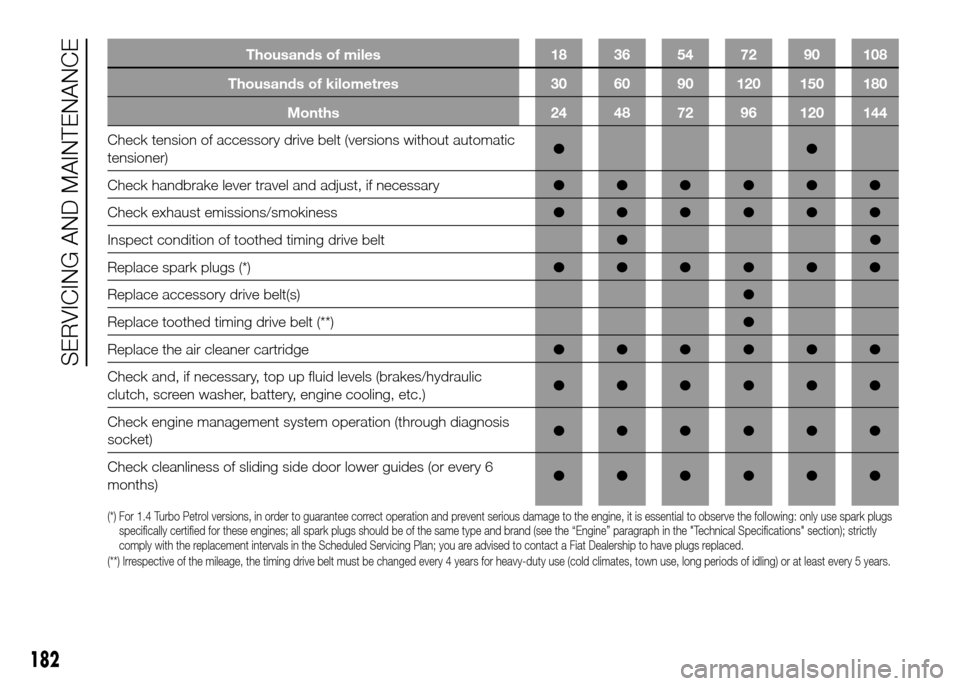
Thousands of miles 18 36 54 72 90 108
Thousands of kilometres 30 60 90 120 150 180
Months 24 48 72 96 120 144
Check tension of accessory drive belt (versions without automatic
tensioner)●●
Check handbrake lever travel and adjust, if necessary●●●●●●
Check exhaust emissions/smokiness●●●●●●
Inspect condition of toothed timing drive belt●●
Replace spark plugs (*)●●●●●●
Replace accessory drive belt(s)●
Replace toothed timing drive belt (**)●
Replace the air cleaner cartridge●●●●●●
Check and, if necessary, top up fluid levels (brakes/hydraulic
clutch, screen washer, battery, engine cooling, etc.)●●●●●●
Check engine management system operation (through diagnosis
socket)●●●●●●
Check cleanliness of sliding side door lower guides (or every 6
months)●●●●●●
(*) For 1.4 Turbo Petrol versions, in order to guarantee correct operation and prevent serious damage to the engine, it is essential to observe the following: only use spark plugs
specifically certified for these engines; all spark plugs should be of the same type and brand (see the “Engine” paragraph in the "Technical Specifications" section); strictly
comply with the replacement intervals in the Scheduled Servicing Plan; you are advised to contact a Fiat Dealership to have plugs replaced.
(**) Irrespective of the mileage, the timing drive belt must be changed every 4 years for heavy-duty use (cold climates, town use, long periods of idling) or at least every 5 years.
182
SERVICING AND MAINTENANCE
Page 188 of 323

DIESEL VERSIONS WITHOUT DPF (1.3 MultiJet - 1.6 MultiJet)
Thousands of miles 18 36 54 72 90 108
Thousands of kilometres 30 60 90 120 150 180
Months 24 48 72 96 120 144
Check tyre conditions/wear and adjust pressure, if necessary●●●●●●
Check operation of lighting system (headlights, direction
indicators, hazard warning lights, luggage compartment,
passenger compartment, glove compartment, instrument panel
warning lights, etc.)●●●●●●
Check operation of the wiper/washer system and adjust jets, if
necessary●●●●●●
Check windscreen wiper blade position/wear●●●●●●
Check front disc brake pad condition and wear and operation of
brake pad wear indicator●●●●●●
Check rear drum brake lining condition and wear●●●
Visually inspect condition of: exterior bodywork, underbody
protection, pipes and hoses (exhaust - fuel system - brakes),
rubber elements (boots, sleeves, bushes, etc.)●●●●●●
Check cleanliness of bonnet and luggage compartment locks, as
well as cleanliness and lubrication of linkages●●●●●●
Check and, if necessary, top up fluid levels (brakes/hydraulic
clutch, windscreen washer, battery, engine cooling, etc.)●●●●●●
Check tension of accessory drive belt (versions without automatic
tensioner)●●
184
SERVICING AND MAINTENANCE
Page 189 of 323
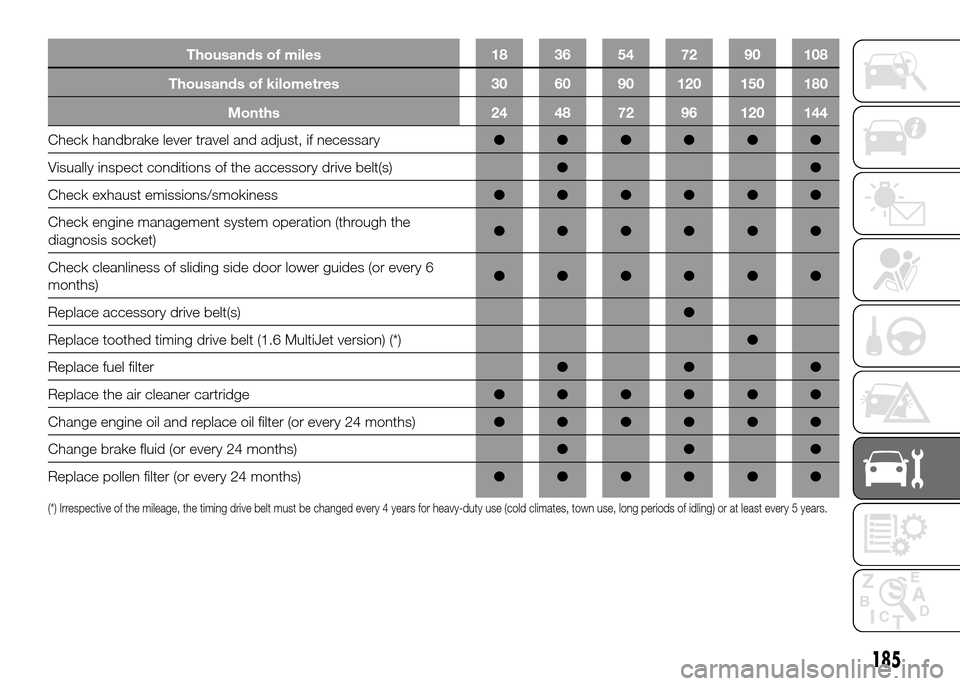
Thousands of miles 18 36 54 72 90 108
Thousands of kilometres 30 60 90 120 150 180
Months 24 48 72 96 120 144
Check handbrake lever travel and adjust, if necessary●●●●●●
Visually inspect conditions of the accessory drive belt(s)●●
Check exhaust emissions/smokiness●●●●●●
Check engine management system operation (through the
diagnosis socket)●●●●●●
Check cleanliness of sliding side door lower guides (or every 6
months)●●●●●●
Replace accessory drive belt(s)●
Replace toothed timing drive belt (1.6 MultiJet version) (*)●
Replace fuel filter●●●
Replace the air cleaner cartridge●●●●●●
Change engine oil and replace oil filter (or every 24 months)●●●●●●
Change brake fluid (or every 24 months)●●●
Replace pollen filter (or every 24 months)●●●●●●
(*) Irrespective of the mileage, the timing drive belt must be changed every 4 years for heavy-duty use (cold climates, town use, long periods of idling) or at least every 5 years.
185
Page 190 of 323

DIESEL VERSIONS WITH DPF (1.3 MultiJet - 1.6 MultiJet - 2.0 MultiJet)
Thousands of miles 18 36 54 72 90
Thousands of kilometres 35 70 105 140 175
Months 24 48 72 96 120
Check tyre conditions/wear and adjust pressure, if necessary●●●●●
Check operation of lighting system (headlights, direction
indicators, hazard warning lights, luggage compartment,
passenger compartment, glove compartment, instrument panel
warning lights, etc.)●●●●●
Check operation of the wiper/washer system and adjust jets, if
necessary●●●●●
Check windscreen wiper blade position/wear●●●●●
Check front disc brake pad condition and wear and operation of
brake pad wear indicator●●●●●
Check rear drum brake lining condition and wear●●
Visually inspect condition of: exterior bodywork, underbody
protection, pipes and hoses (exhaust - fuel system - brakes),
rubber elements (boots, sleeves, bushes, etc.)●●●●●
Check cleanliness of bonnet and luggage compartment locks, as
well as cleanliness and lubrication of linkages●●●●●
Check and, if necessary, top up fluid levels (brakes/hydraulic
clutch, windscreen washer, battery, engine cooling, etc.)●●●●●
Check tension of accessory drive belt (versions without automatic
tensioner)●●
186
SERVICING AND MAINTENANCE
Page 191 of 323
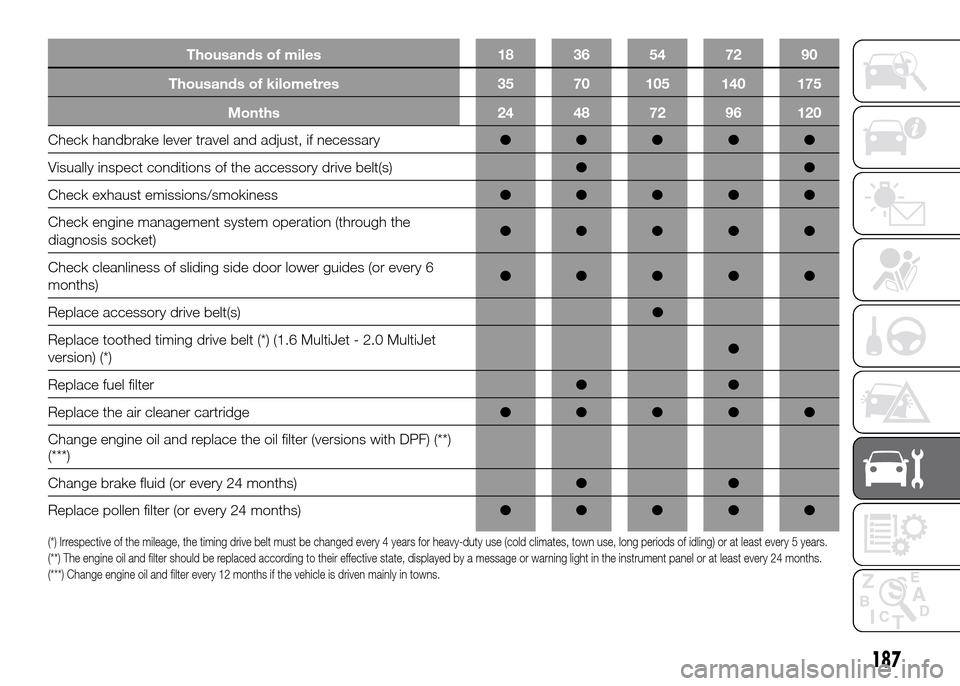
Thousands of miles 18 36 54 72 90
Thousands of kilometres 35 70 105 140 175
Months 24 48 72 96 120
Check handbrake lever travel and adjust, if necessary●●●●●
Visually inspect conditions of the accessory drive belt(s)●●
Check exhaust emissions/smokiness●●●●●
Check engine management system operation (through the
diagnosis socket)●●●●●
Check cleanliness of sliding side door lower guides (or every 6
months)●●●●●
Replace accessory drive belt(s)●
Replace toothed timing drive belt (*) (1.6 MultiJet - 2.0 MultiJet
version) (*)●
Replace fuel filter●●
Replace the air cleaner cartridge●●●●●
Change engine oil and replace the oil filter (versions with DPF) (**)
(***)
Change brake fluid (or every 24 months)●●
Replace pollen filter (or every 24 months)●●●●●
(*) Irrespective of the mileage, the timing drive belt must be changed every 4 years for heavy-duty use (cold climates, town use, long periods of idling) or at least every 5 years.
(**) The engine oil and filter should be replaced according to their effective state, displayed by a message or warning light in the instrument panel orat least every 24 months.
(***) Change engine oil and filter every 12 months if the vehicle is driven mainly in towns.
187
Page 192 of 323
PERIODIC CHECKS
Every 1,000 km or before long
journeys, check and, if necessary, top
up the following:
❒engine coolant level;
❒brake fluid level;
❒windscreen washer fluid level;
❒tyre inflation pressure and condition;
❒operation of lighting system
(headlights, direction indicators,
hazard warning lights, etc.);
❒operation of screen washer/wiper
system and positioning/wear of
windscreen/rear screen wiper blades
(for versions/markets where
provided);
Every 3,000 km check and top up if
required: engine oil level.
DEMANDING
VEHICLE USE
If the vehicle is mostly used in one of
the following conditions:
❒towing a trailer or motorhome;
❒dusty roads;
❒short, repeated journeys (less than
7-8 km) at sub-zero outside
temperatures;
❒engine often idling or driving long
distances at low speeds or long
periods of inactivity;
the following checks must be carried
out more often than indicated in the
Scheduled Servicing Plan:
❒check front disc brake pad condition
and wear;
❒check cleanliness of bonnet and
luggage compartment locks,
cleanliness and lubrication of linkage;
❒visually inspect condition of: engine,
gearbox, transmission, pipes and
hoses (exhaust - fuel system -
brakes) and rubber elements (boots -
sleeves - bushes - etc.);
❒check battery charge and battery
fluid level (electrolyte);
❒visually inspect conditions of the
auxiliary drive belts;❒check and, if necessary, change
engine oil and replace oil filter;
❒check and, if necessary, replace
pollen filter;
❒replacement of air cleaner cartridge
every 15,000 km.
188
SERVICING AND MAINTENANCE
Page 320 of 323
Hazard warning lights..................... 152
Headlights...................................... 66
Headlight washers ......................... 40
Head restraints............................... 30
Heating and ventilation ............... 41-43
Hill Holder system .......................... 108
Identification data .......................... 212
Ignition device ................................ 16
Important information ..................... 126
Inflation pressure ............................ 230
Installing electrical/electronic
devices ........................................ 5
Interior fittings ................................ 62
Interior lights .................................. 36
Interior mirror ................................. 32
Interiors .......................................... 208
Isofix child restraint system
setup ........................................... 119
Jump starting ................................ 174
Lifting the vehicle .......................... 176
Load limiters .................................. 113
Luggage compartment light ........... 37
Main beam headlights............. 34-156
Maintenance of the seat belts ........ 114
Manual climate control system ....... 45
Manual deactivation of
passenger side front airbag and
side bag for chest/head
protection .................................... 123
MSR system .................................. 109Multifunction display....................... 78
– Control buttons ......................... 78
– Set-up menu ............................. 79
Number plate lights (for
hatchback versions) ..................... 158
Number plate lights (for versions
with wing doors)........................... 158
Occupant protection systems ....... 110
Parking ......................................... 132
Parking sensors ............................. 144
Partitions........................................ 28
Passenger side front airbag ............ 122
Performance .................................. 269
Periodic checks ............................. 188
Plastic parts ................................... 208
Plugs (type) .................................... 216
Power socket ................................. 62
Power steering fluid........................ 197
Practical advice for reducing fuel
consumption and harmful
emissions ..................................... 147
Prescriptions for vehicle at end
of life ............................................ 305
Pretensioners ................................. 113
Procedure for diesel versions ......... 130
Procedure for petrol versions.......... 130
Prolonged vehicle inactivity............. 206
Protecting the environment ............ 68
Protection against atmospheric
agents.......................................... 206
Radio (setup) ................................ 67
Radio transmitters and mobile
phones......................................... 5
Rear doors ..................................... 21
Rear fog lights ................................ 57
Rear light clusters .......................... 156
Rear roof light ................................ 159
Rear view mirrors ........................... 32
Rear window washer...................... 40
Rear window wiper ..................... 39-40
Refuelling the vehicle ...................... 146
Replacing a bulb ............................ 152
Replacing an exterior bulb .............. 155
Replacing an interior bulb ............... 158
Replacing fuses.............................. 160
Replacing the battery ..................... 199
Rim Protector................................. 225
Rims and tyres ............................... 224
Roof rack ....................................... 66
Rubber hoses ................................ 205
Saving fuel .................................... 147
SBR system ................................... 112
Scheduled servicing ....................... 180
Scheduled Servicing Plan ............... 181
Seat belts....................................... 111
Seats and fabric parts .................... 208
Seats ............................................. 23
– Driver’s seat .............................. 23
– Passenger seat ......................... 24
INDEX