stop start FIAT DOBLO PANORAMA 2016 2.G Owner's Manual
[x] Cancel search | Manufacturer: FIAT, Model Year: 2016, Model line: DOBLO PANORAMA, Model: FIAT DOBLO PANORAMA 2016 2.GPages: 323, PDF Size: 25.46 MB
Page 141 of 323
EMERGENCY STARTING
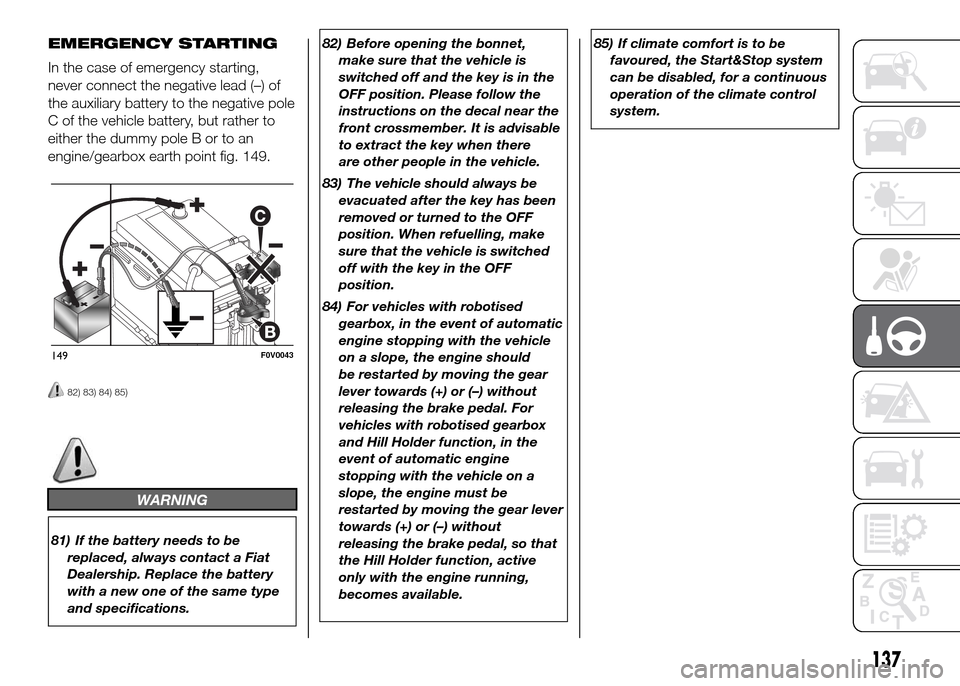
In the case of emergency starting,
never connect the negative lead (–) of
the auxiliary battery to the negative pole
C of the vehicle battery, but rather to
either the dummy pole B or to an
engine/gearbox earth point fig. 149.
82) 83) 84) 85)
WARNING
81) If the battery needs to be
replaced, always contact a Fiat
Dealership. Replace the battery
with a new one of the same type
and specifications.82) Before opening the bonnet,
make sure that the vehicle is
switched off and the key is in the
OFF position. Please follow the
instructions on the decal near the
front crossmember. It is advisable
to extract the key when there
are other people in the vehicle.
83) The vehicle should always be
evacuated after the key has been
removed or turned to the OFF
position. When refuelling, make
sure that the vehicle is switched
off with the key in the OFF
position.
84) For vehicles with robotised
gearbox, in the event of automatic
engine stopping with the vehicle
on a slope, the engine should
be restarted by moving the gear
lever towards (+) or (–) without
releasing the brake pedal. For
vehicles with robotised gearbox
and Hill Holder function, in the
event of automatic engine
stopping with the vehicle on a
slope, the engine must be
restarted by moving the gear lever
towards (+) or (–) without
releasing the brake pedal, so that
the Hill Holder function, active
only with the engine running,
becomes available.85) If climate comfort is to be
favoured, the Start&Stop system
can be disabled, for a continuous
operation of the climate control
system.
149F0V0043
137
Page 144 of 323
IMPORTANT In all the above-mentioned
cases, it is advisable to check the
spare wheel tyre pressure before
starting driving.
NOTE If the tyres are replaced, driving
the vehicle for short stretches, some
time might be needed before the
system is restored.
IMPORTANT
WARNING
86) The TPMS is optimised for the
original tyres and wheels
provided. TPMS pressures and
alerts have been defined
according to the size of the tyres
mounted on the vehicle. Using
equipment with different size,
type or kind may cause irregular
system operation or sensor
damage. Non-original spare
wheels can damage the sensor.
Do not use tyre sealant or
balancing weights if the vehicle is
equipped with TPMS as these
may damage the sensors.87) If the system signals a pressure
decrease on a specific tyre, it is
recommended to check the
pressure on all four tyres.
88) TPMS does not relieve the driver
from the obligation to check the
tyre pressure every month; it is
not to be considered a replacing
system for maintenance or a
safety system.
89) Tyre pressure must be checked
with tyres cold. Should it become
necessary for whatever reason
to check pressure with warm
tyres, do not reduce pressure
even if it is higher than the
prescribed value, but repeat the
check when tyres are cold.
90) The TPMS cannot indicate
sudden tyre pressure drops (for
example when a tyre bursts).
In this case, stop the vehicle,
braking with caution and avoiding
abrupt steering.
91) The system only warns that the
tyre pressure is low: it is not able
to inflate them.
92) Insufficient tyre inflation
increases fuel consumption,
reduces the tread duration and
may affect the capacity to drive
safely.93) Always refit the valve stem cap
after inspecting or adjusting tyre
pressure. This prevents dampness
or dirt from entering the valve
stem and thus the pressure
control sensor from being
damaged.
94) The tyre repair kit (Fix&Go)
provided with the vehicle (for
versions/markets, where
provided) is compatible with the
TPMS sensors; using sealants not
equivalent with that in the original
kit may adversely affect its
operation. If sealants not
equivalent with the original one
are used, it is recommended to
have the TPMS sensor operation
checked by a qualified repair
centre.
140
STARTING AND DRIVING
Page 146 of 323
Restoring the stored
speed
If the device has been deactivated, for
example by depressing the brake or
clutch pedal, the stored speed can be
restored as follows:
❒accelerate progressively until a speed
close to that stored is reached;
❒engage the gear selected at the time
that the speed was stored;
❒press button B fig. 150.
Increasing the stored
speed
This can be done in two ways:
❒by pressing the accelerator and
memorizing the new speed reached;
or
❒by moving the stalk upwards (+).
Each operation of the stalk will
correspond to a slight increase in
speed of about 1 km/h, while keeping
the stalk upwards will increase the
speed continuously.Reducing the stored
speed
This can be done in two ways:
❒by deactivating the device and then
storing the new speed
or
❒by moving the stalk downwards (-)
until the new speed, which will
automatically remain memorised, is
reached.
Each movement of the stalk will
correspond to a slight reduction in
speed of about 1 km/h, while keeping
the stalk held downwards will decrease
the speed continuously.
Deactivating the device
The device can be switched off by the
driver in the following ways:
❒by turning ring nut A to the OFF
position;
❒if the engine is stopped (leaving the
stalk ring nut at ON), when the
ignition key is next turned to ON,
Cruise Control will be activated
automatically.Deactivating the
function
The device can be switched off by the
driver in the following ways:
❒by pressing the brake pedal when the
device is adjusting the speed:
❒by pressing the clutch pedal when
the device is adjusting the speed;
❒by pressing button B fig. 150 when
the device is adjusting the speed
(for versions/markets, where
provided);
❒by pressing the accelerator pedal (in
this case the system is not actually
turned off but the acceleration
request takes priority; the cruise
control remains activated, without the
need to the press button B fig. 150
to restore the previous conditions
once the acceleration is over).
The device is automatically switched off
in the following cases:
❒if the ABS or ESC systems intervene
❒with the vehicle speed below the
set limit
❒in the event of system failure.
142
STARTING AND DRIVING
Page 148 of 323
PARKING SENSORS
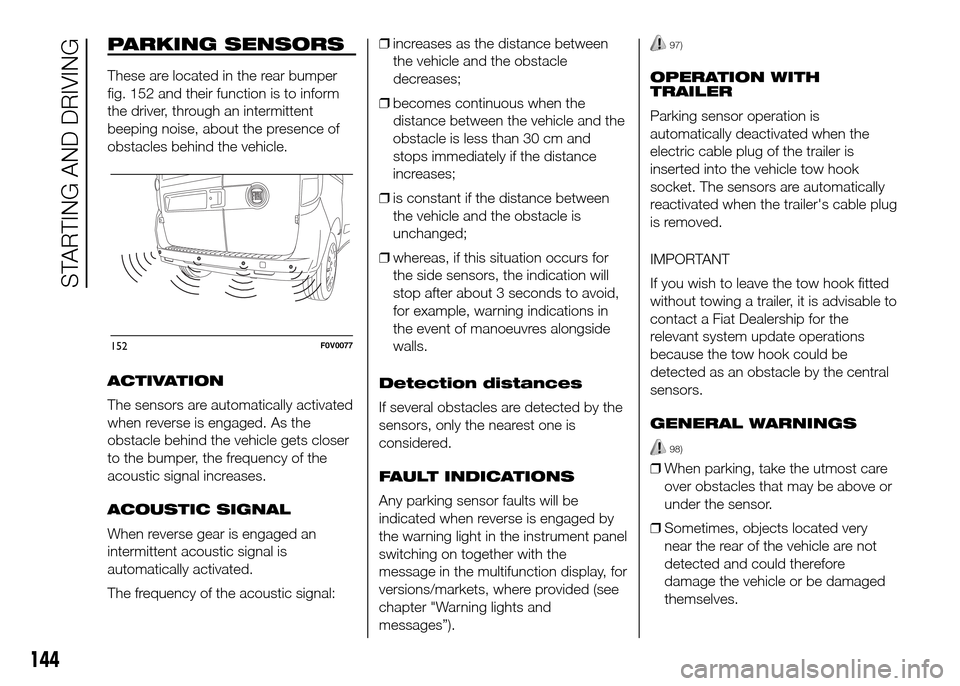
These are located in the rear bumper
fig. 152 and their function is to inform
the driver, through an intermittent
beeping noise, about the presence of
obstacles behind the vehicle.
ACTIVATION
The sensors are automatically activated
when reverse is engaged. As the
obstacle behind the vehicle gets closer
to the bumper, the frequency of the
acoustic signal increases.
ACOUSTIC SIGNAL
When reverse gear is engaged an
intermittent acoustic signal is
automatically activated.
The frequency of the acoustic signal:❒increases as the distance between
the vehicle and the obstacle
decreases;
❒becomes continuous when the
distance between the vehicle and the
obstacle is less than 30 cm and
stops immediately if the distance
increases;
❒is constant if the distance between
the vehicle and the obstacle is
unchanged;
❒whereas, if this situation occurs for
the side sensors, the indication will
stop after about 3 seconds to avoid,
for example, warning indications in
the event of manoeuvres alongside
walls.
Detection distances
If several obstacles are detected by the
sensors, only the nearest one is
considered.
FAULT INDICATIONS
Any parking sensor faults will be
indicated when reverse is engaged by
the warning light in the instrument panel
switching on together with the
message in the multifunction display, for
versions/markets, where provided (see
chapter "Warning lights and
messages”).
97)
OPERATION WITH
TRAILER
Parking sensor operation is
automatically deactivated when the
electric cable plug of the trailer is
inserted into the vehicle tow hook
socket. The sensors are automatically
reactivated when the trailer's cable plug
is removed.
IMPORTANT
If you wish to leave the tow hook fitted
without towing a trailer, it is advisable to
contact a Fiat Dealership for the
relevant system update operations
because the tow hook could be
detected as an obstacle by the central
sensors.
GENERAL WARNINGS
98)
❒When parking, take the utmost care
over obstacles that may be above or
under the sensor.
❒Sometimes, objects located very
near the rear of the vehicle are not
detected and could therefore
damage the vehicle or be damaged
themselves.
152F0V0077
144
STARTING AND DRIVING
Page 152 of 323
Driving style
❒Afterstarting the engineyou
should drive away immediately and
slowly, avoiding high revs. Do not
warm up the engine at low or high
revs when the vehicle is stationary;
this causes the engine to warm
up more slowly, thereby increasing
fuel consumption, emissions and
mechanical component wear.
❒Avoidpointless actionssuch as
revving up when at traffic lights or
before stopping the engine. The latter
action, like double-declutching, is
unnecessary and causes increased
fuel consumption and pollution.
❒Gear selection:select a high gear
as soon as possible (taking into
account normal engine operation and
traffic conditions) without pushing
the engine to high revs during the
intermediate gears. Using low gears
at high revs to get lively acceleration
increases fuel consumption, harmful
emissions and engine wear.❒Vehicle speed:fuel consumption
increases exponentially as the speed
of the vehicle increases. Keep your
speed moderate and as even as
possible, avoiding unnecessary
braking and acceleration, which
cause excessive fuel consumption
and increased emissions. Keeping a
safe distance from the vehicle in
front helps to maintain a steady
speed.
❒Acceleration:accelerating violently
severely affects consumption and
emissions. Acceleration should
be gradual and should not exceed
the maximum engine torque rate.
CONDITIONS OF USE
Cold starting
Short journeys and frequent cold starts
do not allow the engine to reach
optimum operating temperature.
This results in a significant increase in
consumption levels (from +15 to +30%
on the urban cycle) and emissions.Traffic and road
conditions
Rather high consumption levels are
linked to situations with heavy traffic, for
instance when travelling in queues
with frequent use of the lower gears or
in cities with many traffic lights. Winding
mountain roads and rough road
surfaces also adversely affect
consumption.
Stops in traffic
During prolonged hold-ups (e.g. level
crossings) the engine should be
switched off.
148
STARTING AND DRIVING
Page 176 of 323
❒if after 5 minutes it is still impossible
to reach at least 1.5 bar, disengage
the compressor from the valve and
power socket, then move the vehicle
forwards by approx. 10 metres in
order to distribute the sealant inside
the tyre evenly, then repeat the
inflation operation;
❒if after this operation it is still
impossible after 5 minutes to reach at
least 1.8 bar, do not start driving
since the tyre is excessively damaged
and the quick tyre repair kit cannot
guarantee proper hold, contact a Fiat
Dealership;
❒if reaching the tyre pressure specified
in paragraph “Inflation pressure” in
chapter “Technical Data”, start driving
immediately;
118) 119) 120)
❒after having driven for about 10
minutes, stop and recheck the tyre
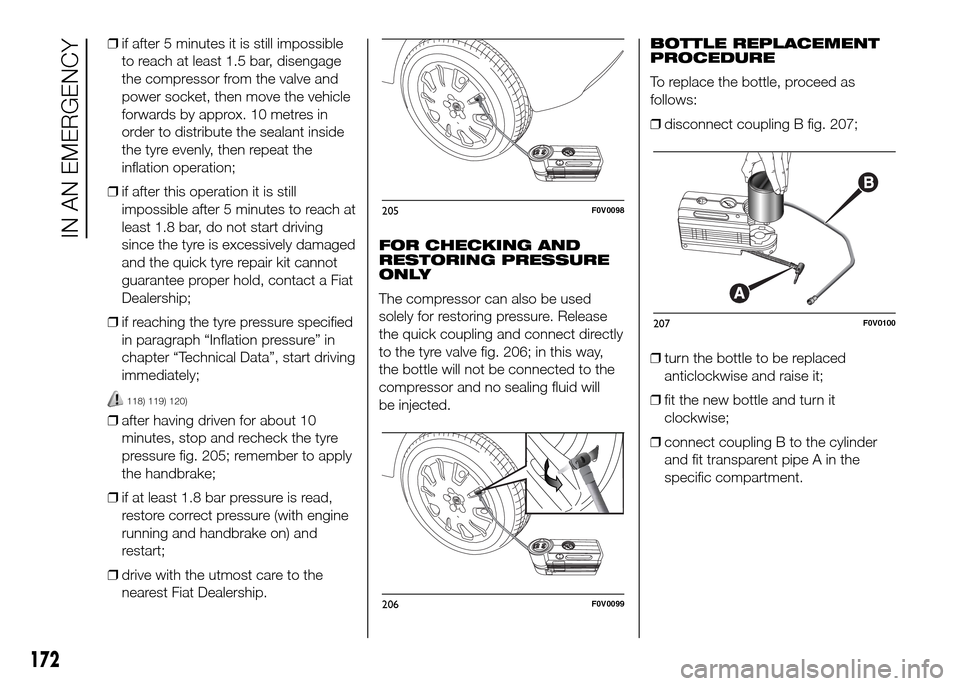
pressure fig. 205; remember to apply
the handbrake;
❒if at least 1.8 bar pressure is read,
restore correct pressure (with engine
running and handbrake on) and
restart;
❒drive with the utmost care to the
nearest Fiat Dealership.FOR CHECKING AND
RESTORING PRESSURE
ONLY
The compressor can also be used
solely for restoring pressure. Release
the quick coupling and connect directly
to the tyre valve fig. 206; in this way,
the bottle will not be connected to the
compressor and no sealing fluid will
be injected.BOTTLE REPLACEMENT
PROCEDURE
To replace the bottle, proceed as
follows:
❒disconnect coupling B fig. 207;
❒turn the bottle to be replaced
anticlockwise and raise it;
❒fit the new bottle and turn it
clockwise;
❒connect coupling B to the cylinder
and fit transparent pipe A in the
specific compartment.
205F0V0098
206F0V0099
207F0V0100
172
IN AN EMERGENCY
Page 179 of 323
IMPORTANT Remember that the brake
booster and the electric power steering
system are not active until the engine
is started, so you will need to apply
much more force to the brake pedal or
steering wheel.
IMPORTANT
29) Never use a fast battery-charger
for emergency starting of the
engine as this could damage the
electronic systems of your vehicle,
particularly the ignition and fuel
supply control units.
WARNING
121) This procedure must be
performed by qualified personnel
as incorrect actions may cause
high-intensity electrical discharge.
Furthermore, battery fluid is
poisonous and corrosive: avoid
contact with skin and eyes. Keep
naked flames away from the
battery. No smoking. Do not cause
sparks.
FUEL CUT-OFF
SYSTEM
This intervenes in the case of an impact
causing:
❒the fuel supply cut-off with the engine
consequently switching off;
❒the automatic unlocking of the doors;
❒the switching on of the interior lights;
❒switching on of the hazard warning
lights (to deactivate the lights press
the dedicated button on the
dashboard).
122)
When the system has been triggered,
the message “Fuel cut off, see
handbook” is displayed on some
versions.
Check carefully for fuel leaks, for
instance in the engine compartment,
under the vehicle or near the tank area.
After a collision, turn the ignition key
to STOP to prevent the battery from
running down.
The following procedure should be
carried out to restore the correct
operation of the vehicle:
❒turn the ignition key to the MAR
position;
❒activate the right direction indicator;
175
Page 181 of 323
WARNING
123) Before starting towing
operations, turn the ignition key to
MAR and then to STOP, without
extracting it. If the key is
extracted, the steering lock
engages automatically and it is
consequently impossible to steer
the wheels.
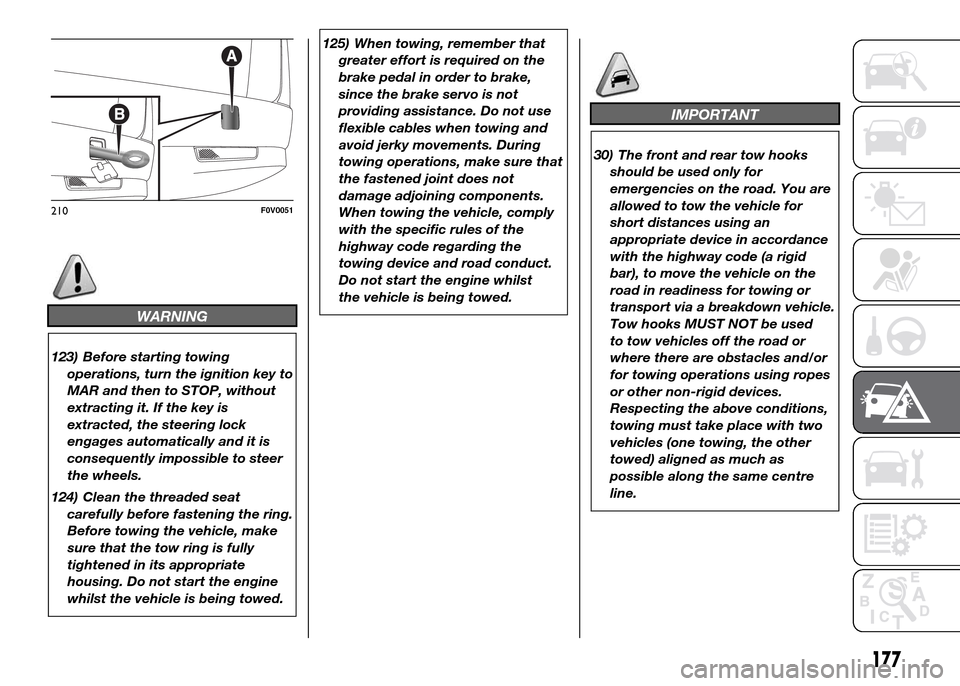
124) Clean the threaded seat
carefully before fastening the ring.
Before towing the vehicle, make
sure that the tow ring is fully
tightened in its appropriate
housing. Do not start the engine
whilst the vehicle is being towed.125) When towing, remember that
greater effort is required on the
brake pedal in order to brake,
since the brake servo is not
providing assistance. Do not use
flexible cables when towing and
avoid jerky movements. During
towing operations, make sure that
the fastened joint does not
damage adjoining components.
When towing the vehicle, comply
with the specific rules of the
highway code regarding the
towing device and road conduct.
Do not start the engine whilst
the vehicle is being towed.
IMPORTANT
30) The front and rear tow hooks
should be used only for
emergencies on the road. You are
allowed to tow the vehicle for
short distances using an
appropriate device in accordance
with the highway code (a rigid
bar), to move the vehicle on the
road in readiness for towing or
transport via a breakdown vehicle.
Tow hooks MUST NOT be used
to tow vehicles off the road or
where there are obstacles and/or
for towing operations using ropes
or other non-rigid devices.
Respecting the above conditions,
towing must take place with two
vehicles (one towing, the other
towed) aligned as much as
possible along the same centre
line.
210F0V0051
177
Page 205 of 323
IMPORTANT
5) Batteries contain substances
which are very dangerous for the
environment. To replace your
battery, we recommend
contacting your Fiat Dealership to
dispose of your old battery in full
respect of the environment and in
compliance with all applicable
laws and regulations.
BATTERY
RECHARGING
IMPORTANT The battery recharging
procedure is given as information only.
This operation should be performed
at a Fiat Dealership.
Charging should be slow at a low
ampere rating for approximately 24
hours. Charging for a long time may
damage the battery.
To recharge, proceed as follows:
IN THE ABSENCE OF THE
START&STOP SYSTEM
❒disconnect the terminal from the
negative battery pole;
❒connect the charger cables to the
battery terminals, observing the
poles;
❒turn on the charger;
❒when you have finished, turn the
charger off before disconnecting
it from the battery;
❒reconnect the negative battery
terminal.WITH START&STOP
SYSTEM
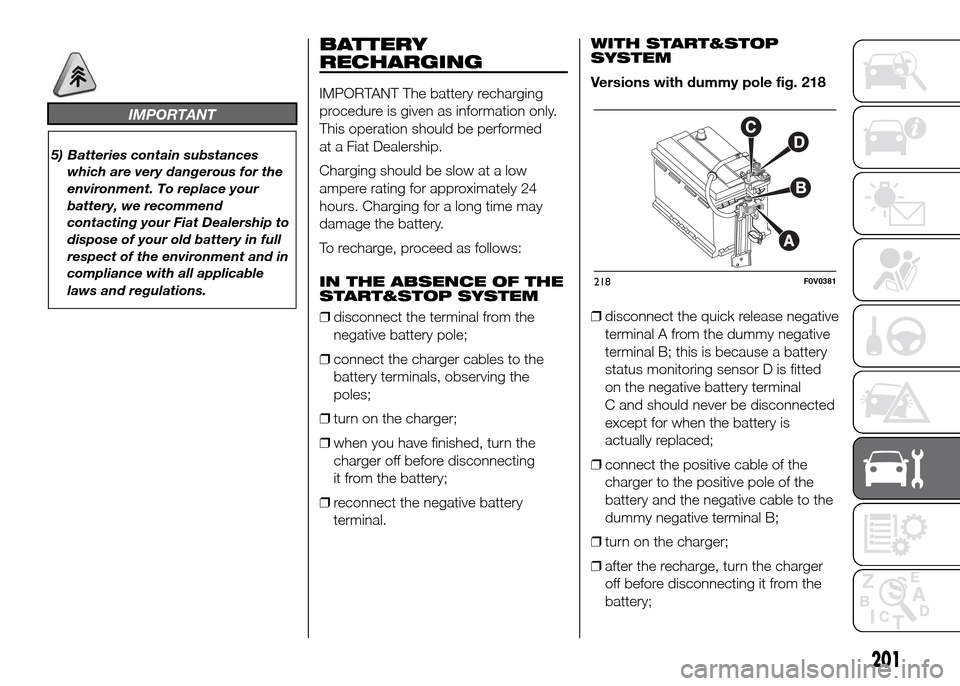
Versions with dummy pole fig. 218
❒disconnect the quick release negative
terminal A from the dummy negative
terminal B; this is because a battery
status monitoring sensor D is fitted
on the negative battery terminal
C and should never be disconnected
except for when the battery is
actually replaced;
❒connect the positive cable of the
charger to the positive pole of the
battery and the negative cable to the
dummy negative terminal B;
❒turn on the charger;
❒after the recharge, turn the charger
off before disconnecting it from the
battery;
218F0V0381
201
Page 208 of 323
Rear window (washer)
The rear window washer jets are fixed.
The nozzle holder is located above
the rear window.
WARNING
138) Driving with worn windscreen
wiper blades is a serious hazard,
because visibility is reduced in
bad weather conditions.
WHEELS AND TYRES
Check the pressure of each tyre,
including the space-saver wheel,
approximately every two weeks and
before long journeys: the pressure
should be checked with the tyre rested
and cold.
It is normal for the pressure to increase
when the vehicle is used; for the correct
tyre inflation pressure, see “Wheels” in
the “Technical specifications” section.
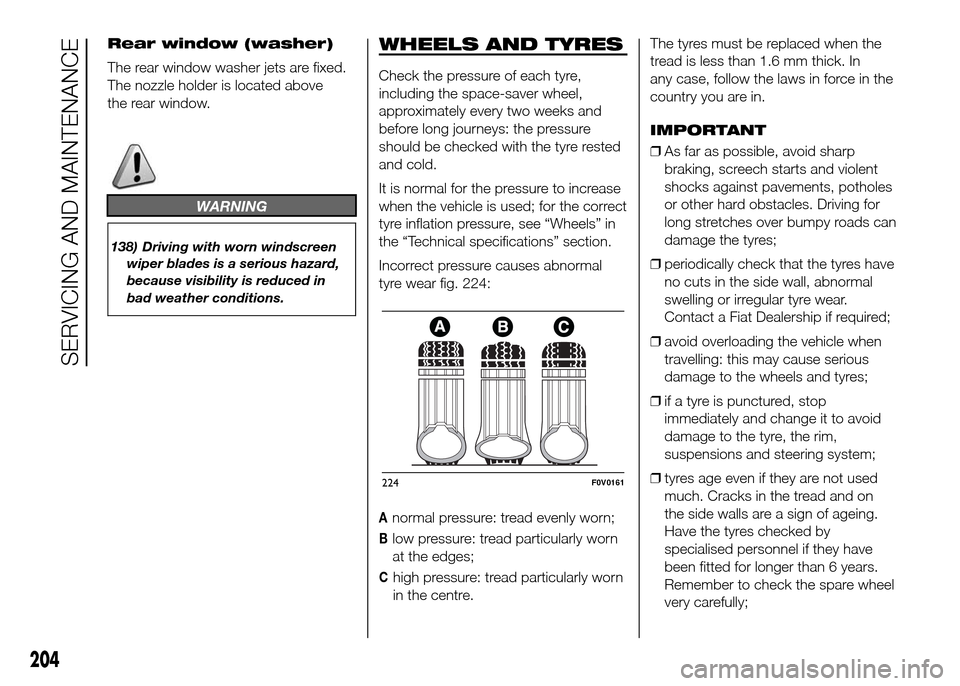
Incorrect pressure causes abnormal
tyre wear fig. 224:
Anormal pressure: tread evenly worn;
Blow pressure: tread particularly worn
at the edges;
Chigh pressure: tread particularly worn
in the centre.The tyres must be replaced when the
tread is less than 1.6 mm thick. In
any case, follow the laws in force in the
country you are in.
IMPORTANT
❒As far as possible, avoid sharp
braking, screech starts and violent
shocks against pavements, potholes
or other hard obstacles. Driving for
long stretches over bumpy roads can
damage the tyres;
❒periodically check that the tyres have
no cuts in the side wall, abnormal
swelling or irregular tyre wear.
Contact a Fiat Dealership if required;
❒avoid overloading the vehicle when
travelling: this may cause serious
damage to the wheels and tyres;
❒if a tyre is punctured, stop
immediately and change it to avoid
damage to the tyre, the rim,
suspensions and steering system;
❒tyres age even if they are not used
much. Cracks in the tread and on
the side walls are a sign of ageing.
Have the tyres checked by
specialised personnel if they have
been fitted for longer than 6 years.
Remember to check the spare wheel
very carefully;
224F0V0161
204
SERVICING AND MAINTENANCE