lock FIAT DOBLO PANORAMA 2016 2.G Owner's Guide
[x] Cancel search | Manufacturer: FIAT, Model Year: 2016, Model line: DOBLO PANORAMA, Model: FIAT DOBLO PANORAMA 2016 2.GPages: 323, PDF Size: 25.46 MB
Page 110 of 323
ACTIVE SAFETY
SYSTEMS
The vehicle has the following active
safety systems:
❒ABS;
❒EBD system;
❒Brake Assist system;
❒ESP system;
❒ASR system;
❒Hill Holder system;
❒MSR system;
For the operation of the systems, see
the following pages.
ABS
This is an integral part of the braking
system, which prevents one or more
wheels from locking or slipping
regardless of the road surface
conditions and braking intensity,
ensuring control of the vehicle even
during emergency braking.
The EBD system (Electronic Braking
Force Distribution) completes the
system allowing the brake force to be
distributed between the front and
rear wheels.
IMPORTANT To get the maximum
efficiency of the braking system,
a bedding-in period of about 500 km is
needed: during this period it is better
to avoid sharp, repeated and prolonged
braking.
SYSTEM INTERVENTION
The driver can feel that the ABS has
come into action because the brake
pedal pulsates slightly and the system
gets noisier: it means that the vehicle
speed should be altered to suit the type
of road surface.
53) 54) 55)
FAULT INDICATIONS
ABS failure
This is indicated by the
warning
light in the instrument panel coming on
(together with the appropriate message
on the multifunction display on some
versions) (see the “Warning lights and
messages” chapter).
In this case, the braking system will still
be effective, although without the
extra capacity offered by the ABS.
Drive carefully to the nearest Fiat
Dealership to have the system
checked.
EBD failure
This is indicated by the
and
warning lights in the instrument
panel coming on (together with the
appropriate message on the
multifunction display on some versions)
(see the “Warning lights and messages”
chapter).
In this case, the rear wheels may
suddenly lock and the vehicle may
swerve when braking sharply. Drive
carefully to the nearest Fiat Dealership
to have the system checked.
56)
106
SAFETY
Page 115 of 323
SEAT BELTS
USING THE SEAT BELTS
The seat belt should be worn keeping
the torso straight and rested against
the backrest.
To fasten the seat belts, hold the
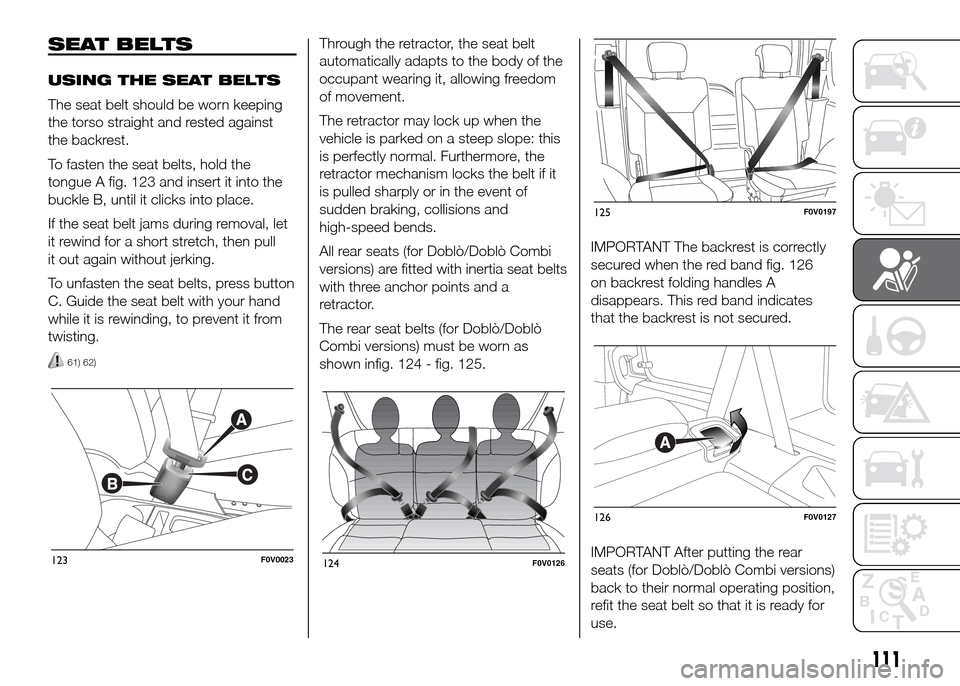
tongue A fig. 123 and insert it into the
buckle B, until it clicks into place.
If the seat belt jams during removal, let
it rewind for a short stretch, then pull
it out again without jerking.
To unfasten the seat belts, press button
C. Guide the seat belt with your hand
while it is rewinding, to prevent it from
twisting.
61) 62)
Through the retractor, the seat belt
automatically adapts to the body of the
occupant wearing it, allowing freedom
of movement.
The retractor may lock up when the
vehicle is parked on a steep slope: this
is perfectly normal. Furthermore, the
retractor mechanism locks the belt if it
is pulled sharply or in the event of
sudden braking, collisions and
high-speed bends.
All rear seats (for Doblò/Doblò Combi
versions) are fitted with inertia seat belts
with three anchor points and a
retractor.
The rear seat belts (for Doblò/Doblò
Combi versions) must be worn as
shown infig. 124 - fig. 125.IMPORTANT The backrest is correctly
secured when the red band fig. 126
on backrest folding handles A
disappears. This red band indicates
that the backrest is not secured.
IMPORTANT After putting the rear
seats (for Doblò/Doblò Combi versions)
back to their normal operating position,
refit the seat belt so that it is ready for
use.
123F0V0023124F0V0126
125F0V0197
126F0V0127
111
Page 116 of 323
63)
ADJUSTING THE SEAT
BELT HEIGHT
64) 65)
The seat belt height can be adjusted to
various positions using the regulator
on the central pillar.
Always adjust the height of the seat
belts to fit the person wearing it: this
precaution could greatly reduce the risk
of injury in the event of collision.
Correct adjustment is obtained when
the belt passes approximately half way
between the shoulder and the neck.
WARNING
61) Never press button C fig. 123
when travelling.
62) Remember that, in the event of a
violent collision, back-seat
passengers not wearing seat belts
represent a serious danger to
the front-seat passengers as well
as to themselves.63) Make sure that the backrest is
correctly secured on both sides
(red bands B not visible) to
prevent it from moving forward in
the event of sharp braking,
causing injuries to passengers.
64) The height of the seat belts must
be adjusted with the vehicle
stationary.
65) After the height adjustment,
always check that the regulator is
locked in one of the preset
positions. To do this, push
downwards to enable the locking
device to click if the grip has
not been released in one of the
possible positions.
SBR SYSTEM
This system consists of a device which,
through the
warning light coming
on the instrument panel and,
depending on vehicle conditions, an
acoustic signal, warns the driver and
front passenger if their seat belts have
not been fastened (for versions where
provided).
If the driver side and/or the passenger
side seat belts are not fastened (with
passenger seated), when 20 km/h
is exceeded or when travelling at
a speed between 10 and 20 km/h for
longer than 5 seconds, an acoustic
signal sequence will be started
(continuous acoustic signal for the first
6 seconds followed by about 90
seconds of intermittent beeping and the
warning light will flash).
At the end of the cycle the
warning
light will stay on fixed until the engine is
switched off or the seat belts are
fastened.
For permanent deactivation, contact a
Fiat Dealership.
The SBR system can also be
reactivated through the setup menu.
112
SAFETY
Page 117 of 323
PRETENSIONERS
To increase the protective efficiency of
the front seat belts, the vehicle is fitted
with pretensioners. These devices, in
the event of a violent head-on crash or
side impact, rewind the seat belts a
few centimetres. In this way, they
ensure that the belts fit tightly to the
wearer before the restraining action
begins.
The seat belt retractor locks to indicate
that the pretensioner has cut in; the
seat belt cannot be drawn back up
even when guided manually.
IMPORTANT To obtain the highest
degree of protection from the action of
the pretensioner, wear the seat belt
keeping it tight to the chest and pelvis.
A slight discharge of smoke may be
produced during the activation of the
pretensioner which is not harmful and
does not indicate any fire hazard.
The pretensioner does not require any
maintenance or lubrication. Anything
that modifies its original conditions
invalidates its efficiency. If, due to
unusual natural events (floods, sea
storms, etc.), the device has been
affected by water and mud, it must
absolutely be replaced.
66)
16)
LOAD LIMITERS
(for versions/markets, where provided)
To increase passenger safety, the
front and rear seat belt retractors (for
versions/markets where provided)
contain a load limiter which controls the
force acting on the chest and
shoulders during the belt restraining
action in the event of a frontal collision.
GENERAL WARNINGS
FOR USING THE SEAT
BELTS
The driver is responsible for respecting
(and ensuring that all the other
passengers also respect) the local laws
in force regarding the use of seat belts.
Always fasten the seat belts before
setting off.
Seat belts must also be worn by
pregnant mothers: the risk of injury in
the event of an accident is greatly
reduced for them and the unborn child
if they are wearing a seat belt. Pregnant
women must position the lower part
of the belt very low down so that it
passes over the pelvis and under the
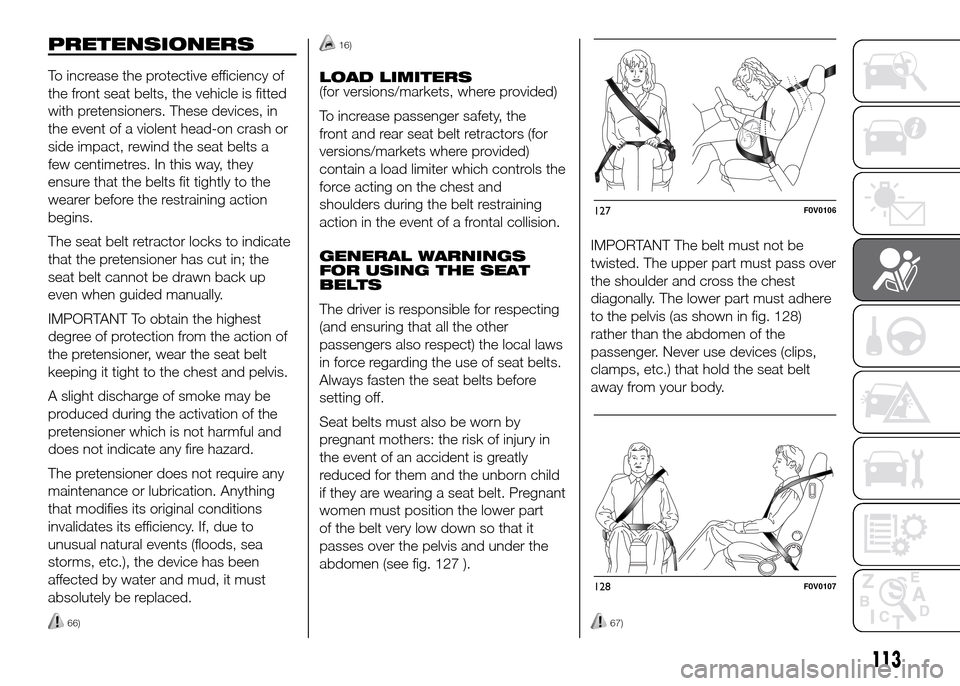
abdomen (see fig. 127 ).IMPORTANT The belt must not be
twisted. The upper part must pass over
the shoulder and cross the chest
diagonally. The lower part must adhere
to the pelvis (as shown in fig. 128)
rather than the abdomen of the
passenger. Never use devices (clips,
clamps, etc.) that hold the seat belt
away from your body.
67)
127F0V0106
128F0V0107
113
Page 133 of 323
STARTING AND DRIVING
Let’s get to the "heart" of the vehicle:
seeing how you can exploit all of its
potential to the full.
We’ll look at how to drive it safely in any
situation, so that it can be a welcome
companion, with our comfort and
our wallets in mind.STARTING THE ENGINE .................130
HANDBRAKE ..................................132
USING THE GEARBOX ...................133
START&STOP SYSTEM ..................134
TPMS (TYRE PRESSURE
MONITORING SYSTEM) .................138
SPEED BLOCK ...............................141
CRUISE CONTROL .........................141
TRACTION PLUS SYSTEM .............143
PARKING SENSORS.......................144
REFUELLING THE VEHICLE ...........146
SAVING FUEL .................................147
TOWING TRAILERS ........................149
SNOW TYRES ................................149
SNOW CHAINS...............................150
129
Page 136 of 323
HANDBRAKE
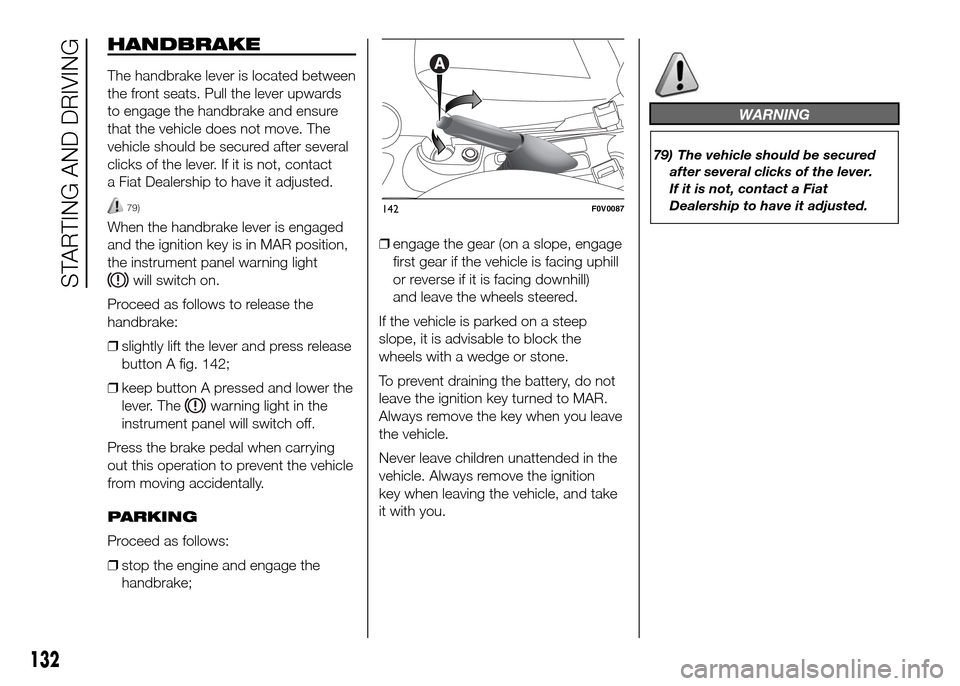
The handbrake lever is located between
the front seats. Pull the lever upwards
to engage the handbrake and ensure
that the vehicle does not move. The
vehicle should be secured after several
clicks of the lever. If it is not, contact
a Fiat Dealership to have it adjusted.
79)
When the handbrake lever is engaged
and the ignition key is in MAR position,
the instrument panel warning light
will switch on.
Proceed as follows to release the
handbrake:
❒slightly lift the lever and press release
button A fig. 142;
❒keep button A pressed and lower the
lever. The
warning light in the
instrument panel will switch off.
Press the brake pedal when carrying
out this operation to prevent the vehicle
from moving accidentally.
PARKING
Proceed as follows:
❒stop the engine and engage the
handbrake;❒engage the gear (on a slope, engage
first gear if the vehicle is facing uphill
or reverse if it is facing downhill)
and leave the wheels steered.
If the vehicle is parked on a steep
slope, it is advisable to block the
wheels with a wedge or stone.
To prevent draining the battery, do not
leave the ignition key turned to MAR.
Always remove the key when you leave
the vehicle.
Never leave children unattended in the
vehicle. Always remove the ignition
key when leaving the vehicle, and take
it with you.
WARNING
79) The vehicle should be secured
after several clicks of the lever.
If it is not, contact a Fiat
Dealership to have it adjusted.
142F0V0087
132
STARTING AND DRIVING
Page 145 of 323
SPEED BLOCK
(for versions/markets, where provided)
The vehicle is equipped with a speed
limitation function that can be set at the
user's request to one of four predefined
values: 90, 100, 110, 130 km/h.
To activate/deactivate this function,
contact a Fiat Dealership.
Following the operation, a sticker will be
applied to the windscreen showing the
top speed setting.
IMPORTANT The speedometer could
indicate a higher maximum speed than
the effective one, set by the Dealership,
in accordance with the regulations in
force.
CRUISE CONTROL
(for versions/markets, where provided)
IN BRIEF
This is an electronic driving aid that
allows you to drive at a speed of
above 30 km/h on long and straight
dry roads (e.g. motorways) with
few driving changes at a preset
speed without having to press the
accelerator pedal. It is therefore not
recommended to use this device
on extra-urban roads with traffic. Do
not use it in town.
Activating the device
When the device is activated, warning
light
comes on together with the
relevant message in the instrument
panel (for versions/markets where
provided).
The speed adjustment function cannot
be activated in 1st or reverse gear; it
is advisable to activate the function
in 4th or higher gears.
When travelling downhill with the device
activated, the vehicle speed may
exceed the memorised one.
95) 96)
Storing vehicle speed
Proceed as follows:
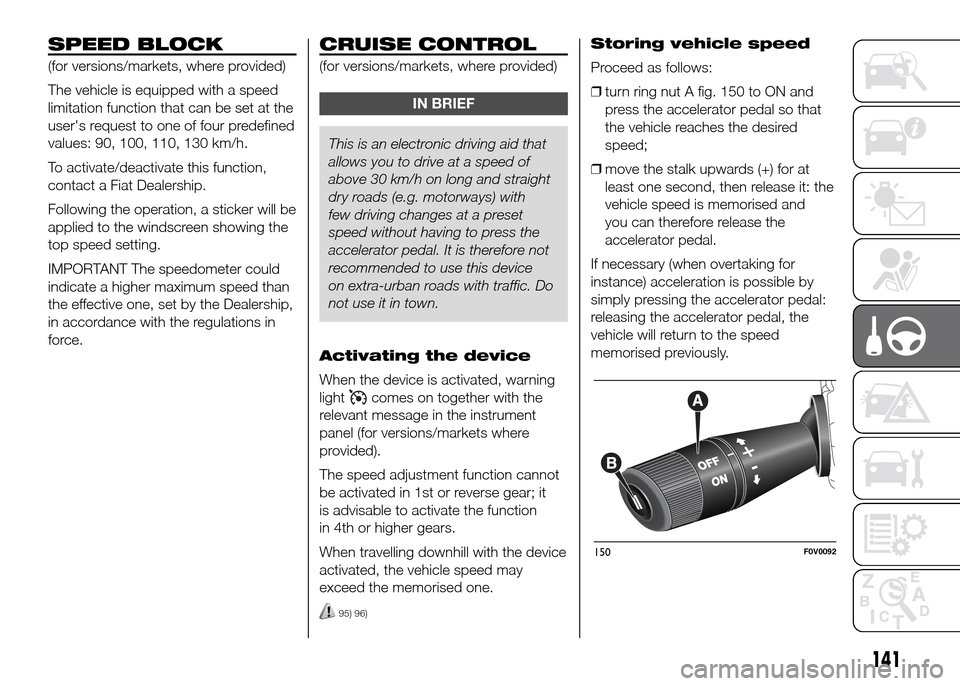
❒turn ring nut A fig. 150 to ON and
press the accelerator pedal so that
the vehicle reaches the desired
speed;
❒move the stalk upwards (+) for at
least one second, then release it: the
vehicle speed is memorised and
you can therefore release the
accelerator pedal.
If necessary (when overtaking for
instance) acceleration is possible by
simply pressing the accelerator pedal:
releasing the accelerator pedal, the
vehicle will return to the speed
memorised previously.
150F0V0092
141
Page 147 of 323
WARNING
95) When travelling with the device
active, never move the gear lever
to neutral.
96) In the event of device faults or
failures, turn the ring nut A to
OFF and contact a Fiat
Dealership.
TRACTION PLUS
SYSTEM
(for versions/markets, where provided)
Traction Plus is a driving aid, useful
for setting off in poor grip conditions
(snow, ice, mud, etc.) which allows the
drive force to be distributed in the
best way over the front axle when one
wheel is slipping.
Traction Plus acts by braking the
wheels with poor grip (or those slipping
more than the others), thereby
transferring the drive force to those
which have greater grip on the ground.
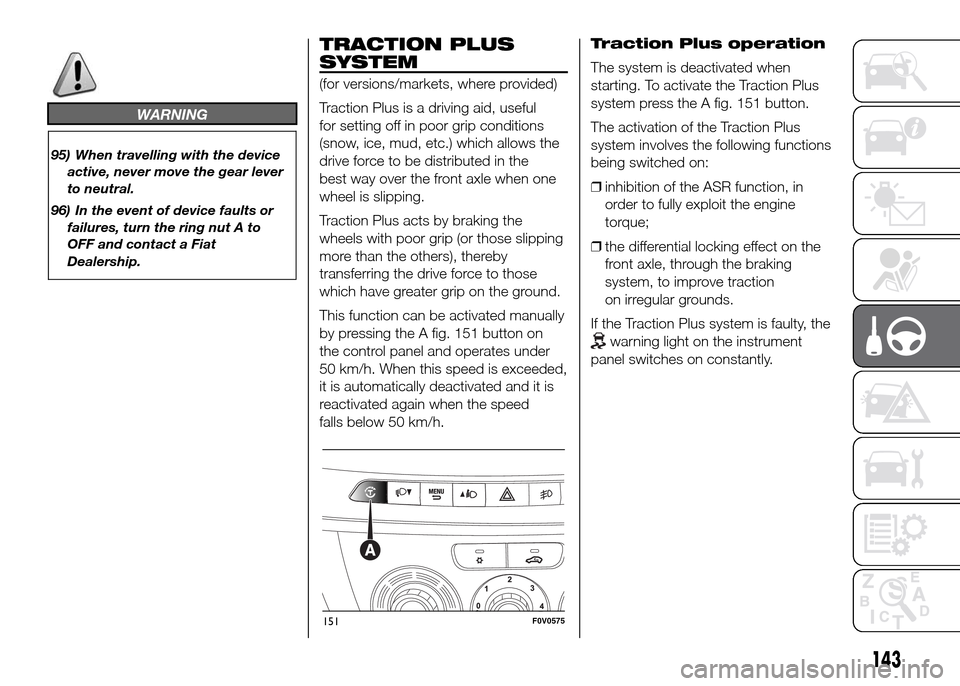
This function can be activated manually
by pressing the A fig. 151 button on
the control panel and operates under
50 km/h. When this speed is exceeded,
it is automatically deactivated and it is
reactivated again when the speed
falls below 50 km/h.Traction Plus operation
The system is deactivated when
starting. To activate the Traction Plus
system press the A fig. 151 button.
The activation of the Traction Plus
system involves the following functions
being switched on:
❒inhibition of the ASR function, in
order to fully exploit the engine
torque;
❒the differential locking effect on the
front axle, through the braking
system, to improve traction
on irregular grounds.
If the Traction Plus system is faulty, the
warning light on the instrument
panel switches on constantly.
151F0V0575
143
Page 150 of 323
REFUELLING THE
VEHICLE
PETROL ENGINES
Only use unleaded petrol, with an
octane number (R.O.N.) not lower than
95.
IMPORTANT An inefficient catalytic
converter leads to harmful exhaust
emissions, thus contributing to air
pollution.
IMPORTANT Never use leaded petrol,
even in small amounts or in an
emergency, as this would damage the
catalytic converter beyond repair.
DIESEL ENGINES
Operation at low
temperatures
If the outside temperature is very low,
the diesel thickens due to the formation
of paraffin clots with consequent
defective operation of the fuel supply
system.In order to avoid these problems,
different types of diesel are distributed
according to the season: summer type,
winter type and arctic type (cold/
mountain areas). If refuelling with diesel
fuel whose specifications are not
suitable for the current temperature, it is
advisable to mix TUTELA DIESEL ART
additive in the proportions shown on
the container. Pour the additive into the
tank before the diesel fuel.
When using or parking the vehicle for a
long time in the mountains or cold
areas, it is advisable to refuel using
locally available diesel fuel.
In this case, it is also advisable to keep
the tank over 50% full.
22)
FILLING THE TANK
To fill the tank completely, top up twice
after the first click of the fuel supply
gun. Further top ups could cause faults
in the fuel supply system.
FUEL TANK PLUG
Opening
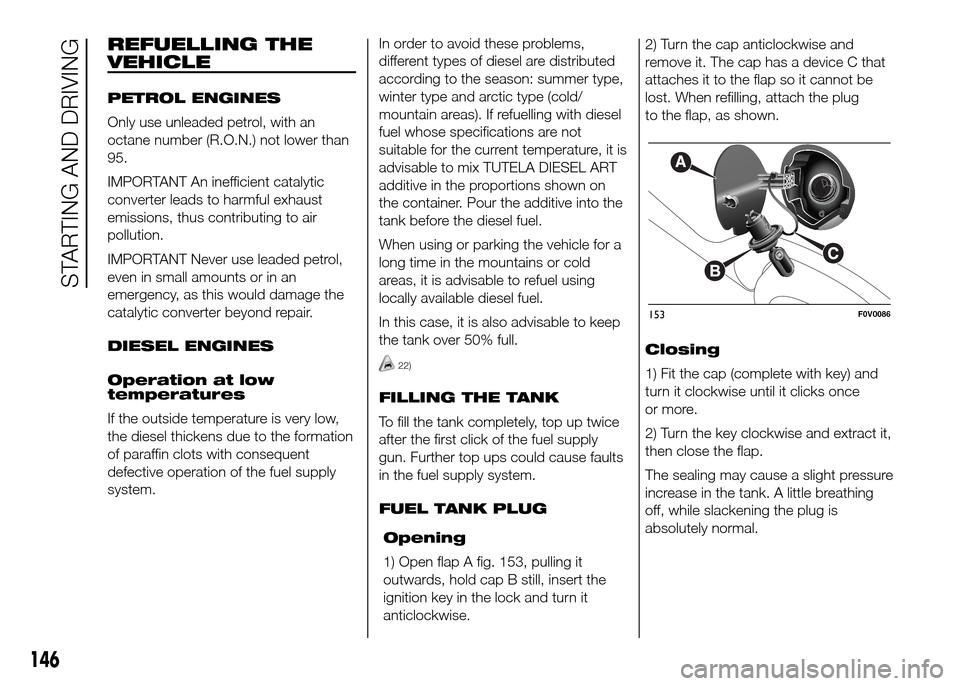
1) Open flap A fig. 153, pulling it
outwards, hold cap B still, insert the
ignition key in the lock and turn it
anticlockwise.2) Turn the cap anticlockwise and
remove it. The cap has a device C that
attaches it to the flap so it cannot be
lost. When refilling, attach the plug
to the flap, as shown.
Closing
1) Fit the cap (complete with key) and
turn it clockwise until it clicks once
or more.
2) Turn the key clockwise and extract it,
then close the flap.
The sealing may cause a slight pressure
increase in the tank. A little breathing
off, while slackening the plug is
absolutely normal.
153F0V0086
146
STARTING AND DRIVING
Page 157 of 323
TYPES OF BULBS
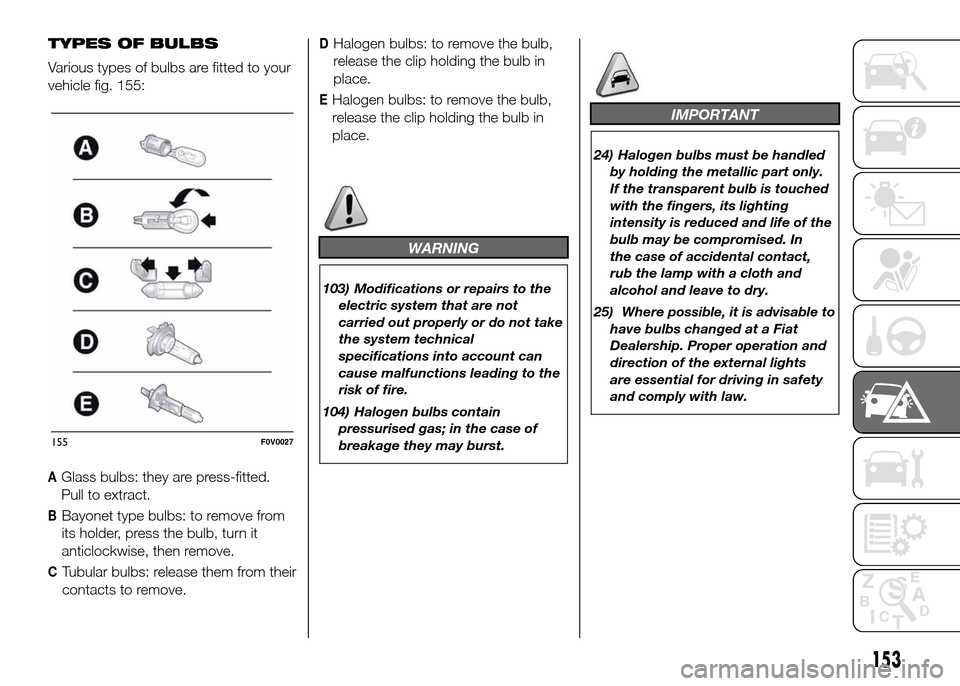
Various types of bulbs are fitted to your
vehicle fig. 155:
AGlass bulbs: they are press-fitted.
Pull to extract.
BBayonet type bulbs: to remove from
its holder, press the bulb, turn it
anticlockwise, then remove.
CTubular bulbs: release them from their
contacts to remove.
DHalogen bulbs: to remove the bulb,
release the clip holding the bulb in
place.
EHalogen bulbs: to remove the bulb,
release the clip holding the bulb in
place.
WARNING
103) Modifications or repairs to the
electric system that are not
carried out properly or do not take
the system technical
specifications into account can
cause malfunctions leading to the
risk of fire.
104) Halogen bulbs contain
pressurised gas; in the case of
breakage they may burst.
IMPORTANT
24) Halogen bulbs must be handled
by holding the metallic part only.
If the transparent bulb is touched
with the fingers, its lighting
intensity is reduced and life of the
bulb may be compromised. In
the case of accidental contact,
rub the lamp with a cloth and
alcohol and leave to dry.
25) Where possible, it is advisable to
have bulbs changed at a Fiat
Dealership. Proper operation and
direction of the external lights
are essential for driving in safety
and comply with law.
155F0V0027
153