warning lights FIAT DOBLO PANORAMA 2016 2.G Owner's Guide
[x] Cancel search | Manufacturer: FIAT, Model Year: 2016, Model line: DOBLO PANORAMA, Model: FIAT DOBLO PANORAMA 2016 2.GPages: 323, PDF Size: 25.46 MB
Page 110 of 323
ACTIVE SAFETY
SYSTEMS
The vehicle has the following active
safety systems:
❒ABS;
❒EBD system;
❒Brake Assist system;
❒ESP system;
❒ASR system;
❒Hill Holder system;
❒MSR system;
For the operation of the systems, see
the following pages.
ABS
This is an integral part of the braking
system, which prevents one or more
wheels from locking or slipping
regardless of the road surface
conditions and braking intensity,
ensuring control of the vehicle even
during emergency braking.
The EBD system (Electronic Braking
Force Distribution) completes the
system allowing the brake force to be
distributed between the front and
rear wheels.
IMPORTANT To get the maximum
efficiency of the braking system,
a bedding-in period of about 500 km is
needed: during this period it is better
to avoid sharp, repeated and prolonged
braking.
SYSTEM INTERVENTION
The driver can feel that the ABS has
come into action because the brake
pedal pulsates slightly and the system
gets noisier: it means that the vehicle
speed should be altered to suit the type
of road surface.
53) 54) 55)
FAULT INDICATIONS
ABS failure
This is indicated by the
warning
light in the instrument panel coming on
(together with the appropriate message
on the multifunction display on some
versions) (see the “Warning lights and
messages” chapter).
In this case, the braking system will still
be effective, although without the
extra capacity offered by the ABS.
Drive carefully to the nearest Fiat
Dealership to have the system
checked.
EBD failure
This is indicated by the
and
warning lights in the instrument
panel coming on (together with the
appropriate message on the
multifunction display on some versions)
(see the “Warning lights and messages”
chapter).
In this case, the rear wheels may
suddenly lock and the vehicle may
swerve when braking sharply. Drive
carefully to the nearest Fiat Dealership
to have the system checked.
56)
106
SAFETY
Page 111 of 323
BRAKE ASSIST
(integrated ESP
emergency braking
assistance)
(for versions/markets, where provided)
This system (which cannot be
deactivated) recognises emergency
braking conditions according to the
speed of operation of the brake pedal
and provides an additional hydraulic
braking pressure to support that
provided by the driver. This allows
faster and more powerful operation of
the braking system.
Brake Assist is deactivated on the
versions equipped with ESP, in the
event of ESP system failure (indicated
by the
warning light coming on
together with the message in the
multifunction display, where provided).
57)
WARNING
53) When the ABS cuts in and you
feel the brake pedal pulsating,
do not raise your foot, but keep it
pressed; in doing so you will stop
in the shortest amount of space
possible depending on the current
road conditions.
54) If the ABS intervenes, it is a sign
that the grip between tyre and the
road surface has reached the
limit: you must slow down to
adapt the speed to the road grip
available.
55) The ABS exploits the grip
available to the full, but it cannot
improve it. Therefore, you should
take great care when driving on
slippery surfaces, without taking
unnecessary risks.56) If only the
warning light
lights up in the instrument panel
(with a message in the display
on some versions), stop the
vehicle immediately and contact
the nearest Fiat Dealership. Fluid
leaking from the hydraulic system
will compromise the operation
of the braking system, whether it
is of the conventional type or
with ABS.
57) When the ABS cuts in and you
feel the brake pedal pulsating,
do not raise your foot, but keep it
pressed; in doing so you will stop
in the shortest amount of space
possible depending on the current
road conditions.
107
Page 112 of 323
ESC (Electronic
Stability Control)
SYSTEM
(for versions/markets, where provided)
IN BRIEF
This is an electronic system that
controls vehicle stability in the event
of tyre grip loss, helping to maintain
directional control.
The ESC system is therefore
particularly useful when grip
conditions of road surfaces change.
The MSR system (adjustment of
the engine braking torque during gear
changes) and the HBA system
(automatic increase in the braking
pressure during emergency braking)
are present with ESC, ASR and
Hill Holder systems (for
versions/markets where provided).
SYSTEM INTERVENTION
This is signalled by the flashing of the
warning light in the instrument panel,
to inform the driver that the vehicle is
in critical stability and grip conditions.SYSTEM ACTIVATION
The ESC system is automatically
activated when the vehicle is started.
FAULT INDICATIONS
In the event of a fault, the ESC will be
automatically switched off and the
warning light will come on
permanently on the instrument panel
along with a message on the
multifunction display (for versions/
markets where provided) (see "Warning
lights and messages" section). The
LED on the ASR OFF button will also
light up. Contact a Fiat Dealership
as soon as possible.
58)
HILL HOLDER SYSTEM
This system is an integral part of the
ESC system and facilitates starting on
slopes. It is automatically activated
in the following conditions:
❒uphill: vehicle stationary on a road
with a gradient higher than 5%,
engine running, brake pressed and
gearbox in neutral or gear (other than
reverse) engaged;
❒downhill: vehicle stationary on a road
with a gradient higher than 5%,
engine running, brake pressed and
reverse gear engaged.When setting off, the ESC system
control unit maintains the braking
pressure at the wheels until the torque
necessary for starting is reached, or
in any case for a maximum of 1.75
seconds, allowing your right foot to be
moved easily from the brake pedal to
the accelerator.
If the vehicle has not departed after
1.75 seconds, the system will
deactivate automatically by gradually
releasing the brake force.
During this release stage, the typical
brake disengagement noise indicating
that the vehicle is going to move
imminently will be heard.
Fault indications
Any system fault is indicated by the
turning on of the
warning light on
the instrument panel with digital display
and the
warning light on the
instrument panel with multifunction
display (for versions/markets where
provided) (see section “Warning lights
and messages”).
IMPORTANT The Hill Holder system is
not a parking brake, therefore do not
leave the vehicle without activating the
handbrake, switching off the engine
and engaging first gear.
59)
108
SAFETY
Page 114 of 323
For the correct operation of the ASR
system, the tyres must absolutely
be the same make and type on all
wheels, in perfect condition and, above
all, of the type, make and size specified.
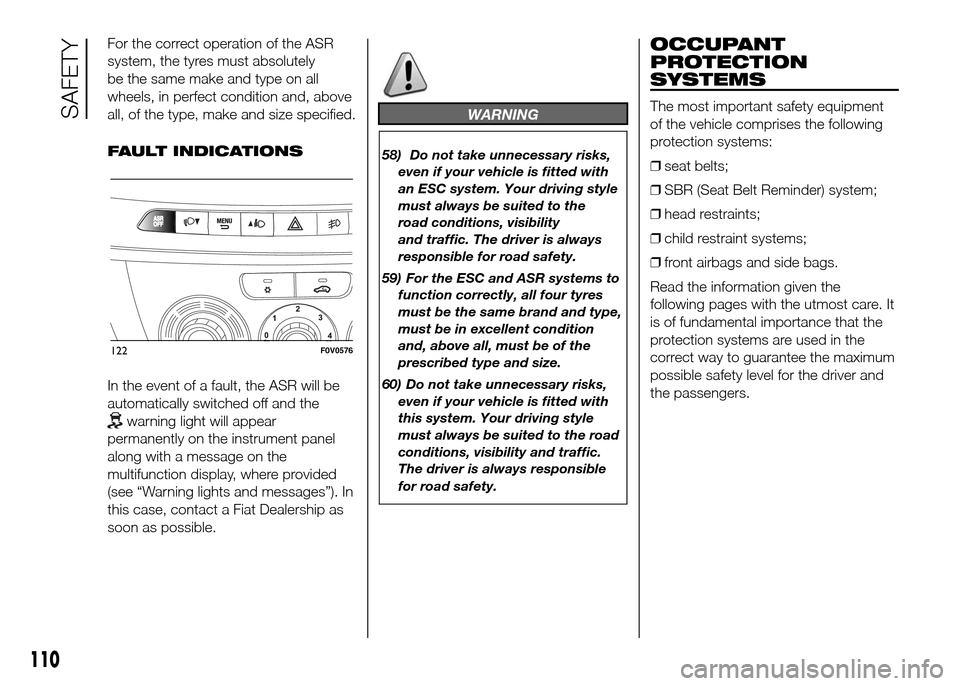
FAULT INDICATIONS
In the event of a fault, the ASR will be
automatically switched off and the
warning light will appear
permanently on the instrument panel
along with a message on the
multifunction display, where provided
(see “Warning lights and messages”). In
this case, contact a Fiat Dealership as
soon as possible.
WARNING
58) Do not take unnecessary risks,
even if your vehicle is fitted with
an ESC system. Your driving style
must always be suited to the
road conditions, visibility
and traffic. The driver is always
responsible for road safety.
59) For the ESC and ASR systems to
function correctly, all four tyres
must be the same brand and type,
must be in excellent condition
and, above all, must be of the
prescribed type and size.
60) Do not take unnecessary risks,
even if your vehicle is fitted with
this system. Your driving style
must always be suited to the road
conditions, visibility and traffic.
The driver is always responsible
for road safety.
OCCUPANT
PROTECTION
SYSTEMS
The most important safety equipment
of the vehicle comprises the following
protection systems:
❒seat belts;
❒SBR (Seat Belt Reminder) system;
❒head restraints;
❒child restraint systems;
❒front airbags and side bags.
Read the information given the
following pages with the utmost care. It
is of fundamental importance that the
protection systems are used in the
correct way to guarantee the maximum
possible safety level for the driver and
the passengers.
122F0V0576
110
SAFETY
Page 134 of 323
STARTING THE
ENGINE
The vehicle is fitted with an immobiliser:
if the engine fails to start, see the
paragraph on “The Fiat CODE system”
in the “Dashboard and controls”
section.
The engine may be noisier during the
first few seconds of operation,
especially after a long period of
inactivity. This is due to the hydraulic
tappets, the timing system chosen for
petrol engine versions to reduce the
number of servicing interventions, and
affects neither functionality nor reliability.
17) 18)
78)
PROCEDURE FOR
PETROL VERSIONS
Proceed as follows:
❒engage the handbrake;
❒put the gear lever into neutral;
❒fully depress the clutch pedal,
without touching the accelerator;
❒turn the ignition key to AVV and
release it as soon as the engine
starts.If the engine does not start at the first
attempt, return the ignition key to STOP
before repeating the starting procedure.
If, when the ignition key is on MAR,
the instrument panel warning light
remains on together with warning
light
, turn the key to STOP and
then back to MAR; if the warning light
remains on, try the other keys provided
with the vehicle. If you are still unable
to start the engine, perform the
emergency starting procedure (see
"Emergency starting" in the "In an
emergency" chapter) and contact a Fiat
Dealership.
PROCEDURE FOR DIESEL
VERSIONS
Proceed as follows:
❒engage the handbrake;
❒put the gear lever into neutral;
❒turn the ignition key to MAR: the
warning lights
andon
the instrument panel will turn on;
❒wait for the warning lights
and
to switch off. The hotter the
engine is, the quicker this will
happen;
❒fully depress the clutch pedal,
without touching the accelerator;❒turn the ignition key to AVV as soon
as warning light
switches off.
Waiting too long will waste the
heating work carried out by the glow
plugs.
Release the key as soon as the engine
starts.
IMPORTANT With the engine cold, the
accelerator pedal must be fully released
when you turn the ignition key to AVV.
If the engine does not start at the
first attempt, return the ignition key to
STOP before repeating the starting
procedure.
If, when the ignition key is at MAR the
warning light remains lit, turn the
key to STOP and then back to MAR; if
the warning light remains lit, try with the
other keys provided with the vehicle. If
you still cannot start the engine, contact
a Fiat Dealership.
19)
WARMING UP THE
ENGINE JUST AFTER IT
HAS STARTED
Proceed as follows:
❒drive off slowly, letting the engine turn
at medium revs. Do not accelerate
abruptly;
130
STARTING AND DRIVING
Page 148 of 323
PARKING SENSORS
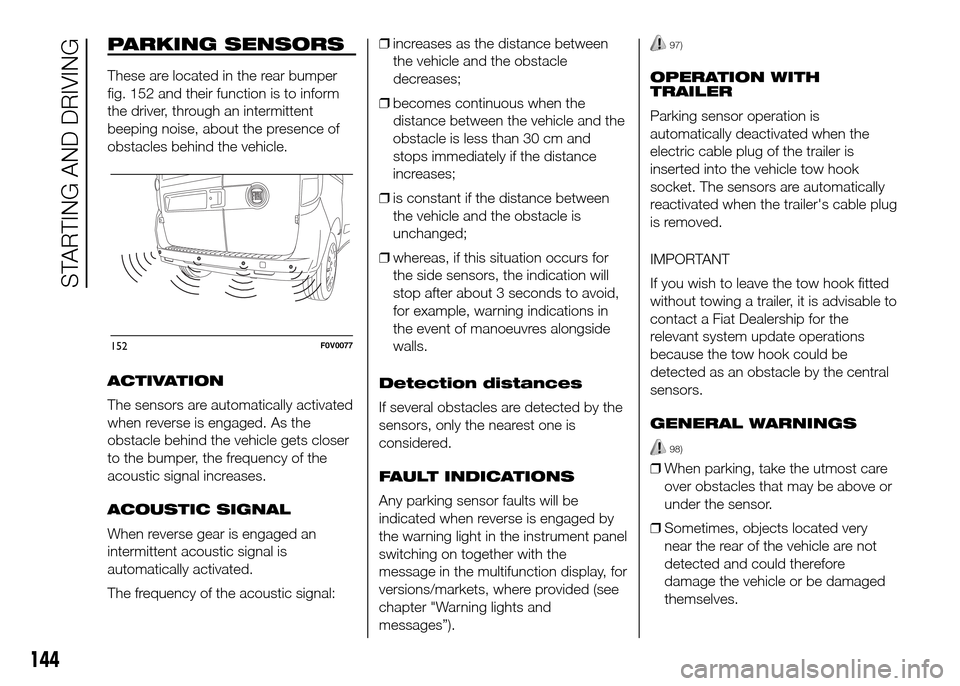
These are located in the rear bumper
fig. 152 and their function is to inform
the driver, through an intermittent
beeping noise, about the presence of
obstacles behind the vehicle.
ACTIVATION
The sensors are automatically activated
when reverse is engaged. As the
obstacle behind the vehicle gets closer
to the bumper, the frequency of the
acoustic signal increases.
ACOUSTIC SIGNAL
When reverse gear is engaged an
intermittent acoustic signal is
automatically activated.
The frequency of the acoustic signal:❒increases as the distance between
the vehicle and the obstacle
decreases;
❒becomes continuous when the
distance between the vehicle and the
obstacle is less than 30 cm and
stops immediately if the distance
increases;
❒is constant if the distance between
the vehicle and the obstacle is
unchanged;
❒whereas, if this situation occurs for
the side sensors, the indication will
stop after about 3 seconds to avoid,
for example, warning indications in
the event of manoeuvres alongside
walls.
Detection distances
If several obstacles are detected by the
sensors, only the nearest one is
considered.
FAULT INDICATIONS
Any parking sensor faults will be
indicated when reverse is engaged by
the warning light in the instrument panel
switching on together with the
message in the multifunction display, for
versions/markets, where provided (see
chapter "Warning lights and
messages”).
97)
OPERATION WITH
TRAILER
Parking sensor operation is
automatically deactivated when the
electric cable plug of the trailer is
inserted into the vehicle tow hook
socket. The sensors are automatically
reactivated when the trailer's cable plug
is removed.
IMPORTANT
If you wish to leave the tow hook fitted
without towing a trailer, it is advisable to
contact a Fiat Dealership for the
relevant system update operations
because the tow hook could be
detected as an obstacle by the central
sensors.
GENERAL WARNINGS
98)
❒When parking, take the utmost care
over obstacles that may be above or
under the sensor.
❒Sometimes, objects located very
near the rear of the vehicle are not
detected and could therefore
damage the vehicle or be damaged
themselves.
152F0V0077
144
STARTING AND DRIVING
Page 155 of 323
IN AN EMERGENCY
A punctured tyre or a burnt-out bulb?
At times, a problem may interfere
with our journey.
The pages on emergencies can help
you to deal with critical situations
independently and with calm.
In an emergency we recommend that
you call the freephone number found in
the Warranty Booklet.
It is also possible to call the 00 800
3428 0000 freephone number to
search the nearest Fiat Dealership.HAZARD WARNING LIGHTS...........152
REPLACING A BULB ......................152
REPLACING AN EXTERIOR BULB ..155
REPLACING AN INTERIOR BULB ...158
REPLACING FUSES........................160
CHANGING A WHEEL ....................166
FIX&GO AUTOMATIC QUICK TYRE
REPAIR KIT .....................................170
EMERGENCY STARTING ................174
FUEL CUT-OFF SYSTEM ................175
LIFTING THE VEHICLE....................176
TOWING THE VEHICLE ..................176
151
Page 156 of 323
HAZARD WARNING
LIGHTS
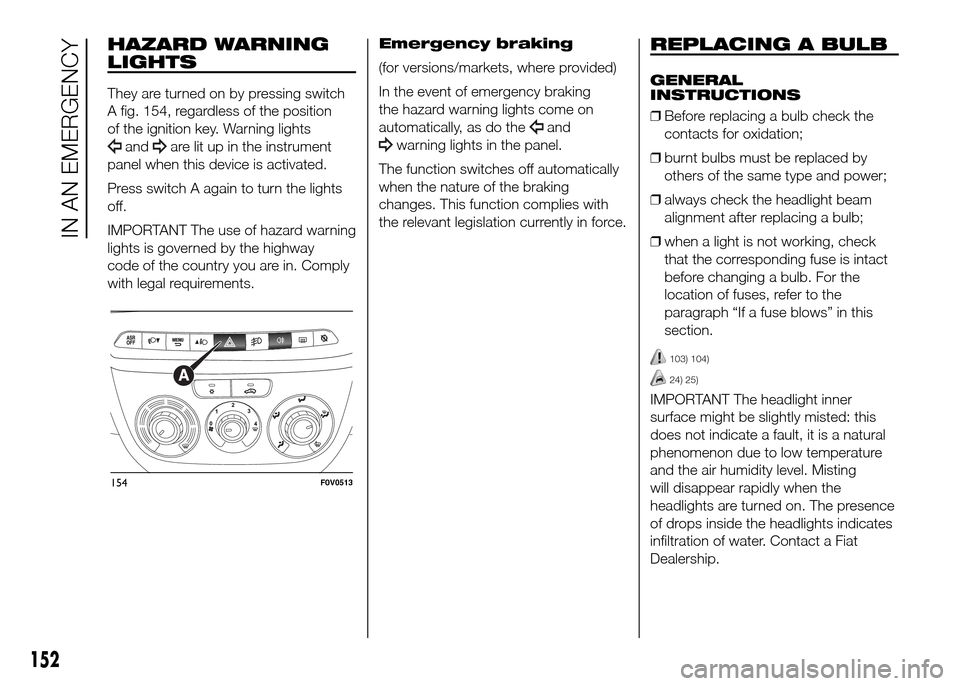
They are turned on by pressing switch
A fig. 154, regardless of the position
of the ignition key. Warning lights
andare lit up in the instrument
panel when this device is activated.
Press switch A again to turn the lights
off.
IMPORTANT The use of hazard warning
lights is governed by the highway
code of the country you are in. Comply
with legal requirements.Emergency braking
(for versions/markets, where provided)
In the event of emergency braking
the hazard warning lights come on
automatically, as do the
and
warning lights in the panel.
The function switches off automatically
when the nature of the braking
changes. This function complies with
the relevant legislation currently in force.
REPLACING A BULB
GENERAL
INSTRUCTIONS
❒Before replacing a bulb check the
contacts for oxidation;
❒burnt bulbs must be replaced by
others of the same type and power;
❒always check the headlight beam
alignment after replacing a bulb;
❒when a light is not working, check
that the corresponding fuse is intact
before changing a bulb. For the
location of fuses, refer to the
paragraph “If a fuse blows” in this
section.
103) 104)
24) 25)
IMPORTANT The headlight inner
surface might be slightly misted: this
does not indicate a fault, it is a natural
phenomenon due to low temperature
and the air humidity level. Misting
will disappear rapidly when the
headlights are turned on. The presence
of drops inside the headlights indicates
infiltration of water. Contact a Fiat
Dealership.
154F0V0513
152
IN AN EMERGENCY
Page 157 of 323
TYPES OF BULBS
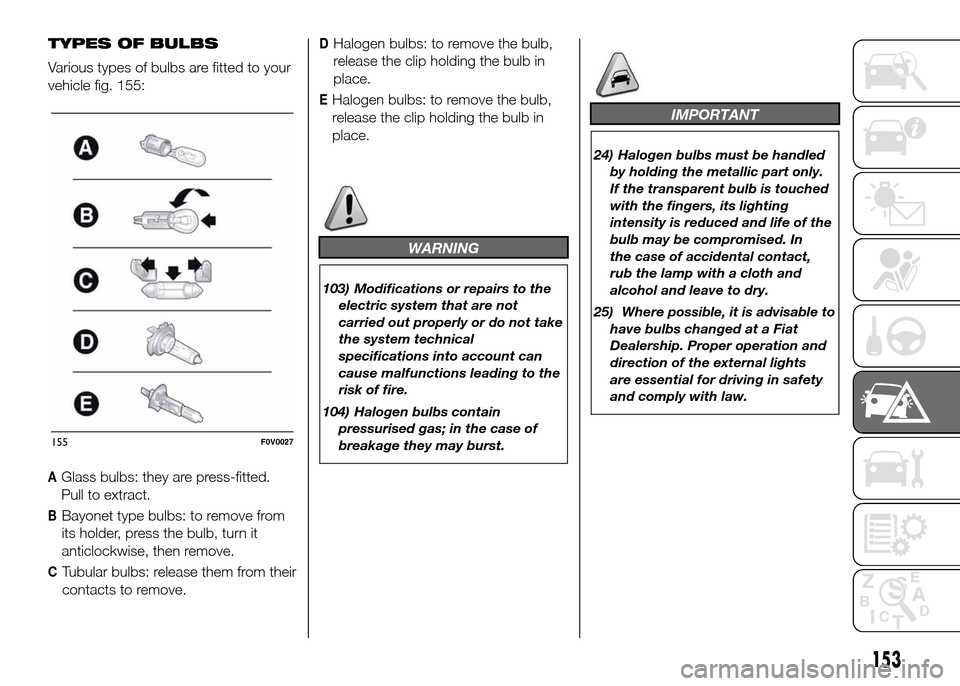
Various types of bulbs are fitted to your
vehicle fig. 155:
AGlass bulbs: they are press-fitted.
Pull to extract.
BBayonet type bulbs: to remove from
its holder, press the bulb, turn it
anticlockwise, then remove.
CTubular bulbs: release them from their
contacts to remove.
DHalogen bulbs: to remove the bulb,
release the clip holding the bulb in
place.
EHalogen bulbs: to remove the bulb,
release the clip holding the bulb in
place.
WARNING
103) Modifications or repairs to the
electric system that are not
carried out properly or do not take
the system technical
specifications into account can
cause malfunctions leading to the
risk of fire.
104) Halogen bulbs contain
pressurised gas; in the case of
breakage they may burst.
IMPORTANT
24) Halogen bulbs must be handled
by holding the metallic part only.
If the transparent bulb is touched
with the fingers, its lighting
intensity is reduced and life of the
bulb may be compromised. In
the case of accidental contact,
rub the lamp with a cloth and
alcohol and leave to dry.
25) Where possible, it is advisable to
have bulbs changed at a Fiat
Dealership. Proper operation and
direction of the external lights
are essential for driving in safety
and comply with law.
155F0V0027
153
Page 170 of 323
CHANGING A WHEEL
The vehicle is originally equipped with
the Fix&Go automatic quick tyre repair
kit (see instructions in the next section).
As an alternative, the vehicle may
have a normal-sized spare wheel.
Wheel changing and correct use of the
jack and spare wheel call for some
precautions, as listed below.
108) 109) 110) 111)
Note for one-way tyres
One-way tyres have a few arrows
on the side indicating the rotation
direction. If a wheel is changed (when
punctured, for example) the direction of
the arrows on the spare wheel tyre
may not coincide with the rotation
direction of the wheel to be replaced.
In these conditions, too, the tyre still
maintains its safety features.
Anyway, it is recommended to have the
wheel repaired and refitted as soon as
possible, as the best performance is
achieved when the rotation direction of
all tyres coincides with the one
indicated by the arrows.
Please note that:
❒the jack weight is 4 kg;
❒the jack requires no adjustment;❒the jack cannot be repaired and in
the event of a fault it must be
replaced by another original one;
❒no tool other than its cranking device
may be fitted on the jack.
To change a wheel, proceed as follows:
❒stop the vehicle in a position that is
not dangerous for oncoming traffic
where you can change the wheel
safely. The ground should be flat
if possible, and sufficiently firm;
❒stop the engine and pull the
handbrake;
❒engage first gear or reverse;
❒wear the reflective safety jacket
(compulsory by law in certain
countries) before getting out of the
vehicle;
❒indicate that the vehicle has broken
down using the devices required by
the law in the current country (e.g.
warning triangle, hazard lights, etc.);
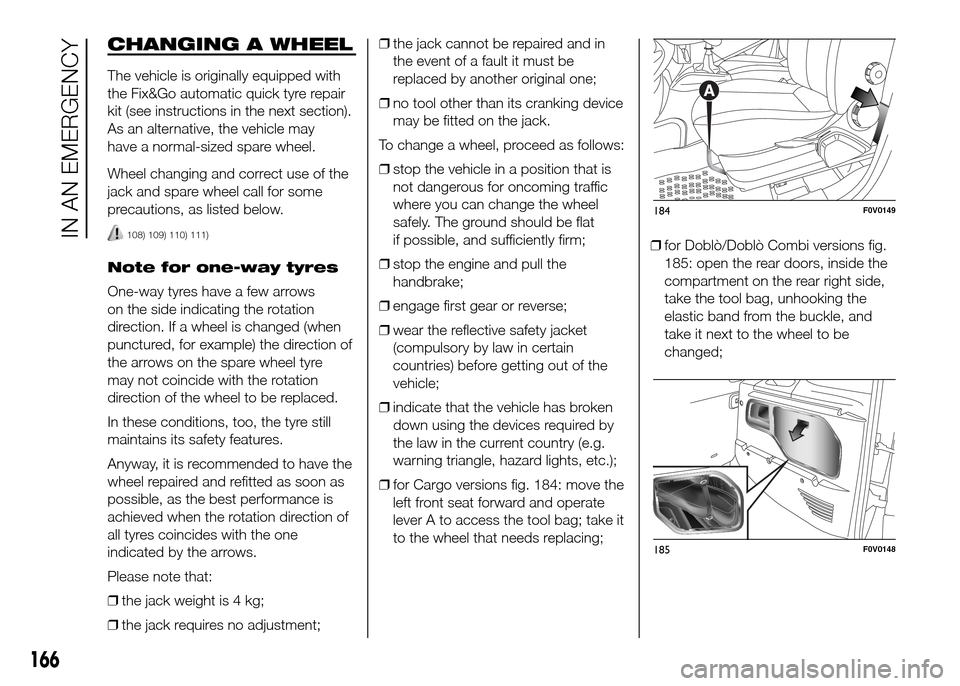
❒for Cargo versions fig. 184: move the
left front seat forward and operate
lever A to access the tool bag; take it
to the wheel that needs replacing;❒for Doblò/Doblò Combi versions fig.
185: open the rear doors, inside the
compartment on the rear right side,
take the tool bag, unhooking the
elastic band from the buckle, and
take it next to the wheel to be
changed;
184F0V0149
185F0V0148
166
IN AN EMERGENCY