roof FIAT DOBLO PANORAMA 2016 2.G Service Manual
[x] Cancel search | Manufacturer: FIAT, Model Year: 2016, Model line: DOBLO PANORAMA, Model: FIAT DOBLO PANORAMA 2016 2.GPages: 323, PDF Size: 25.46 MB
Page 262 of 323
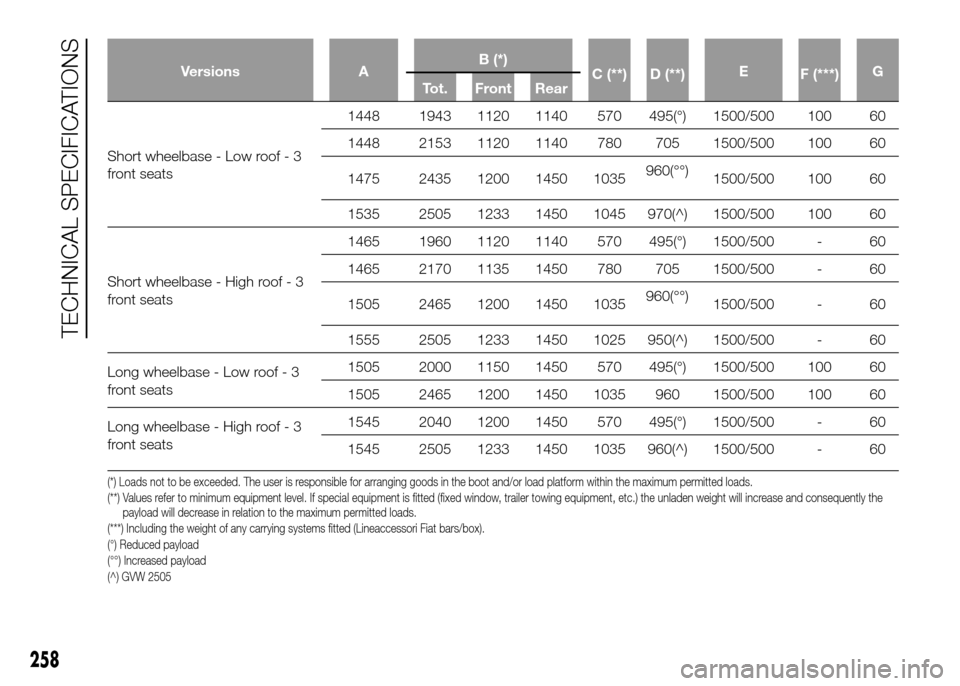
Versions AB (*)
C (**) D (**)E
F (***)G
Tot. Front Rear
Short wheelbase - Low roof - 3
front seats1448 1943 1120 1140 570 495(°) 1500/500 100 60
1448 2153 1120 1140 780 705 1500/500 100 60
1475 2435 1200 1450 1035960(°°)
1500/500 100 60
1535 2505 1233 1450 1045 970(^) 1500/500 100 60
Short wheelbase - High roof - 3
front seats1465 1960 1120 1140 570 495(°) 1500/500 - 60
1465 2170 1135 1450 780 705 1500/500 - 60
1505 2465 1200 1450 1035960(°°)
1500/500 - 60
1555 2505 1233 1450 1025 950(^) 1500/500 - 60
Long wheelbase - Low roof - 3
front seats1505 2000 1150 1450 570 495(°) 1500/500 100 60
1505 2465 1200 1450 1035 960 1500/500 100 60
Long wheelbase - High roof - 3
front seats1545 2040 1200 1450 570 495(°) 1500/500 - 60
1545 2505 1233 1450 1035 960(^) 1500/500 - 60
(*) Loads not to be exceeded. The user is responsible for arranging goods in the boot and/or load platform within the maximum permitted loads.
(**) Values refer to minimum equipment level. If special equipment is fitted (fixed window, trailer towing equipment, etc.) the unladen weight will increase and consequently the
payload will decrease in relation to the maximum permitted loads.
(***) Including the weight of any carrying systems fitted (Lineaccessori Fiat bars/box).
(°) Reduced payload
(°°) Increased payload
(^) GVW 2505
258
TECHNICAL SPECIFICATIONS
Page 263 of 323
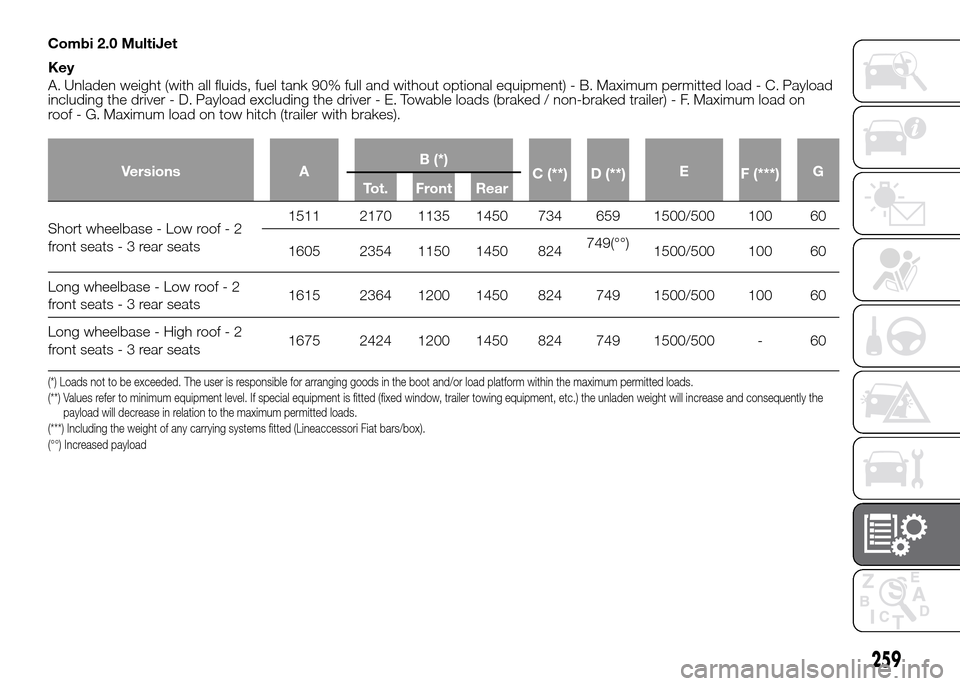
Combi 2.0 MultiJet
Key
A. Unladen weight (with all fluids, fuel tank 90% full and without optional equipment) - B. Maximum permitted load - C. Payload
including the driver - D. Payload excluding the driver - E. Towable loads (braked / non-braked trailer) - F. Maximum load on
roof - G. Maximum load on tow hitch (trailer with brakes).
Versions AB (*)
C (**) D (**)E
F (***)G
Tot. Front Rear
Short wheelbase - Low roof - 2
front seats-3rearseats1511 2170 1135 1450 734 659 1500/500 100 60
1605 2354 1150 1450 824749(°°)
1500/500 100 60
Long wheelbase - Low roof - 2
front seats-3rearseats1615 2364 1200 1450 824 749 1500/500 100 60
Long wheelbase - High roof - 2
front seats-3rearseats1675 2424 1200 1450 824 749 1500/500 - 60
(*) Loads not to be exceeded. The user is responsible for arranging goods in the boot and/or load platform within the maximum permitted loads.
(**) Values refer to minimum equipment level. If special equipment is fitted (fixed window, trailer towing equipment, etc.) the unladen weight will increase and consequently the
payload will decrease in relation to the maximum permitted loads.
(***) Including the weight of any carrying systems fitted (Lineaccessori Fiat bars/box).
(°°) Increased payload
259
Page 264 of 323
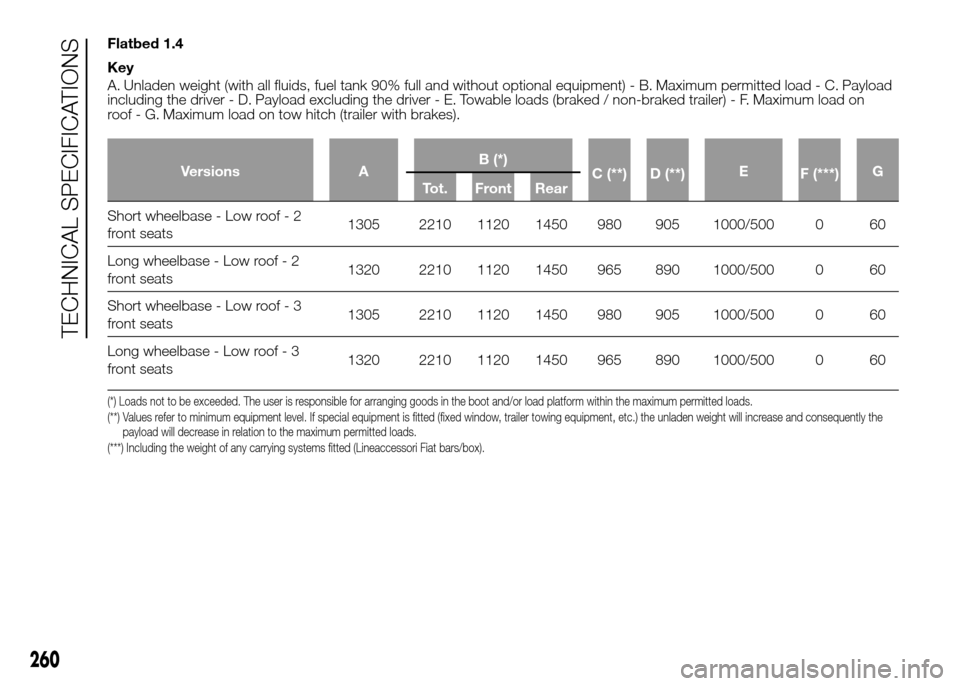
Flatbed 1.4
Key
A. Unladen weight (with all fluids, fuel tank 90% full and without optional equipment) - B. Maximum permitted load - C. Payload
including the driver - D. Payload excluding the driver - E. Towable loads (braked / non-braked trailer) - F. Maximum load on
roof - G. Maximum load on tow hitch (trailer with brakes).
Versions AB (*)
C (**) D (**)E
F (***)G
Tot. Front Rear
Short wheelbase - Low roof - 2
front seats1305 2210 1120 1450 980 905 1000/500 0 60
Long wheelbase - Low roof - 2
front seats1320 2210 1120 1450 965 890 1000/500 0 60
Short wheelbase - Low roof - 3
front seats1305 2210 1120 1450 980 905 1000/500 0 60
Long wheelbase - Low roof - 3
front seats1320 2210 1120 1450 965 890 1000/500 0 60
(*) Loads not to be exceeded. The user is responsible for arranging goods in the boot and/or load platform within the maximum permitted loads.
(**) Values refer to minimum equipment level. If special equipment is fitted (fixed window, trailer towing equipment, etc.) the unladen weight will increase and consequently the
payload will decrease in relation to the maximum permitted loads.
(***) Including the weight of any carrying systems fitted (Lineaccessori Fiat bars/box).
260
TECHNICAL SPECIFICATIONS
Page 265 of 323
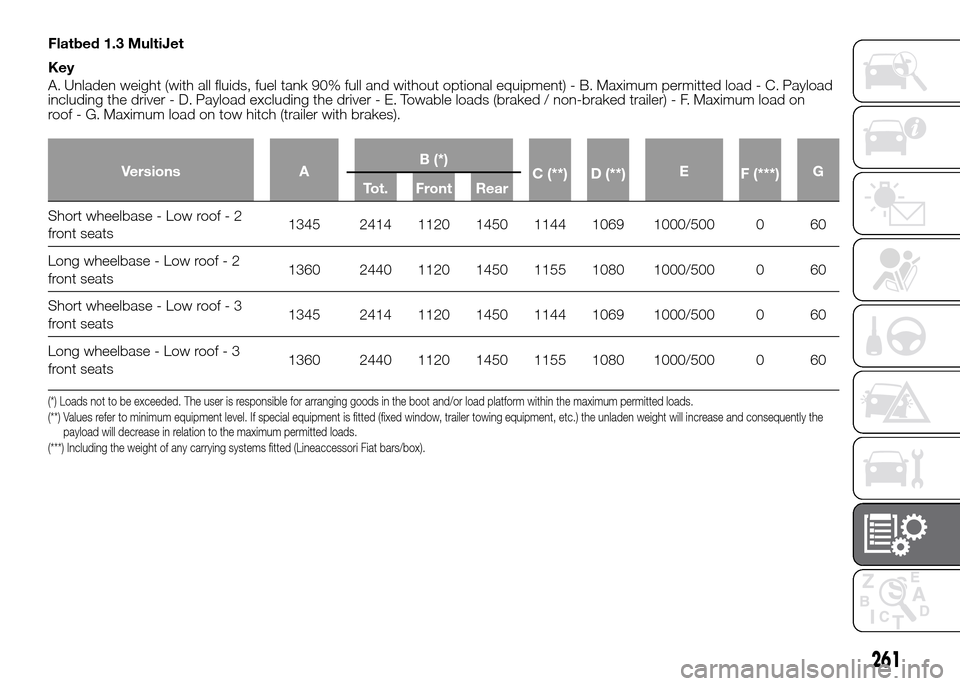
Flatbed 1.3 MultiJet
Key
A. Unladen weight (with all fluids, fuel tank 90% full and without optional equipment) - B. Maximum permitted load - C. Payload
including the driver - D. Payload excluding the driver - E. Towable loads (braked / non-braked trailer) - F. Maximum load on
roof - G. Maximum load on tow hitch (trailer with brakes).
Versions AB (*)
C (**) D (**)E
F (***)G
Tot. Front Rear
Short wheelbase - Low roof - 2
front seats1345 2414 1120 1450 1144 1069 1000/500 0 60
Long wheelbase - Low roof - 2
front seats1360 2440 1120 1450 1155 1080 1000/500 0 60
Short wheelbase - Low roof - 3
front seats1345 2414 1120 1450 1144 1069 1000/500 0 60
Long wheelbase - Low roof - 3
front seats1360 2440 1120 1450 1155 1080 1000/500 0 60
(*) Loads not to be exceeded. The user is responsible for arranging goods in the boot and/or load platform within the maximum permitted loads.
(**) Values refer to minimum equipment level. If special equipment is fitted (fixed window, trailer towing equipment, etc.) the unladen weight will increase and consequently the
payload will decrease in relation to the maximum permitted loads.
(***) Including the weight of any carrying systems fitted (Lineaccessori Fiat bars/box).
261
Page 266 of 323
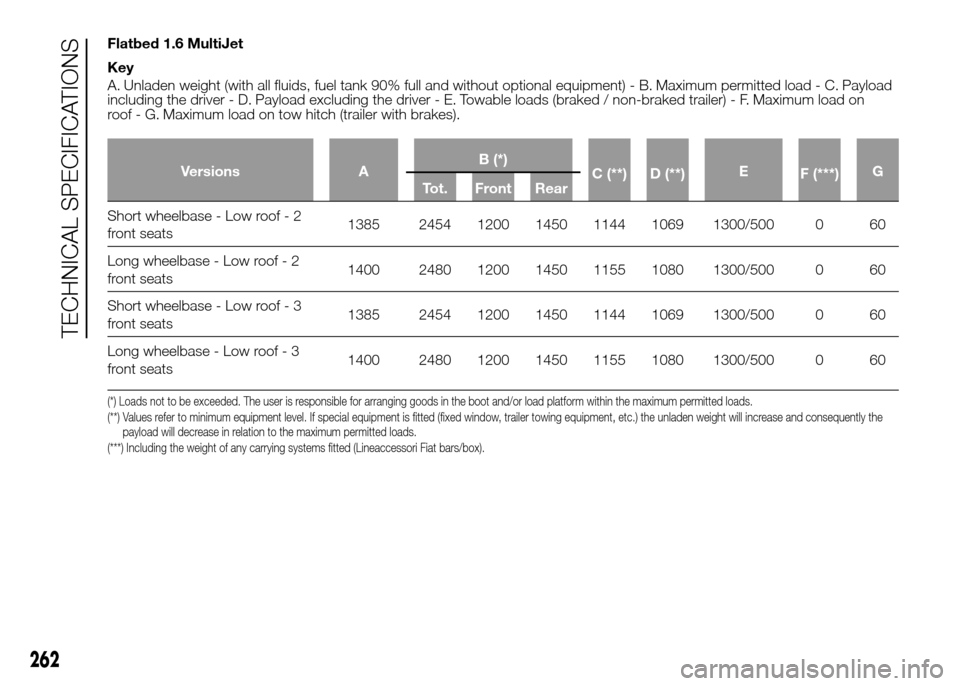
Flatbed 1.6 MultiJet
Key
A. Unladen weight (with all fluids, fuel tank 90% full and without optional equipment) - B. Maximum permitted load - C. Payload
including the driver - D. Payload excluding the driver - E. Towable loads (braked / non-braked trailer) - F. Maximum load on
roof - G. Maximum load on tow hitch (trailer with brakes).
Versions AB (*)
C (**) D (**)E
F (***)G
Tot. Front Rear
Short wheelbase - Low roof - 2
front seats1385 2454 1200 1450 1144 1069 1300/500 0 60
Long wheelbase - Low roof - 2
front seats1400 2480 1200 1450 1155 1080 1300/500 0 60
Short wheelbase - Low roof - 3
front seats1385 2454 1200 1450 1144 1069 1300/500 0 60
Long wheelbase - Low roof - 3
front seats1400 2480 1200 1450 1155 1080 1300/500 0 60
(*) Loads not to be exceeded. The user is responsible for arranging goods in the boot and/or load platform within the maximum permitted loads.
(**) Values refer to minimum equipment level. If special equipment is fitted (fixed window, trailer towing equipment, etc.) the unladen weight will increase and consequently the
payload will decrease in relation to the maximum permitted loads.
(***) Including the weight of any carrying systems fitted (Lineaccessori Fiat bars/box).
262
TECHNICAL SPECIFICATIONS
Page 267 of 323
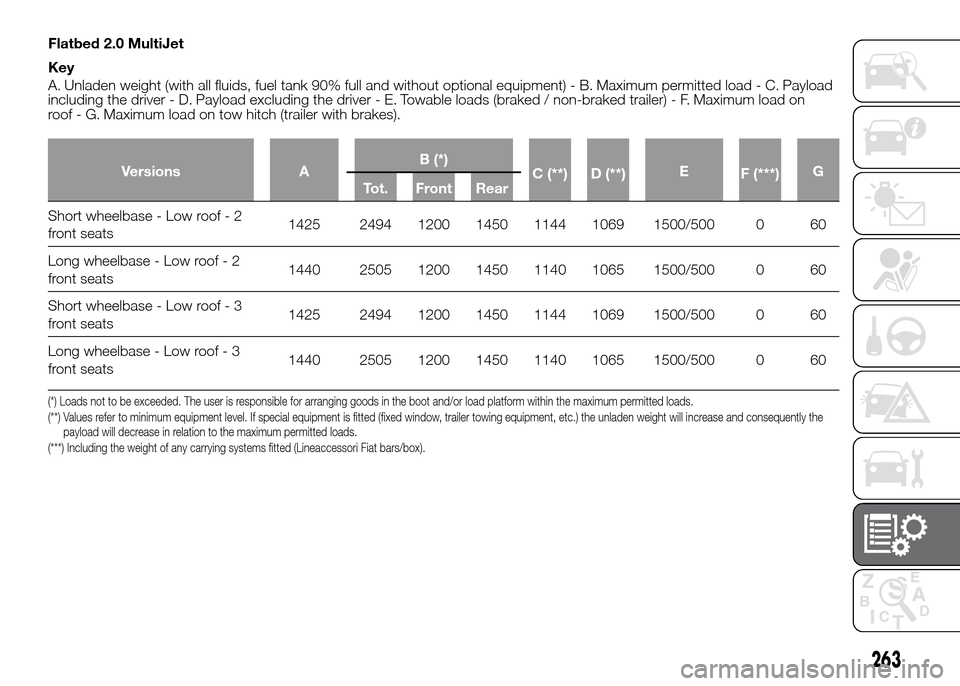
Flatbed 2.0 MultiJet
Key
A. Unladen weight (with all fluids, fuel tank 90% full and without optional equipment) - B. Maximum permitted load - C. Payload
including the driver - D. Payload excluding the driver - E. Towable loads (braked / non-braked trailer) - F. Maximum load on
roof - G. Maximum load on tow hitch (trailer with brakes).
Versions AB (*)
C (**) D (**)E
F (***)G
Tot. Front Rear
Short wheelbase - Low roof - 2
front seats1425 2494 1200 1450 1144 1069 1500/500 0 60
Long wheelbase - Low roof - 2
front seats1440 2505 1200 1450 1140 1065 1500/500 0 60
Short wheelbase - Low roof - 3
front seats1425 2494 1200 1450 1144 1069 1500/500 0 60
Long wheelbase - Low roof - 3
front seats1440 2505 1200 1450 1140 1065 1500/500 0 60
(*) Loads not to be exceeded. The user is responsible for arranging goods in the boot and/or load platform within the maximum permitted loads.
(**) Values refer to minimum equipment level. If special equipment is fitted (fixed window, trailer towing equipment, etc.) the unladen weight will increase and consequently the
payload will decrease in relation to the maximum permitted loads.
(***) Including the weight of any carrying systems fitted (Lineaccessori Fiat bars/box).
263
Page 273 of 323
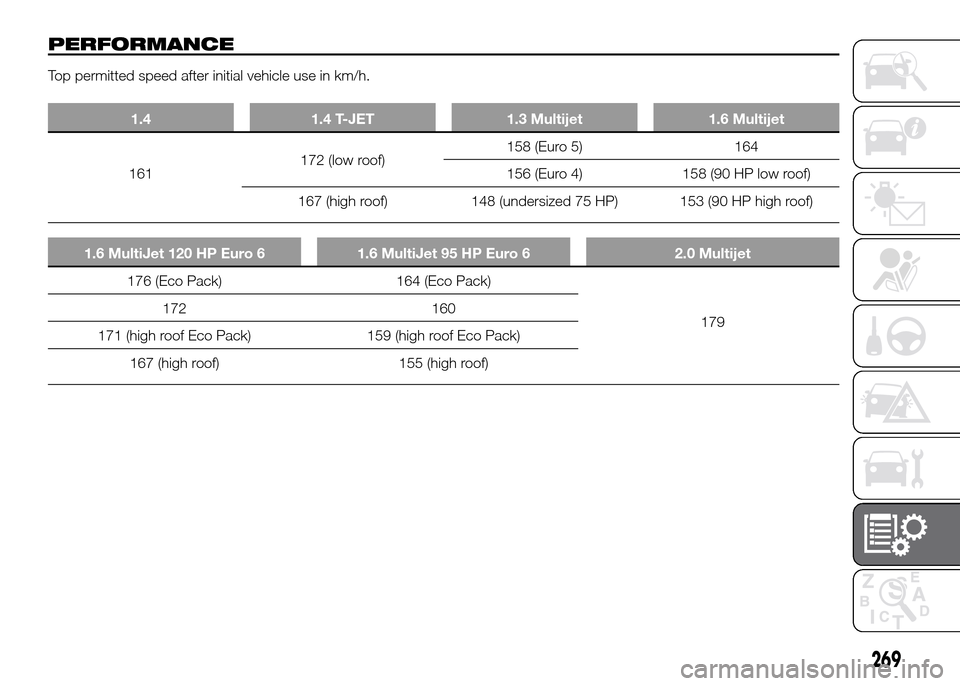
PERFORMANCE
Top permitted speed after initial vehicle use in km/h.
1.4 1.4 T-JET 1.3 Multijet 1.6 Multijet
161172 (low roof)158 (Euro 5) 164
156 (Euro 4) 158 (90 HP low roof)
167 (high roof) 148 (undersized 75 HP) 153 (90 HP high roof)
1.6 MultiJet 120 HP Euro 6 1.6 MultiJet 95 HP Euro 6 2.0 Multijet
176 (Eco Pack) 164 (Eco Pack)
179 172 160
171 (high roof Eco Pack) 159 (high roof Eco Pack)
167 (high roof) 155 (high roof)
269
Page 274 of 323
FUEL
CONSUMPTION
The fuel consumption figures given in
the tables below are determined on the
basis of the type-approval tests laid
down by specific European Directives.
These consumption values refer to
basic vehicles without optionals.
The procedures below are followed for
measuring consumption:
❒urban cycle: begins with cold
starting, followed by driving
simulating the use of the vehicle in
town;
❒extra-urban cycle: driving that
simulates using the vehicle out of
town with frequent acceleration in all
gears; the speed varies from 0 to 120
km/h;
❒combined consumption: calculated
with a weighting of approximately
37% of the urban cycle and 63% of
the extra-urban cycle.IMPORTANT The type of route, traffic
situations, weather conditions, driving
style, general conditions of the vehicle,
trim level/equipment/accessories,
climate control system, vehicle load,
roof rack, other situations that affect air
drag may lead to different fuel
consumption levels than those
measured.IMPORTANT
In practice, fuel consumption may be
higher than the values obtained during
the approval tests.
Here are some of the major factors that
can lead to a difference between test
and real consumption.
1) Vehicle condition: inadequate
servicing, use of roof racks, trailers,
heavy loading, high usage of electrical
devices and the air conditioning.
2) Driving style: frequent cold starts for
short journeys, poor engine warming
technique, gear selection, high speeds,
sudden acceleration and braking.
3) Traffic and road conditions: driving in
traffic, steep hills or winding roads,
road surface conditions.
4) Atmospheric conditions: intemperate
weather, wind, rain, snow, high altitude.
5) Proportion of use in towns and
cities, in the country and on
motorways.
270
TECHNICAL SPECIFICATIONS
Page 275 of 323
PRACTICAL ADVICE FOR
REDUCING FUEL
CONSUMPTION AND
HARMFUL EMISSIONS
Vehicle conditions
1. Have checks and adjustments
carried out in accordance with the
“Scheduled Servicing Plan”.
2. Check tyre pressure regularly, at least
once every four weeks. Excessively
low pressures will increase
consumption because rolling resistance
will be higher. In addition, this wears
the tyre more quickly and impairs
performance.
3. Only use snow tyres when the
weather conditions make them
absolutely necessary. They increase
consumption and noise.
4. Do not travel with a heavy load: the
weight of the vehicle (especially when
driving in town) and its trim greatly
affect fuel consumption and stability.
5. Remove roof racks or ski racks after
use. These accessories reduce the
vehicle's aerodynamic penetration and
have a negative effect on fuel
consumption.
6. When transporting particularly large
objects, use a trailer if possible.7. Use the vehicle's air vents if possible:
travelling with the windows open
impairs aerodynamics.
8. Use electrical devices only for the
amount of time needed. The vehicle’s
heated rear window, additional
headlights, screen wipers and heater
fan require a considerable amount
of energy; increasing the current uptake
increases fuel consumption (by up to
+25% in an urban cycle).
9. Air conditioning leads to higher fuel
consumption (on average up to +30%).
If the temperature outside is not too
extreme, try and use the air vents.Driving style
1. After starting the engine you should
drive away immediately and slowly,
avoiding high revs. Do not warm up the
engine at low or high revs when the
vehicle is stationary; this causes the
engine to warm up more slowly, thereby
increasing fuel consumption, emissions
and mechanical component wear.
2. Avoid pointless actions such
as revving up when at traffic lights or
before stopping the engine. The latter
action, like double-declutching, is
unnecessary and causes increased fuel
consumption and pollution.
3. Gear selection: select a high gear as
soon as possible (taking into account
normal engine operation and traffic
conditions) without pushing the engine
to high revs during the intermediate
gears. Using low gears at high revs to
get lively acceleration increases fuel
consumption, harmful emissions and
engine wear.
271
Page 277 of 323
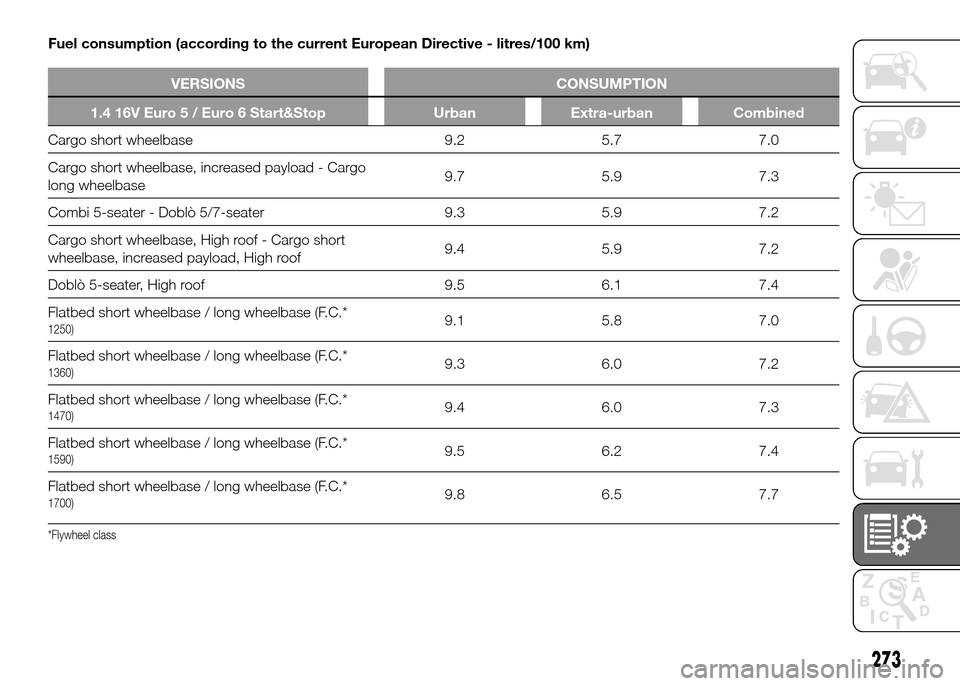
Fuel consumption (according to the current European Directive - litres/100 km)
VERSIONS CONSUMPTION
1.4 16V Euro 5 / Euro 6 Start&Stop Urban Extra-urban Combined
Cargo short wheelbase 9.2 5.7 7.0
Cargo short wheelbase, increased payload - Cargo
long wheelbase9.7 5.9 7.3
Combi 5-seater - Doblò 5/7-seater 9.3 5.9 7.2
Cargo short wheelbase, High roof - Cargo short
wheelbase, increased payload, High roof9.4 5.9 7.2
Doblò 5-seater, High roof 9.5 6.1 7.4
Flatbed short wheelbase / long wheelbase (F.C.*
1250)9.1 5.8 7.0
Flatbed short wheelbase / long wheelbase (F.C.*
1360)9.3 6.0 7.2
Flatbed short wheelbase / long wheelbase (F.C.*
1470)9.4 6.0 7.3
Flatbed short wheelbase / long wheelbase (F.C.*
1590)9.5 6.2 7.4
Flatbed short wheelbase / long wheelbase (F.C.*
1700)9.8 6.5 7.7
*Flywheel class.
273