Part FIAT DOBLO PANORAMA 2016 2.G Manual Online
[x] Cancel search | Manufacturer: FIAT, Model Year: 2016, Model line: DOBLO PANORAMA, Model: FIAT DOBLO PANORAMA 2016 2.GPages: 323, PDF Size: 25.46 MB
Page 208 of 323
Rear window (washer)
The rear window washer jets are fixed.
The nozzle holder is located above
the rear window.
WARNING
138) Driving with worn windscreen
wiper blades is a serious hazard,
because visibility is reduced in
bad weather conditions.
WHEELS AND TYRES
Check the pressure of each tyre,
including the space-saver wheel,
approximately every two weeks and
before long journeys: the pressure
should be checked with the tyre rested
and cold.
It is normal for the pressure to increase
when the vehicle is used; for the correct
tyre inflation pressure, see “Wheels” in
the “Technical specifications” section.
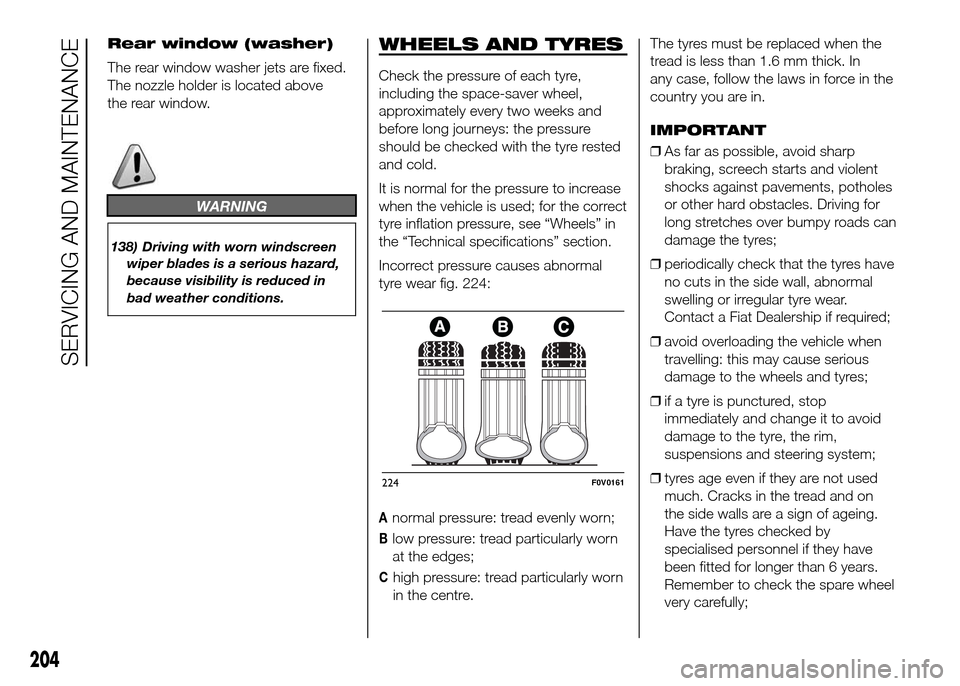
Incorrect pressure causes abnormal
tyre wear fig. 224:
Anormal pressure: tread evenly worn;
Blow pressure: tread particularly worn
at the edges;
Chigh pressure: tread particularly worn
in the centre.The tyres must be replaced when the
tread is less than 1.6 mm thick. In
any case, follow the laws in force in the
country you are in.
IMPORTANT
❒As far as possible, avoid sharp
braking, screech starts and violent
shocks against pavements, potholes
or other hard obstacles. Driving for
long stretches over bumpy roads can
damage the tyres;
❒periodically check that the tyres have
no cuts in the side wall, abnormal
swelling or irregular tyre wear.
Contact a Fiat Dealership if required;
❒avoid overloading the vehicle when
travelling: this may cause serious
damage to the wheels and tyres;
❒if a tyre is punctured, stop
immediately and change it to avoid
damage to the tyre, the rim,
suspensions and steering system;
❒tyres age even if they are not used
much. Cracks in the tread and on
the side walls are a sign of ageing.
Have the tyres checked by
specialised personnel if they have
been fitted for longer than 6 years.
Remember to check the spare wheel
very carefully;
224F0V0161
204
SERVICING AND MAINTENANCE
Page 210 of 323
PROLONGED
VEHICLE INACTIVITY
If the vehicle needs to be off the road
for longer than one month, the following
precautions must be taken:
❒park the vehicle indoors in a dry and,
if possible, well-ventilated place;
❒engage a gear and check that the
handbrake is not engaged;
❒disconnect the negative terminal from
the battery pole (see paragraph
“Vehicle inactivity” in the "Dashboard
and controls" chapter) and check
the charge conditions (see paragraph
“Battery” in the “Care and
maintenance” chapter);
❒clean and protect the painted parts
using protective wax;
❒clean and protect the shiny metal
parts using special compounds
available commercially;
❒sprinkle talcum powder on the
windscreen and rear window wiper
rubber blades and lift them off the
glass;
❒slightly open the windows;❒cover the vehicle with a piece of
fabric or perforated plastic sheet. Do
not use compact plastic tarpaulins,
which prevent humidity from
evaporating from the surface of the
vehicle;
❒inflate tyres to +0.5 bar above the
standard specified pressure and
check it at intervals;
❒do not drain the engine cooling
system.
BODYWORK
PROTECTION AGAINST
ATMOSPHERIC AGENTS
The main causes of corrosion are the
following:
❒atmospheric pollution;
❒salty air and humidity (coastal areas,
or hot humid climates);
❒seasonal environmental conditions.
The abrasive action of wind-borne
atmospheric dust and sand, as well as
mud and gravel raised by other cars
is also not to be underestimated.
On your vehicle, Fiat has implemented
the best manufacturing technologies
to effectively protect the bodywork
against corrosion.
These include:
❒painting products and systems which
give the vehicle particular resistance
to corrosion and abrasion;
❒use of galvanised (or pretreated)
sheet metal, with high resistance
to corrosion;
❒spraying the underbody, engine
compartment, wheelhouse internal
parts and other parts with highly
protective wax products;
206
SERVICING AND MAINTENANCE
Page 211 of 323
❒spraying of plastic parts, with a
protective function in the more
exposed points: underdoor, inner
wing, edges, etc.;
❒use of "open" boxed sections to
prevent condensation and pockets of
moisture from triggering rust inside.
VEHICLE EXTERIOR AND
UNDERBODY WARRANTY
Your vehicle is covered by warranty
against perforation due to corrosion of
any original element of the structure
or body.
For the general terms of this warranty,
refer to the Warranty Booklet.
ADVICE FOR
PRESERVING THE
BODYWORK
Paintwork
Paintwork does not only serve an
aesthetic purpose, but also protects the
underlying sheet metal.
Touch up abrasions and scratches
immediately to prevent rust formation.
Use only original paint products for
touch-ups (see “Bodywork paint
identification plate” in the “Technical
specifications” section).Normal maintenance of paintwork
consists in washing the vehicle: the
frequency depends on the conditions
and environment where the vehicle
is used.
For example, it is advisable to wash the
vehicle more often in areas with high
levels of environmental pollution or on
roads spread with salt.
To correctly wash the vehicle, proceed
as follows:
❒wash the bodywork using a low
pressure jet of water;
❒wipe a sponge with a slightly soapy
solution over the bodywork,
frequently rinsing the sponge;
❒rinse well with water and dry with a
jet of air or a chamois.
If you put the vehicle through a car
wash, follow these recommendations:
– remove the aerial from the roof so
it does not get damaged;
– water added to a soapy solution
should be used for washing;
– rinse thoroughly to avoid soap marks
staying on the bodywork or less visible
parts.
39)
Dry the less visible parts with special
care, such as the door frames, bonnet
and the headlight frames, where water
may stagnate more easily. It is a good
idea to leave the vehicle outdoors
for a while after washing it to give water
time to evaporate.
Do not wash the vehicle after it has
been left in the sun or with the bonnet
hot: this may alter the shine of the
paintwork.
Exterior plastic parts should be cleaned
in the same way as the rest of the
vehicle. Where possible, do not park
the vehicle under trees; the resinous
substances released by many species
give the paint a dull appearance and
increase the possibility of corrosion.
IMPORTANT Bird droppings should be
washed off immediately and thoroughly
as the acid they contain is particularly
aggressive.
6)
Windows
To clean glasses, use specific cleaning
products. Use clean cloths to avoid
scratching the glass or damaging the
transparency.
207
Page 212 of 323
IMPORTANT Wipe the inside surface of
the rear window gently with a cloth in
the direction of the filaments to avoid
damaging the heater coils.
Engine compartment
At the end of each winter, thoroughly
wash the engine compartment, taking
care to avoid spraying the water jet
directly onto the electronic control units
and the relay/fuse box on the left side
of the engine compartment (driving
direction). Have this operation
performed at a specialised workshop.
IMPORTANT The washing should
take place with the engine cold and the
ignition key in the STOP position. After
the washing operation, make sure
that the various protections (e.g. rubber
caps and guards) have not been
removed or damaged.
Headlights
IMPORTANT Never use aromatic
substances (e.g. petrol) or ketones (e.g.
acetone) for cleaning the plastic lenses
of the front headlights.
IMPORTANT
39) Some car washes with old-style
blades and/or in a poor state of
repair can damage the paintwork,
facilitating the formation of lines
that give the paint a dull/misty
appearance, especially on dark
colours. If this happens, lightly
polish the paintwork with
appropriate products.
IMPORTANT
6) Detergents cause water pollution.
The vehicle should be washed in
areas equipped for collecting
and purifying the liquid used in
the washing process.
INTERIORS
Regularly check that water is not
trapped under the mats (due to water
dripping off shoes, umbrellas, etc.),
as this could cause oxidation of the
sheet metal.
143) 144)
SEATS AND FABRIC
PARTS
Remove dust with a soft brush or a
vacuum cleaner. It is advisable to use a
moist brush on velvet upholstery.
Rub the seats with a sponge moistened
with a solution of water and mild soap.
PLASTIC PARTS
It is advisable to clean interior parts with
a moist cloth and a solution of water
and non-abrasive mild soap. Use
specific products for cleaning plastic,
without solvents and specifically
designed to prevent damage to the
appearance and colour of the treated
parts, to remove grease and tough
stains.
IMPORTANT Do not use alcohol,
petrols or their derivatives to clean the
instrument panel glass.
208
SERVICING AND MAINTENANCE
Page 216 of 323
IDENTIFICATION
DATA
It is advisable to take note of the
identification codes. The following
identification codes are printed and
shown on the plates:
❒VIN plate.
❒Chassis marking.
❒Bodywork paint identification plate.
❒Engine marking.
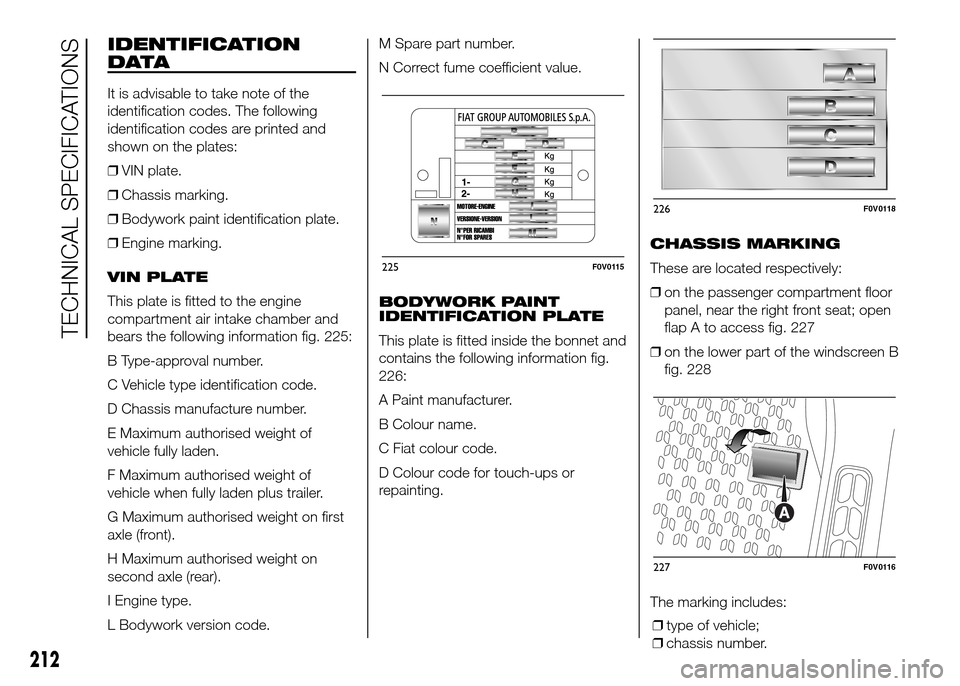
VIN PLATE
This plate is fitted to the engine
compartment air intake chamber and
bears the following information fig. 225:
B Type-approval number.
C Vehicle type identification code.
D Chassis manufacture number.
E Maximum authorised weight of
vehicle fully laden.
F Maximum authorised weight of
vehicle when fully laden plus trailer.
G Maximum authorised weight on first
axle (front).
H Maximum authorised weight on
second axle (rear).
I Engine type.
L Bodywork version code.M Spare part number.
N Correct fume coefficient value.
BODYWORK PAINT
IDENTIFICATION PLATE
This plate is fitted inside the bonnet and
contains the following information fig.
226:
A Paint manufacturer.
B Colour name.
C Fiat colour code.
D Colour code for touch-ups or
repainting.CHASSIS MARKING
These are located respectively:
❒on the passenger compartment floor
panel, near the right front seat; open
flap A to access fig. 227
❒on the lower part of the windscreen B
fig. 228
The marking includes:
❒type of vehicle;
225F0V0115
226F0V0118
227F0V0116
212
TECHNICAL SPECIFICATIONS
❒chassis number.
Page 268 of 323
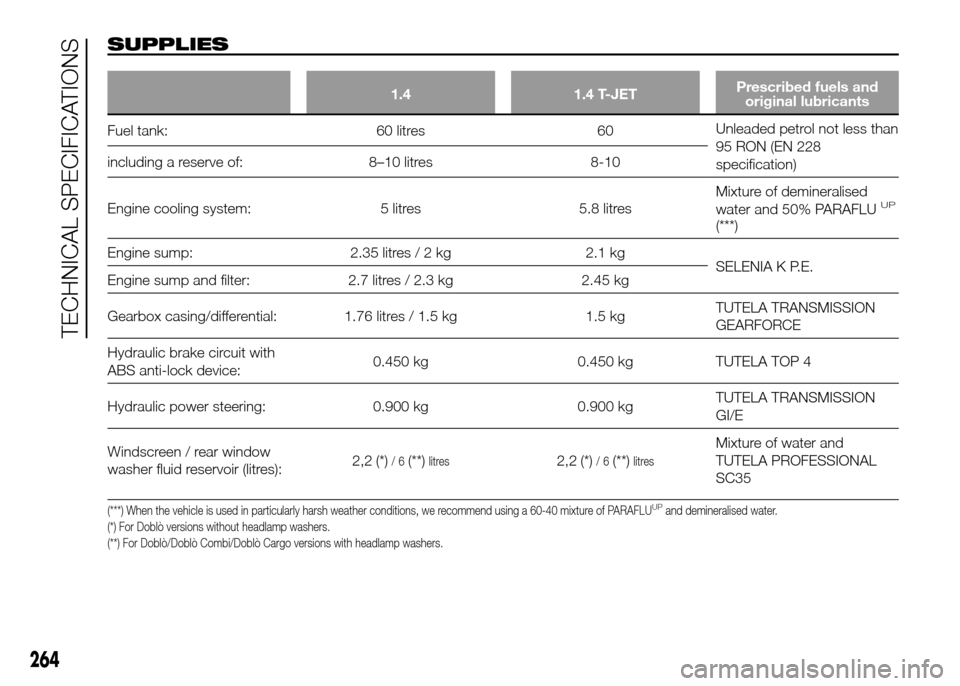
SUPPLIES
1.4 1.4 T-JETPrescribed fuels and
original lubricants
Fuel tank: 60 litres 60Unleaded petrol not less than
95 RON (EN 228
specification) including a reserve of: 8–10 litres 8-10
Engine cooling system: 5 litres 5.8 litresMixture of demineralised
water and 50% PARAFLU
UP
(***)
Engine sump: 2.35 litres/2kg 2.1kg
SELENIA K P.E.
Engine sump and filter: 2.7 litres / 2.3 kg 2.45 kg
Gearbox casing/differential: 1.76 litres / 1.5 kg 1.5 kgTUTELA TRANSMISSION
GEARFORCE
Hydraulic brake circuit with
ABS anti-lock device:0.450 kg 0.450 kg TUTELA TOP 4
Hydraulic power steering: 0.900 kg 0.900 kgTUTELA TRANSMISSION
GI/E
Windscreen / rear window
washer fluid reservoir (litres):2,2 (*)
/6(**)litres2,2 (*)/6(**)litres
Mixture of water and
TUTELA PROFESSIONAL
SC35
(***) When the vehicle is used in particularly harsh weather conditions, we recommend using a 60-40 mixture of PARAFLUUPand demineralised water.
(*) For Doblò versions without headlamp washers.
(**) For Doblò/Doblò Combi/Doblò Cargo versions with headlamp washers.
264
TECHNICAL SPECIFICATIONS
Page 269 of 323
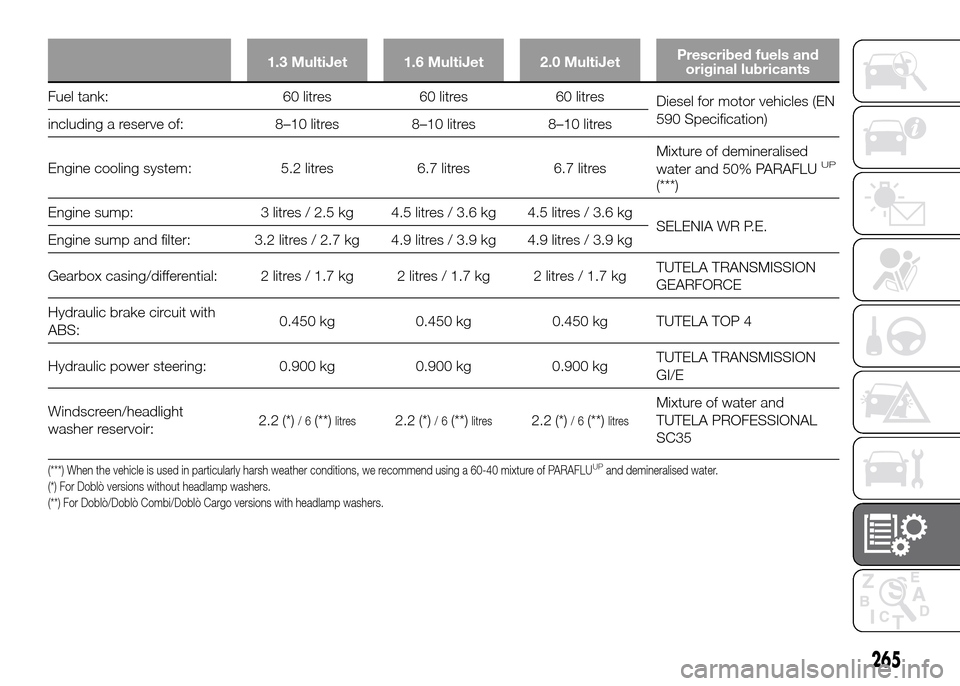
1.3 MultiJet 1.6 MultiJet 2.0 MultiJetPrescribed fuels and
original lubricants
Fuel tank: 60 litres 60 litres 60 litres
Diesel for motor vehicles (EN
590 Specification)
including a reserve of: 8–10 litres 8–10 litres 8–10 litres
Engine cooling system: 5.2 litres 6.7 litres 6.7 litresMixture of demineralised
water and 50% PARAFLU
UP
(***)
Engine sump: 3 litres / 2.5 kg 4.5 litres / 3.6 kg 4.5 litres / 3.6 kg
SELENIA WR P.E.
Engine sump and filter: 3.2 litres / 2.7 kg 4.9 litres / 3.9 kg 4.9 litres / 3.9 kg
Gearbox casing/differential: 2 litres / 1.7 kg 2 litres / 1.7 kg 2 litres / 1.7 kgTUTELA TRANSMISSION
GEARFORCE
Hydraulic brake circuit with
ABS:0.450 kg 0.450 kg 0.450 kg TUTELA TOP 4
Hydraulic power steering: 0.900 kg 0.900 kg 0.900 kgTUTELA TRANSMISSION
GI/E
Windscreen/headlight
washer reservoir:2.2 (*)
/6(**)litres2.2 (*)/6(**)litres2.2 (*)/6(**)litres
Mixture of water and
TUTELA PROFESSIONAL
SC35
(***) When the vehicle is used in particularly harsh weather conditions, we recommend using a 60-40 mixture of PARAFLUUPand demineralised water.
(*) For Doblò versions without headlamp washers.
(**) For Doblò/Doblò Combi/Doblò Cargo versions with headlamp washers.
265
Page 272 of 323
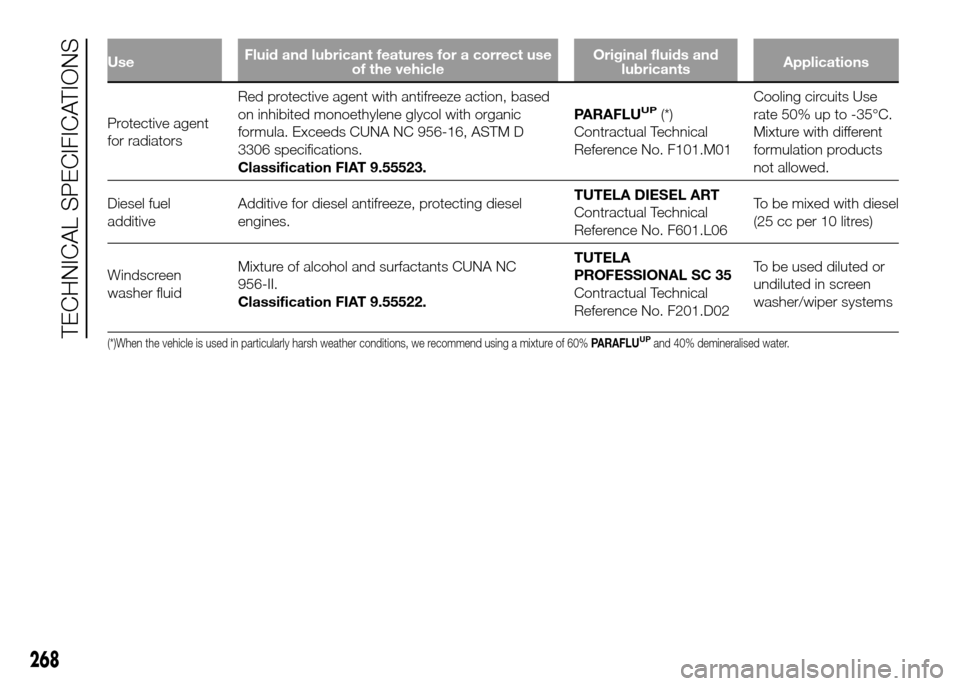
UseFluid and lubricant features for a correct use
of the vehicleOriginal fluids and
lubricantsApplications
Protective agent
for radiatorsRed protective agent with antifreeze action, based
on inhibited monoethylene glycol with organic
formula. Exceeds CUNA NC 956-16, ASTM D
3306 specifications.
Classification FIAT 9.55523.PARAFLUUP(*)
Contractual Technical
Reference No. F101.M01Cooling circuits Use
rate 50% up to -35°C.
Mixture with different
formulation products
not allowed.
Diesel fuel
additiveAdditive for diesel antifreeze, protecting diesel
engines.TUTELA DIESEL ART
Contractual Technical
Reference No. F601.L06To be mixed with diesel
(25 cc per 10 litres)
Windscreen
washer fluidMixture of alcohol and surfactants CUNA NC
956-II.
Classification FIAT 9.55522.TUTELA
PROFESSIONAL SC 35
Contractual Technical
Reference No. F201.D02To be used diluted or
undiluted in screen
washer/wiper systems
(*)When the vehicle is used in particularly harsh weather conditions, we recommend using a mixture of 60%PARAFLUUPand 40% demineralised water.
268
TECHNICAL SPECIFICATIONS
Page 275 of 323
PRACTICAL ADVICE FOR
REDUCING FUEL
CONSUMPTION AND
HARMFUL EMISSIONS
Vehicle conditions
1. Have checks and adjustments
carried out in accordance with the
“Scheduled Servicing Plan”.
2. Check tyre pressure regularly, at least
once every four weeks. Excessively
low pressures will increase
consumption because rolling resistance
will be higher. In addition, this wears
the tyre more quickly and impairs
performance.
3. Only use snow tyres when the
weather conditions make them
absolutely necessary. They increase
consumption and noise.
4. Do not travel with a heavy load: the
weight of the vehicle (especially when
driving in town) and its trim greatly
affect fuel consumption and stability.
5. Remove roof racks or ski racks after
use. These accessories reduce the
vehicle's aerodynamic penetration and
have a negative effect on fuel
consumption.
6. When transporting particularly large
objects, use a trailer if possible.7. Use the vehicle's air vents if possible:
travelling with the windows open
impairs aerodynamics.
8. Use electrical devices only for the
amount of time needed. The vehicle’s
heated rear window, additional
headlights, screen wipers and heater
fan require a considerable amount
of energy; increasing the current uptake
increases fuel consumption (by up to
+25% in an urban cycle).
9. Air conditioning leads to higher fuel
consumption (on average up to +30%).
If the temperature outside is not too
extreme, try and use the air vents.Driving style
1. After starting the engine you should
drive away immediately and slowly,
avoiding high revs. Do not warm up the
engine at low or high revs when the
vehicle is stationary; this causes the
engine to warm up more slowly, thereby
increasing fuel consumption, emissions
and mechanical component wear.
2. Avoid pointless actions such
as revving up when at traffic lights or
before stopping the engine. The latter
action, like double-declutching, is
unnecessary and causes increased fuel
consumption and pollution.
3. Gear selection: select a high gear as
soon as possible (taking into account
normal engine operation and traffic
conditions) without pushing the engine
to high revs during the intermediate
gears. Using low gears at high revs to
get lively acceleration increases fuel
consumption, harmful emissions and
engine wear.
271
Page 309 of 323
PRESCRIPTIONS FOR HANDLING THE VEHICLE AT THE END OF
ITS LIFE
Fiat has been committed for many years to safeguarding the environment through the constant improvement of its production
processes and manufacturing products that are increasingly "eco-compatible". To assure customers of the best possible
service in terms of respecting environmental laws and in response to European Directive 2000/53/EC governing vehicles at the
end of their life, Fiat is offering their customers the opportunity of handing over their vehicle (*) at the end of its life without
incurring any additional costs.
The European Directive sets out that when the vehicle is handed over, the last keeper or owner should not incur any expenses
as a result of it having a zero or negative market value. In particular, in almost all European Union countries, until 1st January
2007, vehicles registered after 1st July 2002 will be collected free of charge, whilst from 2007 collection will be free of charge
irrespective of the year of registration as long as the vehicle contains its basic components (in particular the engine and
bodywork) and has no additional waste.
To hand your vehicle over at the end of its life without extra cost, contact a Fiat Dealership or authorised collection and
scrapping centres. These centres have been carefully chosen to offer high quality service for the collection, treatment and
recycling of vehicles at their end of life, respecting the surrounding environment.
You can find further information on these collection and scrapping centres either from a Fiat or Fiat Commercial Vehicle
Dealership or by calling the freephone number 00800 3428 0000 or by going on the Fiat website.
(*) Vehicle for transporting passengers with a maximum of nine seats and a total permitted weight of 3.5 t
305