mirror FIAT DOBLO PANORAMA 2016 2.G Owners Manual
[x] Cancel search | Manufacturer: FIAT, Model Year: 2016, Model line: DOBLO PANORAMA, Model: FIAT DOBLO PANORAMA 2016 2.GPages: 323, PDF Size: 25.46 MB
Page 7 of 323
USE OF THE OWNER HANDBOOK
OPERATING INSTRUCTIONS
Each time direction instructions (left/right or forwards/backwards) about the vehicle are given, these must be intended as
regarding an occupant in the driver's seat. Special cases not complying with this rule will be specified as appropriate in the text.
The figures in the Owner Handbook are provided by way of example only: this might imply that some details of the image do
not correspond to the actual arrangement of your vehicle. In addition, the Handbook has been conceived considering vehicles
with steering wheel on the left side; it is therefore possible that on vehicles with steering wheel on the right side, the position
or construction of some controls is not exactly mirror-like with respect to the figure.
To identify the chapter with the information needed you can consult the index at the end of this Owner Handbook.
Chapters can be rapidly identified with dedicated graphic tabs, at the side of each odd page. A few pages further there is a key
for getting to know the chapter order and the relevant symbols in the tabs. There is in any case a textual indication of the
current chapter at the side of each even page.
WARNINGS AND PRECAUTIONS
While reading this Owner Handbook you will find a series ofWARNINGSto prevent procedures that could damage your
vehicle.
There are alsoPRECAUTIONSthat must be carefully followed to prevent incorrect use of the components of the vehicle,
which could cause accidents or injuries.
Therefore allWARNINGSandPRECAUTIONSmust always be carefully followed.
WARNINGSandPRECAUTIONSare recalled in the text with the following symbols:
personal safety;
vehicle integrity;
environmental protection.
NOTE These symbols, when necessary, are indicated besides the title or at the end of the line and are followed by a number.
That number recalls the corresponding warning at the end of the relevant section.
Page 13 of 323
GRAPHICAL INDEX
.
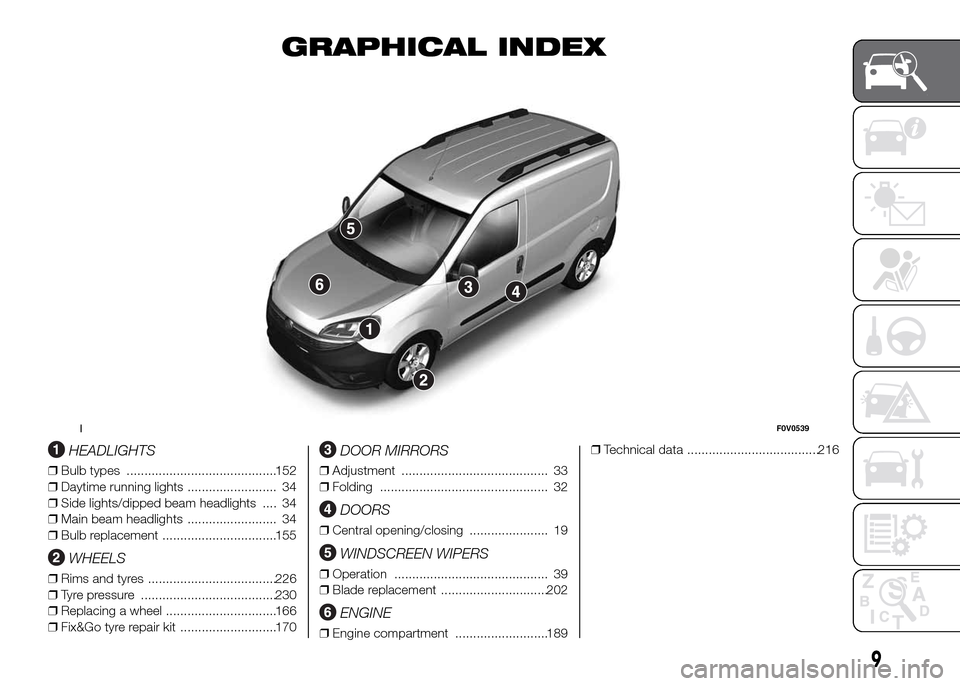
HEADLIGHTS
❒Bulb types ..........................................152
❒Daytime running lights ......................... 34
❒Side lights/dipped beam headlights .... 34
❒Main beam headlights ......................... 34
❒Bulb replacement ................................155
WHEELS
❒Rims and tyres ....................................226
❒Tyre pressure ......................................230
❒Replacing a wheel ...............................166
❒Fix&Go tyre repair kit ...........................170
DOOR MIRRORS
❒Adjustment ......................................... 33
❒Folding ............................................... 32
DOORS
❒Central opening/closing ...................... 19
WINDSCREEN WIPERS
❒Operation ........................................... 39
❒Blade replacement ..............................202
ENGINE
❒Engine compartment ..........................189❒Technical data .....................................216
1F0V0539
9
Page 17 of 323
KNOW YOUR VEHICLE
In-depth knowledge of your new vehicle
starts here.
The booklet that you are reading simply
and directly explains how it is made
and how it works.
That’s why we advise you to read it
seated comfortably on board, so that
you can see what is described here for
yourself.THE KEYS....................................... 14
IGNITION DEVICE ........................... 16
SYMBOLS ...................................... 17
THE FIAT CODE SYSTEM ............... 18
DOORS ........................................... 19
SEATS ............................................ 23
PARTITIONS ................................... 28
HEAD RESTRAINTS ........................ 30
STEERING WHEEL ......................... 32
REAR VIEW MIRRORS .................... 32
EXTERIOR LIGHTS ......................... 34
INTERIOR LIGHTS .......................... 36
WINDSCREEN/REAR WINDOW
WIPER ............................................ 39
HEATING AND VENTILATION
SYSTEM ......................................... 41
DIFFUSERS..................................... 42
HEATING AND VENTILATION.......... 43
MANUAL CLIMATE CONTROL
SYSTEM ......................................... 45
AUTOMATIC CLIMATE CONTROL
SYSTEM ......................................... 49
ELECTRIC WINDOWS .................... 55
CONTROLS .................................... 56
BONNET ......................................... 57
BOOT ............................................. 58
INTERIOR FITTINGS ....................... 62
ROOF RACK/SKI RACK .................. 66HEADLIGHTS.................................. 66
RADIO............................................. 67
PROTECTING THE
ENVIRONMENT .............................. 68
13
Page 36 of 323
STEERING WHEEL
The height and axial position of the
steering wheel can be adjusted on all
versions.
To carry out the adjustment, proceed as
follows:
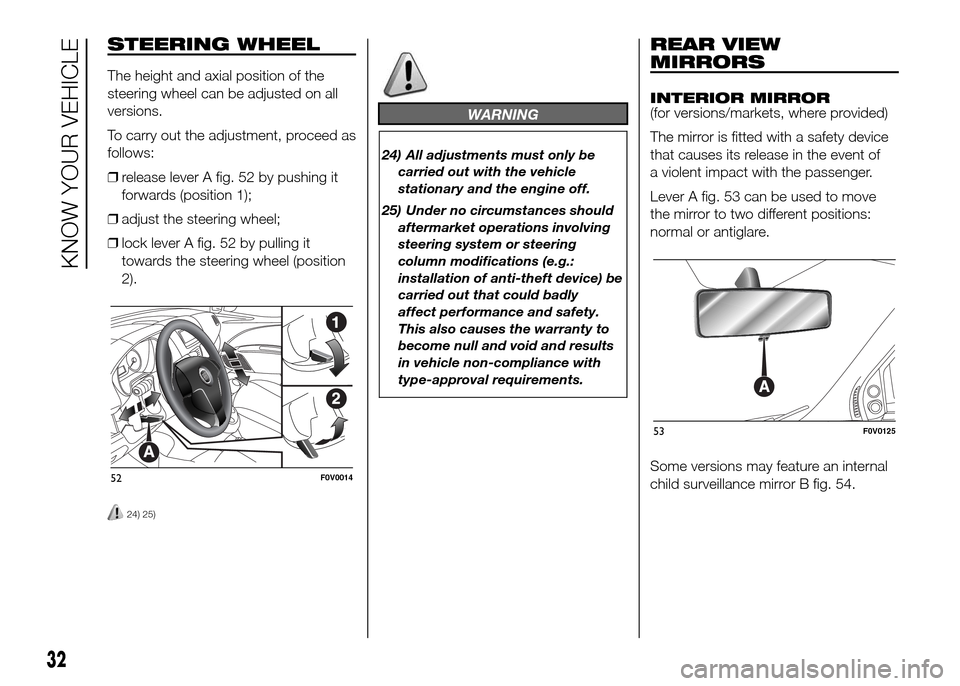
❒release lever A fig. 52 by pushing it
forwards (position 1);
❒adjust the steering wheel;
❒lock lever A fig. 52 by pulling it
towards the steering wheel (position
2).
24) 25)
WARNING
24) All adjustments must only be
carried out with the vehicle
stationary and the engine off.
25) Under no circumstances should
aftermarket operations involving
steering system or steering
column modifications (e.g.:
installation of anti-theft device) be
carried out that could badly
affect performance and safety.
This also causes the warranty to
become null and void and results
in vehicle non-compliance with
type-approval requirements.
REAR VIEW
MIRRORS
INTERIOR MIRROR
(for versions/markets, where provided)
The mirror is fitted with a safety device
that causes its release in the event of
a violent impact with the passenger.
Lever A fig. 53 can be used to move
the mirror to two different positions:
normal or antiglare.
Some versions may feature an internal
child surveillance mirror B fig. 54.
52F0V0014
53F0V0125
32
KNOW YOUR VEHICLE
Page 37 of 323
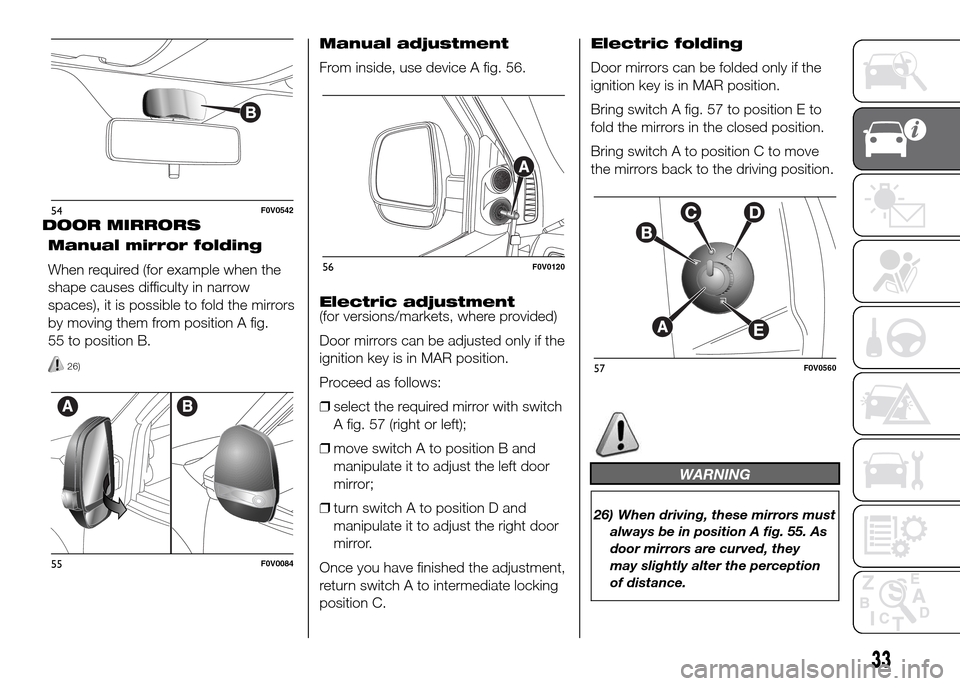
Manual mirror folding
When required (for example when the
shape causes difficulty in narrow
spaces), it is possible to fold the mirrors
by moving them from position A fig.
55 to position B.
26)
Manual adjustment
From inside, use device A fig. 56.
Electric adjustment
(for versions/markets, where provided)
Door mirrors can be adjusted only if the
ignition key is in MAR position.
Proceed as follows:
❒select the required mirror with switch
A fig. 57 (right or left);
❒move switch A to position B and
manipulate it to adjust the left door
mirror;
❒turn switch A to position D and
manipulate it to adjust the right door
mirror.
Once you have finished the adjustment,
return switch A to intermediate locking
position C.Electric folding
Door mirrors can be folded only if the
ignition key is in MAR position.
Bring switch A fig. 57 to position E to
fold the mirrors in the closed position.
Bring switch A to position C to move
the mirrors back to the driving position.
WARNING
26) When driving, these mirrors must
always be in position A fig. 55. As
door mirrors are curved, they
may slightly alter the perception
of distance.
54F0V0542
55F0V0084
56F0V0120
57F0V0560
33
DOOR MIRRORS
Page 49 of 323
IMPORTANT The air recirculation
system makes it possible to reach the
required heating or cooling conditions
faster, depending on the selected
mode. Do not use the internal air
recirculation function on rainy/cold days
to avoid the possibility of the windows
misting.
HEATED REAR WINDOW
AND DOOR MIRRORS
DEMISTING/DEFROSTING
(for versions/markets, where provided)
Press button E
to activate this
function. The LED on the button
switches on to indicate activation.
Press button E
again to disable the
function.
IMPORTANT Do not apply stickers on
the inside of the rear window over
the heating filaments to avoid damage.
45
Page 51 of 323
PASSENGER
COMPARTMENT HEATING
Proceed as follows:
❒turn knob A to the red section;
❒turn knob B to the required speed;
❒turn knob C to:
to warm the feet and demist the
windscreen at the same time
warms the feet and keeps the face
cool (bi-level function)
to warm the feet of those in the front
and rear seats.
❒to turn off internal air recirculation
(button E LED off).
FAST FRONT WINDOW
DEMISTING/DEFROSTING
Proceed as follows:
❒press the
button
❒turn knob A fully to the right;
❒turn knob B to
;
❒turn knob C to
;
❒to turn off internal air recirculation
(button E LED off).
After demisting/defrosting, operate the
controls to maintain optimum visibility
conditions.Window demisting
In the event of considerable external
moisture and/or rain and/or large
differences in temperature inside and
outside the passenger compartment,
perform the following preventive
window demisting procedure:
❒press the
button
❒to turn off internal air recirculation
(button E LED off);
❒turn knob A to the red section;
❒turn knob B to the second speed
level;
❒turn knob C to
or toif the
windows do not show signs of
misting up deactivate the internal air
recirculation (LED on button E off)
The climate control system is
very useful for demisting the windows
more quickly: just carry out the above
procedure and activate the system
by pressing the
button.
HEATED REAR WINDOW
AND DOOR MIRRORS
DEMISTING/DEFROSTING
(for versions/markets, where provided)
Press button F
to activate: when
this function is activated, the LED
on button F
lights up.This function is timed and will turn off
automatically after 20 minutes. Press
button F
again to switch the
function off in advance.
IMPORTANT Do not apply stickers on
the inside of the rear window over
the heating filaments to avoid damage.
ADJUSTING THE FAN
SPEED
To ventilate the passenger
compartment well, proceed as follows:
❒fully open the central and side air
diffusers;
❒turn knob A to the blue section;
❒turn knob B to the required speed;
❒turn knob C to
❒to turn off internal air recirculation
(button E LED off).
INTERNAL AIR
RECIRCULATION
ACTIVATION
Press button E: when the function is
on, the button LED lights up.
47
Page 53 of 323
AUTOMATIC CLIMATE CONTROL SYSTEM
(for versions/markets, where provided).
CONTROLS
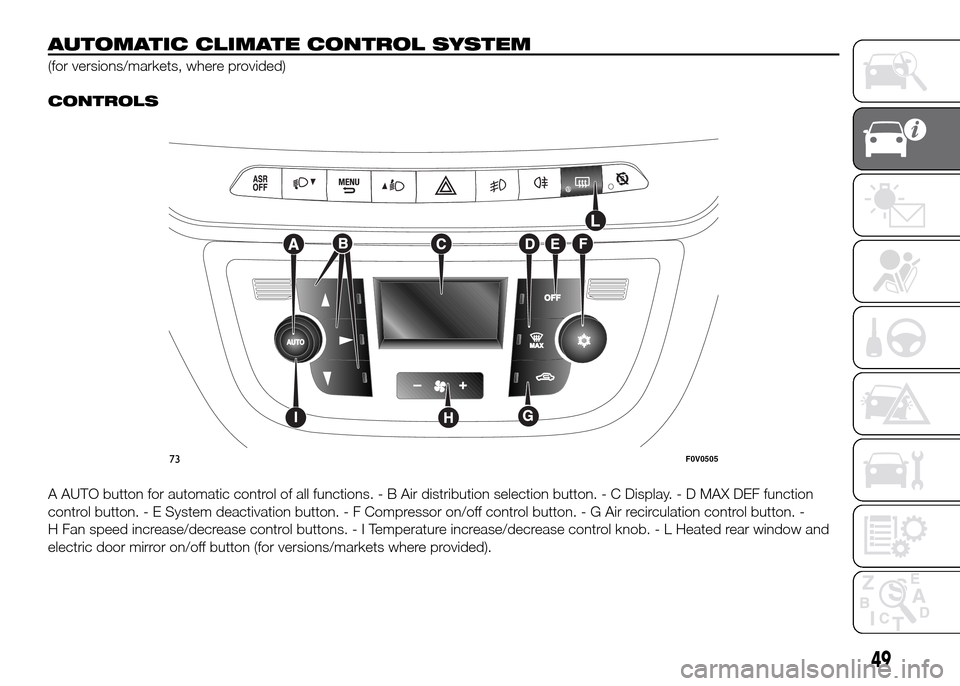
A AUTO button for automatic control of all functions. - B Air distribution selection button. - C Display. - D MAX DEF function
control button. - E System deactivation button. - F Compressor on/off control button. - G Air recirculation control button. -
H Fan speed increase/decrease control buttons.-ITemperature increase/decrease control knob. - L Heated rear window and
electric door mirror on/off button (for versions/markets where provided).
73F0V0505
49
Page 54 of 323
INTRODUCTION
The automatic climate control system
adjusts the temperature, the quantity
and the distribution of the air in the
passenger compartment. The
temperature control is based on the
"equivalent temperature": in other
words, the system continuously works
to keep the comfort level inside the
vehicle constant and to compensate for
possible variations in outside
conditions, including the sun's rays
detected by a dedicated sensor. The
automatically controlled parameters
and functions are:
❒air temperature at the vents;
❒air distribution at the vents;
❒fan speed (continuous variation of the
air flow);
❒compressor activation (for cooling/
dehumidifying the air);
❒air recirculation.
All functions may be changed manually.
In other words, you may select one or
more functions and change the
parameters as required. Automatic
control of the manually changed
functions will be suspended: the
system will override your settings only
for safety-related reasons (e.g. risk
of misting).Manual selections will always take
priority over automatic settings and will
be stored until the user switches the
system back to automatic operation by
pressing the AUTO button again except
for the cases in which the system will
intervene for particular, safety-related
reasons. You can adjust one function
manually without affecting the
automatic control of the others.
The temperature of the air sent is
always controlled automatically,
depending on the temperature set in
the display (except when the system is
off or in certain conditions when the
compressor is switched off).
The system allows the following
parameters and functions to be set or
altered manually: air temperature,
fan speed (continuous variation); air
distribution in seven positions;
compressor enablement; fast
defrosting/demisting function; air
recirculation; switching off the system.USING THE CLIMATE
CONTROL SYSTEM
The system can be started in different
ways, but it is advisable to start by
pressing the AUTO button and then
turning the knob to set the temperature
required on the display. The system
will start running automatically in this
way and the set temperature will be
reached as quickly as possible. The
system will adjust the temperature, the
quantity and the distribution of the air
introduced into the passenger
compartment and will manage the
recirculation function and the
compressor engagement. During fully
automatic operation, the only manual
intervention required is the possible
activation of the following functions:
❒
air recirculation, to keep the
function always either on or off;
❒
to speed up demisting/defrosting
of windscreen, rear window and
external rear view mirrors.
During fully automatic system
operation, you can change the set
temperature, air distribution and fan
speed at any time by using the relevant
buttons or knobs: the system will
automatically change its settings to
adjust to the new requirements.
50
KNOW YOUR VEHICLE
Page 58 of 323
❒switches on climate control
compressor when climatic conditions
are suitable;
❒sets air recirculation off;
❒sets maximum air temperature HI in
both areas;
❒sets the fan speed according to the
engine coolant temperature to limit
the flow of air that is not sufficiently
warm to demist the windows;
❒directs air flow to windscreen and
front side windows vents;
❒sets heated rear window on.
IMPORTANT The rapid demisting/
defrosting function for the windows
remains on for about 3 minutes from
when the engine coolant reaches the
appropriate temperature for a rapid
demisting of the windows.
When this function is active, the LED on
the corresponding button and the one
on the heated rear window button
switch on. The message FULL AUTO
goes off on the display.
You can only adjust the fan speed and
switch off the heated rear window
manually when this function is active.
To restore the previous operating
conditions, simply press button B, air
recirculation button G, compressor
button F or AUTO button A.Heated rear window and
door mirrors electric
control demisting/
defrosting button (L)
(for versions/markets, where provided)
Push this button to activate the
demisting/defrosting of the heated rear
window and electric door mirrors
When this function is active, the button
LED is on.
This function switches off automatically
after about 20 minutes or when you
push the button again, or when the
engine is turned off. It will not be
switched on automatically when the
engine is restarted.
IMPORTANT Do not affix decals to the
inside of the heated rear window over
the heating filaments, to avoid damage
that might cause them to stop working
properly.
Switching the system
OFF (E)
Press button E to switch the climate
control system off. The display will go
out.With the system off, the climate control
system conditions are as follows:
display off, temperature setting not
display, air recirculation on thereby
insulating the passenger compartment
from the outside (recirculation LED
on), climate control compressor off, fan
off. Press the AUTO button to switch
the climate control system back on
in full automatic mode.
54
KNOW YOUR VEHICLE