weight FIAT DOBLO PANORAMA 2016 2.G Owners Manual
[x] Cancel search | Manufacturer: FIAT, Model Year: 2016, Model line: DOBLO PANORAMA, Model: FIAT DOBLO PANORAMA 2016 2.GPages: 323, PDF Size: 25.46 MB
Page 68 of 323
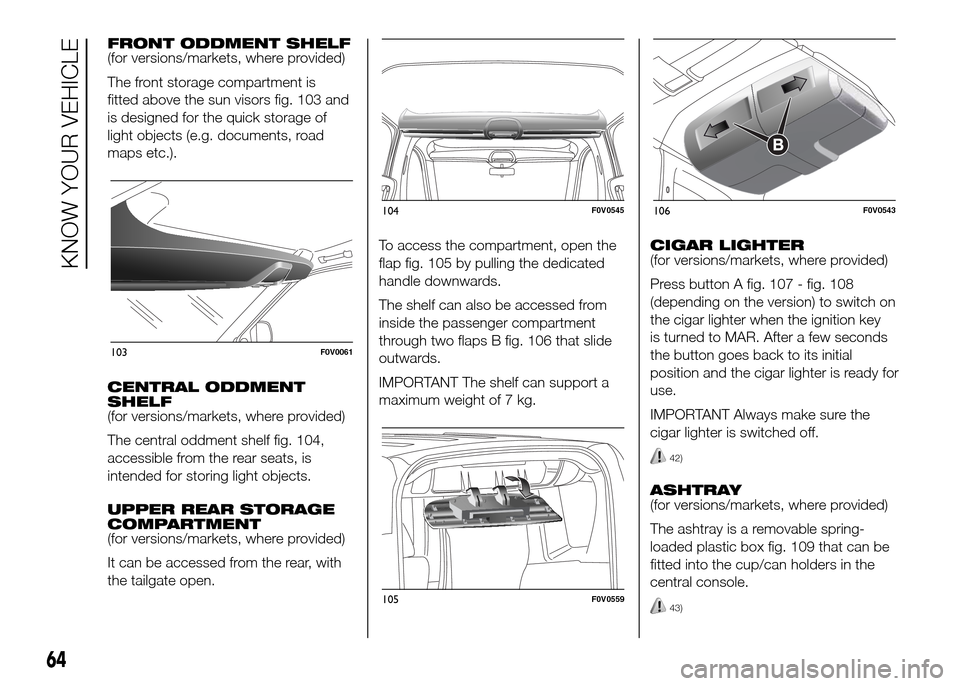
FRONT ODDMENT SHELF
(for versions/markets, where provided)
The front storage compartment is
fitted above the sun visors fig. 103 and
is designed for the quick storage of
light objects (e.g. documents, road
maps etc.).
CENTRAL ODDMENT
SHELF
(for versions/markets, where provided)
The central oddment shelf fig. 104,
accessible from the rear seats, is
intended for storing light objects.
UPPER REAR STORAGE
COMPARTMENT
(for versions/markets, where provided)
It can be accessed from the rear, with
the tailgate open.To access the compartment, open the
flap fig. 105 by pulling the dedicated
handle downwards.
The shelf can also be accessed from
inside the passenger compartment
through two flaps B fig. 106 that slide
outwards.
IMPORTANT The shelf can support a
maximum weight of 7 kg.CIGAR LIGHTER
(for versions/markets, where provided)
Press button A fig. 107 - fig. 108
(depending on the version) to switch on
the cigar lighter when the ignition key
is turned to MAR. After a few seconds
the button goes back to its initial
position and the cigar lighter is ready for
use.
IMPORTANT Always make sure the
cigar lighter is switched off.
42)
ASHTRAY
(for versions/markets, where provided)
The ashtray is a removable spring-
loaded plastic box fig. 109 that can be
fitted into the cup/can holders in the
central console.
43)
103F0V0061
104F0V0545
105F0V0559
106F0V0543
64
KNOW YOUR VEHICLE
Page 71 of 323
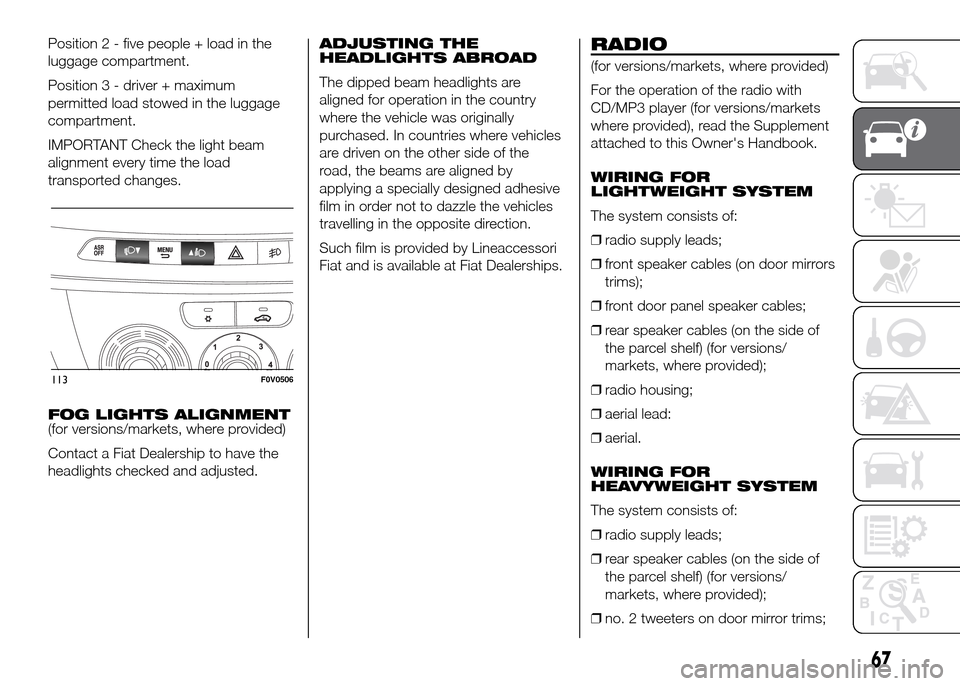
Position 2 - five people + load in the
luggage compartment.
Position 3 - driver + maximum
permitted load stowed in the luggage
compartment.
IMPORTANT Check the light beam
alignment every time the load
transported changes.
FOG LIGHTS ALIGNMENT
(for versions/markets, where provided)
Contact a Fiat Dealership to have the
headlights checked and adjusted.ADJUSTING THE
HEADLIGHTS ABROAD
The dipped beam headlights are
aligned for operation in the country
where the vehicle was originally
purchased. In countries where vehicles
are driven on the other side of the
road, the beams are aligned by
applying a specially designed adhesive
film in order not to dazzle the vehicles
travelling in the opposite direction.
Such film is provided by Lineaccessori
Fiat and is available at Fiat Dealerships.RADIO
(for versions/markets, where provided)
For the operation of the radio with
CD/MP3 player (for versions/markets
where provided), read the Supplement
attached to this Owner's Handbook.
WIRING FOR
LIGHTWEIGHT SYSTEM
The system consists of:
❒radio supply leads;
❒front speaker cables (on door mirrors
trims);
❒front door panel speaker cables;
❒rear speaker cables (on the side of
the parcel shelf) (for versions/
markets, where provided);
❒radio housing;
❒aerial lead:
❒aerial.
WIRING FOR
HEAVYWEIGHT SYSTEM
The system consists of:
❒radio supply leads;
❒rear speaker cables (on the side of
the parcel shelf) (for versions/
markets, where provided);
❒no. 2 tweeters on door mirror trims;
113F0V0506
67
Page 119 of 323
IMPORTANT
16) Operations which lead to knocks,
vibrations or localised heating
(over 100°C for a maximum of 6
hours) in the area around the
pretensioner may cause damage
or trigger it. This device is not
affected by vibrations caused by
irregularities of the road surface
or low obstacles such as kerbs,
etc. Contact a Fiat Dealership for
any assistance.
CARRYING
CHILDREN SAFELY
For optimal protection in the event of an
impact, all passengers must be seated
and wearing adequate restraint
systems.
This is even more important for
children.
This prescription is compulsory in all EU
countries according to EC Directive
2003/20/EC.
Compared with an adult, a child's head
is larger and heavier in proportion to
their body and the child's muscular and
bone structures are not fully developed.
Therefore, correct restraint systems
other than adult seat belts are
necessary to reduce as much as
possible the risk of injuries in the event
of an accident, braking or a sudden
manoeuvre.
Children must be seated safely and
comfortably.
As far as the characteristics of the child
restraint systems used allow, you are
advised to keep children in rearward
facing child restraint systems for as
long as possible, since this is the most
protected position in the event of an
impact.Several child restraint system types are
available; always choose the one most
suitable for the child.
When over 1.50 m in height, from the
point of view of restraint systems,
children are considered as adults and
wear seat belts normally.
In Europe child restraint systems are
classified, among other criteria, into five
weight groups:
Group Weight range
Group0 upto10kg
Group 0+ up to 13 kg
Group 1 9 - 18 kg
Group 2 15 - 25 kg
Group 3 22 - 36 kg
All restraint devices must bear the
certification data, together with the
control mark, on a label solidly fixed to
the child restraint system which must
never be removed.
Lineaccessori Fiat offers child restraint
systems for each weight group. These
devices are recommended having been
specifically designed for Fiat vehicles.
69)
115
Page 120 of 323
GROUP 0 and 0+
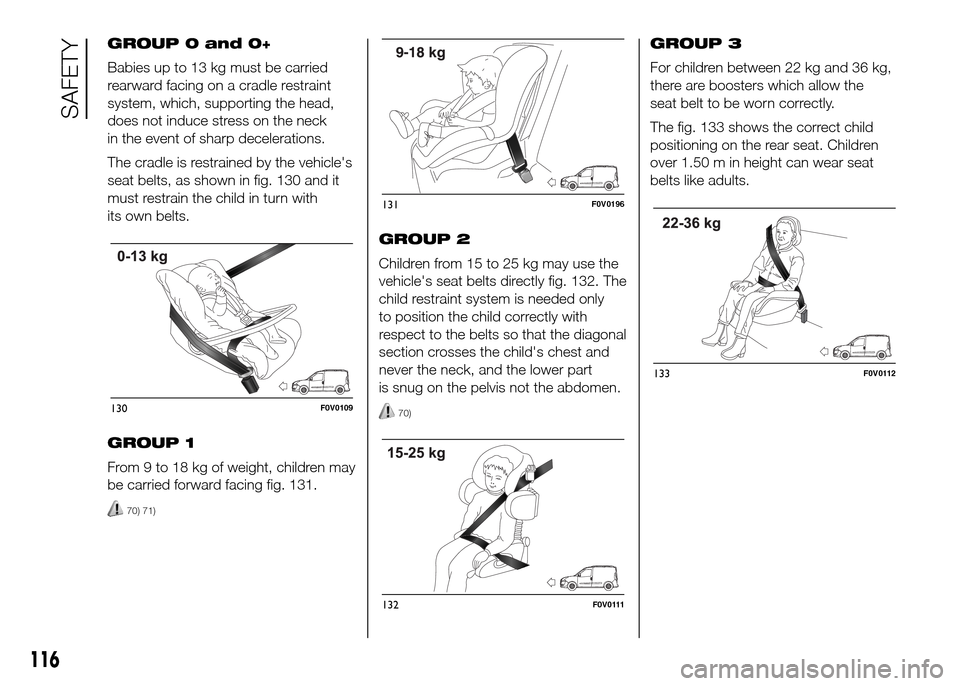
Babies up to 13 kg must be carried
rearward facing on a cradle restraint
system, which, supporting the head,
does not induce stress on the neck
in the event of sharp decelerations.
The cradle is restrained by the vehicle's
seat belts, as shown in fig. 130 and it
must restrain the child in turn with
its own belts.
GROUP 1
From 9 to 18 kg of weight, children may
be carried forward facing fig. 131.
70) 71)
GROUP 2
Children from 15 to 25 kg may use the
vehicle's seat belts directly fig. 132. The
child restraint system is needed only
to position the child correctly with
respect to the belts so that the diagonal
section crosses the child's chest and
never the neck, and the lower part
is snug on the pelvis not the abdomen.
70)
GROUP 3
For children between 22 kg and 36 kg,
there are boosters which allow the
seat belt to be worn correctly.
The fig. 133 shows the correct child
positioning on the rear seat. Children
over 1.50 m in height can wear seat
belts like adults.
130F0V0109
131F0V0196
132F0V0111
133F0V0112
116
SAFETY
Page 121 of 323
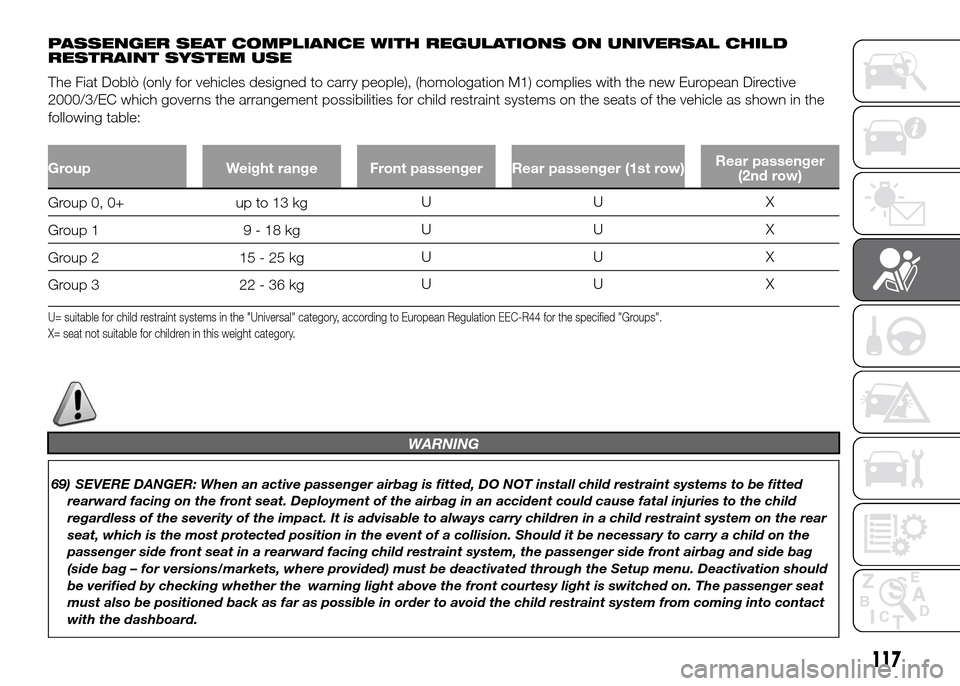
PASSENGER SEAT COMPLIANCE WITH REGULATIONS ON UNIVERSAL CHILD
RESTRAINT SYSTEM USE
The Fiat Doblò (only for vehicles designed to carry people), (homologation M1) complies with the new European Directive
2000/3/EC which governs the arrangement possibilities for child restraint systems on the seats of the vehicle as shown in the
following table:
Group Weight range Front passenger Rear passenger (1st row)Rear passenger
(2nd row)
Group 0, 0+ up to 13 kgUU X
Group 1 9 - 18 kgUU X
Group 2 15 - 25 kgUU X
Group 3 22 - 36 kgUU X
U= suitable for child restraint systems in the "Universal" category, according to European Regulation EEC-R44 for the specified "Groups".
X= seat not suitable for children in this weight category.
WARNING
69) SEVERE DANGER: When an active passenger airbag is fitted, DO NOT install child restraint systems to be fitted
rearward facing on the front seat. Deployment of the airbag in an accident could cause fatal injuries to the child
regardless of the severity of the impact. It is advisable to always carry children in a child restraint system on the rear
seat, which is the most protected position in the event of a collision. Should it be necessary to carry a child on the
passenger side front seat in a rearward facing child restraint system, the passenger side front airbag and side bag
(side bag – for versions/markets, where provided) must be deactivated through the Setup menu. Deactivation should
be verified by checking whether the warning light above the front courtesy light is switched on. The passenger seat
must also be positioned back as far as possible in order to avoid the child restraint system from coming into contact
with the dashboard.
117
Page 123 of 323
ISOFIX CHILD
RESTRAINT SYSTEM
SETUP
(for versions/markets, where provided)
Only for vehicles designed to carry
people, (homologation M1), provision
has been made on some versions to fit
a Universal Isofix child restraint system,
a new European standardised system
for carrying children safely.
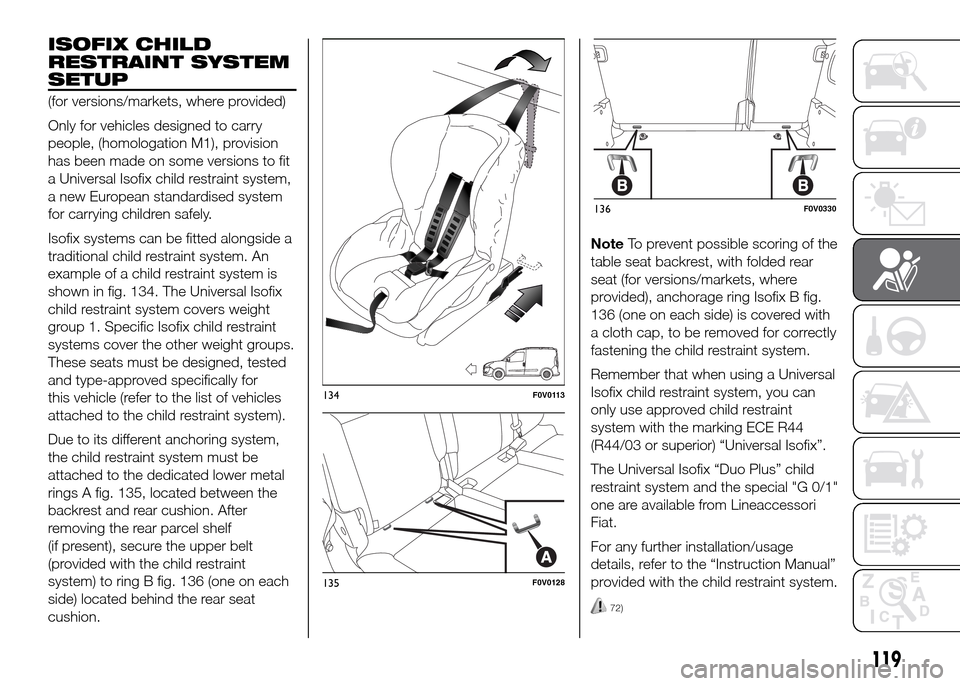
Isofix systems can be fitted alongside a
traditional child restraint system. An
example of a child restraint system is
shown in fig. 134. The Universal Isofix
child restraint system covers weight
group 1. Specific Isofix child restraint
systems cover the other weight groups.
These seats must be designed, tested
and type-approved specifically for
this vehicle (refer to the list of vehicles
attached to the child restraint system).
Due to its different anchoring system,
the child restraint system must be
attached to the dedicated lower metal
rings A fig. 135, located between the
backrest and rear cushion. After
removing the rear parcel shelf
(if present), secure the upper belt
(provided with the child restraint
system) to ring B fig. 136 (one on each
side) located behind the rear seat
cushion.NoteTo prevent possible scoring of the
table seat backrest, with folded rear
seat (for versions/markets, where
provided), anchorage ring Isofix B fig.
136 (one on each side) is covered with
a cloth cap, to be removed for correctly
fastening the child restraint system.
Remember that when using a Universal
Isofix child restraint system, you can
only use approved child restraint
system with the marking ECE R44
(R44/03 or superior) “Universal Isofix”.
The Universal Isofix “Duo Plus” child
restraint system and the special "G 0/1"
one are available from Lineaccessori
Fiat.
For any further installation/usage
details, refer to the “Instruction Manual”
provided with the child restraint system.
72)
134F0V0113
135F0V0128
136F0V0330
119
Page 124 of 323
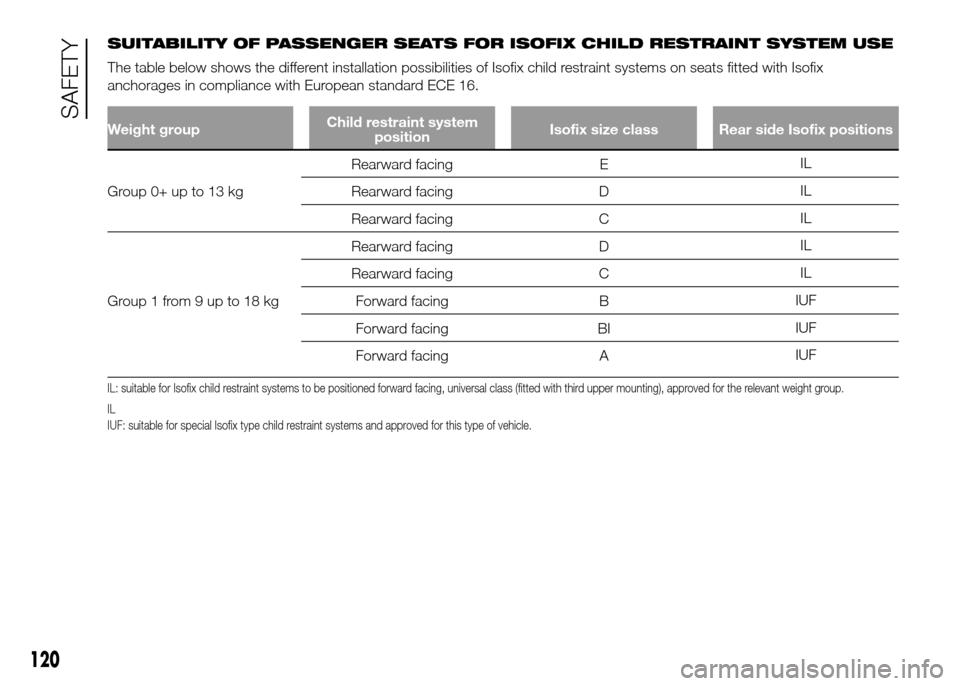
SUITABILITY OF PASSENGER SEATS FOR ISOFIX CHILD RESTRAINT SYSTEM USE
The table below shows the different installation possibilities of Isofix child restraint systems on seats fitted with Isofix
anchorages in compliance with European standard ECE 16.
Weight groupChild restraint system
positionIsofix size class Rear side Isofix positions
Group 0+ up to 13 kgRearward facing EIL
Rearward facing DIL
Rearward facing CIL
Group1from9upto18kgRearward facing DIL
Rearward facing CIL
Forward facing BIUF
Forward facing BIIUF
Forward facing AIUF
IL: suitable for Isofix child restraint systems to be positioned forward facing, universal class (fitted with third upper mounting), approved for the relevant weight group.
IL
IUF: suitable for special Isofix type child restraint systems and approved for this type of vehicle.
120
SAFETY
Page 144 of 323
IMPORTANT In all the above-mentioned
cases, it is advisable to check the
spare wheel tyre pressure before
starting driving.
NOTE If the tyres are replaced, driving
the vehicle for short stretches, some
time might be needed before the
system is restored.
IMPORTANT
WARNING
86) The TPMS is optimised for the
original tyres and wheels
provided. TPMS pressures and
alerts have been defined
according to the size of the tyres
mounted on the vehicle. Using
equipment with different size,
type or kind may cause irregular
system operation or sensor
damage. Non-original spare
wheels can damage the sensor.
Do not use tyre sealant or
balancing weights if the vehicle is
equipped with TPMS as these
may damage the sensors.87) If the system signals a pressure
decrease on a specific tyre, it is
recommended to check the
pressure on all four tyres.
88) TPMS does not relieve the driver
from the obligation to check the
tyre pressure every month; it is
not to be considered a replacing
system for maintenance or a
safety system.
89) Tyre pressure must be checked
with tyres cold. Should it become
necessary for whatever reason
to check pressure with warm
tyres, do not reduce pressure
even if it is higher than the
prescribed value, but repeat the
check when tyres are cold.
90) The TPMS cannot indicate
sudden tyre pressure drops (for
example when a tyre bursts).
In this case, stop the vehicle,
braking with caution and avoiding
abrupt steering.
91) The system only warns that the
tyre pressure is low: it is not able
to inflate them.
92) Insufficient tyre inflation
increases fuel consumption,
reduces the tread duration and
may affect the capacity to drive
safely.93) Always refit the valve stem cap
after inspecting or adjusting tyre
pressure. This prevents dampness
or dirt from entering the valve
stem and thus the pressure
control sensor from being
damaged.
94) The tyre repair kit (Fix&Go)
provided with the vehicle (for
versions/markets, where
provided) is compatible with the
TPMS sensors; using sealants not
equivalent with that in the original
kit may adversely affect its
operation. If sealants not
equivalent with the original one
are used, it is recommended to
have the TPMS sensor operation
checked by a qualified repair
centre.
140
STARTING AND DRIVING
Page 151 of 323
23)
IMPORTANT
22) For diesel engines, use only
diesel fuel for motor vehicles
in accordance with EN590
European specifications. The use
of other products or mixtures
may damage the engine beyond
repair and consequently invalidate
the warranty, due to the damage
caused. If you accidentally refuel
with another type of fuel, do not
start the engine, and drain the
tank. If the engine has run, even
for a very short time, you will need
to have the entire fuel supply
system emptied in addition to the
tank.
23) Do not bring naked flames or lit
cigarettes near the fuel tank filler:
fire risk. Keep your face away
from the fuel filler to prevent
breathing in harmful vapours.
SAVING FUEL
Some useful tips are given below for
fuel saving and reducing harmful
emissions of CO2 and other pollutants
(nitrogen oxides, unburnt
hydrocarbons, Particulate Matter (PM),
etc.).
PRACTICAL ADVICE FOR
REDUCING FUEL
CONSUMPTION AND
HARMFUL EMISSIONS
Vehicle conditions
❒Have checks and adjustments for
vehicle maintenancecarried out
in accordance with the “Scheduled
servicing plan”.
❒Checktyrepressure regularly, at
least once every four weeks.
Excessively low pressures will
increase consumption because
rolling resistance will be higher. In
addition, this wears the tyre more
quickly and impairs performance.
❒Only usesnow tyreswhen
the weather conditions make them
absolutely necessary. They increase
consumption and noise.❒Do not travel witha heavy load: the
weight of the vehicle (especially when
driving in town) and its geometry
greatly affect fuel consumption and
stability.
❒Removeroof racks or ski racks
after use. These accessories reduce
the vehicle's aerodynamic
penetration and have a negative
effect on fuel consumption.
❒When transporting particularly large
objects, use atrailerif possible.
❒Use the vehicle's air vents if possible:
travelling with the windows open
impairs aerodynamics.
❒Use electrical devices only for the
amount of time needed. The vehicle’s
heated rear window, additional
headlights, screen wipers and heater
fan require a considerable amount
of energy; this increases fuel
consumption (by up to +25% in an
urban cycle).
❒Air conditioning leads to higher fuel
consumption (on average up to
+30%). If the temperature outside is
not too extreme, try and use the
air vents.
147
Page 153 of 323
TOWING TRAILERS
IMPORTANT
The vehicle must be equipped with a
type-approved tow hook and adequate
electrical system to tow trailers.
Installation should be carried out by
specialised personnel who will issue the
required papers for travelling on roads.
Install any specific and/or additional
door mirrors as specified by the
Highway Code.
Remember that when towing a trailer,
steep hills are harder to climb, braking
spaces increase and overtaking takes
longer depending on the overall weight.
Engage a low gear when driving
downhill, rather than constantly using
the brake.
The weight of the trailer on the vehicle
tow hook will reduce the loading
capacity of the vehicle by the same
amount.
To make sure that the maximum
towable weight is not exceeded (given
in the vehicle registration document)
account should be taken of the fully
laden trailer, including accessories and
luggage.Do not exceed the speed limits specific
to each country you are driving in, in
the case of vehicles towing trailers.
In any case, the top speed must not
exceed 80 km/h.
99) 100)
WARNING
99) The ABS device with which the
vehicle is equipped will not
control the braking system of the
trailer. Particular caution is
required on slippery roads.
100) Never modify the braking
system of the vehicle to control
the trailer brake. The trailer
braking system must be fully
independent from the hydraulic
system of the vehicle.
SNOW TYRES
Fiat Dealerships will be happy to
provide advice concerning the most
suitable type of tyres for the customer's
requirements.
For the type of tyre to be used, inflation
pressures and the specifications of
snow tyres, follow the instructions given
in the "Wheels" paragraph of the
"Technical specifications" section.
The winter features of these tyres are
reduced considerably when the tread
depth is below 4 mm. Replace them in
this case.
Due to snow tyre characteristics, under
normal conditions of use or on long
motorway journeys, the performance of
these tyres is lower than that of
standard tyres. Limit performance
according to the use for which they
were approved.
IMPORTANT When using snow tyres
with a maximum speed index below the
one that can be reached by the vehicle
(increased by 5%), place a notice in
the passenger compartment, plainly in
view, which states the maximum speed
allowed by the snow tyres (as per EC
Directive).
149