ECU FIAT DOBLO PANORAMA 2017 2.G User Guide
[x] Cancel search | Manufacturer: FIAT, Model Year: 2017, Model line: DOBLO PANORAMA, Model: FIAT DOBLO PANORAMA 2017 2.GPages: 298, PDF Size: 26.04 MB
Page 129 of 298
19)
WARMING UP THE
ENGINE JUST AFTER IT
HAS STARTED
Proceed as follows:
drive off slowly, letting the engine
turn at medium revs. Do not accelerate
abruptly;
do not demand full performance at
first. Wait until the engine coolant
temperature gauge starts moving.
EMERGENCY STARTING
If the instrument panel warning light
stays on steadily, you can perform
an emergency starting by using the
code on the CODE card (see the “In an
emergency” section).
20)
STOPPING THE ENGINE
Turn the ignition key to STOP while the
engine is idling.
IMPORTANT After a taxing drive, you
should allow the engine to “catch
its breath” before turning it off by letting
it idle to allow the temperature in the
engine compartment to fall.
WARNING
17)It is advisable not to demand maximum
performance from your vehicle (e.g.
excessive acceleration, long distances at
high speeds, excessively intense braking,
etc.) during the initial period of use.
18)When the engine is off, do not leave
the key turned to MAR to prevent
unnecessary electrical consumption from
draining the battery.
19)If the indicator flashes for 60
seconds after starting or during an
extended towing period, this indicates
a problem in the glow plug preheating
system. Use the vehicle normally if the
engine starts, but contact a Fiat Dealership
as soon as possible.
20)Never start the engine by pushing,
towing or driving downhill. This could
cause fuel to flow into the catalytic
converter and damage it beyond repair.
WARNING
95)It is dangerous to run the engine in
enclosed areas. The engine takes in
oxygen and releases carbon dioxide,
carbon monoxide and other toxic gases.
HANDBRAKE
The handbrake lever is located between
the front seats. Pull the lever upwards
to engage the handbrake and ensure
that the vehicle does not move. The
vehicle should be secured after several
clicks of the lever. If it is not, contact
a Fiat Dealership to have it adjusted.
96)When the handbrake lever is engaged
and the ignition key is in MAR position,
the instrument panel warning light
will switch on.
Proceed as follows to release the
handbrake:
slightly lift the lever and press
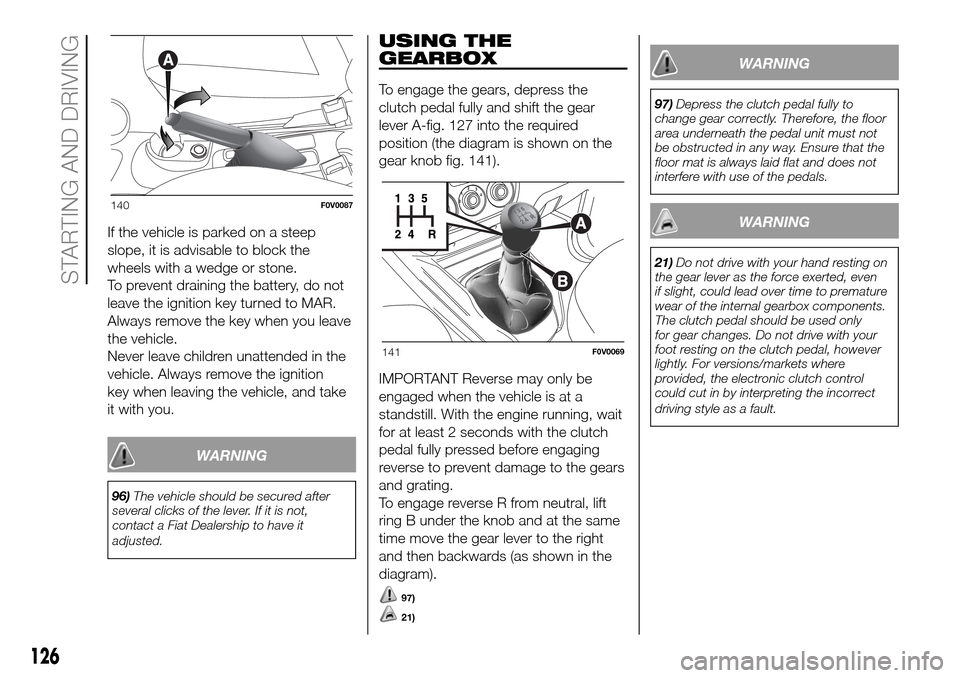
release button A fig. 140;
keep button A pressed and lower
the lever. The
warning light in the
instrument panel will switch off.
Press the brake pedal when carrying
out this operation to prevent the vehicle
from moving accidentally.
PARKING
Proceed as follows:
stop the engine and engage the
handbrake;
engage the gear (on a slope, engage
first gear if the vehicle is facing uphill
or reverse if it is facing downhill) and
leave the wheels steered.
125
Page 130 of 298
If the vehicle is parked on a steep
slope, it is advisable to block the
wheels with a wedge or stone.
To prevent draining the battery, do not
leave the ignition key turned to MAR.
Always remove the key when you leave
the vehicle.
Never leave children unattended in the
vehicle. Always remove the ignition
key when leaving the vehicle, and take
it with you.
WARNING
96)The vehicle should be secured after
several clicks of the lever. If it is not,
contact a Fiat Dealership to have it
adjusted.
USING THE
GEARBOX
To engage the gears, depress the
clutch pedal fully and shift the gear
lever A-fig. 127 into the required
position (the diagram is shown on the
gear knob fig. 141).
IMPORTANT Reverse may only be
engaged when the vehicle is at a
standstill. With the engine running, wait
for at least 2 seconds with the clutch
pedal fully pressed before engaging
reverse to prevent damage to the gears
and grating.
To engage reverse R from neutral, lift
ring B under the knob and at the same
time move the gear lever to the right
and then backwards (as shown in the
diagram).
97)
21)
WARNING
97)Depress the clutch pedal fully to
change gear correctly. Therefore, the floor
area underneath the pedal unit must not
be obstructed in any way. Ensure that the
floor mat is always laid flat and does not
interfere with use of the pedals.
WARNING
21)Do not drive with your hand resting on
the gear lever as the force exerted, even
if slight, could lead over time to premature
wear of the internal gearbox components.
The clutch pedal should be used only
for gear changes. Do not drive with your
foot resting on the clutch pedal, however
lightly. For versions/markets where
provided, the electronic clutch control
could cut in by interpreting the incorrect
driving style as a fault.
140F0V0087
141F0V0069
126
STARTING AND DRIVING
Page 154 of 298
NUMBER PLATE LIGHTS
(for hatchback
versions)
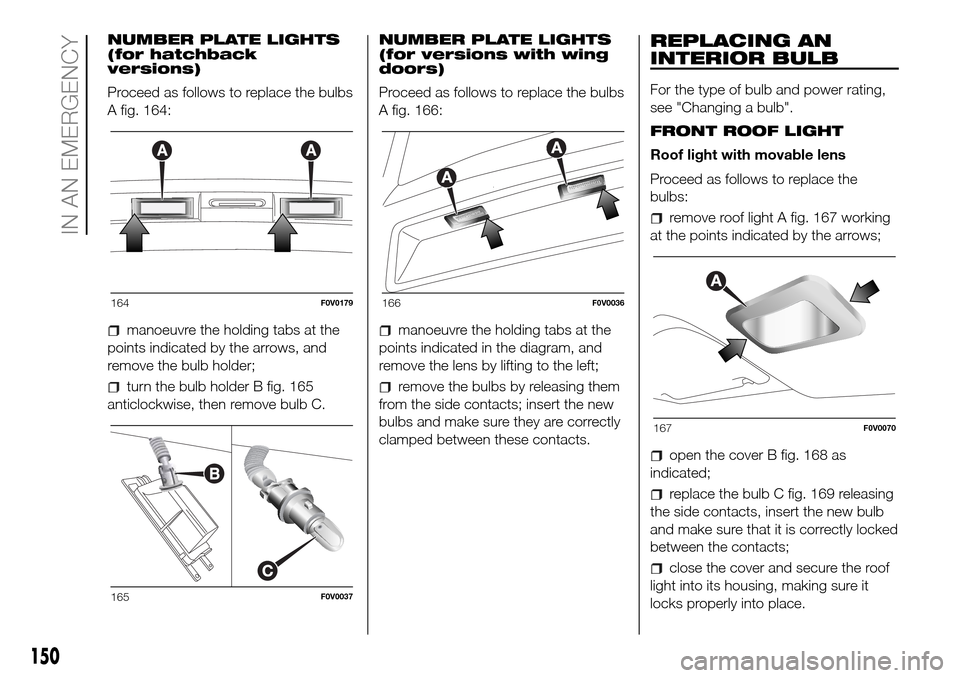
Proceed as follows to replace the bulbs
A fig. 164:
manoeuvre the holding tabs at the
points indicated by the arrows, and
remove the bulb holder;
turn the bulb holder B fig. 165
anticlockwise, then remove bulb C.NUMBER PLATE LIGHTS
(for versions with wing
doors)
Proceed as follows to replace the bulbs
A fig. 166:
manoeuvre the holding tabs at the
points indicated in the diagram, and
remove the lens by lifting to the left;
remove the bulbs by releasing them
from the side contacts; insert the new
bulbs and make sure they are correctly
clamped between these contacts.
REPLACING AN
INTERIOR BULB
For the type of bulb and power rating,
see "Changing a bulb".
FRONT ROOF LIGHT
Roof light with movable lens
Proceed as follows to replace the
bulbs:
remove roof light A fig. 167 working
at the points indicated by the arrows;
open the cover B fig. 168 as
indicated;
replace the bulb C fig. 169 releasing
the side contacts, insert the new bulb
and make sure that it is correctly locked
between the contacts;
close the cover and secure the roof
light into its housing, making sure it
locks properly into place.
164F0V0179
165F0V0037
166F0V0036
167F0V0070
150
IN AN EMERGENCY
Page 155 of 298
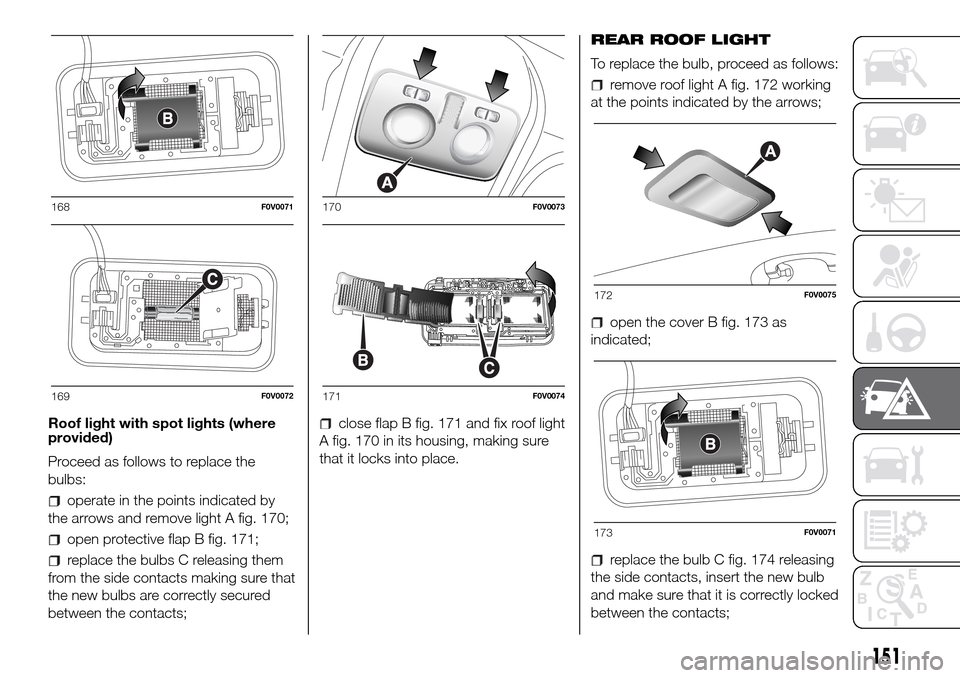
Roof light with spot lights (where
provided)
Proceed as follows to replace the
bulbs:
operate in the points indicated by
the arrows and remove light A fig. 170;
open protective flap B fig. 171;
replace the bulbs C releasing them
from the side contacts making sure that
the new bulbs are correctly secured
between the contacts;
close flap B fig. 171 and fix roof light
A fig. 170 in its housing, making sure
that it locks into place.REAR ROOF LIGHT
To replace the bulb, proceed as follows:
remove roof light A fig. 172 working
at the points indicated by the arrows;
open the cover B fig. 173 as
indicated;
replace the bulb C fig. 174 releasing
the side contacts, insert the new bulb
and make sure that it is correctly locked
between the contacts;
168F0V0071
169F0V0072
170F0V0073
171F0V0074
172F0V0075
173F0V0071
151
Page 156 of 298
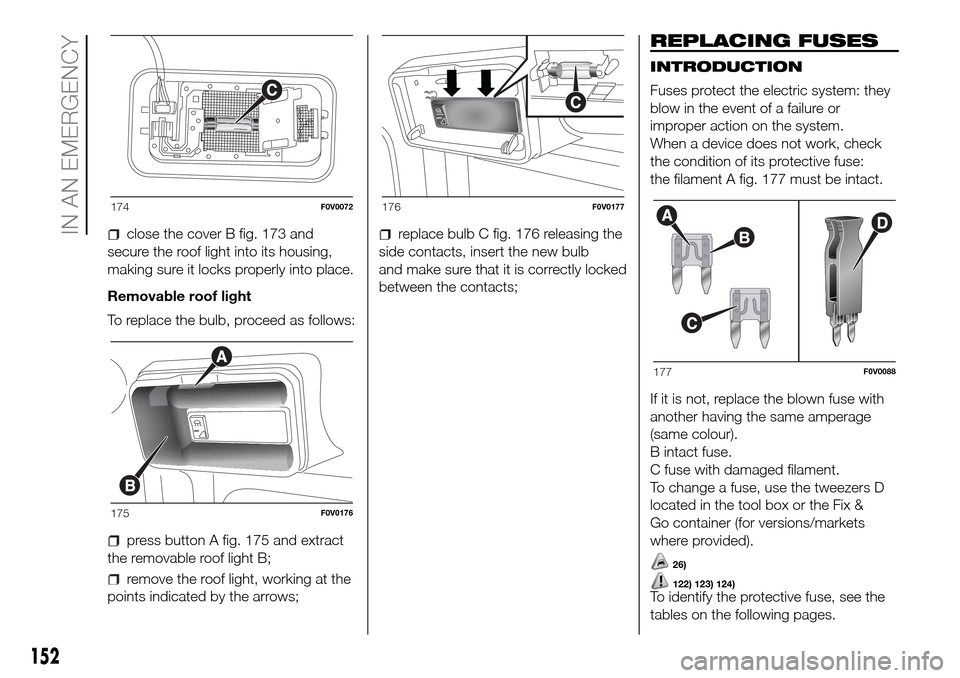
close the cover B fig. 173 and
secure the roof light into its housing,
making sure it locks properly into place.
Removable roof light
To replace the bulb, proceed as follows:
press button A fig. 175 and extract
the removable roof light B;
remove the roof light, working at the
points indicated by the arrows;
replace bulb C fig. 176 releasing the
side contacts, insert the new bulb
and make sure that it is correctly locked
between the contacts;
REPLACING FUSES
INTRODUCTION
Fuses protect the electric system: they
blow in the event of a failure or
improper action on the system.
When a device does not work, check
the condition of its protective fuse:
the filament A fig. 177 must be intact.
If it is not, replace the blown fuse with
another having the same amperage
(same colour).
B intact fuse.
C fuse with damaged filament.
To change a fuse, use the tweezers D
located in the tool box or the Fix &
Go container (for versions/markets
where provided).
26)
122) 123) 124)To identify the protective fuse, see the
tables on the following pages.
174F0V0072
175F0V0176
176F0V0177
177F0V0088
152
IN AN EMERGENCY
Page 164 of 298
warn anybody nearby that the
vehicle is about to be lifted. They must
stay clear and not touch the vehicle
until it is back on the ground.
introduce the handle in the hole on
the nut and the plastic clip, then
operate the jack and raise the vehicle,
until the wheel is a few centimetres
off the ground. When turning the crank,
ensure that it rotates freely in order to
avoid grazing your hands against the
ground. The moving components of the
jack (screws and joints) can also cause
injuries: avoid touching them. If you
become soiled with the lubricating
grease, clean it off thoroughly;
fully loosen the fixing bolts and
remove the wheel;
make sure the contact surfaces
between spare wheel and hub are
clean so that the fastening bolts will not
come loose;
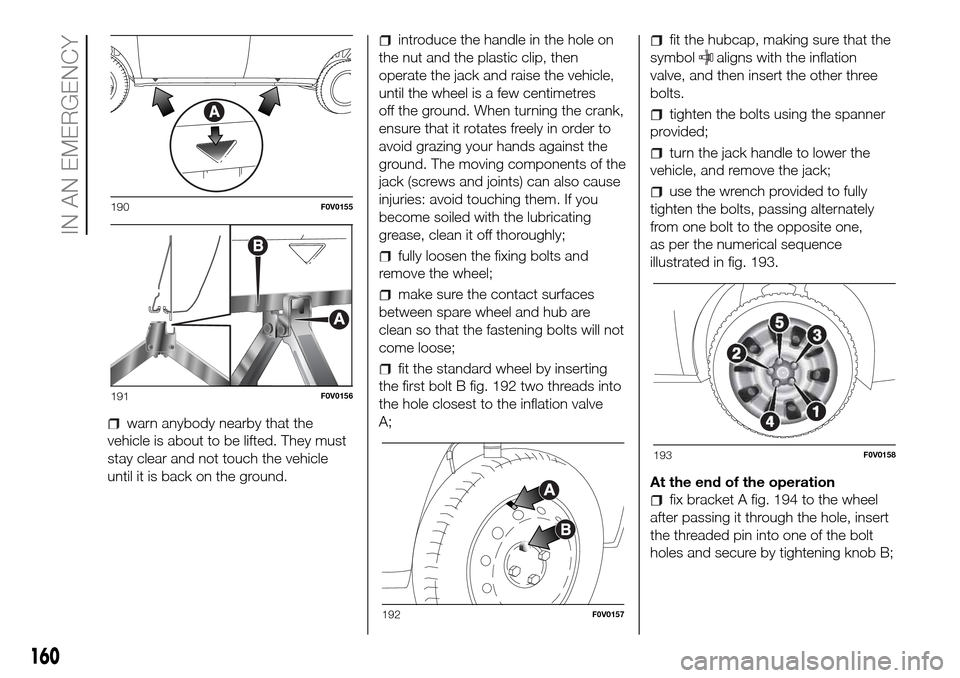
fit the standard wheel by inserting
the first bolt B fig. 192 two threads into
the hole closest to the inflation valve
A;
fit the hubcap, making sure that the
symbol
aligns with the inflation
valve, and then insert the other three
bolts.
tighten the bolts using the spanner
provided;
turn the jack handle to lower the
vehicle, and remove the jack;
use the wrench provided to fully
tighten the bolts, passing alternately
from one bolt to the opposite one,
as per the numerical sequence
illustrated in fig. 193.
At the end of the operation
fix bracket A fig. 194 to the wheel
after passing it through the hole, insert
the threaded pin into one of the bolt
holes and secure by tightening knob B;
190F0V0155
191F0V0156
192F0V0157
193F0V0158
160
IN AN EMERGENCY
Page 166 of 298
126)Use your hazard lights, warning
triangle, etc. to show that your vehicle is
stationary according to the regulations
in force. Passengers should get out of the
vehicle, particularly if it is heavily loaded,
and wait for the wheel to be changed away
from the traffic. If you are on a slope or
uneven surface, place wedges or other
suitable objects under the wheels to secure
the vehicle. Have the wheel repaired and
refitted as soon as possible. Do not apply
grease to the bolt threads before
assembly: they might spontaneously
unscrew.
127)Use the jack only to replace wheels
on the vehicle with which it is supplied
or on other vehicles of the same model.
Never use the jack for other purposes,
such as lifting other models. Never use the
jack to carry out repairs under the vehicle.
Incorrect positioning of the jack may cause
the lifted vehicle to fall. Do not use the
jack for loads higher than those shown on
the label.
128)Incorrect hub cap assembly may
cause it to come off when the vehicle is
moving. Never tamper with the inflation
valve. Never introduce tools of any kind
between rim and tyre. Check tyre and
spare wheel pressures regularly, referring to
the values shown in the "Technical
specifications" section.FIX&GO AUTOMATIC
KIT
(where provided)
DESCRIPTION
28)
129) 130)The quick repair kit Fix&Go automatic is
contained in a suitable bag inside the
compartment on the right rear side
or, for Cargo versions, under the
passenger seat (for versions with fixed
or movable seat), or in the glove
compartment (for versions with folding
seat).
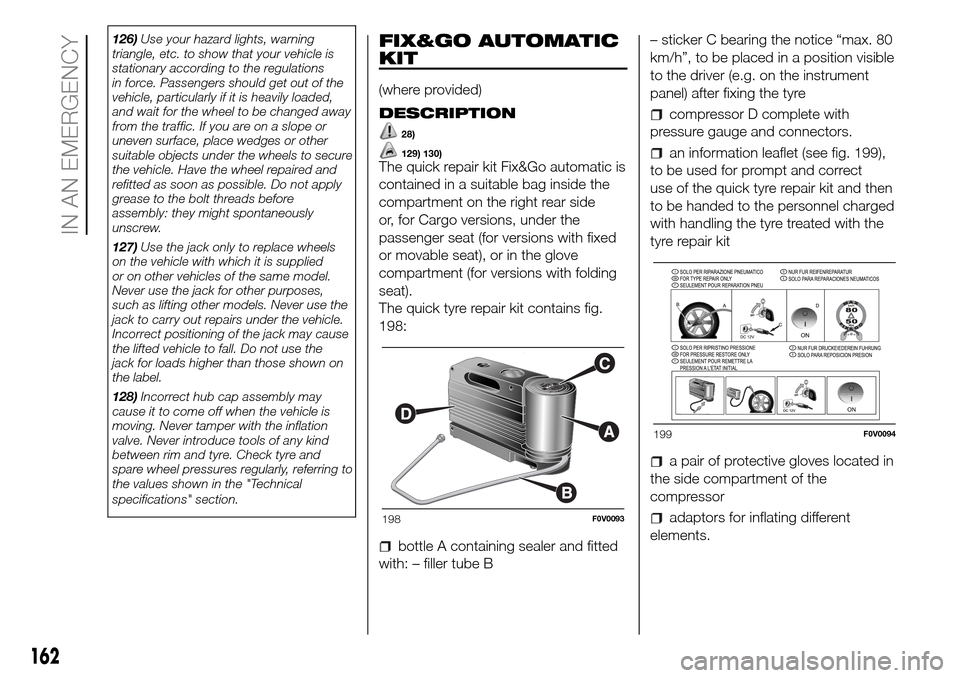
The quick tyre repair kit contains fig.
198:
bottle A containing sealer and fitted
with: – filler tube B– sticker C bearing the notice “max. 80
km/h”, to be placed in a position visible
to the driver (e.g. on the instrument
panel) after fixing the tyre
compressor D complete with
pressure gauge and connectors.
an information leaflet (see fig. 199),
to be used for prompt and correct
use of the quick tyre repair kit and then
to be handed to the personnel charged
with handling the tyre treated with the
tyre repair kit
a pair of protective gloves located in
the side compartment of the
compressor
adaptors for inflating different
elements.198F0V0093
199F0V0094
162
IN AN EMERGENCY
Page 167 of 298
TYRE REPAIRING AND
PRESSURE RESTORING
PROCEDURE
28)
129) 130)Proceed as follows:
place the vehicle in a safe and
suitable area, engaging the parking
brake. Take the kit from the specific
compartment. Remove the adhesive
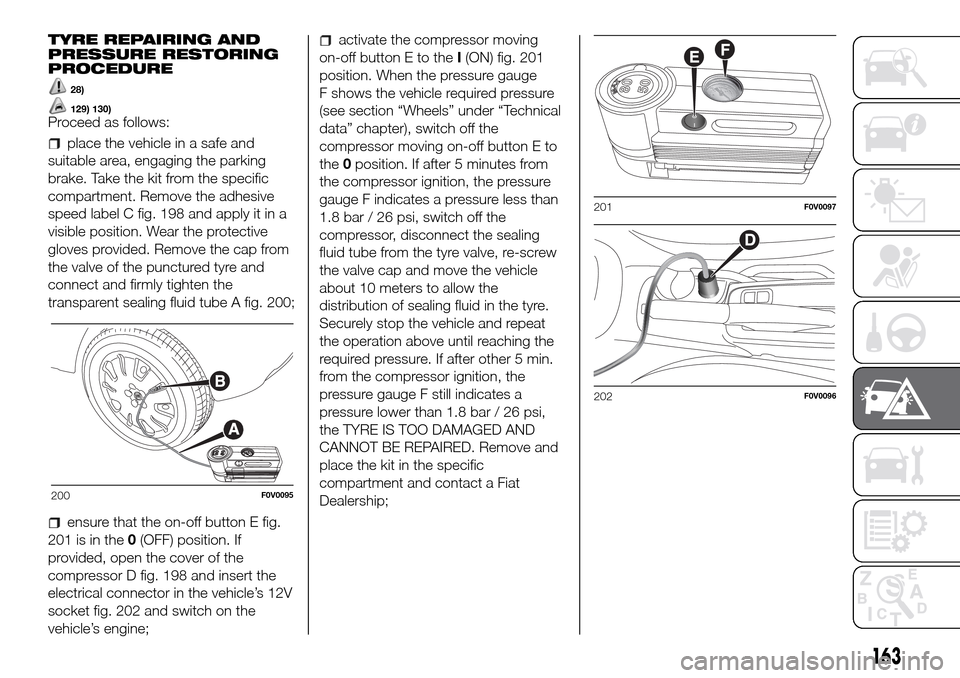
speed label C fig. 198 and apply it in a
visible position. Wear the protective
gloves provided. Remove the cap from
the valve of the punctured tyre and
connect and firmly tighten the
transparent sealing fluid tube A fig. 200;
ensure that the on-off button E fig.
201 is in the0(OFF) position. If
provided, open the cover of the
compressor D fig. 198 and insert the
electrical connector in the vehicle’s 12V
socket fig. 202 and switch on the
vehicle’s engine;
activate the compressor moving
on-off button E to theI(ON) fig. 201
position. When the pressure gauge
F shows the vehicle required pressure
(see section “Wheels” under “Technical
data” chapter), switch off the
compressor moving on-off button E to
the0position. If after 5 minutes from
the compressor ignition, the pressure
gauge F indicates a pressure less than
1.8 bar / 26 psi, switch off the
compressor, disconnect the sealing
fluid tube from the tyre valve, re-screw
the valve cap and move the vehicle
about 10 meters to allow the
distribution of sealing fluid in the tyre.
Securely stop the vehicle and repeat
the operation above until reaching the
required pressure. If after other 5 min.
from the compressor ignition, the
pressure gauge F still indicates a
pressure lower than 1.8 bar / 26 psi,
the TYRE IS TOO DAMAGED AND
CANNOT BE REPAIRED. Remove and
place the kit in the specific
compartment and contact a Fiat
Dealership;
200F0V0095
201F0V0097
202F0V0096
163
Page 169 of 298
WARNING
28)The label on the Fix&Go kit’s packaging
gives the information required by the laws
in force. To ensure that the Fix&Go kit is
safe and effective, it is essential to comply
with all the instructions given on the label.
Carefully read the label before use, avoid
improper use. Fix&Go is subject to
expiration and must be replaced
periodically. The kit should be used by
adults and cannot be used by children.
WARNING
129)Show the package and the label to
the personnel charged with handling
the tyre treated with the tyre repair kit.
130)Fix&Go provides a temporary repair,
therefore the tyre must be examined and
repaired by a specialist as soon as
possible. The sealing fluid is effective at
temperatures between -40°C and +50°C. It
is possible to repair tyres which have
been damaged on tread up to a diameter
of 4mm; however, tyres damaged on
their side cannot be repaired. Before using
Fix&Go kit, ensure that the tyre isn't
excessively damaged and that the rim is in
good condition, otherwise do not use it
and contact a Fiat Dealership. Do not
remove foreign bodies from the tyre. Do
not let the compressor turned on for more
than 20 consecutive minutes - overheating
hazard.
EMERGENCY
STARTING
Go to a Fiat Dealership immediately if
warning light
stays on constantly on
the instrument panel.
JUMP STARTING
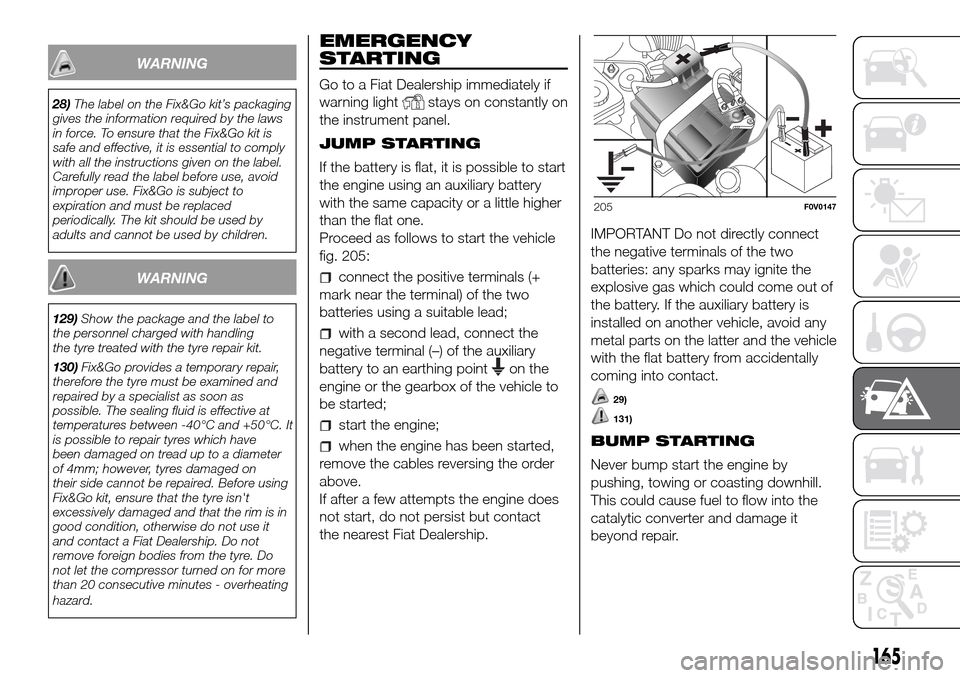
If the battery is flat, it is possible to start
the engine using an auxiliary battery
with the same capacity or a little higher
than the flat one.
Proceed as follows to start the vehicle
fig. 205:
connect the positive terminals (+
mark near the terminal) of the two
batteries using a suitable lead;
with a second lead, connect the
negative terminal (–) of the auxiliary
battery to an earthing point
on the
engine or the gearbox of the vehicle to
be started;
start the engine;
when the engine has been started,
remove the cables reversing the order
above.
If after a few attempts the engine does
not start, do not persist but contact
the nearest Fiat Dealership.IMPORTANT Do not directly connect
the negative terminals of the two
batteries: any sparks may ignite the
explosive gas which could come out of
the battery. If the auxiliary battery is
installed on another vehicle, avoid any
metal parts on the latter and the vehicle
with the flat battery from accidentally
coming into contact.
29)
131)
BUMP STARTING
Never bump start the engine by
pushing, towing or coasting downhill.
This could cause fuel to flow into the
catalytic converter and damage it
beyond repair.
205F0V0147
165
Page 192 of 298
Take great care to ensure that
impurities do not enter the reservoir
when the cap is opened.
For topping-up, always use a funnel
with integrated filter with mesh equal to
or lower than 0.12 mm.
IMPORTANT Brake fluid absorbs
moisture. For this reason, if the vehicle
is mainly used in areas with a high
degree of atmospheric humidity, the
fluid should be replaced at more
frequent intervals than specified in the
“Scheduled Servicing Plan”.
34)
140) 141)
POWER STEERING FLUID
Check that the oil level with the vehicle
on flat ground and the engine cold is
between the MIN and MAX marks
on the reservoir body G fig. 208 - fig.
209 - fig. 210 - fig. 211 - fig. 213 - fig.
214 - fig. 215.
The level may exceed the MAX mark
when the oil is hot.
If topping up is required, make sure the
oil you use has the same specifications
as that already in the system.
142)
3)
35)
WARNING
136)Never smoke while working in the
engine compartment: gas and inflammable
vapours may be present, with the risk of
fire.
137)When the engine is hot, take care
when working inside the engine
compartment to avoid burns. Remember
that when the engine is hot, the fan may
operate: danger of injury. Scarves, ties and
other loose clothing might be pulled by
moving parts.
138)The cooling system is pressurised. If
necessary, only replace the plug with
another original or the operation of the
system may be adversely affected. Do not
remove the reservoir plug when the engine
is hot: you risk scalding yourself.
139)Do not travel with the windscreen
washer fluid reservoir empty: the
windscreen washer is essential for
improving visibility. Some commercial
windscreen washer additives are
flammable. The engine compartment
contains hot components which may set it
on fire.
140)Brake fluid is poisonous and highly
corrosive. In the event of accidental
contact, immediately wash the affected
parts with water and mild soap. Then rinse
thoroughly. Call a doctor immediately if
swallowed.141)The symbol
, on the brake fluid
container indicates if a brake fluid is
synthetic or mineralbased. Using
a mineral-type fluid will damage the special
rubber seals of the braking system beyond
repair.
142)Prevent power steering fluid from
coming into contact with hot engine parts:
it is flammable.
WARNING
31)When topping up, take care not to mix
up the various types of fluids: they are
not compatible with each other and could
seriously damage the vehicle.
32)Do not add oil with specifications other
than those of the oil already existing in
the engine.
33)PARAFLU
UPanti-freeze is used in the
engine cooling system. Use the same
fluid as in the cooling system when topping
up. PARAFLU
UPcannot be mixed with
any other type of fluid. If this occurs, do not
start the engine and contact your Fiat
Dealership immediately.
34)Prevent brake fluid, which is highly
corrosive, from coming into contact with
painted parts. Should it happen,
immediately wash with water.
35)Do not press on the power steering
end of travel with engine on for more than
8 consecutive seconds, since noise is
produced and there is a risk of system
damages.
188
SERVICING AND CARE