heating FIAT DOBLO PANORAMA 2017 2.G User Guide
[x] Cancel search | Manufacturer: FIAT, Model Year: 2017, Model line: DOBLO PANORAMA, Model: FIAT DOBLO PANORAMA 2017 2.GPages: 298, PDF Size: 26.04 MB
Page 56 of 298
You can only adjust the fan speed and
switch off the heated rear window
manually when this function is active.
To restore the previous operating
conditions, simply press button B, air
recirculation button G, compressor
button F or AUTO button A.
Heated rear window and door
mirrors electric control demisting/
defrosting button (L)
(for versions/markets, where provided)
Push this button to activate the
demisting/defrosting of the heated rear
window and electric door mirrors
When this function is active, the button
LED is on.
This function switches off automatically
after about 20 minutes or when you
push the button again, or when the
engine is turned off. It will not be
switched on automatically when the
engine is restarted.
IMPORTANT Do not affix decals to the
inside of the heated rear window over
the heating filaments, to avoid damage
that might cause them to stop working
properly.
Switching the system OFF (E)
Press button E to switch the climate
control system off. The display will go
out.With the system off, the climate control
system conditions are as follows:
display off, temperature setting not
display, air recirculation on thereby
insulating the passenger compartment
from the outside (recirculation LED
on), climate control compressor off, fan
off. Press the AUTO button to switch
the climate control system back on
in full automatic mode.ELECTRIC WINDOWS
FRONT ELECTRIC
WINDOWS
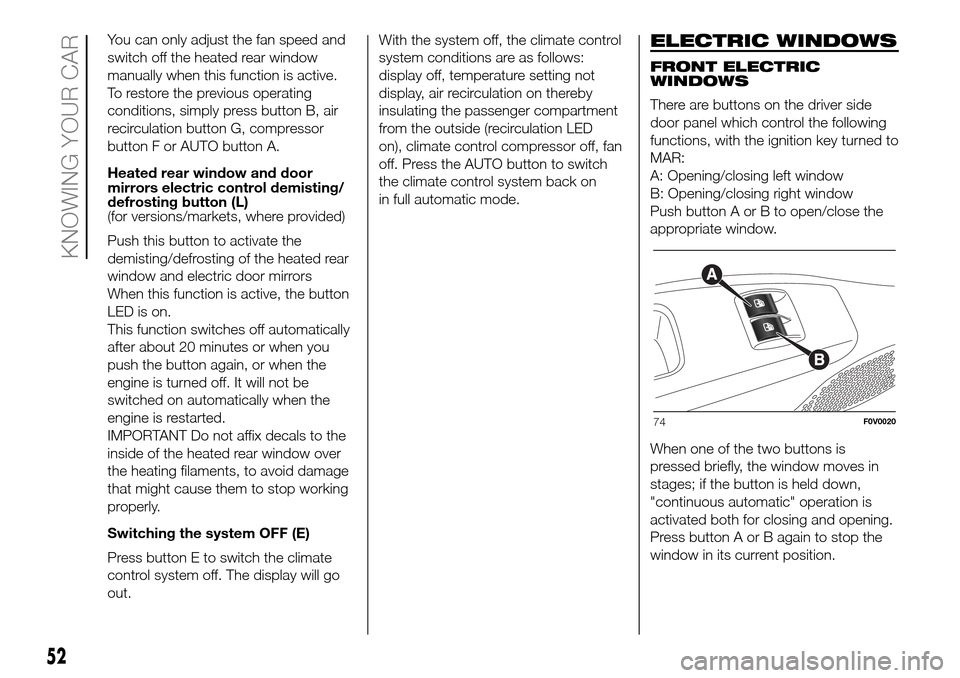
There are buttons on the driver side
door panel which control the following
functions, with the ignition key turned to
MAR:
A: Opening/closing left window
B: Opening/closing right window
Push button A or B to open/close the
appropriate window.
When one of the two buttons is
pressed briefly, the window moves in
stages; if the button is held down,
"continuous automatic" operation is
activated both for closing and opening.
Press button A or B again to stop the
window in its current position.
74F0V0020
52
KNOWING YOUR CAR
Page 71 of 298
KNOWING THE INSTRUMENT PANEL
This section of the booklet gives you all
the information you need to
understand, interpret and use the
instrument panel correctly.CONTROL PANEL AND
ON-BOARD INSTRUMENTS ........... 68
DIGITAL DISPLAY............................ 70
MULTIFUNCTION DISPLAY ............. 73
TRIP COMPUTER ........................... 80
EOBD SYSTEM............................... 82
WARNING LIGHTS AND
MESSAGES .................................... 83
- LOW BRAKE FLUID/HANDBRAKE
ENGAGED .......................................... 83
- EBD FAILURE .................................. 84
- AIRBAG FAILURE ............................. 84
- SEAT BELTS NOT FASTENED .......... 85
- ENGINE COOLANT TEMPERATURE
TOO HIGH .......................................... 85
- LOW BATTERY CHARGE ................. 86
- LOW ENGINE OIL PRESSURE ......... 87
-ENGINE OIL DETERIORATED ........... 87
-LOW ENGINE OIL LEVEL .................. 87
-INCOMPLETE DOOR LOCKING ........ 88
- INJECTION/EOBD SYSTEM
FAILURE ............................................. 89
- ABS FAILURE ................................... 90
-FUEL RESERVE ................................ 90
- GLOW PLUG PREHEATING/GLOW
PLUG PREHEATING FAILURE ............ 91
- WATER IN DIESEL FILTER ................ 91
-VEHICLE PROTECTION SYSTEM
FAILURE - FIAT CODE ........................ 92
- REAR FOG LIGHTS .......................... 92
-GENERIC FAILURE INDICATION ....... 92
-DPF (PARTICULATE FILTER)
CLEANING UNDERWAY ..................... 93
-WORN BRAKE PADS ........................ 94
-ASR SYSTEM DEACTIVATED ............ 94- TRACTION PLUS SYSTEM
ACTIVATION ....................................... 95
- TPMS ............................................... 95
-PARKING SENSOR FAILURE ............ 96
-START&STOP SYSTEM FAILURE ...... 96
- DIPPED BEAM HEADLIGHTS .......... 97
- FOLLOW ME HOME ........................ 97
- LEFT-HAND DIRECTION INDICATOR
............................................................ 97
- RIGHT-HAND DIRECTION
INDICATOR ........................................ 97
-FOG LIGHTS ..................................... 98
- CRUISE CONTROL .......................... 98
- MAIN BEAM HEADLIGHTS .............. 98
67
Page 72 of 298
CONTROL PANEL AND ON-BOARD INSTRUMENTS.
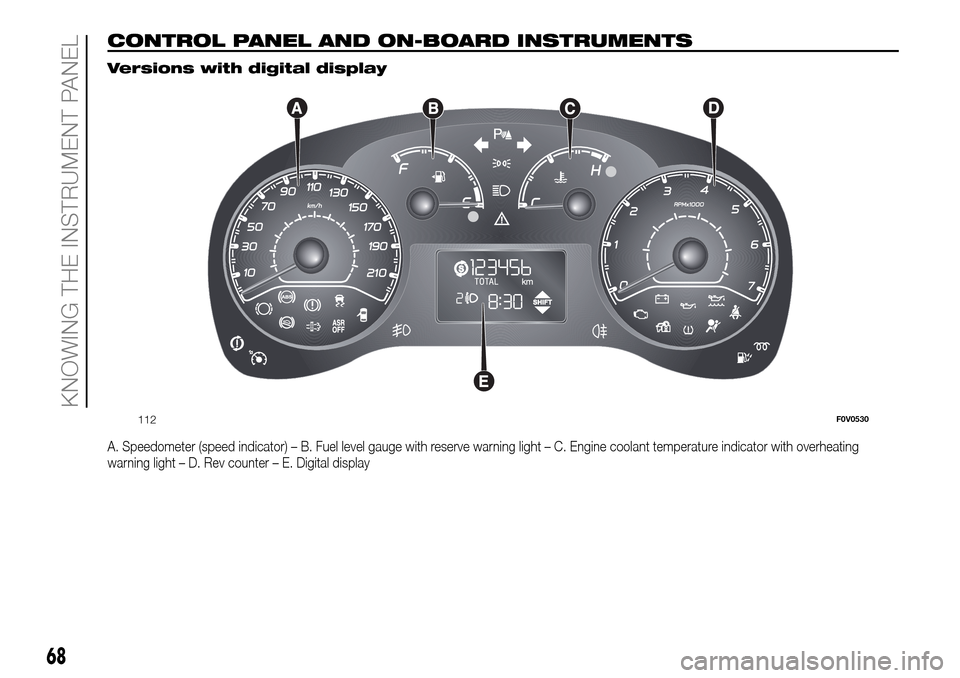
Versions with digital display
A. Speedometer (speed indicator) – B. Fuel level gauge with reserve warning light – C. Engine coolant temperature indicator with overheating
warning light – D. Rev counter – E. Digital display
112F0V0530
68
KNOWING THE INSTRUMENT PANEL
Page 73 of 298
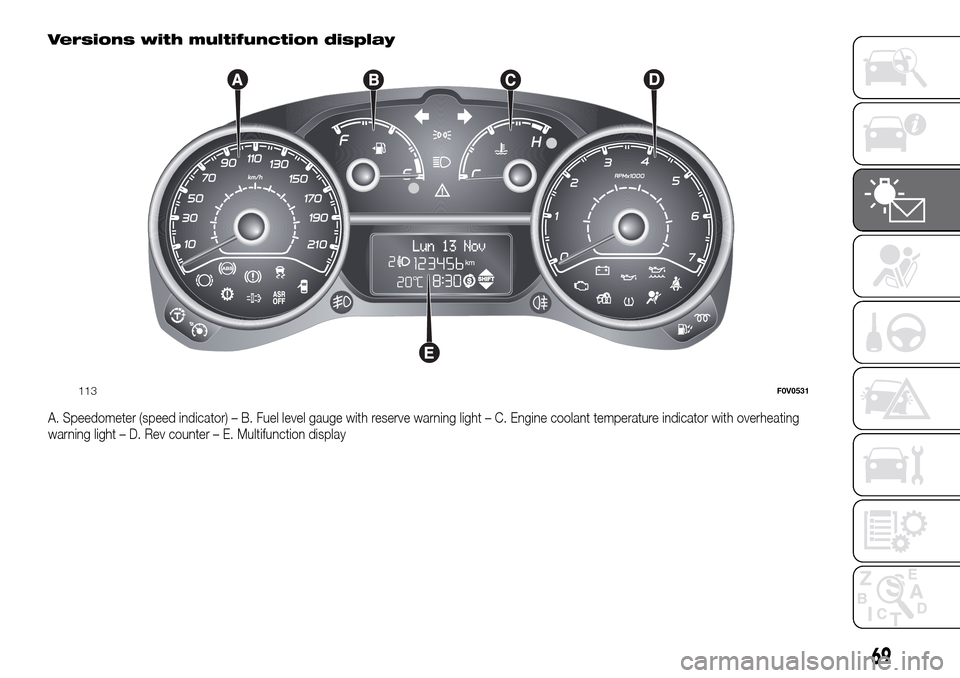
Versions with multifunction display
A. Speedometer (speed indicator) – B. Fuel level gauge with reserve warning light – C. Engine coolant temperature indicator with overheating
warning light – D. Rev counter – E. Multifunction display
113F0V0531
69
Page 95 of 298
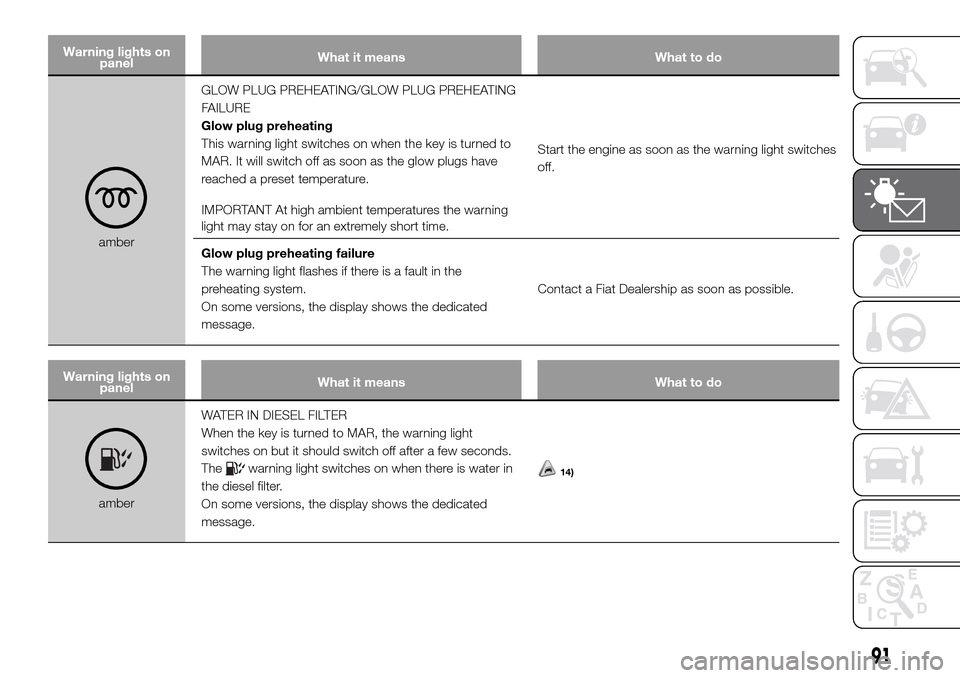
Warning lights on
panelWhat it means What to do
amberGLOW PLUG PREHEATING/GLOW PLUG PREHEATING
FAILURE
Glow plug preheating
This warning light switches on when the key is turned to
MAR. It will switch off as soon as the glow plugs have
reached a preset temperature.
IMPORTANT At high ambient temperatures the warning
light may stay on for an extremely short time.Start the engine as soon as the warning light switches
off.
Glow plug preheating failure
The warning light flashes if there is a fault in the
preheating system.
On some versions, the display shows the dedicated
message.Contact a Fiat Dealership as soon as possible.
Warning lights on
panelWhat it means What to do
amberWATER IN DIESEL FILTER
When the key is turned to MAR, the warning light
switches on but it should switch off after a few seconds.
The
warning light switches on when there is water in
the diesel filter.
On some versions, the display shows the dedicated
message.14)
91
Page 112 of 298
WARNING
65)The pretensioner may be used only
once. After it is triggered, have it replaced
at a Fiat Dealership.
66)For maximum safety, keep the backrest
upright, lean back into it and make sure
the seat belt fits closely across your chest
and pelvis. Always fasten the seat belts
on both the front and the rear seats!
Travelling without wearing seat belts will
increase the risk of serious injury and even
death in the event of an accident.
67)If the belt has been sharply pulled, for
example as the result of an accident, the
seat belt, together with the anchoring
devices, the anchoring device fixing screws
and the pretensioner must be completely
replaced. Even if the belt does not present
any exterior signs of wear or damage, it
may have lost its restraining properties.
WARNING
16)Operations which lead to knocks,
vibrations or localised heating (over 100°C
for a maximum of 6 hours) in the area
around the pretensioners may cause
damage or trigger them. These devices are
not affected by vibrations caused by
irregularities of the road surface or low
obstacles such as kerbs, etc. Contact a
Fiat Dealership for any assistance.
CARRYING
CHILDREN SAFELY
For optimal protection in the event of an
impact, all passengers must be seated
and wearing adequate restraint
systems.
This is even more important for
children.
This prescription is compulsory in all EU
countries according to EC Directive
2003/20/EC.
Compared with an adult, a child's head
is larger and heavier in proportion to
their body and the child's muscular and
bone structures are not fully developed.
Therefore, correct restraint systems
other than adult seat belts are
necessary to reduce as much as
possible the risk of injuries in the event
of an accident, braking or a sudden
manoeuvre.
Children must be seated safely and
comfortably.
Depending on the characteristics of the
child restraint systems used, you are
advised to keep children in rear-facing
child restraint systems for as long as
possible (at least until 3-4 years old),
since this is the most protected position
in the event of an impact.It is recommended to always choose
the restraint system most suitable
for the child; for this reason always refer
to the Owner Handbook provided with
the child restraint system, to be sure
that it is of the right type for the children
it is intended for.
When over 1.50 m in height, from the
point of view of restraint systems,
children are considered as adults and
wear seat belts normally.
In Europe child restraint systems are
classified, among other criteria, into five
weight groups:
Group Weight groups
Group 0up to 10 kg in
weight
Group 0+up to 13 kg in
weight
Group 1 9 - 18 kg
Group 2 15 - 25 kg
Group 3 22 - 36 kg
All restraint devices must bear the
certification data, together with the
control mark, on a label solidly fixed to
the child restraint system which must
never be removed.
Lineaccessori Fiat offers child restraint
systems for each weight group. These
devices are recommended having been
specifically designed for Fiat vehicles.
108
SAFETY
Page 128 of 298
STARTING THE
ENGINE
The vehicle is fitted with an immobiliser:
if the engine fails to start, see the
paragraph on “The Fiat CODE system”
in the “Dashboard and controls”
section.
The engine may be noisier during the
first few seconds of operation,
especially after a long period of
inactivity. This is due to the hydraulic
tappets, the timing system chosen for
petrol engine versions to reduce the
number of servicing interventions, and
affects neither functionality nor reliability.
17) 18)
95)
PROCEDURE FOR
PETROL VERSIONS
Proceed as follows:
engage the handbrake;
put the gear lever into neutral;
fully depress the clutch pedal,
without touching the accelerator;
turn the ignition key to AVV and
release it as soon as the engine starts.
If the engine does not start at the
first attempt, return the ignition key to
STOP before repeating the starting
procedure.
If, when the ignition key is on MAR, the
instrument panel warning light
remains on together with warning
light
, turn the key to STOP and
then back to MAR; if the warning light
remains on, try the other keys provided
with the vehicle. If you are still unable
to start the engine, perform the
emergency starting procedure (see
"Emergency starting" in the "In an
emergency" chapter) and contact a Fiat
Dealership.PROCEDURE FOR DIESEL
VERSIONS
Proceed as follows:
engage the handbrake;
put the gear lever into neutral;
turn the ignition key to MAR: the
warning lights
andon the
instrument panel will turn on;
wait for the warning lightsand
to switch off. The hotter the engine
is, the quicker this will happen;
fully depress the clutch pedal,
without touching the accelerator;
turn the ignition key to AVV as soon
as warning light
switches off.
Waiting too long will waste the heating
work carried out by the glow plugs.
Release the key as soon as the engine
starts.
IMPORTANT With the engine cold, the
accelerator pedal must be fully released
when you turn the ignition key to AVV.
If the engine does not start at the
first attempt, return the ignition key to
STOP before repeating the starting
procedure.
If, when the ignition key is at MAR the
warning light remains lit, turn the
key to STOP and then back to MAR; if
the warning light remains lit, try with the
other keys provided with the vehicle. If
you still cannot start the engine, contact
a Fiat Dealership.
124
STARTING AND DRIVING
Page 129 of 298
19)
WARMING UP THE
ENGINE JUST AFTER IT
HAS STARTED
Proceed as follows:
drive off slowly, letting the engine
turn at medium revs. Do not accelerate
abruptly;
do not demand full performance at
first. Wait until the engine coolant
temperature gauge starts moving.
EMERGENCY STARTING
If the instrument panel warning light
stays on steadily, you can perform
an emergency starting by using the
code on the CODE card (see the “In an
emergency” section).
20)
STOPPING THE ENGINE
Turn the ignition key to STOP while the
engine is idling.
IMPORTANT After a taxing drive, you
should allow the engine to “catch
its breath” before turning it off by letting
it idle to allow the temperature in the
engine compartment to fall.
WARNING
17)It is advisable not to demand maximum
performance from your vehicle (e.g.
excessive acceleration, long distances at
high speeds, excessively intense braking,
etc.) during the initial period of use.
18)When the engine is off, do not leave
the key turned to MAR to prevent
unnecessary electrical consumption from
draining the battery.
19)If the indicator flashes for 60
seconds after starting or during an
extended towing period, this indicates
a problem in the glow plug preheating
system. Use the vehicle normally if the
engine starts, but contact a Fiat Dealership
as soon as possible.
20)Never start the engine by pushing,
towing or driving downhill. This could
cause fuel to flow into the catalytic
converter and damage it beyond repair.
WARNING
95)It is dangerous to run the engine in
enclosed areas. The engine takes in
oxygen and releases carbon dioxide,
carbon monoxide and other toxic gases.
HANDBRAKE
The handbrake lever is located between
the front seats. Pull the lever upwards
to engage the handbrake and ensure
that the vehicle does not move. The
vehicle should be secured after several
clicks of the lever. If it is not, contact
a Fiat Dealership to have it adjusted.
96)When the handbrake lever is engaged
and the ignition key is in MAR position,
the instrument panel warning light
will switch on.
Proceed as follows to release the
handbrake:
slightly lift the lever and press
release button A fig. 140;
keep button A pressed and lower
the lever. The
warning light in the
instrument panel will switch off.
Press the brake pedal when carrying
out this operation to prevent the vehicle
from moving accidentally.
PARKING
Proceed as follows:
stop the engine and engage the
handbrake;
engage the gear (on a slope, engage
first gear if the vehicle is facing uphill
or reverse if it is facing downhill) and
leave the wheels steered.
125
Page 135 of 298
The TPMS does not replace the
normal tyre maintenance service and
does not indicate any fault in a tyre.
Therefore, the TPMS should not be
used as pressure switch while adjusting
the tyre inflation pressure.
Driving with insufficient tyre pressure
causes their overheating and can
result in tyre failure. The low inflation
pressure reduces fuel efficiency and
tyre tread life and may also affect
handling and braking performance of
the vehicle.
The TPMS does not replace the
correct tyre maintenance. It is up to the
driver to maintain the correct tyre
pressure level measuring it with
a suitable pressure switch. This is
necessary even if the decrease in the
inflation pressure value does not cause
the tyre pressure control warning light
to switch on.
The TPMS warns the driver of any
condition of insufficient tyre pressure
If this drops below the insufficient
pressure limit for any reason including
low temperature and normal pressure
loss of the tyre.
The seasonal temperature changes
affect tyre pressure.The TPMS uses wireless devices with
electronic sensors mounted on the
wheel rims to constantly monitor the
value of tyre pressure. The sensors
mounted on each wheel as part of the
valve stem transmit various information
of the tyres to the receiver module, in
order to calculate the pressure.
IMPORTANT Monitoring and
maintaining the correct pressure in all
four tyres are particularly important.
Tyre pressure monitoring system
low pressure warning
The system warns the driver if one or
more tyres are flat by switching on
the warning light
on the instrument
panel (together with a warning message
and an acoustic signal).The TPMS continues to advise the
driver of the low tyre pressure condition
until this is corrected; the warning
continues until the pressure
corresponds or exceeds the pressure
prescribed for the cold tyres. When the
tyre low pressure control warning
light
switches on constantly, the
inflation pressure must be adjusted until
it reaches the pressure prescribed for
cold tyres. After the automatic update
of the system, the tyre pressure control
warning light switches off. You may
need to drive the vehicle for about 20
minutes at a speed higher than 20
km/h to allow the TPMS to receive this
information.
IMPORTANT In the case of deflation of
more than one tyre sequentially, without
switching off and on the engine, from
the second tyre involved the acoustic
signal is not activated, only the
dedicated signal is shown on the
display.
To prevent the signal from being stored
in the event of pressure loss of a
subsequent tyre (with deactivation of
the acoustic signal), the ignition key
must be turned to MAR and then to
STOP, each time pressure is restored.
131
Page 169 of 298
WARNING
28)The label on the Fix&Go kit’s packaging
gives the information required by the laws
in force. To ensure that the Fix&Go kit is
safe and effective, it is essential to comply
with all the instructions given on the label.
Carefully read the label before use, avoid
improper use. Fix&Go is subject to
expiration and must be replaced
periodically. The kit should be used by
adults and cannot be used by children.
WARNING
129)Show the package and the label to
the personnel charged with handling
the tyre treated with the tyre repair kit.
130)Fix&Go provides a temporary repair,
therefore the tyre must be examined and
repaired by a specialist as soon as
possible. The sealing fluid is effective at
temperatures between -40°C and +50°C. It
is possible to repair tyres which have
been damaged on tread up to a diameter
of 4mm; however, tyres damaged on
their side cannot be repaired. Before using
Fix&Go kit, ensure that the tyre isn't
excessively damaged and that the rim is in
good condition, otherwise do not use it
and contact a Fiat Dealership. Do not
remove foreign bodies from the tyre. Do
not let the compressor turned on for more
than 20 consecutive minutes - overheating
hazard.
EMERGENCY
STARTING
Go to a Fiat Dealership immediately if
warning light
stays on constantly on
the instrument panel.
JUMP STARTING
If the battery is flat, it is possible to start
the engine using an auxiliary battery
with the same capacity or a little higher
than the flat one.
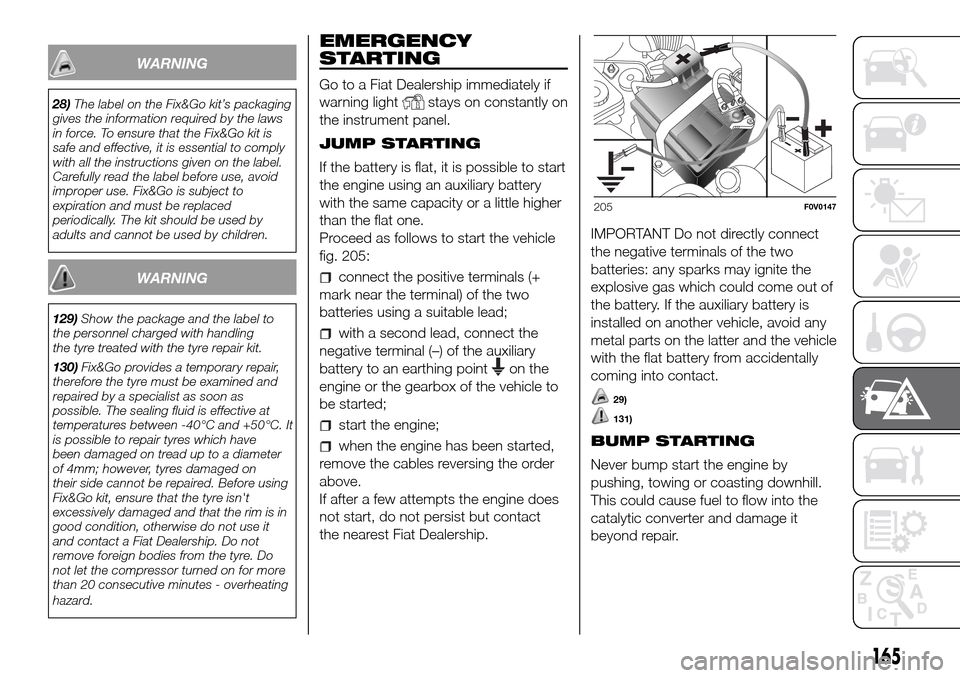
Proceed as follows to start the vehicle
fig. 205:
connect the positive terminals (+
mark near the terminal) of the two
batteries using a suitable lead;
with a second lead, connect the
negative terminal (–) of the auxiliary
battery to an earthing point
on the
engine or the gearbox of the vehicle to
be started;
start the engine;
when the engine has been started,
remove the cables reversing the order
above.
If after a few attempts the engine does
not start, do not persist but contact
the nearest Fiat Dealership.IMPORTANT Do not directly connect
the negative terminals of the two
batteries: any sparks may ignite the
explosive gas which could come out of
the battery. If the auxiliary battery is
installed on another vehicle, avoid any
metal parts on the latter and the vehicle
with the flat battery from accidentally
coming into contact.
29)
131)
BUMP STARTING
Never bump start the engine by
pushing, towing or coasting downhill.
This could cause fuel to flow into the
catalytic converter and damage it
beyond repair.
205F0V0147
165