brake light FIAT DUCATO 2006 3.G User Guide
[x] Cancel search | Manufacturer: FIAT, Model Year: 2006, Model line: DUCATO, Model: FIAT DUCATO 2006 3.GPages: 258, PDF Size: 4.05 MB
Page 109 of 258
108GETTING THE BEST OUT OF YOUR VEHICLE
SWITCHING OFF
THE ENGINE
Turn the ignition key to STOPwhile
the engine is idling.
IMPORTANTAfter a taxing drive
you should allow the engine to “catch
its breath” before turning it off by let-
ting it idle to allow temperature in the
engine compartment to fall.PARKING
Switch off the engine, pull up the
handbrake and engage a gear (1st gear
or reverse, according to whether the
vehicle is facing up or downhill) and
leave the wheels turned. If the vehi-
cle is left on a steep slope, wedges or
a rock should be used to lock the
wheels.
Do not leave the ignition key at
MAR to prevent running the battery
down. Always remove the key when
you leave the vehicle.HANDBRAKE
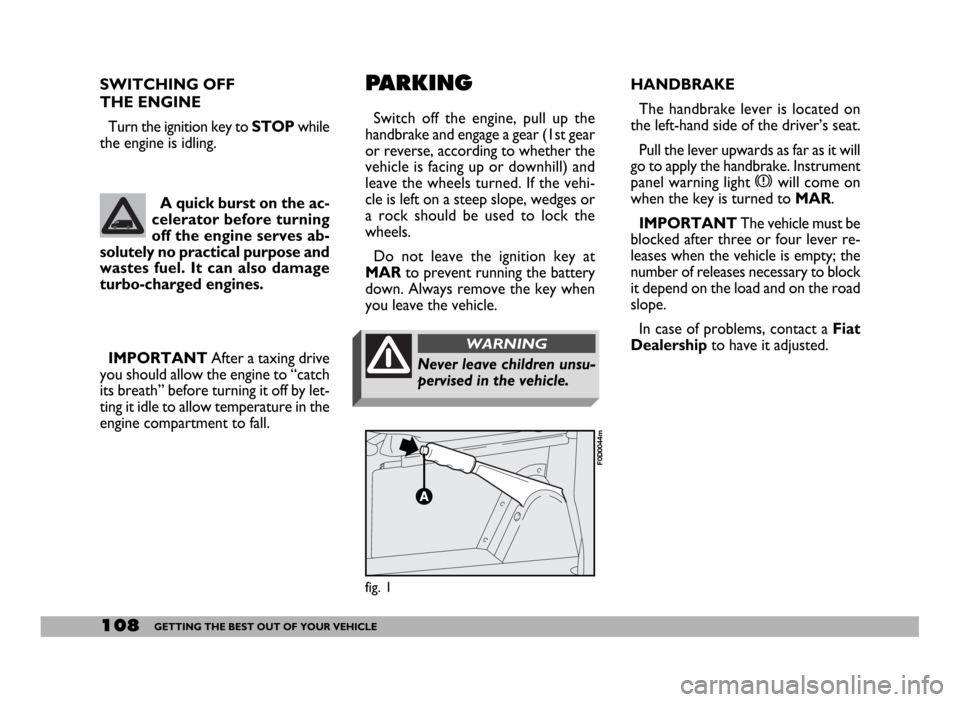
The handbrake lever is located on
the left-hand side of the driver’s seat.
Pull the lever upwards as far as it will
go to apply the handbrake. Instrument
panel warning light xwill come on
when the key is turned to MAR.
IMPORTANTThe vehicle must be
blocked after three or four lever re-
leases when the vehicle is empty; the
number of releases necessary to block
it depend on the load and on the road
slope.
In case of problems, contact a Fiat
Dealershipto have it adjusted. A quick burst on the ac-
celerator before turning
off the engine serves ab-
solutely no practical purpose and
wastes fuel. It can also damage
turbo-charged engines.
fig. 1
F0D0044m
Never leave children unsu-
pervised in the vehicle.
WARNING
Page 110 of 258
109GETTING THE BEST OUT OF YOUR VEHICLE
To release the handbrake:
1)slightly lift the handbrake and press
release button A-fig. 1;
2)keep the button pressed and low-
er the lever. Warning light xwill go
out;
3)press the brake pedal when car-
rying out this operation to prevent the
vehicle moving accidentally.
IMPORTANTPull the handbrake
lever only when the vehicle is at a
standstill, or when the vehicle is run-
ning, but however only in case of a fail-
ure of the hydraulic system.
Should the handbrake be exception-
ally used when the vehicle is running, it
is suggested to keep a moderate trac-
tion to avoid causing the rear axle
block, entailing vehicle side skidding.USING THE
MANUAL GEARBOX
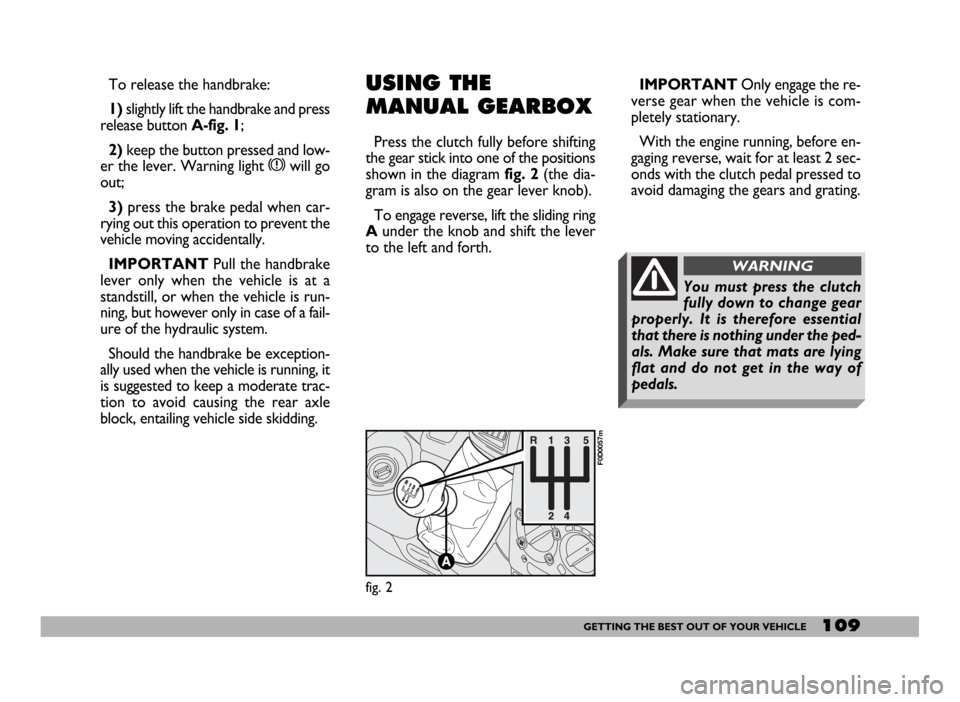
Press the clutch fully before shifting
the gear stick into one of the positions
shown in the diagram fig. 2(the dia-
gram is also on the gear lever knob).
To engage reverse, lift the sliding ring
Aunder the knob and shift the lever
to the left and forth.IMPORTANTOnly engage the re-
verse gear when the vehicle is com-
pletely stationary.
With the engine running, before en-
gaging reverse, wait for at least 2 sec-
onds with the clutch pedal pressed to
avoid damaging the gears and grating.
fig. 2
F0D0057m
You must press the clutch
fully down to change gear
properly. It is therefore essential
that there is nothing under the ped-
als. Make sure that mats are lying
flat and do not get in the way of
pedals.
WARNING
Page 113 of 258
112GETTING THE BEST OUT OF YOUR VEHICLE
IMPORTANTRemoving the igni-
tion key is only allowed with the
gearshift lever in position Pand for a
maximum time of 30 seconds from
when the engine is turned off P, when
the door is opened a buzzer will sound
for about 15 seconds to alert the dri-
ver.
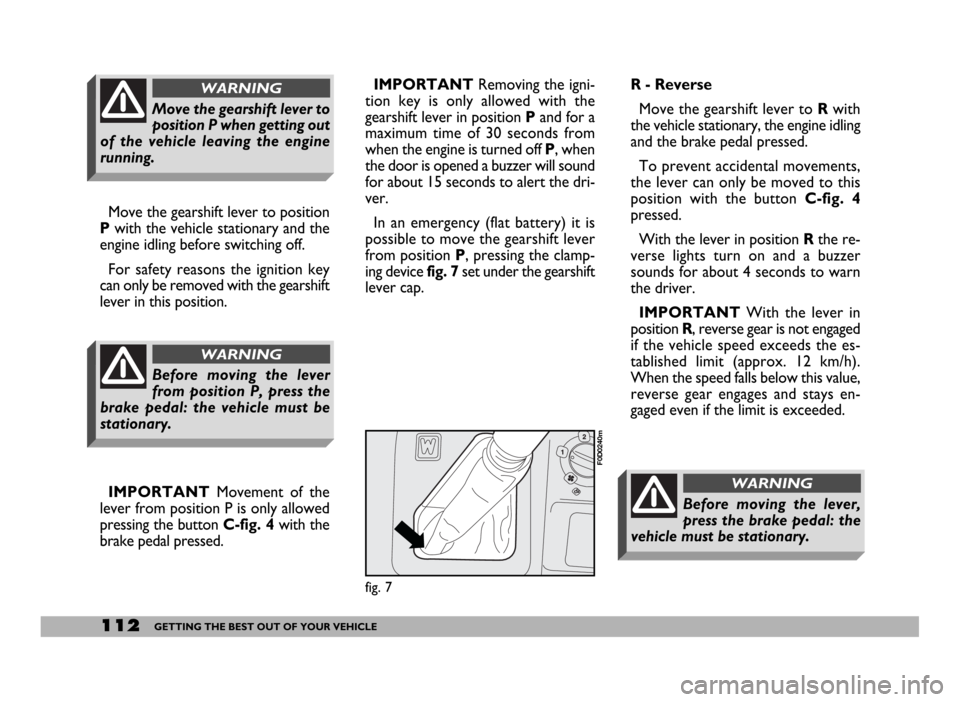
In an emergency (flat battery) it is
possible to move the gearshift lever
from position P, pressing the clamp-
ing device fig. 7set under the gearshift
lever cap.R - Reverse
Move the gearshift lever to Rwith
the vehicle stationary, the engine idling
and the brake pedal pressed.
To prevent accidental movements,
the lever can only be moved to this
position with the button C-fig. 4
pressed.
With the lever in position Rthe re-
verse lights turn on and a buzzer
sounds for about 4 seconds to warn
the driver.
IMPORTANTWith the lever in
position R, reverse gear is not engaged
if the vehicle speed exceeds the es-
tablished limit (approx. 12 km/h).
When the speed falls below this value,
reverse gear engages and stays en-
gaged even if the limit is exceeded.
fig. 7
F0D0240m
Before moving the lever,
press the brake pedal: the
vehicle must be stationary.
WARNING
Move the gearshift lever to position
Pwith the vehicle stationary and the
engine idling before switching off.
For safety reasons the ignition key
can only be removed with the gearshift
lever in this position.
IMPORTANTMovement of the
lever from position P is only allowed
pressing the button C-fig. 4with the
brake pedal pressed.
Move the gearshift lever to
position P when getting out
of the vehicle leaving the engine
running.
WARNING
Before moving the lever
from position P, press the
brake pedal: the vehicle must be
stationary.
WARNING
Page 121 of 258
120GETTING THE BEST OUT OF YOUR VEHICLE
BEFORE GETTING BEHIND
THE WHEEL
– Make sure all light, including the
headlights, are working properly;
– adjust the position of seats and dri-
ving and door mirrors properly for the
best driving position;
– make sure that nothing (mats, etc.)
gets in the way of the pedals when
they are pushed down;
– make sure that any child restraint
systems (child seats, cradles, etc.) are
properly fixed;
– place any objects in the load com-
partment in such a way that they can-
not be thrown forwards in the event
of an accident;
– light eating will help keep your re-
flexes prompt. Above all, do not have
anything alcoholic to drink.
Remember to periodically check:
– tyre pressure,
– engine oil level,
– engine coolant level and cooling
system conditions,– brake fluid level,
– windscreen washer fluid level.
WHEN TRAVELLING
– The first rule of safe driving is pru-
dence;
– prudence also means putting your-
self into a position where you can pre-
dict wrong or imprudent behaviour
from other drivers;
– stick closely to the rules of the
road in the particular country where
the vehicle is being driven and, above
all, do not exceed speed limits;
– ensure that, besides yourself, all the
other passengers in the vehicle have
their seat belts fastened, that children
are sitting in the appropriate child
seats and any animals in the vehicle are
placed in suitable compartment;
– you should be physically fit and
mentally alert before setting out on
long journeys.
Always fasten both front
and back seat belts
(Panorama, Minibus, Combi and
Crew Cab versions). Travelling with
the seat belts unfastened increas-
es the risk of injury or death if you
are in a collision.
WARNING
Driving while drunk or un-
der the influence of drugs
or certain medicines is dangerous
for both you and other road users.
WARNING
Page 122 of 258
121GETTING THE BEST OUT OF YOUR VEHICLE
– Do not drive too many hours at a
time but stop at intervals to stretch
your legs and recoup your energy;
– make sure the air in the passenger’s
compartment is being changed
continuously;
– never coast downhill (i.e. with the
engine off): if you do, you lose the aid
of engine braking, power brakes and
power steering so that braking re-
quires greater effort on the pedal and
steering requires greater effort on the
steering wheel.DRIVING AT NIGHT
These are the main rules to follow
when you are driving at night:
– drive especially carefully: it is hard-
er to drive at night;
– slow down especially if the road is
not lit;
– at the first signs of sleepiness, stop:
continuing would be a risk for yourself
and everybody else. Only start driving
again when you have had enough rest;
– keep a greater safety distance from
the vehicles in front of you than dur-
ing daylight hours: it is hard to judge
how fast other vehicles are going when
all you can see are their lights;
– make sure the headlights beams are
properly positioned: if they are too
low, they reduce visibility and strain
your eyes. If they are too high they can
dazzle other drivers. Adjust headlight
beam according to transported load;
– only use main beam headlights
when you are driving outside town
and when you are sure they do not an-
noy other drivers. dip your headlights
Water, ice or salt sprinkled
on the road can deposit on
the brake discs and reduce effi-
ciency of the first braking.
WARNING
Do not drive with objects
on the floor in front of the
driver’s seat: they could caught un-
der the pedals making braking or
accelerating impossible.
WARNING
Pay attention to the mats:
even a small problem to the
braking system may require in-
creased brake pedal stroke with re-
spect to normal.
WARNING
Page 124 of 258

123GETTING THE BEST OUT OF YOUR VEHICLE
– if you are forced to stop your ve-
hicle (breakdown, limited visibility,
etc.) try to stop off the road. Turn on
the hazard lights and, if possible, the
dipped beam headlights. Rhythmically
sound the horn if you release anoth-
er vehicle is coming.
DRIVING IN THE
MOUNTAINS
– Check fluid levels (oil, brake fluid,
coolant) and tyre wear before driving
in the mountains;
– when driving downhill use the en-
gine braking effect by engaging a low
gear so as not to overheat the brakes;
– under no circumstances should you
drive downhill with the engine off or
with the gear in neutral, let alone with
the ignition key out;
– drive at moderate speed and avoid
“cutting” corners;
– remember that overtaking while
going uphill is slower and therefore re-
quires more free road. If you are be-
ing overtaken while driving uphill,
make it easier for the other vehicle
to pass.DRIVING ON SNOW
AND ICE
Here are some tips for driving in
these conditions:
– keep your speed down;
– use chains if the roads are covered
with snow;
– do not park the vehicle with the
engine running for long periods of
time: snow could divert exhaust fumes
into the passenger compartment;
– mainly use the braking effect of the
engine and under all circumstances
avoid braking sharply;
– when braking a vehicle not fitted
with ABS, reduce the possibility of the
wheels locking by varying the pressure
you exert on the brake pedal;
– do not accelerate suddenly and
avoid swerving;– in the winter, even apparently dry
roads may have icy patches. Be care-
ful therefore when driving over
stretches that do not get much expo-
sure to the sun or are lined with trees
or rocks where ice might not have
melted;
– keep a good distance from the ve-
hicles in front.
DRIVING WITH ABS
– ABS is a braking system that es-
sentially offers two advantages:
1) It prevents wheel lock and con-
sequent skidding in emergency stops,
particularly when the road does not
offer much grip.
2) it makes it possible to brake and
steer at the same time and direct the
vehicle where you want while braking.
Page 125 of 258

124GETTING THE BEST OUT OF YOUR VEHICLE
To get the most out of ABS:
– During emergency stops or when
grip conditions are poor, you will feel
a slight pulsation on the brake pedal.
This is the sign that the ABS is work-
ing. Do not release the brake pedal but
continue to press so as not to inter-
rupt the braking action;
– ABS enables you to brake and steer
at the same time. If you meet an un-
expected obstacle you can therefore
steer around it;
– the ABS prevents the wheels from
locking but it does not increase actu-
al grip conditions between tyre and
road. Therefore, even if your vehicle
is fitted with ABS, keep a safe distance
from the vehicle in front of you and
keep your speed down when driving
into bends.
ABS serves to increase your control
over the vehicle, not to enable you to
go faster.Some suggestions which may help
you to keep the running costs of the
vehicle down and lower the amount
of toxic emissions released into the at-
mosphere are given below.
GENERAL
CONSIDERATIONS
Vehicle maintenance
Carry out the checks and adjust-
ments/regulations specified in the
“Service Schedule”.
Tyres
Check tyre inflation pressure regu-
larly. Tyres should be checked at least
once every four weeks: if the pressure
is too low, fuel consumption increas-
es as the resistance to the rolling
movement of the tyre is greater.Unnecessary loads
Do not travel with too much load.
The weight of the vehicle (specially in
urban traffic) and its trim greatly ef-
fects consumption and stability.
Roof rack/ski rack
Remove the roof or ski racks from
the vehicle as soon as they are no
longer needed. These accessories re-
duce the aerodynamic penetration of
the vehicle and will increase con-
sumption. When transporting partic-
ularly large objects, use a trailer,
where possible.CONTAINING RUNNING COSTS
Page 131 of 258
130GETTING THE BEST OUT OF YOUR VEHICLE
The electrical brake or other device
(electrical winch, etc.) must be pow-
ered directly from the battery by
means of a lead with a cross-section
area not smaller than 2.5 mm
2.
In addition to the electrical connec-
tions, only the power wire for an ad-
ditional electrical brake and for inter-
nal trailer lighting with a power not
exceeding 15W can be connected to
the vehicle’s electrical system.
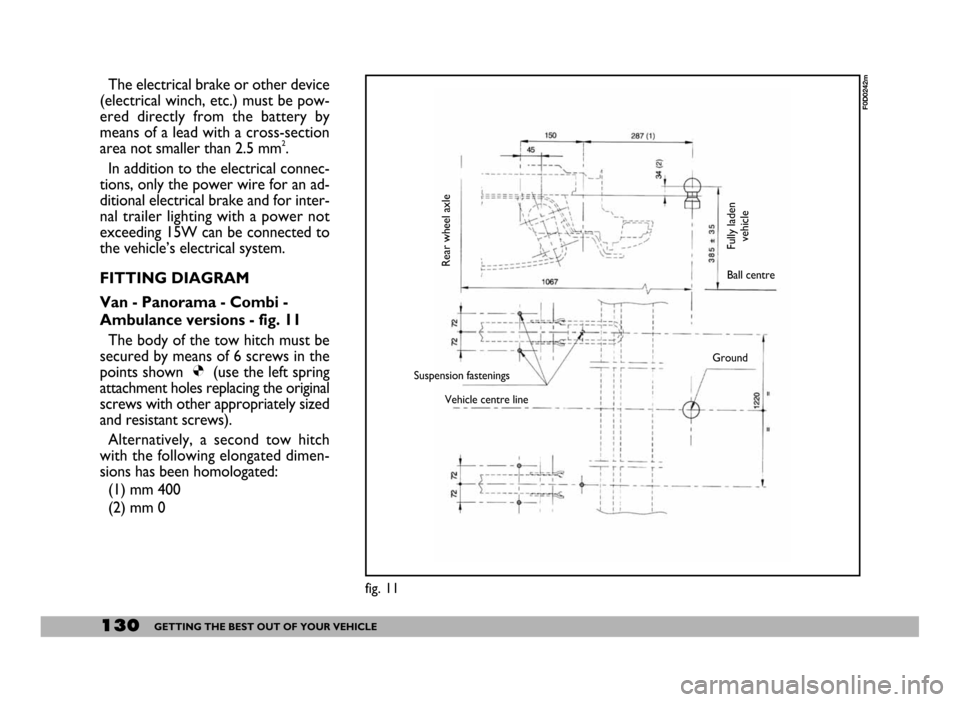
FITTING DIAGRAM
Van - Panorama - Combi -
Ambulance versions - fig. 11
The body of the tow hitch must be
secured by means of 6 screws in the
points shown Ø(use the left spring
attachment holes replacing the original
screws with other appropriately sized
and resistant screws).
Alternatively, a second tow hitch
with the following elongated dimen-
sions has been homologated:
(1) mm 400
(2) mm 0
fig. 11
F0D0242m
Rear wheel axle
Fully laden
vehicleBall centre
Suspension fastenings
Vehicle centre lineGround
Page 135 of 258

134GETTING THE BEST OUT OF YOUR VEHICLE
VEHICLE STORAGE
The following precautions should be
taken if the vehicle will not be used for
several months:
– park the vehicle in covered, dry and
if possible well-ventilated premises;
– engage a gear;
– remove the cables from the battery
(first remove the cable to the negative
terminal) and check the battery
charge. If the vehicle is to be stored
for long periods the charge of the bat-
tery should be checked every month
and recharged if it falls below 12.5 V;– make sure the handbrake is not en-
gaged;
– clean and protect the painted parts
using protective wax;
– clean and protect the shiny metal
parts using special compounds readi-
ly available;
– sprinkle talcum powder on the rub-
ber windscreen and rear window
wiper blades and lift them off the glass;
– slightly open the windows;
– cover the vehicle with a cloth or
perforated plastic sheet. Do not use
sheets of non-perforated plastic as
they do not allow moisture on the ve-
hicle body to evaporate;– inflate the tyres to 0.5 bar above
the normal specified pressure and
check it at intervals;
– do not drain the engine cooling sys-
tem.
IMPORTANTWhere relevant,
switch off the electronic vehicle alarm
with the remote control and deacti-
vate the system by turning the emer-
gency key to OFF (see “Electronic
alarm” in section “Getting to know
your vehicle”).
Page 139 of 258
138IN AN EMERGENCY
1. STOP THE VEHICLE
– Stop the vehicle in a position that
is not dangerous for oncoming traffic
where you can change the wheel safe-
ly. The ground should be flat and ad-
equately firm. If you have to change
the wheel at night, choose a lit area if
possible.
– Turn the engine off and pull up the
handbrake.
– Engage first or reverse gear.
– Alert other drivers that the vehicle
is stationary in compliance with local
regulations: hazard warning lights,
warning triangle, etc.
Any passengers should get out and
wait as far away as possible from the
danger of traffic.
If the road is sloping or bumpy, place
wedges or other suitable material to
prevent the vehicle from moving, un-
der the wheels.2. TAKE OUT THE TOOLS,
JACK AND SPARE WHEEL
The tools are in the cab near the
seats.
Please note:
– the jack weights 4.2 kg;
– the jack requires no adjustments;
– the jack cannot be repaired. If it
breaks it must be replaced with a new
jack;
– no other tool, apart from the ex-
tension and the ratchet wrench shown
in this chapter can be fitted to the jack.
The spare wheel is located under the
rear part of the load bed.
Do not lubricate the bolt
threads before fitting
them back: they could come
loose.
WARNING
Check tyre pressure and
spare wheel pressure regu-
larly. Refer to section “Technical
Specifications”.
WARNING