gearbox FIAT DUCATO 2006 3.G User Guide
[x] Cancel search | Manufacturer: FIAT, Model Year: 2006, Model line: DUCATO, Model: FIAT DUCATO 2006 3.GPages: 258, PDF Size: 4.05 MB
Page 116 of 258
115GETTING THE BEST OUT OF YOUR VEHICLE
Moving the lever back to position D
the gearbox instantly resumes the au-
tomatic mode selecting the ratio ac-
cording to the driving characteristics.
IMPORTANTThe electronic con-
trol unit is programmed to change
gear one at a time, therefore repeat-
ed fast actuations will not result in re-
peated engagements of the gears. The
higher or lower gear is engaged mov-
ing the lever to the (+) or (–) position
when the previous request has been
performed.
In the event of a fault to the sequen-
tial manual system, the system will se-
lect the automatic mode.FAILURE INDICATIONS
Automatic gearbox faults are indi-
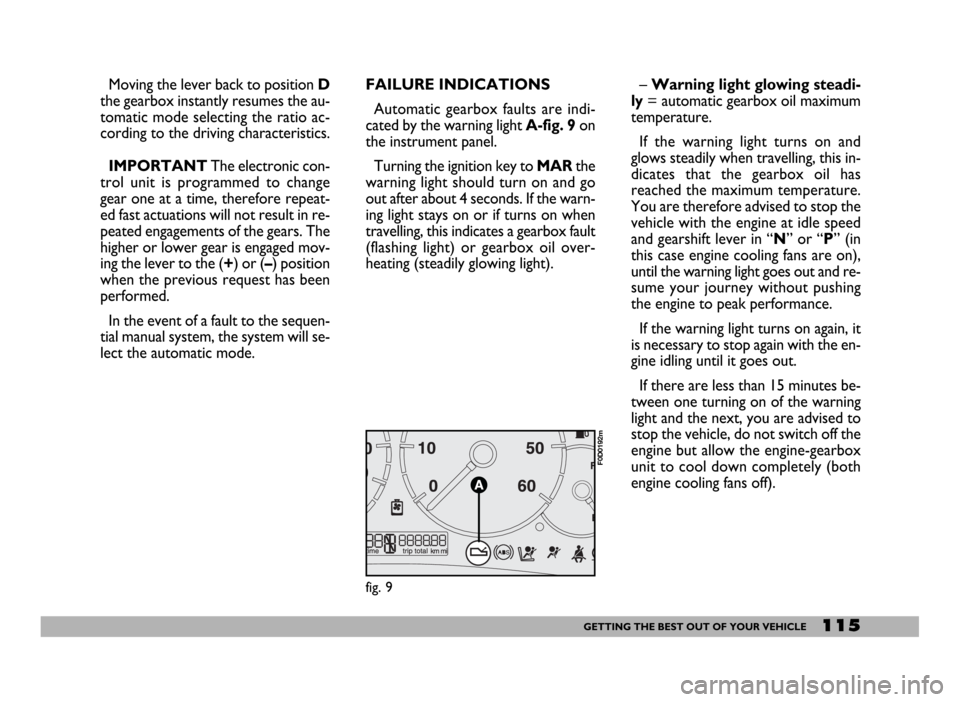
cated by the warning light A-fig. 9 on
the instrument panel.
Turning the ignition key to MARthe
warning light should turn on and go
out after about 4 seconds. If the warn-
ing light stays on or if turns on when
travelling, this indicates a gearbox fault
(flashing light) or gearbox oil over-
heating (steadily glowing light).– Warning light glowing steadi-
ly= automatic gearbox oil maximum
temperature.
If the warning light turns on and
glows steadily when travelling, this in-
dicates that the gearbox oil has
reached the maximum temperature.
You are therefore advised to stop the
vehicle with the engine at idle speed
and gearshift lever in “N” or “P” (in
this case engine cooling fans are on),
until the warning light goes out and re-
sume your journey without pushing
the engine to peak performance.
If the warning light turns on again, it
is necessary to stop again with the en-
gine idling until it goes out.
If there are less than 15 minutes be-
tween one turning on of the warning
light and the next, you are advised to
stop the vehicle, do not switch off the
engine but allow the engine-gearbox
unit to cool down completely (both
engine cooling fans off).
fig. 9
F0D0192m
Page 117 of 258
116GETTING THE BEST OUT OF YOUR VEHICLE
BUMP STARTING
Starting by pushing or towing the ve-
hicle is not possible. In the event of an
emergency, when the battery is flat,
start the vehicle with a suitable emer-
gency battery, following the instruc-
tions given in section “In an emer-
gency” at paragraph “Jump starting”.
TOWING THE VEHICLE
IMPORTANTFor towing the ve-
hicle comply with current local regu-
lations and follow the instructions giv-
en in section “In an emergency” at
paragraph “Towing the vehicle”.If the vehicle is to be towed, adhere
to the following recommendations:
– if possible, carry the vehicle on the
floor of a rescue vehicle;
– if this is not possible, tow the ve-
hicle raising the driving wheels (front)
from the ground;
– if this, too, is not possible, the ve-
hicle should not be towed for more
than 200 km at a speed of no more
than 50 km/h.
When towing, the gearshift lever
should be at N.
Do not start the engine
while the vehicle is being
towed.
The failure to comply
with these instructions
may cause serious dam-
age to the automatic gearbox.
When travelling with the
gearbox faulty, drive with
the utmost care in consideration of
the limited performance (in terms
of acceleration and speed) that the
vehicle can offer.
WARNING
When travelling with the
gearbox faulty, the revers-
ing gear lock might not be active:
absolutely never move the lever to
the R position with the vehicle on
the move.
WARNING– Warning light flashing= auto-
matic gearbox fault.
Warning light flashing at starting or
when travelling indicates a fault in the
automatic gearbox.
The automatic control system sets
an “emergency programme” engaging
the 3
rdgear.
Switching the engine off and then on
again, the self-test system could ex-
clude the fault and therefore turn off
the warning light. The failure is how-
ever stored and the automatic gear-
box shall be checked at a Fiat Deal-
ership.
Page 118 of 258

117GETTING THE BEST OUT OF YOUR VEHICLE
CONSTRUCTION FEATURES
DUCATO automatic gearbox is con-
trolled electronically with four for-
ward gears and reverse.
It is controlled by an electronic con-
trol unit which handles:
– the torque distributor;
– gearshifting;
– specific programmes.
The gearbox is coupled with a flow
power torque distributor with piloted
antislip device which makes it possible
to obtain demultiplication ratios.
The characteristic of this gearbox
which works without idle gear enables:
– higher compactness and weight re-
duction;
– improved output due to less fric-
tion;
– lower stress of transmission com-
ponents.GENERAL FEATURES
Electronic gearbox control makes it
possible to obtain gearshifting suited
to momentary engine characteristics
with a certain elasticity.
The electronic control unit has the
following task:
– adapting the oil pressure for
gearshifting to the engine torque;
– activating safety functions;
– defining the manual gearshifting
programme;
– system diagnostics.
For controlling these operating log-
ics the control unit uses the follow-
ing signals:
– engine rpm;
– engine temperature;
– engine torque;
– vehicle speed;
– gearbox oil temperature;– gearshift lever position;
– accelerator pedal position;
– brake pedal position.
The control unit also communicates
with the injection system electronic
control unit.
Conditions of use analysed by
the control unit
The control unit analyses each single
condition of use of the vehicle, dis-
criminating it on the basis of the sig-
nals received from the various sensors.
Analysed conditions are the follow-
ing:
– starting (position/accelerator ped-
al changing speed);
– acceleration (accelerator pedal
completely pushing down speed);
– full load (number of engine full load
kickdown signals or position mainte-
nance time);
Page 119 of 258

118GETTING THE BEST OUT OF YOUR VEHICLE
– braking (accelerator pedal release
time and braking system operation);
– type of programme (gearshift se-
lector lever position);
– winter driving (driving wheel
torque reduction);
– driving with trailer or uphill (vehi-
cle speed in relation to transmitted
torque)
– driving downhill (vehicle accelera-
tion in relation to the position of the
accelerator pedal);
– driving in towns or queues (accel-
erator pedal position and vehicle
speed);
– gear required by the driver
(gearshift lever position);
– cold starting (engine temperature).Gearshift programme control
To optimise vehicle handling the
electronic control unit has the fol-
lowing memorised programmes:
– automatic operation;
– manual operation;
– winter driving (to be selected
through buttonWINTER);
– engine warming up;
– protection against excessive gear-
box oil temperature .Automatic programme
This comprises 16 gearshifting pro-
grammes.
In relation to the vehicle speed and
torque transmitted, the control unit
detects the slope of the road surface
and depending on the sporty features
chosen, it autonomously chooses the
programme most suited to the situa-
tion.
During gearshifting, the gearbox con-
trol unit asks the injection control unit
to momentarily reduce the torque.
The duration of torque reduction
varies depending on the travelling con-
ditions.
Page 120 of 258

119GETTING THE BEST OUT OF YOUR VEHICLE
Manual sequential programme
This function enables manual se-
quential use of the gearbox merely
moving the selector lever to the left.
Each time the lever is pressed only
one gear is shifted: more than one shift
cannot be obtained.
To avoid overevving or excessively
low engine rpm, the control unit in-
hibits requests for gearshifting that
would cause such situations.
Winter driving programme
This programme is engaged by press-
ing button WINTERnear the
gearshift lever,
in case of driving wheel skidding and
it changes to specific gears.
Starting is possible only in 2
ndgear.
On snowy roads use however snow
chains and/or tyres.
The WINTERfunction shall always
be off on slopes.Engine warming up programme
This programme allows the engine to
reach normal operating temperature
in the shortest time possible (de-
pending on the outside temperature)
highering the gearshifting points, in re-
lation to engine temperature.
The programme engages automati-
cally after starting, if the engine tem-
perature is below 30 °C and it remains
active up to 34 °C.
Excessive gearbox oil
temperature programme
This is activated when the gearbox
oil temperature reaches 120 °C and it
remains active down to 117 °C.
To facilitate oil cooling, this pro-
gramme inhibits gearshifting, either up
or down. It is however possible to use
the manual programme.
SAFE DRIVING
In designing Ducato, Fiat has made
every effort to come up with a vehicle
able to provide driver and passengers
with top-class levels of safety. Never-
theless it is always the behaviour of the
person at the wheel that determines
road safety.
In the following pages you will find
some simple tips to help you travel in
safety under different conditions. You
will no doubt be familiar with many of
them already but it will be useful to
read them all carefully.
Page 137 of 258
136IN AN EMERGENCY
JUMP STARTING
If the battery is flat, you can use an-
other battery to start the engine. Its
capacity must be the same or slightly
greater than the flat battery.
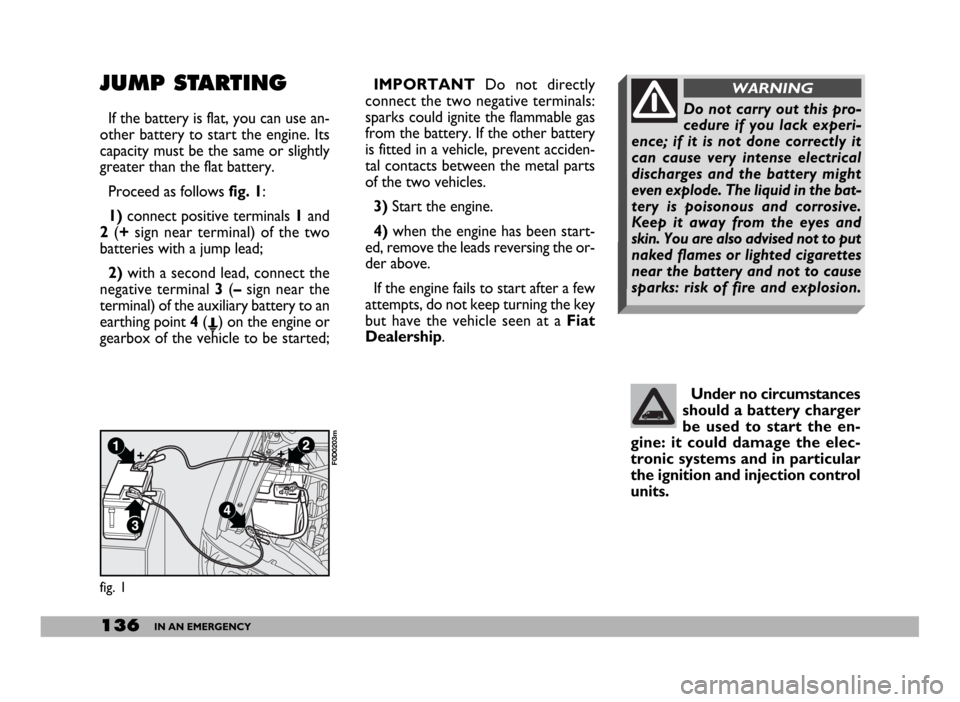
Proceed as follows fig. 1:
1) connect positive terminals1and
2 (+sign near terminal) of the two
batteries with a jump lead;
2) with a second lead, connect the
negative terminal 3(– sign near the
terminal) of the auxiliary battery to an
earthing point 4(E) on the engine or
gearbox of the vehicle to be started;IMPORTANTDo not directly
connect the two negative terminals:
sparks could ignite the flammable gas
from the battery. If the other battery
is fitted in a vehicle, prevent acciden-
tal contacts between the metal parts
of the two vehicles.
3) Start the engine.
4)when the engine has been start-
ed, remove the leads reversing the or-
der above.
If the engine fails to start after a few
attempts, do not keep turning the key
but have the vehicle seen at a Fiat
Dealership.
fig. 1
F0D0203m
Under no circumstances
should a battery charger
be used to start the en-
gine: it could damage the elec-
tronic systems and in particular
the ignition and injection control
units.
Do not carry out this pro-
cedure if you lack experi-
ence; if it is not done correctly it
can cause very intense electrical
discharges and the battery might
even explode. The liquid in the bat-
tery is poisonous and corrosive.
Keep it away from the eyes and
skin. You are also advised not to put
naked flames or lighted cigarettes
near the battery and not to cause
sparks: risk of fire and explosion.
WARNING
Page 157 of 258
156IN AN EMERGENCY
System/Component
Front fog lights
Windscreen wiper motor
Engine cooling fan 2nd speed
Engine control unit 2nd speed
Radiator fan 2nd speed remote switch coil (climate control)
Engine cooling fan 1st speed
Engine control unit 1st speed
Cab fan (climate control)
ABS control unit
Ignition switch
Glow plug preheating
Right-hand dipped beam headlight
Left-hand dipped beam headlight
E.I. system
Fiat code
Automatic gearbox control unit
Fiat code
Compressor
Engine control unit
PTC
Engine control unit
Fuel pump
Engine control unit
Automatic gearbox control unit
Main beam headlights
Windscreen washer pumpFuse no.
F 09
F 08
F 07
F 07
F 07
F 06
F 06
F 05
F 04
F 03
F 02
F 14
F 15
F 16
F 16
F 24
F 18
F 19
F 18
F 20
F 11
F 21
F 17
F 23
F 30
F 08Ampere
15
30
40/60
40/60
40/60
40
40
30
50
30
50
10
10
7.5
7.5
15
7.5
7.5
7.5
30
10
15
5
10
15
30Location
Fig. 41
Fig. 41
Fig. 41
Fig. 41
Fig. 41
Fig. 41
Fig. 41
Fig. 41
Fig. 41
Fig. 41
Fig. 41
Fig. 41
Fig. 41
Fig. 41
Fig. 41
Fig. 41
Fig. 41
Fig. 41
Fig. 41
Fig. 41
Fig. 41
Fig. 41
Fig. 41
Fig. 41
Fig. 41
Fig. 41
Page 161 of 258
160IN AN EMERGENCY
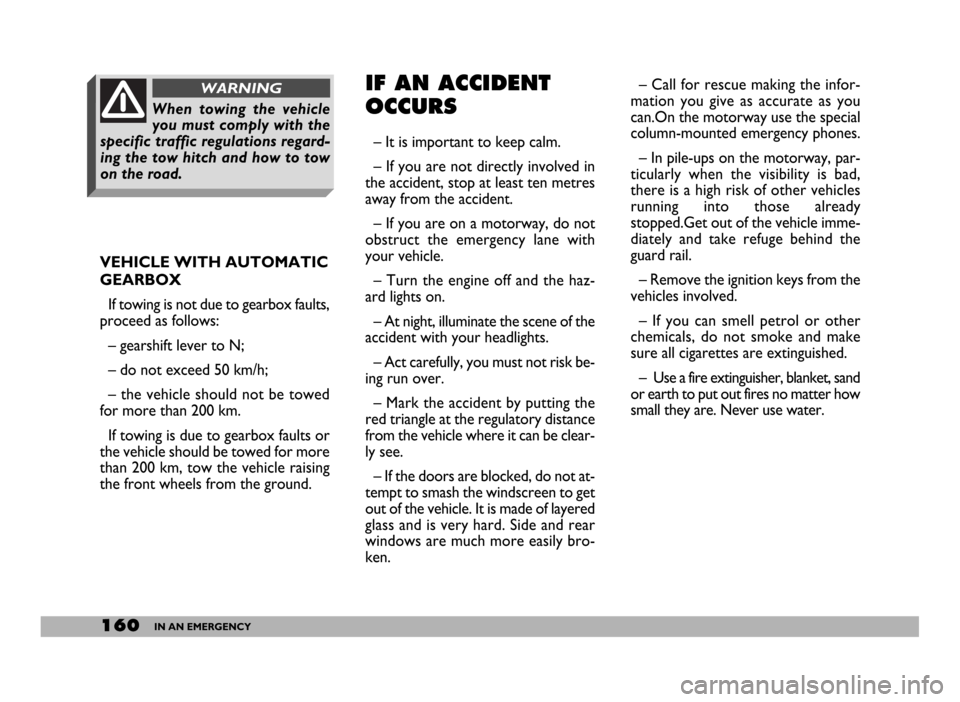
IF AN ACCIDENT
OCCURS
– It is important to keep calm.
– If you are not directly involved in
the accident, stop at least ten metres
away from the accident.
– If you are on a motorway, do not
obstruct the emergency lane with
your vehicle.
– Turn the engine off and the haz-
ard lights on.
– At night, illuminate the scene of the
accident with your headlights.
– Act carefully, you must not risk be-
ing run over.
– Mark the accident by putting the
red triangle at the regulatory distance
from the vehicle where it can be clear-
ly see.
– If the doors are blocked, do not at-
tempt to smash the windscreen to get
out of the vehicle. It is made of layered
glass and is very hard. Side and rear
windows are much more easily bro-
ken. VEHICLE WITH AUTOMATIC
GEARBOX
If towing is not due to gearbox faults,
proceed as follows:
– gearshift lever to N;
– do not exceed 50 km/h;
– the vehicle should not be towed
for more than 200 km.
If towing is due to gearbox faults or
the vehicle should be towed for more
than 200 km, tow the vehicle raising
the front wheels from the ground.– Call for rescue making the infor-
mation you give as accurate as you
can.On the motorway use the special
column-mounted emergency phones.
– In pile-ups on the motorway, par-
ticularly when the visibility is bad,
there is a high risk of other vehicles
running into those already
stopped.Get out of the vehicle imme-
diately and take refuge behind the
guard rail.
– Remove the ignition keys from the
vehicles involved.
– If you can smell petrol or other
chemicals, do not smoke and make
sure all cigarettes are extinguished.
– Use a fire extinguisher, blanket, sand
or earth to put out fires no matter how
small they are. Never use water.
When towing the vehicle
you must comply with the
specific traffic regulations regard-
ing the tow hitch and how to tow
on the road.
WARNING
Page 165 of 258
164VEHICLE MAINTENANCE
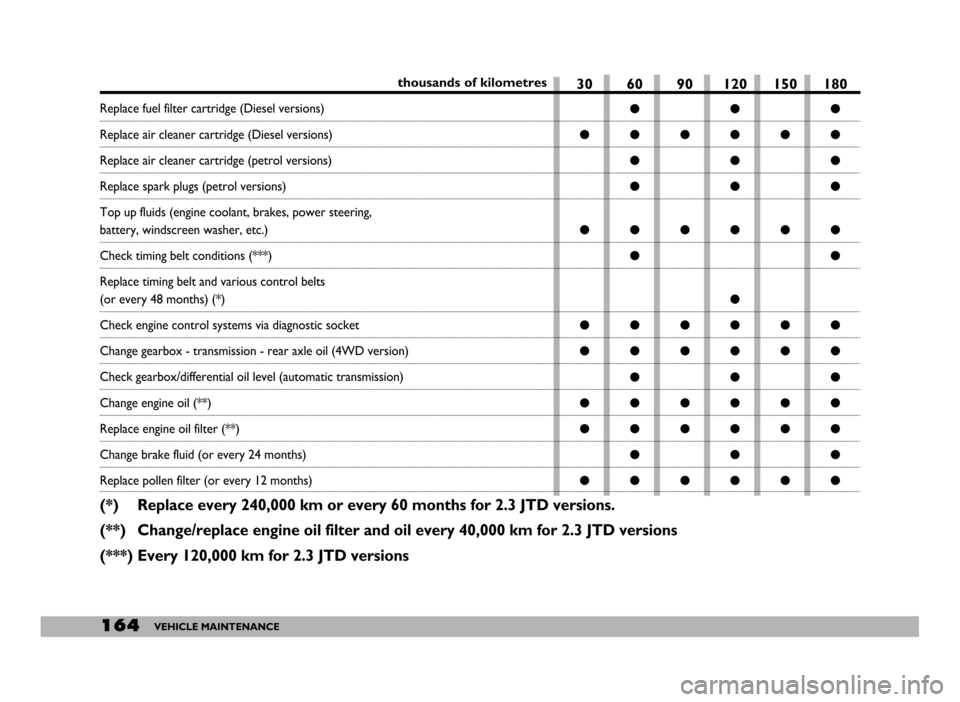
thousands of kilometres
Replace fuel filter cartridge (Diesel versions)
Replace air cleaner cartridge (Diesel versions)
Replace air cleaner cartridge (petrol versions)
Replace spark plugs (petrol versions)
Top up fluids (engine coolant, brakes, power steering,
battery, windscreen washer, etc.)
Check timing belt conditions (***)
Replace timing belt and various control belts
(or every 48 months) (*)
Check engine control systems via diagnostic socket
Change gearbox - transmission - rear axle oil (4WD version)
Check gearbox/differential oil level (automatic transmission)
Change engine oil (**)
Replace engine oil filter (**)
Change brake fluid (or every 24 months)
Replace pollen filter (or every 12 months)
(*) Replace every 240,000 km or every 60 months for 2.3 JTD versions.
(**) Change/replace engine oil filter and oil every 40,000 km for 2.3 JTD versions
(***) Every 120,000 km for 2.3 JTD versions
30 60 90 120 150 180
●●●
●●●●●●
●●●
●●●
●●●●●●
●●
●
●●●●●●
●●●●●●
●●●
●●●●●●
●●●●●●
●●●
●●●●●●
Page 191 of 258
190TECHNICAL SPECIFICATIONS
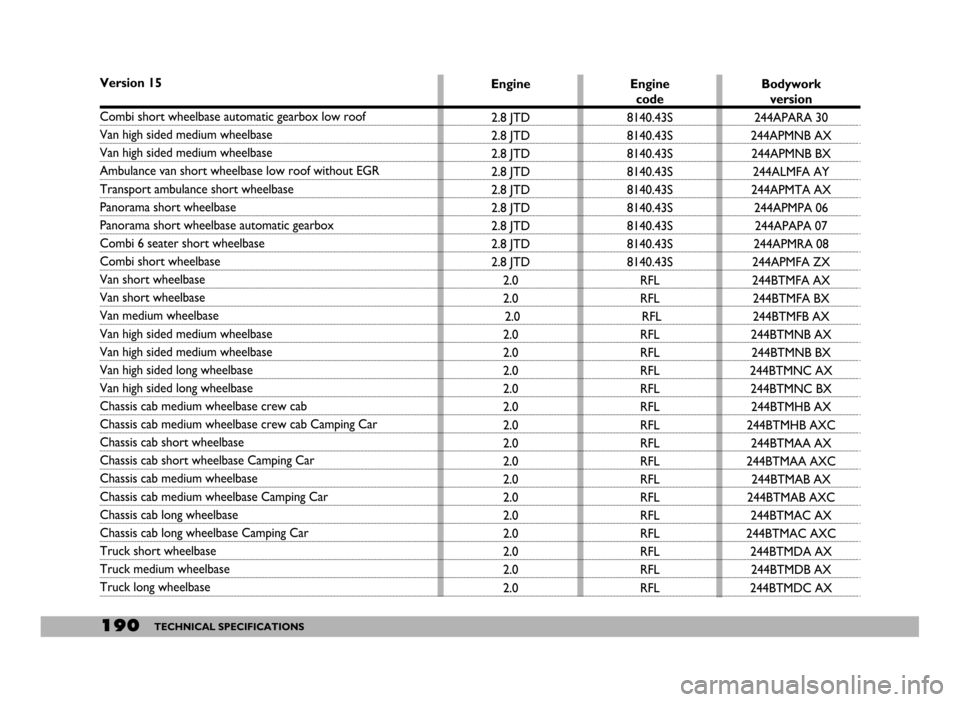
Version 15
Combi short wheelbase automatic gearbox low roof
Van high sided medium wheelbase
Van high sided medium wheelbase
Ambulance van short wheelbase low roof without EGR
Transport ambulance short wheelbase
Panorama short wheelbase
Panorama short wheelbase automatic gearbox
Combi 6 seater short wheelbase
Combi short wheelbase
Van short wheelbase
Van short wheelbase
Van medium wheelbase
Van high sided medium wheelbase
Van high sided medium wheelbase
Van high sided long wheelbase
Van high sided long wheelbase
Chassis cab medium wheelbase crew cab
Chassis cab medium wheelbase crew cab Camping Car
Chassis cab short wheelbase
Chassis cab short wheelbase Camping Car
Chassis cab medium wheelbase
Chassis cab medium wheelbase Camping Car
Chassis cab long wheelbase
Chassis cab long wheelbase Camping Car
Truck short wheelbase
Truck medium wheelbase
Truck long wheelbaseEngine
2.8 JTD
2.8 JTD
2.8 JTD
2.8 JTD
2.8 JTD
2.8 JTD
2.8 JTD
2.8 JTD
2.8 JTD
2.0
2.0
2.0
2.0
2.0
2.0
2.0
2.0
2.0
2.0
2.0
2.0
2.0
2.0
2.0
2.0
2.0
2.0Engine
code
8140.43S
8140.43S
8140.43S
8140.43S
8140.43S
8140.43S
8140.43S
8140.43S
8140.43S
RFL
RFL
RFL
RFL
RFL
RFL
RFL
RFL
RFL
RFL
RFL
RFL
RFL
RFL
RFL
RFL
RFL
RFLBodywork
version
244APARA 30
244APMNB AX
244APMNB BX
244ALMFA AY
244APMTA AX
244APMPA 06
244APAPA 07
244APMRA 08
244APMFA ZX
244BTMFA AX
244BTMFA BX
244BTMFB AX
244BTMNB AX
244BTMNB BX
244BTMNC AX
244BTMNC BX
244BTMHB AX
244BTMHB AXC
244BTMAA AX
244BTMAA AXC
244BTMAB AX
244BTMAB AXC
244BTMAC AX
244BTMAC AXC
244BTMDA AX
244BTMDB AX
244BTMDC AX