sound system FIAT DUCATO 2006 3.G User Guide
[x] Cancel search | Manufacturer: FIAT, Model Year: 2006, Model line: DUCATO, Model: FIAT DUCATO 2006 3.GPages: 258, PDF Size: 4.05 MB
Page 176 of 258
175VEHICLE MAINTENANCE
When working on the bat-
tery or near it, always wear
the proper goggles.
WARNING
Running the battery with
low fluid level can damage
the battery beyond repair and
could also cause its explosion.
WARNING
If the vehicle is to stand for
a long time in the cold, re-
move the battery and store it in a
warm place to avoid it freezing.
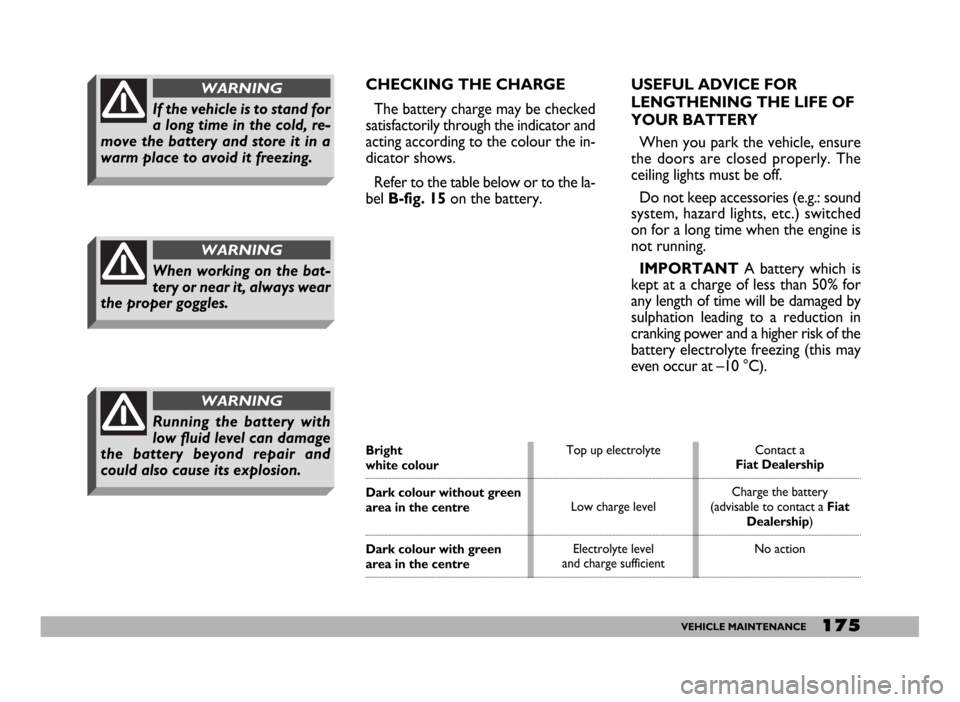
WARNINGCHECKING THE CHARGE
The battery charge may be checked
satisfactorily through the indicator and
acting according to the colour the in-
dicator shows.
Refer to the table below or to the la-
belB-fig. 15on the battery.USEFUL ADVICE FOR
LENGTHENING THE LIFE OF
YOUR BATTERY
When you park the vehicle, ensure
the doors are closed properly. The
ceiling lights must be off.
Do not keep accessories (e.g.: sound
system, hazard lights, etc.) switched
on for a long time when the engine is
not running.
IMPORTANTA battery which is
kept at a charge of less than 50% for
any length of time will be damaged by
sulphation leading to a reduction in
cranking power and a higher risk of the
battery electrolyte freezing (this may
even occur at –10 °C).
Bright white colour
Dark colour without green
area in the centre
Dark colour with green
area in the centreTop up electrolyte
Low charge level
Electrolyte level
and charge sufficientContact a
Fiat Dealership
Charge the battery
(advisable to contact a Fiat
Dealership)
No action
Page 178 of 258
177VEHICLE MAINTENANCE
ELECTRONIC
CONTROL UNIT
When the vehicle is being used nor-
mally, special measures are not nec-
essary.
The following instructions must be
followed very carefully however, if
you work on the electrical system or
in cases where emergency starting is
necessary:
– never disconnect the battery from
the electric system while the engine is
running;
– disconnect the battery from the
electric system if you are recharging it;
– never perform emergency starting
with a battery charger. Always use an
auxiliary battery;
– be particularly careful when con-
necting the battery to the electric sys-
tem. Make sure that the polarity is
correct and that the connection is ef-
ficient;
– do not connect or disconnect the
terminals of the electronic units while
the ignition key is at MAR;
– do not check polarity through
sparking;– disconnect the electronic control
units if you are electrically welding the
vehicle body. Remove the units if tem-
peratures exceed 80 °C (special op-
erations on the bodywork, etc.).
IMPORTANTIf the sound system
or vehicle alarm systems are not in-
stalled correctly, they can interfere
with the working of the electronic
control units.
Modifications or repairs to
the electrical system car-
ried out incorrectly and without
bearing the features of the system
in mind can cause malfunctions
with the risk of fire.
WARNING
SPEED LIMITER
On certain version, the injection con-
trol unit is set to limit the vehicle
speed at a max. preset limit.
Speed limits are the following:
– for Minibus versions (M2 homolo-
gation category): 100 km/h;
– for good Transport versions (ve-
hicle dead weight: > 3.5 t) (N2 ho-
mologation category): 90 km/h;
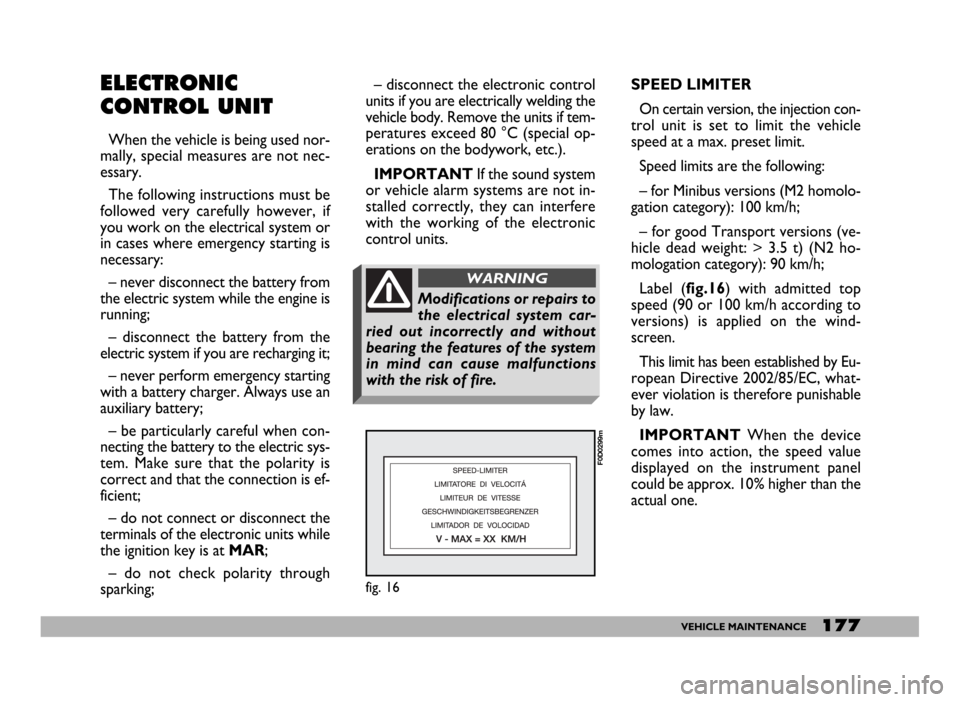
Label (fig.16) with admitted top
speed (90 or 100 km/h according to
versions) is applied on the wind-
screen.
This limit has been established by Eu-
ropean Directive 2002/85/EC, what-
ever violation is therefore punishable
by law.
IMPORTANTWhen the device
comes into action, the speed value
displayed on the instrument panel
could be approx. 10% higher than the
actual one.
fig. 16
F0D0299m
Page 216 of 258
215TECHNICAL SPECIFICATIONS
FUEL SUPPLY/IGNITION
Petrol version
Electronic Multipoint sequential
phased integrated electronic injection
and ignition; a single injection system
controls both functions. It processes
both the time the injection lasts (for
fuel metering) and the ignition advance
angle.FUEL SUPPLY
JTD/JTD POWER versions
UNIJET (Common Rail) electronic
control direct injection, turbosuper-
charger with WASTEGATE valve and
intercooler (2.3 JTD, 2.8 JTD and 2.8
JTD POWER versions).SPARK PLUGS
The cleanness and soundness of the
spark plugs are very important for
keeping the engine efficient and pol-
luting emissions down.
The appearance of the spark plug, if
examined by an expert eyes, is a good
way of pinpointing a problem even if it
has nothing to do with the ignition sys-
tem. Therefore, if the engine has prob-
lems, it is important to have the spark
plugs checked at a Fiat Dealership.
The spark plugs must be
changed at the times
specified in the
SERVICE
SCHEDULE
. Only use the type of
plugs indicated: if the heat ratio
is less than required or the life
specified is not guaranteed, prob-
lems can arise.
Modifications or repairs to
the fuel feed system that
are not carried out properly or do
not take the system’s technical
specifications into account can
cause malfunctions leading to the
risk of fire.
WARNING
Page 251 of 258
250INDEX
Rev counter ................................. 30
Reversing light replacement ..... 146
Rims
- understanding rim markings .. 219
Roof rack/ski rack (presetting) .. 101
Rubber tubing .............................. 179
Safe driving.................................. 119
Scheduled Service ....................... 162
Seat belts ....................................... 15
Seats ............................................... 42
Self-standing supplementary
heater .......................................... 59
Service indicator .......................... 33
Service Schedule .......................... 163
Side central windows (opening) 78
Side/taillights ................................. 65
- front bulb replacement ......... 146
Smart wash ................................... 67
Snow chains .......................... 133-218
Snow tyres ............................ 132-221Sound system ............................... 98
- aerial ......................................... 100
- heavy set-up ............................ 98
- light set-up ............................... 98
Spare wheel .................................. 218
Spark plugs .................................... 215
Speed limiter ................................ 177
Speedometer ................................ 30
Spray nozzles ............................... 181
Starting the engine ...................... 105
- bump starting .......................... 137
- Diesel engine procedure ...... 106
- emergency starting ......... 107-135
- ignition switch ......................... 28
- jump starting .................... 136-157
- petrol engine procedure ...... 105
- stopping the engine ................ 108
- warming up the engine after
it has just started ................... 107
Steering ......................................... 218
Steering column lock .................. 28Steering column stalks ............... 65
Steering wheel ............................. 51
Sun visors ...................................... 78
Suspensions .................................. 217
Symbols ......................................... 7
Tank cap ................................ 99-103
Technical specifications........ 185
Third brake light
replacement ................................. 146
Tools ................................................ 138
Top speeds ..................................... 226
Tow hitch
(fitting diagrams)................... 130-131
Tow hitch installation .................. 129
Towing a trailer ............................. 129
Towing the vehicle ....................... 159
Transmission .................................. 216
Transporting children in safety .. 22
Tyre pressure ................................. 220
Tyres ......................................... 178-220