ESP FIAT DUCATO 2006 3.G Owner's Manual
[x] Cancel search | Manufacturer: FIAT, Model Year: 2006, Model line: DUCATO, Model: FIAT DUCATO 2006 3.GPages: 258, PDF Size: 4.05 MB
Page 150 of 258
149IN AN EMERGENCY
Before changing a fuse,
check the ignition key has
been removed and that
all the other electric devices have
been turned off/disabled.IF A FUSE BLOWS
GENERAL FEATURES
A fuse is an element for protecting
the electrical system. A fuse will trip
(i.e. blow) in the event of a failure or
improper interventions in the electri-
cal system.
If an electric device is not working,
check whether the respective fuse is
blown (i.e. the conductor is broken
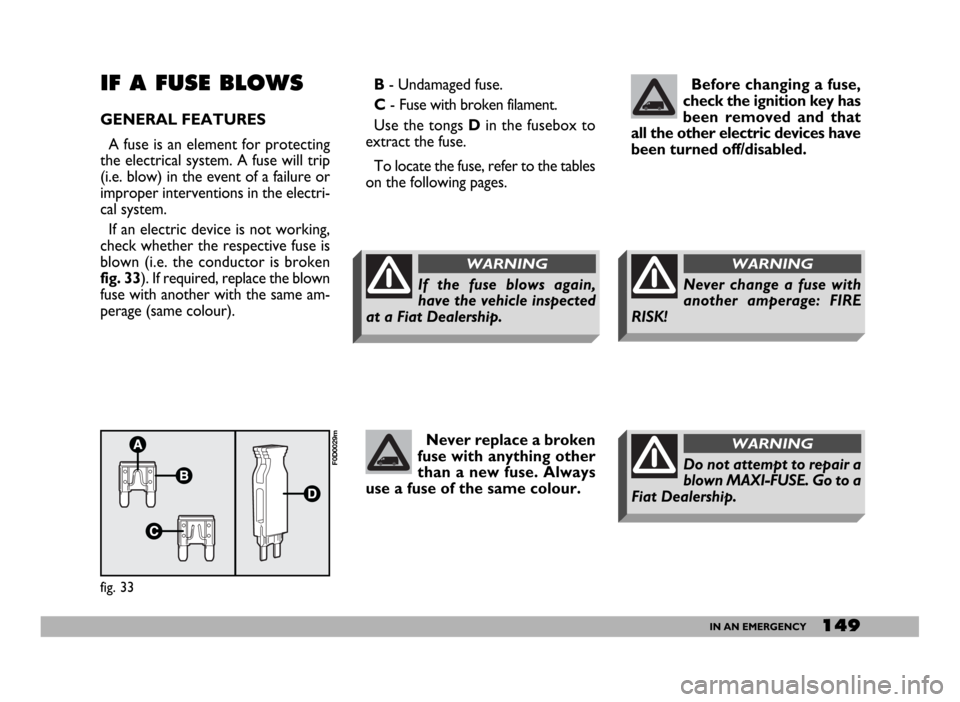
fig. 33). If required, replace the blown
fuse with another with the same am-
perage (same colour).B- Undamaged fuse.
C- Fuse with broken filament.
Use the tongs Din the fusebox to
extract the fuse.
To locate the fuse, refer to the tables
on the following pages.
fig. 33
F0D0029m
Never replace a broken
fuse with anything other
than a new fuse. Always
use a fuse of the same colour.
If the fuse blows again,
have the vehicle inspected
at a Fiat Dealership.
WARNING
Never change a fuse with
another amperage: FIRE
RISK!
WARNING
Do not attempt to repair a
blown MAXI-FUSE. Go to a
Fiat Dealership.
WARNING
Page 167 of 258
166VEHICLE MAINTENANCE
IMPORTANT - Pollen filter
If the vehicle is often used in dusty
or extremely polluted environments,
you should change the filter element
more frequently. It should be changed
especially if the amount of air intro-
duced into the passenger compart-
ment has decreased.
IMPORTANT - Diesel filter
Refuelling with diesel fuel not com-
plying with the grade of purity pre-
scribed by European Specification
EN590 might make it necessary to re-
place the filter more frequently than
indicated in the Service Schedule.
IMPORTANT - Battery
The charge in your battery should be
checked, where possible at the start
of the winter, to limit the risk of the
battery electrolyte freezing.
This check should be carried out
more frequently if the vehicle is mainly
used for short trips or if it is fitted
with accessories that permanently
take in electricity even when the igni-
tion key is removed, especially in the
case of after market accessories.You should check the battery fluid
(electrolyte) level more frequently
than shown in the Service Schedule if
the vehicle is used in hot climates or
particularly demanding conditions.
IMPORTANTAs concerns Camp-
ing Car versions, due to high electric
absorption, observe indications rele-
vant to battery contained in para-
graphs "Vehicle storage" (section
"Getting the best out of your vehicle")
and "Battery – Checking the charge"
(section "Vehicle maintenance").
Maintenance of your ve-
hicle should be entrusted
to a Fiat Dealership. For
ordinary routine maintenance
operations which you are able to
carry out yourself, ensure that
you have the necessary tools and
original Fiat spare parts and flu-
ids available. Do not carry out
servicing operations if you have
no experience.IMPORTANT - Engine oil
Change the engine oil more fre-
quently than shown in the Service
Schedule if the vehicle is normally dri-
ven in one of the following particular-
ly severe conditions:
– towing a trailer
– on dusty roads
– short distances (less than 7-8 km)
repeated and with external tempera-
tures below zero.
– frequently idling engines or long
distance low speed driving (e. g. taxis
or door-to-door deliveries) or in case
of a long term inactivity replace engine
oil more frequently than required on
Scheduled Maintenance Plan.
IMPORTANT - Air cleaner
Replace the air cleaner more fre-
quently if the vehicle is used on dusty
roads.
If you are in doubt about how often
the engine oil or the air cleaner should
be changed in relation to how you use
the vehicle, contact a Fiat Dealer-
ship.
Page 170 of 258
169VEHICLE MAINTENANCE
Do not add oil with dif-
ferent specifications from
the oil already in the en-
gine.
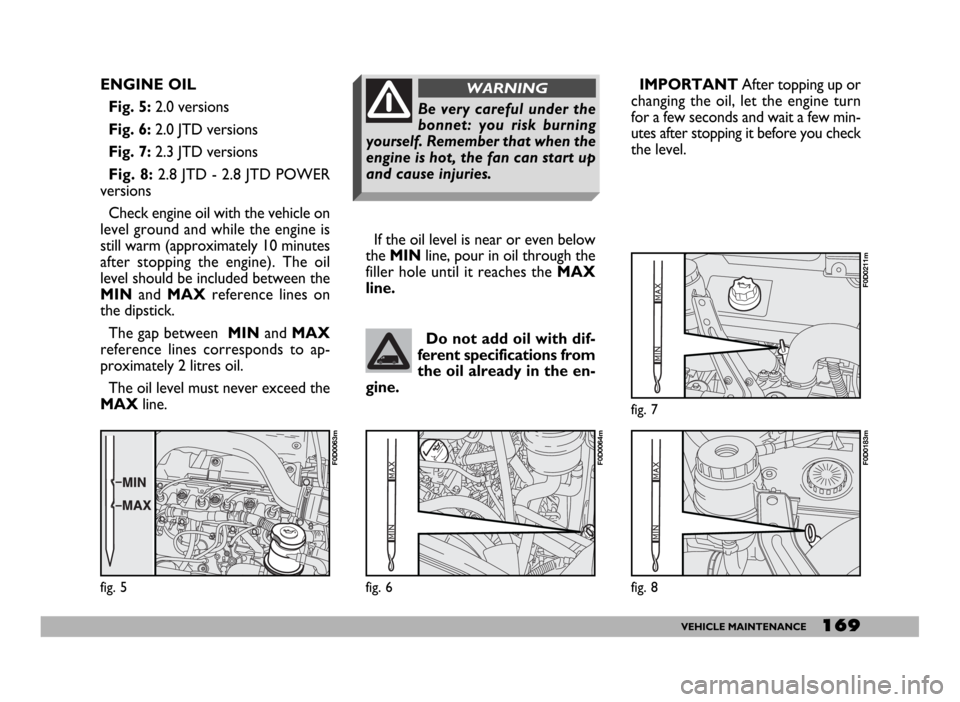
ENGINE OIL
Fig. 5:2.0 versions
Fig. 6:2.0 JTD versions
Fig. 7:2.3 JTD versions
Fig. 8: 2.8 JTD - 2.8 JTD POWER
versions
Check engine oil with the vehicle on
level ground and while the engine is
still warm (approximately 10 minutes
after stopping the engine). The oil
level should be included between the
MINand MAXreference lines on
the dipstick.
The gap between MINand MAX
reference lines corresponds to ap-
proximately 2 litres oil.
The oil level must never exceed the
MAXline.If the oil level is near or even below
the MINline, pour in oil through the
filler hole until it reaches the MAX
line.
fig. 5
F0D0063m
fig. 6
F0D0064m
fig. 7
F0D0211m
fig. 8
F0D0183m
Be very careful under the
bonnet: you risk burning
yourself. Remember that when the
engine is hot, the fan can start up
and cause injuries.
WARNINGIMPORTANT After topping up or
changing the oil, let the engine turn
for a few seconds and wait a few min-
utes after stopping it before you check
the level.
Page 174 of 258
173VEHICLE MAINTENANCE
AIR CLEANER
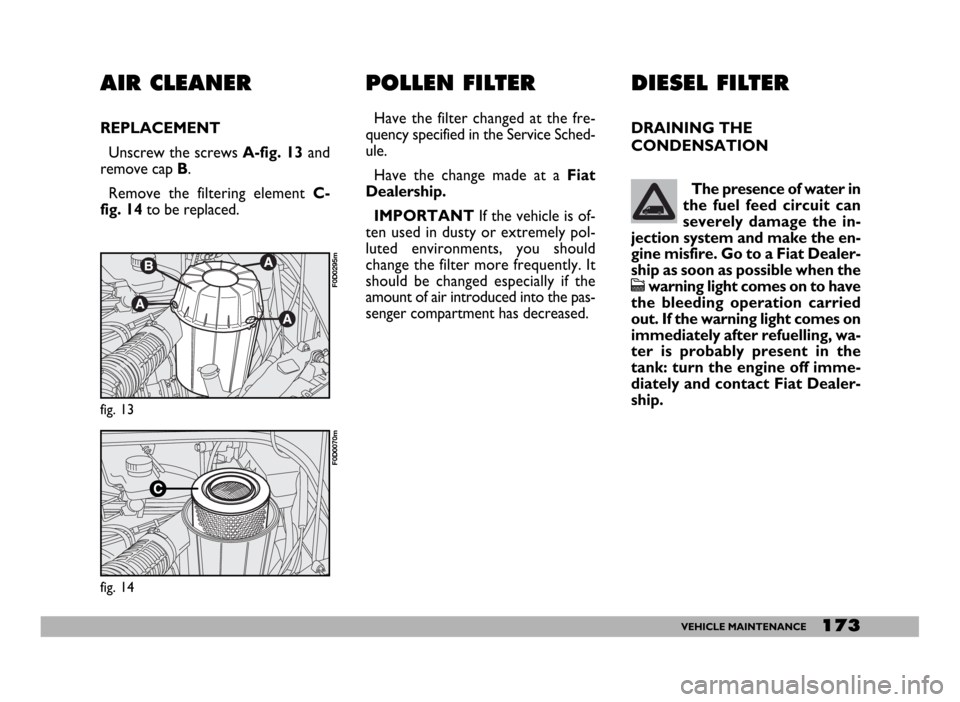
REPLACEMENT
Unscrew the screws A-fig. 13and
remove cap B.
Remove the filtering element C-
fig. 14to be replaced.
fig. 13
F0D0295m
fig. 14
F0D0070m
POLLEN FILTER
Have the filter changed at the fre-
quency specified in the Service Sched-
ule.
Have the change made at a Fiat
Dealership.
IMPORTANTIf the vehicle is of-
ten used in dusty or extremely pol-
luted environments, you should
change the filter more frequently. It
should be changed especially if the
amount of air introduced into the pas-
senger compartment has decreased.
DIESEL FILTER
DRAINING THE
CONDENSATION
The presence of water in
the fuel feed circuit can
severely damage the in-
jection system and make the en-
gine misfire. Go to a Fiat Dealer-
ship as soon as possible when the
cwarning light comes on to have
the bleeding operation carried
out. If the warning light comes on
immediately after refuelling, wa-
ter is probably present in the
tank: turn the engine off imme-
diately and contact Fiat Dealer-
ship.
Page 187 of 258
186TECHNICAL SPECIFICATIONS
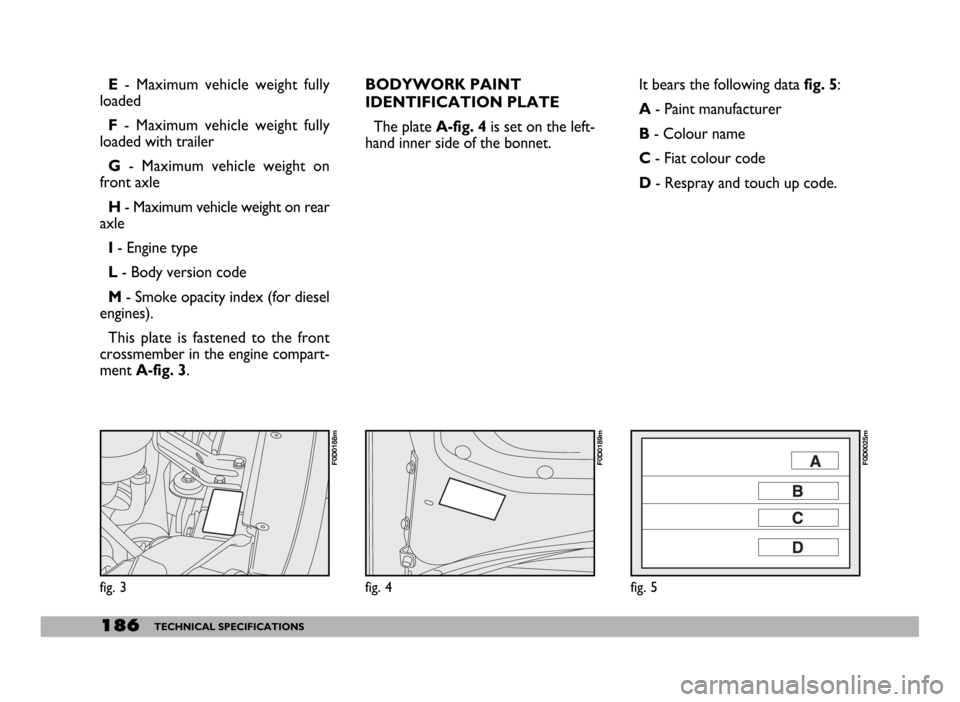
E- Maximum vehicle weight fully
loaded
F - Maximum vehicle weight fully
loaded with trailer
G - Maximum vehicle weight on
front axle
H - Maximum vehicle weight on rear
axle
I - Engine type
L - Body version code
M - Smoke opacity index (for diesel
engines).
This plate is fastened to the front
crossmember in the engine compart-
ment A-fig. 3.BODYWORK PAINT
IDENTIFICATION PLATE
The plateA-fig. 4 is set on the left-
hand inner side of the bonnet.It bears the following data fig. 5:
A - Paint manufacturer
B - Colour name
C - Fiat colour code
D- Respray and touch up code.
fig. 3
F0D0188m
fig. 4
F0D0189m
fig. 5
F0D0025m
Page 215 of 258
214TECHNICAL SPECIFICATIONS
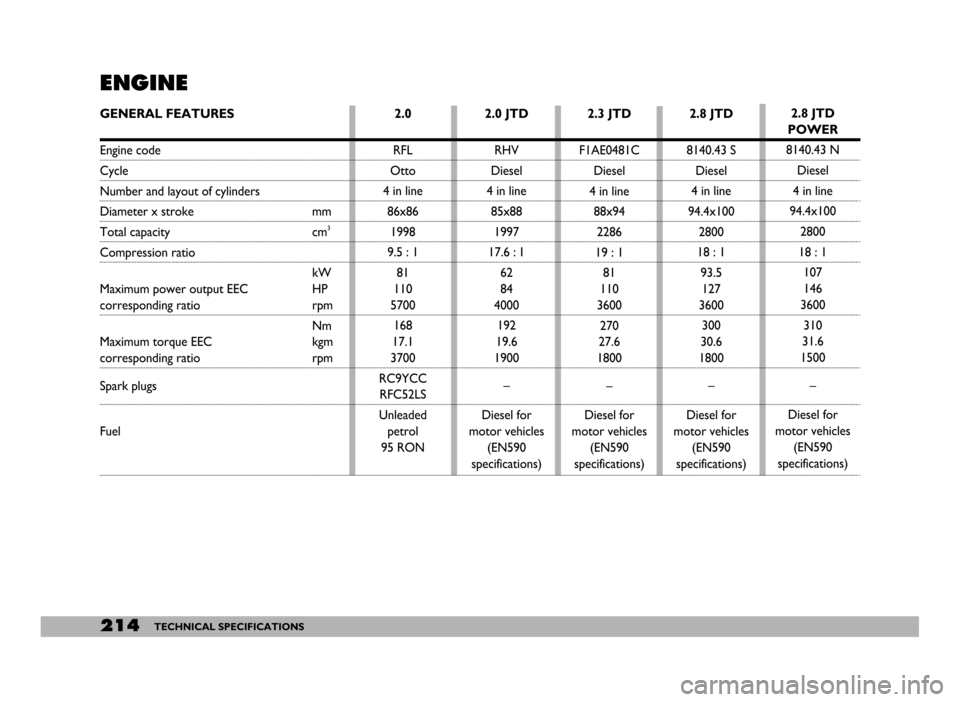
ENGINE
GENERAL FEATURES
Engine code
Cycle
Number and layout of cylinders
Diameter x stroke mm
Total capacity cm3
Compression ratio
kW
Maximum power output EEC HP
corresponding ratio rpm
Nm
Maximum torque EEC kgm
corresponding ratio rpm
Spark plugs
Fuel
2.0
RFL
Otto
4 in line
86x86
1998
9.5 : 1
81
110
5700
168
17.1
3700
RC9YCC
RFC52LS
Unleaded
petrol
95 RON2.0 JTD
RHV
Diesel
4 in line
85x88
1997
17.6 : 1
62
84
4000
192
19.6
1900
–
Diesel for
motor vehicles
(EN590
specifications)2.3 JTD
F1AE0481C
Diesel
4 in line
88x94
2286
19 : 1
81
110
3600
270
27.6
1800
–
Diesel for
motor vehicles
(EN590
specifications)2.8 JTD
8140.43 S
Diesel
4 in line
94.4x100
2800
18 : 1
93.5
127
3600
300
30.6
1800
–
Diesel for
motor vehicles
(EN590
specifications)2.8 JTD
POWER
8140.43 N
Diesel
4 in line
94.4x100
2800
18 : 1
107
146
3600
310
31.6
1500
–
Diesel for
motor vehicles
(EN590
specifications)
Page 220 of 258
219TECHNICAL SPECIFICATIONS
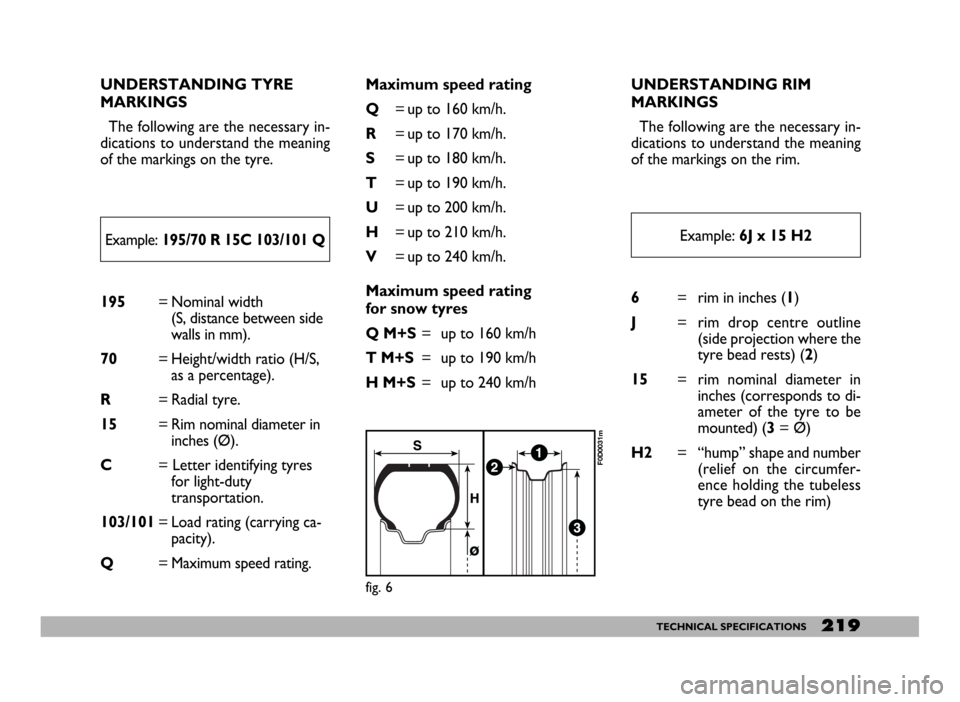
UNDERSTANDING TYRE
MARKINGS
The following are the necessary in-
dications to understand the meaning
of the markings on the tyre.
195= Nominal width
(S, distance between side
walls in mm).
70= Height/width ratio (H/S,
as a percentage).
R= Radial tyre.
15= Rim nominal diameter in
inches (Ø).
C= Letter identifying tyres
for light-duty
transportation.
103/101= Load rating (carrying ca-
pacity).
Q= Maximum speed rating.6= rim in inches (1)
J= rim drop centre outline
(side projection where the
tyre bead rests) (2)
15= rim nominal diameter in
inches (corresponds to di-
ameter of the tyre to be
mounted) (3 = Ø)
H2= “hump” shape and number
(relief on the circumfer-
ence holding the tubeless
tyre bead on the rim) Maximum speed rating
Q= up to 160 km/h.
R= up to 170 km/h.
S= up to 180 km/h.
T= up to 190 km/h.
U= up to 200 km/h.
H= up to 210 km/h.
V= up to 240 km/h.
Maximum speed rating
for snow tyres
Q M+S= up to 160 km/h
T M+S= up to 190 km/h
H M+S= up to 240 km/hUNDERSTANDING RIM
MARKINGS
The following are the necessary in-
dications to understand the meaning
of the markings on the rim.
Example: 195/70 R 15C 103/101 QExample: 6J x 15 H2
fig. 6
F0D0031m
Page 228 of 258
227TECHNICAL SPECIFICATIONS
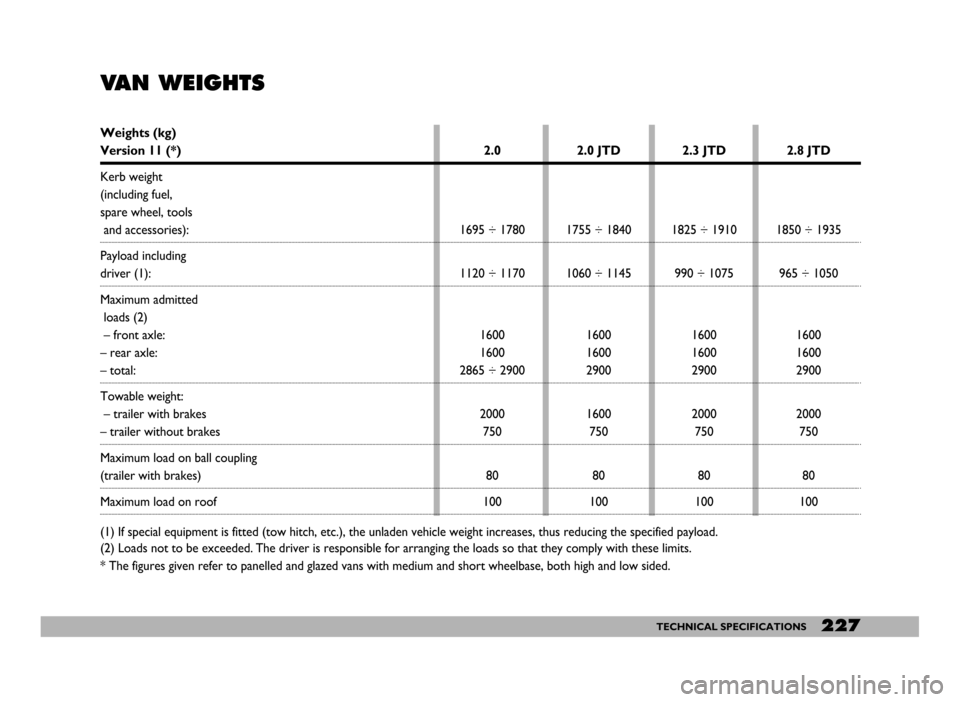
VAN WEIGHTS
Weights (kg)
Version 11 (*)
Kerb weight
(including fuel,
spare wheel, tools
and accessories):
Payload including
driver (1):
Maximum admitted
loads (2)
– front axle:
– rear axle:
– total:
Towable weight:
– trailer with brakes
– trailer without brakes
Maximum load on ball coupling
(trailer with brakes)
Maximum load on roof
(1) If special equipment is fitted (tow hitch, etc.), the unladen vehicle weight increases, thus reducing the specified payload.
(2) Loads not to be exceeded. The driver is responsible for arranging the loads so that they comply with these limits.
* The figures given refer to panelled and glazed vans with medium and short wheelbase, both high and low sided.2.0
1695 ÷ 1780
1120 ÷ 1170
1600
1600
2865 ÷ 2900
2000
750
80
1002.0 JTD
1755 ÷ 1840
1060 ÷ 1145
1600
1600
2900
1600
750
80
1002.3 JTD
1825 ÷ 1910
990 ÷ 1075
1600
1600
2900
2000
750
80
1002.8 JTD
1850 ÷ 1935
965 ÷ 1050
1600
1600
2900
2000
750
80
100
Page 229 of 258
228TECHNICAL SPECIFICATIONS
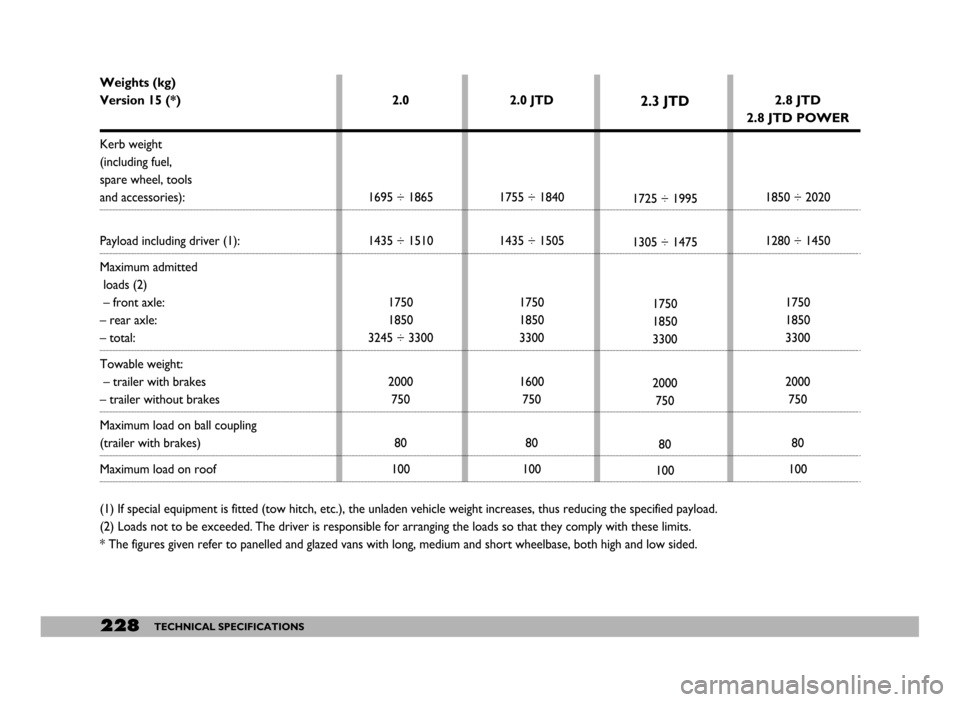
Weights (kg)
Version 15 (*)
Kerb weight
(including fuel,
spare wheel, tools
and accessories):
Payload including driver (1):
Maximum admitted
loads (2)
– front axle:
– rear axle:
– total:
Towable weight:
– trailer with brakes
– trailer without brakes
Maximum load on ball coupling
(trailer with brakes)
Maximum load on roof
(1) If special equipment is fitted (tow hitch, etc.), the unladen vehicle weight increases, thus reducing the specified payload.
(2) Loads not to be exceeded. The driver is responsible for arranging the loads so that they comply with these limits.
* The figures given refer to panelled and glazed vans with long, medium and short wheelbase, both high and low sided.2.0
1695 ÷ 1865
1435 ÷ 1510
1750
1850
3245 ÷ 3300
2000
750
80
1002.0 JTD
1755 ÷ 1840
1435 ÷ 1505
1750
1850
3300
1600
750
80
100
2.3 JTD
1725 ÷ 1995
1305 ÷ 1475
1750
1850
3300
2000
750
80
100
2.8 JTD
2.8 JTD POWER
1850 ÷ 2020
1280 ÷ 1450
1750
1850
3300
2000
750
80
100
Page 230 of 258
229TECHNICAL SPECIFICATIONS
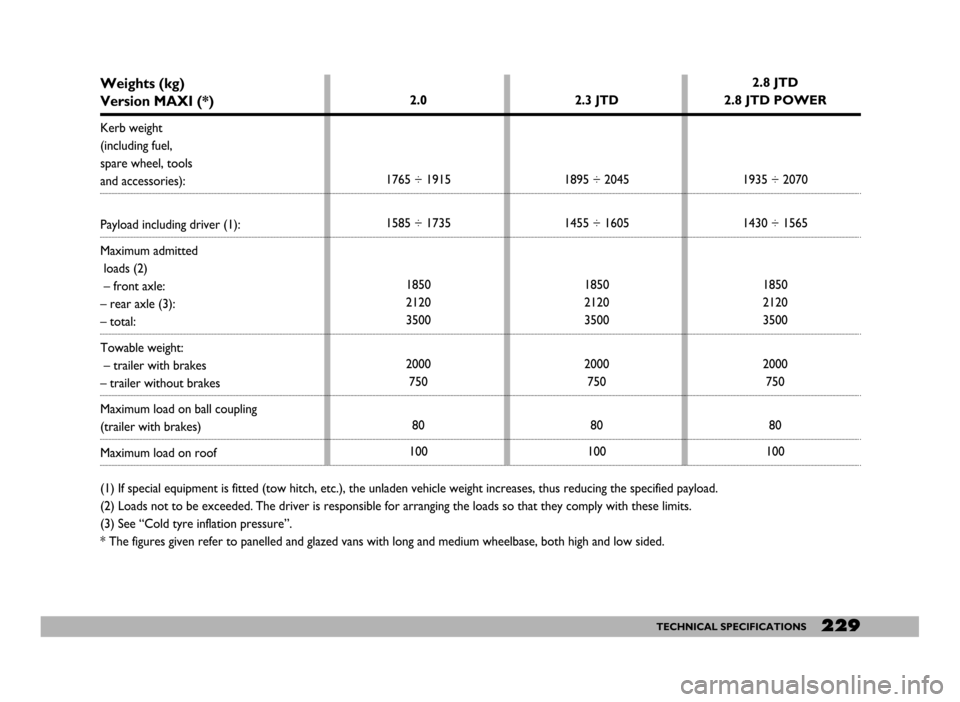
Weights (kg)
Version MAXI (*)
Kerb weight
(including fuel,
spare wheel, tools
and accessories):
Payload including driver (1):
Maximum admitted
loads (2)
– front axle:
– rear axle (3):
– total:
Towable weight:
– trailer with brakes
– trailer without brakes
Maximum load on ball coupling
(trailer with brakes)
Maximum load on roof
(1) If special equipment is fitted (tow hitch, etc.), the unladen vehicle weight increases, thus reducing the specified payload.
(2) Loads not to be exceeded. The driver is responsible for arranging the loads so that they comply with these limits.
(3) See “Cold tyre inflation pressure”.
* The figures given refer to panelled and glazed vans with long and medium wheelbase, both high and low sided.2.0
1765 ÷ 1915
1585 ÷ 1735
1850
2120
3500
2000
750
80
1002.3 JTD
1895 ÷ 2045
1455 ÷ 1605
1850
2120
3500
2000
750
80
100
2.8 JTD
2.8 JTD POWER
1935 ÷ 2070
1430 ÷ 1565
1850
2120
3500
2000
750
80
100