belt FIAT DUCATO 2006 3.G Owner's Manual
[x] Cancel search | Manufacturer: FIAT, Model Year: 2006, Model line: DUCATO, Model: FIAT DUCATO 2006 3.GPages: 258, PDF Size: 4.05 MB
Page 121 of 258
120GETTING THE BEST OUT OF YOUR VEHICLE
BEFORE GETTING BEHIND
THE WHEEL
– Make sure all light, including the
headlights, are working properly;
– adjust the position of seats and dri-
ving and door mirrors properly for the
best driving position;
– make sure that nothing (mats, etc.)
gets in the way of the pedals when
they are pushed down;
– make sure that any child restraint
systems (child seats, cradles, etc.) are
properly fixed;
– place any objects in the load com-
partment in such a way that they can-
not be thrown forwards in the event
of an accident;
– light eating will help keep your re-
flexes prompt. Above all, do not have
anything alcoholic to drink.
Remember to periodically check:
– tyre pressure,
– engine oil level,
– engine coolant level and cooling
system conditions,– brake fluid level,
– windscreen washer fluid level.
WHEN TRAVELLING
– The first rule of safe driving is pru-
dence;
– prudence also means putting your-
self into a position where you can pre-
dict wrong or imprudent behaviour
from other drivers;
– stick closely to the rules of the
road in the particular country where
the vehicle is being driven and, above
all, do not exceed speed limits;
– ensure that, besides yourself, all the
other passengers in the vehicle have
their seat belts fastened, that children
are sitting in the appropriate child
seats and any animals in the vehicle are
placed in suitable compartment;
– you should be physically fit and
mentally alert before setting out on
long journeys.
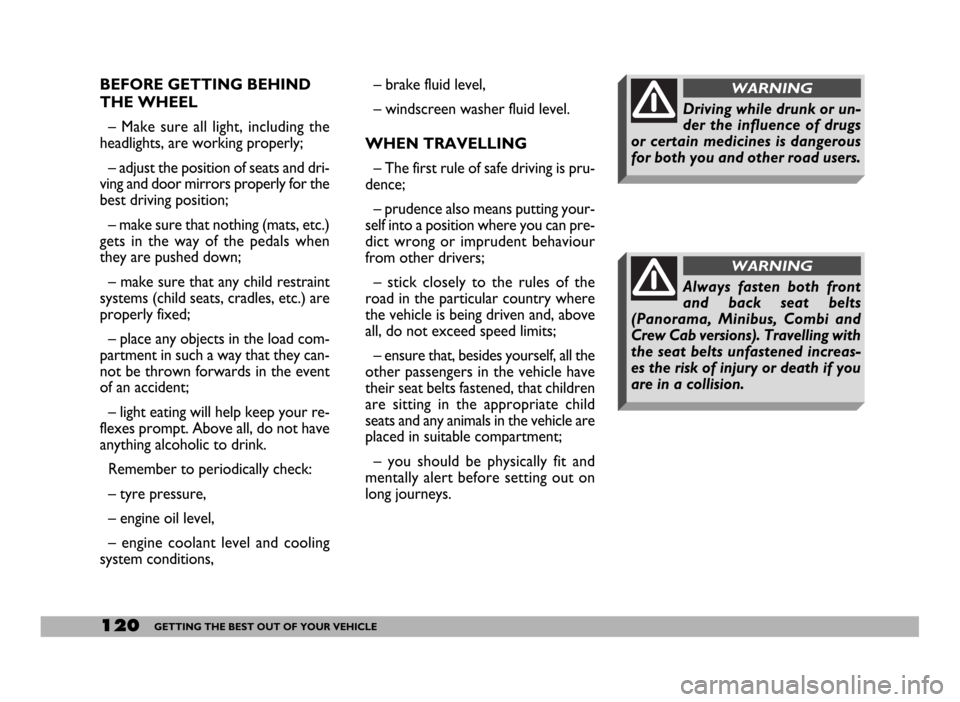
Always fasten both front
and back seat belts
(Panorama, Minibus, Combi and
Crew Cab versions). Travelling with
the seat belts unfastened increas-
es the risk of injury or death if you
are in a collision.
WARNING
Driving while drunk or un-
der the influence of drugs
or certain medicines is dangerous
for both you and other road users.
WARNING
Page 162 of 258

161IN AN EMERGENCY
FIRST-AID KIT
It is a good idea to keep a fire extin-
guisher and blanket in the vehicle in
addition to the first-aid kit. IF ANYONE IS INJURED
– Never leave the injured person
alone. The obligation to provide as-
sistance exists even for those not di-
rectly involved in the accident;
– Do not congregate around the in-
jured person.
– Reassure the injured person that
help is on its way and will arrive soon.
Stay close by to calm him/her down in
case of panic.
– Unfasten or cut seat belts holding
injured parties.
– Do not give an injured person any-
thing to drink.
– Do not move an injured person un-
less the following situations arise.
– Pull the injured person from the ve-
hicle only if it risks catching fire, it is
sinking in water or is likely to fall over
a cliff or similar.Do not pull his/her
arms or legs, do not bend the head
and, as far as possible, keep the body
horizontal.
Page 164 of 258
163VEHICLE MAINTENANCE
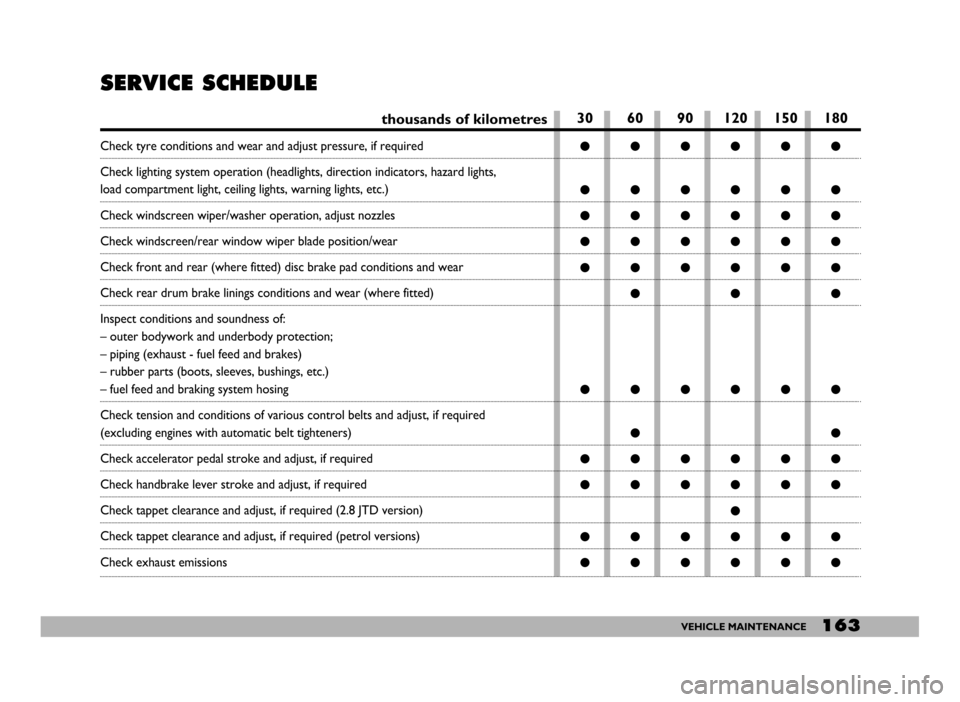
SERVICE SCHEDULE
thousands of kilometres
Check tyre conditions and wear and adjust pressure, if required
Check lighting system operation (headlights, direction indicators, hazard lights,
load compartment light, ceiling lights, warning lights, etc.)
Check windscreen wiper/washer operation, adjust nozzles
Check windscreen/rear window wiper blade position/wear
Check front and rear (where fitted) disc brake pad conditions and wear
Check rear drum brake linings conditions and wear (where fitted)
Inspect conditions and soundness of:
– outer bodywork and underbody protection;
– piping (exhaust - fuel feed and brakes)
– rubber parts (boots, sleeves, bushings, etc.)
– fuel feed and braking system hosing
Check tension and conditions of various control belts and adjust, if required
(excluding engines with automatic belt tighteners)
Check accelerator pedal stroke and adjust, if required
Check handbrake lever stroke and adjust, if required
Check tappet clearance and adjust, if required (2.8 JTD version)
Check tappet clearance and adjust, if required (petrol versions)
Check exhaust emissions
30 60 90 120 150 180
●●●●●●
●●●●●●
●●●●●●
●●●●●●
●●●●●●
●●●
●●●●●●
●●
●●●●●●
●●●●●●
●
●●●●●●
●●●●●●
Page 165 of 258
164VEHICLE MAINTENANCE
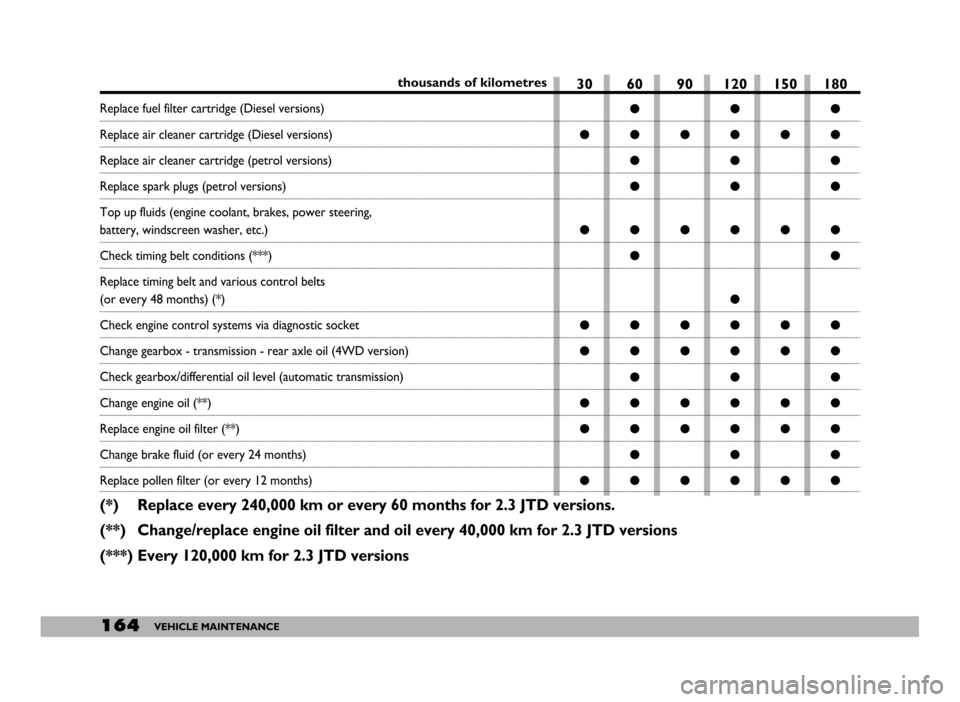
thousands of kilometres
Replace fuel filter cartridge (Diesel versions)
Replace air cleaner cartridge (Diesel versions)
Replace air cleaner cartridge (petrol versions)
Replace spark plugs (petrol versions)
Top up fluids (engine coolant, brakes, power steering,
battery, windscreen washer, etc.)
Check timing belt conditions (***)
Replace timing belt and various control belts
(or every 48 months) (*)
Check engine control systems via diagnostic socket
Change gearbox - transmission - rear axle oil (4WD version)
Check gearbox/differential oil level (automatic transmission)
Change engine oil (**)
Replace engine oil filter (**)
Change brake fluid (or every 24 months)
Replace pollen filter (or every 12 months)
(*) Replace every 240,000 km or every 60 months for 2.3 JTD versions.
(**) Change/replace engine oil filter and oil every 40,000 km for 2.3 JTD versions
(***) Every 120,000 km for 2.3 JTD versions
30 60 90 120 150 180
●●●
●●●●●●
●●●
●●●
●●●●●●
●●
●
●●●●●●
●●●●●●
●●●
●●●●●●
●●●●●●
●●●
●●●●●●
Page 166 of 258
165VEHICLE MAINTENANCE
ANNUAL
INSPECTION
SCHEDULE
The following annual inspection
schedule is required for vehicles trav-
elling 15,000 Kmapprox. a year. The
schedule includes the following oper-
ations:
– check tyre condition and wear and
adjust pressure, if required (including
spare wheel);
– check operation of lights (head-
lights, direction indicators, hazard
lights, boot light, passenger compart-
ment light, instrument panel lights,
etc.);
– check windscreen wiper/washer
and adjust nozzles;
– check position and wear of wind-
screen/rear window wiper blades;
– check front pad conditions and
wear;
– check for bonnet and boot lock
cleanness, lever cleanness and lubri-
cation;– inspect conditions of: engine, gear-
box, transmission, piping (exhaust, fu-
el feed, brakes), rubber parts (boots,
sleeves, bushings, etc.), brake and fu-
el line hoses;
– check battery charge status;
– check conditions of various control
belts;
– check and top up fluid levels (en-
gine coolant, brakes, windscreen
washer, battery, etc.);
– check and top up engine oil;
– replace pollen filter.
ADDITIONAL
CHECKS
Every 1,000 km or before long
trips, check and top up as necessary:
– engine coolant level
– brake fluid level
– power steering fluid level
– battery electrolyte level
– windscreen washer fluid
– tyre pressure and conditions.
Every 3,000 km or before long
trips, check and top up as necessary:
engine oil
Every 10,000 kmor at cwarning
light coming on (diesel engines only):
bleed water from fuel filter.
You are recommended to use FL
Seleniaproducts designed and pro-
duced for Fiat vehicles (see the “Ca-
pacities” table in the “Technical Spec-
ifications” section).
Page 251 of 258

250INDEX
Rev counter ................................. 30
Reversing light replacement ..... 146
Rims
- understanding rim markings .. 219
Roof rack/ski rack (presetting) .. 101
Rubber tubing .............................. 179
Safe driving.................................. 119
Scheduled Service ....................... 162
Seat belts ....................................... 15
Seats ............................................... 42
Self-standing supplementary
heater .......................................... 59
Service indicator .......................... 33
Service Schedule .......................... 163
Side central windows (opening) 78
Side/taillights ................................. 65
- front bulb replacement ......... 146
Smart wash ................................... 67
Snow chains .......................... 133-218
Snow tyres ............................ 132-221Sound system ............................... 98
- aerial ......................................... 100
- heavy set-up ............................ 98
- light set-up ............................... 98
Spare wheel .................................. 218
Spark plugs .................................... 215
Speed limiter ................................ 177
Speedometer ................................ 30
Spray nozzles ............................... 181
Starting the engine ...................... 105
- bump starting .......................... 137
- Diesel engine procedure ...... 106
- emergency starting ......... 107-135
- ignition switch ......................... 28
- jump starting .................... 136-157
- petrol engine procedure ...... 105
- stopping the engine ................ 108
- warming up the engine after
it has just started ................... 107
Steering ......................................... 218
Steering column lock .................. 28Steering column stalks ............... 65
Steering wheel ............................. 51
Sun visors ...................................... 78
Suspensions .................................. 217
Symbols ......................................... 7
Tank cap ................................ 99-103
Technical specifications........ 185
Third brake light
replacement ................................. 146
Tools ................................................ 138
Top speeds ..................................... 226
Tow hitch
(fitting diagrams)................... 130-131
Tow hitch installation .................. 129
Towing a trailer ............................. 129
Towing the vehicle ....................... 159
Transmission .................................. 216
Transporting children in safety .. 22
Tyre pressure ................................. 220
Tyres ......................................... 178-220