instrument panel FIAT DUCATO 2006 3.G Owner's Manual
[x] Cancel search | Manufacturer: FIAT, Model Year: 2006, Model line: DUCATO, Model: FIAT DUCATO 2006 3.GPages: 258, PDF Size: 4.05 MB
Page 178 of 258
177VEHICLE MAINTENANCE
ELECTRONIC
CONTROL UNIT
When the vehicle is being used nor-
mally, special measures are not nec-
essary.
The following instructions must be
followed very carefully however, if
you work on the electrical system or
in cases where emergency starting is
necessary:
– never disconnect the battery from
the electric system while the engine is
running;
– disconnect the battery from the
electric system if you are recharging it;
– never perform emergency starting
with a battery charger. Always use an
auxiliary battery;
– be particularly careful when con-
necting the battery to the electric sys-
tem. Make sure that the polarity is
correct and that the connection is ef-
ficient;
– do not connect or disconnect the
terminals of the electronic units while
the ignition key is at MAR;
– do not check polarity through
sparking;– disconnect the electronic control
units if you are electrically welding the
vehicle body. Remove the units if tem-
peratures exceed 80 °C (special op-
erations on the bodywork, etc.).
IMPORTANTIf the sound system
or vehicle alarm systems are not in-
stalled correctly, they can interfere
with the working of the electronic
control units.
Modifications or repairs to
the electrical system car-
ried out incorrectly and without
bearing the features of the system
in mind can cause malfunctions
with the risk of fire.
WARNING
SPEED LIMITER
On certain version, the injection con-
trol unit is set to limit the vehicle
speed at a max. preset limit.
Speed limits are the following:
– for Minibus versions (M2 homolo-
gation category): 100 km/h;
– for good Transport versions (ve-
hicle dead weight: > 3.5 t) (N2 ho-
mologation category): 90 km/h;
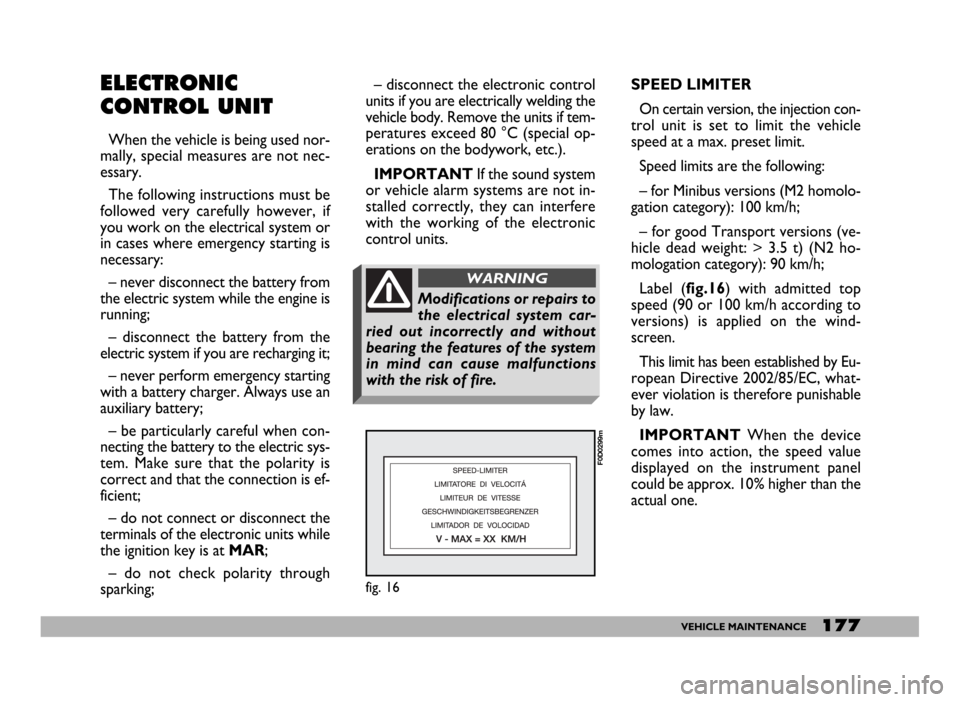
Label (fig.16) with admitted top
speed (90 or 100 km/h according to
versions) is applied on the wind-
screen.
This limit has been established by Eu-
ropean Directive 2002/85/EC, what-
ever violation is therefore punishable
by law.
IMPORTANTWhen the device
comes into action, the speed value
displayed on the instrument panel
could be approx. 10% higher than the
actual one.
fig. 16
F0D0299m
Page 185 of 258
184VEHICLE MAINTENANCE
INTERIORS
From time to time check that water
has not collected under the mats
(from dripping shoes, umbrellas, etc.)
which could cause the steel to rust.
CLEANING SEATS
AND FABRICS
Remove dust with a soft brush and
vacuum cleaner. For velvet seats use
a damp brush.
Brush the seats with a damp sponge
with water and neutral soap.PLASTIC PARTS INSIDE
THE VEHICLE
Clean plastic parts with damp cloth
with water and non-abrasive neutral
soap. To remove grease or hard
stains, use special solvent-free prod-
ucts designed not to alter the appear-
ance and colour of components.
IMPORTANTDo not use alcohol
or petrol to clean the instrument
panel.
Never use flammable prod-
ucts (petroleum ether or
petrol) to clean the inside of the ve-
hicle. Electrostatic charges gener-
ated by rubbing while cleaning
could cause fires.
WARNING
Do not keep aerosol cans in
the vehicle. There is the risk
they might explode. Aerosol cans
must never be exposed to a tem-
perature above 50°C; when the
weather starts to get hot the tem-
perature inside the vehicle might go
well beyond that figure.
WARNING
Page 250 of 258

249INDEX
Glove compartment/oddment
compartment ............................. 73
Headlight washer ...................... 181
Headlights
- beam adjustment .................... 86
Head restraints ............................ 50
Heat flange .................................... 106
Heating .......................................... 56
Heating and ventilation .............. 54
Identification data ...................... 185
If a bulb burns out ...................... 141
If an accident occurs .................. 160
If anyone is injured
(during accidents) ..................... 161
If an exterior light burns out ... 143
If an interior light burns out .... 148
Ignition switch ............................. 28
In an emergency..................... 135
Individual settings ........................ 42
Instrument panel ......................... 29Instruments .................................. 30
Interior equipment ..................... 73
Interiors ........................................ 184
Jacking the vehicle .................... 158
Jump starting ........................... 136-157
Keys ............................................ 7
Load recommendations .......... 126
Main beam headlights ............ 65
- bulb replacement ................... 143
Manual gearbox ........................... 109
Mobile foot board ....................... 80
Model plate ................................... 185
Multimeter .................................... 78
Number plate light
replacement ............................... 147
Object holder/
food box ..................................... 75
Oddment compartments............ 73
Odometer ...................................... 31
Paintwork .................................... 182
Parking ............................................ 108
Parking sensors ............................. 67
Performance .................................. 226
Pollen filter .................................... 173
Power steering fluid level ........... 171
Pretensioners ................................ 18
Protecting the environment ...... 104
Radio transmitters
and cellular phones .................. 101
Reading/writing desk .................. 74
Rear fog light replacement ....... 145
Rearview camera ........................ 67
Rearview mirrors ................ 51-52
Recharging the battery .............. 157
Remote control ........................... 9