lights FIAT DUCATO 2006 3.G Owner's Manual
[x] Cancel search | Manufacturer: FIAT, Model Year: 2006, Model line: DUCATO, Model: FIAT DUCATO 2006 3.GPages: 258, PDF Size: 4.05 MB
Page 126 of 258
125GETTING THE BEST OUT OF YOUR VEHICLE
Electric devices
Use electric devices for the neces-
sary time only. The heated rear win-
dow, fog lights, windscreen wipers,
heater fan require large amounts of
electricity and increasing the request
for power will also increase fuel con-
sumption (up to +25% when driving in
towns).
Climate control system
The climate control system is an ad-
ditional load which greatly affects the
engine leading to higher consumption.
When the temperature outside the
vehicle allows it, use the air vents
where possible.
DRIVING STYLE
Starting
Do not warm the engine when the
vehicle is stationary or at high or low
speed: in this way the engine will warm
up gradually increasing consumption
and emissions. You should drive off
slowly straight away avoiding high revs
so that the engine will warm up more
quickly.Unnecessary actions
Avoid revving the engine when
stopped at traffic lights or before
switching off the engine and avoid dou-
bling the clutch as these actions have
no purpose on modern vehicles and
serve only to increase consumption
and pollution.
Gear selections
As soon as the traffic and road con-
ditions allow it, shift to a higher gear.
Using a low gear to liven up accelera-
tion greatly increases consumption. In
the same way improper use of high
gears will increase consumption, emis-
sions and engine wear.
On passenger transportation versions
fitted with 2.3, 2.8 JTD and 2.8 JTD
POWER engines, fuel consumption can
be optimised by starting (on level road)
in 2nd gear instead of 1st gear.Top speeds
Fuel consumption increases consid-
erably as speed increases. Your speed
should be kept as even as possible and
superfluous braking and acceleration
avoided as this increases both con-
sumption and emissions.
Acceleration
Accelerating violently increasing the
revs will greatly affect consumption
and emissions; acceleration should be
gradual and should not exceed the
maximum torque.
Page 127 of 258
126GETTING THE BEST OUT OF YOUR VEHICLE
CONDITIONS OF USE
Cold starting
Frequent cold starting will not enable
the engine to reach optimal running
temperature. It follows, therefore,
that consumption will be higher (from
+15 to +30% in towns) as will the
production of toxic emissions.
Traffic and road conditions
Heavy traffic and higher consumption
are synonymous: for example, when
driving slowly with frequent use of low-
er gears or in towns where there are
numerous traffic lights.
Winding roads, mountain roads and
bumpy roads also have a negative effect
on consumption.
Enforced halts
During prolonged stops (traffic lights,
level crossings, etc.) the engine should
be switched off.LOAD
RECOMMENDATIONS
The version of the Ducato you are
driving has been designed and ap-
proved on the basis of several set
maximum weights (see the tables
“Weights” in section “Technical spec-
ifications”):
– kerb weight
– payload
– total weight
– total weight on the front axle
– total weight on the rear axle
– towable weight
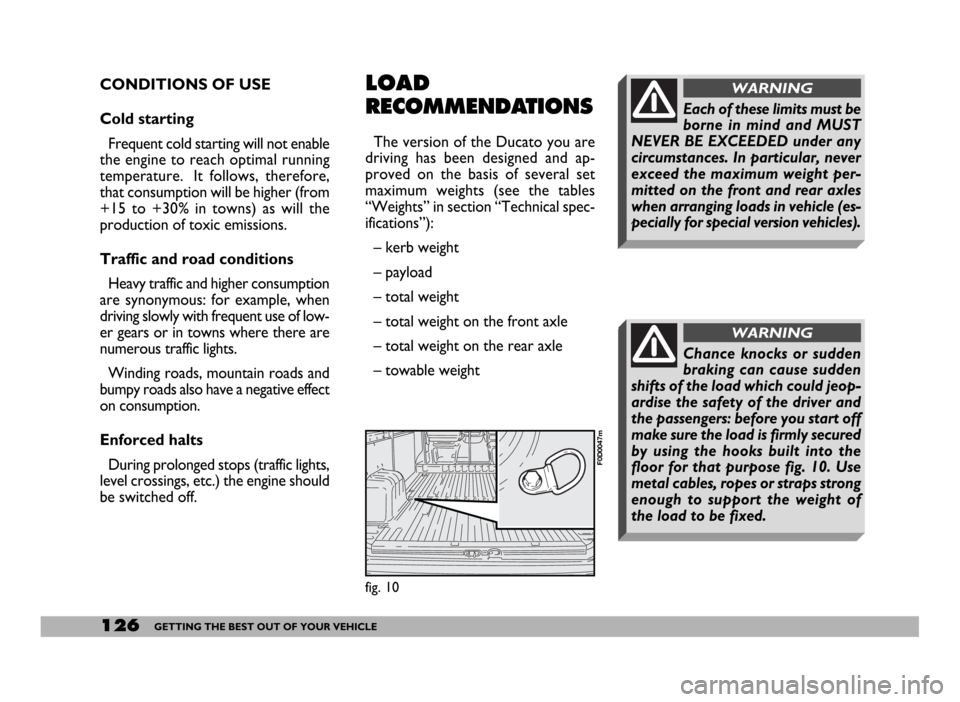
fig. 10
F0D0047m
Each of these limits must be
borne in mind and MUST
NEVER BE EXCEEDED under any
circumstances. In particular, never
exceed the maximum weight per-
mitted on the front and rear axles
when arranging loads in vehicle (es-
pecially for special version vehicles).
WARNING
Chance knocks or sudden
braking can cause sudden
shifts of the load which could jeop-
ardise the safety of the driver and
the passengers: before you start off
make sure the load is firmly secured
by using the hooks built into the
floor for that purpose fig. 10. Use
metal cables, ropes or straps strong
enough to support the weight of
the load to be fixed.
WARNING
Page 136 of 258
135IN AN EMERGENCY
I I
N N
A A
N N
E E
M M
E E
R R
G G
E E
N N
C C
Y Y
EMERGENCY
START-UP
DIESEL VERSIONS
Emergency start-ups cannot be per-
formed on versions with a diesel en-
gine; contact aFiat Dealership.
PETROL VERSIONS
If the Fiat CODE cannot deactivate
the engine immobiliser, the Yand
Uwarning lights stay on and the en-
gine will not start. Follow the emer-
gency start-up procedure to start the
engine.
Read the whole procedure care-
fully before trying to carry it out.
If you make a mistake, you must turn
the ignition key back to STOPand re-
peat the whole operation from the be-
ginning (step 1).1) Read the 5-figure electronic code
given on the CODE card.
2) Turn the ignition key to MAR.
3)Press and hold down the accel-
erator pedal. Warning light
Uwill
come on for about 8 seconds, and
then go out. At this point release the
accelerator pedal and get ready to
count the flashes of the warning light
U.
4) Count the number of flashes that
corresponds to the first figure of the
code on the CODE card, then press
the accelerator pedal and keep it there
until the warning light
Ucomes on
for four seconds and then goes out;
release the accelerator pedal.
5) Warning light
Uwill start flash-
ing again: after it has flashed the num-
ber of times that corresponds to the
second figure on the CODE card,
press the accelerator pedal and keep
it pressed.
6) Do the same for the remaining fig-
ures on the CODE card.7) Once the final figure has been en-
tered, keep the accelerator pedal
pressed. Warning light
Uwill light up
for four seconds and then go out; re-
lease the accelerator pedal.
8)Warning light
Uwill flash rapid-
ly for about 4 seconds to indicate that
the operation has been completed
correctly.
9) Start the engine by turning the ig-
nition key from MARto AVV.
If, however, the warning light
U
stays on, turn the ignition key to
STOPan repeat the procedure from
step 1).
IMPORTANT After an emergency
start-up, you should contact a Fiat
Dealership otherwise you will have
to repeat the procedure described
each time you want to start the en-
gine.
Page 139 of 258
138IN AN EMERGENCY
1. STOP THE VEHICLE
– Stop the vehicle in a position that
is not dangerous for oncoming traffic
where you can change the wheel safe-
ly. The ground should be flat and ad-
equately firm. If you have to change
the wheel at night, choose a lit area if
possible.
– Turn the engine off and pull up the
handbrake.
– Engage first or reverse gear.
– Alert other drivers that the vehicle
is stationary in compliance with local
regulations: hazard warning lights,
warning triangle, etc.
Any passengers should get out and
wait as far away as possible from the
danger of traffic.
If the road is sloping or bumpy, place
wedges or other suitable material to
prevent the vehicle from moving, un-
der the wheels.2. TAKE OUT THE TOOLS,
JACK AND SPARE WHEEL
The tools are in the cab near the
seats.
Please note:
– the jack weights 4.2 kg;
– the jack requires no adjustments;
– the jack cannot be repaired. If it
breaks it must be replaced with a new
jack;
– no other tool, apart from the ex-
tension and the ratchet wrench shown
in this chapter can be fitted to the jack.
The spare wheel is located under the
rear part of the load bed.
Do not lubricate the bolt
threads before fitting
them back: they could come
loose.
WARNING
Check tyre pressure and
spare wheel pressure regu-
larly. Refer to section “Technical
Specifications”.
WARNING
Page 142 of 258
141IN AN EMERGENCY
GENERAL INSTRUCTIONS
When a light is not working, check
that it has not fused before changing
the bulb.
For the location of the fuses, refer to
“If a fuse blows” in this section.
Before replacing a bulb that does not
work, check that the contacts are not
oxidised.
Burnt-out bulbs must be replaced
with ones of the same type. Light from
bulbs with insufficient power is dim
while those which are too powerful
use too much electricity. Always check
the height of the headlight beam after
changing a bulb. Only touch the metal
part when handling halo-
gen bulbs. If the transpar-
ent bulb is touched it reduces the
intensity of the light emitted and
can also reduce the life of the
bulb. If you touch the bulb acci-
dentally, rub it with a cloth
moistened with alcohol and leave
it to dry.IF A BULB
BURNS OUT
Modifications or repairs to
the electrical system car-
ried out incorrectly and without
bearing the features of the system
in mind can cause malfunctions
with the risk of fire.
WARNING
You should have the bulbs
replaced at a Fiat Dealer-
ship, if possible. Correct operation
and proper beam height are essen-
tial for safe driving and compliance
with law requirements.
WARNING
Halogen bulbs contain
pressurised gas which, if
broken, may cause small fragments
of glass to be projected outwards.
WARNING
IMPORTANTOn the inside sur-
face of the headlight there could ap-
pear a slight coat of fogging; this does
not show a defect, since it is a natur-
al occurrence due to low temperature
and to the degree of humidity in the
air; it will disappear as soon as the
lights are turned on. The presence of
drops inside the headlight shows wa-
ter seepage, contact Fiat Dealership.
Page 143 of 258
142IN AN EMERGENCY
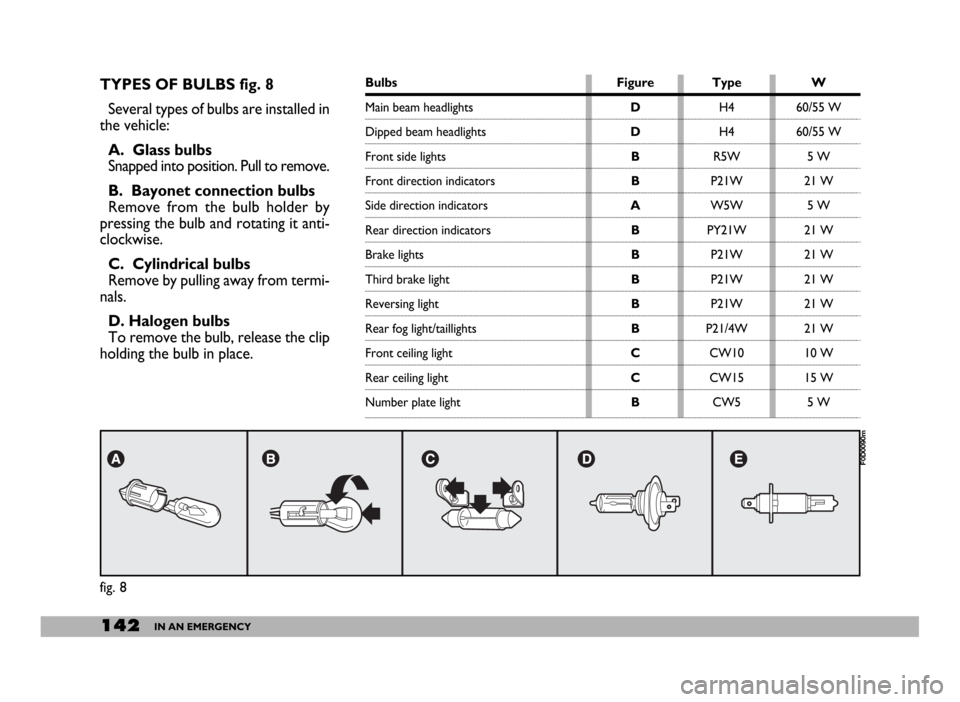
Bulbs
Main beam headlights
Dipped beam headlights
Front side lights
Front direction indicators
Side direction indicators
Rear direction indicators
Brake lights
Third brake light
Reversing light
Rear fog light/taillights
Front ceiling light
Rear ceiling light
Number plate lightW
60/55 W
60/55 W
5 W
21 W
5 W
21 W
21 W
21 W
21 W
21 W
10 W
15 W
5 W Type
H4
H4
R5W
P21W
W5W
PY21W
P21W
P21W
P21W
P21/4W
CW10
CW15
CW5
Figure
D
D
B
B
A
B
B
B
B
B
C
C
B
fig. 8
F0D0090m
TYPES OF BULBS fig. 8
Several types of bulbs are installed in
the vehicle:
A. Glass bulbs
Snapped into position. Pull to remove.
B. Bayonet connection bulbs
Remove from the bulb holder by
pressing the bulb and rotating it anti-
clockwise.
C. Cylindrical bulbs
Remove by pulling away from termi-
nals.
D. Halogen bulbs
To remove the bulb, release the clip
holding the bulb in place.
Page 144 of 258
143IN AN EMERGENCY
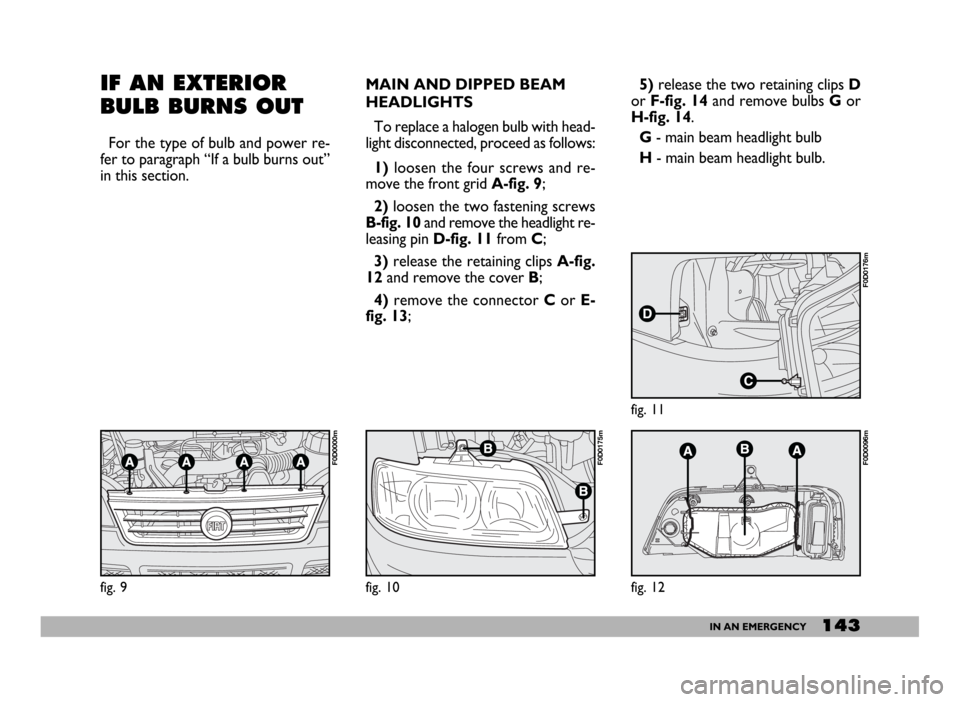
MAIN AND DIPPED BEAM
HEADLIGHTS
To replace a halogen bulb with head-
light disconnected, proceed as follows:
1)loosen the four screws and re-
move the front grid A-fig. 9;
2)loosen the two fastening screws
B-fig. 10and remove the headlight re-
leasing pin D-fig. 11from C;
3)release the retaining clips A-fig.
12and remove the cover B;
4)remove the connector Cor E-
fig. 13;5)release the two retaining clips D
or F-fig. 14and remove bulbs Gor
H-fig. 14.
G- main beam headlight bulb
H- main beam headlight bulb.
fig. 12
F0D0096m
fig. 11
F0D0176m
fig. 10
F0D0175m
IF AN EXTERIOR
BULB BURNS OUT
For the type of bulb and power re-
fer to paragraph “If a bulb burns out”
in this section.
fig. 9
F0D0000m
Page 145 of 258
144IN AN EMERGENCY
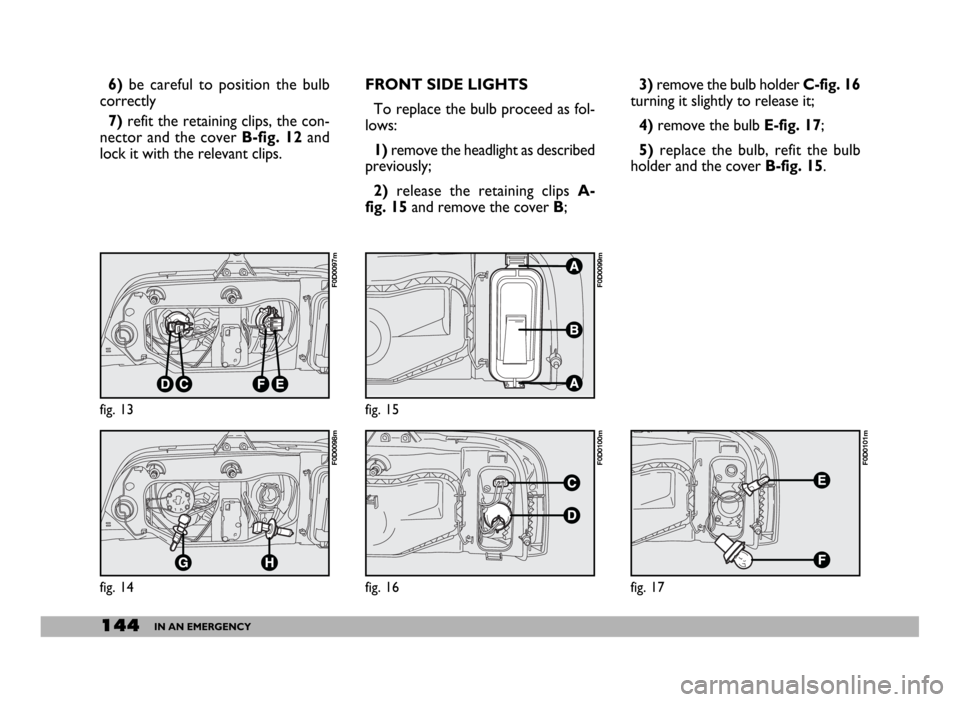
3)remove the bulb holder C-fig. 16
turning it slightly to release it;
4)remove the bulb E-fig. 17;
5) replace the bulb, refit the bulb
holder and the cover B-fig. 15. 6)be careful to position the bulb
correctly
7)refit the retaining clips, the con-
nector and the cover B-fig. 12and
lock it with the relevant clips.
fig. 15
F0D0099m
fig. 16
F0D0100m
fig. 17
F0D0101m
FRONT SIDE LIGHTS
To replace the bulb proceed as fol-
lows:
1)remove the headlight as described
previously;
2)release the retaining clips A-
fig. 15and remove the cover B;
fig. 13
F0D0097m
fig. 14
F0D0098m
Page 146 of 258
145IN AN EMERGENCY
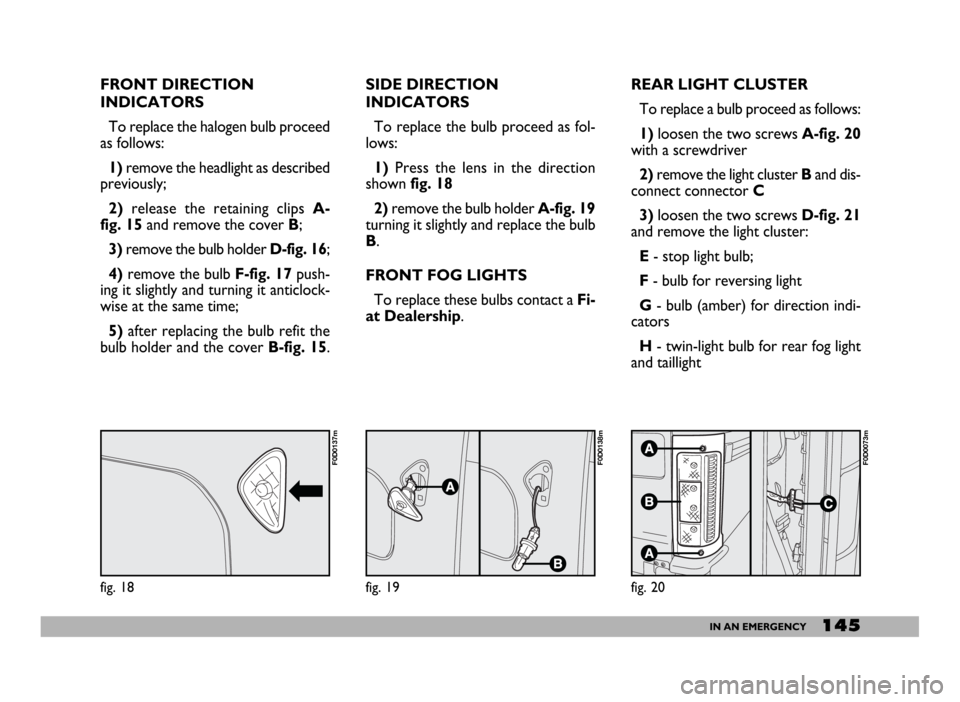
REAR LIGHT CLUSTER
To replace a bulb proceed as follows:
1)loosen the two screws A-fig. 20
with a screwdriver
2)remove the light cluster Band dis-
connect connector C
3)loosen the two screws D-fig. 21
and remove the light cluster:
E- stop light bulb;
F- bulb for reversing light
G - bulb (amber) for direction indi-
cators
H- twin-light bulb for rear fog light
and taillight
fig. 20
F0D0073m
FRONT DIRECTION
INDICATORS
To replace the halogen bulb proceed
as follows:
1) remove the headlight as described
previously;
2)release the retaining clips A-
fig. 15 and remove the cover B;
3)remove the bulb holder D-fig. 16;
4)remove the bulb F-fig. 17push-
ing it slightly and turning it anticlock-
wise at the same time;
5)after replacing the bulb refit the
bulb holder and the cover B-fig. 15.SIDE DIRECTION
INDICATORS
To replace the bulb proceed as fol-
lows:
1)Press the lens in the direction
shown fig. 18
2)remove the bulb holder A-fig. 19
turning it slightly and replace the bulb
B.
FRONT FOG LIGHTS
To replace these bulbs contact a Fi-
at Dealership.
fig. 18
F0D0137m
fig. 19
F0D0138m
Page 149 of 258
148IN AN EMERGENCY
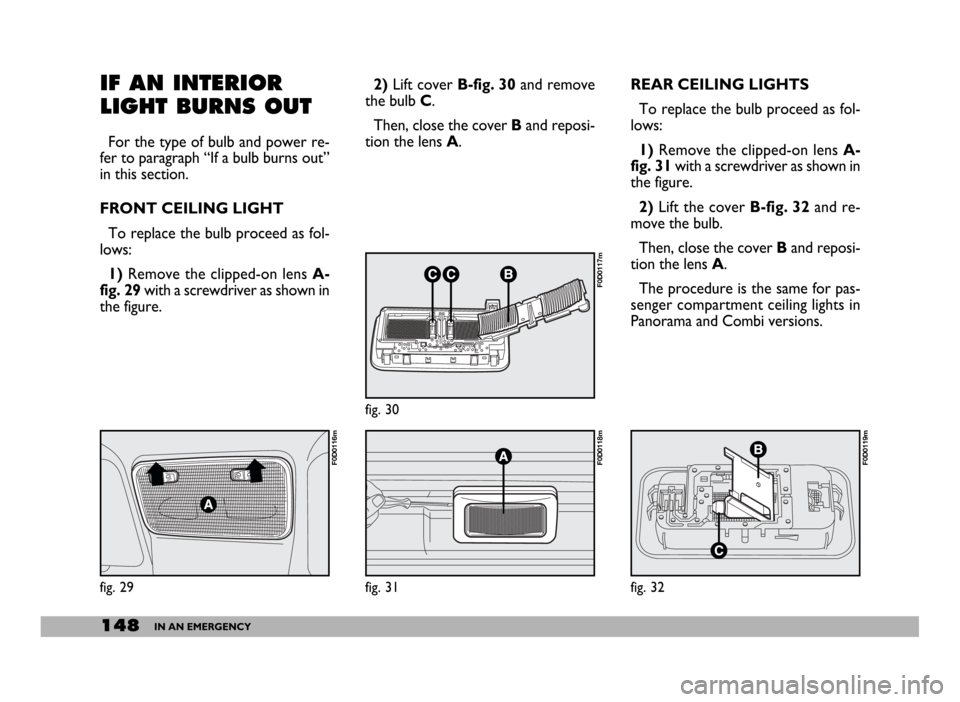
REAR CEILING LIGHTS
To replace the bulb proceed as fol-
lows:
1) Remove the clipped-on lens A-
fig. 31with a screwdriver as shown in
the figure.
2)Lift the cover B-fig. 32 and re-
move the bulb.
Then, close the cover Band reposi-
tion the lens A.
The procedure is the same for pas-
senger compartment ceiling lights in
Panorama and Combi versions.IF AN INTERIOR
LIGHT BURNS OUT
For the type of bulb and power re-
fer to paragraph “If a bulb burns out”
in this section.
FRONT CEILING LIGHT
To replace the bulb proceed as fol-
lows:
1) Remove the clipped-on lens A-
fig. 29with a screwdriver as shown in
the figure.2)Lift cover B-fig. 30and remove
the bulb C.
Then, close the cover Band reposi-
tion the lens A.
fig. 29
F0D0116m
fig. 30
F0D0117m
fig. 31
F0D0118m
fig. 32
F0D0119m