Back seat FIAT DUCATO 2008 3.G User Guide
[x] Cancel search | Manufacturer: FIAT, Model Year: 2008, Model line: DUCATO, Model: FIAT DUCATO 2008 3.GPages: 282, PDF Size: 4.55 MB
Page 122 of 282
121
CORRECT USE
OF THE
VEHICLE
WARNING
LIGHTS AND
MESSAGES
IN AN
EMERGENCY
VEHICLE
MAINTENANCE
TECHNICAL
SPECIFICATIONS
INDEX
DASHBOARD
AND CONTROLS
SAFETY
DEVICES
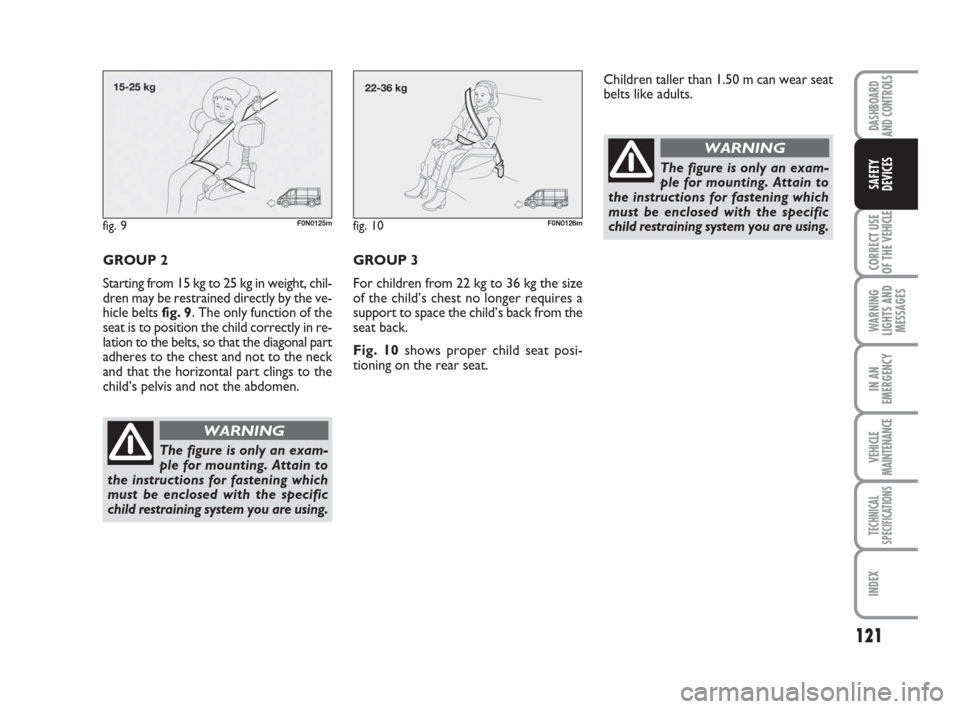
fig. 9F0N0125m
GROUP 2
Starting from 15 kg to 25 kg in weight, chil-
dren may be restrained directly by the ve-
hicle belts fig. 9. The only function of the
seat is to position the child correctly in re-
lation to the belts, so that the diagonal part
adheres to the chest and not to the neck
and that the horizontal part clings to the
child’s pelvis and not the abdomen.
The figure is only an exam-
ple for mounting. Attain to
the instructions for fastening which
must be enclosed with the specific
child restraining system you are using.
WARNING
GROUP 3
For children from 22 kg to 36 kg the size
of the child’s chest no longer requires a
support to space the child’s back from the
seat back.
Fig. 10shows proper child seat posi-
tioning on the rear seat.
fig. 10F0N0126m
The figure is only an exam-
ple for mounting. Attain to
the instructions for fastening which
must be enclosed with the specific
child restraining system you are using.
WARNING
Children taller than 1.50 m can wear seat
belts like adults.
Page 124 of 282
123
CORRECT USE
OF THE
VEHICLE
WARNING
LIGHTS AND
MESSAGES
IN AN
EMERGENCY
VEHICLE
MAINTENANCE
TECHNICAL
SPECIFICATIONS
INDEX
DASHBOARD
AND CONTROLS
SAFETY
DEVICES
To sum up the safety precautions
to follow when transporting
children:
1) The recommended position for in-
stalling child’s seat is on the rear seat, as
it is the most protected in the case of a
crash.
2) If the passenger’s air bag is deactivat-
ed always check the amber warning light
on the cluster to make sure that it has ac-
tually been deactivated.
3) Attain to the instructions for fastening
the specific child restraint system which
you are using. These instructions must be
provided by the manufacturer. Keep the
child restraint system installation instruc-
tions with the vehicle documents and with
this Handbook. Never use a child restraint
system without installation instructions.
4) Always check the seat belt is well fas-
tened by pulling the webbing.5) Only one child is to be strapped to
each retaining system.
6) Always check the seat belts do not fit
around the child’s throat.
7) While travelling, do not let the child
sit incorrectly or release the belts.
8) Passengers should never carry children
on their laps. No-one, however strong
they are, can hold a child in the event of
a crash.
9) In case of an accident, replace the
child’s seat with a new one.
With front passenger’s air
bag active do not place cra-
dle child’s seats facing backwards on
the front passenger seat since the air
bag activation could cause serious in-
juries, even mortal regardless of the
seriousness of the crash. You are ad-
vised to carry children always on the
rear seat, as this is the most protect-
ed position in the case of a crash.
WARNING
Page 125 of 282
124
CORRECT USE
OF THE
VEHICLE
WARNING
LIGHTS AND
MESSAGES
IN AN
EMERGENCY
VEHICLE
MAINTENANCE
TECHNICAL
SPECIFICATIONS
IINDEX
DASHBOARD
AND CONTROLS
SAFETY
DEVICES
PRESETTING FOR
MOUNTING THE
“UNIVERSAL ISOFIX”
CHILD RESTRAINT
SYSTEM
This vehicle is preset for mounting the
Universal Isofix child restraint system, a
new European standardised system for
carrying children safely.
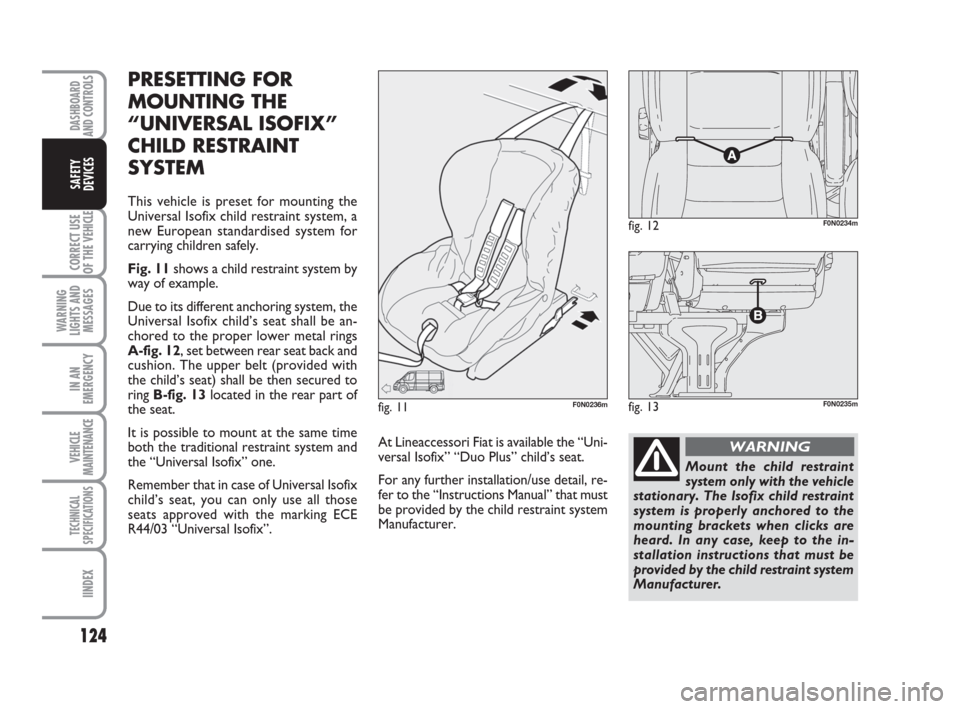
Fig. 11shows a child restraint system by
way of example.
Due to its different anchoring system, the
Universal Isofix child’s seat shall be an-
chored to the proper lower metal rings
A-fig. 12, set between rear seat back and
cushion. The upper belt (provided with
the child’s seat) shall be then secured to
ring B-fig. 13located in the rear part of
the seat.
It is possible to mount at the same time
both the traditional restraint system and
the “Universal Isofix” one.
Remember that in case of Universal Isofix
child’s seat, you can only use all those
seats approved with the marking ECE
R44/03 “Universal Isofix”.
fig. 11F0N0236m
fig. 12F0N0234m
fig. 13F0N0235m
At Lineaccessori Fiat is available the “Uni-
versal Isofix” “Duo Plus” child’s seat.
For any further installation/use detail, re-
fer to the “Instructions Manual” that must
be provided by the child restraint system
Manufacturer.
Mount the child restraint
system only with the vehicle
stationary. The Isofix child restraint
system is properly anchored to the
mounting brackets when clicks are
heard. In any case, keep to the in-
stallation instructions that must be
provided by the child restraint system
Manufacturer.
WARNING
Page 126 of 282
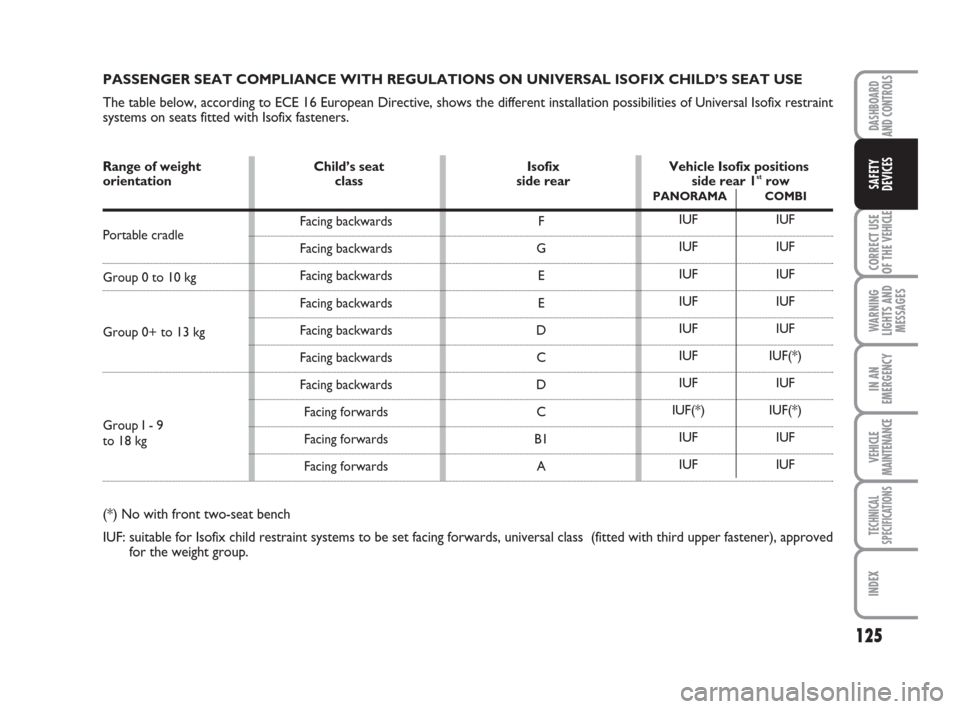
PASSENGER SEAT COMPLIANCE WITH REGULATIONS ON UNIVERSAL ISOFIX CHILD’S SEAT USE
The table below, according to ECE 16 European Directive, shows the different installation possibilities of Universal Isofix restraint
systems on seats fitted with Isofix fasteners.
125
CORRECT USE
OF THE
VEHICLE
WARNING
LIGHTS AND
MESSAGES
IN AN
EMERGENCY
VEHICLE
MAINTENANCE
TECHNICAL
SPECIFICATIONS
INDEX
DASHBOARD
AND CONTROLS
SAFETY
DEVICES
F
G
E
E
D
C
D
C
B1
A Facing backwards
Facing backwards
Facing backwards
Facing backwards
Facing backwards
Facing backwards
Facing backwards
Facing forwards
Facing forwards
Facing forwardsIUF
IUF
IUF
IUF
IUF
IUF
IUF
IUF(*)
IUF
IUFIUF
IUF
IUF
IUF
IUF
IUF(*)
IUF
IUF(*)
IUF
IUF
Range of weight Child’s seat Isofix Vehicle Isofix positions
orientation class side rear side rear 1strowPANORAMA COMBI
Portable cradle
Group 0 to 10 kg
Group 0+ to 13 kg
Group I - 9
to 18 kg
(*) No with front two-seat bench
IUF: suitable for Isofix child restraint systems to be set facing forwards, universal class (fitted with third upper fastener), approved
for the weight group.
Page 129 of 282
MANUAL DEACTIVATION OF
PASSENGER’S FRONT AIR BAG
AND SIDE BAG
(where provided)
Should it be absolutely necessary to car-
ry a child on the front seat, the passenger’s
front air bag and the side bag (where pro-
vided) can be deactivated.
The instrument panel warning light Fwill
stay on glowing steadily until reactivating
the passenger’s front air bag and the Side
Bag (where provided).
128
CORRECT USE
OF THE
VEHICLE
WARNING
LIGHTS AND
MESSAGES
IN AN
EMERGENCY
VEHICLE
MAINTENANCE
TECHNICAL
SPECIFICATIONS
IINDEX
DASHBOARD
AND CONTROLS
SAFETY
DEVICES
SERIOUS DANGER: With
passenger’s air bag active
(ON), never place child’s
seats with the cradle facing
backwards since the air bag
activation could cause to
the child serious injuries, even mortal.
In the case of need, always deactivate
the passenger’s air bag when a child’s
seat is placed on the front seat. The
front passenger’s seat shall be ad-
justed in the most backward position
to prevent any contact between
child’s seat and dashboard. Even if
not compulsory by law, you are rec-
ommended to reactivate the air bag
immediately as soon as child trans-
port is no longer necessary.
WARNING
To deactivate the passen-
ger’s front air bag and the
side bag (where provided), refer to
paragraphs “Digital display” and
“Multifunction display” in section
“Dashboard and controls”.
WARNING
SIDE AIR BAGS
The vehicle is fitted with front side bags
for driver and passenger (where provid-
ed) for protecting the chest and window
bags (where provided) for protecting front
passengers’ head.
Side bags (where provided) protect vehi-
cle occupants from side crashes of medi-
um-high severity, by placing the cushion
between the occupant and the internal
parts of the side structure of the vehicle.
Non-activation of side bags in other types
of collisions (front collisions, rear shunts,
roll-overs, etc...) is not a system malfunc-
tion.
In case of side crash, an electronic control
unit, when required triggers the inflation
of the cushion. The cushion immediately
inflates, placing itself as a protection, be-
tween the occupant’s body and the struc-
ture that could cause injuries. Immediate-
ly after, the cushion deflates.
Side bags (where provided) are not a re-
placement of but complementary to the
belts, which you are recommended to al-
ways wear, as specified by law in Europe
and most non-European countries.
Page 130 of 282
129
CORRECT USE
OF THE
VEHICLE
WARNING
LIGHTS AND
MESSAGES
IN AN
EMERGENCY
VEHICLE
MAINTENANCE
TECHNICAL
SPECIFICATIONS
INDEX
DASHBOARD
AND CONTROLS
SAFETY
DEVICES
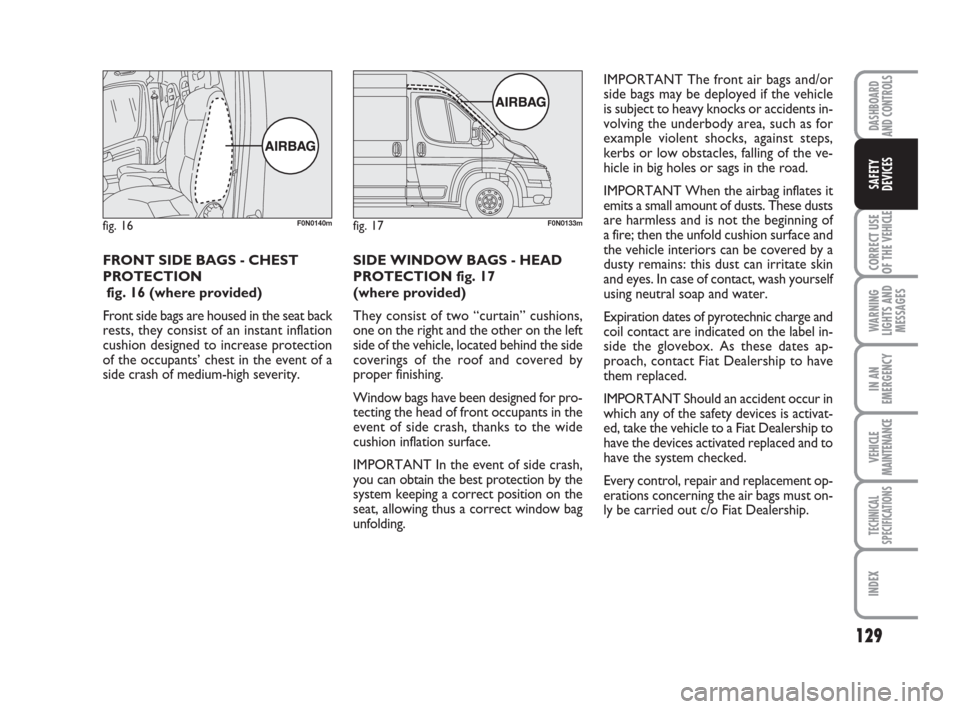
FRONT SIDE BAGS - CHEST
PROTECTION
fig. 16 (where provided)
Front side bags are housed in the seat back
rests, they consist of an instant inflation
cushion designed to increase protection
of the occupants’ chest in the event of a
side crash of medium-high severity.SIDE WINDOW BAGS - HEAD
PROTECTION fig. 17
(where provided)
They consist of two “curtain” cushions,
one on the right and the other on the left
side of the vehicle, located behind the side
coverings of the roof and covered by
proper finishing.
Window bags have been designed for pro-
tecting the head of front occupants in the
event of side crash, thanks to the wide
cushion inflation surface.
IMPORTANT In the event of side crash,
you can obtain the best protection by the
system keeping a correct position on the
seat, allowing thus a correct window bag
unfolding.
fig. 16F0N0140mfig. 17F0N0133m
IMPORTANT The front air bags and/or
side bags may be deployed if the vehicle
is subject to heavy knocks or accidents in-
volving the underbody area, such as for
example violent shocks, against steps,
kerbs or low obstacles, falling of the ve-
hicle in big holes or sags in the road.
IMPORTANT When the airbag inflates it
emits a small amount of dusts. These dusts
are harmless and is not the beginning of
a fire; then the unfold cushion surface and
the vehicle interiors can be covered by a
dusty remains: this dust can irritate skin
and eyes. In case of contact, wash yourself
using neutral soap and water.
Expiration dates of pyrotechnic charge and
coil contact are indicated on the label in-
side the glovebox. As these dates ap-
proach, contact Fiat Dealership to have
them replaced.
IMPORTANT Should an accident occur in
which any of the safety devices is activat-
ed, take the vehicle to a Fiat Dealership to
have the devices activated replaced and to
have the system checked.
Every control, repair and replacement op-
erations concerning the air bags must on-
ly be carried out c/o Fiat Dealership.
Page 131 of 282
If you are having the vehicle scrapped,
have the air bag system deactivated at a Fi-
at Dealership first. If the vehicle changes
ownership, the new owner must be in-
formed of the method of use of air bags
and the above warnings and also be given
this “Owner Handbook”.
IMPORTANT The triggering of preten-
sioners, front air bags and side bags is de-
cided in a differentiated manner by the
electronic control unit, depending on the
type of crash. The failure to deploy one or
more of them does not mean that the sys-
tem is not working properly.
130
CORRECT USE
OF THE
VEHICLE
WARNING
LIGHTS AND
MESSAGES
IN AN
EMERGENCY
VEHICLE
MAINTENANCE
TECHNICAL
SPECIFICATIONS
IINDEX
DASHBOARD
AND CONTROLS
SAFETY
DEVICES
Never rest head, arms and
elbows on the door, on the
windows and in the window bag area
to prevent possible injuries during in-
flation phase.
WARNING
Never lean head, arms and
elbows out of window.
WARNING
GENERAL WARNINGS
If when turning the key to
MAR the warning light ¬
does not turn on or if it stays on when
travelling (together with the message
on the multifunction display, where
provided) there could be a failure in
safety systems; in this event air bags
or pretensioners could not trigger in
case of impact or, in a minor number
of cases, they could trigger acciden-
tally. Contact Fiat Dealership imme-
diately to have the system checked.
WARNING
Do not cover the backrest of
front and rear seats with
trims or covers that are not suitable
to be used with side bags.
WARNING
Page 132 of 282
131
CORRECT USE
OF THE
VEHICLE
WARNING
LIGHTS AND
MESSAGES
IN AN
EMERGENCY
VEHICLE
MAINTENANCE
TECHNICAL
SPECIFICATIONS
INDEX
DASHBOARD
AND CONTROLS
SAFETY
DEVICES
Never travel with objects on
your lap, in front of your
chest or with a pipe, pencil, etc. be-
tween your lips; injury may result in
the event of the air bag being trig-
gered.
WARNING
Always keep your hands on
the steering wheel rim when
driving, so that if the air bag is trig-
gered, it can inflate without meeting
any obstacles which could cause seri-
ous harm to you. Do not drive with
the body bent forwards, keep the seat
back rest in the erect position and
lean your back well against it.
WARNING
Remember that with the key
engaged and at MAR, even if
the engine is not running, the air bags
may be triggered on a stationary ve-
hicle if it is bumped by another mov-
ing vehicle. Therefore, never seat chil-
dren on the front seat even when the
vehicle is stationary. On the other
hand remember that if the key is at
STOP, no safety system (air bags or
pretensioners) is triggered in the
event of an impact; in this case, fail-
ure to come into action cannot be
considered as a sign that the system
is not working properly.
WARNING
If the vehicle has been stolen
or an attempt to steal it has
been made, if it has been subjected to
vandals or floods, have the air bag
system checked by Fiat Dealership.
WARNING
When the ignition key is
turned to MAR, the warning
light F(with passenger’s front air
bag active) turns on and flashes for
few seconds to remind that passen-
ger’s air bag will be deployed in a
crash, after which it should go off.
WARNING
Page 133 of 282
132
CORRECT USE
OF THE
VEHICLE
WARNING
LIGHTS AND
MESSAGES
IN AN
EMERGENCY
VEHICLE
MAINTENANCE
TECHNICAL
SPECIFICATIONS
IINDEX
DASHBOARD
AND CONTROLS
SAFETY
DEVICES
Do not wash the seat back
rest with pressurised water
or steam (by hand or at automatic
seat washing stations).
WARNING
The front air bag is triggered
for shocks greater in magni-
tude that the pretensioners. For im-
pacts between these two thresholds,
it is therefore normal that only the
pretensioners are triggered.
WARNING
Do not hook rigid objects to
the coat hooks and to the
support handles.
WARNING
The air bag does not substi-
tute the seat belts, but only
increases their effectiveness. More-
over, since the front air bags do not
come into operation in the event of
front impact at low speed, side colli-
sions, bumps from behind or over-
turning, in these circumstances the
occupants would only be protected
by the seat belts which must therefore
always be fastened.
WARNING
Page 164 of 282
163
WARNING
LIGHTS AND
MESSAGES
VEHICLE
MAINTENANCE
TECHNICAL
SPECIFICATIONS
INDEX
DASHBOARD
AND CONTROLS
SAFETY
DEVICES
CORRECT USE
OF THE
VEHICLE
IN AN
EMERGENCY
QUICK TYRE REPAIR
KIT - Automatic
FIX & GO
The automatic Fix & Go quick tyre repair
kit is located in the front part of the pas-
senger compartment and includes:
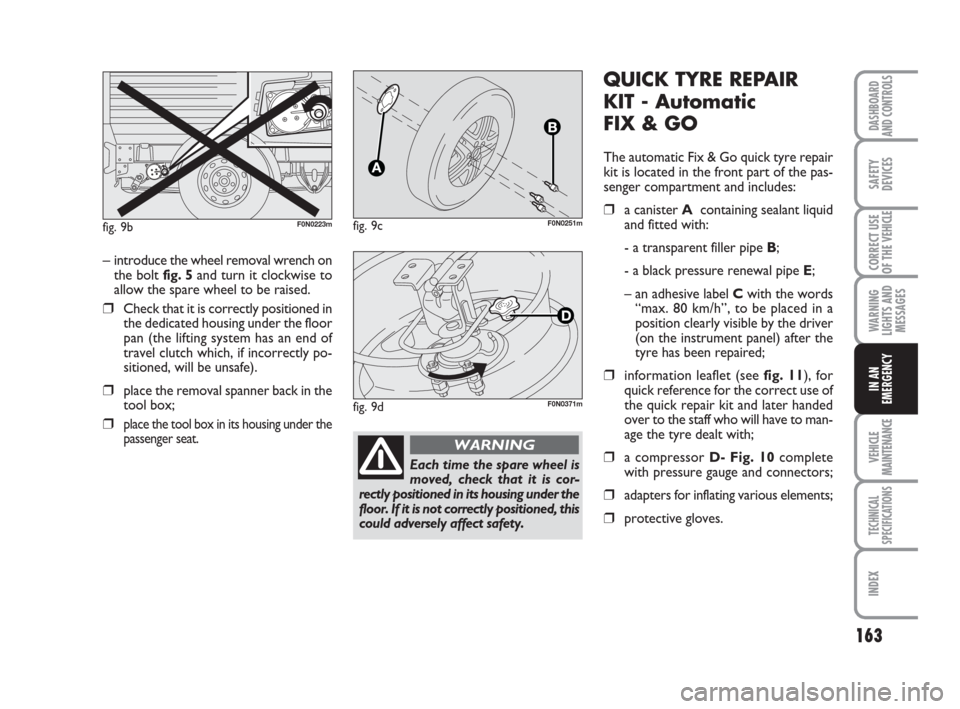
❒a canister A containing sealant liquid
and fitted with:
- a transparent filler pipe B;
- a black pressure renewal pipe E;
– an adhesive label Cwith the words
“max. 80 km/h”, to be placed in a
position clearly visible by the driver
(on the instrument panel) after the
tyre has been repaired;
❒information leaflet (see fig. 11), for
quick reference for the correct use of
the quick repair kit and later handed
over to the staff who will have to man-
age the tyre dealt with;
❒a compressor D- Fig. 10complete
with pressure gauge and connectors;
❒adapters for inflating various elements;
❒protective gloves.
– introduce the wheel removal wrench on
the bolt fig. 5and turn it clockwise to
allow the spare wheel to be raised.
❒Check that it is correctly positioned in
the dedicated housing under the floor
pan (the lifting system has an end of
travel clutch which, if incorrectly po-
sitioned, will be unsafe).
❒place the removal spanner back in the
tool box;
❒place the tool box in its housing under the
passenger seat.
Each time the spare wheel is
moved, check that it is cor-
rectly positioned in its housing under the
floor. If it is not correctly positioned, this
could adversely affect safety.
WARNING
fig. 9bF0N0223mfig. 9cF0N0251m
fig. 9dF0N0371m