Gear FIAT DUCATO 2008 3.G User Guide
[x] Cancel search | Manufacturer: FIAT, Model Year: 2008, Model line: DUCATO, Model: FIAT DUCATO 2008 3.GPages: 282, PDF Size: 4.55 MB
Page 135 of 282
134
WARNING
LIGHTS AND
MESSAGES
IN AN
EMERGENCY
VEHICLE
MAINTENANCE
TECHNICAL
SPECIFICATIONS
INDEX
DASHBOARD
AND CONTROLS
SAFETY
DEVICES
CORRECT USE
OF THE VEHICLE
ENGINE
STARTING
The vehicle is fitted with an electronic en-
gine lock device: if the engine fails to start,
see the paragraph “The Fiat CODE sys-
tem” in section “Dashboard and controls”.
We recommend that during
the initial period you do not
drive to full vehicle perfor-
mance (e.g.: excessive accel-
eration, long journeys at top speed,
sharp braking, etc.).
When the engine is switched
off never leave the key into
the ignition switch to prevent
pointless current absorption
from draining the battery.
Running the engine in con-
fined areas is extremely dan-
gerous. The engine consumes oxygen
and produces carbon monoxide
which is a highly toxic and lethal gas.
WARNING
Remember that the servo-
brake and power steering
are not operational until the engine
has been started, therefore much ef-
fort than usual is required on the
brake pedal and steering wheel.
WARNING
STARTING PROCEDURE
Proceed as follows:
❒engage the handbrake;
❒put the gear lever into neutral;
❒turn the ignition key to MAR: the
warning lights
mand Yon the in-
strument panel will turn on;
❒wait for the warning lights Yand
mto turn off. The hotter the engine
is, the quicker this will happen;
❒press the clutch pedal down to the
floor without pressing the accelerator;
❒turn the ignition key to AVVas soon
as warning light
mturns off. If you
wait too long you will lose the bene-
fit of the work done by the glow plugs.
Release the key as soon as the engine
starts.
Page 137 of 282
136
WARNING
LIGHTS AND
MESSAGES
IN AN
EMERGENCY
VEHICLE
MAINTENANCE
TECHNICAL
SPECIFICATIONS
INDEX
DASHBOARD
AND CONTROLS
SAFETY
DEVICES
CORRECT USE
OF THE VEHICLEWhen the handbrake lever is pulled up
and the ignition key is at MAR, the in-
strument panel warning light
xwill turn
on.
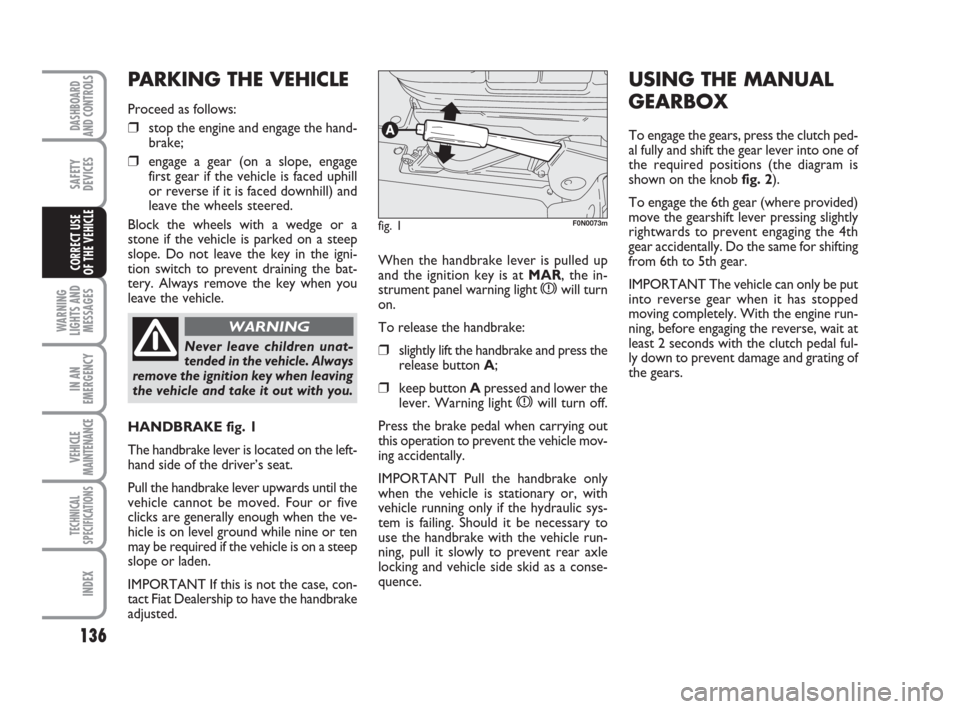
To release the handbrake:
❒slightly lift the handbrake and press the
release button A;
❒keep button Apressed and lower the
lever. Warning light xwill turn off.
Press the brake pedal when carrying out
this operation to prevent the vehicle mov-
ing accidentally.
IMPORTANT Pull the handbrake only
when the vehicle is stationary or, with
vehicle running only if the hydraulic sys-
tem is failing. Should it be necessary to
use the handbrake with the vehicle run-
ning, pull it slowly to prevent rear axle
locking and vehicle side skid as a conse-
quence.
PARKING THE VEHICLE
Proceed as follows:
❒stop the engine and engage the hand-
brake;
❒engage a gear (on a slope, engage
first gear if the vehicle is faced uphill
or reverse if it is faced downhill) and
leave the wheels steered.
Block the wheels with a wedge or a
stone if the vehicle is parked on a steep
slope. Do not leave the key in the igni-
tion switch to prevent draining the bat-
tery. Always remove the key when you
leave the vehicle.
HANDBRAKE fig. 1
The handbrake lever is located on the left-
hand side of the driver’s seat.
Pull the handbrake lever upwards until the
vehicle cannot be moved. Four or five
clicks are generally enough when the ve-
hicle is on level ground while nine or ten
may be required if the vehicle is on a steep
slope or laden.
IMPORTANT If this is not the case, con-
tact Fiat Dealership to have the handbrake
adjusted.
Never leave children unat-
tended in the vehicle. Always
remove the ignition key when leaving
the vehicle and take it out with you.
WARNING
fig. 1F0N0073m
USING THE MANUAL
GEARBOX
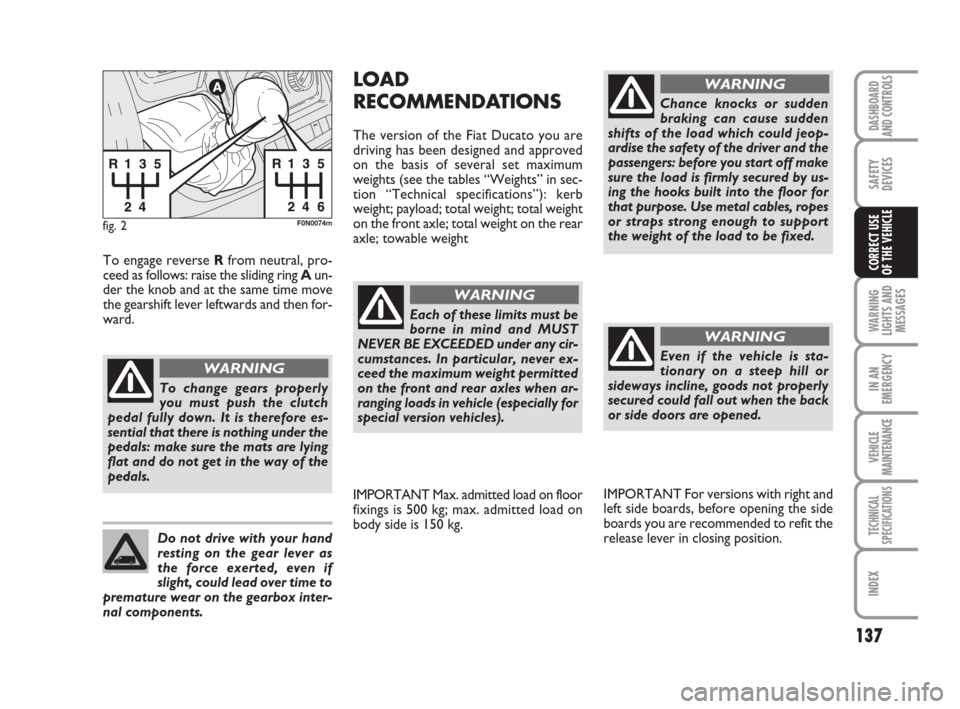
To engage the gears, press the clutch ped-
al fully and shift the gear lever into one of
the required positions (the diagram is
shown on the knob fig. 2).
To engage the 6th gear (where provided)
move the gearshift lever pressing slightly
rightwards to prevent engaging the 4th
gear accidentally. Do the same for shifting
from 6th to 5th gear.
IMPORTANT The vehicle can only be put
into reverse gear when it has stopped
moving completely. With the engine run-
ning, before engaging the reverse, wait at
least 2 seconds with the clutch pedal ful-
ly down to prevent damage and grating of
the gears.
Page 138 of 282
137
WARNING
LIGHTS AND
MESSAGES
IN AN
EMERGENCY
VEHICLE
MAINTENANCE
TECHNICAL
SPECIFICATIONS
INDEX
DASHBOARD
AND CONTROLS
SAFETY
DEVICES
CORRECT USE
OF THE VEHICLE
fig. 2F0N0074m
To change gears properly
you must push the clutch
pedal fully down. It is therefore es-
sential that there is nothing under the
pedals: make sure the mats are lying
flat and do not get in the way of the
pedals.
WARNING
Do not drive with your hand
resting on the gear lever as
the force exerted, even if
slight, could lead over time to
premature wear on the gearbox inter-
nal components.
To engage reverse R from neutral, pro-
ceed as follows: raise the sliding ring Aun-
der the knob and at the same time move
the gearshift lever leftwards and then for-
ward.
LOAD
RECOMMENDATIONS
The version of the Fiat Ducato you are
driving has been designed and approved
on the basis of several set maximum
weights (see the tables “Weights” in sec-
tion “Technical specifications”): kerb
weight; payload; total weight; total weight
on the front axle; total weight on the rear
axle; towable weight
Each of these limits must be
borne in mind and MUST
NEVER BE EXCEEDED under any cir-
cumstances. In particular, never ex-
ceed the maximum weight permitted
on the front and rear axles when ar-
ranging loads in vehicle (especially for
special version vehicles).Chance knocks or sudden
braking can cause sudden
shifts of the load which could jeop-
ardise the safety of the driver and the
passengers: before you start off make
sure the load is firmly secured by us-
ing the hooks built into the floor for
that purpose. Use metal cables, ropes
or straps strong enough to support
the weight of the load to be fixed.
WARNING
WARNING
Even if the vehicle is sta-
tionary on a steep hill or
sideways incline, goods not properly
secured could fall out when the back
or side doors are opened.
WARNING
IMPORTANT Max. admitted load on floor
fixings is 500 kg; max. admitted load on
body side is 150 kg.IMPORTANT For versions with right and
left side boards, before opening the side
boards you are recommended to refit the
release lever in closing position.
Page 140 of 282
139
WARNING
LIGHTS AND
MESSAGES
IN AN
EMERGENCY
VEHICLE
MAINTENANCE
TECHNICAL
SPECIFICATIONS
INDEX
DASHBOARD
AND CONTROLS
SAFETY
DEVICES
CORRECT USE
OF THE VEHICLE
Acceleration
Accelerating violently increasing the revs
will greatly affect consumption and emis-
sions: acceleration should be gradual and
should not exceed the maximum torque.
CONDITIONS OF USE
Cold starting
Short journeys and frequent cold starts do
not allow the engine to reach optimum op-
erating temperature. This results in a sig-
nificant increase in consumption levels
(from +15 to +30% on the urban cycle)
and emission of harmful substances.
Traffic and
road conditions
Rather high consumption levels are tied to
situations with heavy traffic, for example
in queues with frequent use of the lower
gears or in cities with many traffic lights.
Also winding mountain roads and rough
road surfaces adversely affect consump-
tion.
Traffic hold-ups
During prolonged hold-ups (level crossings)
the engine should be switched off.TOWING TRAILERS
IMPORTANT NOTES
For towing caravans or trailers the vehi-
cle must be fitted with a certified tow
hook and an adequate electric system. In-
stallation should be carried out by spe-
cialised personnel who release a special
document for circulation on the road.
Install any specific and/or additional rear-
view mirrors as specified by law.
Remember that when towing a trailer,
steep hills are harder to climb, the brak-
ing spaces increase and overtaking takes
longer depending on the overall weight.
Engage a low gear when driving downhill,
rather than constantly using the brake.
The weight the trailer exerts on the ve-
hicle tow hook reduces by the same
amount the actual vehicle loading capaci-
ty. To make sure the maximum towable
weight is not exceeded (given in the log
book) account should be taken of the ful-
ly laden trailer, including accessories and
personal belongings. DRIVING STYLE
Starting
Do not warm the engine when the vehi-
cle is stationary or at high or low speed:
in this way the engine will warm up grad-
ually increasing consumption and emis-
sions. You should drive off slowly straight
away avoiding high revs so that the engine
will warm up more quickly.
Unnecessary actions
Avoid accelerating when waiting at traffic
lights or before switching off the engine.
This and also double declutching is ab-
solutely pointless on modern vehicles and
also increase consumption and pollution.
Gear selection
As soon as the conditions of the traffic and
road allow, use a higher gear. Using a low
gear to obtain brilliant performance in-
creases consumption.
In the same way improper use of a high
gear increases consumption, emissions an
engine wear.
Top speed
Fuel consumption considerably increases
with speed. Avoid superfluous braking and
accelerating, which cost in terms of both
fuel and emissions.
Page 145 of 282
144
WARNING
LIGHTS AND
MESSAGES
IN AN
EMERGENCY
VEHICLE
MAINTENANCE
TECHNICAL
SPECIFICATIONS
INDEX
DASHBOARD
AND CONTROLS
SAFETY
DEVICES
CORRECT USE
OF THE VEHICLE
VEHICLE INACTIVITY
If the vehicle is to be left inactive for longer
than a month, the following precautions
should be noted:
❒park the vehicle in covered, dry and
if possible well-ventilated premises;
❒engage a gear;
❒make sure the handbrake is not en-
gaged;
❒disconnect the battery negative ter-
minal and check the battery charge.
This check is to be repeated every
three months. Recharge if the optical
indicator shows a dark colour without
the central green area (see “Recharg-
ing the battery” in section “In an emer-
gency”); if the vehicle is equipped with
a battery disconnection function (dis-
connector), see the description of the
procedure in the “Controls” para-
graph in the “Dashboard and controls”
chapter;
❒clean and protect the painted parts us-
ing protective wax;
❒clean and protect the shiny metal parts
using special compounds readily avail-
able;
❒sprinkle talcum powder on the rubber
windscreen and rear window wiper
blades and lift them off the glass;
❒slightly open the windows;
❒cover the vehicle with a cloth or per-
forated plastic sheet. Do not use
sheets of non-perforated plastic as
they do not allow moisture on the ve-
hicle body to evaporate;
❒inflate tyres to +0.5 bar above the
normal specified pressure and check it
at intervals;
❒if you don’t disconnect the battery
from the electric system, check its
charge every month and recharge it if
the optical indicator shows a dark
colour without the central green area;
❒do not drain the engine cooling sys-
tem.
IMPORTANT Where relevant, switch off
the vehicle alarm with the remote control.
Keep your speed down when
snow chains are fitted. Do
not exceed 50 km/h. Avoid
potholes, steps and pave-
ments and avoid also to dri-
ve for long distances on
roads not covered with snow to pre-
vent damaging the vehicle and the
roadbed.
WARNING
Page 146 of 282
145
IN AN
EMERGENCY
VEHICLE
MAINTENANCE
TECHNICAL
SPECIFICATIONS
INDEX
DASHBOARD
AND CONTROLS
SAFETY
DEVICES
CORRECT USE
OF THE
VEHICLE
WARNING
LIGHTS AND
MESSAGES
GENERAL WARNINGS ..................................................... 146
LOW BRAKE FLUID............................................................ 146
HANDBRAKE ON................................................................ 146
AIR BAG FAILURE................................................................ 147
ENGINE COOLANT
HIGH TEMPERATURE......................................................... 147
LOW BATTERY CHARGE................................................. 148
LOW ENGINE OIL PRESSURE.......................................... 148
EXHAUSTED OIL ................................................................ 148
INCOMPLETE DOOR LOCKING.................................... 149
SEAT BELTS NOT FASTENED.......................................... 149
EBD SYSTEM FAILURE........................................................ 149
INJECTION SYSTEM FAILURE ......................................... 150
FRONT PASSENGER AIR BAG DEACTIVATED.......... 150
ABS SYSTEM FAILURE......................................................... 150
FUEL RESERVE....................................................................... 150
GLOW PLUG WARMING ................................................ 151
GLOW PLUG WARMING FAILURE............................... 151
WATER IN DIESEL FUEL FILTER .................................... 151
VEHICLE PROTECTION SYSTEM FAILURE
FIAT CODE ........................................................................... 151
EXTERNAL LIGHTS FAILURE........................................... 152
REAR FOGLIGHTS............................................................... 152
GENERIC FAILURE INDICATION ................................. 152ESP - ASR SYSTEM FAILURE ............................................. 153
DIESEL PARTICULATE FILTER CLOGGED................... 153
BRAKE PAD WEAR ............................................................ 153
HILL HOLDER FAILURE .................................................... 153
PARKING SENSOR FAILURE............................................ 154
SIDELIGHTS AND LOW BEAMS..................................... 154
FOLLOW ME HOME........................................................... 154
FRONT FOG LIGHTS.......................................................... 154
LEFT-HAND DIRECTION INDICATOR........................ 154
RIGHT-HAND DIRECTION INDICATOR.................... 155
CRUISE CONTROL ............................................................ 155
MAIN BEAM HEADLIGHTS............................................... 155
ASR SYSTEM ......................................................................... 155
POWER STEERING FAILURE............................................ 155
POSSIBLE PRESENCE OF ICE ON THE ROAD ........... 156
LIMITED RANGE ................................................................. 156
SPEED LIMIT EXCEEDED .................................................. 156
SCHEDULED SERVICING.................................................. 156
SELF-LEVELLING SUSPENSIONS FAILURE.................... 156
AUTOMATIC TRANSMISSION FAILURE/
MAX. GEARBOX OIL TEMPERATURE........................... 156
WW W
A A
R R
N N
I I
N N
G G
L L
I I
G G
H H
T T
S S
A A
N N
D D
M M
E E
S S
S S
A A
G G
E E
S S
Page 147 of 282
146
IN AN
EMERGENCY
VEHICLE
MAINTENANCE
TECHNICAL
SPECIFICATIONS
INDEX
DASHBOARD
AND CONTROLS
SAFETY
DEVICES
CORRECT USE
OF THE
VEHICLE
WARNING
LIGHTS AND
MESSAGES
WARNING LIGHTS
AND MESSAGES
GENERAL WARNINGS
Turning on of warning light is accompa-
nied by specific message and/or by buzzer
sound where provided by instrument pan-
el. These indications are concise and
cautionaryand shall not be considered
as exhaustive and/or as an alternative to
the specifications contained in this Own-
er Handbook which shall always be read
through carefully and thoroughly. In case
of failure indication always refer to the
specifications contained in this sec-
tion.
IMPORTANT Failure indications displayed
are divided into two categories: very se-
riousand less seriousfailures.
Very seriousfailures are indicated by a
repeated and prolonged warning “cycle”.
Less seriousfailures are indicated by a lim-
ited warning “cycle”.
The warning cycle of both failure cate-
gories can be stopped by pressing button
MODE. The instrument panel warning
light will stay on until eliminating the fault.
As concerns messages relevant to the ver-
sions equipped with Dualogic gearbox, see
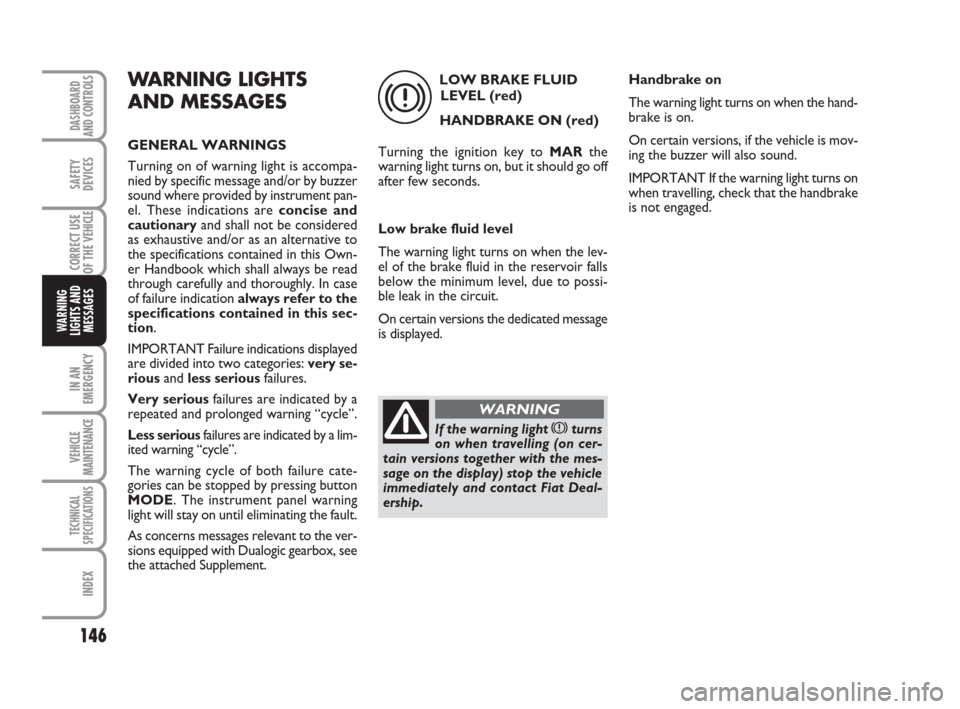
the attached Supplement.LOW BRAKE FLUID
LEVEL (red)
HANDBRAKE ON (red)
Turning the ignition key to MARthe
warning light turns on, but it should go off
after few seconds.
Low brake fluid level
The warning light turns on when the lev-
el of the brake fluid in the reservoir falls
below the minimum level, due to possi-
ble leak in the circuit.
On certain versions the dedicated message
is displayed.
x
If the warning light xturns
on when travelling (on cer-
tain versions together with the mes-
sage on the display) stop the vehicle
immediately and contact Fiat Deal-
ership.
WARNING
Handbrake on
The warning light turns on when the hand-
brake is on.
On certain versions, if the vehicle is mov-
ing the buzzer will also sound.
IMPORTANT If the warning light turns on
when travelling, check that the handbrake
is not engaged.
Page 157 of 282
156
IN AN
EMERGENCY
VEHICLE
MAINTENANCE
TECHNICAL
SPECIFICATIONS
INDEX
DASHBOARD
AND CONTROLS
SAFETY
DEVICES
CORRECT USE
OF THE
VEHICLE
WARNING
LIGHTS AND
MESSAGES
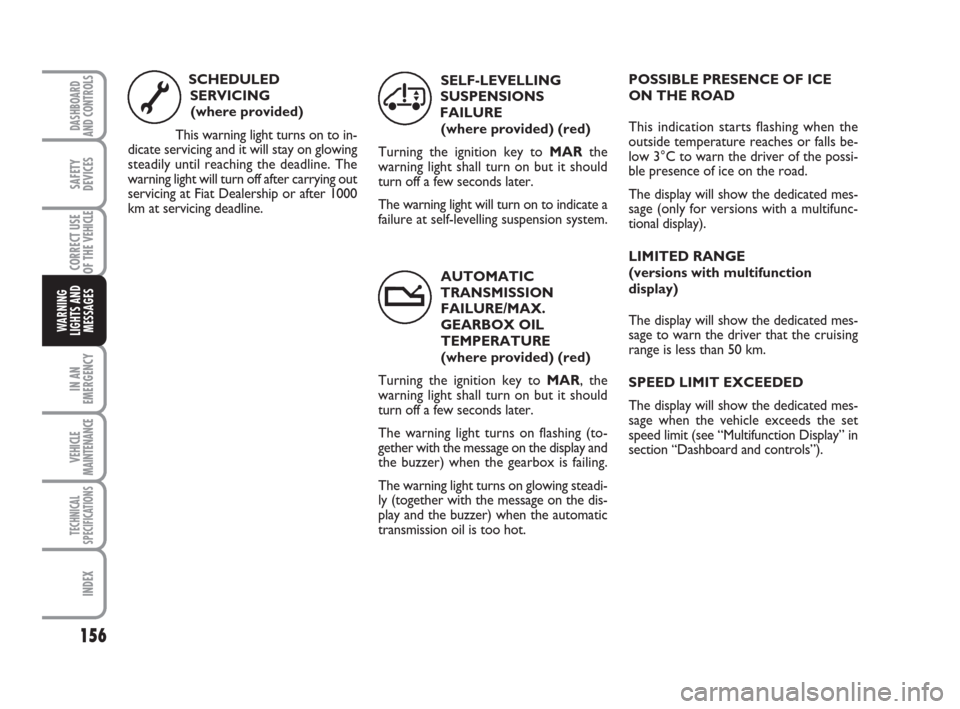
AUTOMATIC
TRANSMISSION
FAILURE/MAX.
GEARBOX OIL
TEMPERATURE
(where provided) (red)
Turning the ignition key to MAR, the
warning light shall turn on but it should
turn off a few seconds later.
The warning light turns on flashing (to-
gether with the message on the display and
the buzzer) when the gearbox is failing.
The warning light turns on glowing steadi-
ly (together with the message on the dis-
play and the buzzer) when the automatic
transmission oil is too hot. SCHEDULED
SERVICING
(where provided)
This warning light turns on to in-
dicate servicing and it will stay on glowing
steadily until reaching the deadline. The
warning light will turn off after carrying out
servicing at Fiat Dealership or after 1000
km at servicing deadline.SELF-LEVELLING
SUSPENSIONS
FAILURE
(where provided) (red)
Turning the ignition key to MARthe
warning light shall turn on but it should
turn off a few seconds later.
The warning light will turn on to indicate a
failure at self-levelling suspension system.POSSIBLE PRESENCE OF ICE
ON THE ROAD
This indication starts flashing when the
outside temperature reaches or falls be-
low 3°C to warn the driver of the possi-
ble presence of ice on the road.
The display will show the dedicated mes-
sage (only for versions with a multifunc-
tional display).
LIMITED RANGE
(versions with multifunction
display)
The display will show the dedicated mes-
sage to warn the driver that the cruising
range is less than 50 km.
SPEED LIMIT EXCEEDED
The display will show the dedicated mes-
sage when the vehicle exceeds the set
speed limit (see “Multifunction Display” in
section “Dashboard and controls”).
õŒ
t
Page 161 of 282
160
WARNING
LIGHTS AND
MESSAGES
VEHICLE
MAINTENANCE
TECHNICAL
SPECIFICATIONS
IINDEX
DASHBOARD
AND CONTROLS
SAFETY
DEVICES
CORRECT USE
OF THE
VEHICLE
IN AN
EMERGENCY
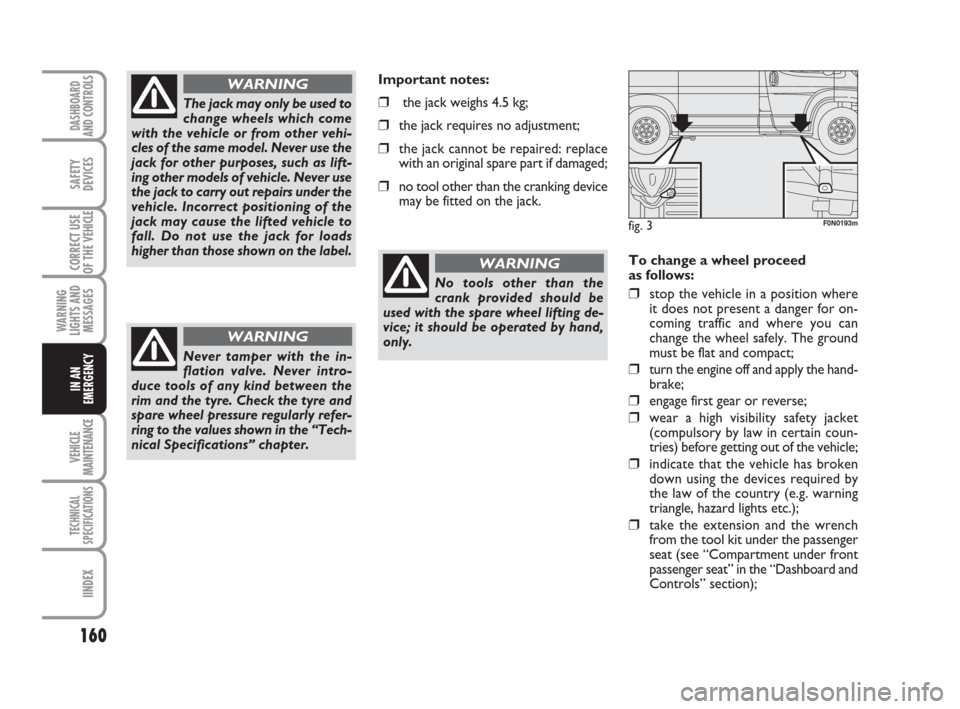
To change a wheel proceed
as follows:
❒stop the vehicle in a position where
it does not present a danger for on-
coming traffic and where you can
change the wheel safely. The ground
must be flat and compact;
❒turn the engine off and apply the hand-
brake;
❒engage first gear or reverse;
❒wear a high visibility safety jacket
(compulsory by law in certain coun-
tries) before getting out of the vehicle;
❒indicate that the vehicle has broken
down using the devices required by
the law of the country (e.g. warning
triangle, hazard lights etc.);
❒take the extension and the wrench
from the tool kit under the passenger
seat (see “Compartment under front
passenger seat” in the “Dashboard and
Controls” section);
The jack may only be used to
change wheels which come
with the vehicle or from other vehi-
cles of the same model. Never use the
jack for other purposes, such as lift-
ing other models of vehicle. Never use
the jack to carry out repairs under the
vehicle. Incorrect positioning of the
jack may cause the lifted vehicle to
fall. Do not use the jack for loads
higher than those shown on the label.
WARNING
Never tamper with the in-
flation valve. Never intro-
duce tools of any kind between the
rim and the tyre. Check the tyre and
spare wheel pressure regularly refer-
ring to the values shown in the “Tech-
nical Specifications” chapter.
WARNING
Important notes:
❒the jack weighs 4.5 kg;
❒the jack requires no adjustment;
❒the jack cannot be repaired: replace
with an original spare part if damaged;
❒no tool other than the cranking device
may be fitted on the jack.
fig. 3F0N0193m
No tools other than the
crank provided should be
used with the spare wheel lifting de-
vice; it should be operated by hand,
only.
WARNING
Page 196 of 282
195
WARNING
LIGHTS AND
MESSAGES
TECHNICAL
SPECIFICATIONS
INDEX
DASHBOARD
AND CONTROLS
SAFETY
DEVICES
CORRECT USE
OF THE VEHICLE
IN AN
EMERGENCY
VEHICLE
MAINTENANCE
HEAVY-DUTY
Should prevailing use of the vehicle be un-
der one of the following specially heavy
conditions:
❒trailer or caravan towing;
❒dusty roads;
❒short distances (less than 7-8 km) re-
peated and with external tempera-
tures below zero;
❒frequently idling engines or long dis-
tance low speed driving (e.g. door-to-
door deliveries) or in case of a long
term inactivity;
❒driving in the city;
carry out the following checks more fre-
quently than required in the Service
Schedule:
❒check front disk brake pad conditions
and wear;
❒check cleanness of locks, bonnet and
boot and lever cleanness and lubri-
cation;
❒sight inspect the conditions of: engine,
gearbox, transmission, pipes and
hoses (exhaust - fuel - brakes), rub-
ber parts (boots, sleeves, bushes,
etc.);
❒check battery charge and fluid level
(electrolyte);
❒visual check on various drive belt con-
ditions;
❒check and replace pollen filter, if re-
quired;
❒check and replace air cleaner, if re-
quired.
ROUTINE
MAINTENANCE
Every 1,000 km or before long journeys,
check and top up if required:
❒engine coolant fluid level;
❒brake fluid level;
❒windscreen washer fluid level;
❒tyre pressure and conditions;
❒light system operation (headlights, di-
rection indicators, hazard lights, etc.);
❒windscreen wiper/washer operation
and windscreen/rear window blade
position/wear;
Every 3,000 km check and top up if re-
quired: engine oil level.
You are recommended to use FL
Selenia, products, designed and pro-
duced specifically for Fiat vehicles (see
table “Capacities” in section “Technical
specifications”).