Heater FIAT DUCATO 2008 3.G User Guide
[x] Cancel search | Manufacturer: FIAT, Model Year: 2008, Model line: DUCATO, Model: FIAT DUCATO 2008 3.GPages: 282, PDF Size: 4.55 MB
Page 70 of 282
69
SAFETY
DEVICES
CORRECT USE
OF THE
VEHICLE
WARNING
LIGHTS AND
MESSAGES
IN AN
EMERGENCY
VEHICLE
MAINTENANCE
TECHNICAL
SPECIFICATIONS
INDEX
DASHBOARD
AND CONTROLS
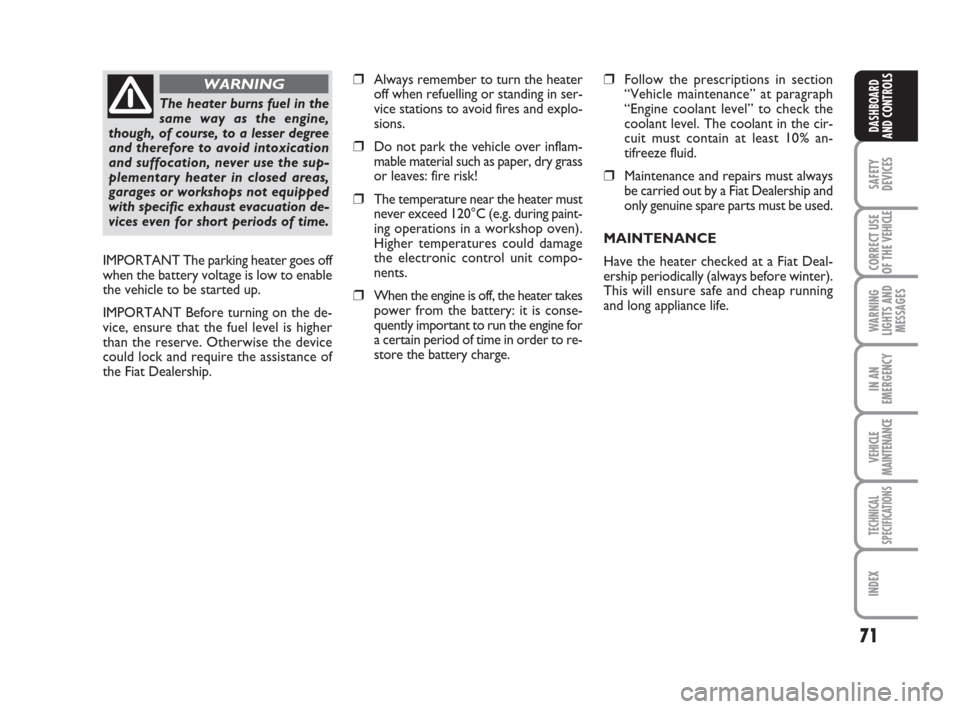
Programmed heating fig. 58
Heater ignition can be delayed from 1
minute to 24 hours. Three different times
can be programmed but only one will be
activated for each pre-warming cycle.
To program starting time:
❒press button 6: either symbol 10 or
the previously programmed time and
number 3 (corresponding to the pre-
set function recalled) will light up for
10 seconds; Setting the clock
❒Press button 4: display and warning
light 9-fig. 57will light up.
❒Within 10 seconds, press button 5or
7to select the correct time.
When the display is turned off, the cur-
rent time will be stored.
Keeping button 5or 7pressed will fast
forward or backward the clock.
Reading the clock fig. 48
To read the clock, press button 4: current
time will be displayed for approximately
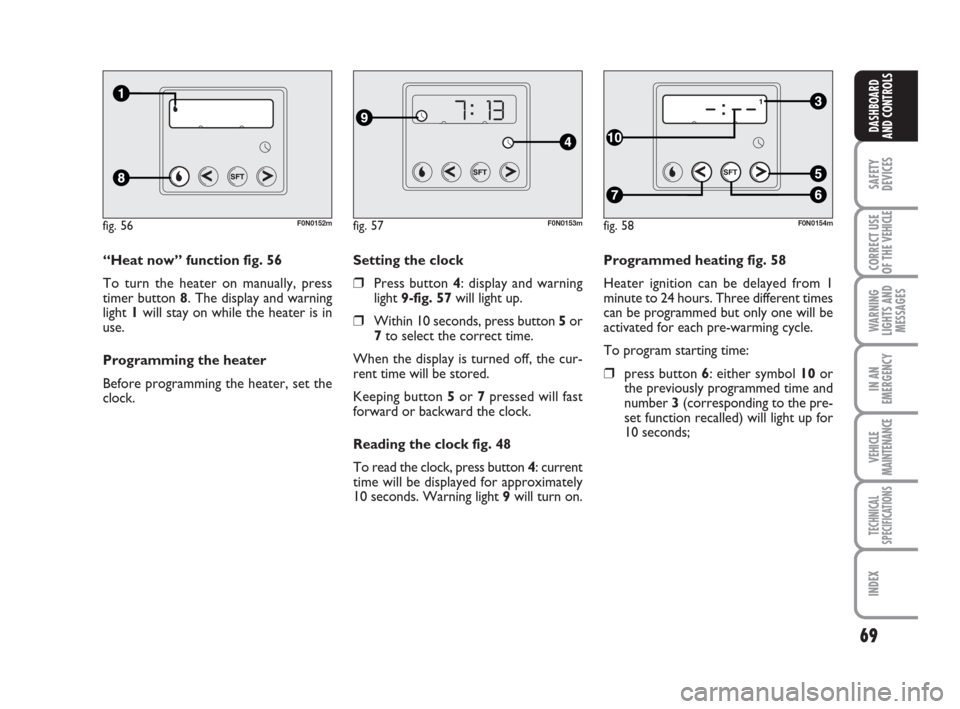
10 seconds. Warning light 9will turn on. “Heat now” function fig. 56
To turn the heater on manually, press
timer button 8. The display and warning
light 1will stay on while the heater is in
use.
Programming the heater
Before programming the heater, set the
clock.
fig. 56F0N0152mfig. 57F0N0153mfig. 58F0N0154m
Page 71 of 282
70
SAFETY
DEVICES
CORRECT USE
OF THE
VEHICLE
WARNING
LIGHTS AND
MESSAGES
IN AN
EMERGENCY
VEHICLE
MAINTENANCE
TECHNICAL
SPECIFICATIONS
INDEX
DASHBOARD
AND CONTROLS
IMPORTANT To recall other preset
times, press button 6within 10 seconds.
– press button 5or 7within 10 seconds
to select the starting time required.
IMPORTANT Time is stored when:
❒starting time goes off;
❒number 3 is displayed;
❒the display turns on.
IMPORTANT At turning on:
❒warning light corresponding to flame
1 on the display will turn on;
❒number 3 will turn off.
Deleting a programmed
starting time fig. 58
To delete the programmed starting time,
press button 6briefly: the display light will
go off and number 3corresponding to the
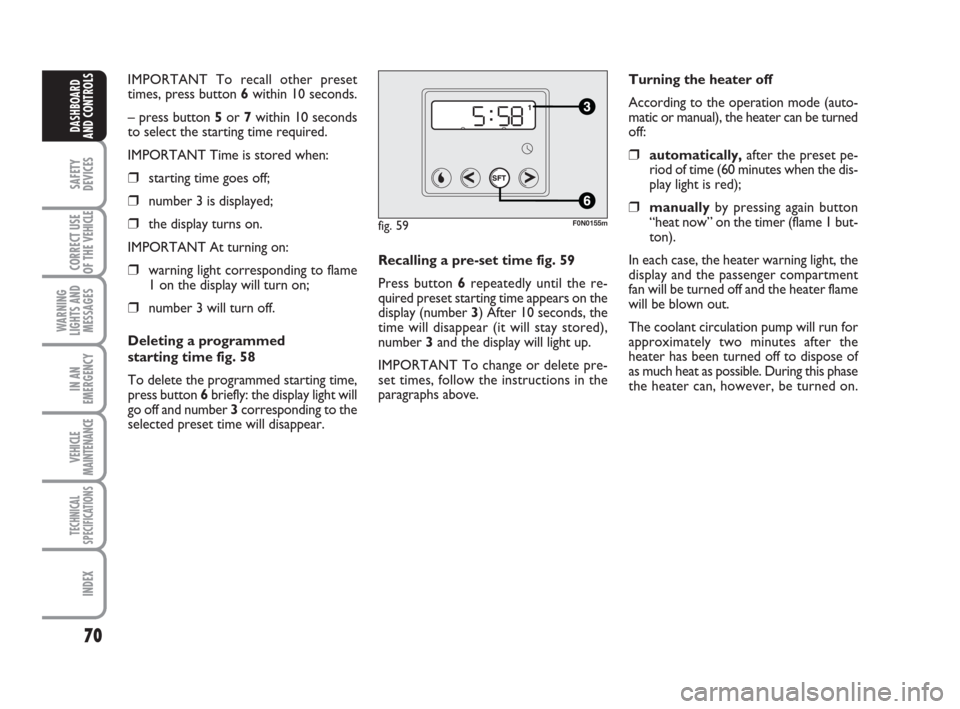
selected preset time will disappear.Recalling a pre-set time fig. 59
Press button 6repeatedly until the re-
quired preset starting time appears on the
display (number 3) After 10 seconds, the
time will disappear (it will stay stored),
number 3 and the display will light up.
IMPORTANT To change or delete pre-
set times, follow the instructions in the
paragraphs above.Turning the heater off
According to the operation mode (auto-
matic or manual), the heater can be turned
off:
❒automatically,after the preset pe-
riod of time (60 minutes when the dis-
play light is red);
❒manuallyby pressing again button
“heat now” on the timer (flame 1 but-
ton).
In each case, the heater warning light, the
display and the passenger compartment
fan will be turned off and the heater flame
will be blown out.
The coolant circulation pump will run for
approximately two minutes after the
heater has been turned off to dispose of
as much heat as possible. During this phase
the heater can, however, be turned on.
fig. 59F0N0155m
Page 72 of 282
71
SAFETY
DEVICES
CORRECT USE
OF THE
VEHICLE
WARNING
LIGHTS AND
MESSAGES
IN AN
EMERGENCY
VEHICLE
MAINTENANCE
TECHNICAL
SPECIFICATIONS
INDEX
DASHBOARD
AND CONTROLS
❒Always remember to turn the heater
off when refuelling or standing in ser-
vice stations to avoid fires and explo-
sions.
❒Do not park the vehicle over inflam-
mable material such as paper, dry grass
or leaves: fire risk!
❒The temperature near the heater must
never exceed 120°C (e.g. during paint-
ing operations in a workshop oven).
Higher temperatures could damage
the electronic control unit compo-
nents.
❒When the engine is off, the heater takes
power from the battery: it is conse-
quently important to run the engine for
a certain period of time in order to re-
store the battery charge.
❒Follow the prescriptions in section
“Vehicle maintenance” at paragraph
“Engine coolant level” to check the
coolant level. The coolant in the cir-
cuit must contain at least 10% an-
tifreeze fluid.
❒Maintenance and repairs must always
be carried out by a Fiat Dealership and
only genuine spare parts must be used.
MAINTENANCE
Have the heater checked at a Fiat Deal-
ership periodically (always before winter).
This will ensure safe and cheap running
and long appliance life.
The heater burns fuel in the
same way as the engine,
though, of course, to a lesser degree
and therefore to avoid intoxication
and suffocation, never use the sup-
plementary heater in closed areas,
garages or workshops not equipped
with specific exhaust evacuation de-
vices even for short periods of time.
WARNING
IMPORTANT The parking heater goes off
when the battery voltage is low to enable
the vehicle to be started up.
IMPORTANT Before turning on the de-
vice, ensure that the fuel level is higher
than the reserve. Otherwise the device
could lock and require the assistance of
the Fiat Dealership.
Page 73 of 282
72
SAFETY
DEVICES
CORRECT USE
OF THE
VEHICLE
WARNING
LIGHTS AND
MESSAGES
IN AN
EMERGENCY
VEHICLE
MAINTENANCE
TECHNICAL
SPECIFICATIONS
INDEX
DASHBOARD
AND CONTROLS
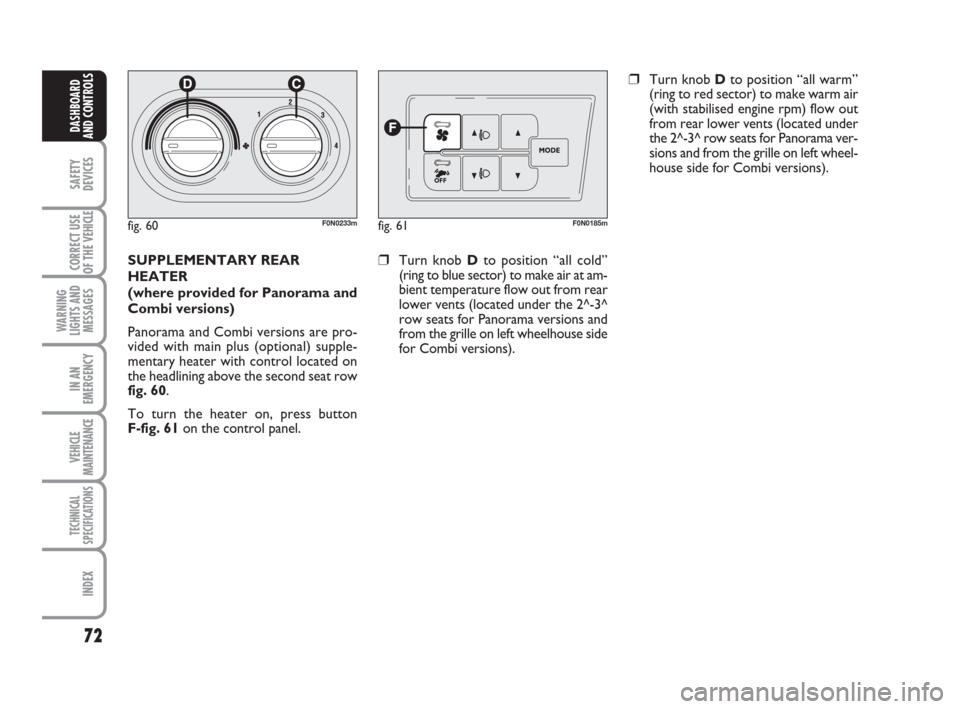
fig. 60F0N0233mfig. 61F0N0185m
SUPPLEMENTARY REAR
HEATER
(where provided for Panorama and
Combi versions)
Panorama and Combi versions are pro-
vided with main plus (optional) supple-
mentary heater with control located on
the headlining above the second seat row
fig. 60.
To turn the heater on, press button
F-fig. 61on the control panel.❒Turn knob Dto position “all cold”
(ring to blue sector) to make air at am-
bient temperature flow out from rear
lower vents (located under the 2^-3^
row seats for Panorama versions and
from the grille on left wheelhouse side
for Combi versions).
❒Turn knob Dto position “all warm”
(ring to red sector) to make warm air
(with stabilised engine rpm) flow out
from rear lower vents (located under
the 2^-3^ row seats for Panorama ver-
sions and from the grille on left wheel-
house side for Combi versions).
Page 74 of 282
73
SAFETY
DEVICES
CORRECT USE
OF THE
VEHICLE
WARNING
LIGHTS AND
MESSAGES
IN AN
EMERGENCY
VEHICLE
MAINTENANCE
TECHNICAL
SPECIFICATIONS
INDEX
DASHBOARD
AND CONTROLS
SUPPLEMENTARY REAR AIR
CONDITIONER
(where provided for Panorama and
Combi versions)
Panorama and Combi versions are pro-
vided with main plus (optional) supple-
mentary heater/air conditioner with con-
trol located on the headlining above the
second seat row fig. 60.
For turning on, press button F-fig. 61
on the control panel, the supplementary
air conditioner works only if the main one
is on.❒Turn knob Dto position “all cold”
(ring to blue sector) to make cold air
flow out from the vents located on the
roof.
❒Turn knob Dto position “all warm”
(ring to red sector) to make warm air
(with stabilised engine rpm) flow out
from rear lower vents (located under
the 2
nd-3rdrow seats for Panorama ver-
sions and from the grille on left wheel-
house side for Combi versions).
❒Turning knob Dto intermediate posi-
tions will distribute air flow between
roof vents and lower vents, changing
air temperature.IMPORTANT Turning the main condi-
tioner compressor on (pressing button E),
although the supplementary conditioner
fan is at 0, will automatically activate the
1st speed to prevent the formation of ice
and damages to the component as a con-
sequence.
Page 139 of 282
138
WARNING
LIGHTS AND
MESSAGES
IN AN
EMERGENCY
VEHICLE
MAINTENANCE
TECHNICAL
SPECIFICATIONS
INDEX
DASHBOARD
AND CONTROLS
SAFETY
DEVICES
CORRECT USE
OF THE VEHICLE
CONTAINING
RUNNING COSTS
Here are some suggestions which may
help you to keep the running costs of your
vehicle down and lower the amount of
toxic emissions released into the atmos-
phere.
GENERAL CONSIDERATIONS
Vehicle maintenance
Carry out the checks and adjustments/reg-
ulations specified in the “Service Sched-
ule”.
Tyres
Check the pressure of the tyres routine-
ly at an interval of no more than 4 weeks:
if the pressure is too low, consumption
levels increase as resistance to rolling is
higher.
Unnecessary loads
Do not travel with too much luggage
stowed in the boot. The weight of the ve-
hicle (especially when driving in town) and
its trim greatly affects consumption and
stability.Roof rack/ski rack
Remove the roof rack or the ski rack from
the roof as soon as they are no longer
used. These accessories lower air pene-
tration and adversely affect consumption
levels. When needing to carry particular-
ly voluminous objects, preferably use a
trailer.
Electric devices
Use electric devices only for the amount
of time needed. Rear heated window, ad-
ditional headlights, windscreen wipers and
heater fan need a considerable amount of
energy, therefore increasing the require-
ment of current increases fuel consump-
tion (up to +25% in the urban cycle).
Climate control
The air conditioner is an additional load
which greatly affects the engine leading to
higher consumption (on average up to
+20%). When the temperature outside
the vehicle permits it, use the air vents
where possible.
Spoilers
The use of non-certified aerodynamic
items may adversely affect air drag and
consumption levels.
Observe the enforced rules if
you need to carry a spare
can of petrol. Only use a homologat-
ed can and secure it to the load an-
choring eyebolts. Even given these
precautions, the risk of fire in the
event of an accident is increased.
WARNING
In addition to these general precautions,
some simple measures could enhance dri-
ving safety, comfort and the length of the
vehicle’s life:
❒distribute the load evenly over the
load floor: if you need to concentrate
it all in one point choose the part be-
tween the axles;
❒remember that the lower the load is,
the lower the vehicle’s centre of grav-
ity will be, contributing to a safe drive;
you should therefore always position
the heavier goods at the bottom;
❒finally, remember that the way in
which the vehicle moves is influenced
by the weight being carried. In partic-
ular, stopping distance lengthens par-
ticularly at high speed.
Page 185 of 282
184
WARNING
LIGHTS AND
MESSAGES
VEHICLE
MAINTENANCE
TECHNICAL
SPECIFICATIONS
IINDEX
DASHBOARD
AND CONTROLS
SAFETY
DEVICES
CORRECT USE
OF THE
VEHICLE
IN AN
EMERGENCY
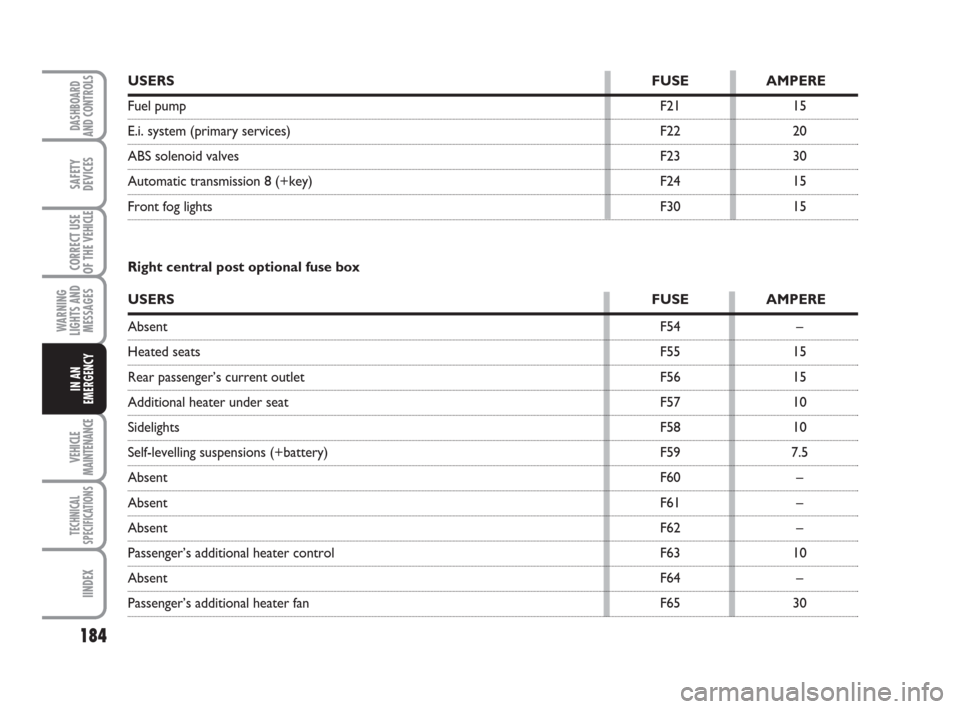
USERSFUSE AMPERE
Fuel pump F21 15
E.i. system (primary services) F22 20
ABS solenoid valves F23 30
Automatic transmission 8 (+key) F24 15
Front fog lightsF30 15
Right central post optional fuse box
USERSFUSE AMPERE
AbsentF54 –
Heated seatsF55 15
Rear passenger’s current outlet F56 15
Additional heater under seat F57 10
SidelightsF58 10
Self-levelling suspensions (+battery) F59 7.5
AbsentF60 –
AbsentF61 –
AbsentF62 –
Passenger’s additional heater control F63 10
AbsentF64 –
Passenger’s additional heater fan F65 30
Page 262 of 282
261
WARNING
LIGHTS AND
MESSAGES
INDEX
DASHBOARD
AND CONTROLS
SAFETY
DEVICES
CORRECT USE
OF THE
VEHICLE
IN AN
EMERGENCY
VEHICLE
MAINTENANCE
TECHNICAL
SPECIFICATIONS
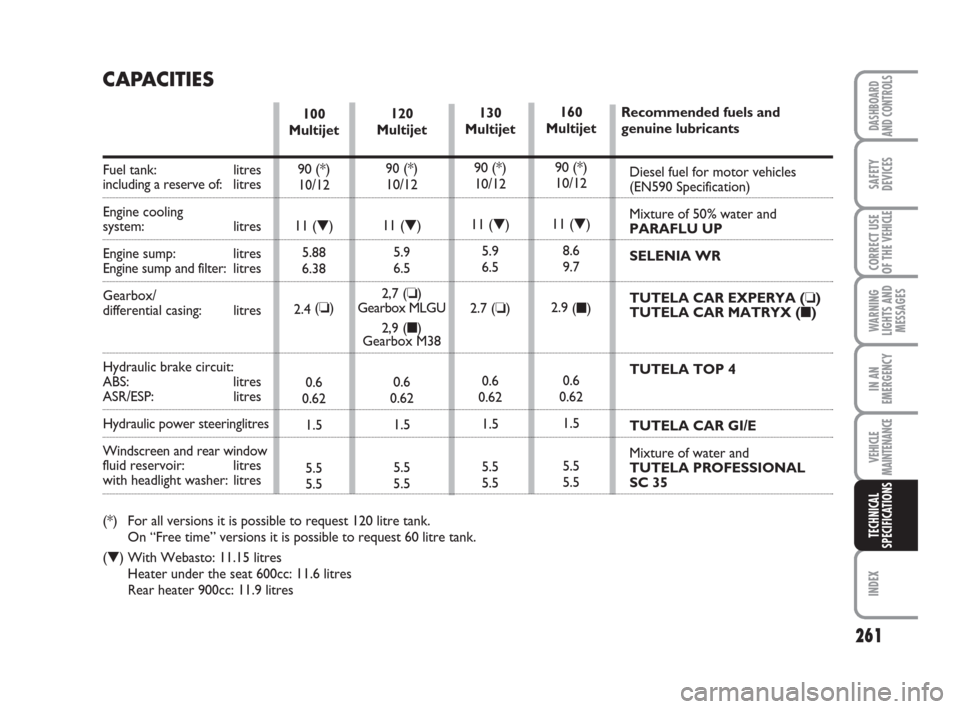
CAPACITIES
Fuel tank: litresincluding a reserve of:litres
Engine cooling
system: litres
Engine sump: litres
Engine sump and filter: litres
Gearbox/
differential casing: litres
Hydraulic brake circuit:
ABS: litres
ASR/ESP: litres
Hydraulic power steeringlitres
Windscreen and rear window
fluid reservoir: litres
with headlight washer: litres
(*) For all versions it is possible to request 120 litre tank.
On “Free time” versions it is possible to request 60 litre tank.
(▼) With Webasto: 11.15 litres
Heater under the seat 600cc: 11.6 litres
Rear heater 900cc: 11.9 litresRecommended fuels and
genuine lubricants
Diesel fuel for motor vehicles
(EN590 Specification)
Mixture of 50% water and
PARAFLU UP
SELENIA WR
TUTELA CAR EXPERYA (❏)
TUTELA CAR MATRYX (■)
TUTELA TOP 4
TUTELA CAR GI/E
Mixture of water and
TUTELA PROFESSIONAL
SC 35 120
Multijet
90 (*)
10/12
11 (▼)
5.9
6.5
2,7 (❏)
Gearbox MLGU
2,9 (■)
Gearbox M38
0.6
0.62
1.5
5.5
5.5130
Multijet
90 (*)
10/12
11 (▼)
5.9
6.5
2.7 (❏)
0.6
0.62
1.5
5.5
5.5160
Multijet
90 (*)
10/12
11 (▼)
8.6
9.7
2.9
(■)
0.6
0.62
1.5
5.5
5.5 100
Multijet
90 (*)
10/12
11 (▼)
5.88
6.38
2.4 (❏)
0.6
0.62
1.5
5.5
5.5
Page 271 of 282
270
WARNING
LIGHTS AND
MESSAGES
DASHBOARD
AND CONTROLS
SAFETY
DEVICES
CORRECT USE
OF THE
VEHICLE
IN AN
EMERGENCY
VEHICLE
MAINTENANCE
TECHNICAL
SPECIFICATIONS
INDEX
– jump starting .................................. 158
– recharging........................................ 185
– replacing ......................................... 202
– battery disconnection function ... 83
Bodywork
– maintenance .................................. 208
– version codes ................................ 212
Bonnet .................................................. 98
Brake Assist
(brake assist in an emergency) ....... 103
Brake fluid level.................................... 200
Brakes
– fluid level ........................................ 200
– technical data ................................ 218
Bulb (replacement)
– bulb types ....................................... 168
– general instructions....................... 168
Ceiling lights
– front................................................. 81
– rear................................................... 82
Chassis (marking) ............................... 213
Checking fluid levels............................ 196Child restraint systems
(specifications for use)..................... 119
Cigar lighter ......................................... 87
CO
2exhaust emissions ..................... 265
Code card............................................. 8
Consumption
– engine oil......................................... 198
– fuel.................................................... 264
Containing running costs................... 138
Controls ............................................... 82
Correct use of the vehicle................. 133
Cruise Control .................................... 79
Current outlet...................................... 88
Dashboard (left hand drive version) 5
Dashboard (right hand drive version) 6
Dashboard and controls..................... 4
Dead lock device
– activation/deactivation.................. 94
Digital display........................................ 20
Dimensions .......................................... 223
Dipped beam headlights
– bulb replacement .......................... 171
ABS ...................................................... 102
Accessories purchased by
the user .............................................. 109
Additional climate control system
(rear).................................................... 73
Additional rear heater........................ 72
Air bags (front)..................................... 123
Air bags (side)....................................... 125
Air cleaner............................................. 201
Air vents ............................................... 47
Armrest
– front................................................. 38
Ashtray................................................... 87
ASR ........................................................ 105
– activation/deactivation ................. 105
At the filling station............................. 125
Automatic climate control system .. 55
Automatic headlight sensor
(daylight sensor)................................ 92
Battery
– checking the charge ..................... 202
II I
N N
D D
E E
X X
Page 274 of 282
273
WARNING
LIGHTS AND
MESSAGES
DASHBOARD
AND CONTROLS
SAFETY
DEVICES
CORRECT USE
OF THE
VEHICLE
IN AN
EMERGENCY
VEHICLE
MAINTENANCE
TECHNICAL
SPECIFICATIONS
INDEX
Steering column lock ......................... 15
Steering wheel adjustment ............... 44
Storing the vehicle .............................. 144
Sun visors ............................................. 88
Supplementary heater......................... 55
Suspensions .......................................... 218
Symbols ................................................. 7
Technical specifications..................... 211
Third brake light ................................. 175
Tips on loading..................................... 137
Top speeds ........................................... 229
Towing a trailer
– tow hitch installation ................... 140
Towing the vehicle ............................. 186
Transmission ........................................ 217
Tyre pressure ...................................... 222
Tyres
– changing .......................................... 159
– snow tyres ..................................... 143
– standard .......................................... 221
– understanding tyre marking ........ 219
Under-seat basket.............................. 41
Using the manual gearbox ................ 137
Vehicle inactivity................................. 144
Vehicle maintenance........................... 189
– heavy-duty....................................... 195
– routine maintenance..................... 195
– scheduled service ......................... 190
– Service Schedule ....................191-193
Ventilation ............................................ 47
Warning lights and messages .......... 145
Weights ................................................ 230
Wheel geometry.................................. 219
Wheel replacement ........................... 159
Wheels
– changing .......................................... 159
Window washing................................. 77
Windows (cleaning)............................ 209
Windscreen washer
– control ............................................ 77
– fluid level ........................................ 200
Windscreen wipers
– blades .............................................. 207
– control ............................................ 77
– nozzles ............................................ 207
Windscreen/rear window/
headlight washer fluid level ............. 200
Writing/reading desk........................... 88 – pretensioners .........................100-116
– use ..............................................98-114
Seats
– adjustment....................................... 37
– cleaning ........................................... 210
S.B.R. system......................................... 115
Self-standing supplementary heater ... 66
Side sliding door................................... 95
Side/taillights
– control ............................................ 74
– front bulb replacement................. 170
– rear bulb replacement.................. 173
– changing side bulb.......................... 175
Sliding side window............................. 95
Smart washing ..................................... 77
Snow chains ......................................... 143
Sound system ...................................... 108
Speed block........................................... 92
Starting the engine............................... 134
– bump starting ................................ 159
– diesel engines ................................ 134
– emergency start-up ...................... 158
– ignition switch ............................... 15
– jump starting .................................. 158
– stopping the engine ...................... 135
– warming up the engine ................ 135