Wheels FIAT DUCATO 2008 3.G User Guide
[x] Cancel search | Manufacturer: FIAT, Model Year: 2008, Model line: DUCATO, Model: FIAT DUCATO 2008 3.GPages: 282, PDF Size: 4.55 MB
Page 162 of 282
161
WARNING
LIGHTS AND
MESSAGES
VEHICLE
MAINTENANCE
TECHNICAL
SPECIFICATIONS
INDEX
DASHBOARD
AND CONTROLS
SAFETY
DEVICES
CORRECT USE
OF THE
VEHICLE
IN AN
EMERGENCY
❒for versions with alloy wheels, remo-
ve the press-fitted hub cap;
❒loosen the bolts on the wheel to be
replaced by one turn;
❒turn the ring nut to extend the jack
partly;
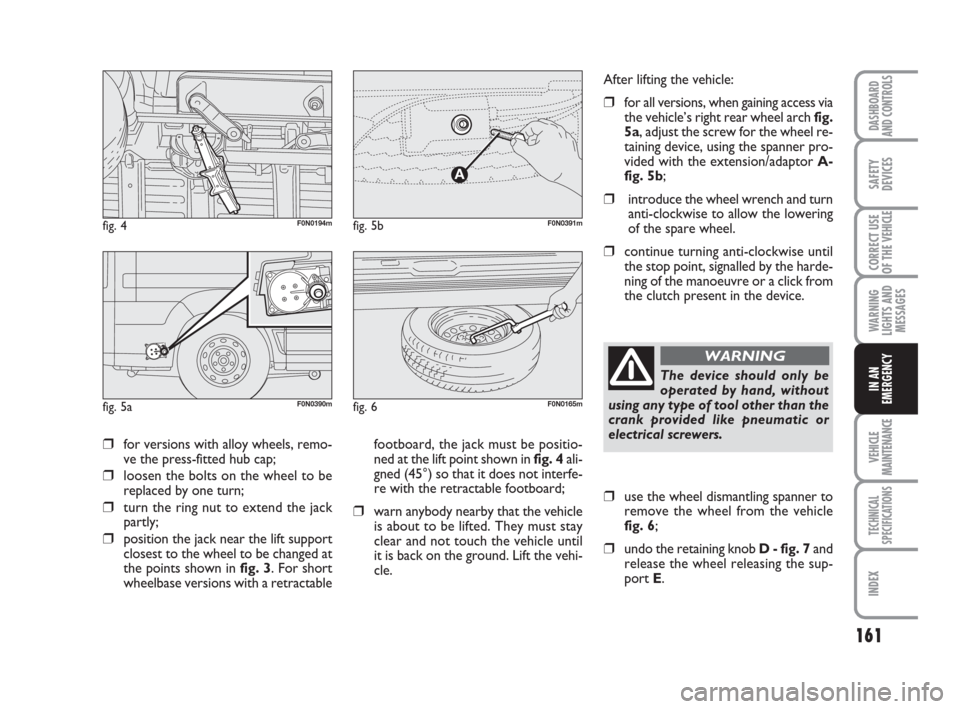
❒position the jack near the lift support
closest to the wheel to be changed at
the points shown in fig. 3. For short
wheelbase versions with a retractablefootboard, the jack must be positio-
ned at the lift point shown in fig. 4ali-
gned (45°) so that it does not interfe-
re with the retractable footboard;
❒warn anybody nearby that the vehicle
is about to be lifted. They must stay
clear and not touch the vehicle until
it is back on the ground. Lift the vehi-
cle.After lifting the vehicle:
❒for all versions, when gaining access via
the vehicle’s right rear wheel arch fig.
5a, adjust the screw for the wheel re-
taining device, using the spanner pro-
vided with the extension/adaptor A-
fig. 5b;
❒introduce the wheel wrench and turn
anti-clockwise to allow the lowering
of the spare wheel.
❒continue turning anti-clockwise until
the stop point, signalled by the harde-
ning of the manoeuvre or a click from
the clutch present in the device.
fig. 4F0N0194m
fig. 6F0N0165m
The device should only be
operated by hand, without
using any type of tool other than the
crank provided like pneumatic or
electrical screwers.
WARNING
❒use the wheel dismantling spanner to
remove the wheel from the vehicle
fig. 6;
❒undo the retaining knob D - fig. 7 and
release the wheel releasing the sup-
port E.
fig. 5aF0N0390m
fig. 5b
A
F0N0391m
Page 163 of 282
162
WARNING
LIGHTS AND
MESSAGES
VEHICLE
MAINTENANCE
TECHNICAL
SPECIFICATIONS
IINDEX
DASHBOARD
AND CONTROLS
SAFETY
DEVICES
CORRECT USE
OF THE
VEHICLE
IN AN
EMERGENCY
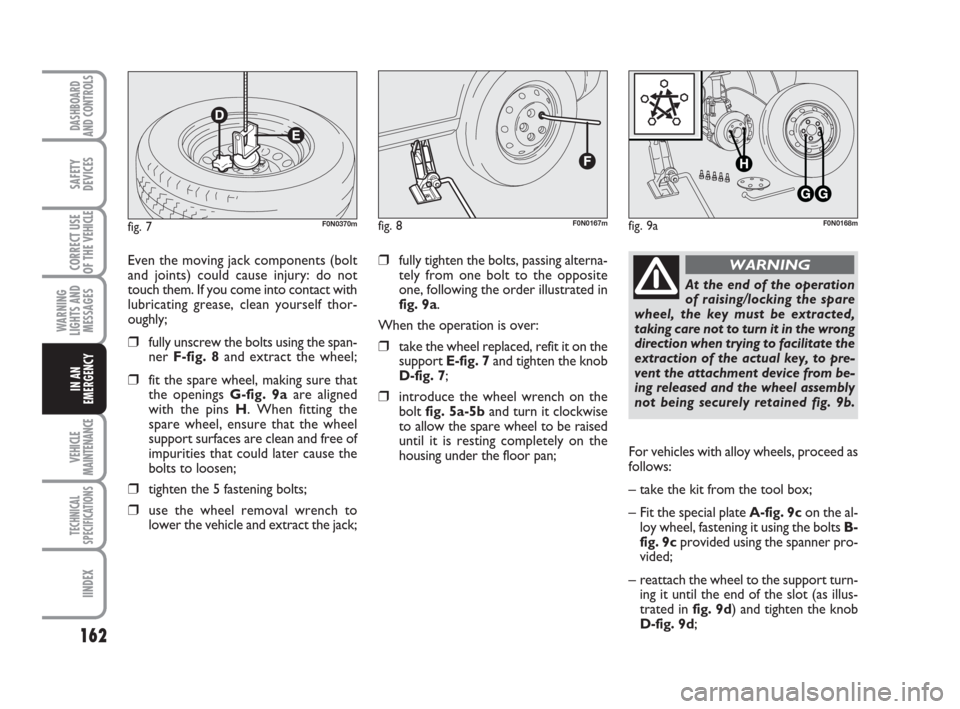
❒fully tighten the bolts, passing alterna-
tely from one bolt to the opposite
one, following the order illustrated in
fig. 9a.
When the operation is over:
❒take the wheel replaced, refit it on the
support E-fig. 7and tighten the knob
D-fig. 7;
❒introduce the wheel wrench on the
bolt fig. 5a-5band turn it clockwise
to allow the spare wheel to be raised
until it is resting completely on the
housing under the floor pan; Even the moving jack components (bolt
and joints) could cause injury: do not
touch them. If you come into contact with
lubricating grease, clean yourself thor-
oughly;
❒fully unscrew the bolts using the span-
ner F-fig. 8and extract the wheel;
❒fit the spare wheel, making sure that
the openings G-fig. 9aare aligned
with the pins H. When fitting the
spare wheel, ensure that the wheel
support surfaces are clean and free of
impurities that could later cause the
bolts to loosen;
❒tighten the 5 fastening bolts;
❒use the wheel removal wrench to
lower the vehicle and extract the jack;
At the end of the operation
of raising/locking the spare
wheel, the key must be extracted,
taking care not to turn it in the wrong
direction when trying to facilitate the
extraction of the actual key, to pre-
vent the attachment device from be-
ing released and the wheel assembly
not being securely retained fig. 9b.
WARNING
For vehicles with alloy wheels, proceed as
follows:
– take the kit from the tool box;
– Fit the special plate A-fig. 9con the al-
loy wheel, fastening it using the bolts B-
fig. 9cprovided using the spanner pro-
vided;
– reattach the wheel to the support turn-
ing it until the end of the slot (as illus-
trated in fig. 9d) and tighten the knob
D-fig. 9d;
fig. 8F0N0167mfig. 9aF0N0168mfig. 7F0N0370m
Page 190 of 282
189
WARNING
LIGHTS AND
MESSAGES
TECHNICAL
SPECIFICATIONS
INDEX
DASHBOARD
AND CONTROLS
SAFETY
DEVICES
CORRECT USE
OF THE VEHICLE
IN AN
EMERGENCY
VEHICLE
MAINTENANCE
SCHEDULED SERVICING ................................................ 190
SERVICE SCHEDULE........................................................... 191
ROUTINE MAINTENANCE ............................................. 195
HEAVY-DUTY ...................................................................... 195
CHECKING FLUID LEVELS................................................ 196
AIR FILTER ............................................................................ 202
POLLEN FILTER ................................................................... 202
BATTERY................................................................................ 202
WHEELS AND TYRES......................................................... 205
RUBBER HOSES.................................................................... 206
WINDSCREEN/REAR WINDOW WIPERS................... 206
BODYWORK........................................................................ 208
INTERIORS ............................................................................ 210
VV V
E E
H H
I I
C C
L L
E E
M M
A A
I I
N N
T T
E E
N N
A A
N N
C C
E E
Page 206 of 282
205
WARNING
LIGHTS AND
MESSAGES
TECHNICAL
SPECIFICATIONS
INDEX
DASHBOARD
AND CONTROLS
SAFETY
DEVICES
CORRECT USE
OF THE VEHICLE
IN AN
EMERGENCY
VEHICLE
MAINTENANCE
WHEELS AND TYRES
Check the pressure of each tyre, includ-
ing the spare, every two weeks and before
long journeys. The pressure should be
checked with the tyre rested and cold.
It is normal for pressure to rise when you
are driving. For the correct tyre inflation
pressure, see “Wheels” in section “Tech-
nical specifications”.
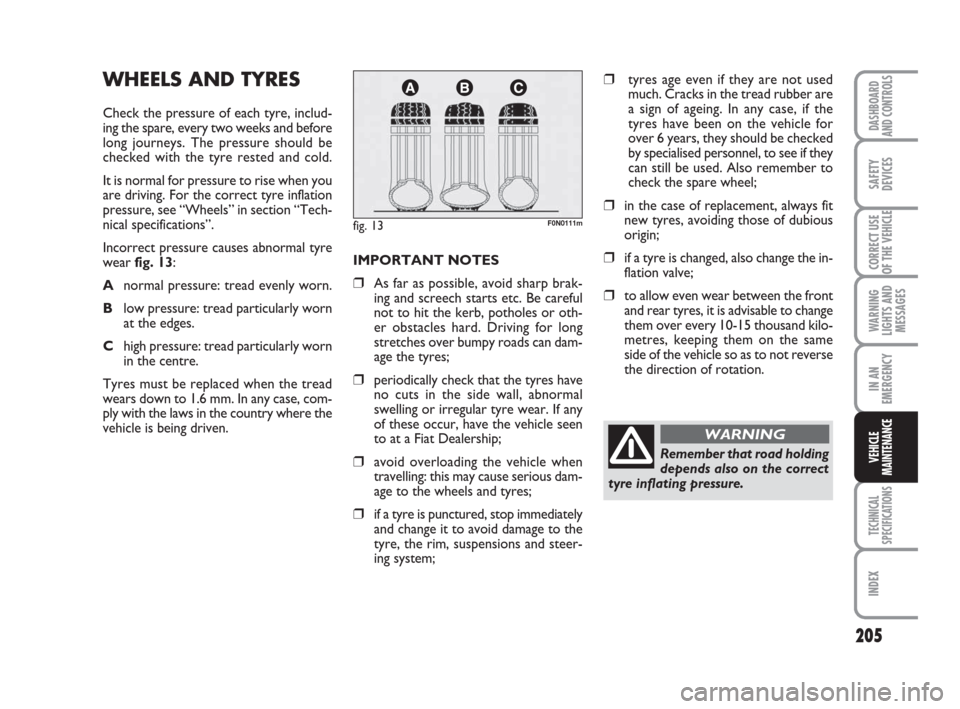
Incorrect pressure causes abnormal tyre
wearfig. 13:
Anormal pressure: tread evenly worn.
Blow pressure: tread particularly worn
at the edges.
Chigh pressure: tread particularly worn
in the centre.
Tyres must be replaced when the tread
wears down to 1.6 mm. In any case, com-
ply with the laws in the country where the
vehicle is being driven.
fig. 13F0N0111m
IMPORTANT NOTES
❒As far as possible, avoid sharp brak-
ing and screech starts etc. Be careful
not to hit the kerb, potholes or oth-
er obstacles hard. Driving for long
stretches over bumpy roads can dam-
age the tyres;
❒periodically check that the tyres have
no cuts in the side wall, abnormal
swelling or irregular tyre wear. If any
of these occur, have the vehicle seen
to at a Fiat Dealership;
❒avoid overloading the vehicle when
travelling: this may cause serious dam-
age to the wheels and tyres;
❒if a tyre is punctured, stop immediately
and change it to avoid damage to the
tyre, the rim, suspensions and steer-
ing system;
❒tyres age even if they are not used
much. Cracks in the tread rubber are
a sign of ageing. In any case, if the
tyres have been on the vehicle for
over 6 years, they should be checked
by specialised personnel, to see if they
can still be used. Also remember to
check the spare wheel;
❒in the case of replacement, always fit
new tyres, avoiding those of dubious
origin;
❒if a tyre is changed, also change the in-
flation valve;
❒to allow even wear between the front
and rear tyres, it is advisable to change
them over every 10-15 thousand kilo-
metres, keeping them on the same
side of the vehicle so as to not reverse
the direction of rotation.
Remember that road holding
depends also on the correct
tyre inflating pressure.
WARNING
Page 207 of 282
206
WARNING
LIGHTS AND
MESSAGES
TECHNICAL
SPECIFICATIONS
INDEX
DASHBOARD
AND CONTROLS
SAFETY
DEVICES
CORRECT USE
OF THE VEHICLE
IN AN
EMERGENCY
VEICHLE
MAINTENANCE
WINDSCREEN
BLADES
Periodically clean the rubber part using
special products; TUTELA PROFES-
SIONAL SC 35is recommended.
If the rubber blades are bent or worn they
should be replaced. In any case they should
be changed once a year.
A few simple notions can reduce the pos-
sibility of damage to the blades:
❒if the temperature fall below zero,
make sure that ice has not frozen the
rubber against glass. If necessary, thaw
using an antifreeze product;
❒remove any snow from the glass: in ad-
dition to protecting the blades, this
prevents effort on the motor and
overheating;
❒do not operate the windscreen
wipers on dry glass.
Driving with worn wiper
blades is a serious hazard,
because visibility is reduced in bad
weather.
WARNING
RUBBER HOSES
As far as the brake system and fuel rubber
hoses are concerned, carefully follow the
“Service schedule” in this section.
Indeed ozone, high temperatures and pro-
longed lack of fluid in the system may
cause hardening and cracking of the hoses,
with possible leaks. Careful control is
therefore necessary.If the pressure is too low the
tyre overheats and this can
cause it serious damage.
WARNING
Do not cross switch the
tyres, moving them from the
right of the vehicle to the left and vice
versa.
WARNING
Never submit alloy rims to
repainting treatments re-
quiring to use temperatures exceed-
ing 150°C since the mechanical prop-
erties of the wheels could be im-
paired.
WARNING
Page 212 of 282
211
WARNING
LIGHTS AND
MESSAGES
INDEX
DASHBOARD
AND CONTROLS
SAFETY
DEVICES
CORRECT USE
OF THE
VEHICLE
IN AN
EMERGENCY
VEHICLE
MAINTENANCE
TECHNICAL
SPECIFICATIONS
IDENTIFICATION DATA ................................................. 212
ENGINE CODES - BODYWORK VERSIONS .............. 214
ENGINE .................................................................................. 216
FUEL FEED ............................................................................. 217
TRANSMISSION .................................................................. 217
BRAKES................................................................................... 218
SUSPENSIONS....................................................................... 218
STEERING............................................................................... 218
WHEELS.................................................................................. 219
DIMENSIONS......................................................................... 223
PERFORMANCE................................................................... 229
WEIGHTS............................................................................... 230
CAPACITIES .......................................................................... 261
FLUIDS AND LUBRICANTS.............................................. 262
FUEL CONSUMPTION....................................................... 264
CO
2EMISSIONS .................................................................. 265
RADIO FREQUENCY REMOTE CONTROL:
MINISTERIAL CERTIFICATIONS .................................... 266
TT T
E E
C C
H H
N N
I I
C C
A A
L L
S S
P P
E E
C C
I I
F F
I I
C C
A A
T T
I I
O O
N N
S S
Page 219 of 282
218
WARNING
LIGHTS AND
MESSAGES
INDEX
DASHBOARD
AND CONTROLS
SAFETY
DEVICES
CORRECT USE
OF THE
VEHICLE
IN AN
EMERGENCY
VEHICLE
MAINTENANCE
TECHNICAL
SPECIFICATIONS
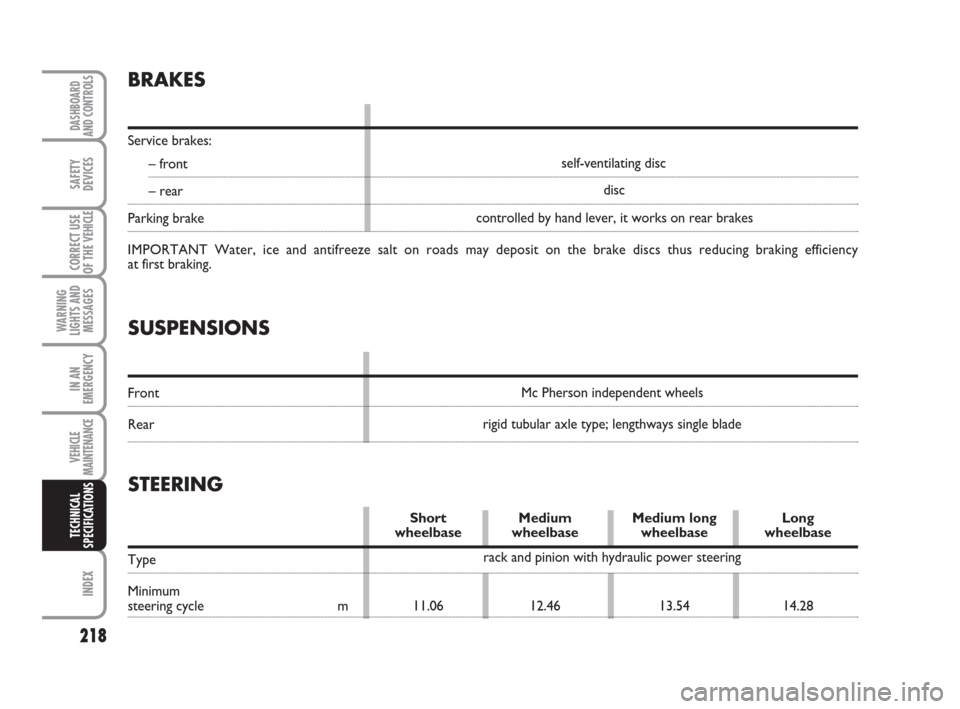
SUSPENSIONS
Front
Rear
BRAKES
Service brakes:
– front
– rear
Parking brake
IMPORTANT Water, ice and antifreeze salt on roads may deposit on the brake discs thus reducing braking efficiency
at first braking.
Mc Pherson independent wheels
rigid tubular axle type; lengthways single blade controlled by hand lever, it works on rear brakesdisc self-ventilating disc
rack and pinion with hydraulic power steering
STEERING
Short Medium Medium long Long wheelbase wheelbase wheelbase wheelbase
Type
Minimum
steering cycle m 11.06 12.46 13.54 14.28
Page 220 of 282
219
WARNING
LIGHTS AND
MESSAGES
INDEX
DASHBOARD
AND CONTROLS
SAFETY
DEVICES
CORRECT USE
OF THE
VEHICLE
IN AN
EMERGENCY
VEHICLE
MAINTENANCE
TECHNICAL
SPECIFICATIONS
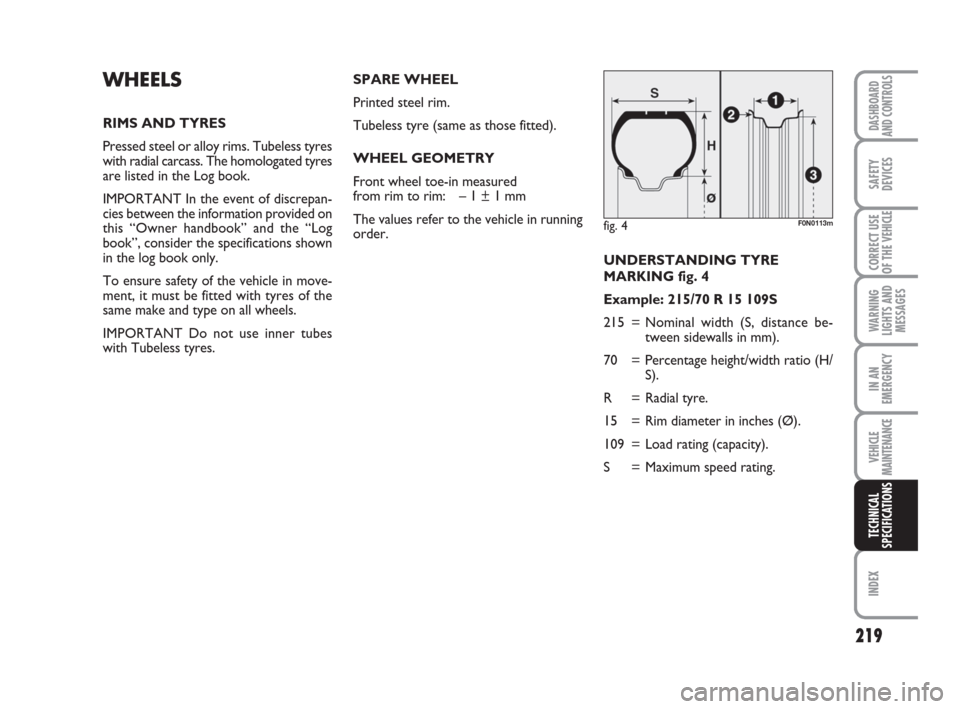
UNDERSTANDING TYRE
MARKING fig. 4
Example: 215/70 R 15 109S
215 = Nominal width (S, distance be-
tween sidewalls in mm).
70 = Percentage height/width ratio (H/
S).
R = Radial tyre.
15 = Rim diameter in inches (Ø).
109 = Load rating (capacity).
S = Maximum speed rating.
WHEELS
RIMS AND TYRES
Pressed steel or alloy rims. Tubeless tyres
with radial carcass. The homologated tyres
are listed in the Log book.
IMPORTANT In the event of discrepan-
cies between the information provided on
this “Owner handbook” and the “Log
book”, consider the specifications shown
in the log book only.
To ensure safety of the vehicle in move-
ment, it must be fitted with tyres of the
same make and type on all wheels.
IMPORTANT Do not use inner tubes
with Tubeless tyres.
fig. 4F0N0113m
SPARE WHEEL
Printed steel rim.
Tubeless tyre (same as those fitted).
WHEEL GEOMETRY
Front wheel toe-in measured
from rim to rim: – 1 ± 1 mm
The values refer to the vehicle in running
order.
Page 222 of 282
221
WARNING
LIGHTS AND
MESSAGES
INDEX
DASHBOARD
AND CONTROLS
SAFETY
DEVICES
CORRECT USE
OF THE
VEHICLE
IN AN
EMERGENCY
VEHICLE
MAINTENANCE
TECHNICAL
SPECIFICATIONS
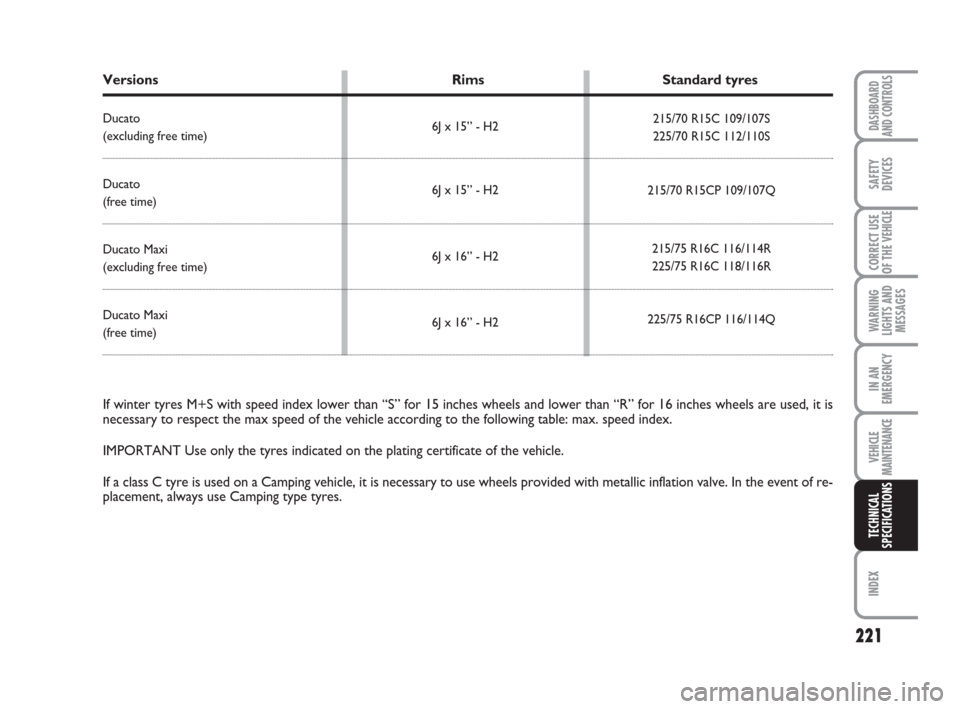
215/70 R15C 109/107S
225/70 R15C 112/110S
215/70 R15CP 109/107Q
215/75 R16C 116/114R
225/75 R16C 118/116R
225/75 R16CP 116/114Q 6J x 15” - H2
6J x 15” - H2
6J x 16” - H2
6J x 16” - H2
Versions Rims Standard tyres
Ducato
(excluding free time)
Ducato
(free time)
Ducato Maxi
(excluding free time)
Ducato Maxi
(free time)
If winter tyres M+S with speed index lower than “S” for 15 inches wheels and lower than “R” for 16 inches wheels are used, it is
necessary to respect the max speed of the vehicle according to the following table: max. speed index.
IMPORTANT Use only the tyres indicated on the plating certificate of the vehicle.
If a class C tyre is used on a Camping vehicle, it is necessary to use wheels provided with metallic inflation valve. In the event of re-
placement, always use Camping type tyres.
Page 274 of 282
273
WARNING
LIGHTS AND
MESSAGES
DASHBOARD
AND CONTROLS
SAFETY
DEVICES
CORRECT USE
OF THE
VEHICLE
IN AN
EMERGENCY
VEHICLE
MAINTENANCE
TECHNICAL
SPECIFICATIONS
INDEX
Steering column lock ......................... 15
Steering wheel adjustment ............... 44
Storing the vehicle .............................. 144
Sun visors ............................................. 88
Supplementary heater......................... 55
Suspensions .......................................... 218
Symbols ................................................. 7
Technical specifications..................... 211
Third brake light ................................. 175
Tips on loading..................................... 137
Top speeds ........................................... 229
Towing a trailer
– tow hitch installation ................... 140
Towing the vehicle ............................. 186
Transmission ........................................ 217
Tyre pressure ...................................... 222
Tyres
– changing .......................................... 159
– snow tyres ..................................... 143
– standard .......................................... 221
– understanding tyre marking ........ 219
Under-seat basket.............................. 41
Using the manual gearbox ................ 137
Vehicle inactivity................................. 144
Vehicle maintenance........................... 189
– heavy-duty....................................... 195
– routine maintenance..................... 195
– scheduled service ......................... 190
– Service Schedule ....................191-193
Ventilation ............................................ 47
Warning lights and messages .......... 145
Weights ................................................ 230
Wheel geometry.................................. 219
Wheel replacement ........................... 159
Wheels
– changing .......................................... 159
Window washing................................. 77
Windows (cleaning)............................ 209
Windscreen washer
– control ............................................ 77
– fluid level ........................................ 200
Windscreen wipers
– blades .............................................. 207
– control ............................................ 77
– nozzles ............................................ 207
Windscreen/rear window/
headlight washer fluid level ............. 200
Writing/reading desk........................... 88 – pretensioners .........................100-116
– use ..............................................98-114
Seats
– adjustment....................................... 37
– cleaning ........................................... 210
S.B.R. system......................................... 115
Self-standing supplementary heater ... 66
Side sliding door................................... 95
Side/taillights
– control ............................................ 74
– front bulb replacement................. 170
– rear bulb replacement.................. 173
– changing side bulb.......................... 175
Sliding side window............................. 95
Smart washing ..................................... 77
Snow chains ......................................... 143
Sound system ...................................... 108
Speed block........................................... 92
Starting the engine............................... 134
– bump starting ................................ 159
– diesel engines ................................ 134
– emergency start-up ...................... 158
– ignition switch ............................... 15
– jump starting .................................. 158
– stopping the engine ...................... 135
– warming up the engine ................ 135