brake fluid FIAT DUCATO 2008 3.G User Guide
[x] Cancel search | Manufacturer: FIAT, Model Year: 2008, Model line: DUCATO, Model: FIAT DUCATO 2008 3.GPages: 282, PDF Size: 4.55 MB
Page 202 of 282
201
WARNING
LIGHTS AND
MESSAGES
TECHNICAL
SPECIFICATIONS
INDEX
DASHBOARD
AND CONTROLS
SAFETY
DEVICES
CORRECT USE
OF THE VEHICLE
IN AN
EMERGENCY
VEHICLE
MAINTENANCE
Brake fluid is poisonous and
highly corrosive. In the event
of accidental contact, wash the parts
involved immediately with neutral
soap and water, then rinse thor-
oughly. Call the doctor immediately
if the fluid is swallowed.
WARNING
The symbol πon the con-
tainer indicates synthetic
brake fluid, distinguishing it from the
mineral kind. Using mineral fluids ir-
reversibly damages the special brak-
ing system rubber seals.
WARNING
POWER STEERING
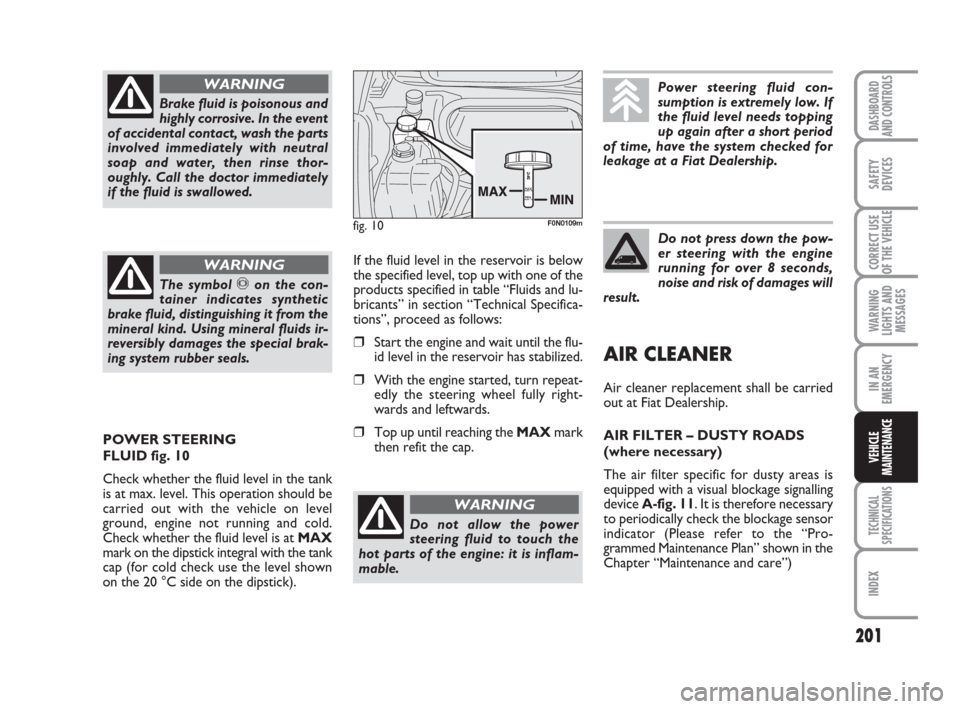
FLUID fig. 10
Check whether the fluid level in the tank
is at max. level. This operation should be
carried out with the vehicle on level
ground, engine not running and cold.
Check whether the fluid level is at MAX
mark on the dipstick integral with the tank
cap (for cold check use the level shown
on the 20 °C side on the dipstick).If the fluid level in the reservoir is below
the specified level, top up with one of the
products specified in table “Fluids and lu-
bricants” in section “Technical Specifica-
tions”, proceed as follows:
❒Start the engine and wait until the flu-
id level in the reservoir has stabilized.
❒With the engine started, turn repeat-
edly the steering wheel fully right-
wards and leftwards.
❒Top up until reaching the MAXmark
then refit the cap.
fig. 10F0N0109m
Do not allow the power
steering fluid to touch the
hot parts of the engine: it is inflam-
mable.
WARNING
Do not press down the pow-
er steering with the engine
running for over 8 seconds,
noise and risk of damages will
result.
Power steering fluid con-
sumption is extremely low. If
the fluid level needs topping
up again after a short period
of time, have the system checked for
leakage at a Fiat Dealership.
AIR CLEANER
Air cleaner replacement shall be carried
out at Fiat Dealership.
AIR FILTER – DUSTY ROADS
(where necessary)
The air filter specific for dusty areas is
equipped with a visual blockage signalling
device A-fig. 11. It is therefore necessary
to periodically check the blockage sensor
indicator (Please refer to the “Pro-
grammed Maintenance Plan” shown in the
Chapter “Maintenance and care”)
Page 207 of 282
206
WARNING
LIGHTS AND
MESSAGES
TECHNICAL
SPECIFICATIONS
INDEX
DASHBOARD
AND CONTROLS
SAFETY
DEVICES
CORRECT USE
OF THE VEHICLE
IN AN
EMERGENCY
VEICHLE
MAINTENANCE
WINDSCREEN
BLADES
Periodically clean the rubber part using
special products; TUTELA PROFES-
SIONAL SC 35is recommended.
If the rubber blades are bent or worn they
should be replaced. In any case they should
be changed once a year.
A few simple notions can reduce the pos-
sibility of damage to the blades:
❒if the temperature fall below zero,
make sure that ice has not frozen the
rubber against glass. If necessary, thaw
using an antifreeze product;
❒remove any snow from the glass: in ad-
dition to protecting the blades, this
prevents effort on the motor and
overheating;
❒do not operate the windscreen
wipers on dry glass.
Driving with worn wiper
blades is a serious hazard,
because visibility is reduced in bad
weather.
WARNING
RUBBER HOSES
As far as the brake system and fuel rubber
hoses are concerned, carefully follow the
“Service schedule” in this section.
Indeed ozone, high temperatures and pro-
longed lack of fluid in the system may
cause hardening and cracking of the hoses,
with possible leaks. Careful control is
therefore necessary.If the pressure is too low the
tyre overheats and this can
cause it serious damage.
WARNING
Do not cross switch the
tyres, moving them from the
right of the vehicle to the left and vice
versa.
WARNING
Never submit alloy rims to
repainting treatments re-
quiring to use temperatures exceed-
ing 150°C since the mechanical prop-
erties of the wheels could be im-
paired.
WARNING
Page 212 of 282
211
WARNING
LIGHTS AND
MESSAGES
INDEX
DASHBOARD
AND CONTROLS
SAFETY
DEVICES
CORRECT USE
OF THE
VEHICLE
IN AN
EMERGENCY
VEHICLE
MAINTENANCE
TECHNICAL
SPECIFICATIONS
IDENTIFICATION DATA ................................................. 212
ENGINE CODES - BODYWORK VERSIONS .............. 214
ENGINE .................................................................................. 216
FUEL FEED ............................................................................. 217
TRANSMISSION .................................................................. 217
BRAKES................................................................................... 218
SUSPENSIONS....................................................................... 218
STEERING............................................................................... 218
WHEELS.................................................................................. 219
DIMENSIONS......................................................................... 223
PERFORMANCE................................................................... 229
WEIGHTS............................................................................... 230
CAPACITIES .......................................................................... 261
FLUIDS AND LUBRICANTS.............................................. 262
FUEL CONSUMPTION....................................................... 264
CO
2EMISSIONS .................................................................. 265
RADIO FREQUENCY REMOTE CONTROL:
MINISTERIAL CERTIFICATIONS .................................... 266
TT T
E E
C C
H H
N N
I I
C C
A A
L L
S S
P P
E E
C C
I I
F F
I I
C C
A A
T T
I I
O O
N N
S S
Page 231 of 282
230
WARNING
LIGHTS AND
MESSAGES
INDEX
DASHBOARD
AND CONTROLS
SAFETY
DEVICES
CORRECT USE
OF THE
VEHICLE
IN AN
EMERGENCY
VEHICLE
MAINTENANCE
TECHNICAL
SPECIFICATIONS
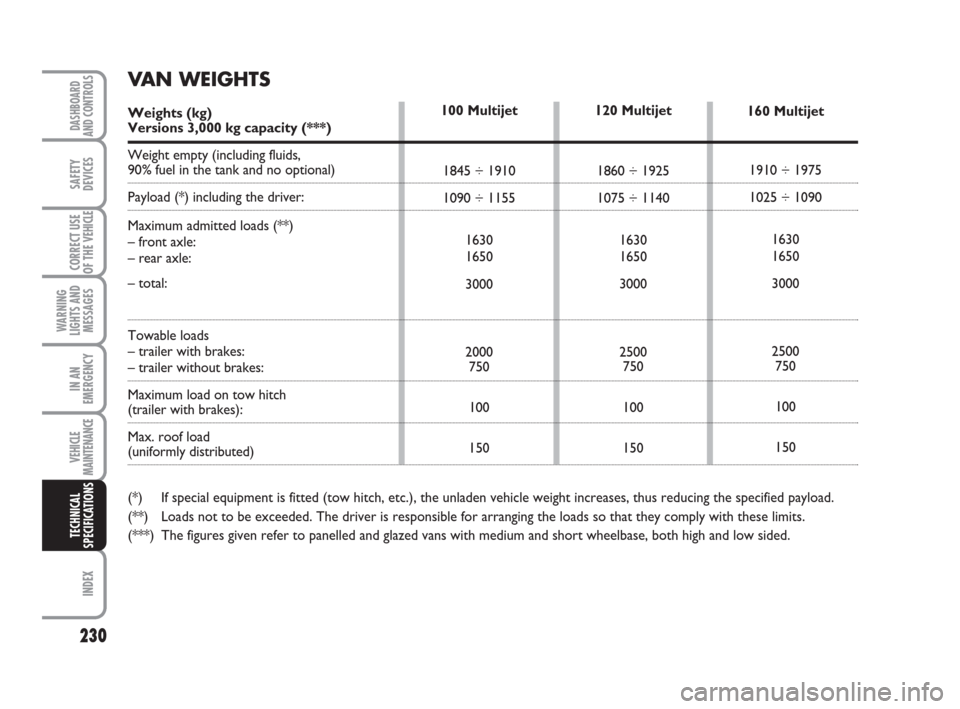
120 Multijet
1860 ÷ 1925
1075 ÷ 1140
1630
1650
3000
2500
750
100
150160 Multijet
1910 ÷ 1975
1025 ÷ 1090
1630
1650
3000
2500
750
100
150 100 Multijet
1845 ÷ 1910
1090 ÷ 1155
1630
1650
3000
2000
750
100
150
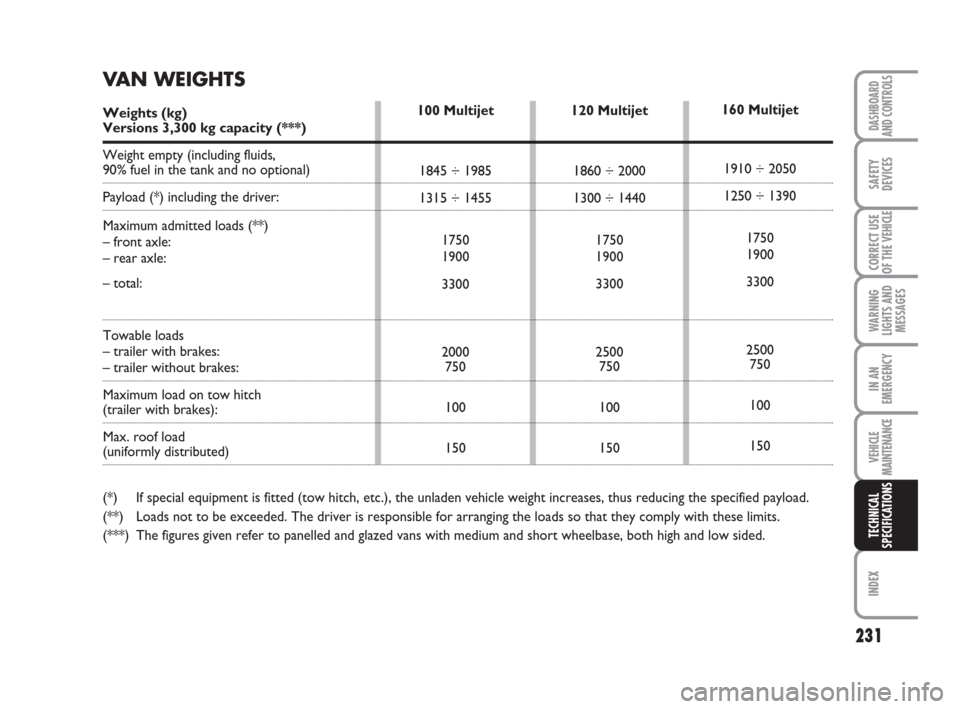
VAN WEIGHTS
Weights (kg)Versions 3,000 kg capacity (***)
Weight empty (including fluids,
90% fuel in the tank and no optional)
Payload (*) including the driver:
Maximum admitted loads (**)
– front axle:
– rear axle:
– total:
Towable loads
– trailer with brakes:
– trailer without brakes:
Maximum load on tow hitch
(trailer with brakes):
Max. roof load
(uniformly distributed)
(*) If special equipment is fitted (tow hitch, etc.), the unladen vehicle weight increases, thus reducing the specified payload.
(**) Loads not to be exceeded. The driver is responsible for arranging the loads so that they comply with these limits.
(***) The figures given refer to panelled and glazed vans with medium and short wheelbase, both high and low sided.
Page 232 of 282
231
WARNING
LIGHTS AND
MESSAGES
INDEX
DASHBOARD
AND CONTROLS
SAFETY
DEVICES
CORRECT USE
OF THE
VEHICLE
IN AN
EMERGENCY
VEHICLE
MAINTENANCE
TECHNICAL
SPECIFICATIONS
120 Multijet
1860 ÷ 2000
1300 ÷ 1440
1750
1900
3300
2500
750
100
150160 Multijet
1910 ÷ 2050
1250 ÷ 1390
1750
1900
3300
2500
750
100
150 100 Multijet
1845 ÷ 1985
1315 ÷ 1455
1750
1900
3300
2000
750
100
150
VAN WEIGHTS
Weights (kg)Versions 3,300 kg capacity (***)
Weight empty (including fluids,
90% fuel in the tank and no optional)
Payload (*) including the driver:
Maximum admitted loads (**)
– front axle:
– rear axle:
– total:
Towable loads
– trailer with brakes:
– trailer without brakes:
Maximum load on tow hitch
(trailer with brakes):
Max. roof load
(uniformly distributed)
(*) If special equipment is fitted (tow hitch, etc.), the unladen vehicle weight increases, thus reducing the specified payload.
(**) Loads not to be exceeded. The driver is responsible for arranging the loads so that they comply with these limits.
(***) The figures given refer to panelled and glazed vans with medium and short wheelbase, both high and low sided.
Page 233 of 282
232
WARNING
LIGHTS AND
MESSAGES
INDEX
DASHBOARD
AND CONTROLS
SAFETY
DEVICES
CORRECT USE
OF THE
VEHICLE
IN AN
EMERGENCY
VEHICLE
MAINTENANCE
TECHNICAL
SPECIFICATIONS
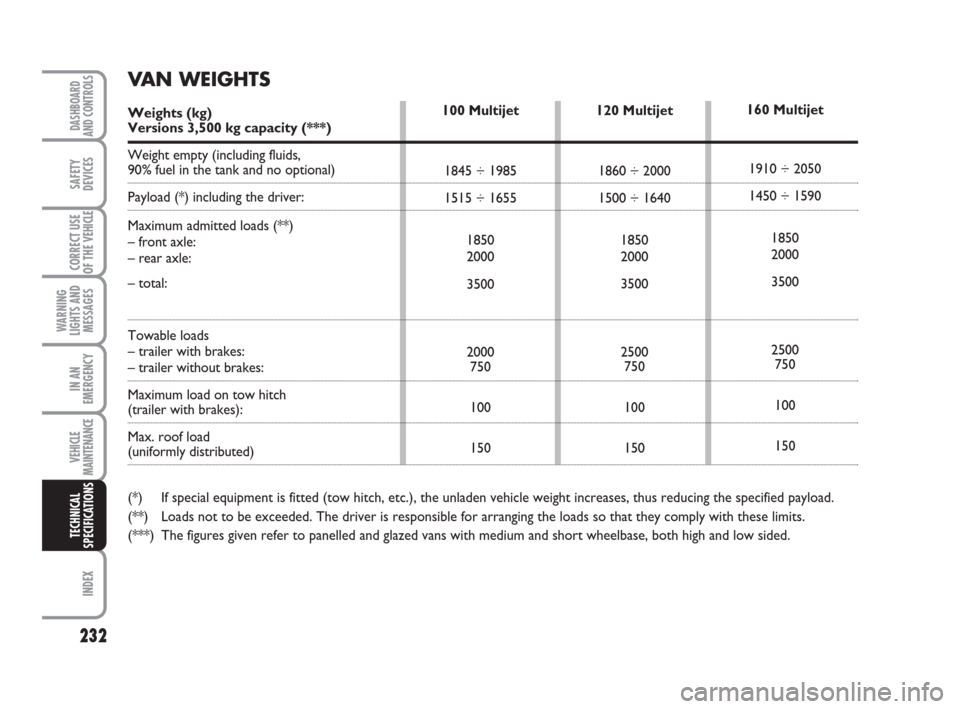
120 Multijet
1860 ÷ 2000
1500 ÷ 1640
1850
2000
3500
2500
750
100
150160 Multijet
1910 ÷ 2050
1450 ÷ 1590
1850
2000
3500
2500
750
100
150 100 Multijet
1845 ÷ 1985
1515 ÷ 1655
1850
2000
3500
2000
750
100
150
VAN WEIGHTS
Weights (kg)Versions 3,500 kg capacity (***)
Weight empty (including fluids,
90% fuel in the tank and no optional)
Payload (*) including the driver:
Maximum admitted loads (**)
– front axle:
– rear axle:
– total:
Towable loads
– trailer with brakes:
– trailer without brakes:
Maximum load on tow hitch
(trailer with brakes):
Max. roof load
(uniformly distributed)
(*) If special equipment is fitted (tow hitch, etc.), the unladen vehicle weight increases, thus reducing the specified payload.
(**) Loads not to be exceeded. The driver is responsible for arranging the loads so that they comply with these limits.
(***) The figures given refer to panelled and glazed vans with medium and short wheelbase, both high and low sided.
Page 234 of 282
233
WARNING
LIGHTS AND
MESSAGES
INDEX
DASHBOARD
AND CONTROLS
SAFETY
DEVICES
CORRECT USE
OF THE
VEHICLE
IN AN
EMERGENCY
VEHICLE
MAINTENANCE
TECHNICAL
SPECIFICATIONS
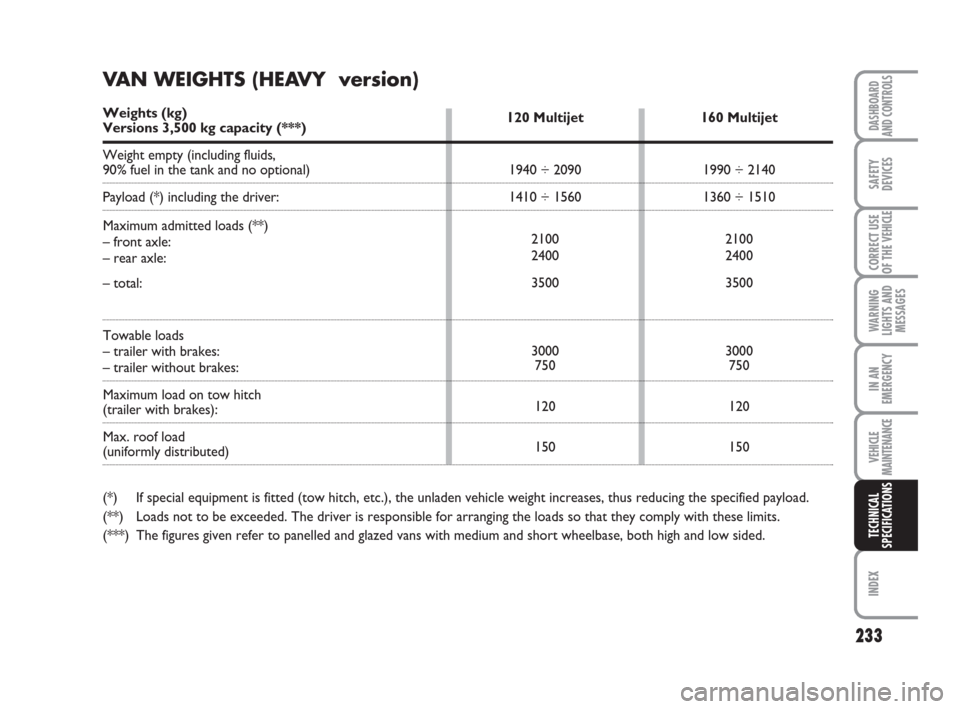
120 Multijet
1940 ÷ 2090
1410 ÷ 1560
2100
2400
3500
3000
750
120
150160 Multijet
1990 ÷ 2140
1360 ÷ 1510
2100
2400
3500
3000
750
120
150
VAN WEIGHTS (HEAVY version)
Weights (kg)Versions 3,500 kg capacity (***)
Weight empty (including fluids,
90% fuel in the tank and no optional)
Payload (*) including the driver:
Maximum admitted loads (**)
– front axle:
– rear axle:
– total:
Towable loads
– trailer with brakes:
– trailer without brakes:
Maximum load on tow hitch
(trailer with brakes):
Max. roof load
(uniformly distributed)
(*) If special equipment is fitted (tow hitch, etc.), the unladen vehicle weight increases, thus reducing the specified payload.
(**) Loads not to be exceeded. The driver is responsible for arranging the loads so that they comply with these limits.
(***) The figures given refer to panelled and glazed vans with medium and short wheelbase, both high and low sided.
Page 235 of 282
234
WARNING
LIGHTS AND
MESSAGES
INDEX
DASHBOARD
AND CONTROLS
SAFETY
DEVICES
CORRECT USE
OF THE
VEHICLE
IN AN
EMERGENCY
VEHICLE
MAINTENANCE
TECHNICAL
SPECIFICATIONS
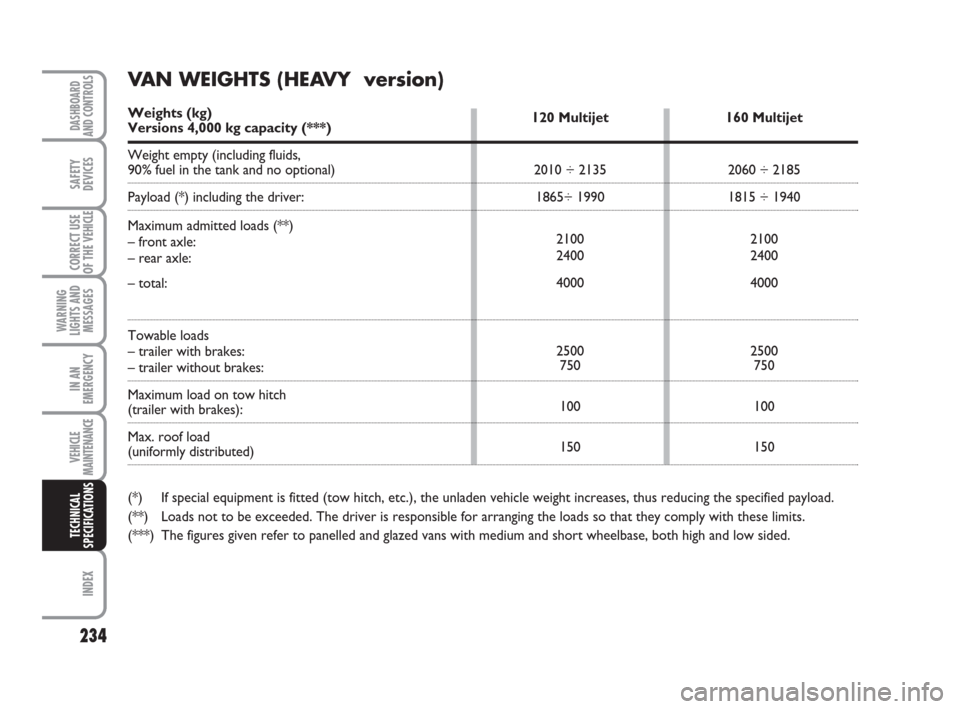
120 Multijet
2010 ÷ 2135
1865÷ 1990
2100
2400
4000
2500
750
100
150160 Multijet
2060 ÷ 2185
1815 ÷ 1940
2100
2400
4000
2500
750
100
150
VAN WEIGHTS (HEAVY version)
Weights (kg)Versions 4,000 kg capacity (***)
Weight empty (including fluids,
90% fuel in the tank and no optional)
Payload (*) including the driver:
Maximum admitted loads (**)
– front axle:
– rear axle:
– total:
Towable loads
– trailer with brakes:
– trailer without brakes:
Maximum load on tow hitch
(trailer with brakes):
Max. roof load
(uniformly distributed)
(*) If special equipment is fitted (tow hitch, etc.), the unladen vehicle weight increases, thus reducing the specified payload.
(**) Loads not to be exceeded. The driver is responsible for arranging the loads so that they comply with these limits.
(***) The figures given refer to panelled and glazed vans with medium and short wheelbase, both high and low sided.
Page 236 of 282
235
WARNING
LIGHTS AND
MESSAGES
INDEX
DASHBOARD
AND CONTROLS
SAFETY
DEVICES
CORRECT USE
OF THE
VEHICLE
IN AN
EMERGENCY
VEHICLE
MAINTENANCE
TECHNICAL
SPECIFICATIONS
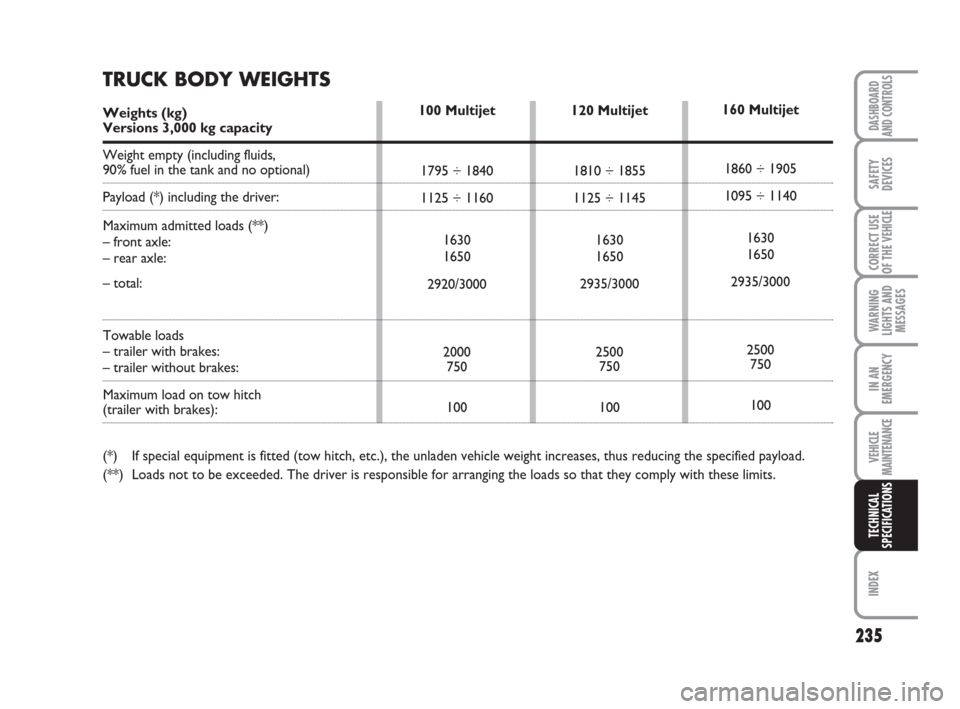
120 Multijet
1810 ÷ 1855
1125 ÷ 1145
1630
1650
2935/3000
2500
750
100160 Multijet
1860 ÷ 1905
1095 ÷ 1140
1630
1650
2935/3000
2500
750
100 100 Multijet
1795 ÷ 1840
1125 ÷ 1160
1630
1650
2920/3000
2000
750
100
TRUCK BODY WEIGHTS
Weights (kg)Versions 3,000 kg capacity
Weight empty (including fluids,
90% fuel in the tank and no optional)
Payload (*) including the driver:
Maximum admitted loads (**)
– front axle:
– rear axle:
– total:
Towable loads
– trailer with brakes:
– trailer without brakes:
Maximum load on tow hitch
(trailer with brakes):
(*) If special equipment is fitted (tow hitch, etc.), the unladen vehicle weight increases, thus reducing the specified payload.
(**) Loads not to be exceeded. The driver is responsible for arranging the loads so that they comply with these limits.
Page 237 of 282
236
WARNING
LIGHTS AND
MESSAGES
INDEX
DASHBOARD
AND CONTROLS
SAFETY
DEVICES
CORRECT USE
OF THE
VEHICLE
IN AN
EMERGENCY
VEHICLE
MAINTENANCE
TECHNICAL
SPECIFICATIONS
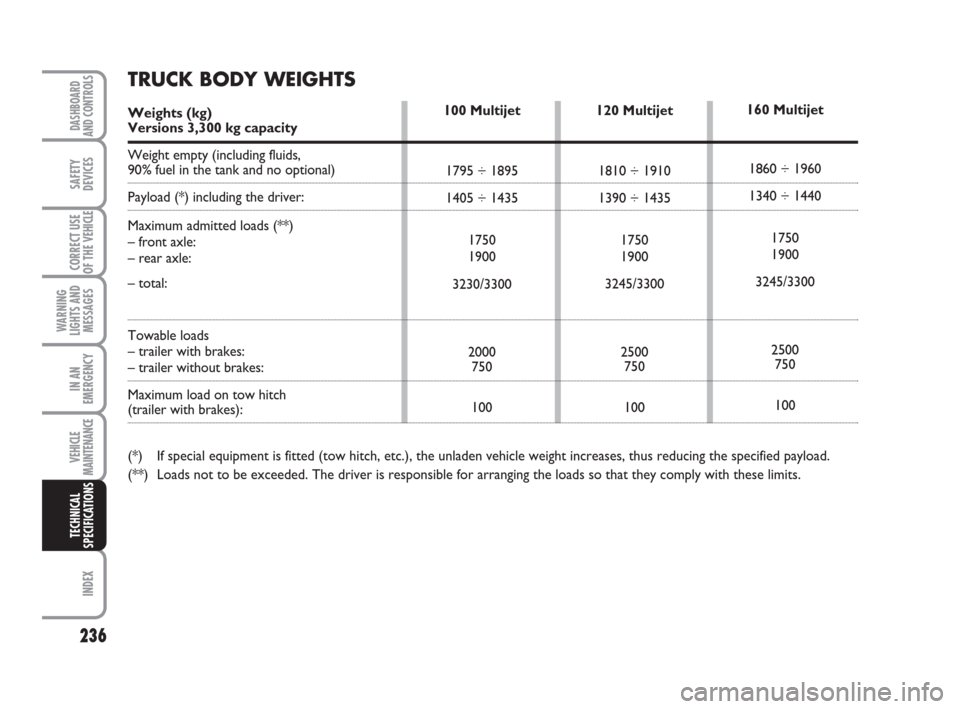
120 Multijet
1810 ÷ 1910
1390 ÷ 1435
1750
1900
3245/3300
2500
750
100160 Multijet
1860 ÷ 1960
1340 ÷ 1440
1750
1900
3245/3300
2500
750
100 100 Multijet
1795 ÷ 1895
1405 ÷ 1435
1750
1900
3230/3300
2000
750
100
TRUCK BODY WEIGHTS
Weights (kg)Versions 3,300 kg capacity
Weight empty (including fluids,
90% fuel in the tank and no optional)
Payload (*) including the driver:
Maximum admitted loads (**)
– front axle:
– rear axle:
– total:
Towable loads
– trailer with brakes:
– trailer without brakes:
Maximum load on tow hitch
(trailer with brakes):
(*) If special equipment is fitted (tow hitch, etc.), the unladen vehicle weight increases, thus reducing the specified payload.
(**) Loads not to be exceeded. The driver is responsible for arranging the loads so that they comply with these limits.