tow FIAT DUCATO 2008 3.G User Guide
[x] Cancel search | Manufacturer: FIAT, Model Year: 2008, Model line: DUCATO, Model: FIAT DUCATO 2008 3.GPages: 282, PDF Size: 4.55 MB
Page 80 of 282
79
SAFETY
DEVICES
CORRECT USE
OF THE
VEHICLE
WARNING
LIGHTS AND
MESSAGES
IN AN
EMERGENCY
VEHICLE
MAINTENANCE
TECHNICAL
SPECIFICATIONS
INDEX
DASHBOARD
AND CONTROLS
CRUISE CONTROL
(where provided)
It is a device able to support the driver,
with electronic control, which allows dri-
ving at speed over 30 km/h on long and
straight dry roads (e.g.: motorways), at a
desired speed, without pressing the ac-
celerator pedal. Therefore it is not sug-
gested to use this device on extra-urban
roads with traffic. Do not use it in town
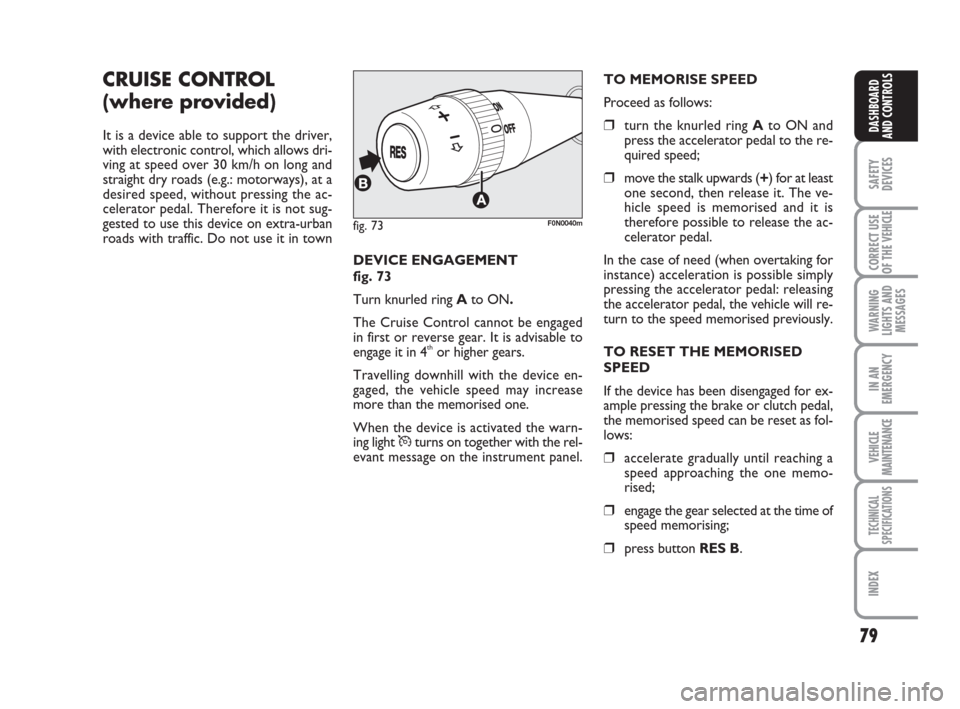
DEVICE ENGAGEMENT
fig. 73
Turn knurled ring Ato ON.
The Cruise Control cannot be engaged
in first or reverse gear. It is advisable to
engage it in 4
thor higher gears.
Travelling downhill with the device en-
gaged, the vehicle speed may increase
more than the memorised one.
When the device is activated the warn-
ing light
Üturns on together with the rel-
evant message on the instrument panel.TO MEMORISE SPEED
Proceed as follows:
❒turn the knurled ring Ato ON and
press the accelerator pedal to the re-
quired speed;
❒move the stalk upwards (+) for at least
one second, then release it. The ve-
hicle speed is memorised and it is
therefore possible to release the ac-
celerator pedal.
In the case of need (when overtaking for
instance) acceleration is possible simply
pressing the accelerator pedal: releasing
the accelerator pedal, the vehicle will re-
turn to the speed memorised previously.
TO RESET THE MEMORISED
SPEED
If the device has been disengaged for ex-
ample pressing the brake or clutch pedal,
the memorised speed can be reset as fol-
lows:
❒accelerate gradually until reaching a
speed approaching the one memo-
rised;
❒engage the gear selected at the time of
speed memorising;
❒press button RES B.
fig. 73F0N0040m
Page 89 of 282
88
SAFETY
DEVICES
CORRECT USE
OF THE
VEHICLE
WARNING
LIGHTS AND
MESSAGES
IN AN
EMERGENCY
VEHICLE
MAINTENANCE
TECHNICAL
SPECIFICATIONS
INDEX
DASHBOARD
AND CONTROLS
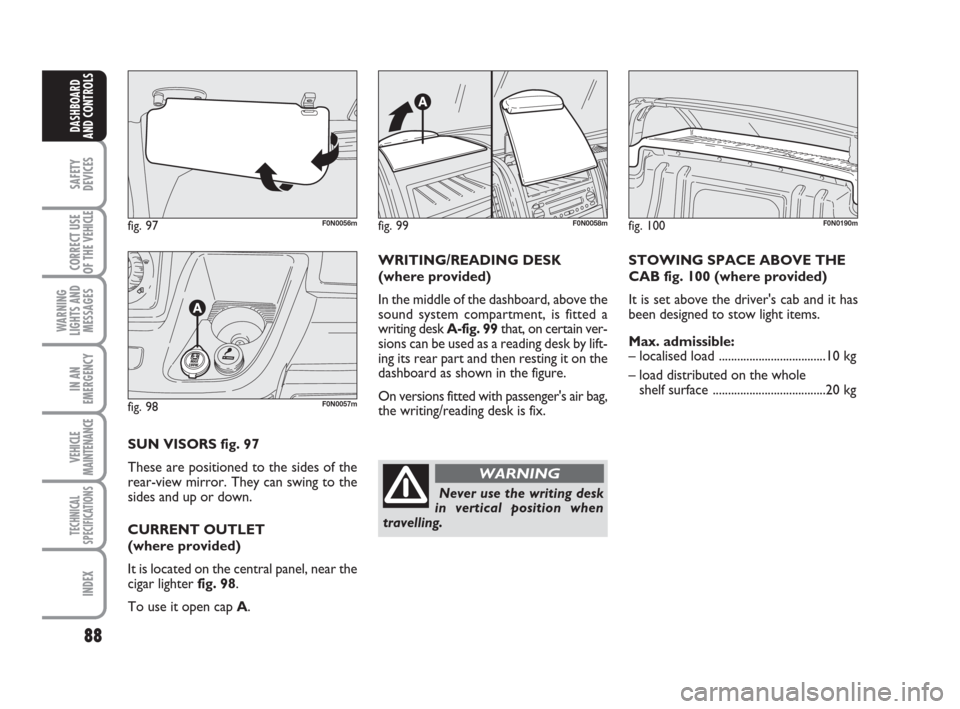
fig. 97F0N0056m
fig. 98F0N0057m
SUN VISORS fig. 97
These are positioned to the sides of the
rear-view mirror. They can swing to the
sides and up or down.
CURRENT OUTLET
(where provided)
It is located on the central panel, near the
cigar lighter fig. 98.
To use it open cap A.WRITING/READING DESK
(where provided)
In the middle of the dashboard, above the
sound system compartment, is fitted a
writing desk A-fig. 99that, on certain ver-
sions can be used as a reading desk by lift-
ing its rear part and then resting it on the
dashboard as shown in the figure.
On versions fitted with passenger's air bag,
the writing/reading desk is fix.STOWING SPACE ABOVE THE
CAB fig. 100 (where provided)
It is set above the driver's cab and it has
been designed to stow light items.
Max. admissible:
– localised load ...................................10 kg
– load distributed on the whole
shelf surface .....................................20 kg
fig. 99F0N0058mfig. 100F0N0190m
Never use the writing desk
in vertical position when
travelling.
WARNING
Page 90 of 282
89
SAFETY
DEVICES
CORRECT USE
OF THE
VEHICLE
WARNING
LIGHTS AND
MESSAGES
IN AN
EMERGENCY
VEHICLE
MAINTENANCE
TECHNICAL
SPECIFICATIONS
INDEX
DASHBOARD
AND CONTROLS
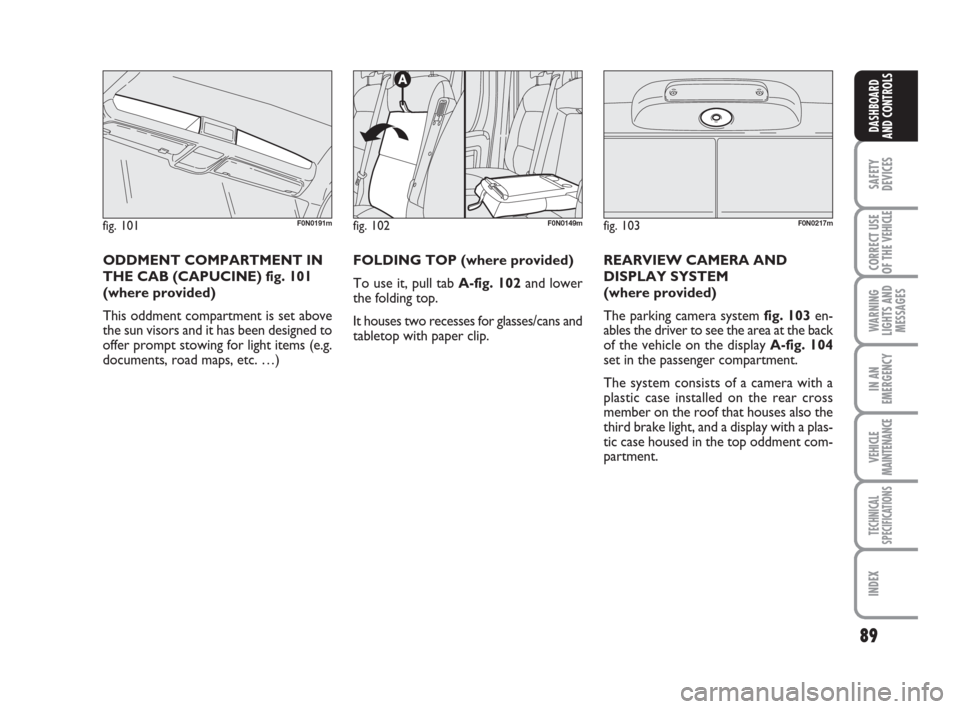
fig. 102F0N0149m
FOLDING TOP (where provided)
To use it, pull tab A-fig. 102 and lower
the folding top.
It houses two recesses for glasses/cans and
tabletop with paper clip.
fig. 101F0N0191m
ODDMENT COMPARTMENT IN
THE CAB (CAPUCINE) fig. 101
(where provided)
This oddment compartment is set above
the sun visors and it has been designed to
offer prompt stowing for light items (e.g.
documents, road maps, etc. …)REARVIEW CAMERA AND
DISPLAY SYSTEM
(where provided)
The parking camera system fig. 103en-
ables the driver to see the area at the back
of the vehicle on the display A-fig. 104
set in the passenger compartment.
The system consists of a camera with a
plastic case installed on the rear cross
member on the roof that houses also the
third brake light, and a display with a plas-
tic case housed in the top oddment com-
partment.
fig. 103F0N0217m
Page 91 of 282
90
SAFETY
DEVICES
CORRECT USE
OF THE
VEHICLE
WARNING
LIGHTS AND
MESSAGES
IN AN
EMERGENCY
VEHICLE
MAINTENANCE
TECHNICAL
SPECIFICATIONS
INDEX
DASHBOARD
AND CONTROLS
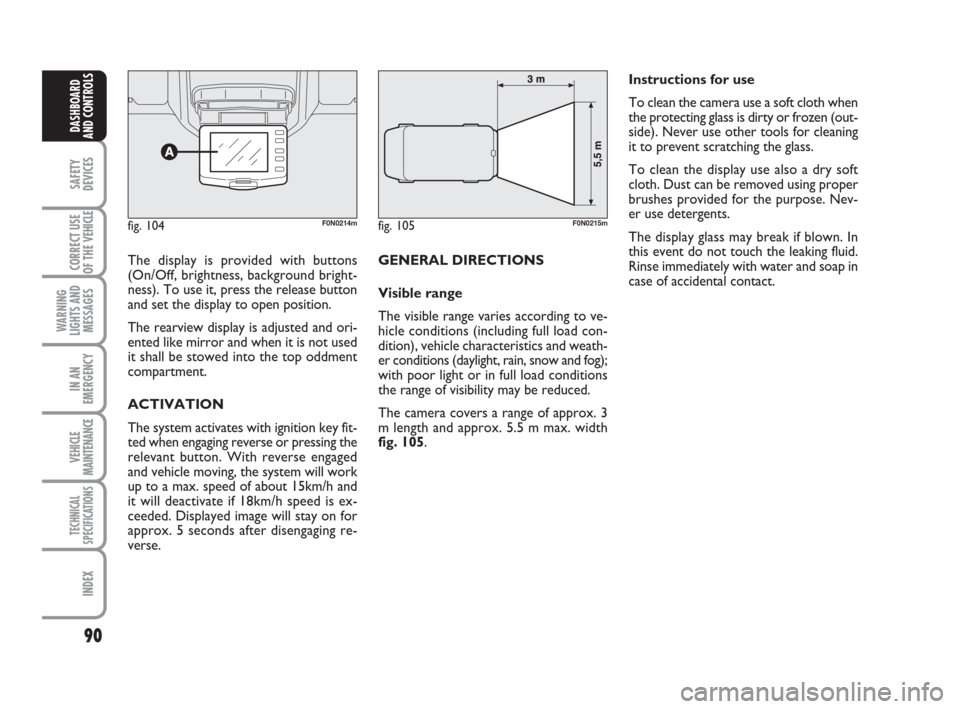
The display is provided with buttons
(On/Off, brightness, background bright-
ness). To use it, press the release button
and set the display to open position.
The rearview display is adjusted and ori-
ented like mirror and when it is not used
it shall be stowed into the top oddment
compartment.
ACTIVATION
The system activates with ignition key fit-
ted when engaging reverse or pressing the
relevant button. With reverse engaged
and vehicle moving, the system will work
up to a max. speed of about 15km/h and
it will deactivate if 18km/h speed is ex-
ceeded. Displayed image will stay on for
approx. 5 seconds after disengaging re-
verse. GENERAL DIRECTIONS
Visible range
The visible range varies according to ve-
hicle conditions (including full load con-
dition), vehicle characteristics and weath-
er conditions (daylight, rain, snow and fog);
with poor light or in full load conditions
the range of visibility may be reduced.
The camera covers a range of approx. 3
m length and approx. 5.5 m max. width
fig. 105.Instructions for use
To clean the camera use a soft cloth when
the protecting glass is dirty or frozen (out-
side). Never use other tools for cleaning
it to prevent scratching the glass.
To clean the display use also a dry soft
cloth. Dust can be removed using proper
brushes provided for the purpose. Nev-
er use detergents.
The display glass may break if blown. In
this event do not touch the leaking fluid.
Rinse immediately with water and soap in
case of accidental contact.
fig. 104F0N0214mfig. 105F0N0215m
Page 96 of 282
95
SAFETY
DEVICES
CORRECT USE
OF THE
VEHICLE
WARNING
LIGHTS AND
MESSAGES
IN AN
EMERGENCY
VEHICLE
MAINTENANCE
TECHNICAL
SPECIFICATIONS
INDEX
DASHBOARD
AND CONTROLS
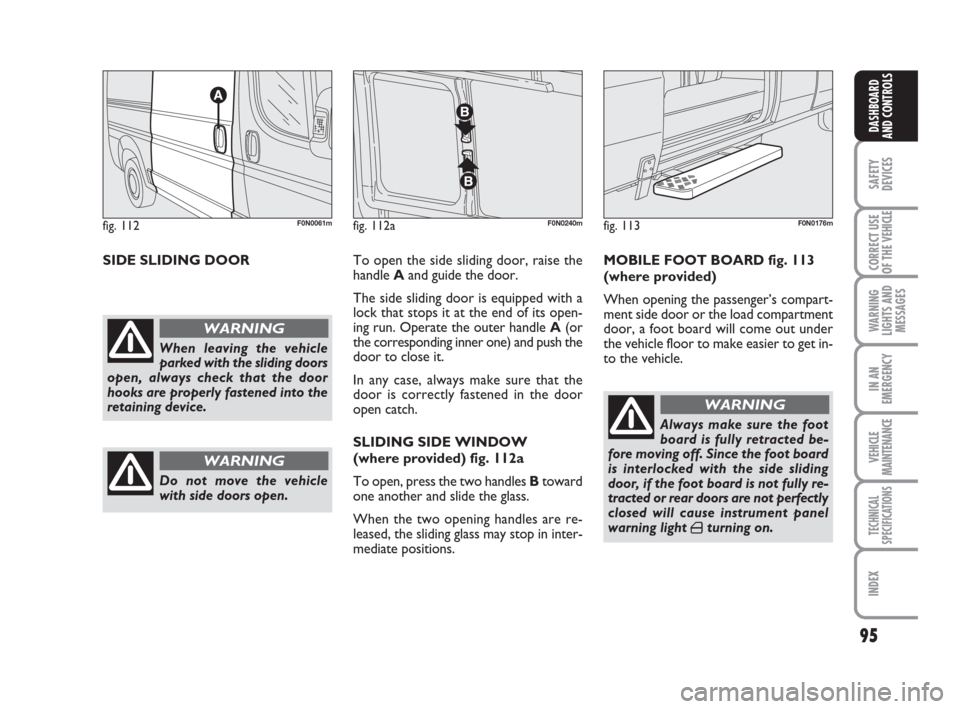
SIDE SLIDING DOORTo open the side sliding door, raise the
handle Aand guide the door.
The side sliding door is equipped with a
lock that stops it at the end of its open-
ing run. Operate the outer handle A(or
the corresponding inner one) and push the
door to close it.
In any case, always make sure that the
door is correctly fastened in the door
open catch.
SLIDING SIDE WINDOW
(where provided) fig. 112a
To open, press the two handles Btoward
one another and slide the glass.
When the two opening handles are re-
leased, the sliding glass may stop in inter-
mediate positions.MOBILE FOOT BOARD fig. 113
(where provided)
When opening the passenger’s compart-
ment side door or the load compartment
door, a foot board will come out under
the vehicle floor to make easier to get in-
to the vehicle.
fig. 112F0N0061m
When leaving the vehicle
parked with the sliding doors
open, always check that the door
hooks are properly fastened into the
retaining device.
WARNING
Do not move the vehicle
with side doors open.
WARNING
Always make sure the foot
board is fully retracted be-
fore moving off. Since the foot board
is interlocked with the side sliding
door, if the foot board is not fully re-
tracted or rear doors are not perfectly
closed will cause instrument panel
warning light
´turning on.
WARNING
fig. 113F0N0176mfig. 112aF0N0240m
Page 108 of 282
107
SAFETY
DEVICES
CORRECT USE
OF THE
VEHICLE
WARNING
LIGHTS AND
MESSAGES
IN AN
EMERGENCY
VEHICLE
MAINTENANCE
TECHNICAL
SPECIFICATIONS
INDEX
DASHBOARD
AND CONTROLS
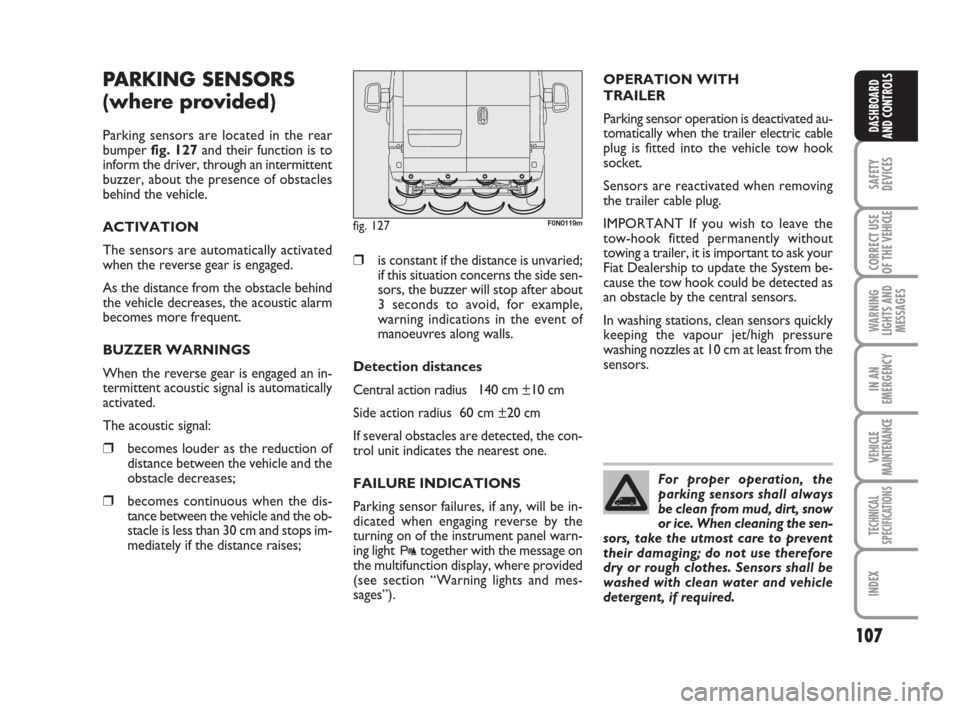
PARKING SENSORS
(where provided)
Parking sensors are located in the rear
bumper fig. 127and their function is to
inform the driver, through an intermittent
buzzer, about the presence of obstacles
behind the vehicle.
ACTIVATION
The sensors are automatically activated
when the reverse gear is engaged.
As the distance from the obstacle behind
the vehicle decreases, the acoustic alarm
becomes more frequent.
BUZZER WARNINGS
When the reverse gear is engaged an in-
termittent acoustic signal is automatically
activated.
The acoustic signal:
❒becomes louder as the reduction of
distance between the vehicle and the
obstacle decreases;
❒becomes continuous when the dis-
tance between the vehicle and the ob-
stacle is less than 30 cm and stops im-
mediately if the distance raises;
❒is constant if the distance is unvaried;
if this situation concerns the side sen-
sors, the buzzer will stop after about
3 seconds to avoid, for example,
warning indications in the event of
manoeuvres along walls.
Detection distances
Central action radius 140 cm ±10 cm
Side action radius 60 cm ±20 cm
If several obstacles are detected, the con-
trol unit indicates the nearest one.
FAILURE INDICATIONS
Parking sensor failures, if any, will be in-
dicated when engaging reverse by the
turning on of the instrument panel warn-
ing light
ttogether with the message on
the multifunction display, where provided
(see section “Warning lights and mes-
sages”).
fig. 127F0N0119m
For proper operation, the
parking sensors shall always
be clean from mud, dirt, snow
or ice. When cleaning the sen-
sors, take the utmost care to prevent
their damaging; do not use therefore
dry or rough clothes. Sensors shall be
washed with clean water and vehicle
detergent, if required.
OPERATION WITH
TRAILER
Parking sensor operation is deactivated au-
tomatically when the trailer electric cable
plug is fitted into the vehicle tow hook
socket.
Sensors are reactivated when removing
the trailer cable plug.
IMPORTANT If you wish to leave the
tow-hook fitted permanently without
towing a trailer, it is important to ask your
Fiat Dealership to update the System be-
cause the tow hook could be detected as
an obstacle by the central sensors.
In washing stations, clean sensors quickly
keeping the vapour jet/high pressure
washing nozzles at 10 cm at least from the
sensors.
Page 134 of 282
133
WARNING
LIGHTS AND
MESSAGES
IN AN
EMERGENCY
VEHICLE
MAINTENANCE
TECHNICAL
SPECIFICATIONS
INDEX
DASHBOARD
AND CONTROLS
SAFETY
DEVICES
CORRECT USE
OF THE VEHICLE
ENGINE STARTING ........................................................... 134
PARKING................................................................................ 136
USING THE MANUAL GEARBOX ................................. 136
LOAD RECOMMENDATIONS ........................................ 137
CONTAINING RUNNING COSTS................................. 138
TOWING TRAILERS............................................................ 139
SNOW TYRES....................................................................... 143
SNOW CHAINS................................................................... 143
VEHICLE INACTIVITY ....................................................... 144
CC C
O O
R R
R R
E E
C C
T T
U U
S S
E E
O O
F F
T T
H H
E E
V V
E E
H H
I I
C C
L L
E E
Page 136 of 282
135
WARNING
LIGHTS AND
MESSAGES
IN AN
EMERGENCY
VEHICLE
MAINTENANCE
TECHNICAL
SPECIFICATIONS
INDEX
DASHBOARD
AND CONTROLS
SAFETY
DEVICES
CORRECT USE
OF THE VEHICLE
If the engine does not start at the first at-
tempt, return the ignition key to STOP
before repeating starting.
If, when the ignition key is at MAR, the in-
strument panel warning light
Yremains
lit together with warning light
mturn
the key to STOPand then back to MAR;
if the warning lights remain on, try with
the other keys provided with the vehicle.
IMPORTANT If the instrument panel
warning light
Ystays on glowing steadi-
ly, contact immediately Fiat Dealership.
IMPORTANT Never leave the ignition key
to MARwhen the engine is off.
The warning light
mwill
flash for 60 seconds at start-
up or during prolonged crank-
ing to indicate a fault in the
glow plug heating system. You can use
the vehicle as usual if the engine starts
but you should contact Fiat Dealership
as soon as possible.
HOW TO WARM UP THE
ENGINE AFTER IT HAS JUST
STARTED
Proceed as follows:
❒drive off slowly, letting the engine turn
at medium revs. Do not accelerate
abruptly;
❒do not drive at full performance for
the initial kilometres. Wait until the
coolant temperature gauge starts
moving.
Remember that the servo-
brake and power steering are
not operational until the en-
gine has been started, there-
fore much effort than usual is required
on the brake pedal and steering wheel.
Never bump start the engine
by pushing, towing or coast-
ing downhill as this could
cause fuel to flow into the
catalytic exhaust system and damage
it beyond repair.
STOPPING THE ENGINE
Turn the ignition to STOPwhile the en-
gine is idling.
IMPORTANT After a taxing drive, you
should allow the engine to “catch its
breath” before turning it off by letting it
idle to allow the temperature in the en-
gine compartment to fall.
A quick burst on the acceler-
ator before turning off the en-
gine serves absolutely no
practical purpose, it wastes
fuel and is damaging especially to tur-
bocharged engines.
Page 138 of 282
137
WARNING
LIGHTS AND
MESSAGES
IN AN
EMERGENCY
VEHICLE
MAINTENANCE
TECHNICAL
SPECIFICATIONS
INDEX
DASHBOARD
AND CONTROLS
SAFETY
DEVICES
CORRECT USE
OF THE VEHICLE
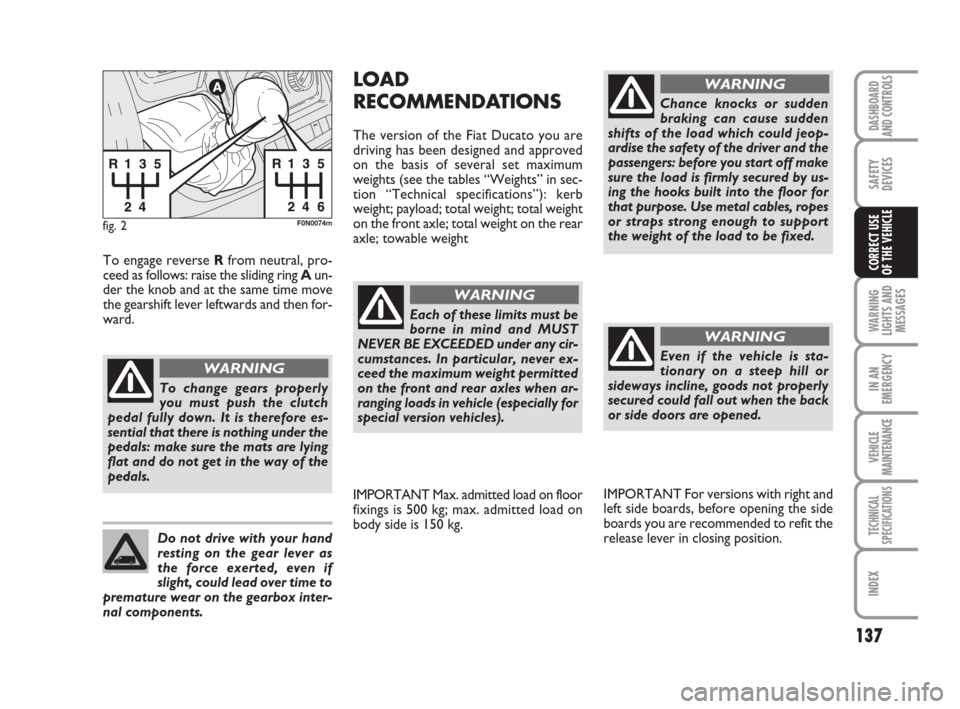
fig. 2F0N0074m
To change gears properly
you must push the clutch
pedal fully down. It is therefore es-
sential that there is nothing under the
pedals: make sure the mats are lying
flat and do not get in the way of the
pedals.
WARNING
Do not drive with your hand
resting on the gear lever as
the force exerted, even if
slight, could lead over time to
premature wear on the gearbox inter-
nal components.
To engage reverse R from neutral, pro-
ceed as follows: raise the sliding ring Aun-
der the knob and at the same time move
the gearshift lever leftwards and then for-
ward.
LOAD
RECOMMENDATIONS
The version of the Fiat Ducato you are
driving has been designed and approved
on the basis of several set maximum
weights (see the tables “Weights” in sec-
tion “Technical specifications”): kerb
weight; payload; total weight; total weight
on the front axle; total weight on the rear
axle; towable weight
Each of these limits must be
borne in mind and MUST
NEVER BE EXCEEDED under any cir-
cumstances. In particular, never ex-
ceed the maximum weight permitted
on the front and rear axles when ar-
ranging loads in vehicle (especially for
special version vehicles).Chance knocks or sudden
braking can cause sudden
shifts of the load which could jeop-
ardise the safety of the driver and the
passengers: before you start off make
sure the load is firmly secured by us-
ing the hooks built into the floor for
that purpose. Use metal cables, ropes
or straps strong enough to support
the weight of the load to be fixed.
WARNING
WARNING
Even if the vehicle is sta-
tionary on a steep hill or
sideways incline, goods not properly
secured could fall out when the back
or side doors are opened.
WARNING
IMPORTANT Max. admitted load on floor
fixings is 500 kg; max. admitted load on
body side is 150 kg.IMPORTANT For versions with right and
left side boards, before opening the side
boards you are recommended to refit the
release lever in closing position.
Page 139 of 282
138
WARNING
LIGHTS AND
MESSAGES
IN AN
EMERGENCY
VEHICLE
MAINTENANCE
TECHNICAL
SPECIFICATIONS
INDEX
DASHBOARD
AND CONTROLS
SAFETY
DEVICES
CORRECT USE
OF THE VEHICLE
CONTAINING
RUNNING COSTS
Here are some suggestions which may
help you to keep the running costs of your
vehicle down and lower the amount of
toxic emissions released into the atmos-
phere.
GENERAL CONSIDERATIONS
Vehicle maintenance
Carry out the checks and adjustments/reg-
ulations specified in the “Service Sched-
ule”.
Tyres
Check the pressure of the tyres routine-
ly at an interval of no more than 4 weeks:
if the pressure is too low, consumption
levels increase as resistance to rolling is
higher.
Unnecessary loads
Do not travel with too much luggage
stowed in the boot. The weight of the ve-
hicle (especially when driving in town) and
its trim greatly affects consumption and
stability.Roof rack/ski rack
Remove the roof rack or the ski rack from
the roof as soon as they are no longer
used. These accessories lower air pene-
tration and adversely affect consumption
levels. When needing to carry particular-
ly voluminous objects, preferably use a
trailer.
Electric devices
Use electric devices only for the amount
of time needed. Rear heated window, ad-
ditional headlights, windscreen wipers and
heater fan need a considerable amount of
energy, therefore increasing the require-
ment of current increases fuel consump-
tion (up to +25% in the urban cycle).
Climate control
The air conditioner is an additional load
which greatly affects the engine leading to
higher consumption (on average up to
+20%). When the temperature outside
the vehicle permits it, use the air vents
where possible.
Spoilers
The use of non-certified aerodynamic
items may adversely affect air drag and
consumption levels.
Observe the enforced rules if
you need to carry a spare
can of petrol. Only use a homologat-
ed can and secure it to the load an-
choring eyebolts. Even given these
precautions, the risk of fire in the
event of an accident is increased.
WARNING
In addition to these general precautions,
some simple measures could enhance dri-
ving safety, comfort and the length of the
vehicle’s life:
❒distribute the load evenly over the
load floor: if you need to concentrate
it all in one point choose the part be-
tween the axles;
❒remember that the lower the load is,
the lower the vehicle’s centre of grav-
ity will be, contributing to a safe drive;
you should therefore always position
the heavier goods at the bottom;
❒finally, remember that the way in
which the vehicle moves is influenced
by the weight being carried. In partic-
ular, stopping distance lengthens par-
ticularly at high speed.