towing FIAT DUCATO 2008 3.G User Guide
[x] Cancel search | Manufacturer: FIAT, Model Year: 2008, Model line: DUCATO, Model: FIAT DUCATO 2008 3.GPages: 282, PDF Size: 4.55 MB
Page 158 of 282
157
WARNING
LIGHTS AND
MESSAGES
VEHICLE
MAINTENANCE
TECHNICAL
SPECIFICATIONS
INDEX
DASHBOARD
AND CONTROLS
SAFETY
DEVICES
CORRECT USE
OF THE
VEHICLE
IN AN
EMERGENCY
ENGINE STARTING ........................................................... 158
IF A TYRE IS PUNCTURED............................................... 159
QUICK TYRE REPAIR KIT
FIX & GO automatic ........................................................... 163
WHEN NEEDING TO CHANGE A BULB ................... 168
IF AN EXTERIOR LIGHT BURNS OUT.......................... 170
IF AN INTERIOR LIGHT BURNS OUT.......................... 176
IF A FUSE BLOWS................................................................ 177
IF THE BATTERY IS FLAT .................................................. 185
JACKING THE VEHICLE ................................................... 186
TOWING THE VEHICLE ................................................... 186
II I
N N
A A
N N
E E
M M
E E
R R
G G
E E
N N
C C
Y Y
In an emergency we recommend that you call the toll-free number found on the
Warranty Booklet. You can also connect to the site www.fiat.com
to search for the nearest Fiat Dealership point
Page 160 of 282
159
WARNING
LIGHTS AND
MESSAGES
VEHICLE
MAINTENANCE
TECHNICAL
SPECIFICATIONS
INDEX
DASHBOARD
AND CONTROLS
SAFETY
DEVICES
CORRECT USE
OF THE
VEHICLE
IN AN
EMERGENCY
IMPORTANT Never connect the negative
terminals of the two batteries directly:
sparks could ignite explosive gas released
from the battery. If the auxiliary battery is
installed on another vehicle, avoid any
metal parts on the latter and the vehicle
with the flat battery from accidentally
coming into contact.
BUMP STARTING
Never jump start the engine by pushing,
towing or driving downhill. This could
cause a flow of fuel into the catalytic con-
verter and damage it beyond repair.
IMPORTANT Remember that the brake
servo and the power steering system are
not activated until the engine is started, a
greater effort will therefore be required
to press the brake pedal or turn the steer-
ing wheel.CHANGING
A WHEEL
GENERAL INSTRUCTIONS
To chage a wheel and the use the jack and
spare wheel correctly, observe some of
the precautions listed below.
Signal that the vehicle is sta-
tionary in accordance with
the following legal requirements:
hazard warning lights, emergency
warning triangle, etc. It is advisable
for the people in the vehicle to get
out, especially if the vehicle is heavi-
ly laden, and wait until the repair is
carried out, well away from any dan-
gerous traffic. Apply the handbrake
WARNING
The spare wheel is specific
for your vehicle. Therefore,
it must not be used on vehicles of a
different model. Do not use spare
wheels of different models on your ve-
hicle. The wheel bolts are specific for
your vehicle. Do not use them on ve-
hicles of different models. Do not use
bolts of different models on your ve-
hicle.
WARNING
Repair and refit the wheel
changed as soon as possible.
Do not apply grease to the bolt
threads before assembly: the bolts
could come loose unexpectedly.
WARNING
Page 187 of 282
186
WARNING
LIGHTS AND
MESSAGES
VEHICLE
MAINTENANCE
TECHNICAL
SPECIFICATIONS
IINDEX
DASHBOARD
AND CONTROLS
SAFETY
DEVICES
CORRECT USE
OF THE
VEHICLE
IN AN
EMERGENCY
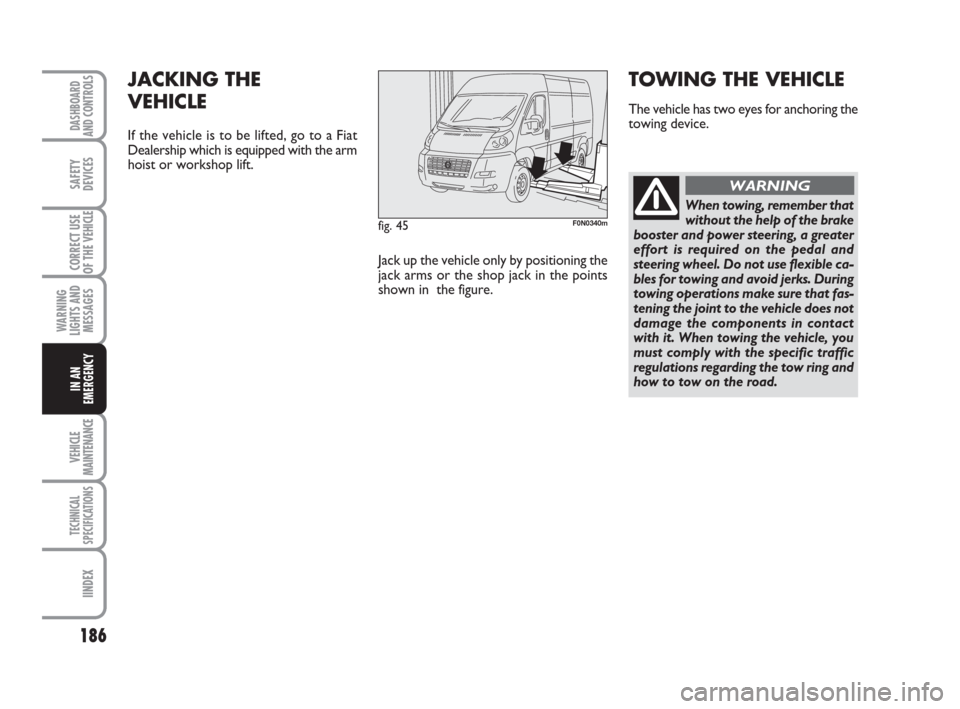
fig. 45F0N0340m
JACKING THE
VEHICLE
If the vehicle is to be lifted, go to a Fiat
Dealership which is equipped with the arm
hoist or workshop lift.
Jack up the vehicle only by positioning the
jack arms or the shop jack in the points
shown in the figure.
TOWING THE VEHICLE
The vehicle has two eyes for anchoring the
towing device.
When towing, remember that
without the help of the brake
booster and power steering, a greater
effort is required on the pedal and
steering wheel. Do not use flexible ca-
bles for towing and avoid jerks. During
towing operations make sure that fas-
tening the joint to the vehicle does not
damage the components in contact
with it. When towing the vehicle, you
must comply with the specific traffic
regulations regarding the tow ring and
how to tow on the road.
WARNING
Page 188 of 282
187
WARNING
LIGHTS AND
MESSAGES
VEHICLE
MAINTENANCE
TECHNICAL
SPECIFICATIONS
INDEX
DASHBOARD
AND CONTROLS
SAFETY
DEVICES
CORRECT USE
OF THE
VEHICLE
IN AN
EMERGENCY
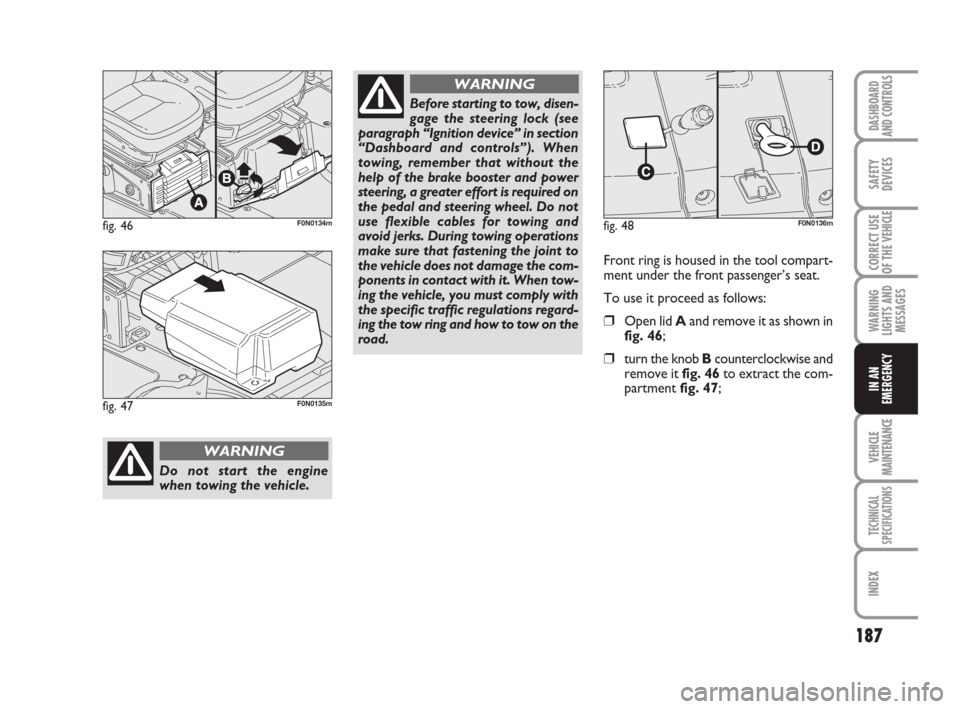
fig. 46F0N0134m
Do not start the engine
when towing the vehicle.
WARNING
Before starting to tow, disen-
gage the steering lock (see
paragraph “Ignition device” in section
“Dashboard and controls”). When
towing, remember that without the
help of the brake booster and power
steering, a greater effort is required on
the pedal and steering wheel. Do not
use flexible cables for towing and
avoid jerks. During towing operations
make sure that fastening the joint to
the vehicle does not damage the com-
ponents in contact with it. When tow-
ing the vehicle, you must comply with
the specific traffic regulations regard-
ing the tow ring and how to tow on the
road.
WARNING
fig. 47F0N0135m
fig. 48F0N0136m
Front ring is housed in the tool compart-
ment under the front passenger’s seat.
To use it proceed as follows:
❒Open lid Aand remove it as shown in
fig. 46;
❒turn the knob Bcounterclockwise and
remove it fig. 46 to extract the com-
partment fig. 47;
Page 195 of 282
194
WARNING
LIGHTS AND
MESSAGES
TECHNICAL
SPECIFICATIONS
INDEX
DASHBOARD
AND CONTROLS
SAFETY
DEVICES
CORRECT USE
OF THE VEHICLE
IN AN
EMERGENCY
VEICHLE
MAINTENANCE
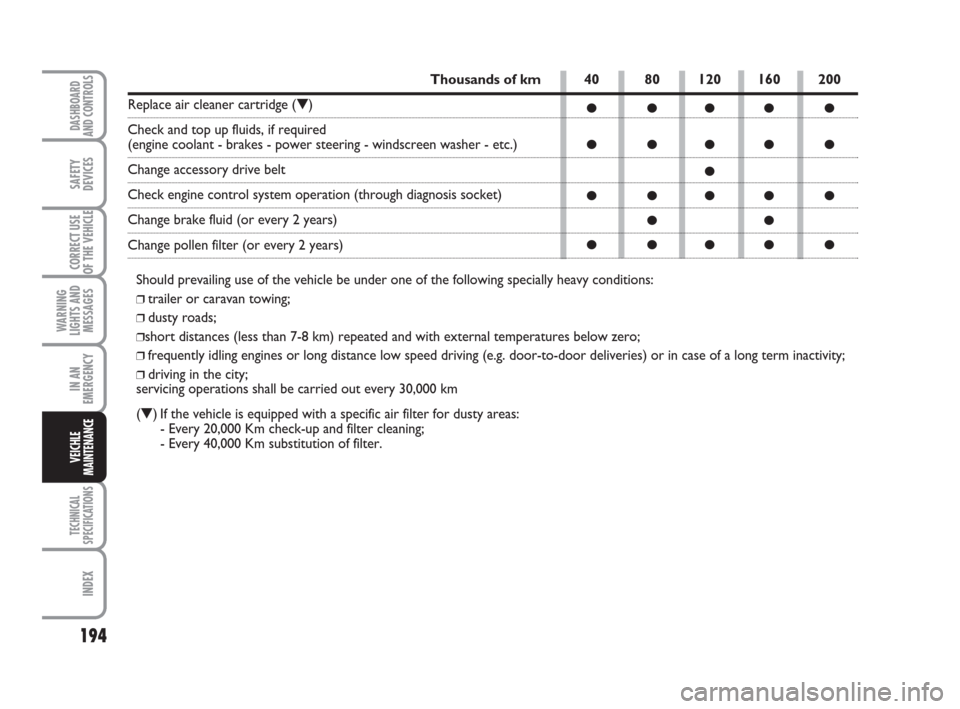
40 80 120 160 200
●●●●●
●●●●●
●
●●●●●
●●
●●●●●
Thousands of km
Replace air cleaner cartridge (▼)
Check and top up fluids, if required
(engine coolant - brakes - power steering - windscreen washer - etc.)
Change accessory drive belt
Check engine control system operation (through diagnosis socket)
Change brake fluid (or every 2 years)
Change pollen filter (or every 2 years)
Should prevailing use of the vehicle be under one of the following specially heavy conditions:
❒trailer or caravan towing;
❒dusty roads;
❒short distances (less than 7-8 km) repeated and with external temperatures below zero;
❒frequently idling engines or long distance low speed driving (e.g. door-to-door deliveries) or in case of a long term inactivity;
❒driving in the city;
servicing operations shall be carried out every 30,000 km
(▼) If the vehicle is equipped with a specific air filter for dusty areas:
- Every 20,000 Km check-up and filter cleaning;
- Every 40,000 Km substitution of filter.
Page 196 of 282
195
WARNING
LIGHTS AND
MESSAGES
TECHNICAL
SPECIFICATIONS
INDEX
DASHBOARD
AND CONTROLS
SAFETY
DEVICES
CORRECT USE
OF THE VEHICLE
IN AN
EMERGENCY
VEHICLE
MAINTENANCE
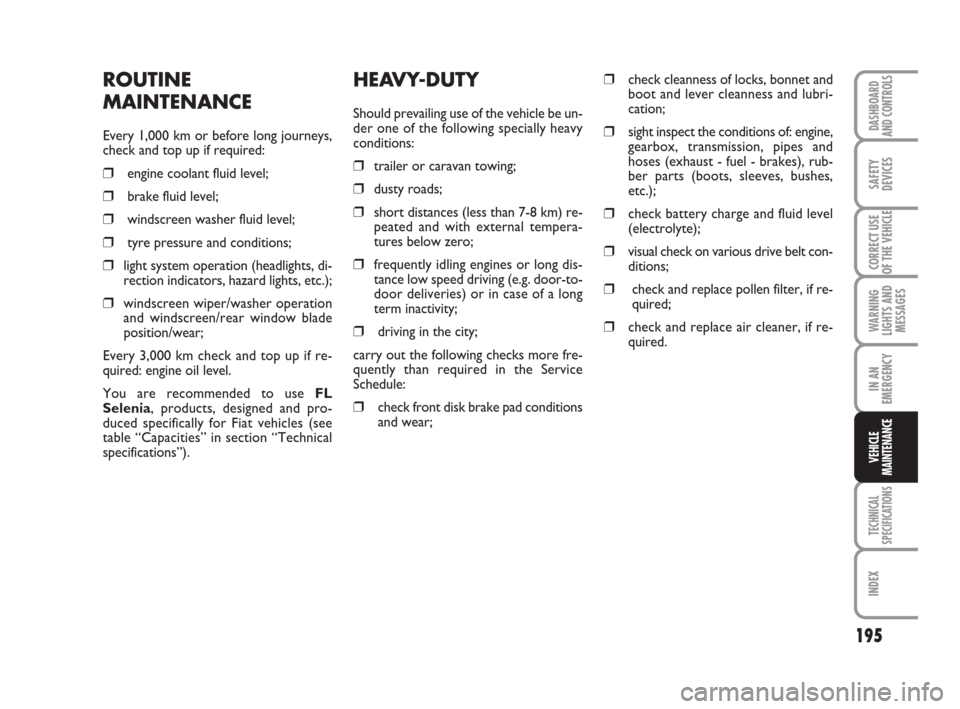
HEAVY-DUTY
Should prevailing use of the vehicle be un-
der one of the following specially heavy
conditions:
❒trailer or caravan towing;
❒dusty roads;
❒short distances (less than 7-8 km) re-
peated and with external tempera-
tures below zero;
❒frequently idling engines or long dis-
tance low speed driving (e.g. door-to-
door deliveries) or in case of a long
term inactivity;
❒driving in the city;
carry out the following checks more fre-
quently than required in the Service
Schedule:
❒check front disk brake pad conditions
and wear;
❒check cleanness of locks, bonnet and
boot and lever cleanness and lubri-
cation;
❒sight inspect the conditions of: engine,
gearbox, transmission, pipes and
hoses (exhaust - fuel - brakes), rub-
ber parts (boots, sleeves, bushes,
etc.);
❒check battery charge and fluid level
(electrolyte);
❒visual check on various drive belt con-
ditions;
❒check and replace pollen filter, if re-
quired;
❒check and replace air cleaner, if re-
quired.
ROUTINE
MAINTENANCE
Every 1,000 km or before long journeys,
check and top up if required:
❒engine coolant fluid level;
❒brake fluid level;
❒windscreen washer fluid level;
❒tyre pressure and conditions;
❒light system operation (headlights, di-
rection indicators, hazard lights, etc.);
❒windscreen wiper/washer operation
and windscreen/rear window blade
position/wear;
Every 3,000 km check and top up if re-
quired: engine oil level.
You are recommended to use FL
Selenia, products, designed and pro-
duced specifically for Fiat vehicles (see
table “Capacities” in section “Technical
specifications”).
Page 274 of 282
273
WARNING
LIGHTS AND
MESSAGES
DASHBOARD
AND CONTROLS
SAFETY
DEVICES
CORRECT USE
OF THE
VEHICLE
IN AN
EMERGENCY
VEHICLE
MAINTENANCE
TECHNICAL
SPECIFICATIONS
INDEX
Steering column lock ......................... 15
Steering wheel adjustment ............... 44
Storing the vehicle .............................. 144
Sun visors ............................................. 88
Supplementary heater......................... 55
Suspensions .......................................... 218
Symbols ................................................. 7
Technical specifications..................... 211
Third brake light ................................. 175
Tips on loading..................................... 137
Top speeds ........................................... 229
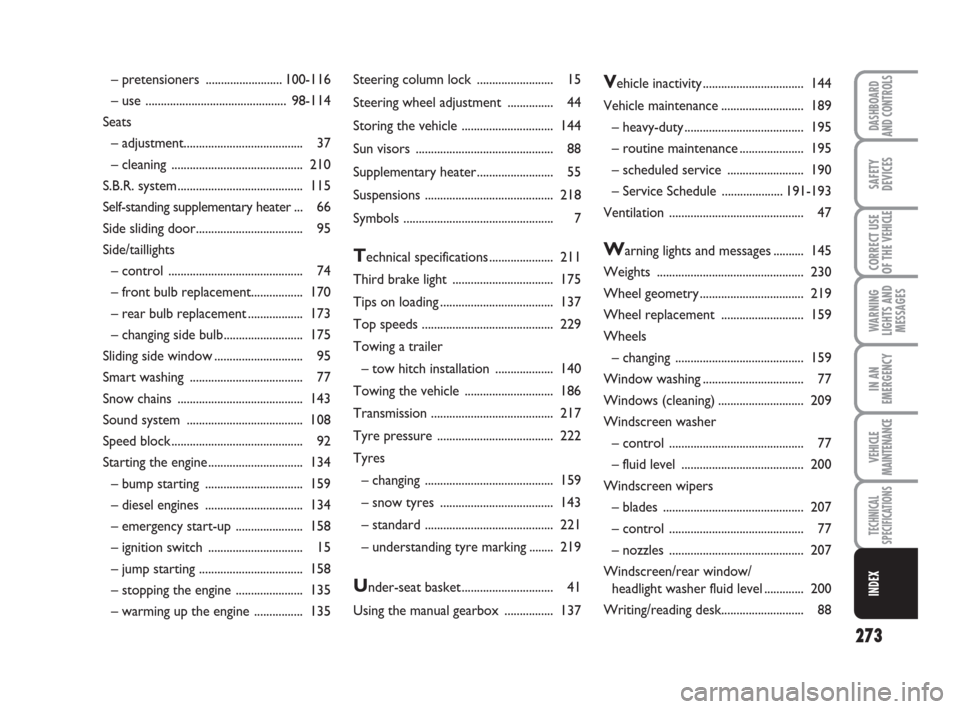
Towing a trailer
– tow hitch installation ................... 140
Towing the vehicle ............................. 186
Transmission ........................................ 217
Tyre pressure ...................................... 222
Tyres
– changing .......................................... 159
– snow tyres ..................................... 143
– standard .......................................... 221
– understanding tyre marking ........ 219
Under-seat basket.............................. 41
Using the manual gearbox ................ 137
Vehicle inactivity................................. 144
Vehicle maintenance........................... 189
– heavy-duty....................................... 195
– routine maintenance..................... 195
– scheduled service ......................... 190
– Service Schedule ....................191-193
Ventilation ............................................ 47
Warning lights and messages .......... 145
Weights ................................................ 230
Wheel geometry.................................. 219
Wheel replacement ........................... 159
Wheels
– changing .......................................... 159
Window washing................................. 77
Windows (cleaning)............................ 209
Windscreen washer
– control ............................................ 77
– fluid level ........................................ 200
Windscreen wipers
– blades .............................................. 207
– control ............................................ 77
– nozzles ............................................ 207
Windscreen/rear window/
headlight washer fluid level ............. 200
Writing/reading desk........................... 88 – pretensioners .........................100-116
– use ..............................................98-114
Seats
– adjustment....................................... 37
– cleaning ........................................... 210
S.B.R. system......................................... 115
Self-standing supplementary heater ... 66
Side sliding door................................... 95
Side/taillights
– control ............................................ 74
– front bulb replacement................. 170
– rear bulb replacement.................. 173
– changing side bulb.......................... 175
Sliding side window............................. 95
Smart washing ..................................... 77
Snow chains ......................................... 143
Sound system ...................................... 108
Speed block........................................... 92
Starting the engine............................... 134
– bump starting ................................ 159
– diesel engines ................................ 134
– emergency start-up ...................... 158
– ignition switch ............................... 15
– jump starting .................................. 158
– stopping the engine ...................... 135
– warming up the engine ................ 135