In ani emergency FIAT DUCATO 2008 3.G Owner's Manual
[x] Cancel search | Manufacturer: FIAT, Model Year: 2008, Model line: DUCATO, Model: FIAT DUCATO 2008 3.GPages: 282, PDF Size: 4.55 MB
Page 207 of 282
206
WARNING
LIGHTS AND
MESSAGES
TECHNICAL
SPECIFICATIONS
INDEX
DASHBOARD
AND CONTROLS
SAFETY
DEVICES
CORRECT USE
OF THE VEHICLE
IN AN
EMERGENCY
VEICHLE
MAINTENANCE
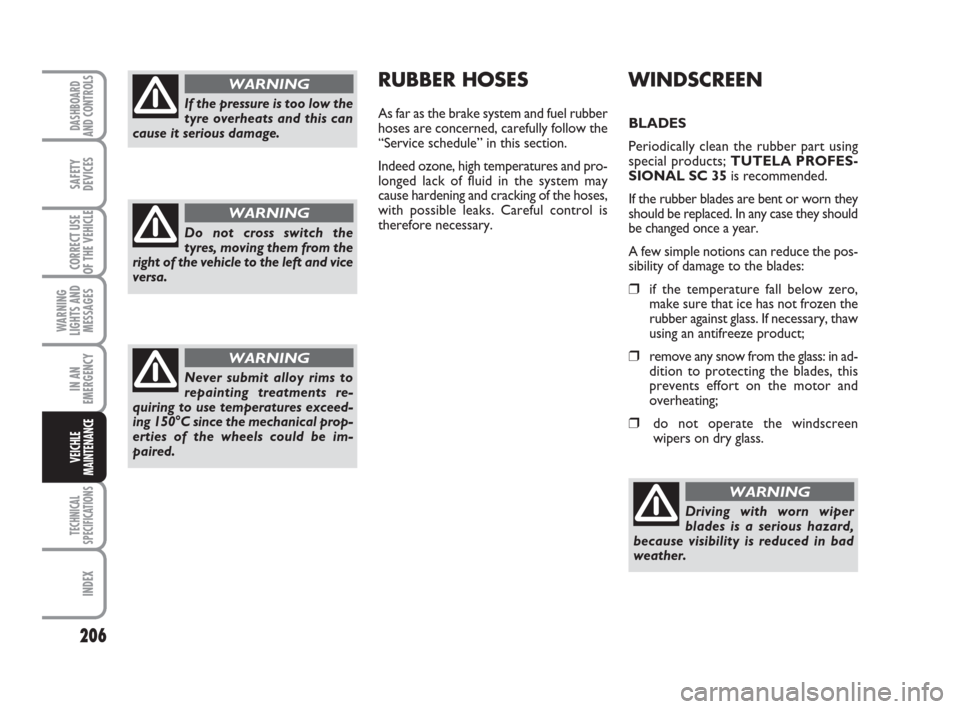
WINDSCREEN
BLADES
Periodically clean the rubber part using
special products; TUTELA PROFES-
SIONAL SC 35is recommended.
If the rubber blades are bent or worn they
should be replaced. In any case they should
be changed once a year.
A few simple notions can reduce the pos-
sibility of damage to the blades:
❒if the temperature fall below zero,
make sure that ice has not frozen the
rubber against glass. If necessary, thaw
using an antifreeze product;
❒remove any snow from the glass: in ad-
dition to protecting the blades, this
prevents effort on the motor and
overheating;
❒do not operate the windscreen
wipers on dry glass.
Driving with worn wiper
blades is a serious hazard,
because visibility is reduced in bad
weather.
WARNING
RUBBER HOSES
As far as the brake system and fuel rubber
hoses are concerned, carefully follow the
“Service schedule” in this section.
Indeed ozone, high temperatures and pro-
longed lack of fluid in the system may
cause hardening and cracking of the hoses,
with possible leaks. Careful control is
therefore necessary.If the pressure is too low the
tyre overheats and this can
cause it serious damage.
WARNING
Do not cross switch the
tyres, moving them from the
right of the vehicle to the left and vice
versa.
WARNING
Never submit alloy rims to
repainting treatments re-
quiring to use temperatures exceed-
ing 150°C since the mechanical prop-
erties of the wheels could be im-
paired.
WARNING
Page 209 of 282
208
WARNING
LIGHTS AND
MESSAGES
TECHNICAL
SPECIFICATIONS
INDEX
DASHBOARD
AND CONTROLS
SAFETY
DEVICES
CORRECT USE
OF THE VEHICLE
IN AN
EMERGENCY
VEICHLE
MAINTENANCE
BODY AND UNDERBODY
WARRANTY
Your vehicle is covered by warranty
against perforation due to rust of any orig-
inal element of the structure or body.
For the general terms of this warranty, re-
fer to Fiat Warranty Booklet.
ADVICE FOR PRESERVING THE
BODYWORK
Paint
Paintwork does not only serve an aesteth-
ic purpose, but also protects the under-
lying sheet metal.
In the case of deep scrapes or scores, you
are advised to have the necessary touching
up carried out immediately to avoid the for-
mation of rust. For touching up use only
original products (see “Bodywork paint
identification plate” in section “Technical
specifications”).
Normal paint maintenance consists in
washing at intervals depending on the con-
ditions and environment of use. For exam-
ple, in highly polluted areas, or if the roads
are sprayed with salt, it is wise to wash the
vehicle more frequently. These include:
❒Painting products and systems which
give the vehicle particular resistance
to corrosion and abrasion;
❒Use of galvanised (or pretreated)
steel sheets, with high resistance to
corrosion;
❒Spraying the underbody, engine com-
partment, wheelhouse internal parts
and other parts with highly protective
wax products;
❒Spraying of plastic parts, with a pro-
tective function, in the more exposed
points: underdoor, inner fender parts,
edges, etc;
❒Use of “open” boxed sections to pre-
vent condensation and pockets of
moisture from triggering rust inside.
BODYWORK
PROTECTION FROM
ATMOSPHERIC AGENTS
The main causes of corrosion are the fol-
lowing:
❒atmospheric pollution;
❒salty air and humidity (coastal areas,
or hot humid climates);
❒seasonal environment conditions.
Not to be underestimated is also the abra-
sive action of wind-borne atmospheric
dust and sand and mud and gravel raised
by other vehicles.
On your vehicle, Fiat implemented the
best manufacturing technologies to effec-
tively protect the bodywork against cor-
rosion.
Page 210 of 282
209
WARNING
LIGHTS AND
MESSAGES
TECHNICAL
SPECIFICATIONS
INDEX
DASHBOARD
AND CONTROLS
SAFETY
DEVICES
CORRECT USE
OF THE VEHICLE
IN AN
EMERGENCY
VEHICLE
MAINTENANCE
To correctly wash the vehicle:
❒remove the aerial from the roof to
prevent damage to it if the vehicle is
washed in an automatic system;
❒wash the body using a low pressure jet
of water;
❒wipe a sponge with a slightly soapy so-
lution over the bodywork, frequently
rinsing with the sponge;
❒rinse well with water and dry with a
jet of air or a chamois leather.
When drying, take particular care with the
less visible parts like door surrounds, bon-
net and around the headlights where wa-
ter may stagnate. The vehicle should not
be taken to a closed area immediately, but
left in the open so that residual water can
evaporate.Do not wash the vehicle after it has been
left in the sun or with the bonnet hot: this
may alter the shine of the paintwork.
Exterior plastic parts must be cleaned in
the same way as the rest of the vehicle.
Where possible, do not park under trees;
the resinous substance many species re-
lease give the paint a dull appearance and
increase the possibility of triggering rust
processes.
For best paint protection, from time to
time polish the bodywork with special
waxes; when paint becomes mat due to
smog, polish the bodywork with polish
waxes that have also a light abrasive effect.
IMPORTANT Bird droppings must be
washed off immediately and thoroughly as
the acid they contain is particularly ag-
gressive.
Detergents cause water pollu-
tion. Therefore the engine
compartment should be
washed in areas equipped for
collecting and purifying the liquid used
in the washing process.
Windows
Use specific window cleaner products.
Use also clean cloths to avoid scratching
the glass or damaging the transparency.
IMPORTANT The inside of the rearscreen
should be wiped gently with a cloth in the
direction of the filaments to avoid damag-
ing the heating device.
Engine compartment
At the end of the winter the engine com-
partment should be carefully washed,
without directing the jet against electron-
ic control units. Contact a specialised
workshop to have this done.
IMPORTANT The vehicle should be
washed with the engine cold and the ig-
nition key at STOP. After washing make
sure that the various protections (e.g. rub-
ber caps and various covers) have not
been damaged or removed.
Front headlights
IMPORTANT Never use aromatic sub-
stances (e.g.: petrol) or ketones (e.g.: ace-
tone) for cleaning front headlight plastic
lens.
Page 211 of 282
210
WARNING
LIGHTS AND
MESSAGES
TECHNICAL
SPECIFICATIONS
INDEX
DASHBOARD
AND CONTROLS
SAFETY
DEVICES
CORRECT USE
OF THE VEHICLE
IN AN
EMERGENCY
VEICHLE
MAINTENANCE
Fabric upholstery of your Fiat
Ducato is purpose-made to
withstand common wear re-
sulting from normal use of the
vehicle. It is however absolutely neces-
sary to prevent hard and/or prolonged
scratching/scraping caused by clothing
accessories like metallic buckles, studs,
“Velcro” fixings, etc. that stressing lo-
cally the fabric could break yarns and
damage the upholstery as a conse-
quence.
INTERIOR PLASTIC PARTS CLEANING SEATS AND FABRIC
AND VELVET PARTS
Use a soft brush or vacuum cleaner to re-
move dust. Velvet is cleaned better if the
brush is moistened.
Rub the seats with a sponge moistened
with a solution of water and neutral de-
tergent.Never use flammable prod-
ucts like oil ether or rectified
petrol for cleaning vehicle interiors.
Electrostatic discharges generated by
rubbing during cleaning operations
could cause fire.
WARNING
Do not keep aerosol cans in
the vehicle: they might ex-
plode. Aerosol cans must never be ex-
posed to a temperature above 50° C.
The temperature inside the vehicle
exposed to the sun may go well be-
yond that figure.
WARNING
INTERIORS
Periodically check that water is not trapped
under the mats (due to water dripping off
shoes, umbrellas, etc.) which could cause
oxidisation of the sheet metal.STEERING WHEEL/GEAR LEVER
KNOB WITH GENUINE
LEATHER COVERING
These components shall only be cleaned
with water and neutral soap.
Never use spirit or alcohol-based prod-
ucts.
Before using special products for clean-
ing interiors, read carefully label instruc-
tions and indications to make sure they
are free from spirit and/or alcohol-based
substances.
If when cleaning the windscreen with spe-
cial glass products, some drops fall on the
leather covering of the steering wheel/gear
lever knob remove them immediately and
then clean with water and neutral soap.
IMPORTANT Take the utmost care when
engaging the steering lock to prevent
scratching the leather covering.
For routine cleaning of interior plastic parts
use a soft cloth moistened with water and
neutral soap. Remove grease or persisting
stains using appropriate solvent-free prod-
ucts designed to preserve appearance and
colour of plastic components.
IMPORTANT Never use spirit or petro-
leum to clean the instrument panel.
Page 216 of 282
215
WARNING
LIGHTS AND
MESSAGES
INDEX
DASHBOARD
AND CONTROLS
SAFETY
DEVICES
CORRECT USE
OF THE
VEHICLE
IN AN
EMERGENCY
VEHICLE
MAINTENANCE
TECHNICAL
SPECIFICATIONS
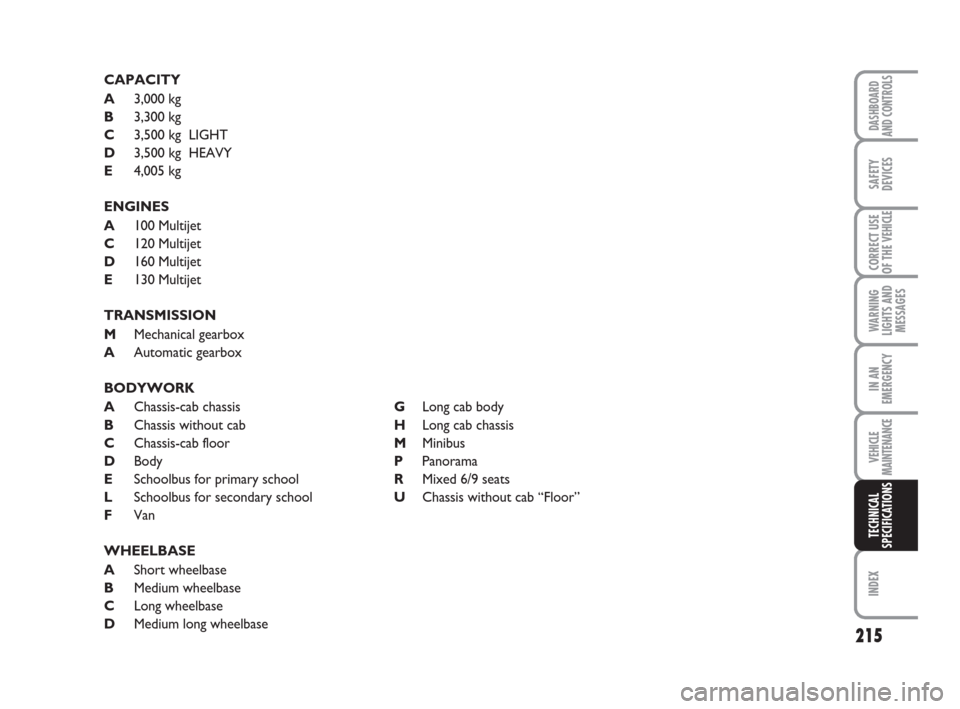
CAPACITY
A3,000 kg
B3,300 kg
C3,500 kg LIGHT
D3,500 kg HEAVY
E4,005 kg
ENGINES
A100 Multijet
C120 Multijet
D160 Multijet
E130 Multijet
TRANSMISSION
MMechanical gearbox
AAutomatic gearbox
BODYWORK
AChassis-cab chassisGLong cab body
BChassis without cabHLong cab chassis
CChassis-cab floorMMinibus
DBodyPPanorama
ESchoolbus for primary schoolRMixed 6/9 seats
LSchoolbus for secondary schoolUChassis without cab “Floor”
FVan
WHEELBASE
AShort wheelbase
BMedium wheelbase
CLong wheelbase
DMedium long wheelbase
Page 264 of 282
263
WARNING
LIGHTS AND
MESSAGES
INDEX
DASHBOARD
AND CONTROLS
SAFETY
DEVICES
CORRECT USE
OF THE
VEHICLE
IN AN
EMERGENCY
VEHICLE
MAINTENANCE
TECHNICAL
SPECIFICATIONS
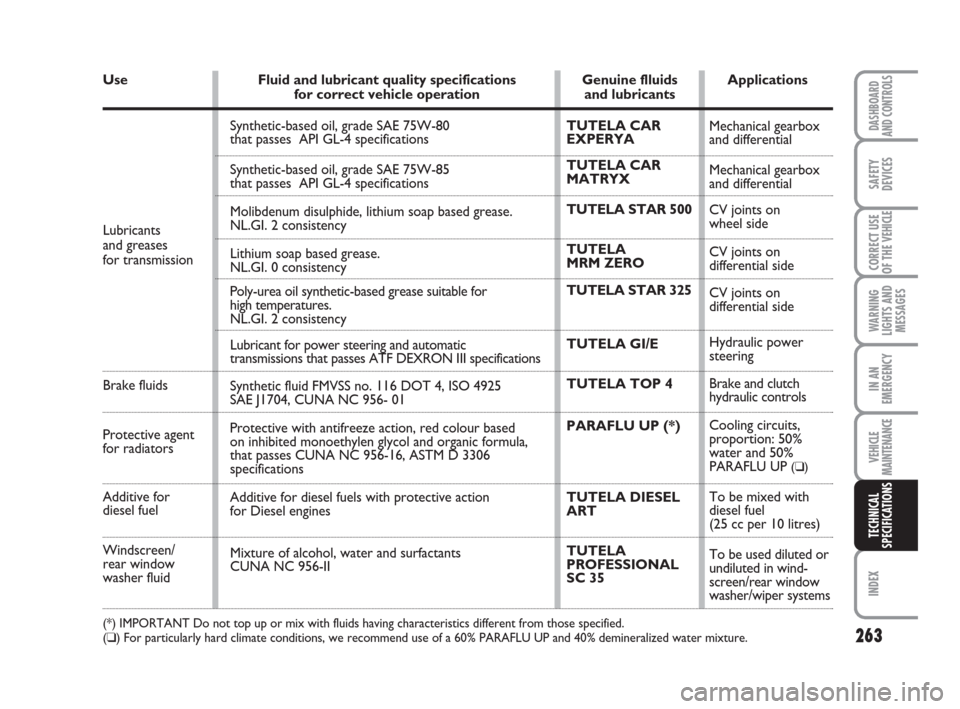
Lubricants
and greases
for transmission Use Fluid and lubricant quality specifications Genuine flluids Applications
for correct vehicle operation and lubricants
Brake fluids
Protective agent
for radiators
Additive for
diesel fuel
Windscreen/
rear window
washer fluid
(*) IMPORTANT Do not top up or mix with fluids having characteristics different from those specified.
(❑) For particularly hard climate conditions, we recommend use of a 60% PARAFLU UP and 40% demineralized water mixture.
Mechanical gearbox
and differential
Mechanical gearbox
and differential
CV joints on
wheel side
CV joints on
differential side
CV joints on
differential side
Hydraulic power
steering
Brake and clutch
hydraulic controls
Cooling circuits,
proportion: 50%
water and 50%
PARAFLU UP
(❑)
To be mixed with
diesel fuel
(25 cc per 10 litres)
To be used diluted or
undiluted in wind-
screen/rear window
washer/wiper systems TUTELA CAR
EXPERYA
TUTELA CAR
MATRYX
TUTELA STAR 500
TUTELA
MRM ZERO
TUTELA STAR 325
TUTELA GI/E
TUTELA TOP 4
PARAFLU UP (*)
TUTELA DIESEL
ART
TUTELA
PROFESSIONAL
SC 35 Synthetic-based oil, grade SAE 75W-80
that passes API GL-4 specifications
Synthetic-based oil, grade SAE 75W-85
that passes API GL-4 specifications
Molibdenum disulphide, lithium soap based grease.
NL.GI. 2 consistency
Lithium soap based grease.
NL.GI. 0 consistency
Poly-urea oil synthetic-based grease suitable for
high temperatures.
NL.GI. 2 consistency
Lubricant for power steering and automatic
transmissions that passes ATF DEXRON III specifications
Synthetic fluid FMVSS no. 116 DOT 4, ISO 4925
SAE J1704, CUNA NC 956- 01
Protective with antifreeze action, red colour based
on inhibited monoethylen glycol and organic formula,
that passes CUNA NC 956-16, ASTM D 3306
specifications
Additive for diesel fuels with protective action
for Diesel engines
Mixture of alcohol, water and surfactants
CUNA NC 956-II
Page 274 of 282
273
WARNING
LIGHTS AND
MESSAGES
DASHBOARD
AND CONTROLS
SAFETY
DEVICES
CORRECT USE
OF THE
VEHICLE
IN AN
EMERGENCY
VEHICLE
MAINTENANCE
TECHNICAL
SPECIFICATIONS
INDEX
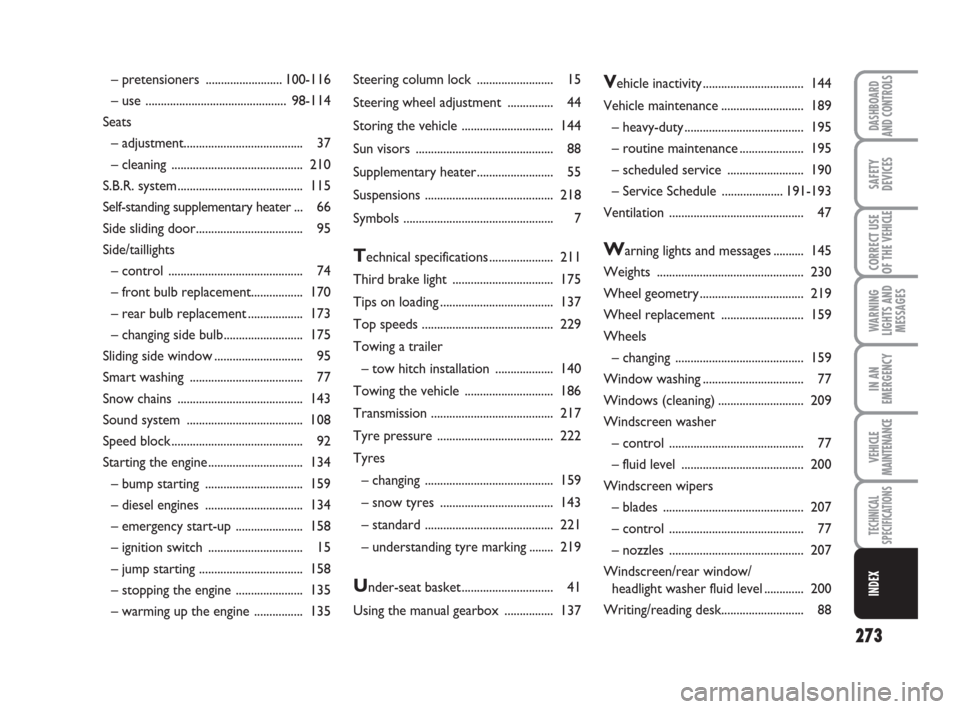
Steering column lock ......................... 15
Steering wheel adjustment ............... 44
Storing the vehicle .............................. 144
Sun visors ............................................. 88
Supplementary heater......................... 55
Suspensions .......................................... 218
Symbols ................................................. 7
Technical specifications..................... 211
Third brake light ................................. 175
Tips on loading..................................... 137
Top speeds ........................................... 229
Towing a trailer
– tow hitch installation ................... 140
Towing the vehicle ............................. 186
Transmission ........................................ 217
Tyre pressure ...................................... 222
Tyres
– changing .......................................... 159
– snow tyres ..................................... 143
– standard .......................................... 221
– understanding tyre marking ........ 219
Under-seat basket.............................. 41
Using the manual gearbox ................ 137
Vehicle inactivity................................. 144
Vehicle maintenance........................... 189
– heavy-duty....................................... 195
– routine maintenance..................... 195
– scheduled service ......................... 190
– Service Schedule ....................191-193
Ventilation ............................................ 47
Warning lights and messages .......... 145
Weights ................................................ 230
Wheel geometry.................................. 219
Wheel replacement ........................... 159
Wheels
– changing .......................................... 159
Window washing................................. 77
Windows (cleaning)............................ 209
Windscreen washer
– control ............................................ 77
– fluid level ........................................ 200
Windscreen wipers
– blades .............................................. 207
– control ............................................ 77
– nozzles ............................................ 207
Windscreen/rear window/
headlight washer fluid level ............. 200
Writing/reading desk........................... 88 – pretensioners .........................100-116
– use ..............................................98-114
Seats
– adjustment....................................... 37
– cleaning ........................................... 210
S.B.R. system......................................... 115
Self-standing supplementary heater ... 66
Side sliding door................................... 95
Side/taillights
– control ............................................ 74
– front bulb replacement................. 170
– rear bulb replacement.................. 173
– changing side bulb.......................... 175
Sliding side window............................. 95
Smart washing ..................................... 77
Snow chains ......................................... 143
Sound system ...................................... 108
Speed block........................................... 92
Starting the engine............................... 134
– bump starting ................................ 159
– diesel engines ................................ 134
– emergency start-up ...................... 158
– ignition switch ............................... 15
– jump starting .................................. 158
– stopping the engine ...................... 135
– warming up the engine ................ 135