charge battery FIAT DUCATO 2008 3.G Owners Manual
[x] Cancel search | Manufacturer: FIAT, Model Year: 2008, Model line: DUCATO, Model: FIAT DUCATO 2008 3.GPages: 282, PDF Size: 4.55 MB
Page 72 of 282
71
SAFETY
DEVICES
CORRECT USE
OF THE
VEHICLE
WARNING
LIGHTS AND
MESSAGES
IN AN
EMERGENCY
VEHICLE
MAINTENANCE
TECHNICAL
SPECIFICATIONS
INDEX
DASHBOARD
AND CONTROLS
❒Always remember to turn the heater
off when refuelling or standing in ser-
vice stations to avoid fires and explo-
sions.
❒Do not park the vehicle over inflam-
mable material such as paper, dry grass
or leaves: fire risk!
❒The temperature near the heater must
never exceed 120°C (e.g. during paint-
ing operations in a workshop oven).
Higher temperatures could damage
the electronic control unit compo-
nents.
❒When the engine is off, the heater takes
power from the battery: it is conse-
quently important to run the engine for
a certain period of time in order to re-
store the battery charge.
❒Follow the prescriptions in section
“Vehicle maintenance” at paragraph
“Engine coolant level” to check the
coolant level. The coolant in the cir-
cuit must contain at least 10% an-
tifreeze fluid.
❒Maintenance and repairs must always
be carried out by a Fiat Dealership and
only genuine spare parts must be used.
MAINTENANCE
Have the heater checked at a Fiat Deal-
ership periodically (always before winter).
This will ensure safe and cheap running
and long appliance life.
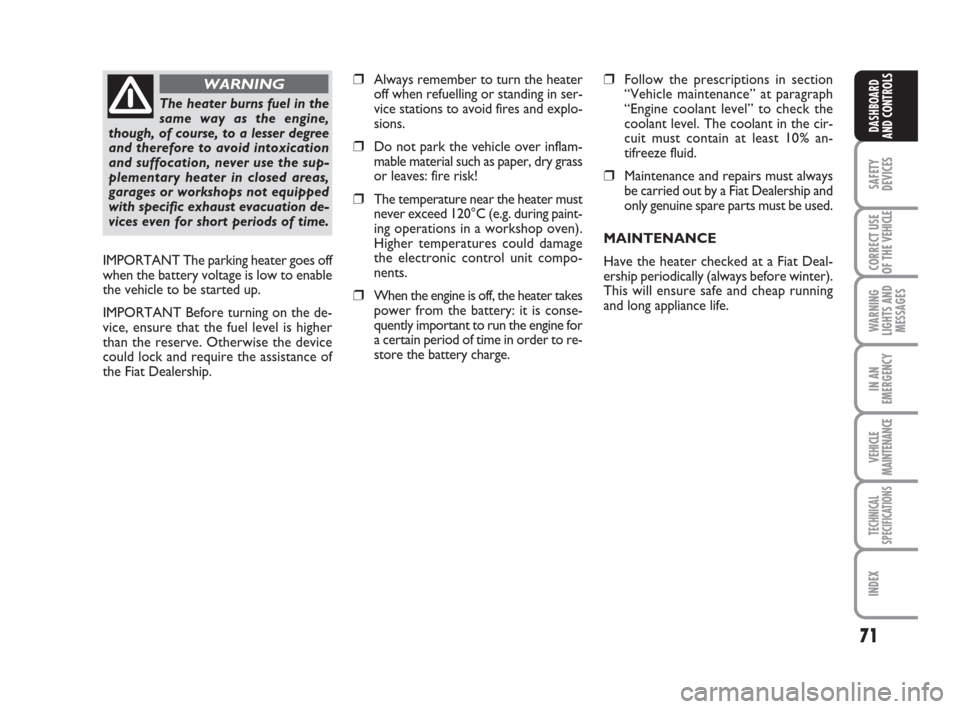
The heater burns fuel in the
same way as the engine,
though, of course, to a lesser degree
and therefore to avoid intoxication
and suffocation, never use the sup-
plementary heater in closed areas,
garages or workshops not equipped
with specific exhaust evacuation de-
vices even for short periods of time.
WARNING
IMPORTANT The parking heater goes off
when the battery voltage is low to enable
the vehicle to be started up.
IMPORTANT Before turning on the de-
vice, ensure that the fuel level is higher
than the reserve. Otherwise the device
could lock and require the assistance of
the Fiat Dealership.
Page 85 of 282
84
SAFETY
DEVICES
CORRECT USE
OF THE
VEHICLE
WARNING
LIGHTS AND
MESSAGES
IN AN
EMERGENCY
VEHICLE
MAINTENANCE
TECHNICAL
SPECIFICATIONS
INDEX
DASHBOARD
AND CONTROLS
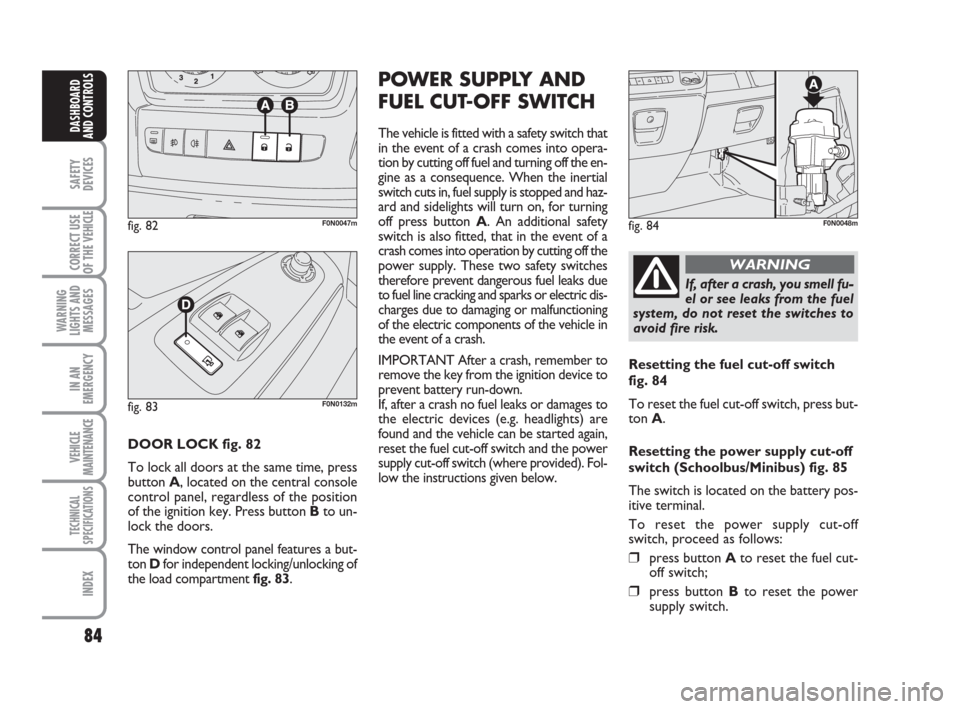
DOOR LOCK fig. 82
To lock all doors at the same time, press
button A, located on the central console
control panel, regardless of the position
of the ignition key. Press button Bto un-
lock the doors.
The window control panel features a but-
ton Dfor independent locking/unlocking of
the load compartment fig. 83.
POWER SUPPLY AND
FUEL CUT-OFF SWITCH
The vehicle is fitted with a safety switch that
in the event of a crash comes into opera-
tion by cutting off fuel and turning off the en-
gine as a consequence. When the inertial
switch cuts in, fuel supply is stopped and haz-
ard and sidelights will turn on, for turning
off press button A. An additional safety
switch is also fitted, that in the event of a
crash comes into operation by cutting off the
power supply. These two safety switches
therefore prevent dangerous fuel leaks due
to fuel line cracking and sparks or electric dis-
charges due to damaging or malfunctioning
of the electric components of the vehicle in
the event of a crash.
IMPORTANT After a crash, remember to
remove the key from the ignition device to
prevent battery run-down.
If, after a crash no fuel leaks or damages to
the electric devices (e.g. headlights) are
found and the vehicle can be started again,
reset the fuel cut-off switch and the power
supply cut-off switch (where provided). Fol-
low the instructions given below.
fig. 82F0N0047mfig. 84F0N0048m
If, after a crash, you smell fu-
el or see leaks from the fuel
system, do not reset the switches to
avoid fire risk.
WARNING
Resetting the fuel cut-off switch
fig. 84
To reset the fuel cut-off switch, press but-
ton A.
Resetting the power supply cut-off
switch (Schoolbus/Minibus) fig. 85
The switch is located on the battery pos-
itive terminal.
To reset the power supply cut-off
switch, proceed as follows:
❒press button Ato reset the fuel cut-
off switch;
❒press button Bto reset the power
supply switch.
fig. 83F0N0132m
Page 92 of 282
91
SAFETY
DEVICES
CORRECT USE
OF THE
VEHICLE
WARNING
LIGHTS AND
MESSAGES
IN AN
EMERGENCY
VEHICLE
MAINTENANCE
TECHNICAL
SPECIFICATIONS
INDEX
DASHBOARD
AND CONTROLS
MULTIMETER
See the booklet provided by the multi-
meter Manufacturer for more detailed in-
formation on operation and use.
Multimeter installation is compulsory if the
vehicle weight (with or without the trail-
er) exceeds 3.5 tons.
IMPORTANT Changes to the instrument
or to the signal transmission system which
effects the instrument recordings, espe-
cially for fraudulent purposes, may be a
criminal offence.
IMPORTANT When a macrograph is fit-
ted and the vehicle has been parked for
longer than 5 days, it is advisable to dis-
connect the battery negative terminal to
preserve the charge status. USER INTERFACE
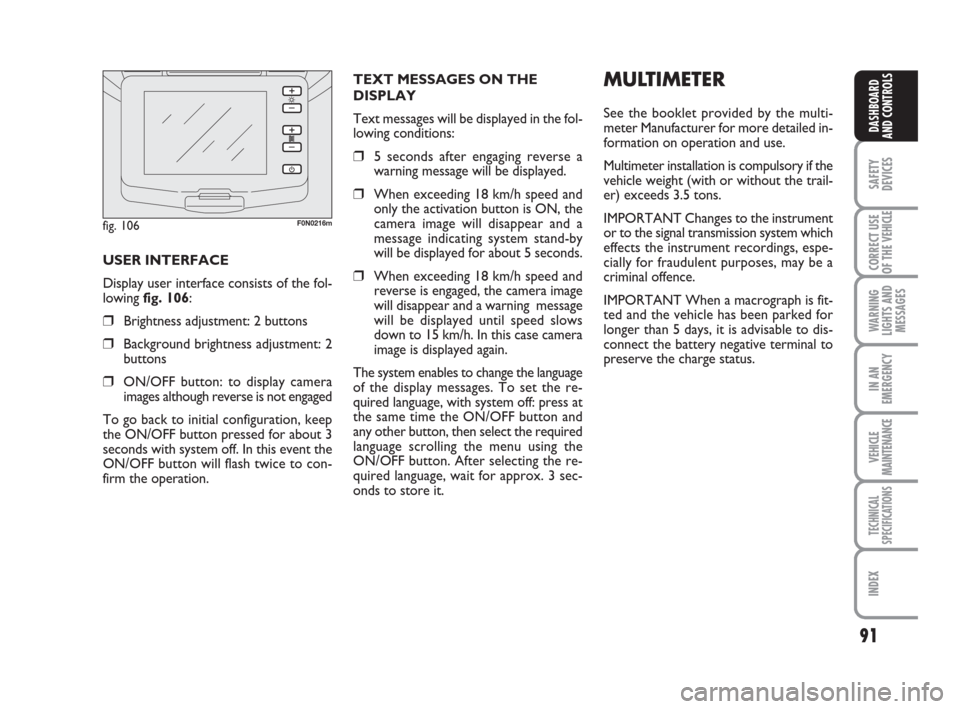
Display user interface consists of the fol-
lowing fig. 106:
❒Brightness adjustment: 2 buttons
❒Background brightness adjustment: 2
buttons
❒ON/OFF button: to display camera
images although reverse is not engaged
To go back to initial configuration, keep
the ON/OFF button pressed for about 3
seconds with system off. In this event the
ON/OFF button will flash twice to con-
firm the operation.TEXT MESSAGES ON THE
DISPLAY
Text messages will be displayed in the fol-
lowing conditions:
❒5 seconds after engaging reverse a
warning message will be displayed.
❒When exceeding 18 km/h speed and
only the activation button is ON, the
camera image will disappear and a
message indicating system stand-by
will be displayed for about 5 seconds.
❒When exceeding 18 km/h speed and
reverse is engaged, the camera image
will disappear and a warning message
will be displayed until speed slows
down to 15 km/h. In this case camera
image is displayed again.
The system enables to change the language
of the display messages. To set the re-
quired language, with system off: press at
the same time the ON/OFF button and
any other button, then select the required
language scrolling the menu using the
ON/OFF button. After selecting the re-
quired language, wait for approx. 3 sec-
onds to store it.
fig. 106F0N0216m
Page 145 of 282
144
WARNING
LIGHTS AND
MESSAGES
IN AN
EMERGENCY
VEHICLE
MAINTENANCE
TECHNICAL
SPECIFICATIONS
INDEX
DASHBOARD
AND CONTROLS
SAFETY
DEVICES
CORRECT USE
OF THE VEHICLE
VEHICLE INACTIVITY
If the vehicle is to be left inactive for longer
than a month, the following precautions
should be noted:
❒park the vehicle in covered, dry and
if possible well-ventilated premises;
❒engage a gear;
❒make sure the handbrake is not en-
gaged;
❒disconnect the battery negative ter-
minal and check the battery charge.
This check is to be repeated every
three months. Recharge if the optical
indicator shows a dark colour without
the central green area (see “Recharg-
ing the battery” in section “In an emer-
gency”); if the vehicle is equipped with
a battery disconnection function (dis-
connector), see the description of the
procedure in the “Controls” para-
graph in the “Dashboard and controls”
chapter;
❒clean and protect the painted parts us-
ing protective wax;
❒clean and protect the shiny metal parts
using special compounds readily avail-
able;
❒sprinkle talcum powder on the rubber
windscreen and rear window wiper
blades and lift them off the glass;
❒slightly open the windows;
❒cover the vehicle with a cloth or per-
forated plastic sheet. Do not use
sheets of non-perforated plastic as
they do not allow moisture on the ve-
hicle body to evaporate;
❒inflate tyres to +0.5 bar above the
normal specified pressure and check it
at intervals;
❒if you don’t disconnect the battery
from the electric system, check its
charge every month and recharge it if
the optical indicator shows a dark
colour without the central green area;
❒do not drain the engine cooling sys-
tem.
IMPORTANT Where relevant, switch off
the vehicle alarm with the remote control.
Keep your speed down when
snow chains are fitted. Do
not exceed 50 km/h. Avoid
potholes, steps and pave-
ments and avoid also to dri-
ve for long distances on
roads not covered with snow to pre-
vent damaging the vehicle and the
roadbed.
WARNING
Page 146 of 282
145
IN AN
EMERGENCY
VEHICLE
MAINTENANCE
TECHNICAL
SPECIFICATIONS
INDEX
DASHBOARD
AND CONTROLS
SAFETY
DEVICES
CORRECT USE
OF THE
VEHICLE
WARNING
LIGHTS AND
MESSAGES
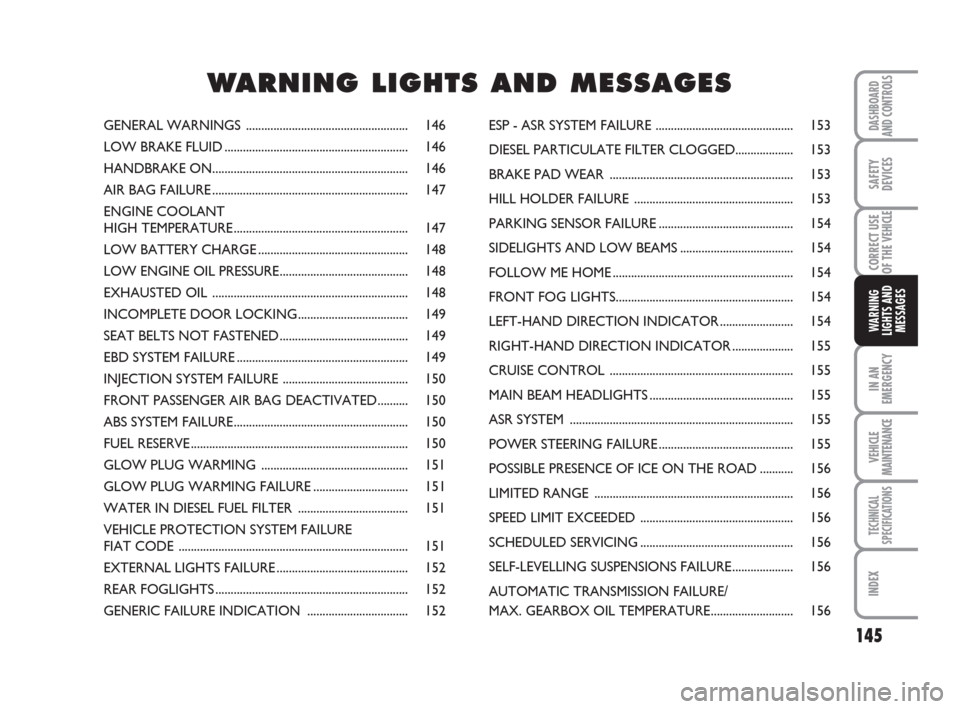
GENERAL WARNINGS ..................................................... 146
LOW BRAKE FLUID............................................................ 146
HANDBRAKE ON................................................................ 146
AIR BAG FAILURE................................................................ 147
ENGINE COOLANT
HIGH TEMPERATURE......................................................... 147
LOW BATTERY CHARGE................................................. 148
LOW ENGINE OIL PRESSURE.......................................... 148
EXHAUSTED OIL ................................................................ 148
INCOMPLETE DOOR LOCKING.................................... 149
SEAT BELTS NOT FASTENED.......................................... 149
EBD SYSTEM FAILURE........................................................ 149
INJECTION SYSTEM FAILURE ......................................... 150
FRONT PASSENGER AIR BAG DEACTIVATED.......... 150
ABS SYSTEM FAILURE......................................................... 150
FUEL RESERVE....................................................................... 150
GLOW PLUG WARMING ................................................ 151
GLOW PLUG WARMING FAILURE............................... 151
WATER IN DIESEL FUEL FILTER .................................... 151
VEHICLE PROTECTION SYSTEM FAILURE
FIAT CODE ........................................................................... 151
EXTERNAL LIGHTS FAILURE........................................... 152
REAR FOGLIGHTS............................................................... 152
GENERIC FAILURE INDICATION ................................. 152ESP - ASR SYSTEM FAILURE ............................................. 153
DIESEL PARTICULATE FILTER CLOGGED................... 153
BRAKE PAD WEAR ............................................................ 153
HILL HOLDER FAILURE .................................................... 153
PARKING SENSOR FAILURE............................................ 154
SIDELIGHTS AND LOW BEAMS..................................... 154
FOLLOW ME HOME........................................................... 154
FRONT FOG LIGHTS.......................................................... 154
LEFT-HAND DIRECTION INDICATOR........................ 154
RIGHT-HAND DIRECTION INDICATOR.................... 155
CRUISE CONTROL ............................................................ 155
MAIN BEAM HEADLIGHTS............................................... 155
ASR SYSTEM ......................................................................... 155
POWER STEERING FAILURE............................................ 155
POSSIBLE PRESENCE OF ICE ON THE ROAD ........... 156
LIMITED RANGE ................................................................. 156
SPEED LIMIT EXCEEDED .................................................. 156
SCHEDULED SERVICING.................................................. 156
SELF-LEVELLING SUSPENSIONS FAILURE.................... 156
AUTOMATIC TRANSMISSION FAILURE/
MAX. GEARBOX OIL TEMPERATURE........................... 156
WW W
A A
R R
N N
I I
N N
G G
L L
I I
G G
H H
T T
S S
A A
N N
D D
M M
E E
S S
S S
A A
G G
E E
S S
Page 149 of 282
148
IN AN
EMERGENCY
VEHICLE
MAINTENANCE
TECHNICAL
SPECIFICATIONS
INDEX
DASHBOARD
AND CONTROLS
SAFETY
DEVICES
CORRECT USE
OF THE
VEHICLE
WARNING
LIGHTS AND
MESSAGES
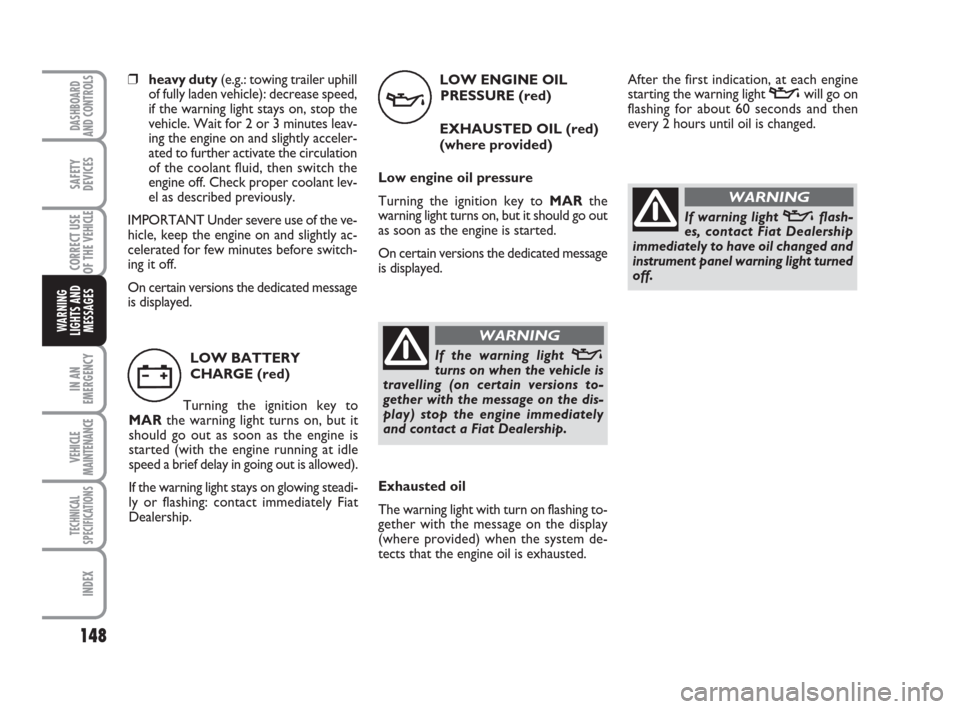
LOW ENGINE OIL
PRESSURE (red)
EXHAUSTED OIL (red)
(where provided)
Low engine oil pressure
Turning the ignition key to MARthe
warning light turns on, but it should go out
as soon as the engine is started.
On certain versions the dedicated message
is displayed.
v
If the warning light v
turns on when the vehicle is
travelling (on certain versions to-
gether with the message on the dis-
play) stop the engine immediately
and contact a Fiat Dealership.
WARNING
❒heavy duty(e.g.: towing trailer uphill
of fully laden vehicle): decrease speed,
if the warning light stays on, stop the
vehicle. Wait for 2 or 3 minutes leav-
ing the engine on and slightly acceler-
ated to further activate the circulation
of the coolant fluid, then switch the
engine off. Check proper coolant lev-
el as described previously.
IMPORTANT Under severe use of the ve-
hicle, keep the engine on and slightly ac-
celerated for few minutes before switch-
ing it off.
On certain versions the dedicated message
is displayed.
LOW BATTERY
CHARGE (red)
Turning the ignition key to
MARthe warning light turns on, but it
should go out as soon as the engine is
started (with the engine running at idle
speed a brief delay in going out is allowed).
If the warning light stays on glowing steadi-
ly or flashing: contact immediately Fiat
Dealership.
w
Exhausted oil
The warning light with turn on flashing to-
gether with the message on the display
(where provided) when the system de-
tects that the engine oil is exhausted.After the first indication, at each engine
starting the warning light vwill go on
flashing for about 60 seconds and then
every 2 hours until oil is changed.
If warning light vflash-
es, contact Fiat Dealership
immediately to have oil changed and
instrument panel warning light turned
off.
WARNING
Page 159 of 282
158
WARNING
LIGHTS AND
MESSAGES
VEHICLE
MAINTENANCE
TECHNICAL
SPECIFICATIONS
IINDEX
DASHBOARD
AND CONTROLS
SAFETY
DEVICES
CORRECT USE
OF THE
VEHICLE
IN AN
EMERGENCY
ENGINE
STARTING
EMERGENCY START-UP
If the instrument panel warning light
Yturns on glowing steadily, contact im-
mediately Fiat Dealership.
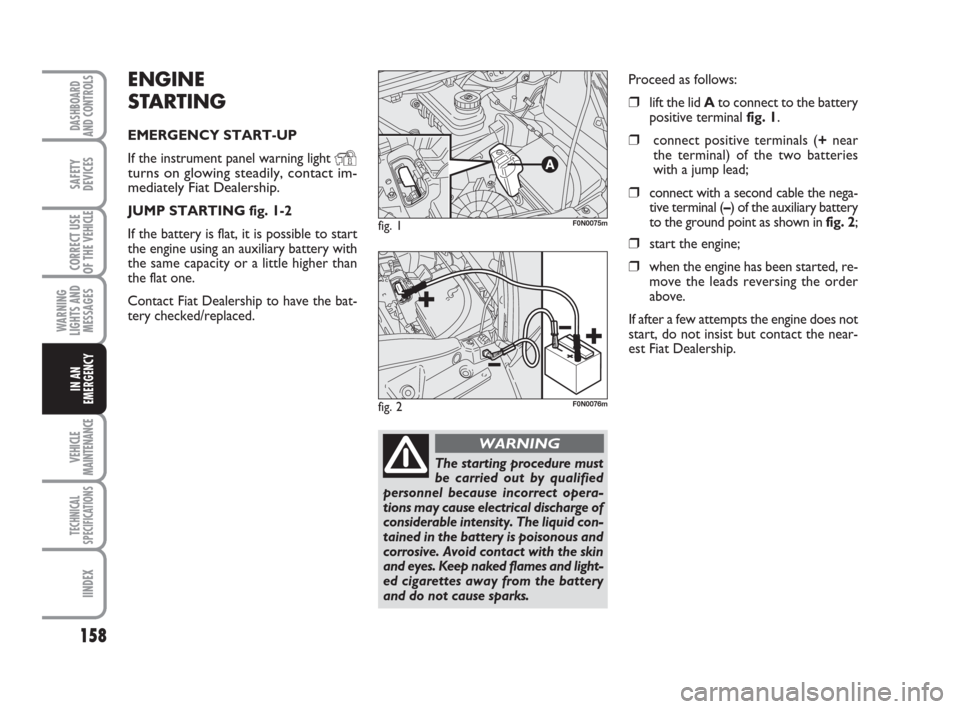
JUMP STARTING fig. 1-2
If the battery is flat, it is possible to start
the engine using an auxiliary battery with
the same capacity or a little higher than
the flat one.
Contact Fiat Dealership to have the bat-
tery checked/replaced.Proceed as follows:
❒lift the lid Ato connect to the battery
positive terminal fig. 1.
❒connect positive terminals (+near
the terminal) of the two batteries
with a jump lead;
❒connect with a second cable the nega-
tive terminal (–) of the auxiliary battery
to the ground point as shown in fig. 2;
❒start the engine;
❒when the engine has been started, re-
move the leads reversing the order
above.
If after a few attempts the engine does not
start, do not insist but contact the near-
est Fiat Dealership.
fig. 1F0N0075m
The starting procedure must
be carried out by qualified
personnel because incorrect opera-
tions may cause electrical discharge of
considerable intensity. The liquid con-
tained in the battery is poisonous and
corrosive. Avoid contact with the skin
and eyes. Keep naked flames and light-
ed cigarettes away from the battery
and do not cause sparks.
WARNING
fig. 2F0N0076m
Page 186 of 282
185
WARNING
LIGHTS AND
MESSAGES
VEHICLE
MAINTENANCE
TECHNICAL
SPECIFICATIONS
INDEX
DASHBOARD
AND CONTROLS
SAFETY
DEVICES
CORRECT USE
OF THE
VEHICLE
IN AN
EMERGENCY
RECHARGING THE
BATTERY
IMPORTANT The battery charging pro-
cedure is described only for information
purposes. This operation should be car-
ried out by Fiat Dealership.
You are advised to recharge the battery
slowly for a period of approximately 24
hours at a low amperage. Charging for too
long could damage the battery. Charge the
battery as follows:
❒disconnect battery negative terminal;
❒connect the charger cables to the bat-
tery terminals, observing the poles;
❒turn on the charger;
❒when you have finished, turn the
charger off before disconnecting the
battery;
❒reconnect the terminal to the battery
negative pole.
The liquid in the battery is
poisonous and corrosive. Do
not let it touch the skin or eyes.
Recharging the battery should be
done in a well ventilated area away
from naked flames or possible sources
of sparks: explosion and fire risk.
WARNING
Do not attempt to charge a
frozen battery: it must first-
ly be thawed, otherwise it may burst.
If freezing has occurred, the battery
should be checked by skilled person-
nel to make sure that the internal el-
ements are not damaged and that the
body is not cracked, with the risk of
leaking poisonous and corrosive acid.
WARNING
Page 196 of 282
195
WARNING
LIGHTS AND
MESSAGES
TECHNICAL
SPECIFICATIONS
INDEX
DASHBOARD
AND CONTROLS
SAFETY
DEVICES
CORRECT USE
OF THE VEHICLE
IN AN
EMERGENCY
VEHICLE
MAINTENANCE
HEAVY-DUTY
Should prevailing use of the vehicle be un-
der one of the following specially heavy
conditions:
❒trailer or caravan towing;
❒dusty roads;
❒short distances (less than 7-8 km) re-
peated and with external tempera-
tures below zero;
❒frequently idling engines or long dis-
tance low speed driving (e.g. door-to-
door deliveries) or in case of a long
term inactivity;
❒driving in the city;
carry out the following checks more fre-
quently than required in the Service
Schedule:
❒check front disk brake pad conditions
and wear;
❒check cleanness of locks, bonnet and
boot and lever cleanness and lubri-
cation;
❒sight inspect the conditions of: engine,
gearbox, transmission, pipes and
hoses (exhaust - fuel - brakes), rub-
ber parts (boots, sleeves, bushes,
etc.);
❒check battery charge and fluid level
(electrolyte);
❒visual check on various drive belt con-
ditions;
❒check and replace pollen filter, if re-
quired;
❒check and replace air cleaner, if re-
quired.
ROUTINE
MAINTENANCE
Every 1,000 km or before long journeys,
check and top up if required:
❒engine coolant fluid level;
❒brake fluid level;
❒windscreen washer fluid level;
❒tyre pressure and conditions;
❒light system operation (headlights, di-
rection indicators, hazard lights, etc.);
❒windscreen wiper/washer operation
and windscreen/rear window blade
position/wear;
Every 3,000 km check and top up if re-
quired: engine oil level.
You are recommended to use FL
Selenia, products, designed and pro-
duced specifically for Fiat vehicles (see
table “Capacities” in section “Technical
specifications”).
Page 203 of 282
202
WARNING
LIGHTS AND
MESSAGES
TECHNICAL
SPECIFICATIONS
INDEX
DASHBOARD
AND CONTROLS
SAFETY
DEVICES
CORRECT USE
OF THE VEHICLE
IN AN
EMERGENCY
VEICHLE
MAINTENANCE
ATTENTION: Use a jet of air so as to
clean the air filter, do not use water or liq-
uid detergents.
Such filter is specific for the versions suit-
able for dusty areas; therefore it is advis-
able to seek help from the Fiat Assistance
Network for the substitution of the filter.
POLLEN FILTER
Pollen filter replacement shall be carried
out at Fiat Dealership.
BATTERY
The battery is of the “Limited mainte-
nance” type: under normal conditions of
use the electrolyte does not need topping
up with distilled water.
The battery is located inside the passen-
ger’s compartment in front of the pedal as-
sy. Remove the protection cover to find it.
Contact Fiat Dealership to have the bat-
tery checked/replaced.
CHECKING
THE CHARGE fig. 12
The battery charge may be checked
through the indicator A(where required)
set on the battery cover and acting ac-
cording to the colour the indicator shows.
The liquid in the battery is
poisonous and corrosive.
Avoid contact with eyes and skin. Do
not bring naked flames or possible
sources of sparks near the battery:
risk of fire and explosion.
WARNING
Running the battery with
low fluid level can damage
the battery beyond repair and could
also cause its explosion.
WARNING
Should the battery be not fitted with bat-
tery charge inspection device (optical elec-
trolyte indicator), inspection operations
shall be carried out by skilled personnel
only.
To check the battery charge, loosen the
two fastening screws and open the cov-
er. Then, close the cover accurately avoid-
ing pinching and short circuits.
Refer to the table below.
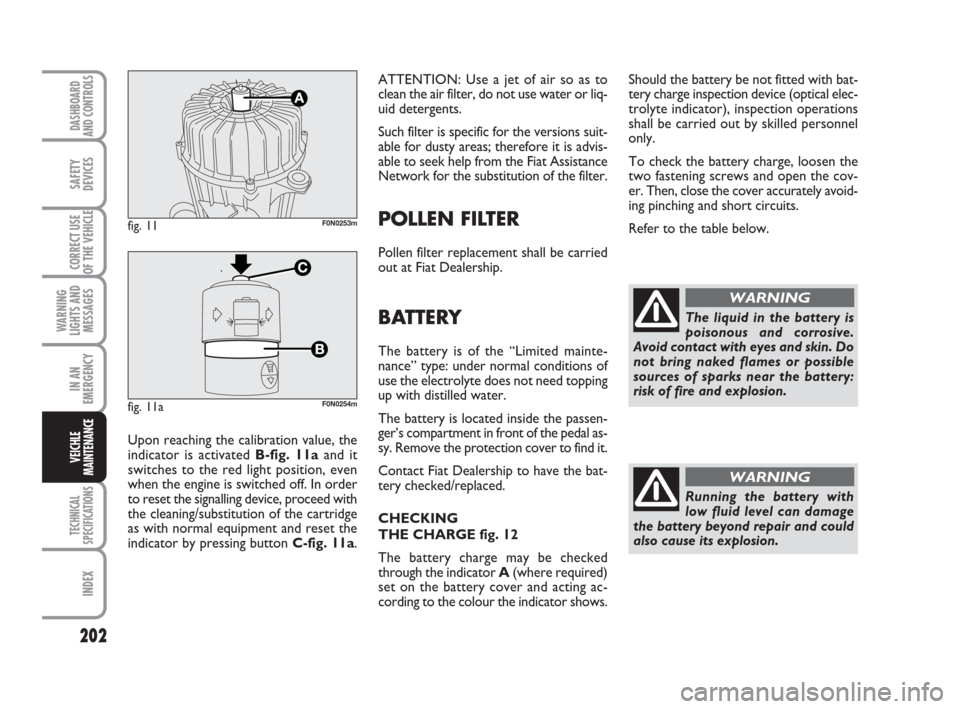
Upon reaching the calibration value, the
indicator is activated B-fig. 11aand it
switches to the red light position, even
when the engine is switched off. In order
to reset the signalling device, proceed with
the cleaning/substitution of the cartridge
as with normal equipment and reset the
indicator by pressing button C-fig. 11a.
fig. 11F0N0253m
fig. 11aF0N0254m