seats FIAT DUCATO 2009 3.G User Guide
[x] Cancel search | Manufacturer: FIAT, Model Year: 2009, Model line: DUCATO, Model: FIAT DUCATO 2009 3.GPages: 282, PDF Size: 4.55 MB
Page 124 of 282
123
CORRECT USE
OF THE
VEHICLE
WARNING
LIGHTS AND
MESSAGES
IN AN
EMERGENCY
VEHICLE
MAINTENANCE
TECHNICAL
SPECIFICATIONS
INDEX
DASHBOARD
AND CONTROLS
SAFETY
DEVICES
To sum up the safety precautions
to follow when transporting
children:
1) The recommended position for in-
stalling child’s seat is on the rear seat, as
it is the most protected in the case of a
crash.
2) If the passenger’s air bag is deactivat-
ed always check the amber warning light
on the cluster to make sure that it has ac-
tually been deactivated.
3) Attain to the instructions for fastening
the specific child restraint system which
you are using. These instructions must be
provided by the manufacturer. Keep the
child restraint system installation instruc-
tions with the vehicle documents and with
this Handbook. Never use a child restraint
system without installation instructions.
4) Always check the seat belt is well fas-
tened by pulling the webbing.5) Only one child is to be strapped to
each retaining system.
6) Always check the seat belts do not fit
around the child’s throat.
7) While travelling, do not let the child
sit incorrectly or release the belts.
8) Passengers should never carry children
on their laps. No-one, however strong
they are, can hold a child in the event of
a crash.
9) In case of an accident, replace the
child’s seat with a new one.
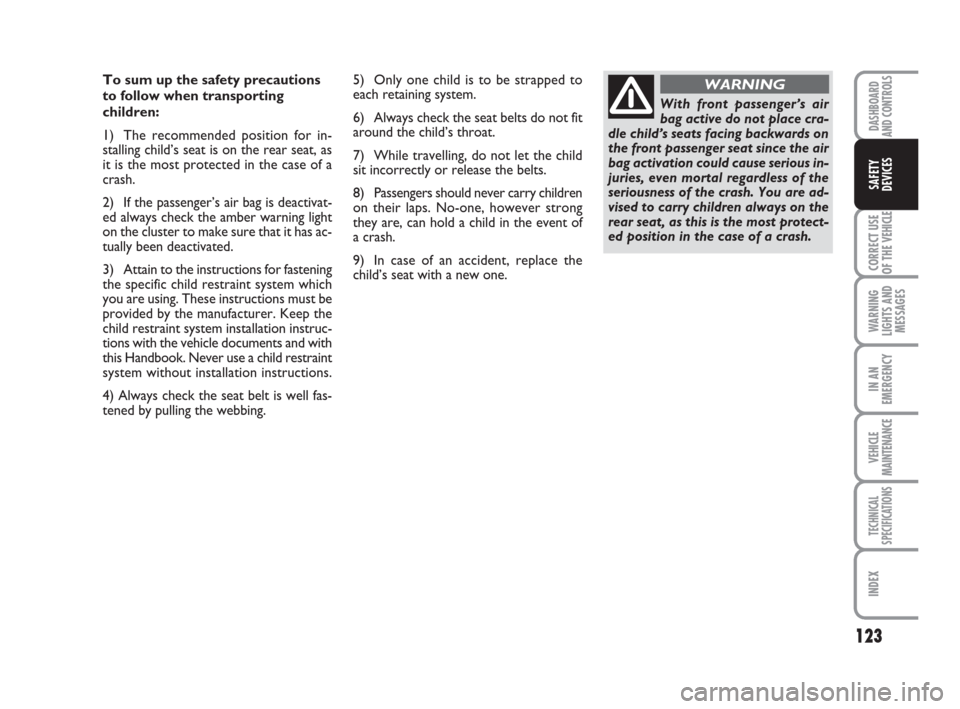
With front passenger’s air
bag active do not place cra-
dle child’s seats facing backwards on
the front passenger seat since the air
bag activation could cause serious in-
juries, even mortal regardless of the
seriousness of the crash. You are ad-
vised to carry children always on the
rear seat, as this is the most protect-
ed position in the case of a crash.
WARNING
Page 125 of 282
124
CORRECT USE
OF THE
VEHICLE
WARNING
LIGHTS AND
MESSAGES
IN AN
EMERGENCY
VEHICLE
MAINTENANCE
TECHNICAL
SPECIFICATIONS
IINDEX
DASHBOARD
AND CONTROLS
SAFETY
DEVICES
PRESETTING FOR
MOUNTING THE
“UNIVERSAL ISOFIX”
CHILD RESTRAINT
SYSTEM
This vehicle is preset for mounting the
Universal Isofix child restraint system, a
new European standardised system for
carrying children safely.
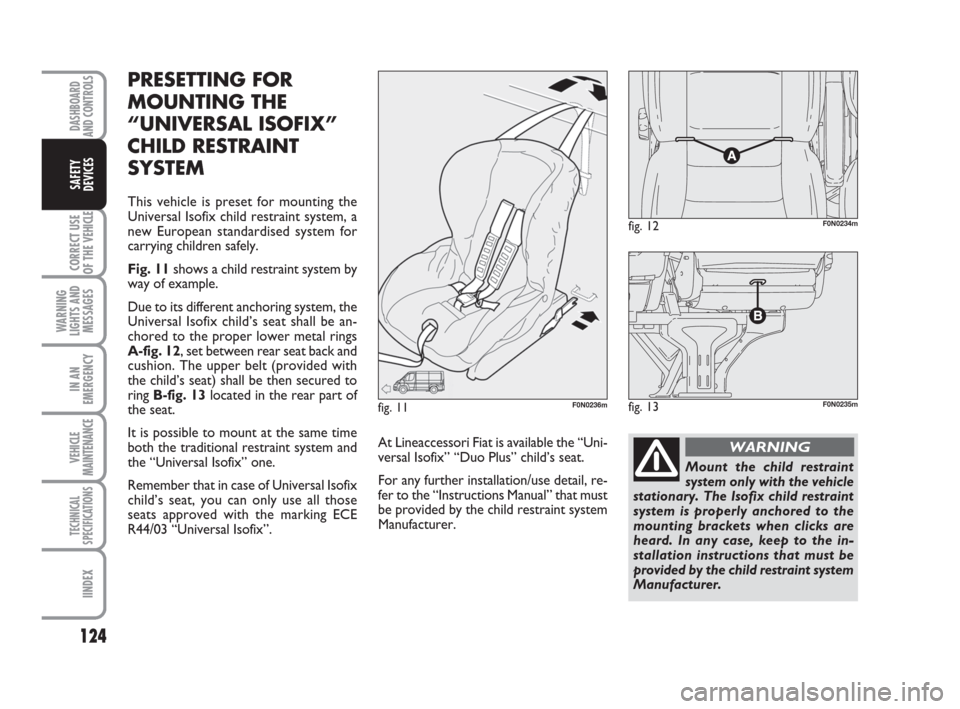
Fig. 11shows a child restraint system by
way of example.
Due to its different anchoring system, the
Universal Isofix child’s seat shall be an-
chored to the proper lower metal rings
A-fig. 12, set between rear seat back and
cushion. The upper belt (provided with
the child’s seat) shall be then secured to
ring B-fig. 13located in the rear part of
the seat.
It is possible to mount at the same time
both the traditional restraint system and
the “Universal Isofix” one.
Remember that in case of Universal Isofix
child’s seat, you can only use all those
seats approved with the marking ECE
R44/03 “Universal Isofix”.
fig. 11F0N0236m
fig. 12F0N0234m
fig. 13F0N0235m
At Lineaccessori Fiat is available the “Uni-
versal Isofix” “Duo Plus” child’s seat.
For any further installation/use detail, re-
fer to the “Instructions Manual” that must
be provided by the child restraint system
Manufacturer.
Mount the child restraint
system only with the vehicle
stationary. The Isofix child restraint
system is properly anchored to the
mounting brackets when clicks are
heard. In any case, keep to the in-
stallation instructions that must be
provided by the child restraint system
Manufacturer.
WARNING
Page 126 of 282
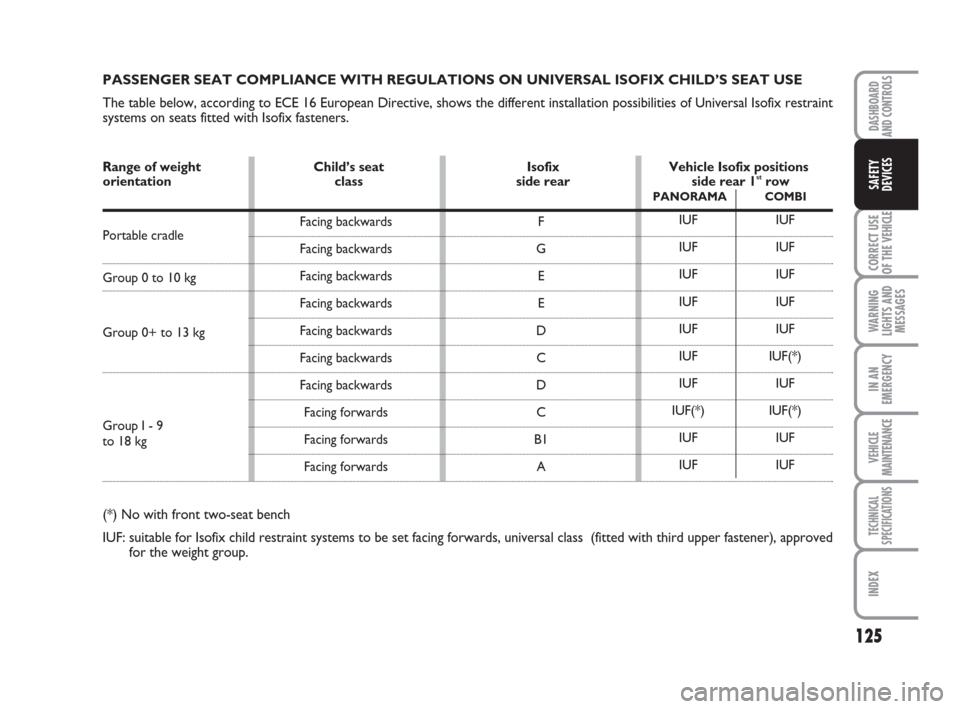
PASSENGER SEAT COMPLIANCE WITH REGULATIONS ON UNIVERSAL ISOFIX CHILD’S SEAT USE
The table below, according to ECE 16 European Directive, shows the different installation possibilities of Universal Isofix restraint
systems on seats fitted with Isofix fasteners.
125
CORRECT USE
OF THE
VEHICLE
WARNING
LIGHTS AND
MESSAGES
IN AN
EMERGENCY
VEHICLE
MAINTENANCE
TECHNICAL
SPECIFICATIONS
INDEX
DASHBOARD
AND CONTROLS
SAFETY
DEVICES
F
G
E
E
D
C
D
C
B1
A Facing backwards
Facing backwards
Facing backwards
Facing backwards
Facing backwards
Facing backwards
Facing backwards
Facing forwards
Facing forwards
Facing forwardsIUF
IUF
IUF
IUF
IUF
IUF
IUF
IUF(*)
IUF
IUFIUF
IUF
IUF
IUF
IUF
IUF(*)
IUF
IUF(*)
IUF
IUF
Range of weight Child’s seat Isofix Vehicle Isofix positions
orientation class side rear side rear 1strowPANORAMA COMBI
Portable cradle
Group 0 to 10 kg
Group 0+ to 13 kg
Group I - 9
to 18 kg
(*) No with front two-seat bench
IUF: suitable for Isofix child restraint systems to be set facing forwards, universal class (fitted with third upper fastener), approved
for the weight group.
Page 129 of 282
MANUAL DEACTIVATION OF
PASSENGER’S FRONT AIR BAG
AND SIDE BAG
(where provided)
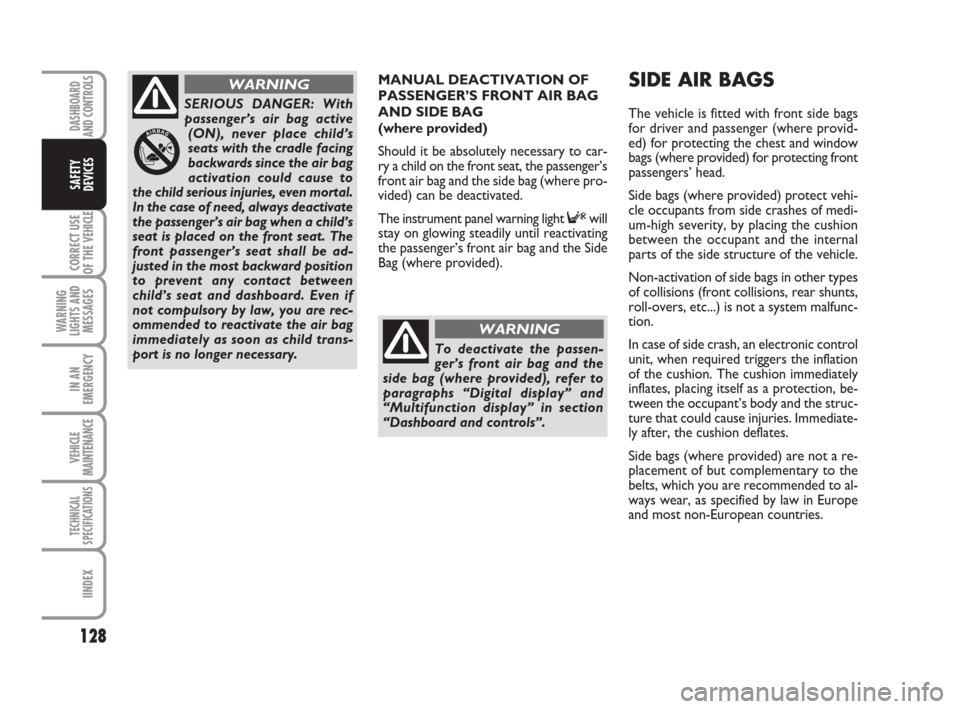
Should it be absolutely necessary to car-
ry a child on the front seat, the passenger’s
front air bag and the side bag (where pro-
vided) can be deactivated.
The instrument panel warning light Fwill
stay on glowing steadily until reactivating
the passenger’s front air bag and the Side
Bag (where provided).
128
CORRECT USE
OF THE
VEHICLE
WARNING
LIGHTS AND
MESSAGES
IN AN
EMERGENCY
VEHICLE
MAINTENANCE
TECHNICAL
SPECIFICATIONS
IINDEX
DASHBOARD
AND CONTROLS
SAFETY
DEVICES
SERIOUS DANGER: With
passenger’s air bag active
(ON), never place child’s
seats with the cradle facing
backwards since the air bag
activation could cause to
the child serious injuries, even mortal.
In the case of need, always deactivate
the passenger’s air bag when a child’s
seat is placed on the front seat. The
front passenger’s seat shall be ad-
justed in the most backward position
to prevent any contact between
child’s seat and dashboard. Even if
not compulsory by law, you are rec-
ommended to reactivate the air bag
immediately as soon as child trans-
port is no longer necessary.
WARNING
To deactivate the passen-
ger’s front air bag and the
side bag (where provided), refer to
paragraphs “Digital display” and
“Multifunction display” in section
“Dashboard and controls”.
WARNING
SIDE AIR BAGS
The vehicle is fitted with front side bags
for driver and passenger (where provid-
ed) for protecting the chest and window
bags (where provided) for protecting front
passengers’ head.
Side bags (where provided) protect vehi-
cle occupants from side crashes of medi-
um-high severity, by placing the cushion
between the occupant and the internal
parts of the side structure of the vehicle.
Non-activation of side bags in other types
of collisions (front collisions, rear shunts,
roll-overs, etc...) is not a system malfunc-
tion.
In case of side crash, an electronic control
unit, when required triggers the inflation
of the cushion. The cushion immediately
inflates, placing itself as a protection, be-
tween the occupant’s body and the struc-
ture that could cause injuries. Immediate-
ly after, the cushion deflates.
Side bags (where provided) are not a re-
placement of but complementary to the
belts, which you are recommended to al-
ways wear, as specified by law in Europe
and most non-European countries.
Page 131 of 282
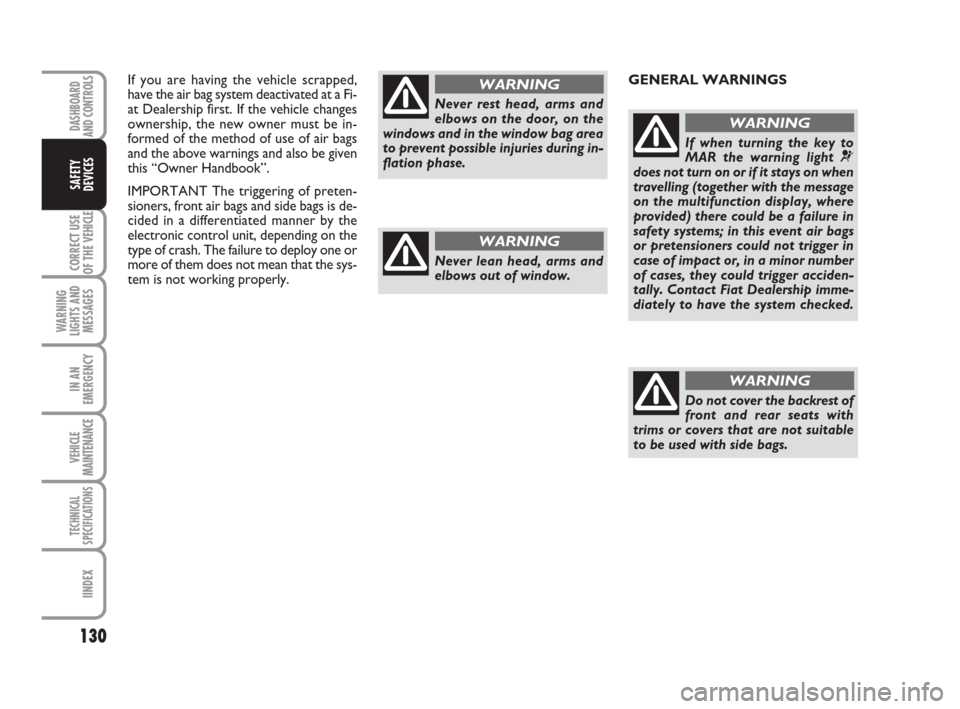
If you are having the vehicle scrapped,
have the air bag system deactivated at a Fi-
at Dealership first. If the vehicle changes
ownership, the new owner must be in-
formed of the method of use of air bags
and the above warnings and also be given
this “Owner Handbook”.
IMPORTANT The triggering of preten-
sioners, front air bags and side bags is de-
cided in a differentiated manner by the
electronic control unit, depending on the
type of crash. The failure to deploy one or
more of them does not mean that the sys-
tem is not working properly.
130
CORRECT USE
OF THE
VEHICLE
WARNING
LIGHTS AND
MESSAGES
IN AN
EMERGENCY
VEHICLE
MAINTENANCE
TECHNICAL
SPECIFICATIONS
IINDEX
DASHBOARD
AND CONTROLS
SAFETY
DEVICES
Never rest head, arms and
elbows on the door, on the
windows and in the window bag area
to prevent possible injuries during in-
flation phase.
WARNING
Never lean head, arms and
elbows out of window.
WARNING
GENERAL WARNINGS
If when turning the key to
MAR the warning light ¬
does not turn on or if it stays on when
travelling (together with the message
on the multifunction display, where
provided) there could be a failure in
safety systems; in this event air bags
or pretensioners could not trigger in
case of impact or, in a minor number
of cases, they could trigger acciden-
tally. Contact Fiat Dealership imme-
diately to have the system checked.
WARNING
Do not cover the backrest of
front and rear seats with
trims or covers that are not suitable
to be used with side bags.
WARNING
Page 185 of 282
184
WARNING
LIGHTS AND
MESSAGES
VEHICLE
MAINTENANCE
TECHNICAL
SPECIFICATIONS
IINDEX
DASHBOARD
AND CONTROLS
SAFETY
DEVICES
CORRECT USE
OF THE
VEHICLE
IN AN
EMERGENCY
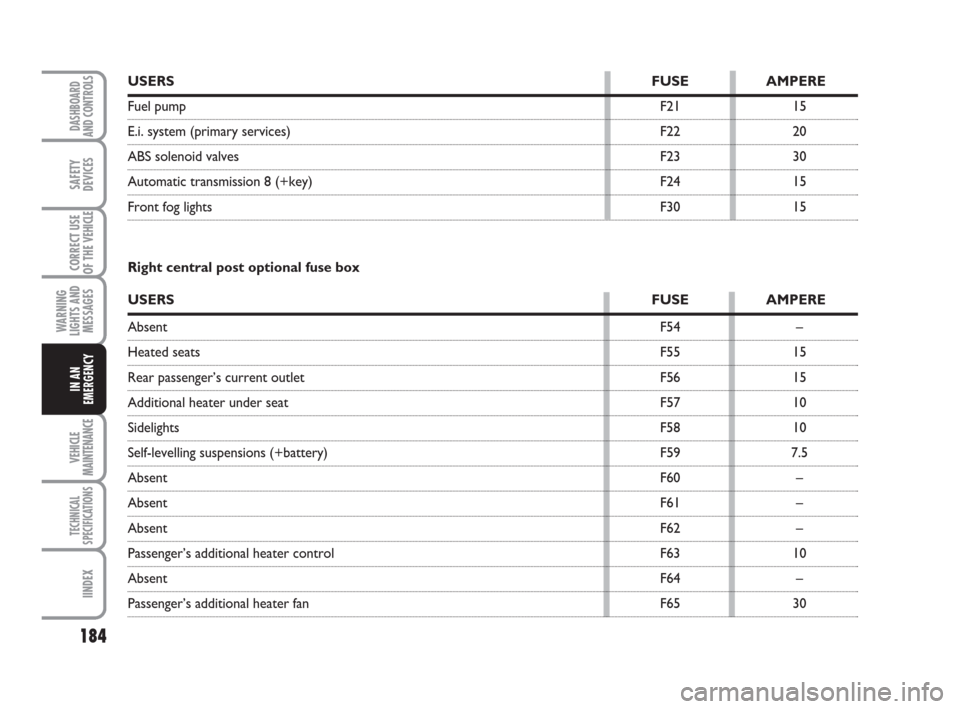
USERSFUSE AMPERE
Fuel pump F21 15
E.i. system (primary services) F22 20
ABS solenoid valves F23 30
Automatic transmission 8 (+key) F24 15
Front fog lightsF30 15
Right central post optional fuse box
USERSFUSE AMPERE
AbsentF54 –
Heated seatsF55 15
Rear passenger’s current outlet F56 15
Additional heater under seat F57 10
SidelightsF58 10
Self-levelling suspensions (+battery) F59 7.5
AbsentF60 –
AbsentF61 –
AbsentF62 –
Passenger’s additional heater control F63 10
AbsentF64 –
Passenger’s additional heater fan F65 30
Page 211 of 282
210
WARNING
LIGHTS AND
MESSAGES
TECHNICAL
SPECIFICATIONS
INDEX
DASHBOARD
AND CONTROLS
SAFETY
DEVICES
CORRECT USE
OF THE VEHICLE
IN AN
EMERGENCY
VEICHLE
MAINTENANCE
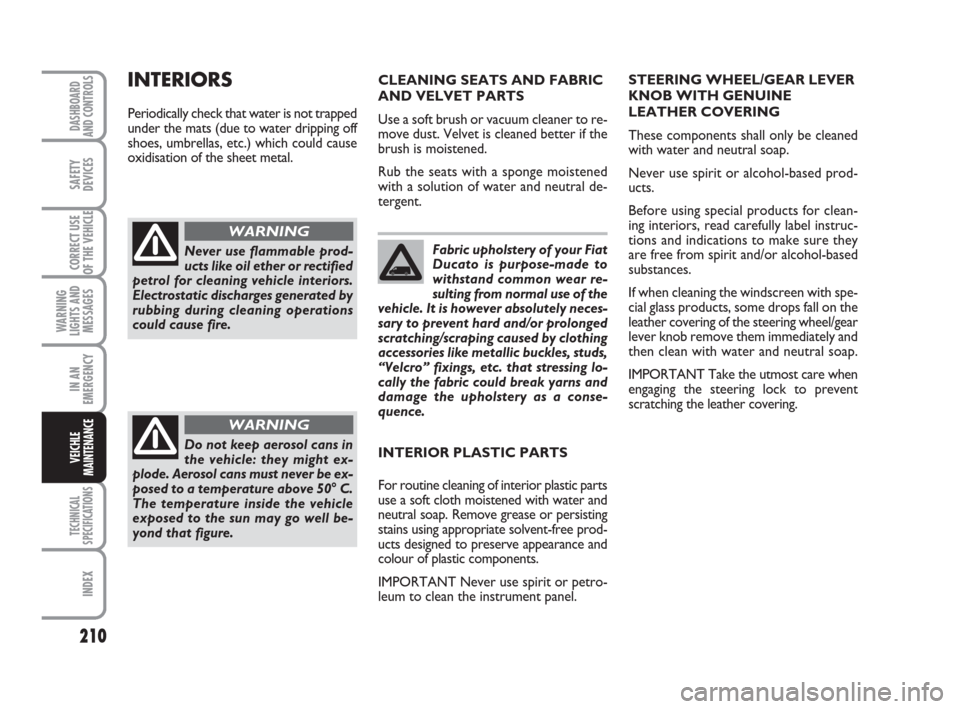
Fabric upholstery of your Fiat
Ducato is purpose-made to
withstand common wear re-
sulting from normal use of the
vehicle. It is however absolutely neces-
sary to prevent hard and/or prolonged
scratching/scraping caused by clothing
accessories like metallic buckles, studs,
“Velcro” fixings, etc. that stressing lo-
cally the fabric could break yarns and
damage the upholstery as a conse-
quence.
INTERIOR PLASTIC PARTS CLEANING SEATS AND FABRIC
AND VELVET PARTS
Use a soft brush or vacuum cleaner to re-
move dust. Velvet is cleaned better if the
brush is moistened.
Rub the seats with a sponge moistened
with a solution of water and neutral de-
tergent.Never use flammable prod-
ucts like oil ether or rectified
petrol for cleaning vehicle interiors.
Electrostatic discharges generated by
rubbing during cleaning operations
could cause fire.
WARNING
Do not keep aerosol cans in
the vehicle: they might ex-
plode. Aerosol cans must never be ex-
posed to a temperature above 50° C.
The temperature inside the vehicle
exposed to the sun may go well be-
yond that figure.
WARNING
INTERIORS
Periodically check that water is not trapped
under the mats (due to water dripping off
shoes, umbrellas, etc.) which could cause
oxidisation of the sheet metal.STEERING WHEEL/GEAR LEVER
KNOB WITH GENUINE
LEATHER COVERING
These components shall only be cleaned
with water and neutral soap.
Never use spirit or alcohol-based prod-
ucts.
Before using special products for clean-
ing interiors, read carefully label instruc-
tions and indications to make sure they
are free from spirit and/or alcohol-based
substances.
If when cleaning the windscreen with spe-
cial glass products, some drops fall on the
leather covering of the steering wheel/gear
lever knob remove them immediately and
then clean with water and neutral soap.
IMPORTANT Take the utmost care when
engaging the steering lock to prevent
scratching the leather covering.
For routine cleaning of interior plastic parts
use a soft cloth moistened with water and
neutral soap. Remove grease or persisting
stains using appropriate solvent-free prod-
ucts designed to preserve appearance and
colour of plastic components.
IMPORTANT Never use spirit or petro-
leum to clean the instrument panel.
Page 216 of 282
215
WARNING
LIGHTS AND
MESSAGES
INDEX
DASHBOARD
AND CONTROLS
SAFETY
DEVICES
CORRECT USE
OF THE
VEHICLE
IN AN
EMERGENCY
VEHICLE
MAINTENANCE
TECHNICAL
SPECIFICATIONS
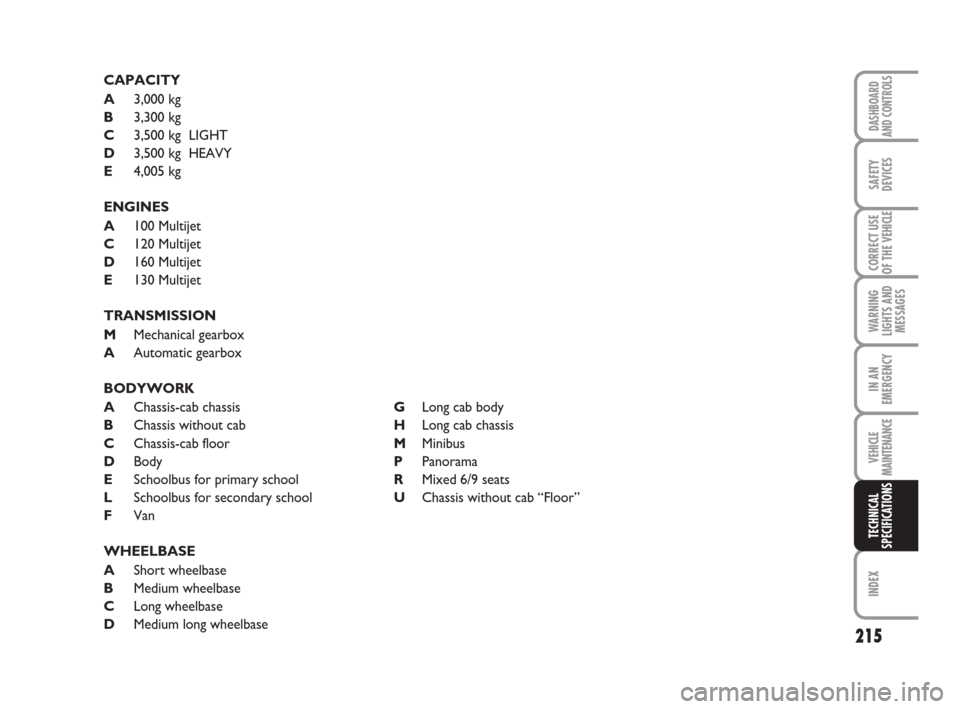
CAPACITY
A3,000 kg
B3,300 kg
C3,500 kg LIGHT
D3,500 kg HEAVY
E4,005 kg
ENGINES
A100 Multijet
C120 Multijet
D160 Multijet
E130 Multijet
TRANSMISSION
MMechanical gearbox
AAutomatic gearbox
BODYWORK
AChassis-cab chassisGLong cab body
BChassis without cabHLong cab chassis
CChassis-cab floorMMinibus
DBodyPPanorama
ESchoolbus for primary schoolRMixed 6/9 seats
LSchoolbus for secondary schoolUChassis without cab “Floor”
FVan
WHEELBASE
AShort wheelbase
BMedium wheelbase
CLong wheelbase
DMedium long wheelbase
Page 274 of 282
273
WARNING
LIGHTS AND
MESSAGES
DASHBOARD
AND CONTROLS
SAFETY
DEVICES
CORRECT USE
OF THE
VEHICLE
IN AN
EMERGENCY
VEHICLE
MAINTENANCE
TECHNICAL
SPECIFICATIONS
INDEX
Steering column lock ......................... 15
Steering wheel adjustment ............... 44
Storing the vehicle .............................. 144
Sun visors ............................................. 88
Supplementary heater......................... 55
Suspensions .......................................... 218
Symbols ................................................. 7
Technical specifications..................... 211
Third brake light ................................. 175
Tips on loading..................................... 137
Top speeds ........................................... 229
Towing a trailer
– tow hitch installation ................... 140
Towing the vehicle ............................. 186
Transmission ........................................ 217
Tyre pressure ...................................... 222
Tyres
– changing .......................................... 159
– snow tyres ..................................... 143
– standard .......................................... 221
– understanding tyre marking ........ 219
Under-seat basket.............................. 41
Using the manual gearbox ................ 137
Vehicle inactivity................................. 144
Vehicle maintenance........................... 189
– heavy-duty....................................... 195
– routine maintenance..................... 195
– scheduled service ......................... 190
– Service Schedule ....................191-193
Ventilation ............................................ 47
Warning lights and messages .......... 145
Weights ................................................ 230
Wheel geometry.................................. 219
Wheel replacement ........................... 159
Wheels
– changing .......................................... 159
Window washing................................. 77
Windows (cleaning)............................ 209
Windscreen washer
– control ............................................ 77
– fluid level ........................................ 200
Windscreen wipers
– blades .............................................. 207
– control ............................................ 77
– nozzles ............................................ 207
Windscreen/rear window/
headlight washer fluid level ............. 200
Writing/reading desk........................... 88 – pretensioners .........................100-116
– use ..............................................98-114
Seats
– adjustment....................................... 37
– cleaning ........................................... 210
S.B.R. system......................................... 115
Self-standing supplementary heater ... 66
Side sliding door................................... 95
Side/taillights
– control ............................................ 74
– front bulb replacement................. 170
– rear bulb replacement.................. 173
– changing side bulb.......................... 175
Sliding side window............................. 95
Smart washing ..................................... 77
Snow chains ......................................... 143
Sound system ...................................... 108
Speed block........................................... 92
Starting the engine............................... 134
– bump starting ................................ 159
– diesel engines ................................ 134
– emergency start-up ...................... 158
– ignition switch ............................... 15
– jump starting .................................. 158
– stopping the engine ...................... 135
– warming up the engine ................ 135