3,0 FIAT DUCATO 2009 3.G Owners Manual
[x] Cancel search | Manufacturer: FIAT, Model Year: 2009, Model line: DUCATO, Model: FIAT DUCATO 2009 3.GPages: 282, PDF Size: 4.55 MB
Page 196 of 282
195
WARNING
LIGHTS AND
MESSAGES
TECHNICAL
SPECIFICATIONS
INDEX
DASHBOARD
AND CONTROLS
SAFETY
DEVICES
CORRECT USE
OF THE VEHICLE
IN AN
EMERGENCY
VEHICLE
MAINTENANCE
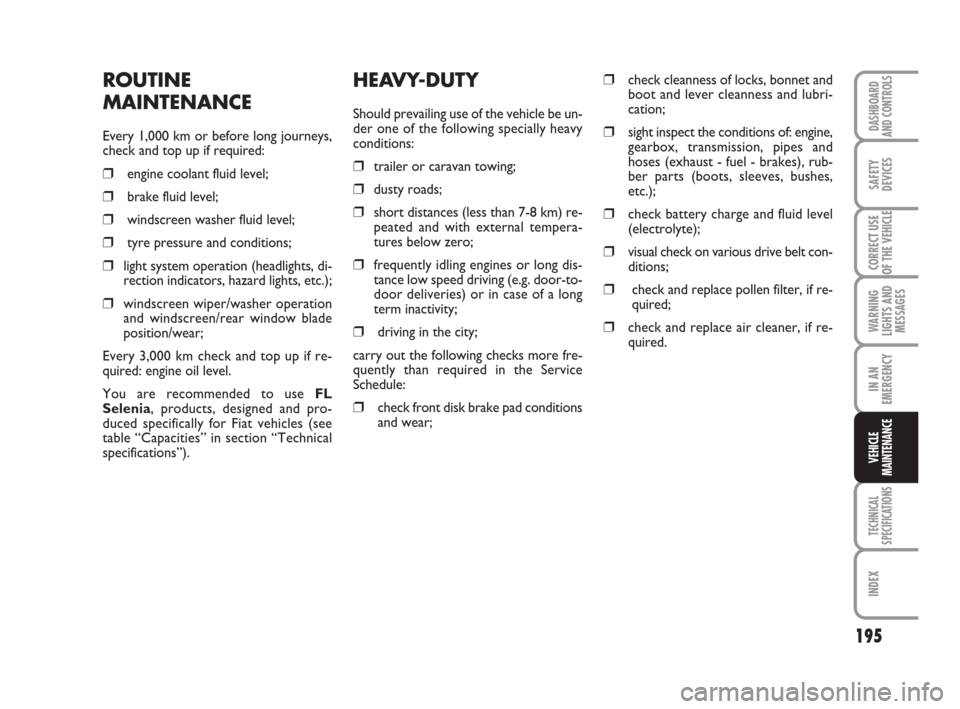
HEAVY-DUTY
Should prevailing use of the vehicle be un-
der one of the following specially heavy
conditions:
❒trailer or caravan towing;
❒dusty roads;
❒short distances (less than 7-8 km) re-
peated and with external tempera-
tures below zero;
❒frequently idling engines or long dis-
tance low speed driving (e.g. door-to-
door deliveries) or in case of a long
term inactivity;
❒driving in the city;
carry out the following checks more fre-
quently than required in the Service
Schedule:
❒check front disk brake pad conditions
and wear;
❒check cleanness of locks, bonnet and
boot and lever cleanness and lubri-
cation;
❒sight inspect the conditions of: engine,
gearbox, transmission, pipes and
hoses (exhaust - fuel - brakes), rub-
ber parts (boots, sleeves, bushes,
etc.);
❒check battery charge and fluid level
(electrolyte);
❒visual check on various drive belt con-
ditions;
❒check and replace pollen filter, if re-
quired;
❒check and replace air cleaner, if re-
quired.
ROUTINE
MAINTENANCE
Every 1,000 km or before long journeys,
check and top up if required:
❒engine coolant fluid level;
❒brake fluid level;
❒windscreen washer fluid level;
❒tyre pressure and conditions;
❒light system operation (headlights, di-
rection indicators, hazard lights, etc.);
❒windscreen wiper/washer operation
and windscreen/rear window blade
position/wear;
Every 3,000 km check and top up if re-
quired: engine oil level.
You are recommended to use FL
Selenia, products, designed and pro-
duced specifically for Fiat vehicles (see
table “Capacities” in section “Technical
specifications”).
Page 216 of 282
215
WARNING
LIGHTS AND
MESSAGES
INDEX
DASHBOARD
AND CONTROLS
SAFETY
DEVICES
CORRECT USE
OF THE
VEHICLE
IN AN
EMERGENCY
VEHICLE
MAINTENANCE
TECHNICAL
SPECIFICATIONS
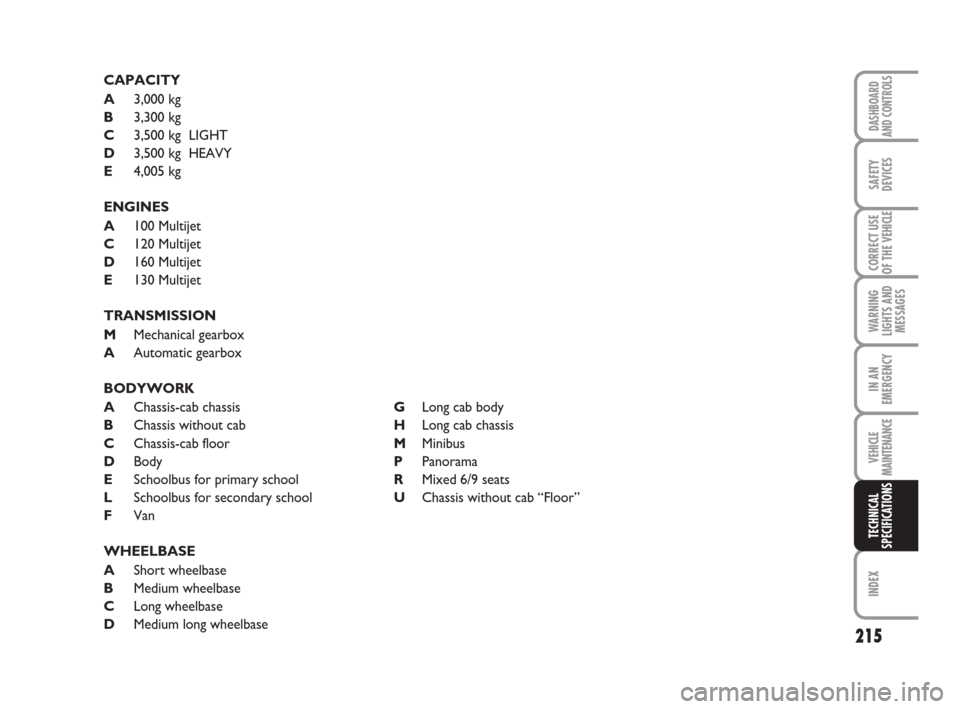
CAPACITY
A3,000 kg
B3,300 kg
C3,500 kg LIGHT
D3,500 kg HEAVY
E4,005 kg
ENGINES
A100 Multijet
C120 Multijet
D160 Multijet
E130 Multijet
TRANSMISSION
MMechanical gearbox
AAutomatic gearbox
BODYWORK
AChassis-cab chassisGLong cab body
BChassis without cabHLong cab chassis
CChassis-cab floorMMinibus
DBodyPPanorama
ESchoolbus for primary schoolRMixed 6/9 seats
LSchoolbus for secondary schoolUChassis without cab “Floor”
FVan
WHEELBASE
AShort wheelbase
BMedium wheelbase
CLong wheelbase
DMedium long wheelbase
Page 231 of 282
230
WARNING
LIGHTS AND
MESSAGES
INDEX
DASHBOARD
AND CONTROLS
SAFETY
DEVICES
CORRECT USE
OF THE
VEHICLE
IN AN
EMERGENCY
VEHICLE
MAINTENANCE
TECHNICAL
SPECIFICATIONS
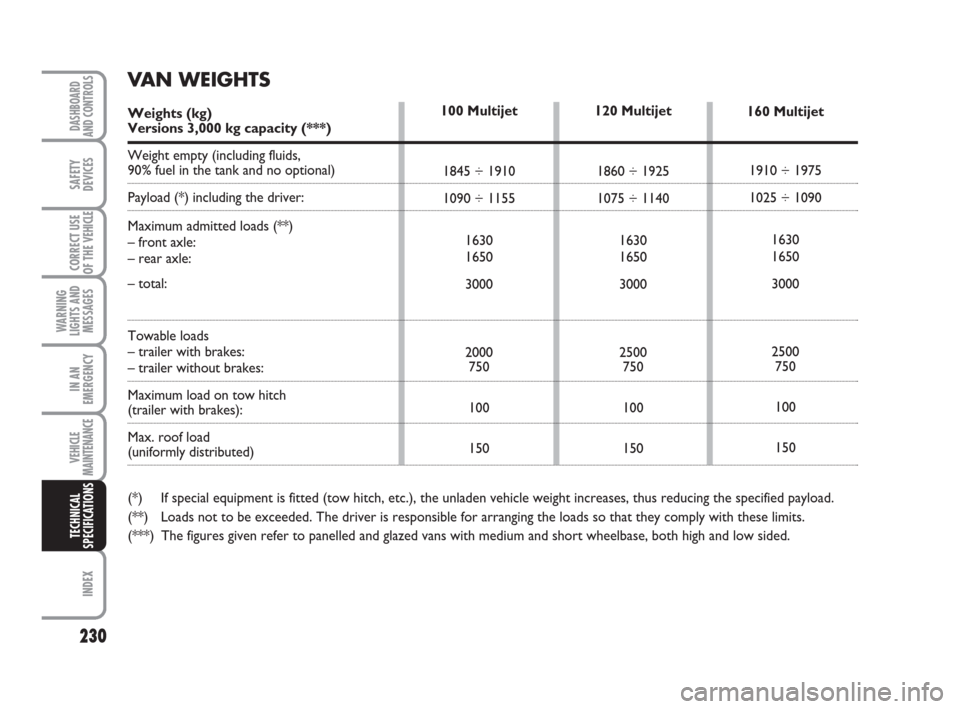
120 Multijet
1860 ÷ 1925
1075 ÷ 1140
1630
1650
3000
2500
750
100
150160 Multijet
1910 ÷ 1975
1025 ÷ 1090
1630
1650
3000
2500
750
100
150 100 Multijet
1845 ÷ 1910
1090 ÷ 1155
1630
1650
3000
2000
750
100
150
VAN WEIGHTS
Weights (kg)Versions 3,000 kg capacity (***)
Weight empty (including fluids,
90% fuel in the tank and no optional)
Payload (*) including the driver:
Maximum admitted loads (**)
– front axle:
– rear axle:
– total:
Towable loads
– trailer with brakes:
– trailer without brakes:
Maximum load on tow hitch
(trailer with brakes):
Max. roof load
(uniformly distributed)
(*) If special equipment is fitted (tow hitch, etc.), the unladen vehicle weight increases, thus reducing the specified payload.
(**) Loads not to be exceeded. The driver is responsible for arranging the loads so that they comply with these limits.
(***) The figures given refer to panelled and glazed vans with medium and short wheelbase, both high and low sided.
Page 236 of 282
235
WARNING
LIGHTS AND
MESSAGES
INDEX
DASHBOARD
AND CONTROLS
SAFETY
DEVICES
CORRECT USE
OF THE
VEHICLE
IN AN
EMERGENCY
VEHICLE
MAINTENANCE
TECHNICAL
SPECIFICATIONS
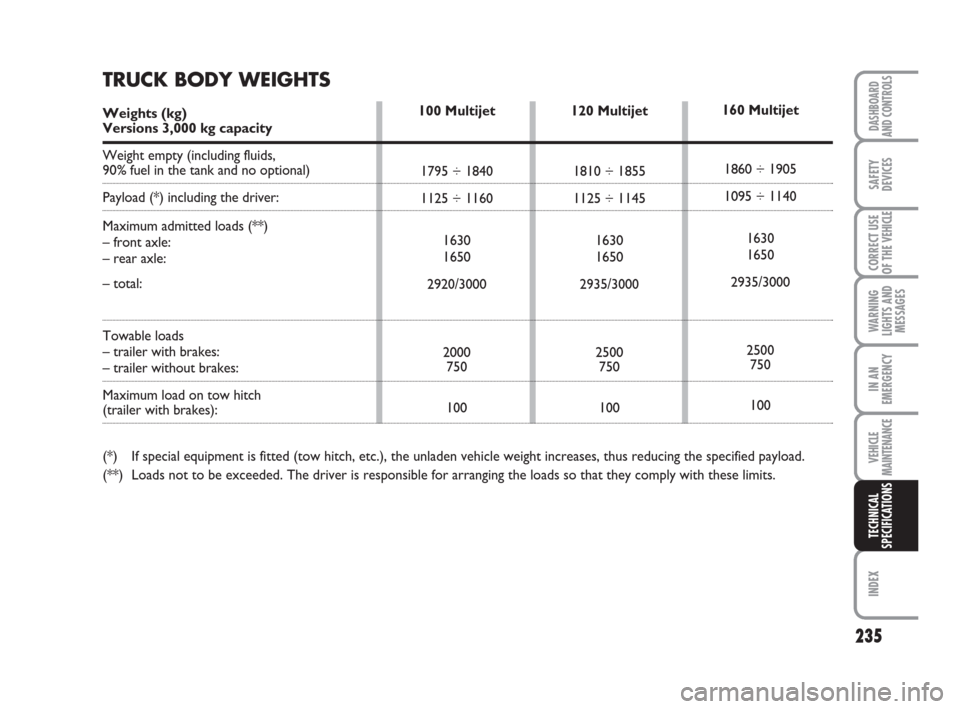
120 Multijet
1810 ÷ 1855
1125 ÷ 1145
1630
1650
2935/3000
2500
750
100160 Multijet
1860 ÷ 1905
1095 ÷ 1140
1630
1650
2935/3000
2500
750
100 100 Multijet
1795 ÷ 1840
1125 ÷ 1160
1630
1650
2920/3000
2000
750
100
TRUCK BODY WEIGHTS
Weights (kg)Versions 3,000 kg capacity
Weight empty (including fluids,
90% fuel in the tank and no optional)
Payload (*) including the driver:
Maximum admitted loads (**)
– front axle:
– rear axle:
– total:
Towable loads
– trailer with brakes:
– trailer without brakes:
Maximum load on tow hitch
(trailer with brakes):
(*) If special equipment is fitted (tow hitch, etc.), the unladen vehicle weight increases, thus reducing the specified payload.
(**) Loads not to be exceeded. The driver is responsible for arranging the loads so that they comply with these limits.
Page 241 of 282
240
WARNING
LIGHTS AND
MESSAGES
INDEX
DASHBOARD
AND CONTROLS
SAFETY
DEVICES
CORRECT USE
OF THE
VEHICLE
IN AN
EMERGENCY
VEHICLE
MAINTENANCE
TECHNICAL
SPECIFICATIONS
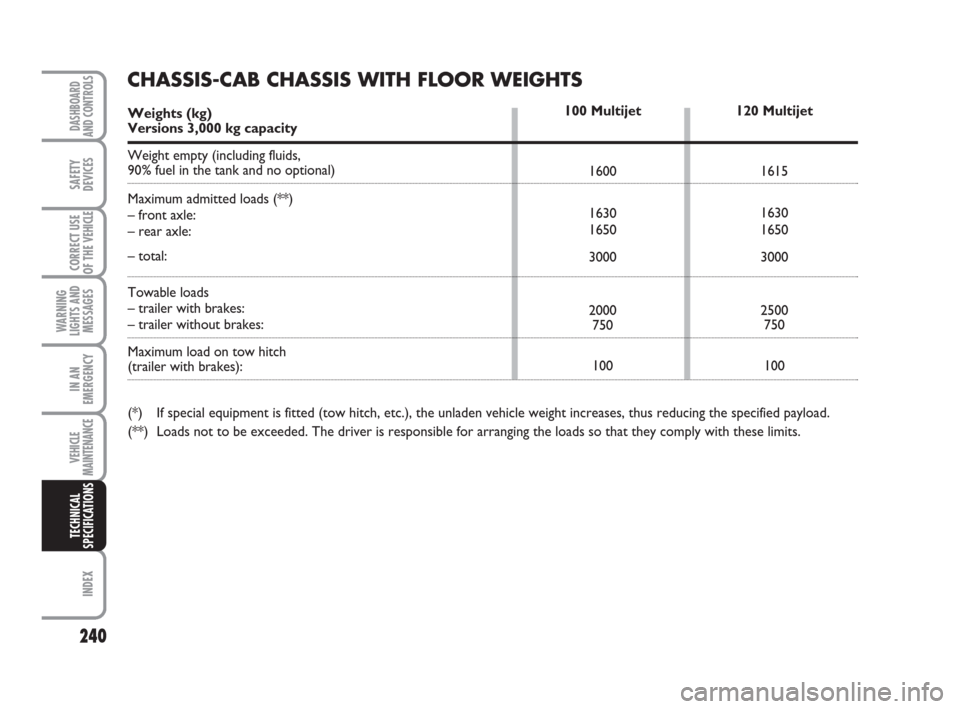
120 Multijet
1615
1630
1650
3000
2500
750
100 100 Multijet
1600
1630
1650
3000
2000
750
100
CHASSIS-CAB CHASSIS WITH FLOOR WEIGHTS
Weights (kg)Versions 3,000 kg capacity
Weight empty (including fluids,
90% fuel in the tank and no optional)
Maximum admitted loads (**)
– front axle:
– rear axle:
– total:
Towable loads
– trailer with brakes:
– trailer without brakes:
Maximum load on tow hitch
(trailer with brakes):
(*) If special equipment is fitted (tow hitch, etc.), the unladen vehicle weight increases, thus reducing the specified payload.
(**) Loads not to be exceeded. The driver is responsible for arranging the loads so that they comply with these limits.
Page 246 of 282
245
WARNING
LIGHTS AND
MESSAGES
INDEX
DASHBOARD
AND CONTROLS
SAFETY
DEVICES
CORRECT USE
OF THE
VEHICLE
IN AN
EMERGENCY
VEHICLE
MAINTENANCE
TECHNICAL
SPECIFICATIONS
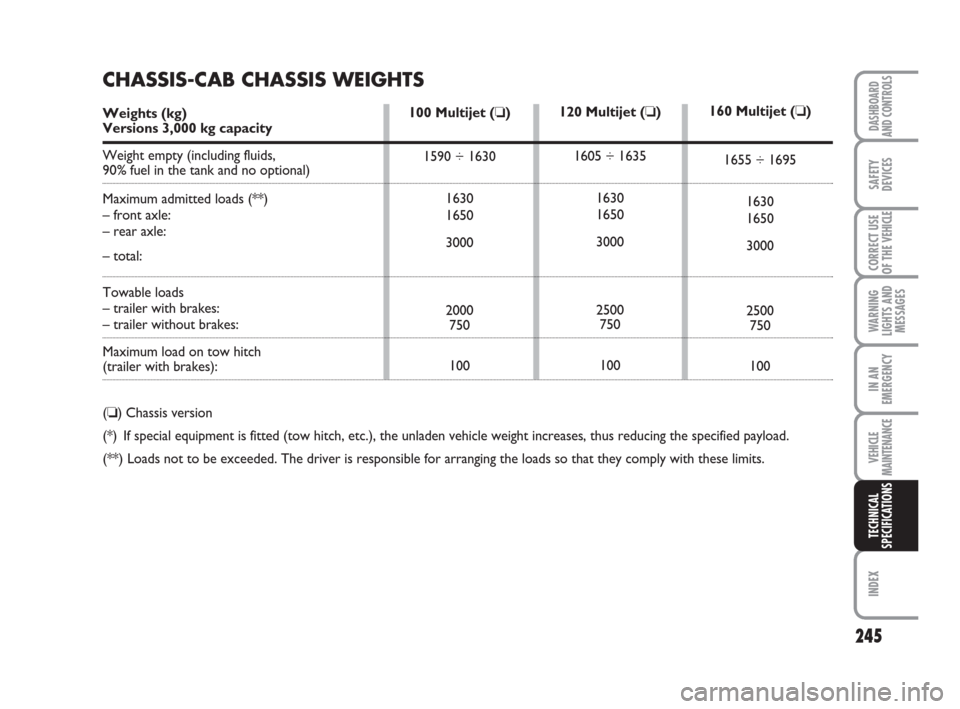
120 Multijet (❏)
1605 ÷ 1635
1630
1650
3000
2500
750
100160 Multijet (❏)
1655 ÷ 1695
1630
1650
3000
2500
750
100 100 Multijet (❏)
1590 ÷ 1630
1630
1650
3000
2000
750
100
CHASSIS-CAB CHASSIS WEIGHTS
Weights (kg)Versions 3,000 kg capacity
Weight empty (including fluids,
90% fuel in the tank and no optional)
Maximum admitted loads (**)
– front axle:
– rear axle:
– total:
Towable loads
– trailer with brakes:
– trailer without brakes:
Maximum load on tow hitch
(trailer with brakes):
(❏) Chassis version
(*) If special equipment is fitted (tow hitch, etc.), the unladen vehicle weight increases, thus reducing the specified payload.
(**) Loads not to be exceeded. The driver is responsible for arranging the loads so that they comply with these limits.
Page 256 of 282
255
WARNING
LIGHTS AND
MESSAGES
INDEX
DASHBOARD
AND CONTROLS
SAFETY
DEVICES
CORRECT USE
OF THE
VEHICLE
IN AN
EMERGENCY
VEHICLE
MAINTENANCE
TECHNICAL
SPECIFICATIONS
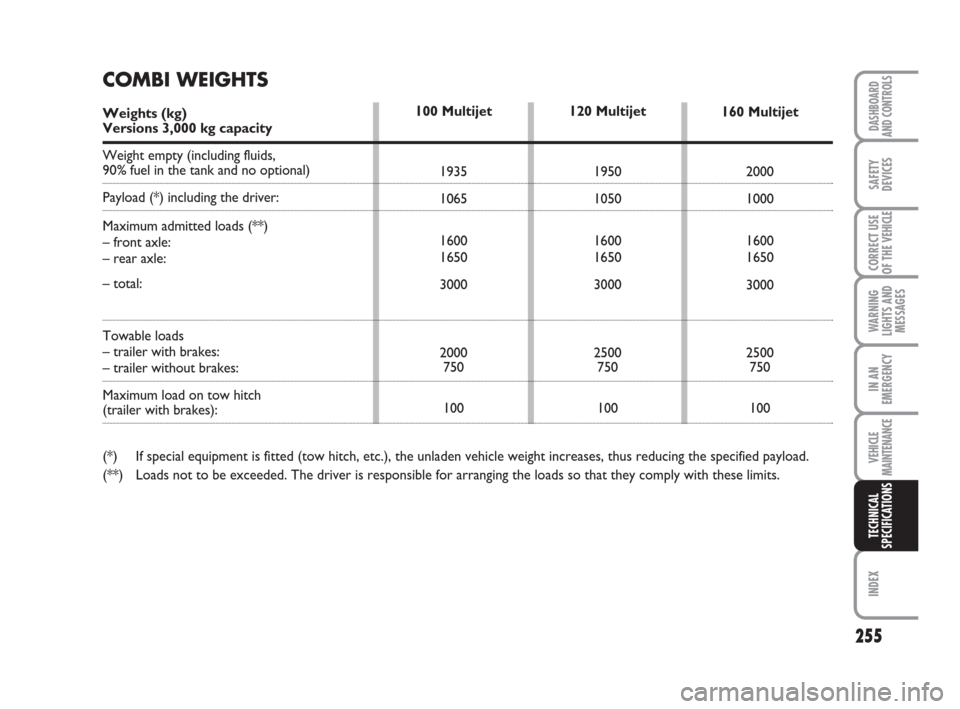
120 Multijet
1950
1050
1600
1650
3000
2500
750
100160 Multijet
2000
1000
1600
1650
3000
2500
750
100 100 Multijet
1935
1065
1600
1650
3000
2000
750
100
COMBI WEIGHTS
Weights (kg)Versions 3,000 kg capacity
Weight empty (including fluids,
90% fuel in the tank and no optional)
Payload (*) including the driver:
Maximum admitted loads (**)
– front axle:
– rear axle:
– total:
Towable loads
– trailer with brakes:
– trailer without brakes:
Maximum load on tow hitch
(trailer with brakes):
(*) If special equipment is fitted (tow hitch, etc.), the unladen vehicle weight increases, thus reducing the specified payload.
(**) Loads not to be exceeded. The driver is responsible for arranging the loads so that they comply with these limits.
Page 260 of 282
259
WARNING
LIGHTS AND
MESSAGES
INDEX
DASHBOARD
AND CONTROLS
SAFETY
DEVICES
CORRECT USE
OF THE
VEHICLE
IN AN
EMERGENCY
VEHICLE
MAINTENANCE
TECHNICAL
SPECIFICATIONS
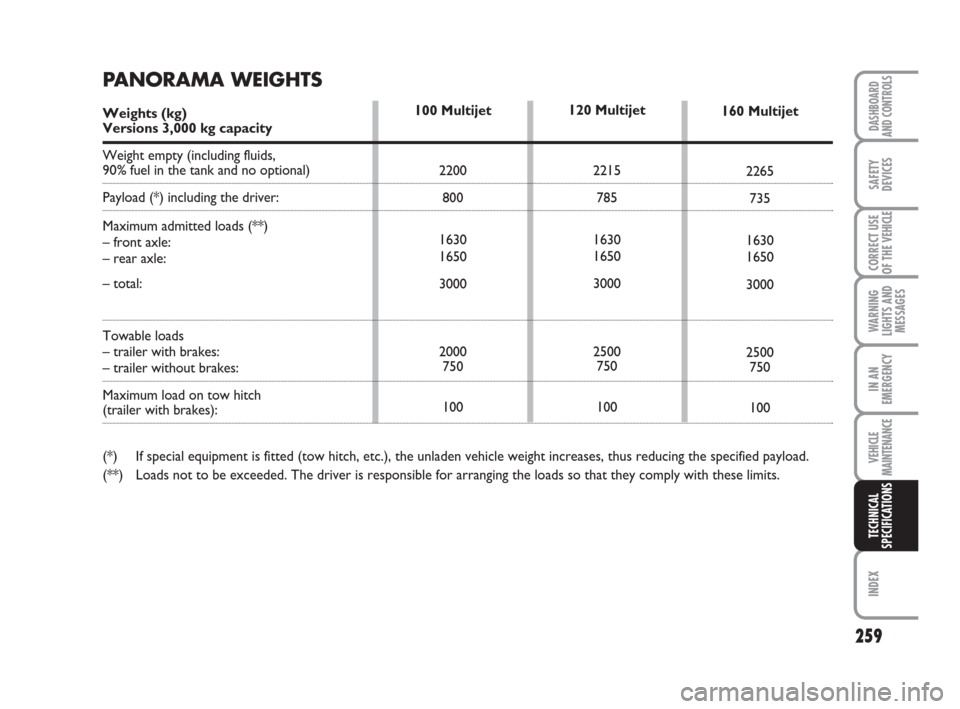
120 Multijet
2215
785
1630
1650
3000
2500
750
100160 Multijet
2265
735
1630
1650
3000
2500
750
100 100 Multijet
2200
800
1630
1650
3000
2000
750
100
PANORAMA WEIGHTS
Weights (kg)Versions 3,000 kg capacity
Weight empty (including fluids,
90% fuel in the tank and no optional)
Payload (*) including the driver:
Maximum admitted loads (**)
– front axle:
– rear axle:
– total:
Towable loads
– trailer with brakes:
– trailer without brakes:
Maximum load on tow hitch
(trailer with brakes):
(*) If special equipment is fitted (tow hitch, etc.), the unladen vehicle weight increases, thus reducing the specified payload.
(**) Loads not to be exceeded. The driver is responsible for arranging the loads so that they comply with these limits.