Specifications FIAT DUCATO 2014 3.G User Guide
[x] Cancel search | Manufacturer: FIAT, Model Year: 2014, Model line: DUCATO, Model: FIAT DUCATO 2014 3.GPages: 367, PDF Size: 20.39 MB
Page 241 of 367
BATTERYThe battery is “limited maintenance”
type: under normal conditions of use,
the electrolyte does not need topping
up with distilled water.
It does, however, need to be checked
periodically at a Fiat Dealership or
by specialist personnel to make sure it
is working correctly.
The battery is located inside the
passenger compartment, in front of the
pedals. Remove the protective cover
to gain access to it.
184) 185)
REPLACING THE
BATTERY
If required, replace the battery with an
original spare part with the same
specifications.
If a battery with different specifications
is fitted, the service intervals given in
the “Scheduled Servicing Plan” will no
longer be valid.
Follow the battery manufacturer's
instructions for maintenance.
51) 52)186) 187)4)
USEFUL ADVICE FOR
EXTENDING THE LIFE OF
YOUR BATTERY
To avoid draining your battery and
make it last longer, observe the
following instructions:
❒when you park the vehicle, ensure
that the doors, tailgate and bonnet
are closed properly, to prevent any
roof lights from remaining on inside
the passenger's compartment;
❒switch off all roof lights inside the
vehicle: the vehicle is however
equipped with a system which
switches all internal lights off
automatically;
❒do not keep accessories (e.g. sound
system, hazard lights, etc.) switched
on for a long time when the engine
is not running;
❒before carrying out any operation on
the electrical system, disconnect the
negative battery cable through the
suitable terminal;
❒Completely tighten the battery
terminals.
237
Page 244 of 367
WHEELS AND TYRESCheck the pressure of each tyre,
including the space-saver wheel,
approximately every two weeks and
before long journeys: the pressure
should be checked with the tyre rested
and cold.
It is normal for the pressure to increase
when the vehicle is used; for the correct
tyre inflation pressure, see “Wheels” in
the “Technical specifications” section.
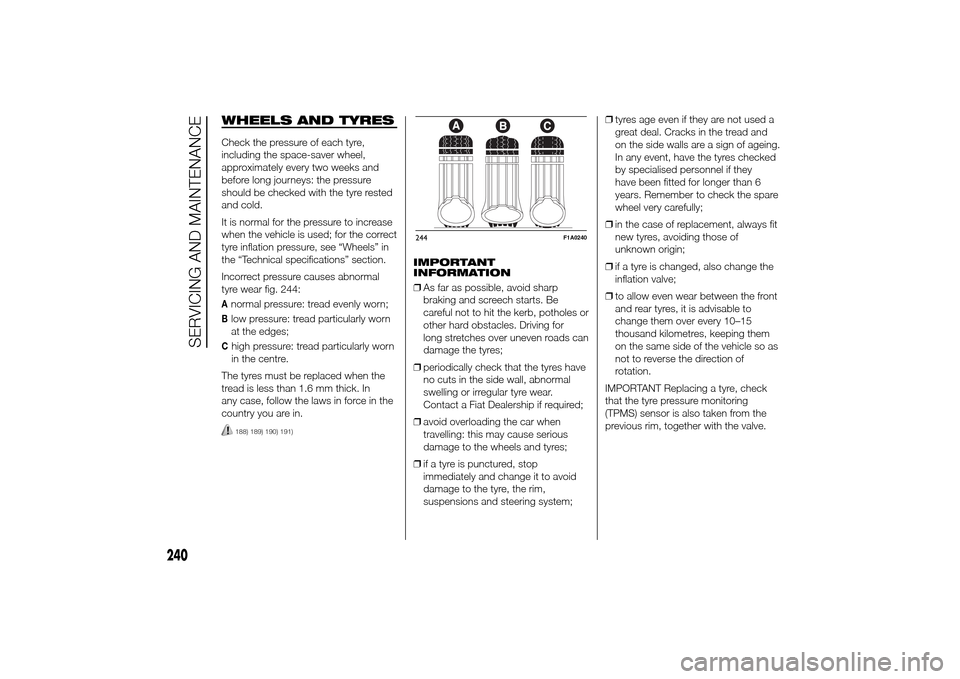
Incorrect pressure causes abnormal
tyre wear fig. 244:Anormal pressure: tread evenly worn;Blow pressure: tread particularly worn
at the edges;Chigh pressure: tread particularly worn
in the centre.
The tyres must be replaced when the
tread is less than 1.6 mm thick. In
any case, follow the laws in force in the
country you are in.188) 189) 190) 191)
IMPORTANT
INFORMATION
❒As far as possible, avoid sharp
braking and screech starts. Be
careful not to hit the kerb, potholes or
other hard obstacles. Driving for
long stretches over uneven roads can
damage the tyres;
❒periodically check that the tyres have
no cuts in the side wall, abnormal
swelling or irregular tyre wear.
Contact a Fiat Dealership if required;
❒avoid overloading the car when
travelling: this may cause serious
damage to the wheels and tyres;
❒if a tyre is punctured, stop
immediately and change it to avoid
damage to the tyre, the rim,
suspensions and steering system;❒tyres age even if they are not used a
great deal. Cracks in the tread and
on the side walls are a sign of ageing.
In any event, have the tyres checked
by specialised personnel if they
have been fitted for longer than 6
years. Remember to check the spare
wheel very carefully;
❒in the case of replacement, always fit
new tyres, avoiding those of
unknown origin;
❒if a tyre is changed, also change the
inflation valve;
❒to allow even wear between the front
and rear tyres, it is advisable to
change them over every 10–15
thousand kilometres, keeping them
on the same side of the vehicle so as
not to reverse the direction of
rotation.
IMPORTANT Replacing a tyre, check
that the tyre pressure monitoring
(TPMS) sensor is also taken from the
previous rim, together with the valve.244
F1A0240
240
SERVICING AND MAINTENANCE
Page 248 of 367
ADVICE FOR
PRESERVING THE
BODYWORK
Paintwork
Paintwork does not only serve an
aesthetic purpose, but also protects the
underlying sheet metal.
Touch up abrasions and scratches
immediately to prevent rust formation.
Only use genuine spare paint products
for touch-ups (see “Bodywork paint
identification plate” in the “Technical
Specifications” section).
Normal maintenance of paintwork
consists in washing the car: the
frequency depends on the conditions
and environment where the car is used.
For example, it is advisable to wash
the vehicle more often in areas with
high levels of environmental pollution or
on roads spread with salt.To correctly wash the vehicle, proceed
as follows:
❒wash the bodywork using a low
pressure jet of water;
❒wipe a sponge with a slightly soapy
solution over the bodywork,
frequently rinsing the sponge;
❒rinse well with water and dry with a
jet of air or a chamois leather.
If you put the car through a car wash,
follow these recommendations:
❒remove the aerial from the roof so it
does not get damaged;
❒the vehicle should be washed with
water added to a soapy solution;
❒rinse thoroughly to avoid soap marks
remaining on the bodywork or less
visible parts.
54)
Dry the less visible parts, such as the
door frames, bonnet and the headlight
frames with special care, as in these
areas water may stagnate more easily.
It is a good idea to leave the vehicle
outdoors for a while after washing it to
give the water time to evaporate.
Do not wash the vehicle after it has
been left in the sun or with the bonnet
hot: this may alter the shine of the
paintwork.
Exterior plastic parts should be cleaned
in the same way as the rest of the
vehicle. Where possible, do not park
the vehicle under trees; the resinous
substances released by many species
give the paint a dull appearance and
increase the possibility of corrosion.
IMPORTANT Bird droppings must be
washed off immediately and thoroughly
as the acid they contain is particularly
aggressive.
5)
Windows
To clean glasses, use specific cleaning
products. Use clean cloths to avoid
scratching the glass or damaging the
transparency.
244
SERVICING AND MAINTENANCE
Page 253 of 367
TECHNICAL SPECIFICATIONS
Everything you may find useful for
understanding how your vehicle
is made and works is contained in this
chapter and illustrated with data, tables
and graphics. For the enthusiasts and
the technician, but also just for those
who want to know every detail of their
vehicle.IDENTIFICATION DATA....................250
ENGINE CODES - BODYWORK
VERSION ........................................252
ENGINE ..........................................254
POWER SUPPLY ............................255
TRANSMISSION .............................256
SUSPENSION .................................257
BRAKES .........................................258
STEERING ......................................259
WHEELS .........................................260
DIMENSIONS ..................................264
PERFORMANCE .............................274
WEIGHTS........................................276
SUPPLIES .......................................316
FLUIDS AND LUBRICANTS ............318
FUEL CONSUMPTION ....................321
CO2 EMISSIONS ............................332
OFFICIAL TYPE APPROVALS .........342
PRESCRIPTIONS FOR HANDLING
THE VEHICLE AT THE END OF ITS
LIFE ................................................346
249
Page 254 of 367
IDENTIFICATION
DATAIt is advisable to take note of the
identification codes. Identification codes
are printed and shown on the plates
as indicated below, together with the
positions:
❒VIN plate.
❒Chassis marking.
❒Bodywork paint identification plate.
❒Engine marking.
V.I.N. PLATE
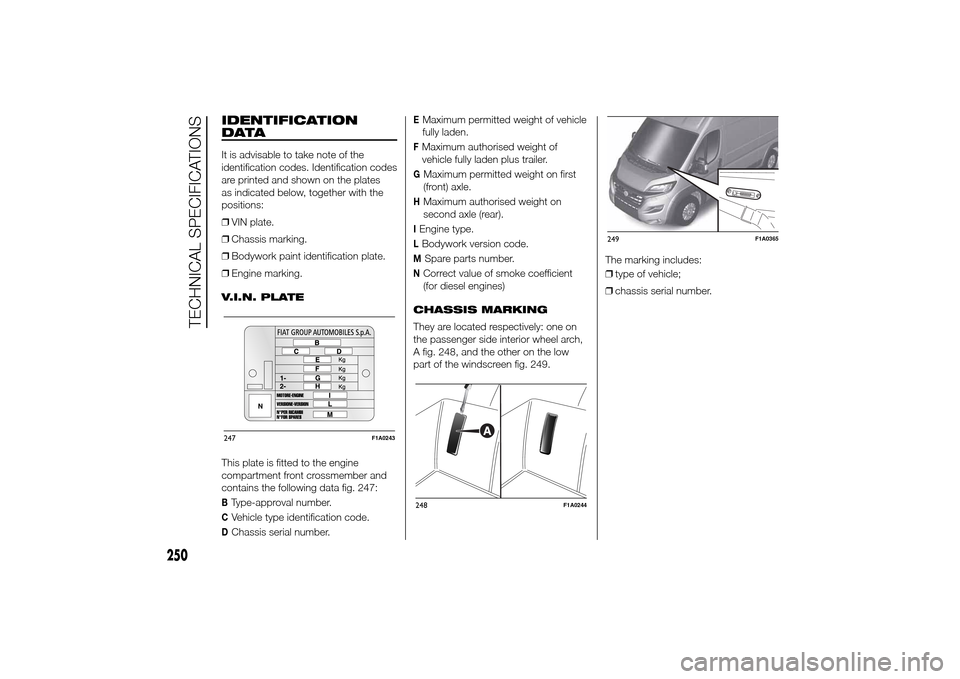
This plate is fitted to the engine
compartment front crossmember and
contains the following data fig. 247:BType-approval number.CVehicle type identification code.DChassis serial number.
EMaximum permitted weight of vehicle
fully laden.FMaximum authorised weight of
vehicle fully laden plus trailer.GMaximum permitted weight on first
(front) axle.HMaximum authorised weight on
second axle (rear).IEngine type.LBodywork version code.M
Spare parts number.
NCorrect value of smoke coefficient
(for diesel engines)
CHASSIS MARKING
They are located respectively: one on
the passenger side interior wheel arch,
A fig. 248, and the other on the low
part of the windscreen fig. 249.The marking includes:
❒type of vehicle;
❒chassis serial number.
247
F1A0243
248
F1A0244
249
F1A0365
250
TECHNICAL SPECIFICATIONS
Page 256 of 367
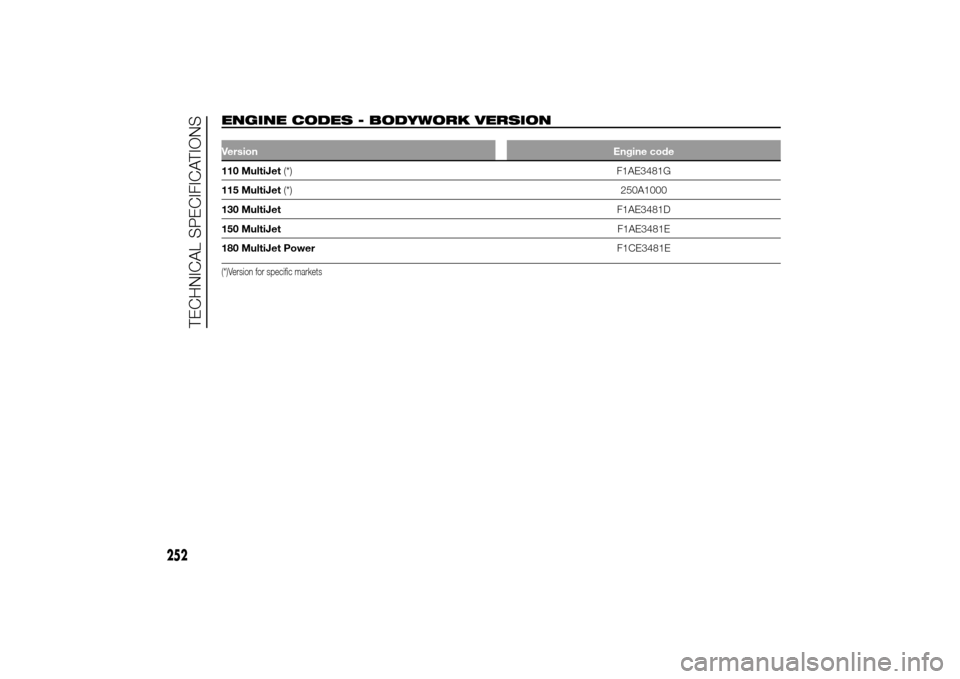
ENGINE CODES - BODYWORK VERSION
.
VersionEngine code110 MultiJet(*) F1AE3481G
115 MultiJet(*)250A1000
130 MultiJetF1AE3481D
150 MultiJetF1AE3481E
180 MultiJet PowerF1CE3481E(*)Version for specific markets
252
TECHNICAL SPECIFICATIONS
Page 258 of 367
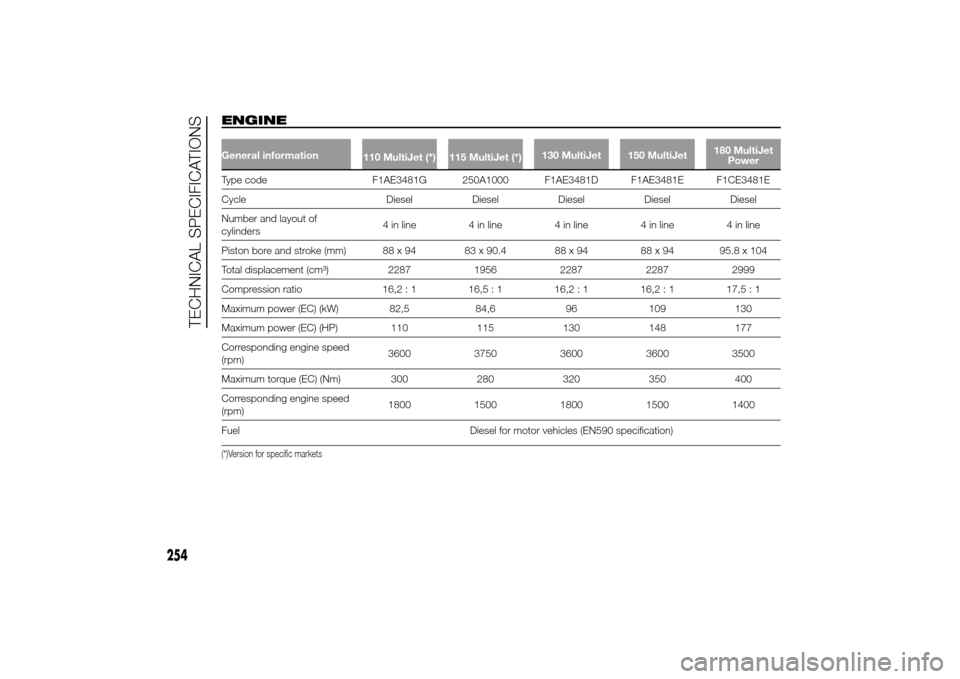
ENGINEGeneral information
110 MultiJet (*) 115 MultiJet (*)130 MultiJet 150 MultiJet180 MultiJet
PowerType code F1AE3481G 250A1000 F1AE3481D F1AE3481E F1CE3481E
Cycle Diesel Diesel Diesel Diesel Diesel
Number and layout of
cylinders4 in line 4 in line 4 in line 4 in line 4 in line
Piston bore and stroke (mm) 88 x 94 83 x 90.4 88 x 94 88 x 94 95.8 x 10⁴
Total displacement (cm³) 2287 1956 2287 2287 2999
Compression ratio 16,2 : 1 16,5 : 1 16,2 : 1 16,2 : 1 17,5 : 1
Maximum power (EC) (kW) 82,5 84,6 96 109 130
Maximum power (EC) (HP) 110 115 130 148 177
Corresponding engine speed
(rpm)3600 3750 3600 3600 3500
Maximum torque (EC) (Nm) 300 280 320 350 400
Corresponding engine speed
(rpm)1800 1500 1800 1500 1400
Fuel Diesel for motor vehicles (EN590 specification)(*)Version for specific markets
254
TECHNICAL SPECIFICATIONS
Page 259 of 367
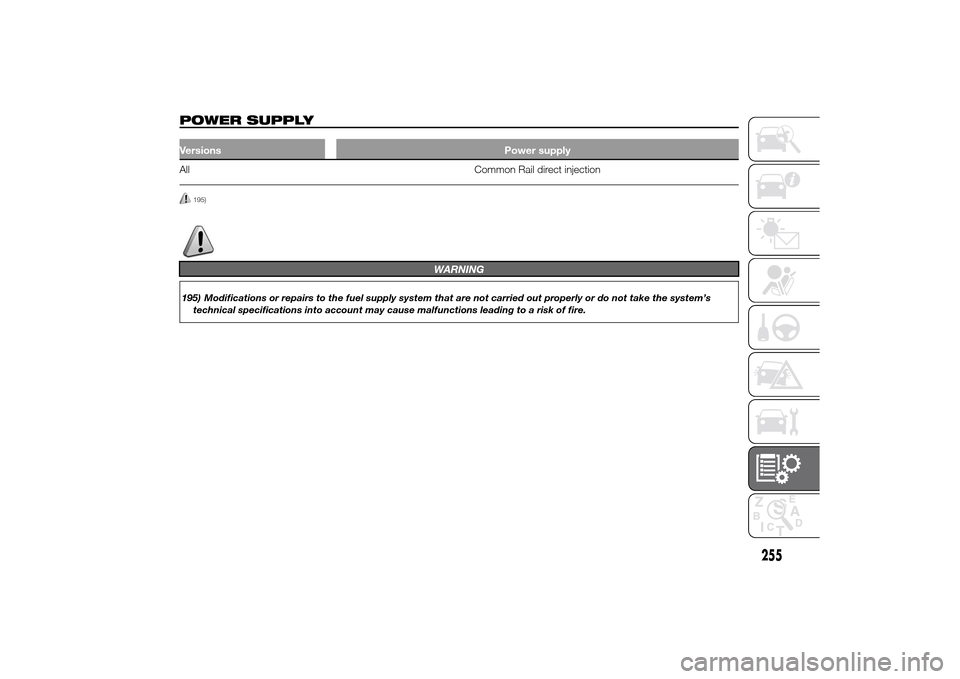
POWER SUPPLYVersions Power supplyAll Common Rail direct injection
195)
WARNING
195) Modifications or repairs to the fuel supply system that are not carried out properly or do not take the system’s
technical specifications into account may cause malfunctions leading to a risk of fire.
255
Page 260 of 367
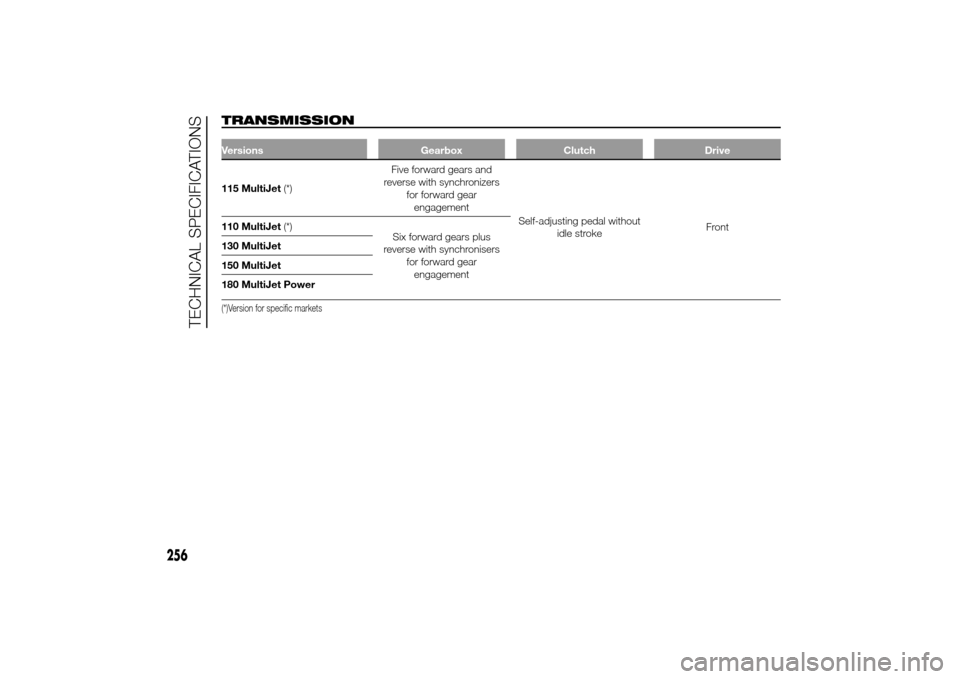
TRANSMISSIONVersions Gearbox Clutch Drive115 MultiJet(*)Five forward gears and
reverse with synchronizers
for forward gear
engagement
Self-adjusting pedal without
idle strokeFront 110 MultiJet(*)
Six forward gears plus
reverse with synchronisers
for forward gear
engagement 130 MultiJet
150 MultiJet
180 MultiJet Power(*)Version for specific markets
256
TECHNICAL SPECIFICATIONS
Page 262 of 367
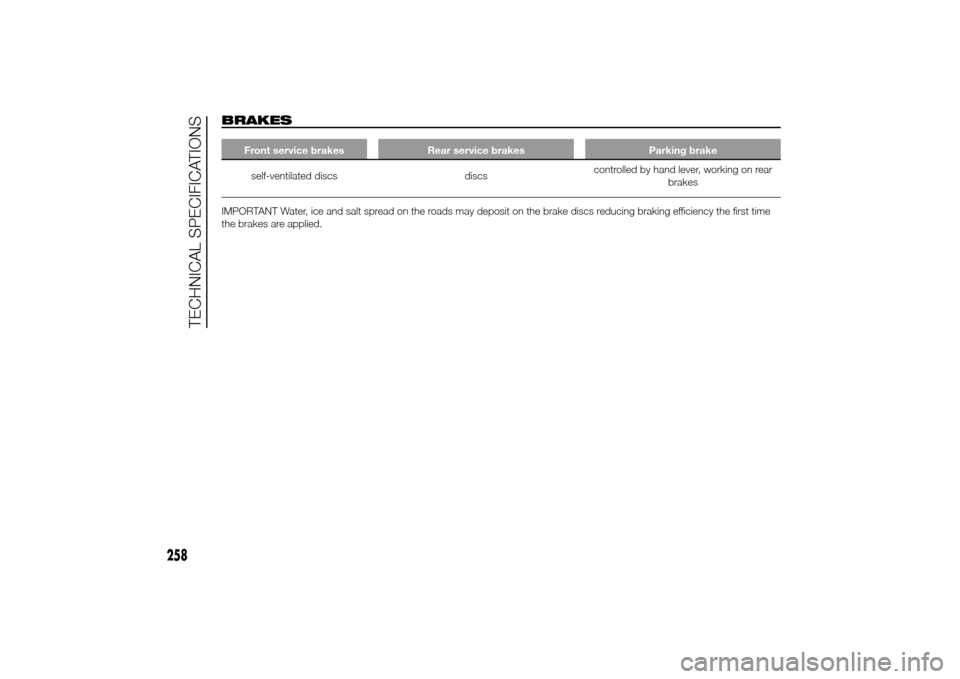
BRAKES
Front service brakes Rear service brakes Parking brakeself-ventilated discs discscontrolled by hand lever, working on rear
brakes
IMPORTANT Water, ice and salt spread on the roads may deposit on the brake discs reducing braking efficiency the first time
the brakes are applied.
258
TECHNICAL SPECIFICATIONS