mirror FIAT DUCATO 2014 3.G User Guide
[x] Cancel search | Manufacturer: FIAT, Model Year: 2014, Model line: DUCATO, Model: FIAT DUCATO 2014 3.GPages: 367, PDF Size: 20.39 MB
Page 87 of 367
68) Tyre pressure must be checked
with tyres cold. Should it become
necessary for whatever reason
to check pressure with warm
tyres, do not reduce pressure
even if it is higher than the
prescribed value, but repeat the
check when tyres are cold.
69) The TPMS cannot indicate
sudden tyre pressure drops (for
example when a tyre bursts).
In this case, stop the car, braking
with caution and avoiding abrupt
steering.
70) The system only warns that the
tyre pressure is low: it is not able
to inflate them.
71) An insufficient tyre inflation
increases fuel consumption,
reduces the tread duration and
may affect the capacity of driving
safely.
72) Always refit the valve stem cap
after inspecting or adjusting tyre
pressure. This prevents dampness
or dirt from entering the valve
stem and thus the pressure
control sensor from being
damaged.73) The tyre repair kit (Fix&Go)
provided with the car (for
versions/markets, where
provided) is compatible with the
TPMS sensors; using sealants not
equivalent with that in the original
kit may adversely affect its
operation. If sealants not
equivalent with the original one
are used, it is recommended to
have the TPMS sensor operation
checked by a qualified repair
centre.
DRIVING ADVISOR(lane crossing warning)
(for versions/markets, where provided)
78) 75) 76)
The Driving Advisor is a warning system
that notifies the driver if he/she crosses
the lane because he/she has been
distracted.
A video sensor, fitted on the windscreen
near the interior rear view mirror,
detects the lane demarcation lines and
the position of the car in relation to
them.
IMPORTANT On cars with Driving
Advisor, it is advisable to contact a Fiat
Dealership should the windscreen
need to be replaced. If the repair is
carried out at a specialist window
replacement centre, it is still necessary
to go to a Fiat Dealership to have the
camera calibrated.
OPERATION
The system is always active when the
vehicle is started. It can be deactivated
or re-activated by pressing button A
fig. 127 on the dashboard (see
following description).
83
Page 94 of 367
IMPORTANT When parking, take the
utmost care over obstacles that may be
above or under the camera range.
WARNING
77) The responsibility for parking
and other manoeuvres is always
and in any case charged to the
driver. While carrying out these
manoeuvres, always make sure
that no people (especially
children) or animals are in the
area concerned. The camera is an
aid for the driver, but the driver
must never allow his/her attention
to lapse during potentially
dangerous manoeuvres, even
those executed at low speeds.
Always keep a slow speed, so as
to promptly brake in the case
of obstacles.
IMPORTANT
8) It is vital, for correct operation,
that the camera is always kept
clean and free from mud, dirt,
snow or ice. Be careful not to
scratch or damage the camera
while cleaning it. Avoid using dry,
rough or hard cloths. The camera
must be washed using clean
water, with the addition of car
shampoo if necessary. In washing
stations which use steam or
high-pressure jets, clean the
camera quickly, keeping the
nozzle more than 10 cm away
from the sensors. Do not apply
stickers to the camera.
TRAFFIC SIGN
RECOGNITION(for versions/markets, where provided)
74) 79) 80) 81)9) 10) 11) 12) 13) 14) 15)
The system automatically detects the
recognisable traffic signs: speed limits,
no overtaking signs and signs indicating
the end of such prohibitions.
The camera is fitted behind the internal
rear view mirror. The sensor always
checks the traffic signs indicating the
current speed limit and possible no
overtaking signs.
IMPORTANT The system is designed to
read signs complying with the
specifications of the Vienna convention.
USE OF THE TRAFFIC
SIGN RECOGNITION
System switching on
and off
The system can be activated/
deactivated using the display menu.
Refer to the "Display" paragraph in the
"Knowing the instrument panel"
chapter.
Note: the system condition and settings
do not change throughout the different
on-off cycles.
90
KNOW YOUR VEHICLE
Page 182 of 367
TOWING TRAILERSIMPORTANT
INFORMATION
The vehicle must be provided with a
type-approved tow hook and adequate
electrical system to tow caravans or
trailers. Installation should be carried
out by specialised personnel who
will issue the required papers for
travelling on roads.
Install any specific and/or additional
door mirrors as specified by the
Highway Code.
Remember that when towing a trailer,
steep hills are harder to climb, the
braking spaces increase and overtaking
takes longer depending on the overall
weight.
Engage a low gear when driving
downhill, rather than constantly using
the brake.
The weight of the trailer on the vehicle
tow hook will reduce the loading
capacity of the vehicle by the same
amount. Consider the weight of the
trailer fully laden, including accessories
and luggage, to make sure you do
not exceed the maximum towable
weight (shown on the vehicle
registration document).Do not exceed the speed limits specific
to each country you are driving in, in
the case of vehicles towing trailers.
In any case, the top speed must not
exceed 100 km/h.
You are advised to fit a suitable
stabiliser to the trailer drawbar.
In the vehicles equipped with parking
sensors, after fitting the tow hook
malfunctioning warnings may be
displayed, as some parts (tow bar, ball
tow hook) may be within the sensor
detection range. In this case the
detection range must be adjusted or
the parking assistance function must be
deactivated.
131) 132)
INSTALLING THE TOW
HOOK
The towing device should be fastened
to the body by specialised personnel
according to any additional and/or
integrative information supplied by the
Manufacturer of the device.
The towing device must meet current
regulations with reference to Directive
94/20/EC and subsequent
amendments.
For any version the towing device used
must match the towable weight of the
vehicle on which it is to be installed.
For the electric connection a standard
connector should be used which is
generally placed on a special bracket
normally fastened to the towing device,
and a special ECU for external trailer
light control must be installed on the
vehicle. For the electrical connection, 7
or 13 pin 12 V DC connections are to
be used (CUNA/UNI and ISO/DIN
Standards). Follow the instructions
provided by the vehicle manufacturer
and/or the tow hitch manufacturer.
An electric brake (or electric winch)
should be supplied directly by the
battery through a cable with a cross
section of no less than 2.5 mm
2.
178
STARTING AND DRIVING
Page 211 of 367
DIPPED HEADLIGHTS
With incandescent bulbs
To replace the bulb, proceed as follows:
❒remove the protective rubber cover
B fig. 203;
❒release the bulb holder A fig. 206
from the side clips B and remove it;
❒disconnect the electrical connector;
❒fit the new bulb, ensuring that the
outline of the metal part coincides
with the grooves on the curve of the
headlight, pressing to engage it
with the side clips;
❒reconnect the electrical connector;
❒refit the protective rubber cover B fig.
203.DIRECTION INDICATORS
To replace the bulb, proceed as follows:
❒remove the protective rubber cover
A fig. 203;
❒turn the bulb holder B fig. 207
anticlockwise;
❒extract the bulb by pulling and
replace it;
❒remove the bulb by pushing it slightly
and turning it anticlockwise (bayonet
mount);
❒refit the bulb holder B by turning it
clockwise and making sure that it
locks correctly
❒refit the protective rubber cover A fig.
203.Side
To change the bulb, proceed as follows
fig. 208:
❒move the mirror manually to permit
access to the two fixing screws A;
❒using the Phillips screwdriver
provided, undo the screws
and extract the bulb holder assembly,
releasing it from the teeth;
❒undo the bulb and replace bulb B,
turning it anticlockwise.206
F1A0316
207
F1A0317
208
F1A0195
207
Page 221 of 367
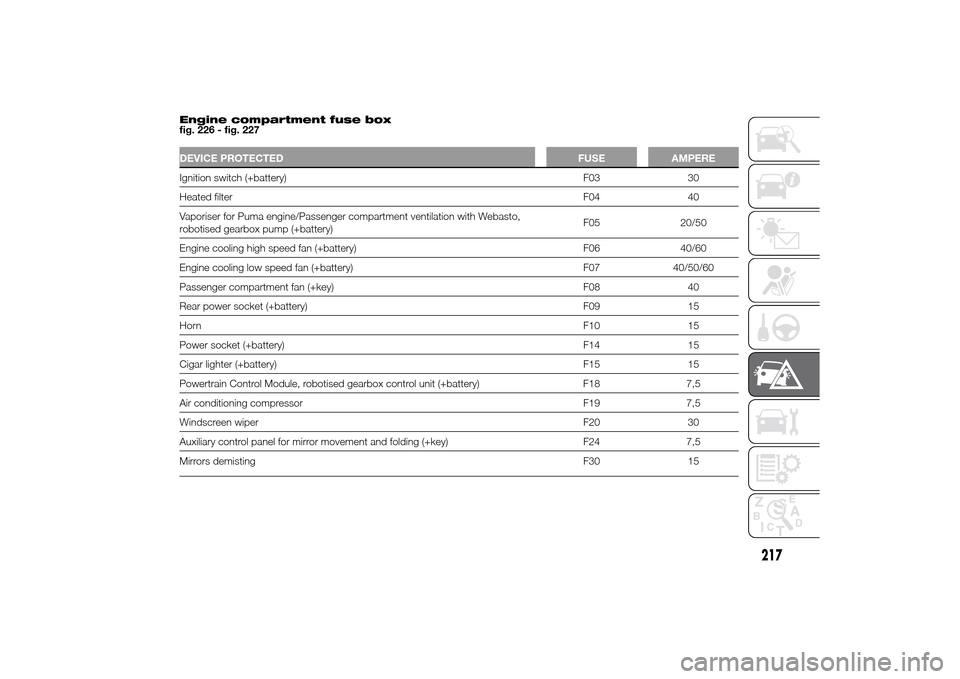
Engine compartment fuse box
fig. 226 - fig. 227DEVICE PROTECTED FUSE AMPEREIgnition switch (+battery) F03 30
Heated filterF04 40
Vaporiser for Puma engine/Passenger compartment ventilation with Webasto,
robotised gearbox pump (+battery)F05 20/50
Engine cooling high speed fan (+battery) F06 40/60
Engine cooling low speed fan (+battery) F07 40/50/60
Passenger compartment fan (+key) F08 40
Rear power socket (+battery) F09 15
HornF10 15
Power socket (+battery) F14 15
Cigar lighter (+battery) F15 15
Powertrain Control Module, robotised gearbox control unit (+battery) F18 7,5
Air conditioning compressor F19 7,5
Windscreen wiper F20 30
Auxiliary control panel for mirror movement and folding (+key) F24 7,5
Mirrors demisting F30 15
217
Page 365 of 367
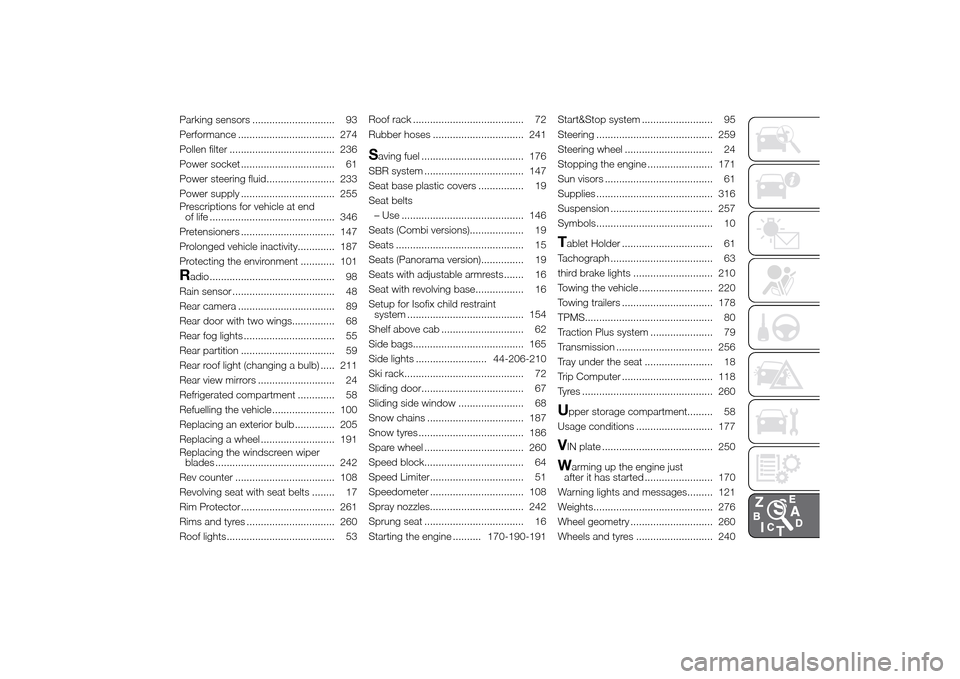
Parking sensors ............................. 93
Performance .................................. 274
Pollen filter ..................................... 236
Power socket ................................. 61
Power steering fluid........................ 233
Power supply ................................. 255
Prescriptions for vehicle at end
of life ............................................ 346
Pretensioners ................................. 147
Prolonged vehicle inactivity............. 187
Protecting the environment ............ 101Radio ............................................ 98
Rain sensor .................................... 48
Rear camera .................................. 89
Rear door with two wings............... 68
Rear fog lights ................................ 55
Rear partition ................................. 59
Rear roof light (changing a bulb) ..... 211
Rear view mirrors ........................... 24
Refrigerated compartment ............. 58
Refuelling the vehicle ...................... 100
Replacing an exterior bulb .............. 205
Replacing a wheel .......................... 191
Replacing the windscreen wiper
blades .......................................... 242
Rev counter ................................... 108
Revolving seat with seat belts ........ 17
Rim Protector................................. 261
Rims and tyres ............................... 260
Roof lights...................................... 53Roof rack ....................................... 72
Rubber hoses ................................ 241
Saving fuel .................................... 176
SBR system ................................... 147
Seat base plastic covers ................ 19
Seat belts
– Use ........................................... 146
Seats (Combi versions)................... 19
Seats ............................................. 15
Seats (Panorama version)............... 19
Seats with adjustable armrests....... 16
Seat with revolving base................. 16
Setup for Isofix child restraint
system ......................................... 154
Shelf above cab ............................. 62
Side bags....................................... 165
Side lights ......................... 44-206-210
Ski rack.......................................... 72
Sliding door.................................... 67
Sliding side window ....................... 68
Snow chains .................................. 187
Snow tyres ..................................... 186
Spare wheel ................................... 260
Speed block................................... 64
Speed Limiter................................. 51
Speedometer ................................. 108
Spray nozzles................................. 242
Sprung seat ................................... 16
Starting the engine .......... 170-190-191Start&Stop system ......................... 95
Steering ......................................... 259
Steering wheel ............................... 24
Stopping the engine ....................... 171
Sun visors ...................................... 61
Supplies ......................................... 316
Suspension .................................... 257
Symbols......................................... 10
Tablet Holder ................................ 61
Tachograph .................................... 63
third brake lights ............................ 210
Towing the vehicle .......................... 220
Towing trailers ................................ 178
TPMS............................................. 80
Traction Plus system ...................... 79
Transmission .................................. 256
Tray under the seat ........................ 18
Trip Computer ................................ 118
Tyres .............................................. 260Upper storage compartment......... 58
Usage conditions ........................... 177VIN plate ....................................... 250W
arming up the engine just
after it has started ........................ 170
Warning lights and messages......... 121
Weights.......................................... 276
Wheel geometry ............................. 260
Wheels and tyres ........................... 240