belt FIAT DUCATO 2014 3.G Owner's Manual
[x] Cancel search | Manufacturer: FIAT, Model Year: 2014, Model line: DUCATO, Model: FIAT DUCATO 2014 3.GPages: 367, PDF Size: 20.39 MB
Page 164 of 367
FRONT AIRBAGSThe vehicle is provided with front
airbags for the driver and the
passenger.
The front driver/passenger airbags have
been designed to protect the front
seat occupants in the event of frontal
impacts of medium-high severity, by
placing the bag between the occupant
and the steering wheel or dashboard.
Therefore, non-activation in other types
of collisions (side collisions, rear shunts,
roll-overs, etc.) is not a system
malfunction.
An electronic control unit will make the
bag inflate in the event of a frontal
impact.
The bag will inflate instantaneously
placing itself between the front
occupants body and the structures
which could cause injury. It will deflate
immediately afterwards.
Driver and passenger front airbags are
not a replacement of but
complementary to the belts, which you
are recommended to always wear, as
specified by law in Europe and most
non-European countries.The volume of the front airbags at
maximum inflation fills most of
the space between the steering wheel
and the driver and between the
dashboard and the passenger.
In the event of an impact, someone not
wearing a seat belt will move forward
and come into contact with the bag
which is still in the opening stage. The
protection offered by the bag is
compromised in these circumstances.
Front airbags may not activate in the
following situations:
❒frontal impacts against highly
deformable objects not involving the
front surface of the vehicle (e.g.
wing collision against guard rail, etc.);
❒jamming of the vehicle underneath
other vehicles or protective barriers
(e.g. underneath a truck or a guard
rail); in this case, the bags would offer
no additional protection with respect
to the seat belt and their deployment
is unnecessary. In these cases,
non-deployment does not indicate a
system malfunction.
110)
The airbags are not deployed in the
event of minor frontal collisions (for
which the restraining action of the seat
belts is sufficient). Safety belts must
always be worn. In the event of frontal
collisions they guarantee correct
positioning of the passenger.
DRIVER'S SIDE FRONT
AIRBAG
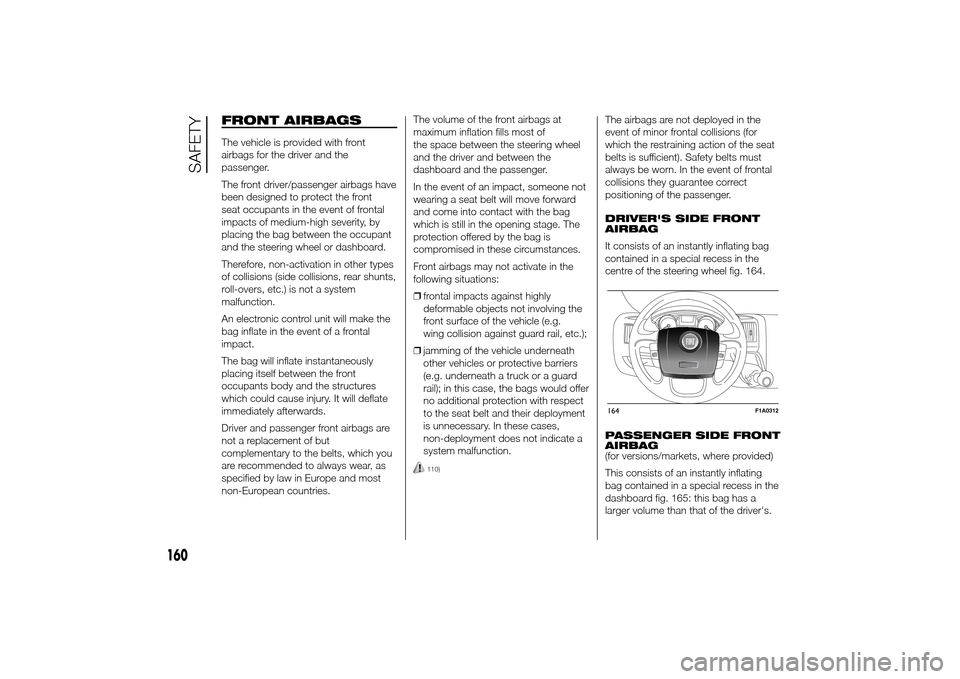
It consists of an instantly inflating bag
contained in a special recess in the
centre of the steering wheel fig. 164.
PASSENGER SIDE FRONT
AIRBAG
(for versions/markets, where provided)
This consists of an instantly inflating
bag contained in a special recess in the
dashboard fig. 165: this bag has a
larger volume than that of the driver's.164
F1A0312
160
SAFETY
Page 169 of 367
SIDE BAGS
112) 113) 114) 115) 116) 117) 118) 119) 120) 121)
122) 123) 124)
The vehicle is fitted with front side bags
for driver and passenger (for versions/
markets where provided) for protecting
the chest and window bags (for
versions/markets where provided) for
protecting front and rear passengers'
heads.
Side bags (for versions/markets where
provided) protect occupants from
side impacts of medium-high severity,
by placing the bag between the
occupant and the internal parts of the
side structure of the vehicle. Non-
activation of side bags in other types of
collisions (front collisions, rear shunts,
roll-overs, etc...) is not a system
malfunction.
An electronic control unit causes the
bags to inflate in the event of a side
impact. The bags inflate
instantaneously placing themselves
between the occupants' bodies and the
structures which could cause injury.
They deflate immediately afterwards.Side bags (for versions/markets where
provided) are not a replacement of
but complementary to the belts, which
you are recommended to always wear,
as specified by law in Europe and
most non-European countries.
FRONT SIDE BAGS FOR
CHEST PROTECTION
(for versions/markets, where provided)
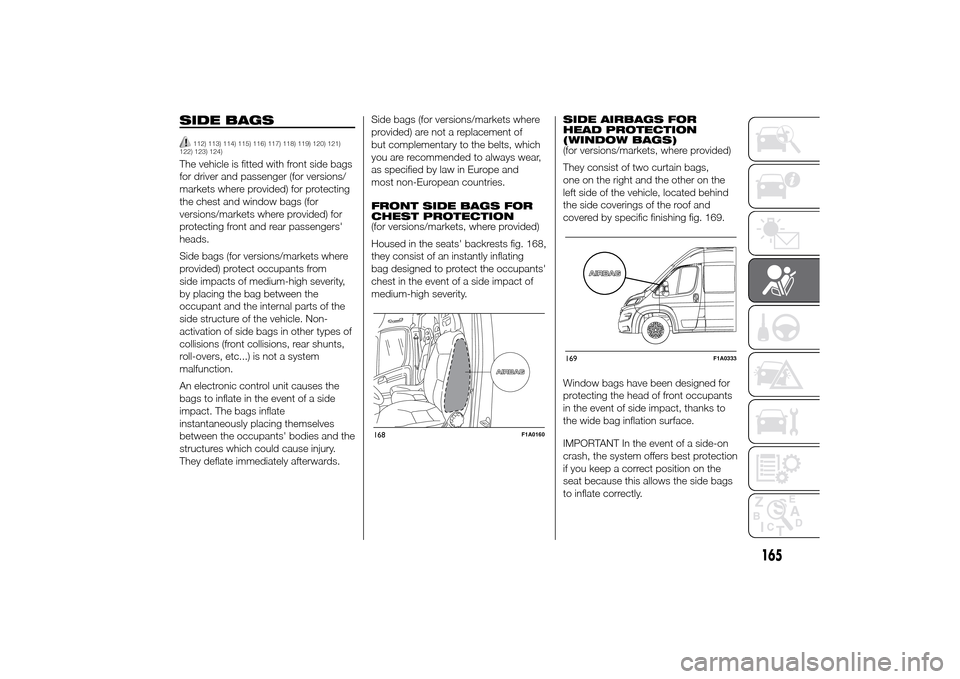
Housed in the seats' backrests fig. 168,
they consist of an instantly inflating
bag designed to protect the occupants'
chest in the event of a side impact of
medium-high severity.SIDE AIRBAGS FOR
HEAD PROTECTION
(WINDOW BAGS)
(for versions/markets, where provided)
They consist of two curtain bags,
one on the right and the other on the
left side of the vehicle, located behind
the side coverings of the roof and
covered by specific finishing fig. 169.
Window bags have been designed for
protecting the head of front occupants
in the event of side impact, thanks to
the wide bag inflation surface.
IMPORTANT In the event of a side-on
crash, the system offers best protection
if you keep a correct position on the
seat because this allows the side bags
to inflate correctly.
168
F1A0160
169
F1A0333
165
Page 171 of 367
118) If the key is inserted and turned
to MAR-ON, airbags may be
deployed if another vehicle
crashes into the vehicle even if
the engine is not running and the
vehicle is stationary. Therefore,
even if the car is stationary, when
an active front passenger airbag
is fitted, DO NOT install rear
facing child restraint systems on
the front passenger seat.
Deployment of the airbag
following an impact could cause
fatal injuries to the child.
Therefore, always deactivate the
passenger airbag when a rear
facing child restraint system is
installed on the front passenger
seat. The front passenger seat
must also be positioned back as
far as possible in order to prevent
the child restraint system from
coming into contact with the
dashboard. Immediately
reactivate the passenger airbag
as soon as the child restraint
system has been removed. Also
remember that, if the key is
turned to STOP, none of the
safety devices (airbags or
pretensioners) will be deployed in
the event of collision. Non-
deployment in such cases does
not indicate a system malfunction.119) If the vehicle has been subject
to theft, attempted theft,
vandalism, or flooding, have the
airbag system inspected at a Fiat
Dealership.
120) When the ignition key is turned
to MAR-ON, the LED on button
on the dashboard blinks for a
few seconds (the number of
seconds may depend on the
market) to check the correct
operation of the LED on the
button.
121) Do not wash the seats with
water or pressurised steam (by
hand or at automatic car seat
washing stations).
122) The front airbag deploys in the
event of more severe collisions
than those required for deploying
the pretensioners. For impacts
whose intensity falls between the
two levels, normally, only the
pretensioners will be activated.
123) Do not affix rigid objects to the
coat hooks or support handles.124) The airbag does not replace
seat belts but increases their
efficiency. Furthermore, since
front airbags are not deployed in
low-speed frontal impacts, side
impacts, rear shunts or roll-overs,
the passengers are protected
only by the seat belts which must
therefore be fastened at all
times.
167
Page 230 of 367
Thousands of miles 30 60 90 120 150
Thousands of kilometres 48 96 144 192 240
Months 24 48 72 96 120
Visual check of accessory drive belt(s) (versions without automatic
tensioner) (110 (°)- 130 - 150 - 180 MultiJet versions)●●
Check tension of accessory drive belt (versions without automatic tensioner)
(^)●●
Check tension of accessory drive belt (versions without automatic tensioner)
(115 MultiJet versions) (°)) (^)●●●
Check condition of toothed timing drive belt (110 (°)- 130 - 150 MultiJet
versions)●
Check condition of toothed timing drive belt (115 MultiJet versions) (°))●●●●●
Check handbrake lever travel and adjust, if required●●●●●
Check exhaust emissions/smokiness●●●●●
Check engine control system operation (through diagnosis socket)●●●●●
Check cleanliness of sliding side door lower guides for versions with S.S.D.
(or every 6 months)●●●●●
Replace the fuel filter cartridge (diesel versions)●●●●●
Replace accessory drive belt(s)●
Replace the accessory drive belt(s) (115 MultiJet versions) (°))●●(°)Version for specific markets
(^) When the engine oil is changed for the first time, check the tension of the accessory drive belt
226
SERVICING AND MAINTENANCE
Page 231 of 367
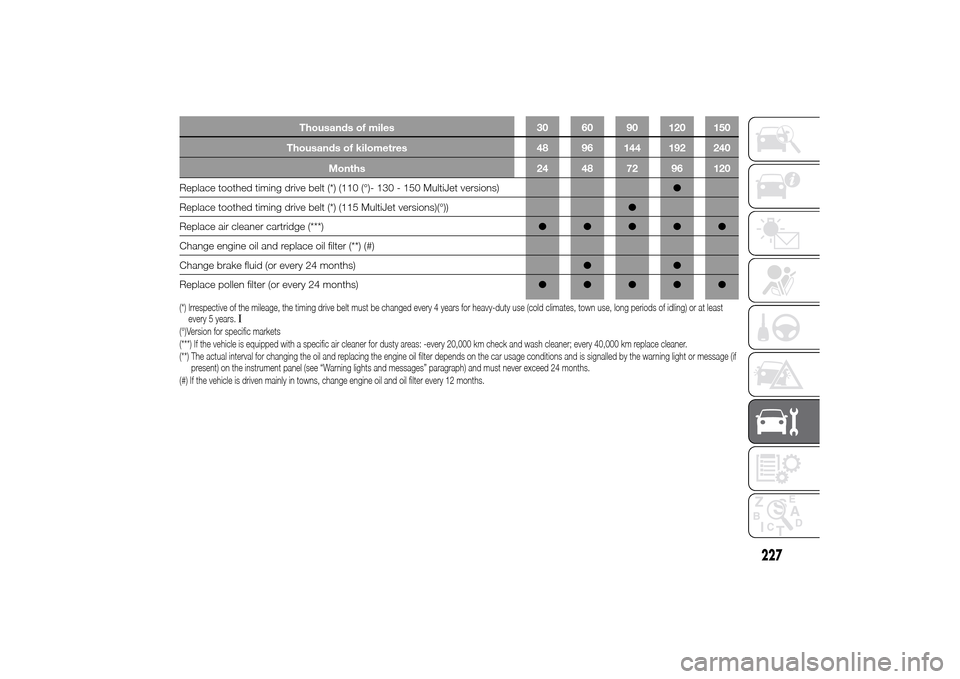
Thousands of miles 30 60 90 120 150
Thousands of kilometres 48 96 144 192 240
Months 24 48 72 96 120
Replace toothed timing drive belt (*) (110 (°)- 130 - 150 MultiJet versions)●
Replace toothed timing drive belt (*) (115 MultiJet versions)(°))●
Replace air cleaner cartridge (***)●●●●●
Change engine oil and replace oil filter (**) (#)
Change brake fluid (or every 24 months)●●
Replace pollen filter (or every 24 months)●●●●●(*) Irrespective of the mileage, the timing drive belt must be changed every 4 years for heavy-duty use (cold climates, town use, long periods of idling) or at least
every 5 years.
I
(°)Version for specific markets
(***) If the vehicle is equipped with a specific air cleaner for dusty areas: -every 20,000 km check and wash cleaner; every 40,000 km replace cleaner.
(**) The actual interval for changing the oil and replacing the engine oil filter depends on the car usage conditions and is signalled by the warning light or message (if
present) on the instrument panel (see “Warning lights and messages” paragraph) and must never exceed 24 months.
(#) If the vehicle is driven mainly in towns, change engine oil and oil filter every 12 months.
227
Page 232 of 367
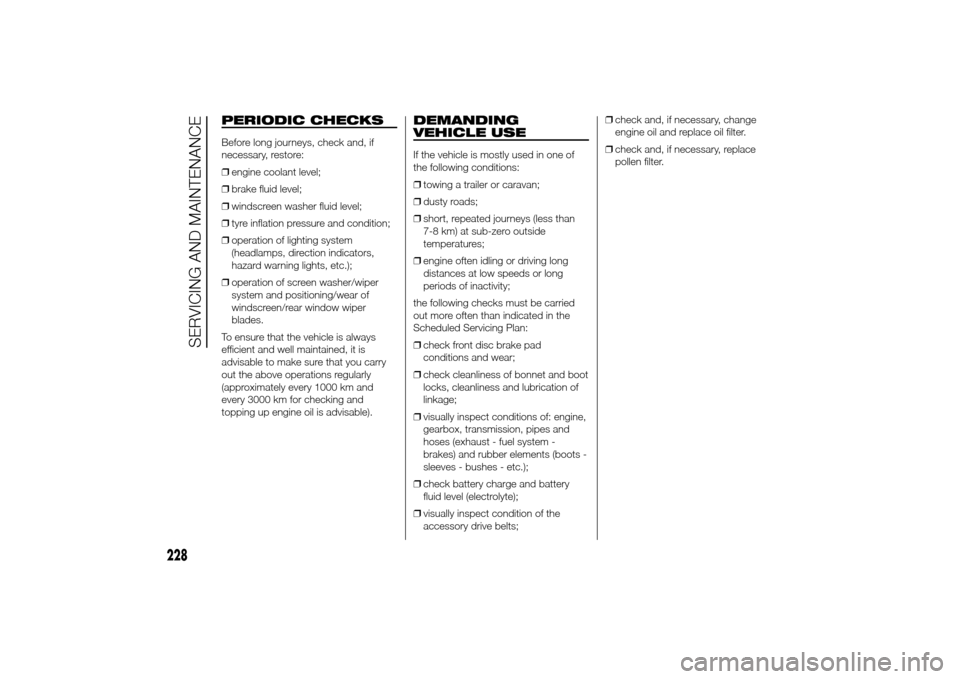
PERIODIC CHECKSBefore long journeys, check and, if
necessary, restore:
❒engine coolant level;
❒brake fluid level;
❒windscreen washer fluid level;
❒tyre inflation pressure and condition;
❒operation of lighting system
(headlamps, direction indicators,
hazard warning lights, etc.);
❒operation of screen washer/wiper
system and positioning/wear of
windscreen/rear window wiper
blades.
To ensure that the vehicle is always
efficient and well maintained, it is
advisable to make sure that you carry
out the above operations regularly
(approximately every 1000 km and
every 3000 km for checking and
topping up engine oil is advisable).
DEMANDING
VEHICLE USEIf the vehicle is mostly used in one of
the following conditions:
❒towing a trailer or caravan;
❒dusty roads;
❒short, repeated journeys (less than
7-8 km) at sub-zero outside
temperatures;
❒engine often idling or driving long
distances at low speeds or long
periods of inactivity;
the following checks must be carried
out more often than indicated in the
Scheduled Servicing Plan:
❒check front disc brake pad
conditions and wear;
❒check cleanliness of bonnet and boot
locks, cleanliness and lubrication of
linkage;
❒visually inspect conditions of: engine,
gearbox, transmission, pipes and
hoses (exhaust - fuel system -
brakes) and rubber elements (boots -
sleeves - bushes - etc.);
❒check battery charge and battery
fluid level (electrolyte);
❒visually inspect condition of the
accessory drive belts;❒check and, if necessary, change
engine oil and replace oil filter.
❒check and, if necessary, replace
pollen filter.
228
SERVICING AND MAINTENANCE
Page 365 of 367
Parking sensors ............................. 93
Performance .................................. 274
Pollen filter ..................................... 236
Power socket ................................. 61
Power steering fluid........................ 233
Power supply ................................. 255
Prescriptions for vehicle at end
of life ............................................ 346
Pretensioners ................................. 147
Prolonged vehicle inactivity............. 187
Protecting the environment ............ 101Radio ............................................ 98
Rain sensor .................................... 48
Rear camera .................................. 89
Rear door with two wings............... 68
Rear fog lights ................................ 55
Rear partition ................................. 59
Rear roof light (changing a bulb) ..... 211
Rear view mirrors ........................... 24
Refrigerated compartment ............. 58
Refuelling the vehicle ...................... 100
Replacing an exterior bulb .............. 205
Replacing a wheel .......................... 191
Replacing the windscreen wiper
blades .......................................... 242
Rev counter ................................... 108
Revolving seat with seat belts ........ 17
Rim Protector................................. 261
Rims and tyres ............................... 260
Roof lights...................................... 53Roof rack ....................................... 72
Rubber hoses ................................ 241
Saving fuel .................................... 176
SBR system ................................... 147
Seat base plastic covers ................ 19
Seat belts
– Use ........................................... 146
Seats (Combi versions)................... 19
Seats ............................................. 15
Seats (Panorama version)............... 19
Seats with adjustable armrests....... 16
Seat with revolving base................. 16
Setup for Isofix child restraint
system ......................................... 154
Shelf above cab ............................. 62
Side bags....................................... 165
Side lights ......................... 44-206-210
Ski rack.......................................... 72
Sliding door.................................... 67
Sliding side window ....................... 68
Snow chains .................................. 187
Snow tyres ..................................... 186
Spare wheel ................................... 260
Speed block................................... 64
Speed Limiter................................. 51
Speedometer ................................. 108
Spray nozzles................................. 242
Sprung seat ................................... 16
Starting the engine .......... 170-190-191Start&Stop system ......................... 95
Steering ......................................... 259
Steering wheel ............................... 24
Stopping the engine ....................... 171
Sun visors ...................................... 61
Supplies ......................................... 316
Suspension .................................... 257
Symbols......................................... 10
Tablet Holder ................................ 61
Tachograph .................................... 63
third brake lights ............................ 210
Towing the vehicle .......................... 220
Towing trailers ................................ 178
TPMS............................................. 80
Traction Plus system ...................... 79
Transmission .................................. 256
Tray under the seat ........................ 18
Trip Computer ................................ 118
Tyres .............................................. 260Upper storage compartment......... 58
Usage conditions ........................... 177VIN plate ....................................... 250W
arming up the engine just
after it has started ........................ 170
Warning lights and messages......... 121
Weights.......................................... 276
Wheel geometry ............................. 260
Wheels and tyres ........................... 240