brake FIAT DUCATO 2014 3.G Workshop Manual
[x] Cancel search | Manufacturer: FIAT, Model Year: 2014, Model line: DUCATO, Model: FIAT DUCATO 2014 3.GPages: 367, PDF Size: 20.39 MB
Page 239 of 367
50) Do not press the power steering
end of travel lock for longer than 8
consecutive seconds with the
engine running because it will
cause noise and risk damaging
the system.
WARNING
175) Never smoke when performing
operations in the engine
compartment. Flammable gases
and fumes may be present and
risk igniting.
176) Be very careful when working in
the engine compartment when
the engine is hot: you may get
burned. Remember that the fan
may start up if the engine is hot:
this could injure you. Scarves, ties
and other loose clothing might
be pulled by moving parts.
177) The cooling system is
pressurised. If necessary, only
replace the plug with another
original one or the operation of
the system may be adversely
affected. Do not remove the
reservoir plug when the engine is
hot: risk of burns.178) Do not travel with the
windscreen washer reservoir
empty: the windscreen washer is
essential for improving visibility.
179) Some commercial windscreen
washer additives are flammable.
The engine compartment contains
hot parts which could start a fire
on contact.
180) Do not release the cap from
the extension without previously
extracting the system using the
ring.
181) Brake fluid is poisonous and
highly corrosive. In the event of
accidental contact, immediately
wash the affected parts with
water and mild soap. Then rinse
thoroughly. Call a doctor
immediately if swallowed.
182) The
symbol on the container
indicates a synthetic brake fluid,
which is different from a mineral
fluid. Using a mineral fluid will
damage the special rubber seals
of the braking system beyond
repair.
183) Prevent power steering fluid
from coming into contact with
hot engine parts: it is flammable.
IMPORTANT
3) Power steering fluid consumption
is extremely low; if another top-up
is required after only a short
period of time, have the system
checked for leaks at a Fiat
Dealership.
235
Page 245 of 367
WARNING
188) Remember that the road
holding qualities of your vehicle
also depend on the correct
inflation pressure of the tyres.
189) If the pressure is too low, the
tyre will overheat and could be
seriously damaged.
190) Avoid switching the tyres from
the right side of the vehicle to the
left side and vice versa.
191) Never submit alloy rims to
repainting treatments requiring
the use of temperatures
exceeding 150°C. The mechanical
properties of the wheels could
be impaired.
RUBBER HOSESAs far as the brake system and fuel
supply system rubber hoses are
concerned, follow the "Scheduled
Servicing Plan" in this chapter carefully.
Ozone, high temperatures and
prolonged lack of fluid in the system
may cause hardening and cracking of
the hoses, with possible leaks. Careful
checking is therefore necessary.
WINDSCREEN
WIPERBLADES
Periodically clean the rubber part using
special products; TUTELA
PROFESSIONAL SC 35 is
recommended.
Replace the blades if the rubber edge is
deformed or worn. In any case, it is
advisable to replace them
approximately once a year.
A few simple precautions can reduce
the possibility of damage to the blades:
❒if the temperature falls below zero,
make sure that ice has not frozen
the rubber against the glass. Use a
de-icing product to release it if
required;
❒remove any snow from the glass: in
addition to protecting the blades,
this prevents effort on the motor and
overheating;
❒do not operate the windscreen and
rear window wipers on dry glass.
192)
241
Page 250 of 367
INTERIORSRegularly check that water is not
trapped under the mats (due to water
dripping off shoes, umbrellas, etc.),
as this could cause oxidation of the
sheet metal.
193) 194)
SEATS AND FABRIC
PARTS
Remove dust with a soft brush or a
vacuum cleaner. It is advisable to use a
moist brush on velvet upholstery.
Rub the seats with a sponge moistened
with a solution of water and mild soap.PLASTIC PARTS
It is advisable to clean interior parts with
a moist cloth and a solution of water
and non-abrasive mild soap. Use
specific products for cleaning plastic,
without solvents and specifically
designed to prevent damage to the
appearance and colour of the treated
parts, to remove grease and tough
stains.
IMPORTANT Do not use alcohol,
petrols or derivatives to clean
the instrument panel glass.LEATHER STEERING
WHEEL/GEAR
KNOB/HANDBRAKE
(for versions/markets, where provided)
These components must be cleaned
with mild soap and water only. Never
use alcohol or alcohol-based products.
Read the product label carefully before
using specific products for cleaning
the interiors: make sure that the
product does not contain spirits or
alcohol-based substances.
If, when cleaning the windscreen with
special products, window cleaner
accidentally drips onto the leather of
the steering wheel/gear lever
knob/handbrake, wipe away
immediately and then wash the affected
area with mild soap and water.
IMPORTANT Be careful when using a
steering wheel lock device, where
applicable, to avoid damaging
the leather upholstery by rubbing.
246
SERVICING AND MAINTENANCE
Page 253 of 367
TECHNICAL SPECIFICATIONS
Everything you may find useful for
understanding how your vehicle
is made and works is contained in this
chapter and illustrated with data, tables
and graphics. For the enthusiasts and
the technician, but also just for those
who want to know every detail of their
vehicle.IDENTIFICATION DATA....................250
ENGINE CODES - BODYWORK
VERSION ........................................252
ENGINE ..........................................254
POWER SUPPLY ............................255
TRANSMISSION .............................256
SUSPENSION .................................257
BRAKES .........................................258
STEERING ......................................259
WHEELS .........................................260
DIMENSIONS ..................................264
PERFORMANCE .............................274
WEIGHTS........................................276
SUPPLIES .......................................316
FLUIDS AND LUBRICANTS ............318
FUEL CONSUMPTION ....................321
CO2 EMISSIONS ............................332
OFFICIAL TYPE APPROVALS .........342
PRESCRIPTIONS FOR HANDLING
THE VEHICLE AT THE END OF ITS
LIFE ................................................346
249
Page 262 of 367
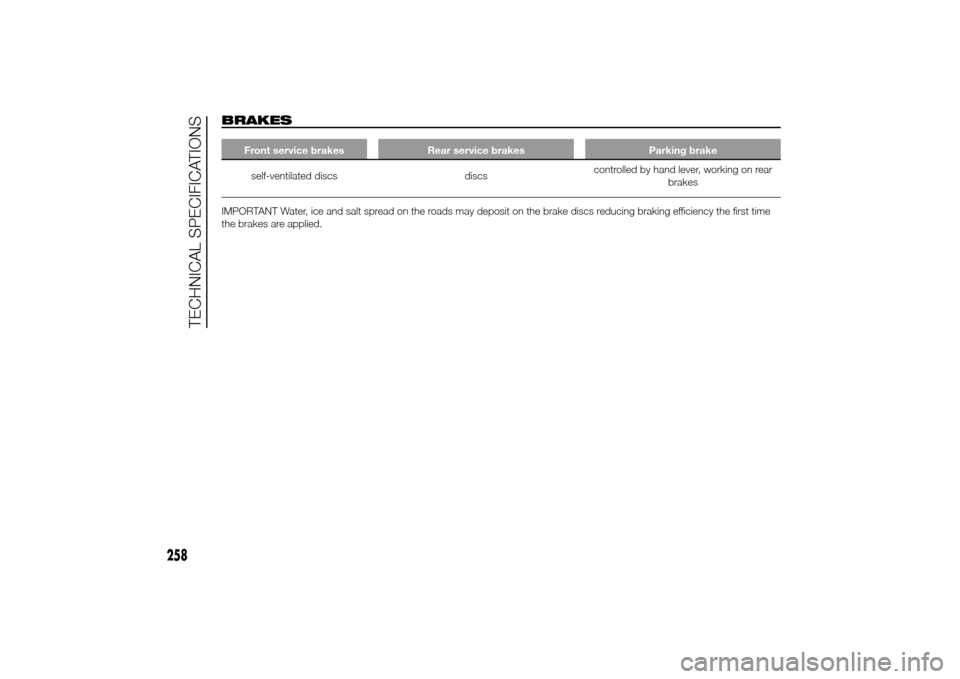
BRAKES
Front service brakes Rear service brakes Parking brakeself-ventilated discs discscontrolled by hand lever, working on rear
brakes
IMPORTANT Water, ice and salt spread on the roads may deposit on the brake discs reducing braking efficiency the first time
the brakes are applied.
258
TECHNICAL SPECIFICATIONS
Page 280 of 367
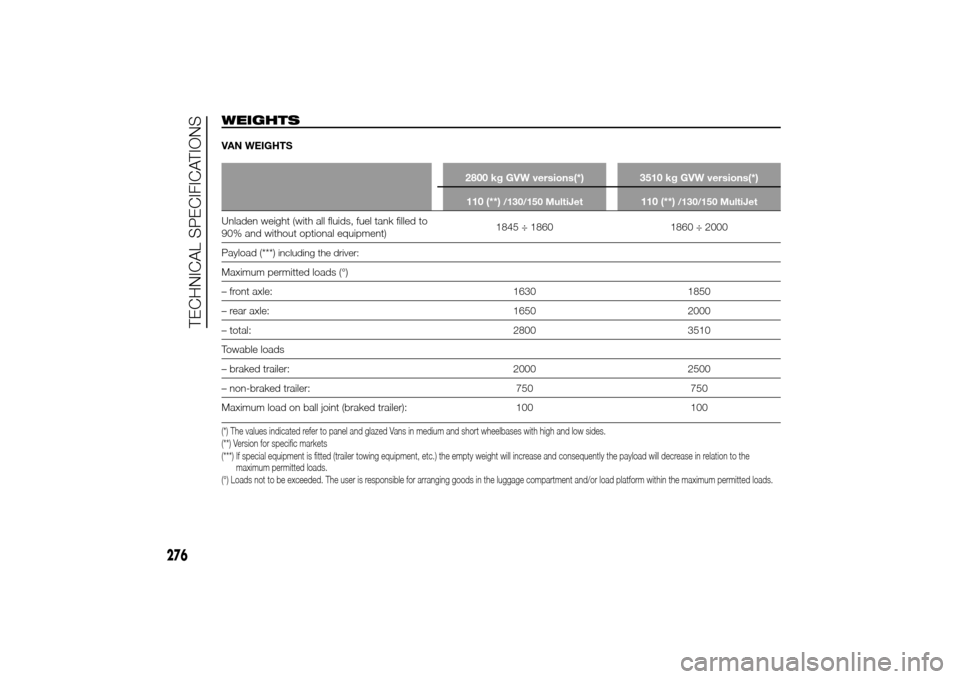
WEIGHTSVAN WEIGHTS
2800 kg GVW versions(*) 3510 kg GVW versions(*)
110 (**)
/130/150 MultiJet
110 (**)
/130/150 MultiJet
Unladen weight (with all fluids, fuel tank filled to
90% and without optional equipment)1845 ÷ 1860 1860 ÷ 2000
Payload (***)
including the driver:
Maximum permitted loads (°)
– front axle: 1630 1850
– rear axle: 1650 2000
– total: 2800 3510
Towable loads
– braked trailer: 2000 2500
– non-braked trailer: 750 750
Maximum load on ball joint (braked trailer): 100 100(*) The values indicated refer to panel and glazed Vans in medium and short wheelbases with high and low sides.
(**) Version for specific markets
(***) If special equipment is fitted (trailer towing equipment, etc.) the empty weight will increase and consequently the payload will decrease in relation to the
maximum permitted loads.
(°) Loads not to be exceeded. The user is responsible for arranging goods in the luggage compartment and/or load platform within the maximum permittedloads.
276
TECHNICAL SPECIFICATIONS
Page 281 of 367
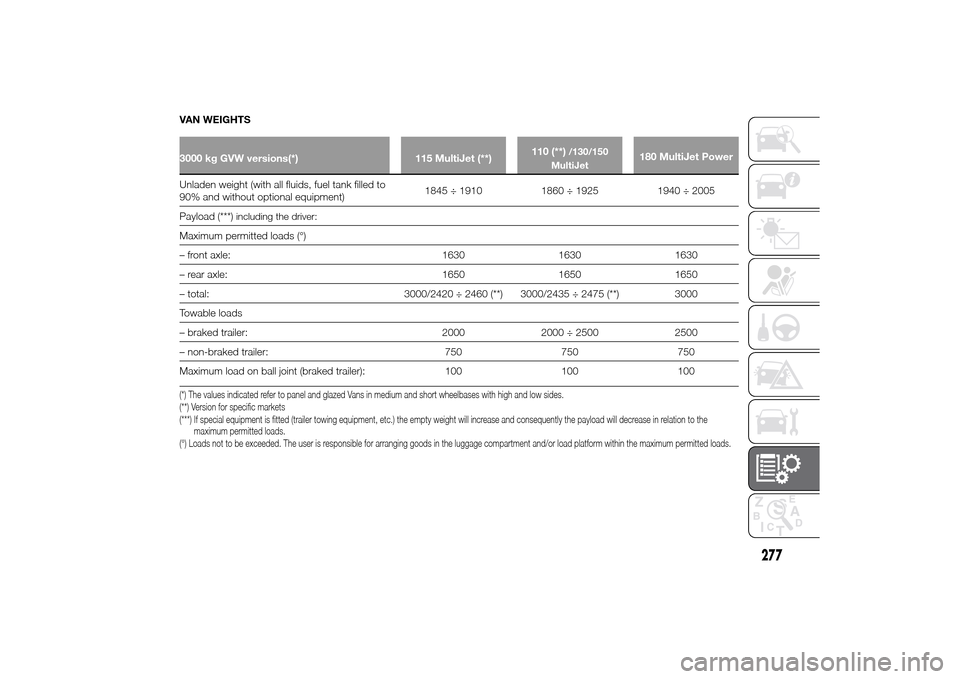
VAN WEIGHTS3000 kg GVW versions(*) 115 MultiJet (**)110 (**)
/130/150
MultiJet
180 MultiJet Power
Unladen weight (with all fluids, fuel tank filled to
90% and without optional equipment)1845 ÷ 1910 1860 ÷ 1925 1940 ÷ 2005
Payload (***)
including the driver:
Maximum permitted loads (°)
– front axle: 1630 1630 1630
– rear axle: 1650 1650 1650
– total: 3000/2420 ÷ 2460 (**) 3000/2435 ÷ 2475 (**) 3000
Towable loads
– braked trailer: 2000 2000 ÷ 2500 2500
– non-braked trailer: 750 750 750
Maximum load on ball joint (braked trailer): 100 100 100(*) The values indicated refer to panel and glazed Vans in medium and short wheelbases with high and low sides.
(**) Version for specific markets
(***) If special equipment is fitted (trailer towing equipment, etc.) the empty weight will increase and consequently the payload will decrease in relation to the
maximum permitted loads.
(°) Loads not to be exceeded. The user is responsible for arranging goods in the luggage compartment and/or load platform within the maximum permittedloads.
277
Page 282 of 367
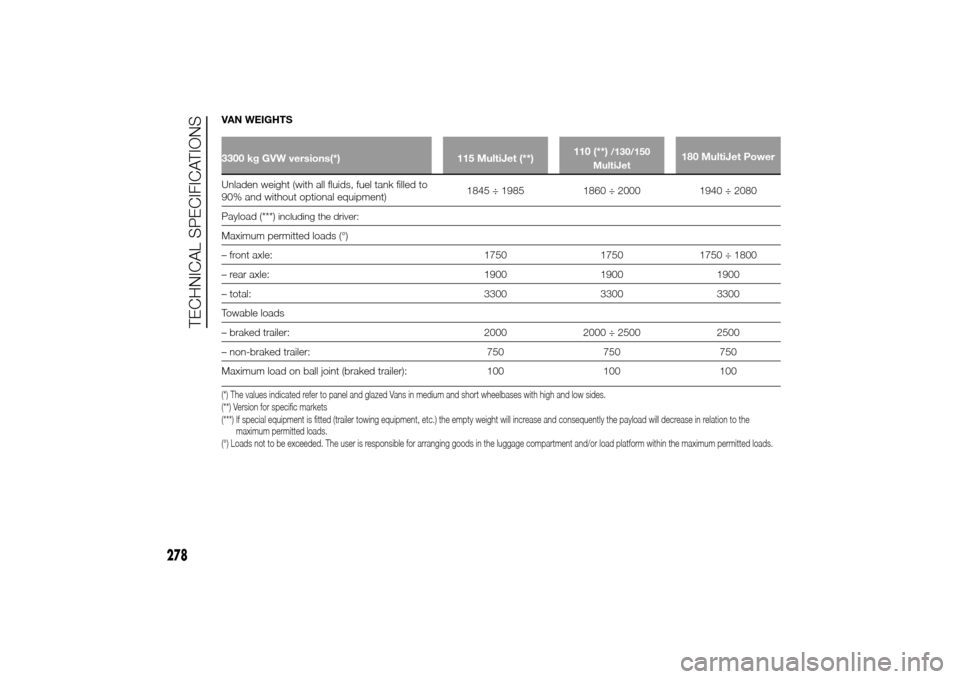
VAN WEIGHTS3300 kg GVW versions(*) 115 MultiJet (**)110 (**)
/130/150
MultiJet
180 MultiJet Power
Unladen weight (with all fluids, fuel tank filled to
90% and without optional equipment)1845 ÷ 1985 1860 ÷ 2000 1940 ÷ 2080
Payload (***)
including the driver:
Maximum permitted loads (°)
– front axle: 1750 1750 1750 ÷ 1800
– rear axle: 1900 1900 1900
– total: 3300 3300 3300
Towable loads
– braked trailer: 2000 2000 ÷ 2500 2500
– non-braked trailer: 750 750 750
Maximum load on ball joint (braked trailer): 100 100 100(*) The values indicated refer to panel and glazed Vans in medium and short wheelbases with high and low sides.
(**) Version for specific markets
(***) If special equipment is fitted (trailer towing equipment, etc.) the empty weight will increase and consequently the payload will decrease in relation to the
maximum permitted loads.
(°) Loads not to be exceeded. The user is responsible for arranging goods in the luggage compartment and/or load platform within the maximum permittedloads.
278
TECHNICAL SPECIFICATIONS
Page 283 of 367
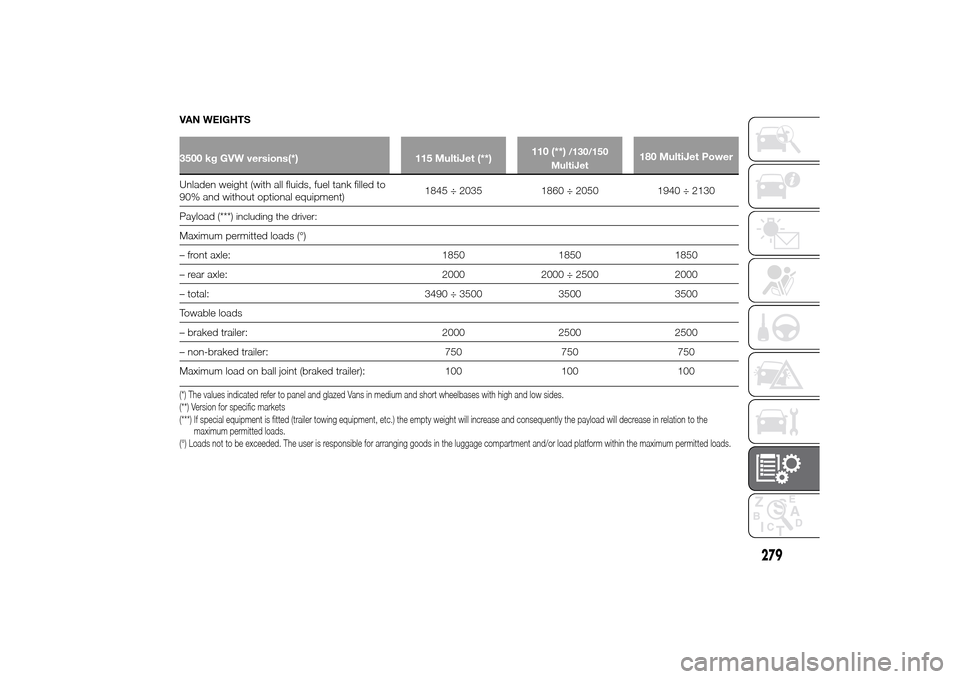
VAN WEIGHTS3500 kg GVW versions(*) 115 MultiJet (**)110 (**)
/130/150
MultiJet
180 MultiJet Power
Unladen weight (with all fluids, fuel tank filled to
90% and without optional equipment)1845 ÷ 2035 1860 ÷ 2050 1940 ÷ 2130
Payload (***)
including the driver:
Maximum permitted loads (°)
– front axle: 1850 1850 1850
– rear axle: 2000 2000 ÷ 2500 2000
– total: 3490 ÷ 3500 3500 3500
Towable loads
– braked trailer: 2000 2500 2500
– non-braked trailer: 750 750 750
Maximum load on ball joint (braked trailer): 100 100 100(*) The values indicated refer to panel and glazed Vans in medium and short wheelbases with high and low sides.
(**) Version for specific markets
(***) If special equipment is fitted (trailer towing equipment, etc.) the empty weight will increase and consequently the payload will decrease in relation to the
maximum permitted loads.
(°) Loads not to be exceeded. The user is responsible for arranging goods in the luggage compartment and/or load platform within the maximum permittedloads.
279
Page 284 of 367
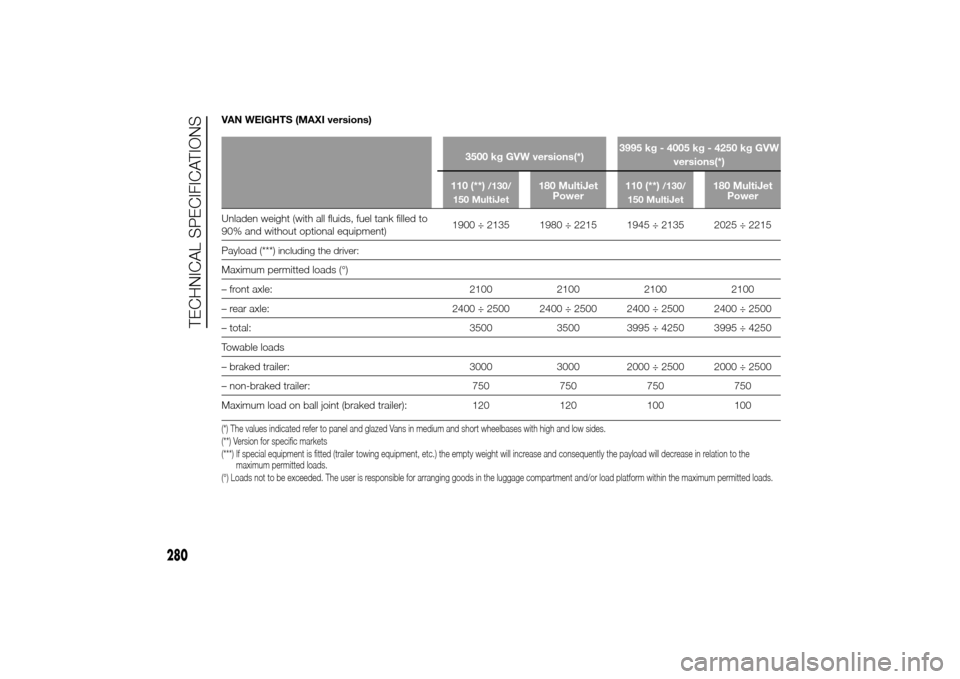
VAN WEIGHTS (MAXI versions)
3500 kg GVW versions(*)3995 kg - 4005 kg - 4250 kg GVW
versions(*)
110 (**)
/130/
150 MultiJet
180 MultiJet
Power110 (**)
/130/
150 MultiJet
180 MultiJet
Power
Unladen weight (with all fluids, fuel tank filled to
90% and without optional equipment)1900 ÷ 2135 1980 ÷ 2215 1945 ÷ 2135 2025 ÷ 2215
Payload (***)
including the driver:
Maximum permitted loads (°)
– front axle: 2100 2100 2100 2100
– rear axle: 2400 ÷ 2500 2400 ÷ 2500 2400 ÷ 2500 2400 ÷ 2500
– total: 3500 3500 3995 ÷ 4250 3995 ÷ 4250
Towable loads
– braked trailer: 3000 3000 2000 ÷ 2500 2000 ÷ 2500
– non-braked trailer: 750 750 750 750
Maximum load on ball joint (braked trailer): 120 120 100 100(*) The values indicated refer to panel and glazed Vans in medium and short wheelbases with high and low sides.
(**) Version for specific markets
(***) If special equipment is fitted (trailer towing equipment, etc.) the empty weight will increase and consequently the payload will decrease in relation to the
maximum permitted loads.
(°) Loads not to be exceeded. The user is responsible for arranging goods in the luggage compartment and/or load platform within the maximum permittedloads.
280
TECHNICAL SPECIFICATIONS