Switch FIAT DUCATO 2015 3.G Owners Manual
[x] Cancel search | Manufacturer: FIAT, Model Year: 2015, Model line: DUCATO, Model: FIAT DUCATO 2015 3.GPages: 387, PDF Size: 20.76 MB
Page 232 of 387
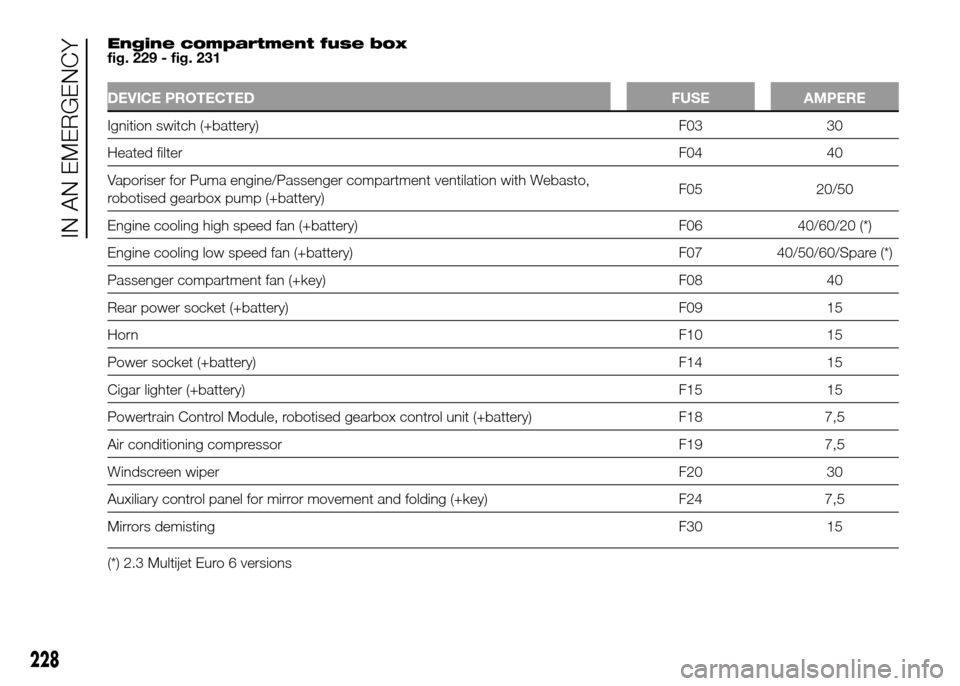
Engine compartment fuse box
fig. 229 - fig. 231
DEVICE PROTECTED FUSE AMPERE
Ignition switch (+battery) F03 30
HeatedfilterF04 40
Vaporiser for Puma engine/Passenger compartment ventilation with Webasto,
robotised gearbox pump (+battery)F05 20/50
Engine cooling high speed fan (+battery) F06 40/60/20 (*)
Engine cooling low speed fan (+battery) F07 40/50/60/Spare (*)
Passenger compartment fan (+key) F08 40
Rear power socket (+battery) F09 15
HornF10 15
Power socket (+battery) F14 15
Cigar lighter (+battery) F15 15
Powertrain Control Module, robotised gearbox control unit (+battery) F18 7,5
Air conditioning compressor F19 7,5
Windscreen wiper F20 30
Auxiliary control panel for mirror movement and folding (+key) F24 7,5
Mirrors demisting F30 15
(*) 2.3 Multijet Euro 6 versions
228
IN AN EMERGENCY
Page 236 of 387
BATTERY
RECHARGING
IMPORTANT The battery recharging
procedure is given as information only.
You are advised to contact a Fiat
Dealership to have this operation
carried out.
IMPORTANT After turning the ignition
key to STOP and having closed the
driver side door, wait at least one
minute before disconnecting the
electrical supply from the battery. When
reconnecting the electrical supply to
the battery, make sure that the ignition
key is in the STOP position and the
driver side door is closed.
Charging should be slow at a low
ampere rating for approximately 24
hours. Charging for a longer time may
damage the battery.
174) 175)
IN THE ABSENCE OF
START&STOP SYSTEM
To recharge, proceed as follows:
❒disconnect the negative battery
terminal;
❒connect the charger cables to the
battery terminals, observing the
polarity;
❒turn on the charger;
❒when it is recharged, turn the charger
off before disconnecting it from the
battery;
❒reconnect the negative battery
terminal.
WITH START&STOP
SYSTEM
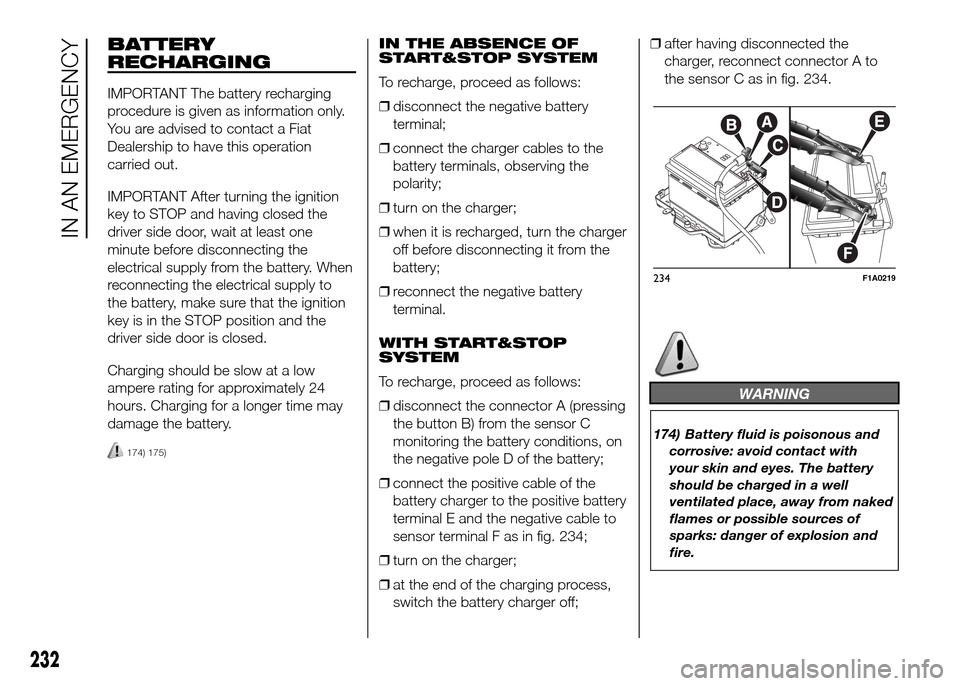
To recharge, proceed as follows:
❒disconnect the connector A (pressing
the button B) from the sensor C
monitoring the battery conditions, on
the negative pole D of the battery;
❒connect the positive cable of the
battery charger to the positive battery
terminal E and the negative cable to
sensor terminal F as in fig. 234;
❒turn on the charger;
❒at the end of the charging process,
switch the battery charger off;❒after having disconnected the
charger, reconnect connector A to
the sensor C as in fig. 234.
WARNING
174) Battery fluid is poisonous and
corrosive: avoid contact with
your skin and eyes. The battery
should be charged in a well
ventilated place, away from naked
flames or possible sources of
sparks: danger of explosion and
fire.
234F1A0219
232
IN AN EMERGENCY
Page 238 of 387
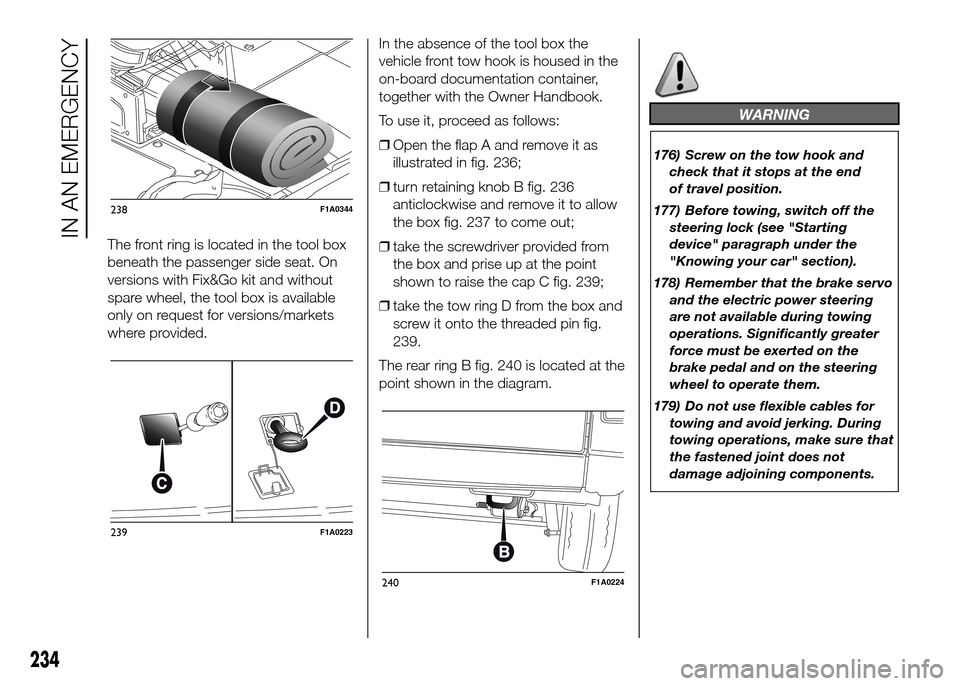
The front ring is located in the tool box
beneath the passenger side seat. On
versions with Fix&Go kit and without
spare wheel, the tool box is available
only on request for versions/markets
where provided.In the absence of the tool box the
vehicle front tow hook is housed in the
on-board documentation container,
together with the Owner Handbook.
To use it, proceed as follows:
❒Open the flap A and remove it as
illustrated in fig. 236;
❒turn retaining knob B fig. 236
anticlockwise and remove it to allow
the box fig. 237 to come out;
❒take the screwdriver provided from
the box and prise up at the point
shown to raise the cap C fig. 239;
❒take the tow ring D from the box and
screw it onto the threaded pin fig.
239.
The rear ring B fig. 240 is located at the
point shown in the diagram.
WARNING
176) Screw on the tow hook and
check that it stops at the end
of travel position.
177) Before towing, switch off the
steering lock (see "Starting
device" paragraph under the
"Knowing your car" section).
178) Remember that the brake servo
and the electric power steering
are not available during towing
operations. Significantly greater
force must be exerted on the
brake pedal and on the steering
wheel to operate them.
179) Do not use flexible cables for
towing and avoid jerking. During
towing operations, make sure that
the fastened joint does not
damage adjoining components.
238F1A0344
239F1A0223
240F1A0224
234
IN AN EMERGENCY
Page 251 of 387
ENGINE OIL
48)
Check the oil level a few minutes (about
5) after the engine has stopped, with
the vehicle parked on level ground.
Check the level is within the MIN. and
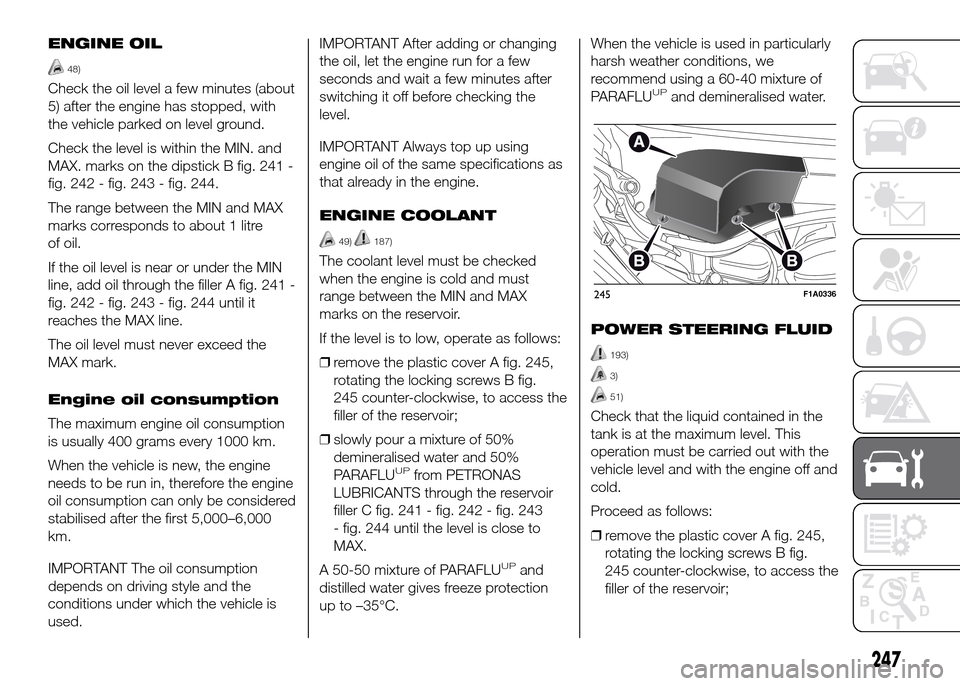
MAX. marks on the dipstick B fig. 241 -
fig. 242 - fig. 243 - fig. 244.
The range between the MIN and MAX
marks corresponds to about 1 litre
of oil.
If the oil level is near or under the MIN
line, add oil through the filler A fig. 241 -
fig. 242 - fig. 243 - fig. 244 until it
reaches the MAX line.
The oil level must never exceed the
MAX mark.
Engine oil consumption
The maximum engine oil consumption
is usually 400 grams every 1000 km.
When the vehicle is new, the engine
needs to be run in, therefore the engine
oil consumption can only be considered
stabilised after the first 5,000–6,000
km.
IMPORTANT The oil consumption
depends on driving style and the
conditions under which the vehicle is
used.IMPORTANT After adding or changing
the oil, let the engine run for a few
seconds and wait a few minutes after
switching it off before checking the
level.
IMPORTANT Always top up using
engine oil of the same specifications as
that already in the engine.
ENGINE COOLANT
49)187)
The coolant level must be checked
when the engine is cold and must
range between the MIN and MAX
marks on the reservoir.
If the level is to low, operate as follows:
❒remove the plastic cover A fig. 245,
rotating the locking screws B fig.
245 counter-clockwise, to access the
filler of the reservoir;
❒slowly pour a mixture of 50%
demineralised water and 50%
PARAFLU
UPfrom PETRONAS
LUBRICANTS through the reservoir
filler C fig. 241 - fig. 242 - fig. 243
- fig. 244 until the level is close to
MAX.
A 50-50 mixture of PARAFLU
UPand
distilled water gives freeze protection
up to –35°C.When the vehicle is used in particularly
harsh weather conditions, we
recommend using a 60-40 mixture of
PARAFLU
UPand demineralised water.
POWER STEERING FLUID
193)
3)
51)
Check that the liquid contained in the
tank is at the maximum level. This
operation must be carried out with the
vehicle level and with the engine off and
cold.
Proceed as follows:
❒remove the plastic cover A fig. 245,
rotating the locking screws B fig.
245 counter-clockwise, to access the
filler of the reservoir;
245F1A0336
247
Page 256 of 387
USEFUL ADVICE FOR
EXTENDING THE LIFE OF
YOUR BATTERY
To avoid draining your battery and
make it last longer, observe the
following instructions:
❒when you park the vehicle, ensure
that the doors, tailgate and bonnet
are closed properly, to prevent any
roof lights from remaining on inside
the passenger's compartment;
❒switch off all roof lights inside the
vehicle: the vehicle is however
equipped with a system which
switches all internal lights off
automatically;
❒do not keep accessories (e.g. sound
system, hazard lights, etc.) switched
on for a long time when the engine
is not running;
❒before carrying out any operation on
the electrical system, disconnect the
negative battery cable through the
suitable terminal;
❒Completely tighten the battery
terminals.IMPORTANT After turning the ignition
key to STOP and having closed the
driver side door, wait at least one
minute before disconnecting the
electrical supply from the battery. When
reconnecting the electrical supply to
the battery, make sure that the ignition
key is in the STOP position and the
driver side door is closed.
IMPORTANT If the charge level remains
under 50% for a long time, the battery
is damaged by sulphation, reducing
its capacity and efficiency at start-up.
The battery is also more prone to the
risk of freezing (at temperatures as high
as -10°C).
Refer to the paragraph "Car inactivity"
in "Starting and driving" if the car is
left parked for a long time.If, after buying the vehicle, you want to
install electrical accessories which
require permanent electric supply
(alarm, etc.) or accessories that in any
case burden the electrical supply,
contact a Fiat Dealership, whose
qualified personnel, in addition
to suggesting the most suitable devices
from Lineaccessori Fiat, will evaluate
the overall electrical consumption,
checking whether the vehicle’s electrical
system is capable of withstanding the
load required, or whether it should
be integrated with a more powerful
battery.
Since some of these devices continue
to consume electricity even when
the engine is off, they gradually run
down the battery.
IMPORTANT If a tachograph is fitted, if
the vehicle is parked for a long period
of 5 days, it is advisable to disconnect
the negative battery terminal to
maintain its charge.
If the vehicle is equipped with a battery
disconnection function (disconnector),
see the description of the procedure
in the "Controls" paragraph in the
"Dashboard and controls" section.
252
SERVICING AND MAINTENANCE
Page 259 of 387
WARNING
198) Remember that the road
holding qualities of your vehicle
also depend on the correct
inflation pressure of the tyres.
199) If the pressure is too low, the
tyre will overheat and could be
seriously damaged.
200) Avoid switching the tyres from
the right side of the vehicle to the
left side and vice versa.
201) Never submit alloy rims to
repainting treatments requiring
the use of temperatures
exceeding 150°C. The mechanical
properties of the wheels could
be impaired.
RUBBER HOSES
As far as the brake system and fuel
supply system rubber hoses are
concerned, follow the "Scheduled
Servicing Plan" in this chapter carefully.
Ozone, high temperatures and
prolonged lack of fluid in the system
may cause hardening and cracking of
the hoses, with possible leaks. Careful
checking is therefore necessary.
WINDSCREEN
WIPER
BLADES
Periodically clean the rubber part using
special products; TUTELA
PROFESSIONAL SC 35 is
recommended.
Replace the blades if the rubber edge is
deformed or worn. In any case, it is
advisable to replace them
approximately once a year.
A few simple precautions can reduce
the possibility of damage to the blades:
❒if the temperature falls below zero,
make sure that ice has not frozen
the rubber against the glass. Use a
de-icing product to release it if
required;
❒remove any snow from the glass: in
addition to protecting the blades,
this prevents effort on the motor and
overheating;
❒do not operate the windscreen and
rear window wipers on dry glass.
202)
255
Page 365 of 387
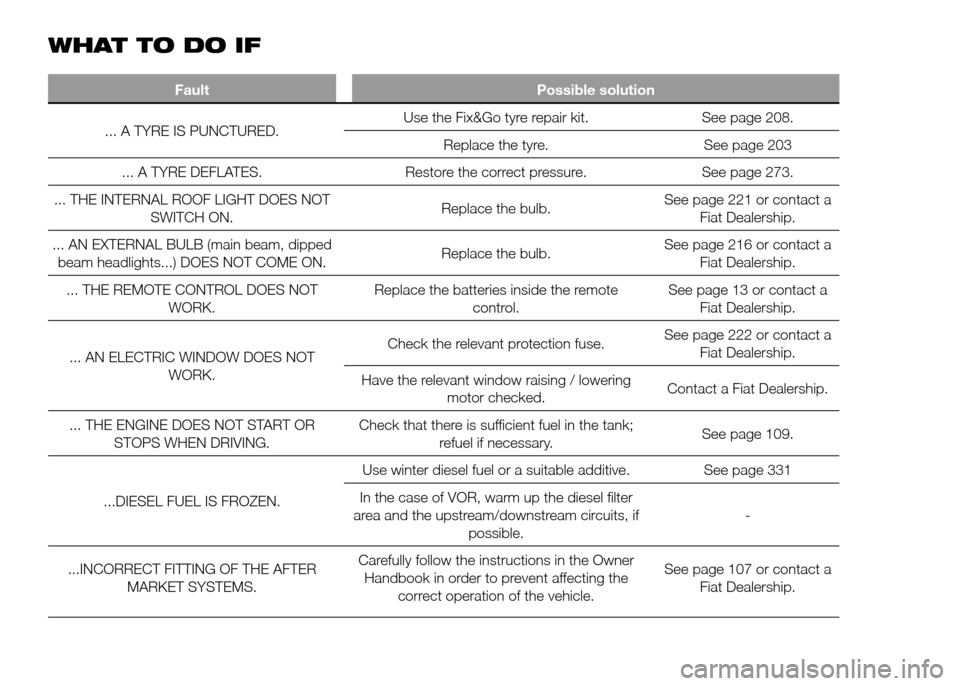
WHATTODOIF
Fault Possible solution
... A TYRE IS PUNCTURED.Use
the Fix&Go tyre repair kit. See page 208.
Replace the tyre. See page 203
... A TYRE DEFLATES. Restore the correct pressure. See page 273.
... THE INTERNAL ROOF LIGHT DOES NOT
SWITCH ON.Replace the bulb.See page 221 or contact a
Fiat Dealership.
... AN EXTERNAL BULB (main beam, dipped
beam headlights...) DOES NOT COME ON.Replace the bulb.See page 216 or contact a
Fiat Dealership.
... THE REMOTE CONTROL DOES NOT
WORK.Replace the batteries inside the remote
control.See page 13 or contact a
Fiat Dealership.
... AN ELECTRIC WINDOW DOES NOT
WORK.Check the relevant protection fuse.See page 222 or contact a
Fiat Dealership.
Have the relevant window raising / lowering
motor checked.Contact a Fiat Dealership.
... THE ENGINE DOES NOT START OR
STOPS WHEN DRIVING.Check that there is sufficient fuel in the tank;
refuel if necessary.See page 109.
...DIESEL FUEL IS FROZEN.Use winter diesel fuel or a suitable additive. See page 331
In the case of VOR, warm up the diesel filter
area and the upstream/downstream circuits, if
possible.-
...INCORRECT FITTING OF THE AFTER
MARKET SYSTEMS.Carefully follow the instructions in the Owner
Handbook in order to prevent affecting the
correct operation of the vehicle.See page 107 or contact a
Fiat Dealership.
Page 366 of 387
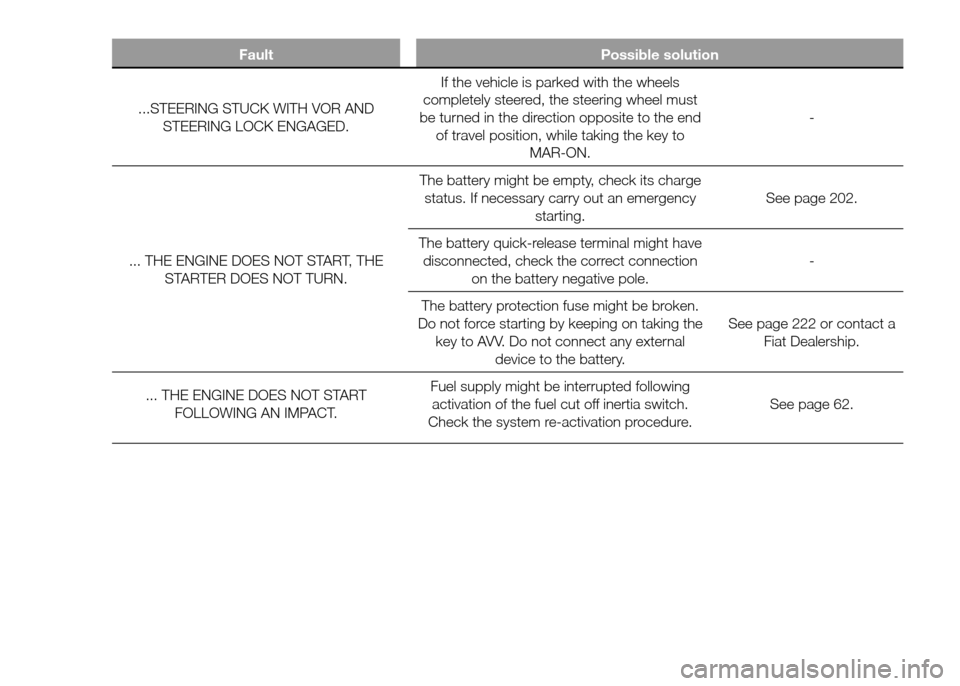
Fault Possible solution
...STEERING STUCK WITH VOR AND
STEERING
LOCK ENGAGED.If the vehicle is parked with the wheels
completely steered, the steering wheel must
be turned in the direction opposite to the end
of travel position, while taking the key to
MAR-ON.-
... THE ENGINE DOES NOT START, THE
STARTER DOES NOT TURN.The battery might be empty, check its charge
status. If necessary carry out an emergency
starting.See page 202.
The battery quick-release terminal might have
disconnected, check the correct connection
on the battery negative pole.-
The battery protection fuse might be broken.
Do not force starting by keeping on taking the
key to AVV. Do not connect any external
device to the battery.See page 222 or contact a
Fiat Dealership.
... THE ENGINE DOES NOT START
FOLLOWING AN IMPACT.Fuel supply might be interrupted following
activation of the fuel cut off inertia switch.
Check the system re-activation procedure.See page 62.
Page 384 of 387
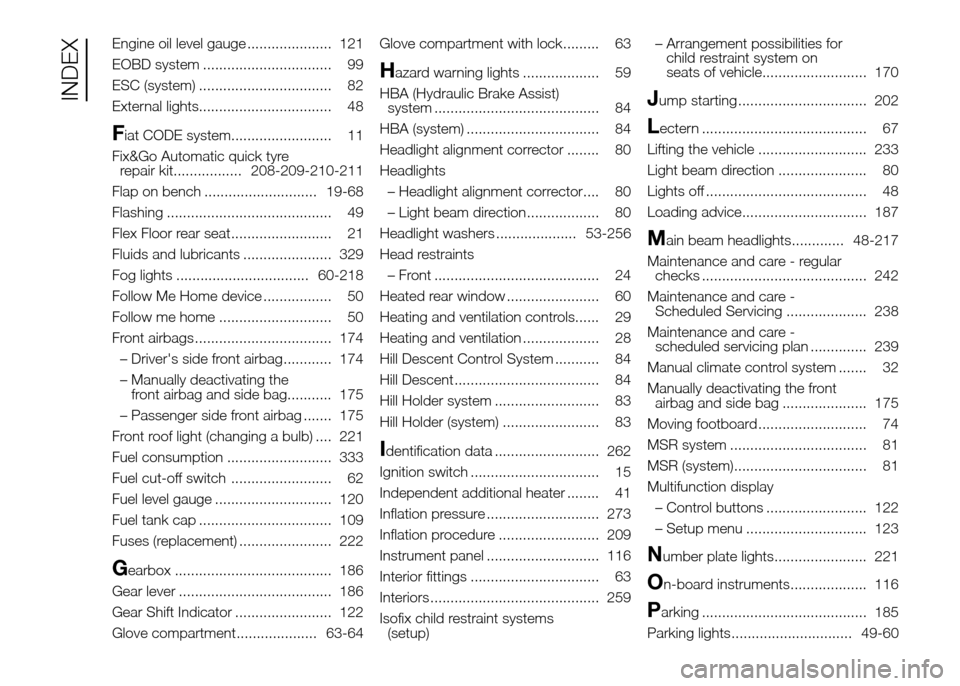
Engine oil level gauge ..................... 121
EOBD system ................................ 99
ESC (system) ................................. 82
External lights................................. 48
Fiat CODE system......................... 11
Fix&Go Automatic quick tyre
repair kit................. 208-209-210-211
Flap on bench ............................ 19-68
Flashing ......................................... 49
Flex Floor rear seat......................... 21
Fluids and lubricants ...................... 329
Fog lights ................................. 60-218
Follow Me Home device ................. 50
Follow me home ............................ 50
Front airbags .................................. 174
– Driver's side front airbag............ 174
– Manually deactivating the
front airbag and side bag........... 175
– Passenger side front airbag ....... 175
Front roof light (changing a bulb) .... 221
Fuel consumption .......................... 333
Fuel cut-off switch ......................... 62
Fuel level gauge ............................. 120
Fuel tank cap ................................. 109
Fuses (replacement) ....................... 222
Gearbox ....................................... 186
Gear lever ...................................... 186
Gear Shift Indicator ........................ 122
Glove compartment.................... 63-64Glove compartment with lock......... 63
Hazard warning lights ................... 59
HBA (Hydraulic Brake Assist)
system ......................................... 84
HBA (system) ................................. 84
Headlight alignment corrector ........ 80
Headlights
– Headlight alignment corrector.... 80
– Light beam direction.................. 80
Headlight washers .................... 53-256
Head restraints
– Front ......................................... 24
Heated rear window ....................... 60
Heating and ventilation controls...... 29
Heating and ventilation ................... 28
Hill Descent Control System ........... 84
Hill Descent .................................... 84
Hill Holder system .......................... 83
Hill Holder (system) ........................ 83
Identification data .......................... 262
Ignition switch ................................ 15
Independent additional heater ........ 41
Inflation pressure ............................ 273
Inflation procedure ......................... 209
Instrument panel ............................ 116
Interior fittings ................................ 63
Interiors .......................................... 259
Isofix child restraint systems
(setup)– Arrangement possibilities for
child restraint system on
seats of vehicle.......................... 170
Jump starting ................................ 202
Lectern ......................................... 67
Lifting the vehicle ........................... 233
Light beam direction ...................... 80
Lights off ........................................ 48
Loading advice............................... 187
Main beam headlights............. 48-217
Maintenance and care - regular
checks ......................................... 242
Maintenance and care -
Scheduled Servicing .................... 238
Maintenance and care -
scheduled servicing plan .............. 239
Manual climate control system ....... 32
Manually deactivating the front
airbag and side bag ..................... 175
Moving footboard ........................... 74
MSR system .................................. 81
MSR (system)................................. 81
Multifunction display
– Control buttons ......................... 122
– Setup menu .............................. 123
Number plate lights....................... 221
On-board instruments................... 116
Parking ......................................... 185
Parking lights.............................. 49-60
INDEX