coolant level FIAT DUCATO 2015 3.G User Guide
[x] Cancel search | Manufacturer: FIAT, Model Year: 2015, Model line: DUCATO, Model: FIAT DUCATO 2015 3.GPages: 387, PDF Size: 20.76 MB
Page 141 of 387
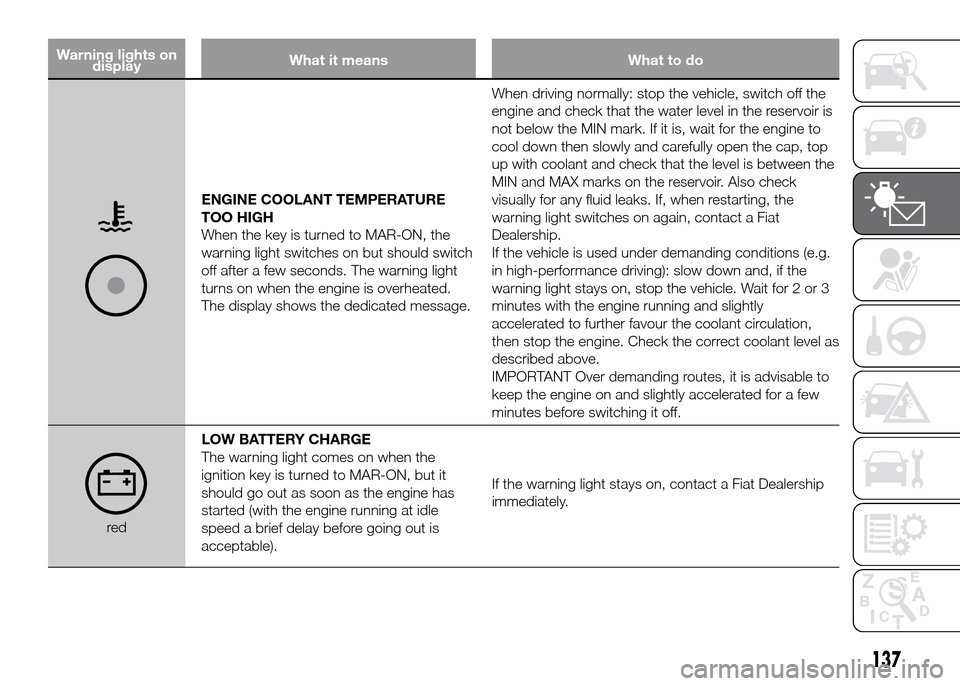
Warning lights on
displayWhat it means What to do
ENGINE COOLANT TEMPERATURE
TOO HIGH
When the key is turned to MAR-ON, the
warning light switches on but should switch
off after a few seconds. The warning light
turns on when the engine is overheated.
The display shows the dedicated message.When driving normally: stop the vehicle, switch off the
engine and check that the water level in the reservoir is
not below the MIN mark. If it is, wait for the engine to
cool down then slowly and carefully open the cap, top
up with coolant and check that the level is between the
MIN and MAX marks on the reservoir. Also check
visually for any fluid leaks. If, when restarting, the
warning light switches on again, contact a Fiat
Dealership.
If the vehicle is used under demanding conditions (e.g.
in high-performance driving): slow down and, if the
warning light stays on, stop the vehicle. Wait for 2 or 3
minutes with the engine running and slightly
accelerated to further favour the coolant circulation,
then stop the engine. Check the correct coolant level as
described above.
IMPORTANT Over demanding routes, it is advisable to
keep the engine on and slightly accelerated for a few
minutes before switching it off.
redLOW BATTERY CHARGE
The warning light comes on when the
ignition key is turned to MAR-ON, but it
should go out as soon as the engine has
started (with the engine running at idle
speed a brief delay before going out is
acceptable).If the warning light stays on, contact a Fiat Dealership
immediately.
137
Page 244 of 387
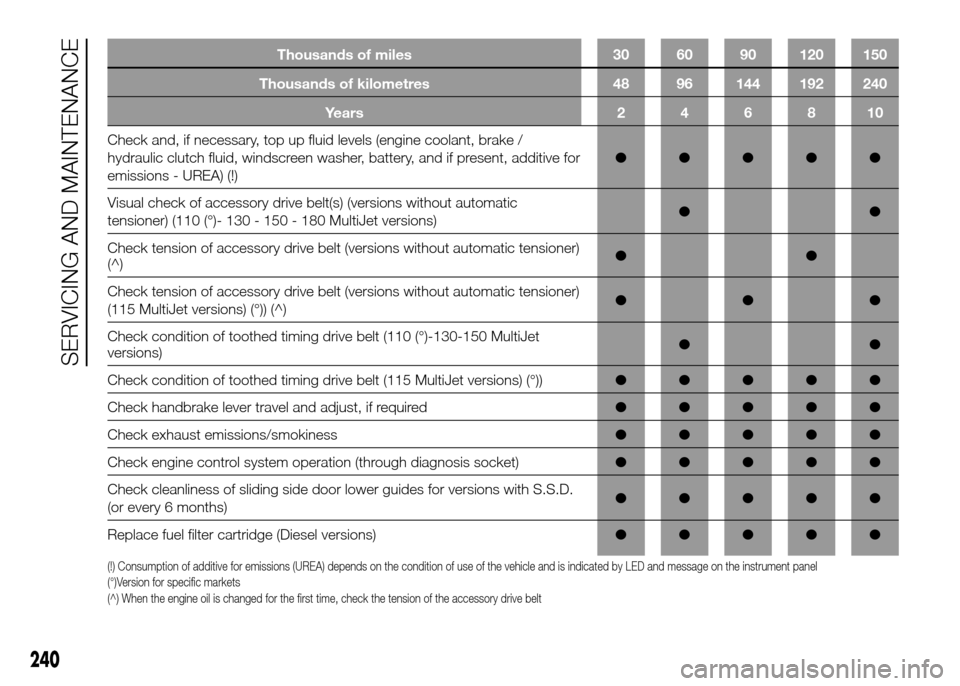
Thousands of miles 30 60 90 120 150
Thousands of kilometres 48 96 144 192 240
Years246810
Check and, if necessary, top up fluid levels (engine coolant, brake /
hydraulicclutch fluid, windscreen washer, battery, and if present, additive for
emissions - UREA) (!)●●●●●
Visual check of accessory drive belt(s) (versions without automatic
tensioner) (110 (°)- 130 - 150 - 180 MultiJet versions)●●
Check tension of accessory drive belt (versions without automatic tensioner)
(^)●●
Check tension of accessory drive belt (versions without automatic tensioner)
(115 MultiJet versions) (°)) (^)●●●
Check condition of toothed timing drive belt (110 (°)-130-150 MultiJet
versions)●●
Check condition of toothed timing drive belt (115 MultiJet versions) (°))●●●●●
Check handbrake lever travel and adjust, if required●●●●●
Check exhaust emissions/smokiness●●●●●
Check engine control system operation (through diagnosis socket)●●●●●
Check cleanliness of sliding side door lower guides for versions with S.S.D.
(or every 6 months)●●●●●
Replace fuel filter cartridge (Diesel versions)●●●●●
(!) Consumption of additive for emissions (UREA) depends on the condition of use of the vehicle and is indicated by LED and message on the instrument panel
(°)Version for specific markets
(^) When the engine oil is changed for the first time, check the tension of the accessory drive belt
240
SERVICING AND MAINTENANCE
Page 246 of 387
PERIODIC CHECKS
Before long journeys, check and, if
necessary, restore:
❒engine coolant level;
❒brake fluid level;
❒control and recovery of additive level
for AdBlue Diesel emissions (UREA)
(for versions/markets, where
provided);
❒windscreen washer fluid level;
❒tyre inflation pressure and condition;
❒operation of lighting system
(headlamps, direction indicators,
hazard warning lights, etc.);
❒operation of screen washer/wiper
system and positioning/wear of
windscreen/rear window wiper
blades.
To ensure that the vehicle is always
efficient and well maintained, it is
advisable to make sure that you carry
out the above operations regularly
(approximately every 1000 km and
every 3000 km for checking and
topping up engine oil is advisable).
DEMANDING
VEHICLE USE
If the vehicle is mostly used in one of
the following conditions:
❒towing a trailer or caravan;
❒dusty roads;
❒short, repeated journeys (less than
7-8 km) at sub-zero outside
temperatures;
❒engine often idling or driving long
distances at low speeds or long
periods of inactivity;
the following checks must be carried
out more often than indicated in the
Scheduled Servicing Plan:
❒check front disc brake pad
conditions and wear;
❒check cleanliness of bonnet and boot
locks, cleanliness and lubrication of
linkage;
❒visually inspect conditions of: engine,
gearbox, transmission, pipes and
hoses (exhaust - fuel system -
brakes) and rubber elements (boots -
sleeves - bushes - etc.);
❒check battery charge and battery
fluid level (electrolyte);
❒visually inspect condition of the
accessory drive belts;❒check and, if necessary, change
engine oil and replace oil filter;
❒Restore additive level for AdBlue
Diesel emissions (UREA) (for versions
/ markets where applicable), at the
ignition of the lamp or the message
on the instrument panel;
❒check and, if necessary, replace
pollen filter.
242
SERVICING AND MAINTENANCE
Page 247 of 387
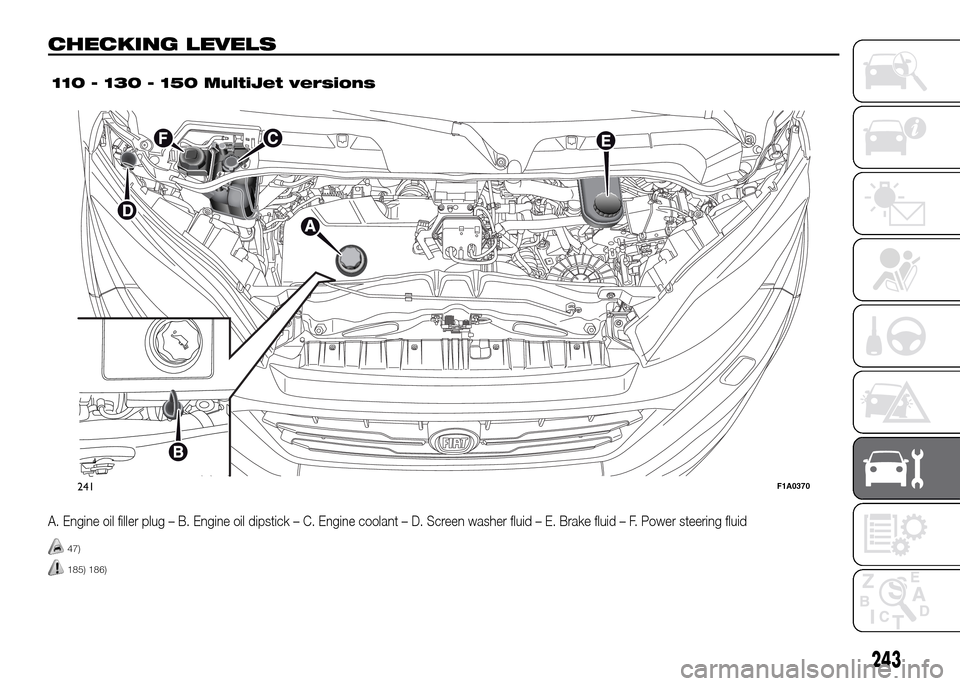
CHECKING LEVELS.
A. Engine oil filler plug – B. Engine oil dipstick – C. Engine coolant – D. Screen washer fluid – E. Brake fluid – F. Power steering fluid
47)
185) 186)
241F1A0370
243
110 - 130 - 150 MultiJet versions
Page 251 of 387
ENGINE OIL
48)
Check the oil level a few minutes (about
5) after the engine has stopped, with
the vehicle parked on level ground.
Check the level is within the MIN. and
MAX. marks on the dipstick B fig. 241 -
fig. 242 - fig. 243 - fig. 244.
The range between the MIN and MAX
marks corresponds to about 1 litre
of oil.
If the oil level is near or under the MIN
line, add oil through the filler A fig. 241 -
fig. 242 - fig. 243 - fig. 244 until it
reaches the MAX line.
The oil level must never exceed the
MAX mark.
Engine oil consumption
The maximum engine oil consumption
is usually 400 grams every 1000 km.
When the vehicle is new, the engine
needs to be run in, therefore the engine
oil consumption can only be considered
stabilised after the first 5,000–6,000
km.
IMPORTANT The oil consumption
depends on driving style and the
conditions under which the vehicle is
used.IMPORTANT After adding or changing
the oil, let the engine run for a few
seconds and wait a few minutes after
switching it off before checking the
level.
IMPORTANT Always top up using
engine oil of the same specifications as
that already in the engine.
ENGINE COOLANT
49)187)
The coolant level must be checked
when the engine is cold and must
range between the MIN and MAX
marks on the reservoir.
If the level is to low, operate as follows:
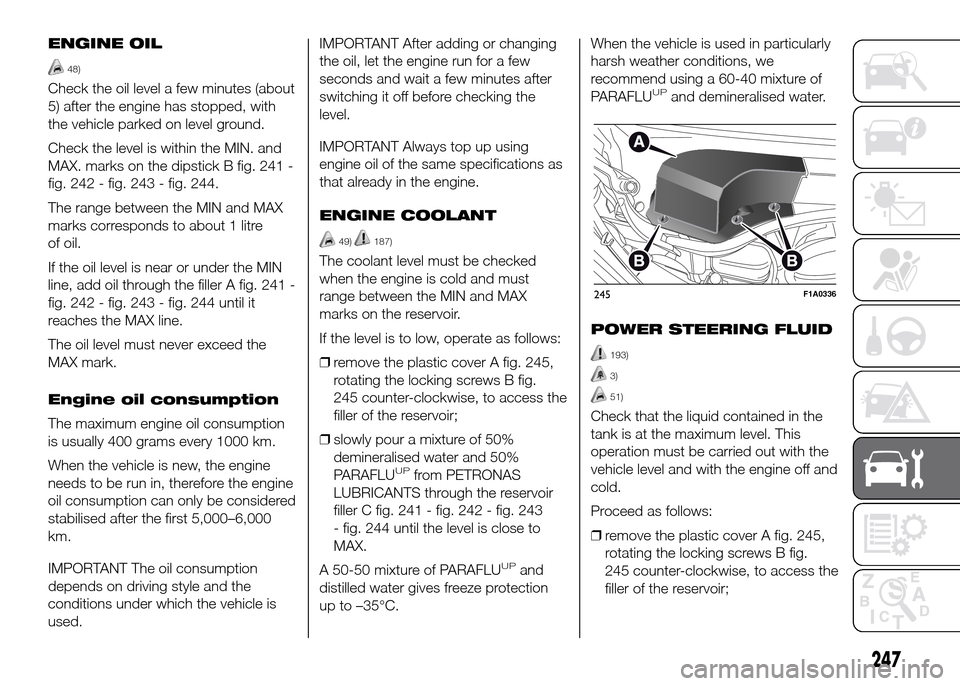
❒remove the plastic cover A fig. 245,
rotating the locking screws B fig.
245 counter-clockwise, to access the
filler of the reservoir;
❒slowly pour a mixture of 50%
demineralised water and 50%
PARAFLU
UPfrom PETRONAS
LUBRICANTS through the reservoir
filler C fig. 241 - fig. 242 - fig. 243
- fig. 244 until the level is close to
MAX.
A 50-50 mixture of PARAFLU
UPand
distilled water gives freeze protection
up to –35°C.When the vehicle is used in particularly
harsh weather conditions, we
recommend using a 60-40 mixture of
PARAFLU
UPand demineralised water.
POWER STEERING FLUID
193)
3)
51)
Check that the liquid contained in the
tank is at the maximum level. This
operation must be carried out with the
vehicle level and with the engine off and
cold.
Proceed as follows:
❒remove the plastic cover A fig. 245,
rotating the locking screws B fig.
245 counter-clockwise, to access the
filler of the reservoir;
245F1A0336
247
Page 383 of 387
INDEX
A
BS .............................................. 81
Additional heater ............................ 41
Additional rear climate control
(Panorama/Combi) ....................... 47
Additional rear heating
(Panorama/Combi) ....................... 46
Advice for extending battery life...... 252
Air cleaner ...................................... 250
Air suspension ............................... 69
Arrangement possibilities for
Universal Isofix child restraint
system on seats of vehicle ........... 170
Ashtray .......................................... 66
ASR system ................................... 83
ASR (system) ................................. 83
Automatic climate control
system ......................................... 35
Automatic headlight sensor ............ 51
Battery (disconnector) ................... 61
Battery disconnector ...................... 61
Battery
– Replacement ............................. 251
Battery (recharging) ........................ 232
Battery replacement ....................... 251
body paintwork identification
plate............................................. 263
Bodywork
– Advice for preserving the
bodywork .................................. 257– Exterior and underbody
warranty .................................... 257
– Protection from atmospheric
agents ....................................... 257
Bodywork version .......................... 264
Bonnet ........................................... 78
Bottle replacement ......................... 211
Brake fluid ...................................... 249
Brakes
– specifications ............................ 269
Bulbs
– types of bulbs ........................... 214
Bump starting ................................ 202
Cab glove compartment ............... 68
Capucine ....................................... 68
Carrying children safely
– Arrangement possibilities for
child restraint systems ............... 166
– Child restraint systems .............. 164
– Safety regulations ...................... 167
Central locking ............................... 61
Changing a bulb............................. 212
Changing an interior bulb ............... 221
Chassis marking ............................ 262
Checking and restoring pressure .... 210
Checking levels .............................. 243
Cigar lighter.................................... 65
Clutch ............................................ 268
CO2 emissions............................... 345Compartment beneath
passenger side front seat ............. 65
Controls ......................................... 59
Cruise Control ................................ 54
Daytime Running Lights ................ 48
Dead lock ...................................... 72
Demanding vehicle use .................. 242
Desk/Book rest .............................. 67
Diesel particulate filter (DPF) ........... 113
Diffusers ......................................... 29
Dimensions .................................... 274
Dipped headlights .................... 48-217
Direction indicators ................... 50-218
Display
– Standard screen ........................ 122
Door pockets ................................. 64
Doors ............................................. 71
DPF (particulate filter) ..................... 113
Driving Advisor (system) ................. 90
Driving style.................................... 189
Electric windows ........................... 77
Electronic alarm ............................. 14
Engine codes ................................. 264
Engine coolant ............................... 247
Engine coolant temperature
indicator ....................................... 120
Engine............................................ 266
Engine marking .............................. 263
Engine oil ....................................... 247