fuel FIAT DUCATO 2015 3.G User Guide
[x] Cancel search | Manufacturer: FIAT, Model Year: 2015, Model line: DUCATO, Model: FIAT DUCATO 2015 3.GPages: 387, PDF Size: 20.76 MB
Page 94 of 387
72) Tyre pressure must be checked
with tyres cold. Should it become
necessary for whatever reason
to check pressure with warm
tyres, do not reduce pressure
even if it is higher than the
prescribed value, but repeat the
check when tyres are cold.
73) The TPMS cannot indicate
sudden tyre pressure drops (for
example when a tyre bursts).
In this case, stop the car, braking
with caution and avoiding abrupt
steering.
74) The system only warns that the
tyre pressure is low: it is not able
to inflate them.
75) An insufficient tyre inflation
increases fuel consumption,
reduces the tread duration and
may affect the capacity of driving
safely.
76) Always refit the valve stem cap
after inspecting or adjusting tyre
pressure. This prevents dampness
or dirt from entering the valve
stem and thus the pressure
control sensor from being
damaged.77) The tyre repair kit (Fix&Go)
provided with the car (for
versions/markets, where
provided) is compatible with the
TPMS sensors; using sealants not
equivalent with that in the original
kit may adversely affect its
operation. If sealants not
equivalent with the original one
are used, it is recommended to
have the TPMS sensor operation
checked by a qualified repair
centre.DRIVING ADVISOR
(lane crossing warning)
(for versions/markets, where provided)
82) 79) 80)
The Driving Advisor is a warning system
that notifies the driver if he/she crosses
the lane because he/she has been
distracted.
A video sensor, fitted on the windscreen
near the interior rear view mirror,
detects the lane demarcation lines and
the position of the car in relation to
them.
IMPORTANT On cars with Driving
Advisor, it is advisable to contact a Fiat
Dealership should the windscreen
need to be replaced. If the repair is
carried out at a specialist window
replacement centre, it is still necessary
to go to a Fiat Dealership to have the
camera calibrated.
90
KNOW YOUR VEHICLE
Page 106 of 387
WARNING
86) The responsibility for parking
and other dangerous manoeuvres
always and in every case lies
with the driver. While carrying out
these manoeuvres, always make
sure that no people (especially
children) or animals are in the
area concerned. The parking
sensors are used to assist the
driver, who must never allow his
attention to lapse during
potentially dangerous
manoeuvres, even those executed
at low speeds.
START&STOP
SYSTEM
IN BRIEF
The Start&Stop device automatically
stopsthe engine each time the
vehicle is stationary and starts it
again when the driver wants to move
off. This improves the efficiency of
the vehicle by reducing fuel
consumption, the emission of harmful
gases and noise pollution.
OPERATING MODES
Engine stopping mode
WITH MANUAL GEARBOX
With the vehicle stationary, the engine
stops with the gearbox in neutral and
the clutch pedal released.
NoteThe engine can only be stopped
automatically after exceeding a speed
of about 10 km/h, to prevent the engine
from being repeatedly stopped when
driving at walking pace.
Engine stopping is signalled by the
icon on the display.Engine restarting mode
WITH MANUAL GEARBOX
Depress the clutch pedal to restart the
engine.
MANUAL ACTIVATION
AND DEACTIVATION OF
THE SYSTEM
To activate/deactivate the system
manually, press the
fig. 133 button
on the dashboard control trim.
Start&Stop system
activation
A message will appear on the display
when the Start&Stop system is
activated. In this condition, the LED on
the
button is off.
Start&Stop system
deactivation
A message will appear on the display
when the Start&Stop system is
deactivated.
The LED on the
button is on when
the system is deactivated.
102
KNOW YOUR VEHICLE
Page 108 of 387
"ENERGY SAVING"
FUNCTION
(for versions/markets, where provided)
If, after the engine has been
automatically restarted, the driver does
not take any action for a period of
about 3 minutes, the Start&Stop
system will definitively stop the engine
to avoid fuel consumption. The engine
can only be started using the key in
such cases.
NoteIn any case, it is possible to keep
the engine running by deactivating
the Start&Stop system.
IRREGULAR OPERATION
In the event of malfunction, the
Start&Stop system is deactivated. The
driver is informed about the fault
through the switching on of the
icon
together with a message on the
display. In this case, contact a Fiat
Dealership.VEHICLE INACTIVITY
In the event of vehicle inactivity, special
attention must be paid to the
disconnection of the battery power
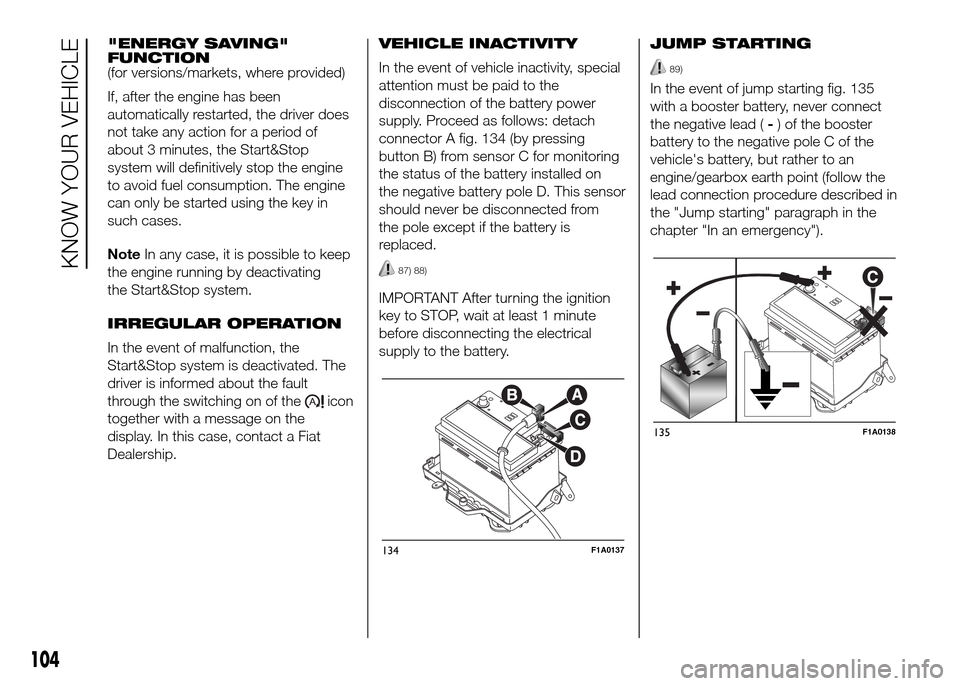
supply. Proceed as follows: detach
connector A fig. 134 (by pressing
button B) from sensor C for monitoring
the status of the battery installed on
the negative battery pole D. This sensor
should never be disconnected from
the pole except if the battery is
replaced.
87) 88)
IMPORTANT After turning the ignition
key to STOP, wait at least 1 minute
before disconnecting the electrical
supply to the battery.JUMP STARTING
89)
In the event of jump starting fig. 135
with a booster battery, never connect
the negative lead (-) of the booster
battery to the negative pole C of the
vehicle's battery, but rather to an
engine/gearbox earth point (follow the
lead connection procedure described in
the "Jump starting" paragraph in the
chapter "In an emergency").
134F1A0137
135F1A0138
104
KNOW YOUR VEHICLE
Page 109 of 387
IMPORTANT
18) If the climate comfort is to be
favoured, the Start&Stop system
can be deactivated, for a
continuous operation of the
climate control system.
WARNING
87) The vehicle should always be
evacuated after the key has been
removed or turned to the STOP
position. When refuelling, make
sure that the car is switched off
with the key in the STOP position.
88) If the battery needs to be
replaced, always contact a Fiat
Dealership. The replacement
battery should be of the same
type (L6 105Ah/850A) and should
have the same characteristics.89) Before opening the bonnet,
make sure that the vehicle is
switched off and the key is in the
STOP position. Follow the
instructions on the label on the
front crossmember. It is advisable
to extract the key when there
are other people in the vehicle.
ADDITIVE FOR
DIESEL EMISSIONS
ADBLUE (UREA)
The vehicle is equipped with a Selective
Catalytic Reduction system to meet
the strict Diesel emissions standards
required by the Agency for
Environmental Protection.
The purpose of the system of Selective
Catalytic Reduction is to reduce the
nitrogen oxides levels emitted by
engines; these elements are harmful to
our health and to the environment
even at minimum levels. A small
amount of additive for Diesel emissions
AdBlue (UREA) is injected upstream
of the catalyst exhaust outlet where,
when it turns into gas, converts
nitrogen oxides, that create smog, in
simple nitrogen and water vapour, two
natural components of air we breathe.
You can use your vehicle with the
peace of mind of knowing that you are
contributing to a cleaner and healthy
environment for future generations.
105
Page 110 of 387
System description
The vehicle is equipped with an UREA
fuel injection system and a Selective
Catalytic Reduction catalyst to meet the
emission standards.
These two systems ensure compliance
with the diesel emissions requirements;
at the same it maintains fuel saving
levels, driveability, torque and power.
For messages and system warnings
refer to "Knowing the instrument panel"
and "Warning lights and messages".
Remarks
❒When you stop the vehicle you could
hear a distinct click coming from
under the vehicle due to the UREA
injection system, this is normal.
❒The UREA injection system pump
continues to operate for a short
period of time after the engine is
switched off, to purge the circuit. This
is normal, and you can still hear its
noise from under the vehicle.RADIO
(for versions/markets, where provided)
For radio operation, consult the
Supplement attached to this Owner
Handbook.
SETUP
(for versions/markets, where provided)
The system consists of:
❒radio supply leads;
❒front speaker connection cables;
❒aerial supply lead;
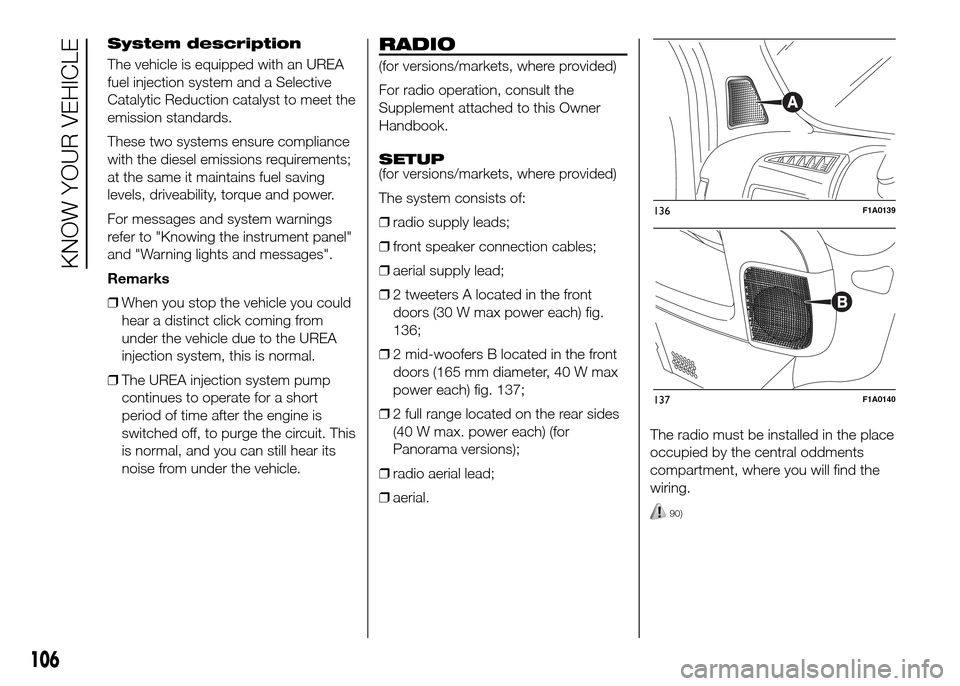
❒2 tweeters A located in the front
doors (30 W max power each) fig.
136;
❒2 mid-woofers B located in the front
doors (165 mm diameter, 40 W max
power each) fig. 137;
❒2 full range located on the rear sides
(40 W max. power each) (for
Panorama versions);
❒radio aerial lead;
❒aerial.The radio must be installed in the place
occupied by the central oddments
compartment, where you will find the
wiring.
90)
136F1A0139
137F1A0140
106
KNOW YOUR VEHICLE
Page 113 of 387
REFUELLING THE
VEHICLE
IN BRIEF
Refuel the vehicle exclusively with
dieselfor motor vehicles in
compliance with European
specification EN590.
Stop the engine before refuelling.
OPERATION AT LOW
TEMPERATURES
If the outside temperature is very low,
diesel thickens due to the formation
of paraffin clots with consequent
defective operation of the fuel supply
system.
In order to avoid these problems,
different types of diesel are distributed
according to the season: summer type,
winter type and arctic type (cold/
mountain areas). If refuelling with diesel
fuel whose specifications are not
suitable for the current temperature, it is
advisable to mix TUTELA DIESEL ART
additive in the proportions shown on
the container. Pour the additive into the
tank before the diesel fuel.When using or parking the vehicle for a
long time in the mountains or cold
areas, it is advisable to refuel using
locally available diesel fuel.
In this case, it is also advisable to keep
the tank over 50% full.
19)
FILLING THE TANK
To fill the tank completely, top-up twice
after the first click of the fuel supply
gun. Further top-ups could cause faults
in the fuel supply system.
FUEL TANK CAP
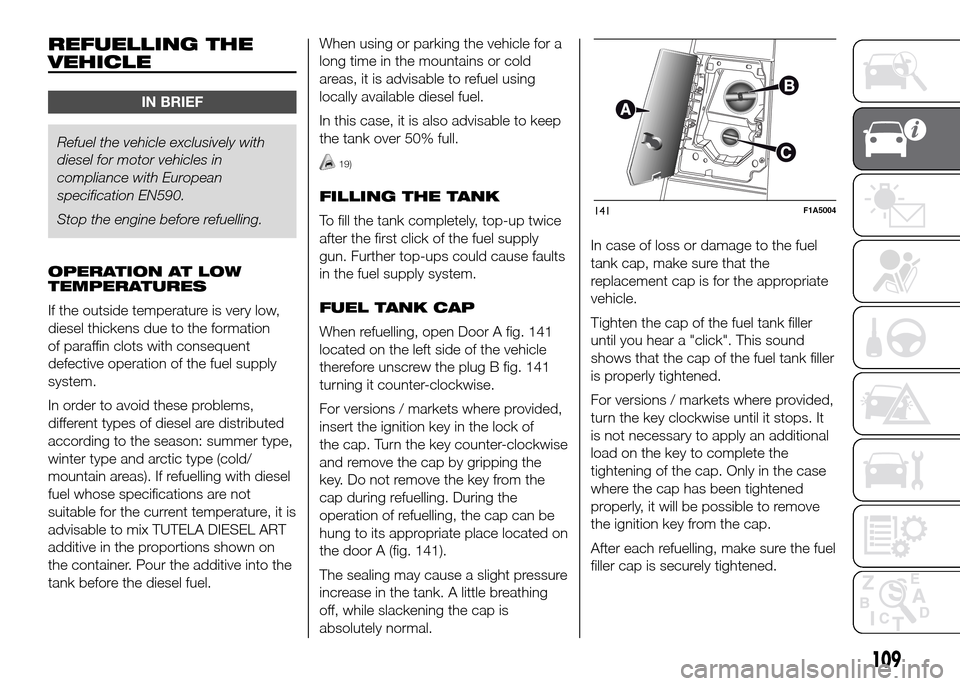
When refuelling, open Door A fig. 141
located on the left side of the vehicle
therefore unscrew the plug B fig. 141
turning it counter-clockwise.
For versions / markets where provided,
insert the ignition key in the lock of
the cap. Turn the key counter-clockwise
and remove the cap by gripping the
key. Do not remove the key from the
cap during refuelling. During the
operation of refuelling, the cap can be
hung to its appropriate place located on
the door A (fig. 141).
The sealing may cause a slight pressure
increase in the tank. A little breathing
off, while slackening the cap is
absolutely normal.In case of loss or damage to the fuel
tank cap, make sure that the
replacement cap is for the appropriate
vehicle.
Tighten the cap of the fuel tank filler
until you hear a "click". This sound
shows that the cap of the fuel tank filler
is properly tightened.
For versions / markets where provided,
turn the key clockwise until it stops. It
is not necessary to apply an additional
load on the key to complete the
tightening of the cap. Only in the case
where the cap has been tightened
properly, it will be possible to remove
the ignition key from the cap.
After each refuelling, make sure the fuel
filler cap is securely tightened.141F1A5004
109
Page 114 of 387
IMPORTANT
❒When the gun distributor fuel "snaps"
or interrupts the supply, the tank is
nearly full and you can run two
additional top-ups after shooting
automatic.
92) 93) 94)
Topping for additive Diesel
Emissions AdBlue (UREA)
96)
When refuelling the additive for Diesel
Emissions AdBlue (UREA) with
dispensing gun:
❒park the vehicle on ground level;
❒turn off the engine by turning the key
in the OFF position;
❒open the door to fuel A fig. 141 and
then unscrew and remove the cap C
fig. 141 from the filler neck of UREA;
❒insert the dispensing gun for topping
up UREA in the filler neck;
❒immediately stop filling the tank
UREA if it shows one of the cases
listed below:
- If AdBlue is spilled out of the filler
neck, clean up well the area and
proceed to filling up again;- If during filling the dispensing gun
clicks, it indicates that the UREA tank is
full. Do not proceed with the
replacement, to prevent spillage of
AdBlue (UREA).
❒When you finished topping, remount
cap C fig. 141 on the filler neck
UREA, turning it clockwise until it
stops;
❒turn the key in the pawl starter in the
ON position (no need to start the
engine);
❒wait for the signal on the instrument
panel to power off before moving the
vehicle, the warning light may stay
on for a few seconds to half a
minute. In case of motor start-up and
movement of the vehicle, the
warning sign will remain on for a
longer period of time, but there are
no problems on the engine
functionality. If topping up is done
with the UREA tank empty, you have
to wait two minutes before starting
the vehicle.
When refuelling the additive for Diesel
Emissions AdBlue (UREA) with bottle:
❒park the vehicle on ground level;
❒turn off the engine by turning the key
in the OFF position;❒open the door to fuel A fig. 141 and
then unscrew and remove the cap C
fig. 141 from the filler neck of UREA;
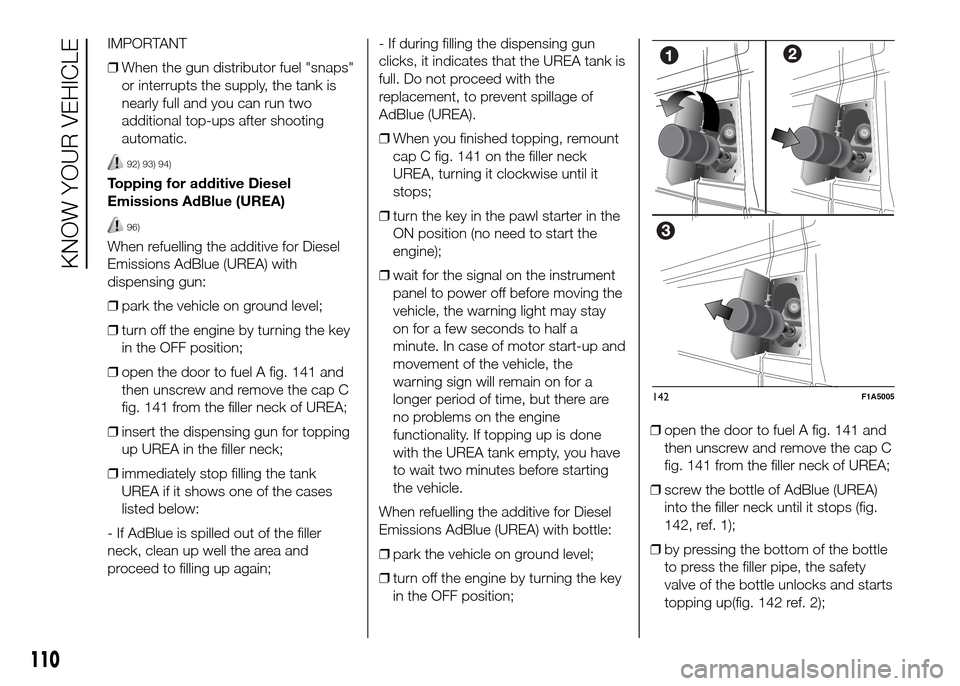
❒screw the bottle of AdBlue (UREA)
into the filler neck until it stops (fig.
142, ref. 1);
❒by pressing the bottom of the bottle
to press the filler pipe, the safety
valve of the bottle unlocks and starts
topping up(fig. 142 ref. 2);
110
KNOW YOUR VEHICLE
142F1A5005
Page 115 of 387
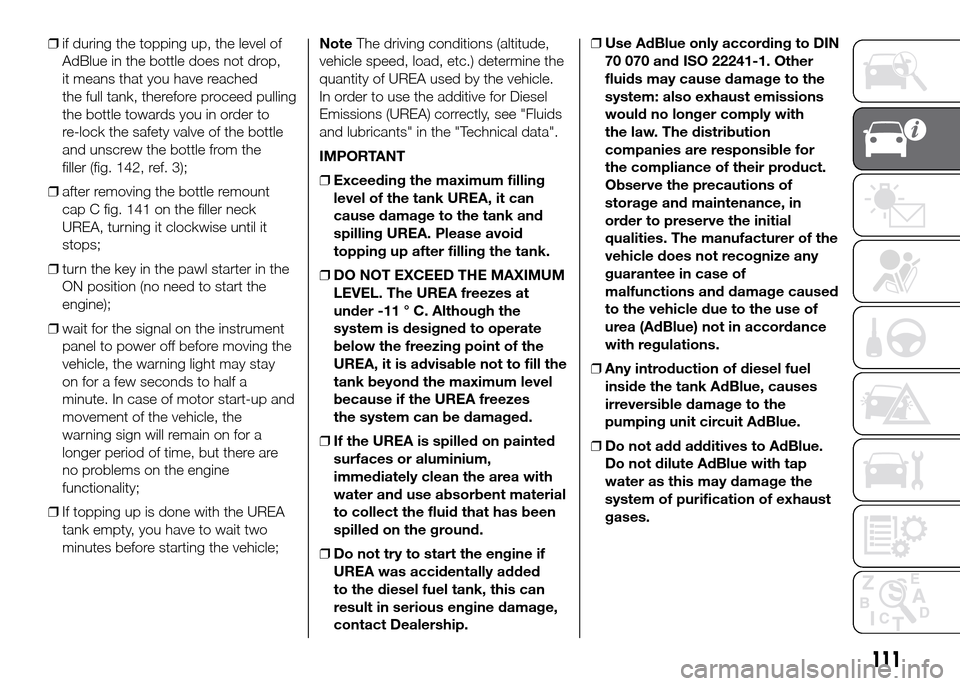
❒if during the topping up, the level of
AdBlue in the bottle does not drop,
it means that you have reached
the full tank, therefore proceed pulling
the bottle towards you in order to
re-lock the safety valve of the bottle
and unscrew the bottle from the
filler (fig. 142, ref. 3);
❒after removing the bottle remount
cap C fig. 141 on the filler neck
UREA, turning it clockwise until it
stops;
❒turn the key in the pawl starter in the
ON position (no need to start the
engine);
❒wait for the signal on the instrument
panel to power off before moving the
vehicle, the warning light may stay
on for a few seconds to half a
minute. In case of motor start-up and
movement of the vehicle, the
warning sign will remain on for a
longer period of time, but there are
no problems on the engine
functionality;
❒If topping up is done with the UREA
tank empty, you have to wait two
minutes before starting the vehicle;NoteThe driving conditions (altitude,
vehicle speed, load, etc.) determine the
quantity of UREA used by the vehicle.
In order to use the additive for Diesel
Emissions (UREA) correctly, see "Fluids
and lubricants" in the "Technical data".
IMPORTANT
❒Exceeding the maximum filling
level of the tank UREA, it can
cause damage to the tank and
spilling UREA. Please avoid
topping up after filling the tank.
❒DO NOT EXCEED THE MAXIMUM
LEVEL. The UREA freezes at
under -11 ° C. Although the
system is designed to operate
below the freezing point of the
UREA, it is advisable not to fill the
tank beyond the maximum level
because if the UREA freezes
the system can be damaged.
❒If the UREA is spilled on painted
surfaces or aluminium,
immediately clean the area with
water and use absorbent material
to collect the fluid that has been
spilled on the ground.
❒Do not try to start the engine if
UREA was accidentally added
to the diesel fuel tank, this can
result in serious engine damage,
contact Dealership.❒Use AdBlue only according to DIN
70 070 and ISO 22241-1. Other
fluids may cause damage to the
system: also exhaust emissions
would no longer comply with
the law. The distribution
companies are responsible for
the compliance of their product.
Observe the precautions of
storage and maintenance, in
order to preserve the initial
qualities. The manufacturer of the
vehicle does not recognize any
guarantee in case of
malfunctions and damage caused
to the vehicle due to the use of
urea (AdBlue) not in accordance
with regulations.
❒Any introduction of diesel fuel
inside the tank AdBlue, causes
irreversible damage to the
pumping unit circuit AdBlue.
❒Do not add additives to AdBlue.
Do not dilute AdBlue with tap
water as this may damage the
system of purification of exhaust
gases.
111
Page 116 of 387
❒In case of damage to the sewage
system of exhaust gas resulting
from the use of additives / tap
water, the introduction of diesel
fuel, or at least by not fulfilling the
requirements, the warranty
expires.
AdBlue tank topping
(UREA) in cold
environments
Since AdBlue (UREA) starts to freeze
around the -11 ° C, the vehicle is
equipped with an automatic system of
heating UREA that allows the system to
function properly at temperatures
below -11 ° C.
If the vehicle remains idle for a long
period at temperatures below the -11 °
C, the UREA in the tank might freeze.
If the tank UREA was filled beyond
the maximum level and freezes, it can
be damaged; for this reason it is
advisable not to exceed the maximum
level of the tank.
Pay extra attention to avoid exceeding
the maximum level when you use
portable containers for topping up.Fuel storage - Diesel
Fuel
95)
In case of the storage of massive
amounts of fuel, good maintenance is
essential. The fuel contaminated with
water favours the proliferation of
"microbes". These microbes create a
"slime" that can clog the filter system
and fuel pipes. Remove water from the
supply tank and regularly replace the
filter pipe.
NoteWhen a diesel engine runs out of
fuel, air is blown through the fuel
system.
AdBlue storage (UREA)
AdBlue (UREA) is considered a very
stable product with a long shelf life. If is
stored at temperatures between -12 °
and 32 ° C, it can be stored at least for
a year.
Since UREA can freeze at temperatures
at or below -11 ° C, the system was
designed to operate also in these cold
environments, thanks to an automatic
heating system which operates when
the engine is started.
NoteWhen you need to keep the
AdBlue (UREA), it is important to know
that:❒any container or part that comes in
contact with the UREA must be
compatible with it (plastic or stainless
steel). Materials such as copper,
brass, aluminium, iron or stainless
steel is not as susceptible to
corrosion by UREA are to be
avoided;
❒if UREA is spilled from a container,
completely clean the area.
IMPORTANT
19) Only refuel with automotive
diesel complying with the
European specification EN 590.
The use of other products or
mixtures may damage the engine
beyond repair and consequently
invalidate the warranty, due to the
damage caused. If you
accidentally introduce other types
of fuel into the tank, do not start
the engine. Empty the tank. If the
engine has been run for even an
extremely limited amount of time,
you must not only drain the fuel
tank, but the rest of the supply
circuit as well.
112
KNOW YOUR VEHICLE
Page 117 of 387
WARNING
92) Do not bring naked flames or lit
cigarettes near to the fuel tank
opening: fire risk. Keep your face
away from the fuel filler to prevent
breathing in harmful vapours.
93) To avoid fuel spillage and the
exceeding of the maximum level,
avoid topping up after filling the
tank.
94) Any fuel pumping in portable
containers located on a floor
can cause a fire. Danger of burns.
Always put the fuel container on
the ground during filling. Avoid
using contaminated fuel: a fuel
contaminated with water or earth
can cause serious damage to
the motor supply. Proper
maintenance of the fuel filter, of
the engine and the fuel tank is
essential.
95) Do not open the fuel system at
high pressure with the engine
running. The operation of the
engine creates a high fuel
pressure. A jet of high-pressure
fuel can cause serious injury or
death.
WARNING
96) If AdBlue overheats for a
prolonged period inside the tank
to over 50 ° C (for example due
to direct solar irradiation), AdBlue
can decompose ammonia
vapours. Ammonia vapours have a
pungent odour when the cap of
the AdBlue tank is unscrewed,
therefore be careful not to inhale
any ammonia vapours in the tank
outlet. In this concentration,
however, the ammonia vapors are
not harmful or dangerous to
health.
PROTECTING THE
ENVIRONMENT
The following devices are used for
reducing diesel fuel engine emissions:
❒oxidising catalytic converter;
❒exhaust gas recirculation system
(EGR);
❒particulate filter (DPF) (for versions/
markets, where provided).
97)
DIESEL PARTICULATE
FILTER (DPF)
The Diesel Particulate Filter is a
mechanical filter, integral to the exhaust
system, that physically traps carbon
particles present in the exhaust gases
of diesel engines.
The diesel particulate filter has been
adopted to eliminate almost all
particulates in compliance with current /
future legal regulations.
During normal use of the vehicle, the
Powertrain Control Module records
a set of data (travel time, type of route,
temperatures reached etc.) and
calculates how much particulate has
been trapped by the filter.
113