fuel consumption FIAT DUCATO 2015 3.G User Guide
[x] Cancel search | Manufacturer: FIAT, Model Year: 2015, Model line: DUCATO, Model: FIAT DUCATO 2015 3.GPages: 387, PDF Size: 20.76 MB
Page 193 of 387
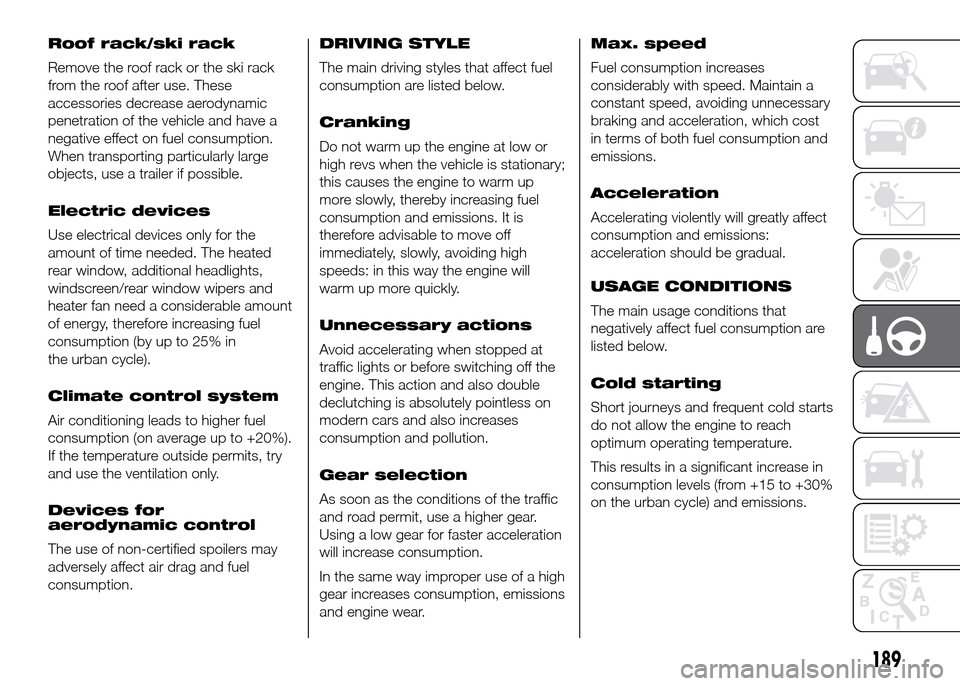
Roof rack/ski rack
Remove the roof rack or the ski rack
from the roof after use. These
accessories decrease aerodynamic
penetration of the vehicle and have a
negative effect on fuel consumption.
When transporting particularly large
objects, use a trailer if possible.
Electric devices
Use electrical devices only for the
amount of time needed. The heated
rear window, additional headlights,
windscreen/rear window wipers and
heater fan need a considerable amount
of energy, therefore increasing fuel
consumption (by up to 25% in
the urban cycle).
Climate control system
Air conditioning leads to higher fuel
consumption (on average up to +20%).
If the temperature outside permits, try
and use the ventilation only.
Devices for
aerodynamic control
The use of non-certified spoilers may
adversely affect air drag and fuel
consumption.DRIVING STYLE
The main driving styles that affect fuel
consumption are listed below.
Cranking
Do not warm up the engine at low or
high revs when the vehicle is stationary;
this causes the engine to warm up
more slowly, thereby increasing fuel
consumption and emissions. It is
therefore advisable to move off
immediately, slowly, avoiding high
speeds: in this way the engine will
warm up more quickly.
Unnecessary actions
Avoid accelerating when stopped at
traffic lights or before switching off the
engine. This action and also double
declutching is absolutely pointless on
modern cars and also increases
consumption and pollution.
Gear selection
As soon as the conditions of the traffic
and road permit, use a higher gear.
Using a low gear for faster acceleration
will increase consumption.
In the same way improper use of a high
gear increases consumption, emissions
and engine wear.Max. speed
Fuel consumption increases
considerably with speed. Maintain a
constant speed, avoiding unnecessary
braking and acceleration, which cost
in terms of both fuel consumption and
emissions.
Acceleration
Accelerating violently will greatly affect
consumption and emissions:
acceleration should be gradual.
USAGE CONDITIONS
The main usage conditions that
negatively affect fuel consumption are
listed below.
Cold starting
Short journeys and frequent cold starts
do not allow the engine to reach
optimum operating temperature.
This results in a significant increase in
consumption levels (from +15 to +30%
on the urban cycle) and emissions.
189
Page 244 of 387
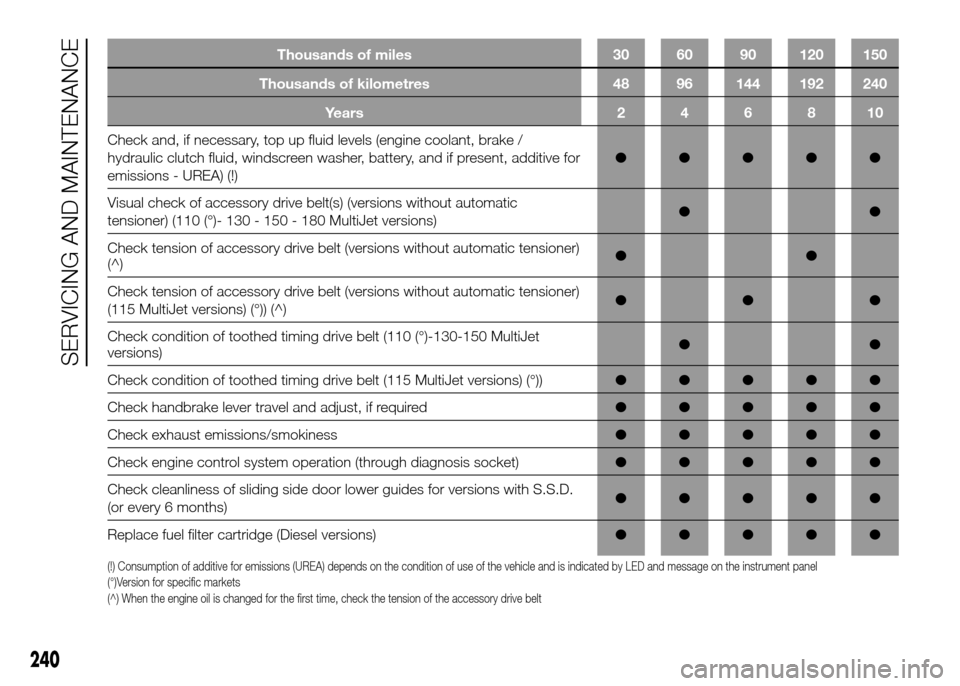
Thousands of miles 30 60 90 120 150
Thousands of kilometres 48 96 144 192 240
Years246810
Check and, if necessary, top up fluid levels (engine coolant, brake /
hydraulicclutch fluid, windscreen washer, battery, and if present, additive for
emissions - UREA) (!)●●●●●
Visual check of accessory drive belt(s) (versions without automatic
tensioner) (110 (°)- 130 - 150 - 180 MultiJet versions)●●
Check tension of accessory drive belt (versions without automatic tensioner)
(^)●●
Check tension of accessory drive belt (versions without automatic tensioner)
(115 MultiJet versions) (°)) (^)●●●
Check condition of toothed timing drive belt (110 (°)-130-150 MultiJet
versions)●●
Check condition of toothed timing drive belt (115 MultiJet versions) (°))●●●●●
Check handbrake lever travel and adjust, if required●●●●●
Check exhaust emissions/smokiness●●●●●
Check engine control system operation (through diagnosis socket)●●●●●
Check cleanliness of sliding side door lower guides for versions with S.S.D.
(or every 6 months)●●●●●
Replace fuel filter cartridge (Diesel versions)●●●●●
(!) Consumption of additive for emissions (UREA) depends on the condition of use of the vehicle and is indicated by LED and message on the instrument panel
(°)Version for specific markets
(^) When the engine oil is changed for the first time, check the tension of the accessory drive belt
240
SERVICING AND MAINTENANCE
Page 265 of 387
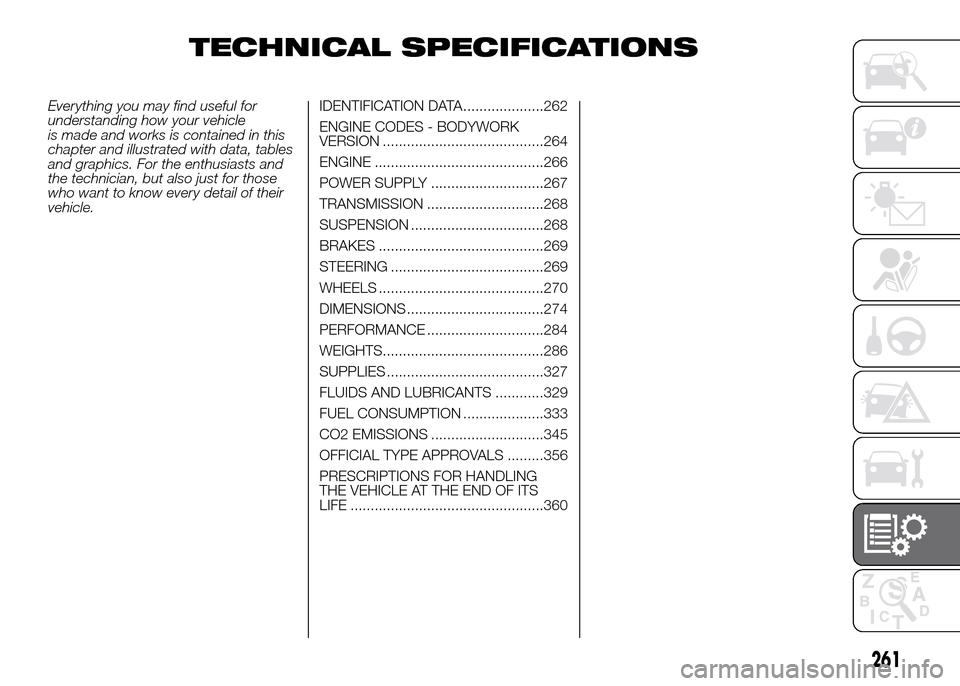
TECHNICAL SPECIFICATIONS
Everything you may find useful for
understanding how your vehicle
is made and works is contained in this
chapter and illustrated with data, tables
and graphics. For the enthusiasts and
the technician, but also just for those
who want to know every detail of their
vehicle.IDENTIFICATION DATA....................262
ENGINE CODES - BODYWORK
VERSION ........................................264
ENGINE ..........................................266
POWER SUPPLY ............................267
TRANSMISSION .............................268
SUSPENSION .................................268
BRAKES .........................................269
STEERING ......................................269
WHEELS .........................................270
DIMENSIONS ..................................274
PERFORMANCE .............................284
WEIGHTS........................................286
SUPPLIES .......................................327
FLUIDS AND LUBRICANTS ............329
FUEL CONSUMPTION ....................333
CO2 EMISSIONS ............................345
OFFICIAL TYPE APPROVALS .........356
PRESCRIPTIONS FOR HANDLING
THE VEHICLE AT THE END OF ITS
LIFE ................................................360
261
Page 333 of 387
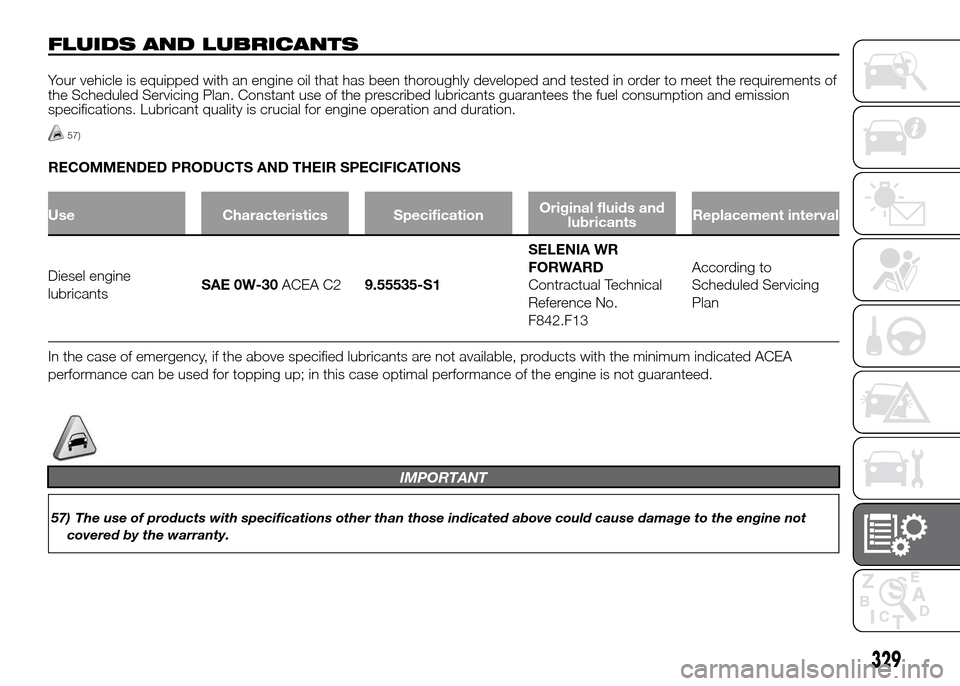
FLUIDS AND LUBRICANTS
Your vehicle is equipped with an engine oil that has been thoroughly developed and tested in order to meet the requirements of
the Scheduled Servicing Plan. Constant use of the prescribed lubricants guarantees the fuel consumption and emission
specifications. Lubricant quality is crucial for engine operation and duration.
57)
RECOMMENDED PRODUCTS AND THEIR SPECIFICATIONS
Use Characteristics SpecificationOriginal fluids and
lubricantsReplacement interval
Diesel engine
lubricantsSAE
0W-30ACEA C29.55535-S1SELENIA WR
FORWARD
Contractual Technical
Reference No.
F842.F13According to
Scheduled Servicing
Plan
In the case of emergency, if the above specified lubricants are not available, products with the minimum indicated ACEA
performance can be used for topping up; in this case optimal performance of the engine is not guaranteed.
IMPORTANT
57) The use of products with specifications other than those indicated above could cause damage to the engine not
covered by the warranty.
329
Page 337 of 387
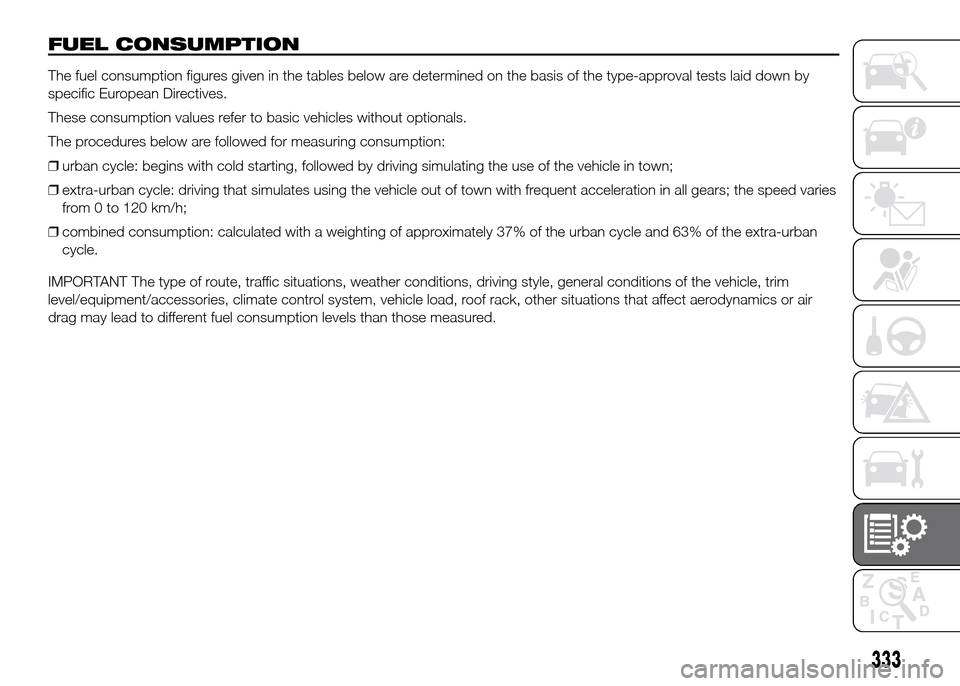
FUEL CONSUMPTION
The fuel consumption figures given in the tables below are determined on the basis of the type-approval tests laid down by
specific European Directives.
These consumption values refer to basic vehicles without optionals.
The procedures below are followed for measuring consumption:
❒urban cycle: begins with cold starting, followed by driving simulating the use of the vehicle in town;
❒extra-urban cycle: driving that simulates using the vehicle out of town with frequent acceleration in all gears; the speed varies
from 0 to 120 km/h;
❒combined consumption: calculated with a weighting of approximately 37% of the urban cycle and 63% of the extra-urban
cycle.
IMPORTANT The type of route, traffic situations, weather conditions, driving style, general conditions of the vehicle, trim
level/equipment/accessories, climate control system, vehicle load, roof rack, other situations that affect aerodynamics or air
drag may lead to different fuel consumption levels than those measured.
333
Page 338 of 387
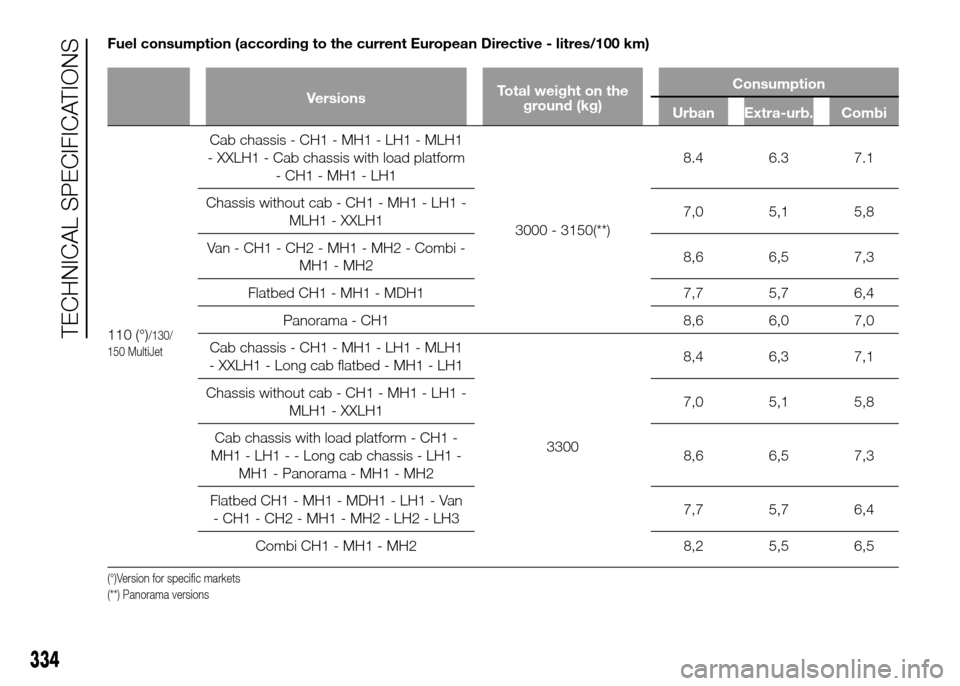
Fuel consumption (according to the current European Directive - litres/100 km)
VersionsTotal weight on the
ground (kg)Consumption
Urban Extra-urb. Combi
110 (°)/130/
150 MultiJet
Cab chassis - CH1 - MH1 - LH1 - MLH1
- XXLH1 - Cab chassis with load platform
- CH1 - MH1 - LH1
3000 - 3150(**)8.4 6.3 7.1
Chassis without cab - CH1 - MH1 - LH1 -
MLH1 - XXLH17,0 5,1 5,8
Van - CH1 - CH2 - MH1 - MH2 - Combi -
MH1 - MH28,6 6,5 7,3
Flatbed CH1 - MH1 - MDH1 7,7 5,7 6,4
Panorama - CH1 8,6 6,0 7,0
Cab chassis - CH1 - MH1 - LH1 - MLH1
- XXLH1 - Long cab flatbed - MH1 - LH1
33008,4 6,3 7,1
Chassis without cab - CH1 - MH1 - LH1 -
MLH1 - XXLH17,0 5,1 5,8
Cab chassis with load platform - CH1 -
MH1 - LH1 - - Long cab chassis - LH1 -
MH1 - Panorama - MH1 - MH28,6 6,5 7,3
Flatbed CH1 - MH1 - MDH1 - LH1 - Van
- CH1 - CH2 - MH1 - MH2 - LH2 - LH37,7 5,7 6,4
Combi CH1 - MH1 - MH2 8,2 5,5 6,5
(°)Version for specific markets
(**) Panorama versions
334
TECHNICAL SPECIFICATIONS
Page 384 of 387
Engine oil level gauge ..................... 121
EOBD system ................................ 99
ESC (system) ................................. 82
External lights................................. 48
Fiat CODE system......................... 11
Fix&Go Automatic quick tyre
repair kit................. 208-209-210-211
Flap on bench ............................ 19-68
Flashing ......................................... 49
Flex Floor rear seat......................... 21
Fluids and lubricants ...................... 329
Fog lights ................................. 60-218
Follow Me Home device ................. 50
Follow me home ............................ 50
Front airbags .................................. 174
– Driver's side front airbag............ 174
– Manually deactivating the
front airbag and side bag........... 175
– Passenger side front airbag ....... 175
Front roof light (changing a bulb) .... 221
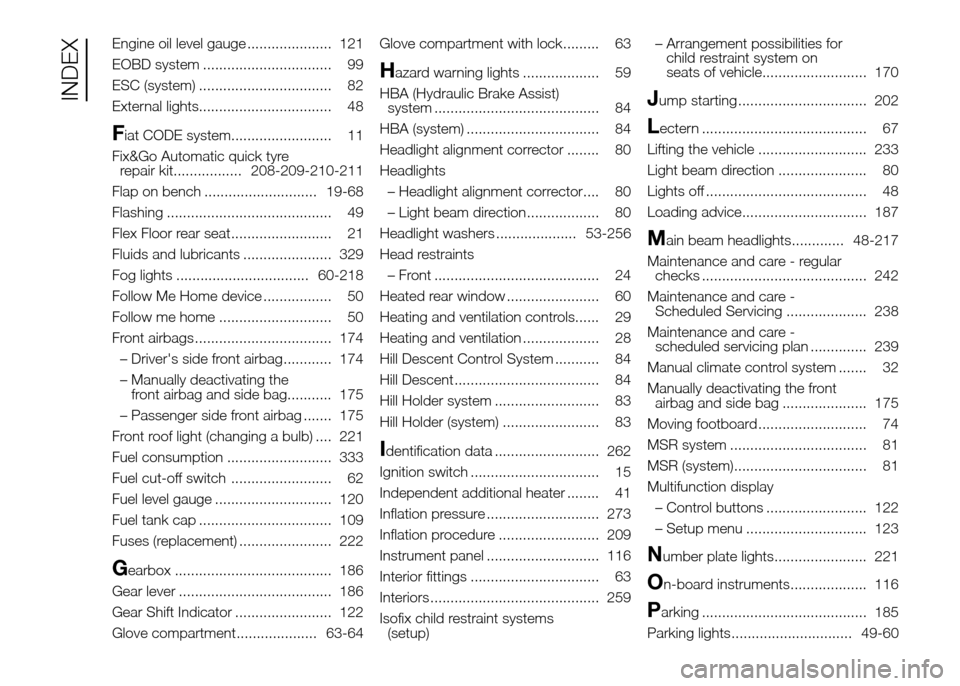
Fuel consumption .......................... 333
Fuel cut-off switch ......................... 62
Fuel level gauge ............................. 120
Fuel tank cap ................................. 109
Fuses (replacement) ....................... 222
Gearbox ....................................... 186
Gear lever ...................................... 186
Gear Shift Indicator ........................ 122
Glove compartment.................... 63-64Glove compartment with lock......... 63
Hazard warning lights ................... 59
HBA (Hydraulic Brake Assist)
system ......................................... 84
HBA (system) ................................. 84
Headlight alignment corrector ........ 80
Headlights
– Headlight alignment corrector.... 80
– Light beam direction.................. 80
Headlight washers .................... 53-256
Head restraints
– Front ......................................... 24
Heated rear window ....................... 60
Heating and ventilation controls...... 29
Heating and ventilation ................... 28
Hill Descent Control System ........... 84
Hill Descent .................................... 84
Hill Holder system .......................... 83
Hill Holder (system) ........................ 83
Identification data .......................... 262
Ignition switch ................................ 15
Independent additional heater ........ 41
Inflation pressure ............................ 273
Inflation procedure ......................... 209
Instrument panel ............................ 116
Interior fittings ................................ 63
Interiors .......................................... 259
Isofix child restraint systems
(setup)– Arrangement possibilities for
child restraint system on
seats of vehicle.......................... 170
Jump starting ................................ 202
Lectern ......................................... 67
Lifting the vehicle ........................... 233
Light beam direction ...................... 80
Lights off ........................................ 48
Loading advice............................... 187
Main beam headlights............. 48-217
Maintenance and care - regular
checks ......................................... 242
Maintenance and care -
Scheduled Servicing .................... 238
Maintenance and care -
scheduled servicing plan .............. 239
Manual climate control system ....... 32
Manually deactivating the front
airbag and side bag ..................... 175
Moving footboard ........................... 74
MSR system .................................. 81
MSR (system)................................. 81
Multifunction display
– Control buttons ......................... 122
– Setup menu .............................. 123
Number plate lights....................... 221
On-board instruments................... 116
Parking ......................................... 185
Parking lights.............................. 49-60
INDEX