roof FIAT DUCATO 2015 3.G User Guide
[x] Cancel search | Manufacturer: FIAT, Model Year: 2015, Model line: DUCATO, Model: FIAT DUCATO 2015 3.GPages: 387, PDF Size: 20.76 MB
Page 193 of 387
Roof rack/ski rack
Remove the roof rack or the ski rack
from the roof after use. These
accessories decrease aerodynamic
penetration of the vehicle and have a
negative effect on fuel consumption.
When transporting particularly large
objects, use a trailer if possible.
Electric devices
Use electrical devices only for the
amount of time needed. The heated
rear window, additional headlights,
windscreen/rear window wipers and
heater fan need a considerable amount
of energy, therefore increasing fuel
consumption (by up to 25% in
the urban cycle).
Climate control system
Air conditioning leads to higher fuel
consumption (on average up to +20%).
If the temperature outside permits, try
and use the ventilation only.
Devices for
aerodynamic control
The use of non-certified spoilers may
adversely affect air drag and fuel
consumption.DRIVING STYLE
The main driving styles that affect fuel
consumption are listed below.
Cranking
Do not warm up the engine at low or
high revs when the vehicle is stationary;
this causes the engine to warm up
more slowly, thereby increasing fuel
consumption and emissions. It is
therefore advisable to move off
immediately, slowly, avoiding high
speeds: in this way the engine will
warm up more quickly.
Unnecessary actions
Avoid accelerating when stopped at
traffic lights or before switching off the
engine. This action and also double
declutching is absolutely pointless on
modern cars and also increases
consumption and pollution.
Gear selection
As soon as the conditions of the traffic
and road permit, use a higher gear.
Using a low gear for faster acceleration
will increase consumption.
In the same way improper use of a high
gear increases consumption, emissions
and engine wear.Max. speed
Fuel consumption increases
considerably with speed. Maintain a
constant speed, avoiding unnecessary
braking and acceleration, which cost
in terms of both fuel consumption and
emissions.
Acceleration
Accelerating violently will greatly affect
consumption and emissions:
acceleration should be gradual.
USAGE CONDITIONS
The main usage conditions that
negatively affect fuel consumption are
listed below.
Cold starting
Short journeys and frequent cold starts
do not allow the engine to reach
optimum operating temperature.
This results in a significant increase in
consumption levels (from +15 to +30%
on the urban cycle) and emissions.
189
Page 219 of 387
Bulbs
Bulbs Type Power Figure ref.
Main beam headlights H7 55 W D
Dippedbeam headlights H7 55 W D
Front side lights/day lights W21/5W - LED (#) - -
Fog lights(*) H11 55 W -
Front direction indicators WY21W 21 W B
Side direction indicatorsW16WF(**) / WY5W
(***)16W (**) / 5W (***) A
Rear direction indicators PY2IW 21 W B
Side lights W5W 5 W A
Rear side lights P21/5 W 21/5W B
Rear side lights/Brake lights P21W 21 W B
3rd brake light W5W 5 W B
Reverse W16W 16 W B
Rear fog light W16W 16 W B
Number plate light C5W 5 W A
Front roof light (movable lens) 12V10W 10 W C
Rear roof light 12V10W 10 W C
(#) where provided, instead of bulb W21/5W
(*)for versions/markets, where provided
(**)XL and recreational versions
(***)all other versions
215
Page 225 of 387
NUMBER PLATE LIGHTS
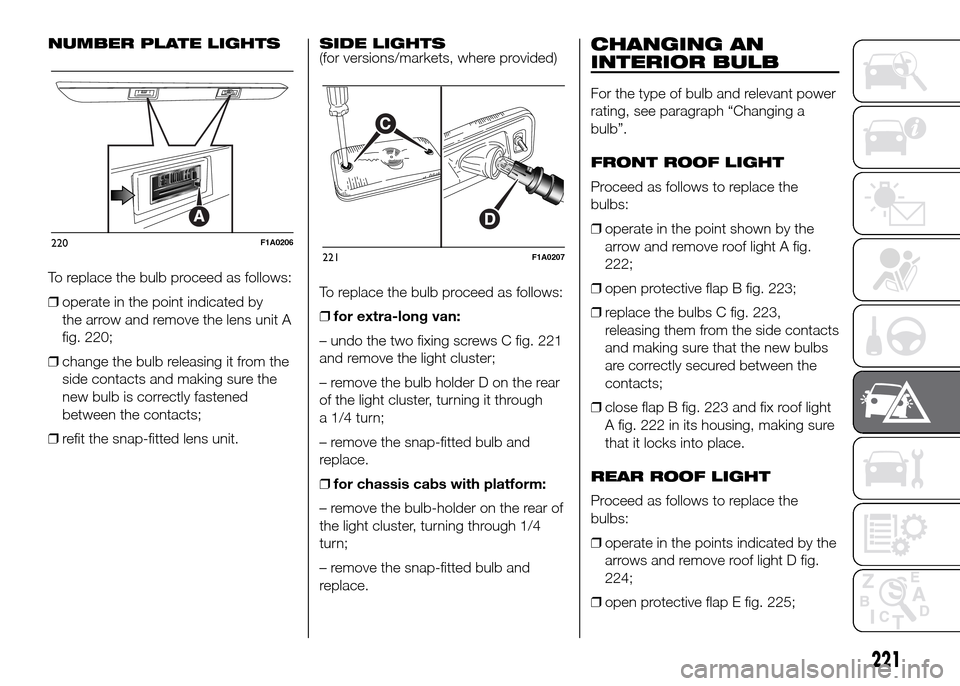
To replace the bulb proceed as follows:
❒operate in the point indicated by
the arrow and remove the lens unit A
fig. 220;
❒change the bulb releasing it from the
side contacts and making sure the
new bulb is correctly fastened
between the contacts;
❒refit the snap-fitted lens unit.SIDE LIGHTS
(for versions/markets, where provided)
To replace the bulb proceed as follows:
❒for extra-long van:
– undo the two fixing screws C fig. 221
and remove the light cluster;
– remove the bulb holder D on the rear
of the light cluster, turning it through
a 1/4 turn;
– remove the snap-fitted bulb and
replace.
❒for chassis cabs with platform:
– remove the bulb-holder on the rear of
the light cluster, turning through 1/4
turn;
– remove the snap-fitted bulb and
replace.CHANGING AN
INTERIOR BULB
For the type of bulb and relevant power
rating, see paragraph “Changing a
bulb”.
FRONT ROOF LIGHT
Proceed as follows to replace the
bulbs:
❒operate in the point shown by the
arrow and remove roof light A fig.
222;
❒open protective flap B fig. 223;
❒replace the bulbs C fig. 223,
releasing them from the side contacts
and making sure that the new bulbs
are correctly secured between the
contacts;
❒close flap B fig. 223 and fix roof light
A fig. 222 in its housing, making sure
that it locks into place.
REAR ROOF LIGHT
Proceed as follows to replace the
bulbs:
❒operate in the points indicated by the
arrows and remove roof light D fig.
224;
❒open protective flap E fig. 225;
220F1A0206221F1A0207
221
Page 226 of 387
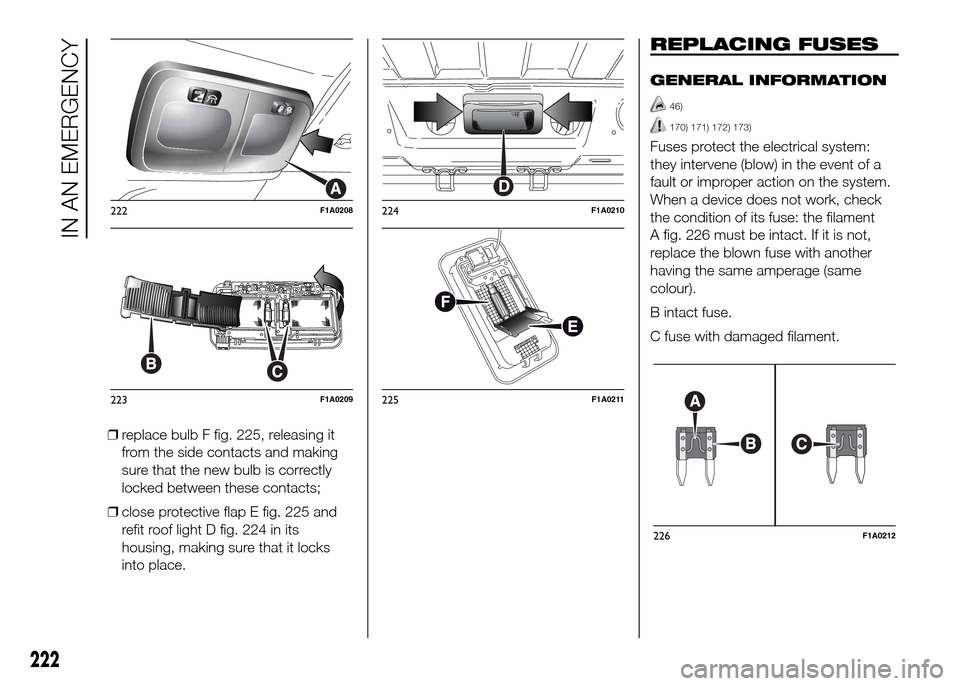
❒replace bulb F fig. 225, releasing it
from the side contacts and making
sure that the new bulb is correctly
locked between these contacts;
❒close protective flap E fig. 225 and
refit roof light D fig. 224 in its
housing, making sure that it locks
into place..
REPLACING FUSES
GENERAL INFORMATION
46)
170) 171) 172) 173)
Fuses protect the electrical system:
they intervene (blow) in the event of a
fault or improper action on the system.
When a device does not work, check
the condition of its fuse: the filament
A fig. 226 must be intact. If it is not,
replace the blown fuse with another
having the same amperage (same
colour).
B intact fuse.
C fuse with damaged filament.
222F1A0208
223F1A0209
224F1A0210
225F1A0211
226F1A0212
222
IN AN EMERGENCY
Page 230 of 387
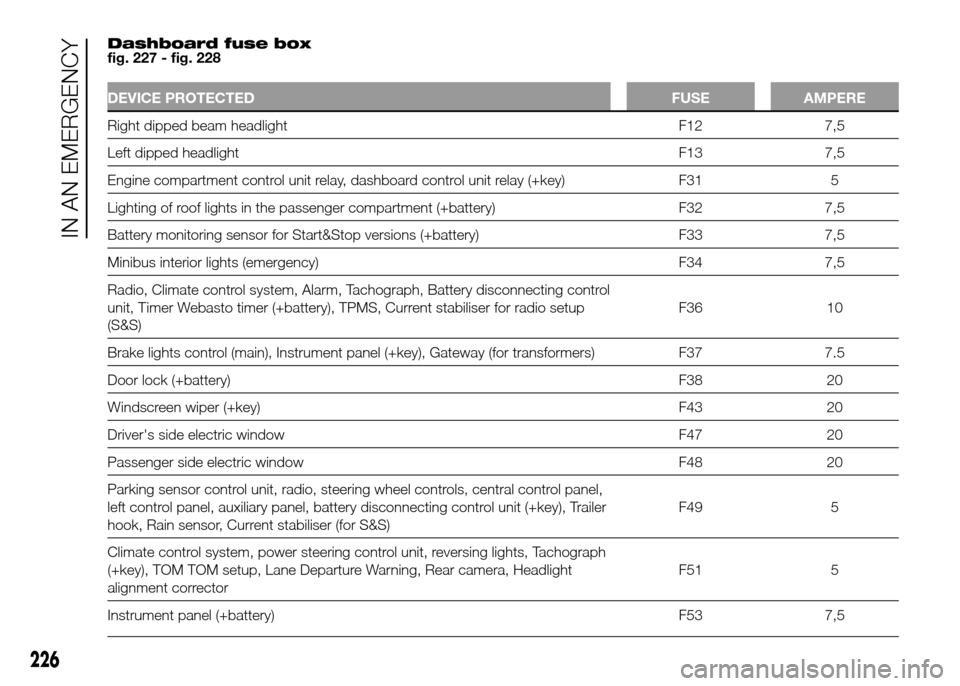
Dashboard fuse box
fig. 227 - fig. 228
DEVICE PROTECTED FUSE AMPERE
Right dipped beam headlight F12 7,5
Leftdipped headlight F13 7,5
Engine compartment control unit relay, dashboard control unit relay (+key) F31 5
Lighting of roof lights in the passenger compartment (+battery) F32 7,5
Battery monitoring sensor for Start&Stop versions (+battery) F33 7,5
Minibus interior lights (emergency) F34 7,5
Radio, Climate control system, Alarm, Tachograph, Battery disconnecting control
unit, Timer Webasto timer (+battery), TPMS, Current stabiliser for radio setup
(S&S)F36 10
Brake lights control (main), Instrument panel (+key), Gateway (for transformers) F37 7.5
Door lock (+battery) F38 20
Windscreen wiper (+key) F43 20
Driver's side electric window F47 20
Passenger side electric window F48 20
Parking sensor control unit, radio, steering wheel controls, central control panel,
left control panel, auxiliary panel, battery disconnecting control unit (+key), Trailer
hook, Rain sensor, Current stabiliser (for S&S)F49 5
Climate control system, power steering control unit, reversing lights, Tachograph
(+key), TOM TOM setup, Lane Departure Warning, Rear camera, Headlight
alignment correctorF51 5
Instrument panel (+battery) F53 7,5
226
IN AN EMERGENCY
Page 256 of 387
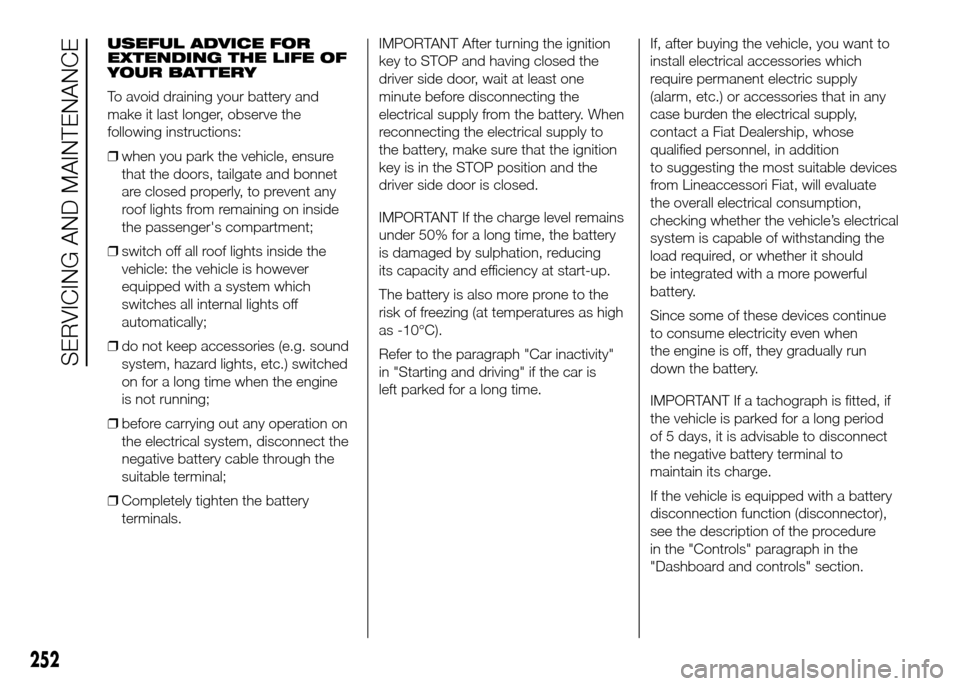
USEFUL ADVICE FOR
EXTENDING THE LIFE OF
YOUR BATTERY
To avoid draining your battery and
make it last longer, observe the
following instructions:
❒when you park the vehicle, ensure
that the doors, tailgate and bonnet
are closed properly, to prevent any
roof lights from remaining on inside
the passenger's compartment;
❒switch off all roof lights inside the
vehicle: the vehicle is however
equipped with a system which
switches all internal lights off
automatically;
❒do not keep accessories (e.g. sound
system, hazard lights, etc.) switched
on for a long time when the engine
is not running;
❒before carrying out any operation on
the electrical system, disconnect the
negative battery cable through the
suitable terminal;
❒Completely tighten the battery
terminals.IMPORTANT After turning the ignition
key to STOP and having closed the
driver side door, wait at least one
minute before disconnecting the
electrical supply from the battery. When
reconnecting the electrical supply to
the battery, make sure that the ignition
key is in the STOP position and the
driver side door is closed.
IMPORTANT If the charge level remains
under 50% for a long time, the battery
is damaged by sulphation, reducing
its capacity and efficiency at start-up.
The battery is also more prone to the
risk of freezing (at temperatures as high
as -10°C).
Refer to the paragraph "Car inactivity"
in "Starting and driving" if the car is
left parked for a long time.If, after buying the vehicle, you want to
install electrical accessories which
require permanent electric supply
(alarm, etc.) or accessories that in any
case burden the electrical supply,
contact a Fiat Dealership, whose
qualified personnel, in addition
to suggesting the most suitable devices
from Lineaccessori Fiat, will evaluate
the overall electrical consumption,
checking whether the vehicle’s electrical
system is capable of withstanding the
load required, or whether it should
be integrated with a more powerful
battery.
Since some of these devices continue
to consume electricity even when
the engine is off, they gradually run
down the battery.
IMPORTANT If a tachograph is fitted, if
the vehicle is parked for a long period
of 5 days, it is advisable to disconnect
the negative battery terminal to
maintain its charge.
If the vehicle is equipped with a battery
disconnection function (disconnector),
see the description of the procedure
in the "Controls" paragraph in the
"Dashboard and controls" section.
252
SERVICING AND MAINTENANCE
Page 261 of 387
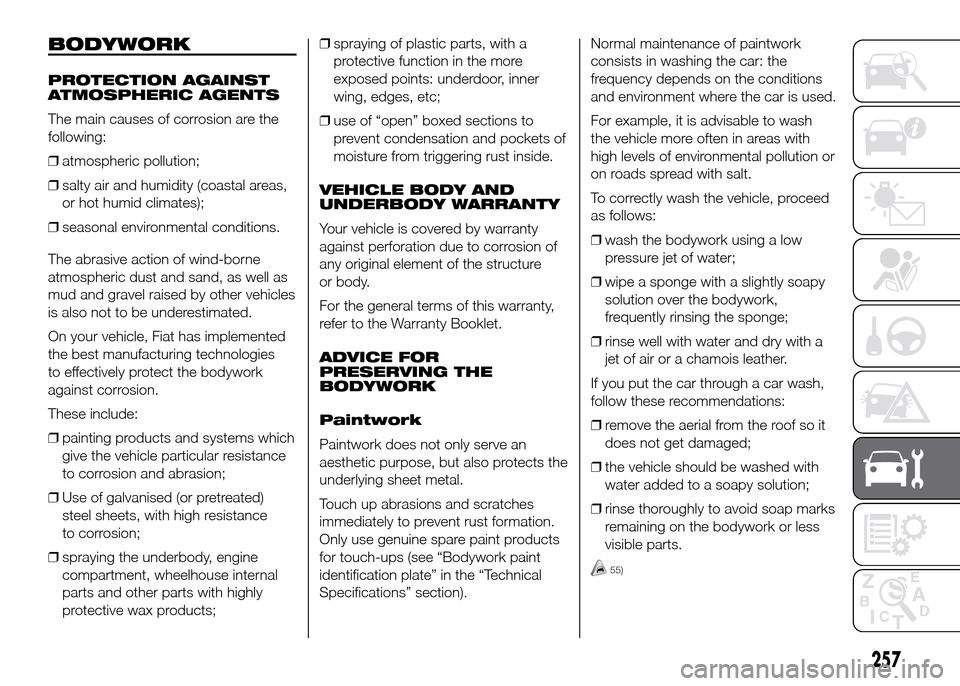
BODYWORK
PROTECTION AGAINST
ATMOSPHERIC AGENTS
The main causes of corrosion are the
following:
❒atmospheric pollution;
❒salty air and humidity (coastal areas,
or hot humid climates);
❒seasonal environmental conditions.
The abrasive action of wind-borne
atmospheric dust and sand, as well as
mud and gravel raised by other vehicles
is also not to be underestimated.
On your vehicle, Fiat has implemented
the best manufacturing technologies
to effectively protect the bodywork
against corrosion.
These include:
❒painting products and systems which
give the vehicle particular resistance
to corrosion and abrasion;
❒Use of galvanised (or pretreated)
steel sheets, with high resistance
to corrosion;
❒spraying the underbody, engine
compartment, wheelhouse internal
parts and other parts with highly
protective wax products;❒spraying of plastic parts, with a
protective function in the more
exposed points: underdoor, inner
wing, edges, etc;
❒use of “open” boxed sections to
prevent condensation and pockets of
moisture from triggering rust inside.
VEHICLE BODY AND
UNDERBODY WARRANTY
Your vehicle is covered by warranty
against perforation due to corrosion of
any original element of the structure
or body.
For the general terms of this warranty,
refer to the Warranty Booklet.
ADVICE FOR
PRESERVING THE
BODYWORK
Paintwork
Paintwork does not only serve an
aesthetic purpose, but also protects the
underlying sheet metal.
Touch up abrasions and scratches
immediately to prevent rust formation.
Only use genuine spare paint products
for touch-ups (see “Bodywork paint
identification plate” in the “Technical
Specifications” section).Normal maintenance of paintwork
consists in washing the car: the
frequency depends on the conditions
and environment where the car is used.
For example, it is advisable to wash
the vehicle more often in areas with
high levels of environmental pollution or
on roads spread with salt.
To correctly wash the vehicle, proceed
as follows:
❒wash the bodywork using a low
pressure jet of water;
❒wipe a sponge with a slightly soapy
solution over the bodywork,
frequently rinsing the sponge;
❒rinse well with water and dry with a
jet of air or a chamois leather.
If you put the car through a car wash,
follow these recommendations:
❒remove the aerial from the roof so it
does not get damaged;
❒the vehicle should be washed with
water added to a soapy solution;
❒rinse thoroughly to avoid soap marks
remaining on the bodywork or less
visible parts.
55)
257
Page 337 of 387
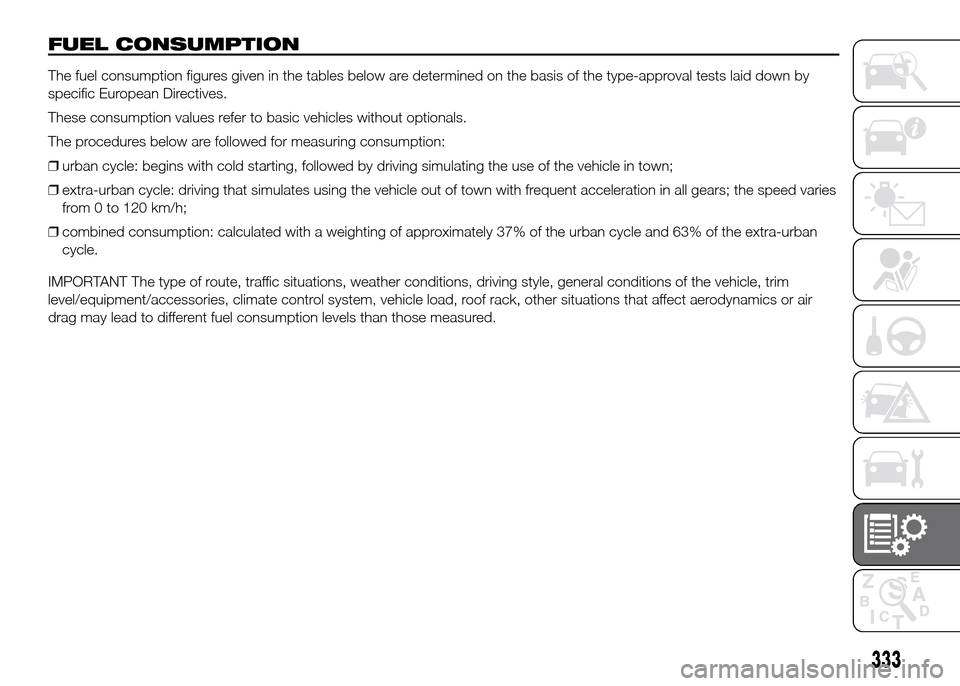
FUEL CONSUMPTION
The fuel consumption figures given in the tables below are determined on the basis of the type-approval tests laid down by
specific European Directives.
These consumption values refer to basic vehicles without optionals.
The procedures below are followed for measuring consumption:
❒urban cycle: begins with cold starting, followed by driving simulating the use of the vehicle in town;
❒extra-urban cycle: driving that simulates using the vehicle out of town with frequent acceleration in all gears; the speed varies
from 0 to 120 km/h;
❒combined consumption: calculated with a weighting of approximately 37% of the urban cycle and 63% of the extra-urban
cycle.
IMPORTANT The type of route, traffic situations, weather conditions, driving style, general conditions of the vehicle, trim
level/equipment/accessories, climate control system, vehicle load, roof rack, other situations that affect aerodynamics or air
drag may lead to different fuel consumption levels than those measured.
333
Page 365 of 387
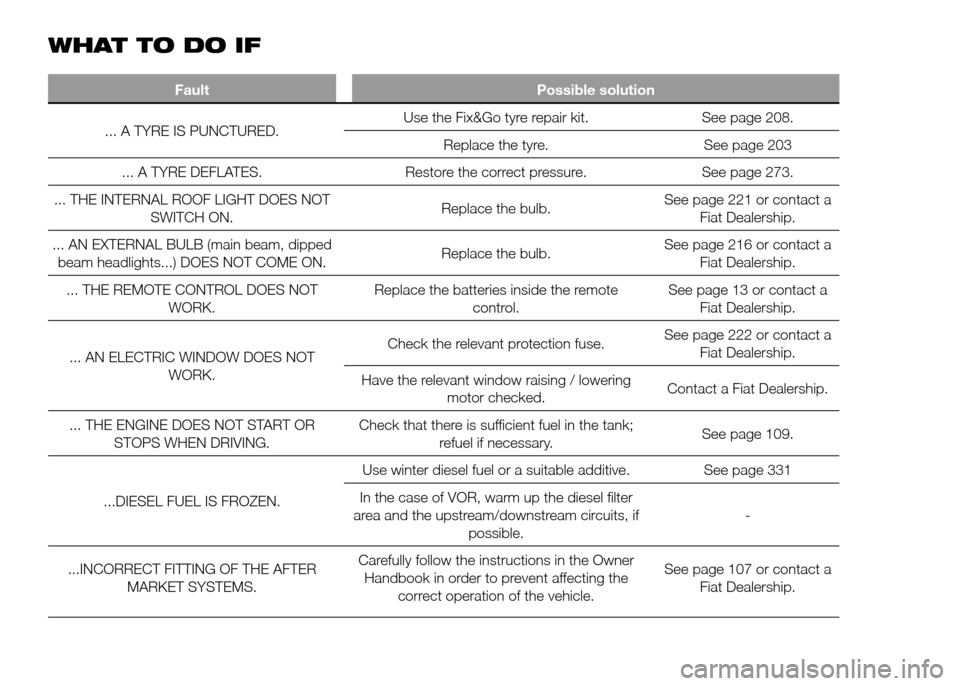
WHATTODOIF
Fault Possible solution
... A TYRE IS PUNCTURED.Use
the Fix&Go tyre repair kit. See page 208.
Replace the tyre. See page 203
... A TYRE DEFLATES. Restore the correct pressure. See page 273.
... THE INTERNAL ROOF LIGHT DOES NOT
SWITCH ON.Replace the bulb.See page 221 or contact a
Fiat Dealership.
... AN EXTERNAL BULB (main beam, dipped
beam headlights...) DOES NOT COME ON.Replace the bulb.See page 216 or contact a
Fiat Dealership.
... THE REMOTE CONTROL DOES NOT
WORK.Replace the batteries inside the remote
control.See page 13 or contact a
Fiat Dealership.
... AN ELECTRIC WINDOW DOES NOT
WORK.Check the relevant protection fuse.See page 222 or contact a
Fiat Dealership.
Have the relevant window raising / lowering
motor checked.Contact a Fiat Dealership.
... THE ENGINE DOES NOT START OR
STOPS WHEN DRIVING.Check that there is sufficient fuel in the tank;
refuel if necessary.See page 109.
...DIESEL FUEL IS FROZEN.Use winter diesel fuel or a suitable additive. See page 331
In the case of VOR, warm up the diesel filter
area and the upstream/downstream circuits, if
possible.-
...INCORRECT FITTING OF THE AFTER
MARKET SYSTEMS.Carefully follow the instructions in the Owner
Handbook in order to prevent affecting the
correct operation of the vehicle.See page 107 or contact a
Fiat Dealership.
Page 384 of 387
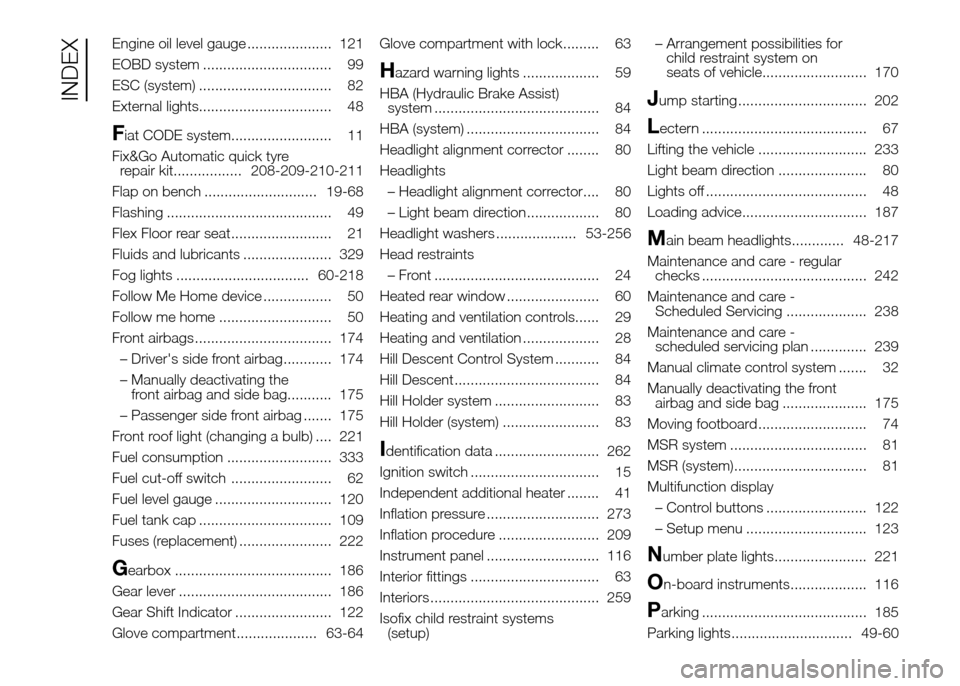
Engine oil level gauge ..................... 121
EOBD system ................................ 99
ESC (system) ................................. 82
External lights................................. 48
Fiat CODE system......................... 11
Fix&Go Automatic quick tyre
repair kit................. 208-209-210-211
Flap on bench ............................ 19-68
Flashing ......................................... 49
Flex Floor rear seat......................... 21
Fluids and lubricants ...................... 329
Fog lights ................................. 60-218
Follow Me Home device ................. 50
Follow me home ............................ 50
Front airbags .................................. 174
– Driver's side front airbag............ 174
– Manually deactivating the
front airbag and side bag........... 175
– Passenger side front airbag ....... 175
Front roof light (changing a bulb) .... 221
Fuel consumption .......................... 333
Fuel cut-off switch ......................... 62
Fuel level gauge ............................. 120
Fuel tank cap ................................. 109
Fuses (replacement) ....................... 222
Gearbox ....................................... 186
Gear lever ...................................... 186
Gear Shift Indicator ........................ 122
Glove compartment.................... 63-64Glove compartment with lock......... 63
Hazard warning lights ................... 59
HBA (Hydraulic Brake Assist)
system ......................................... 84
HBA (system) ................................. 84
Headlight alignment corrector ........ 80
Headlights
– Headlight alignment corrector.... 80
– Light beam direction.................. 80
Headlight washers .................... 53-256
Head restraints
– Front ......................................... 24
Heated rear window ....................... 60
Heating and ventilation controls...... 29
Heating and ventilation ................... 28
Hill Descent Control System ........... 84
Hill Descent .................................... 84
Hill Holder system .......................... 83
Hill Holder (system) ........................ 83
Identification data .......................... 262
Ignition switch ................................ 15
Independent additional heater ........ 41
Inflation pressure ............................ 273
Inflation procedure ......................... 209
Instrument panel ............................ 116
Interior fittings ................................ 63
Interiors .......................................... 259
Isofix child restraint systems
(setup)– Arrangement possibilities for
child restraint system on
seats of vehicle.......................... 170
Jump starting ................................ 202
Lectern ......................................... 67
Lifting the vehicle ........................... 233
Light beam direction ...................... 80
Lights off ........................................ 48
Loading advice............................... 187
Main beam headlights............. 48-217
Maintenance and care - regular
checks ......................................... 242
Maintenance and care -
Scheduled Servicing .................... 238
Maintenance and care -
scheduled servicing plan .............. 239
Manual climate control system ....... 32
Manually deactivating the front
airbag and side bag ..................... 175
Moving footboard ........................... 74
MSR system .................................. 81
MSR (system)................................. 81
Multifunction display
– Control buttons ......................... 122
– Setup menu .............................. 123
Number plate lights....................... 221
On-board instruments................... 116
Parking ......................................... 185
Parking lights.............................. 49-60
INDEX