wheel FIAT DUCATO 2015 3.G Workshop Manual
[x] Cancel search | Manufacturer: FIAT, Model Year: 2015, Model line: DUCATO, Model: FIAT DUCATO 2015 3.GPages: 387, PDF Size: 20.76 MB
Page 261 of 387
BODYWORK
PROTECTION AGAINST
ATMOSPHERIC AGENTS
The main causes of corrosion are the
following:
❒atmospheric pollution;
❒salty air and humidity (coastal areas,
or hot humid climates);
❒seasonal environmental conditions.
The abrasive action of wind-borne
atmospheric dust and sand, as well as
mud and gravel raised by other vehicles
is also not to be underestimated.
On your vehicle, Fiat has implemented
the best manufacturing technologies
to effectively protect the bodywork
against corrosion.
These include:
❒painting products and systems which
give the vehicle particular resistance
to corrosion and abrasion;
❒Use of galvanised (or pretreated)
steel sheets, with high resistance
to corrosion;
❒spraying the underbody, engine
compartment, wheelhouse internal
parts and other parts with highly
protective wax products;❒spraying of plastic parts, with a
protective function in the more
exposed points: underdoor, inner
wing, edges, etc;
❒use of “open” boxed sections to
prevent condensation and pockets of
moisture from triggering rust inside.
VEHICLE BODY AND
UNDERBODY WARRANTY
Your vehicle is covered by warranty
against perforation due to corrosion of
any original element of the structure
or body.
For the general terms of this warranty,
refer to the Warranty Booklet.
ADVICE FOR
PRESERVING THE
BODYWORK
Paintwork
Paintwork does not only serve an
aesthetic purpose, but also protects the
underlying sheet metal.
Touch up abrasions and scratches
immediately to prevent rust formation.
Only use genuine spare paint products
for touch-ups (see “Bodywork paint
identification plate” in the “Technical
Specifications” section).Normal maintenance of paintwork
consists in washing the car: the
frequency depends on the conditions
and environment where the car is used.
For example, it is advisable to wash
the vehicle more often in areas with
high levels of environmental pollution or
on roads spread with salt.
To correctly wash the vehicle, proceed
as follows:
❒wash the bodywork using a low
pressure jet of water;
❒wipe a sponge with a slightly soapy
solution over the bodywork,
frequently rinsing the sponge;
❒rinse well with water and dry with a
jet of air or a chamois leather.
If you put the car through a car wash,
follow these recommendations:
❒remove the aerial from the roof so it
does not get damaged;
❒the vehicle should be washed with
water added to a soapy solution;
❒rinse thoroughly to avoid soap marks
remaining on the bodywork or less
visible parts.
55)
257
Page 263 of 387
INTERIORS
Regularly check that water is not
trapped under the mats (due to water
dripping off shoes, umbrellas, etc.),
as this could cause oxidation of the
sheet metal.
203) 204)
SEATS AND FABRIC
PARTS
Remove dust with a soft brush or a
vacuum cleaner. It is advisable to use a
moist brush on velvet upholstery.
Rub the seats with a sponge moistened
with a solution of water and mild soap.
PLASTIC PARTS
It is advisable to clean interior parts with
a moist cloth and a solution of water
and non-abrasive mild soap. Use
specific products for cleaning plastic,
without solvents and specifically
designed to prevent damage to the
appearance and colour of the treated
parts, to remove grease and tough
stains.
IMPORTANT Do not use alcohol,
petrols or derivatives to clean
the instrument panel glass.LEATHER STEERING
WHEEL/GEAR
KNOB/HANDBRAKE
(for versions/markets, where provided)
These components must be cleaned
with mild soap and water only. Never
use alcohol or alcohol-based products.
Read the product label carefully before
using specific products for cleaning
the interiors: make sure that the
product does not contain spirits or
alcohol-based substances.
If, when cleaning the windscreen with
special products, window cleaner
accidentally drips onto the leather of
the steering wheel/gear lever
knob/handbrake, wipe away
immediately and then wash the affected
area with mild soap and water.
IMPORTANT Be careful when using a
steering wheel lock device, where
applicable, to avoid damaging
the leather upholstery by rubbing.
WARNING
203) Never use flammable products,
such as petroleum ether or
modified petrol, to clean the
inside of the vehicle. The
electrostatic charges which are
generated by rubbing during
the cleaning operation may cause
a fire.
204) Do not keep aerosol cans in the
vehicle: they might explode.
Aerosol cans must not be exposed
to a temperature exceeding 50°C.
When the vehicle is exposed to
sunlight, the internal temperature
can greatly exceed this value.
259
Page 265 of 387
TECHNICAL SPECIFICATIONS
Everything you may find useful for
understanding how your vehicle
is made and works is contained in this
chapter and illustrated with data, tables
and graphics. For the enthusiasts and
the technician, but also just for those
who want to know every detail of their
vehicle.IDENTIFICATION DATA....................262
ENGINE CODES - BODYWORK
VERSION ........................................264
ENGINE ..........................................266
POWER SUPPLY ............................267
TRANSMISSION .............................268
SUSPENSION .................................268
BRAKES .........................................269
STEERING ......................................269
WHEELS .........................................270
DIMENSIONS ..................................274
PERFORMANCE .............................284
WEIGHTS........................................286
SUPPLIES .......................................327
FLUIDS AND LUBRICANTS ............329
FUEL CONSUMPTION ....................333
CO2 EMISSIONS ............................345
OFFICIAL TYPE APPROVALS .........356
PRESCRIPTIONS FOR HANDLING
THE VEHICLE AT THE END OF ITS
LIFE ................................................360
261
Page 266 of 387
IDENTIFICATION
DATA
It is advisable to take note of the
identification codes. Identification codes
are printed and shown on the plates
as indicated below, together with the
positions:
❒VIN plate.
❒Chassis marking.
❒Bodywork paint identification plate.
❒Engine marking.
V.I.N. PLATE
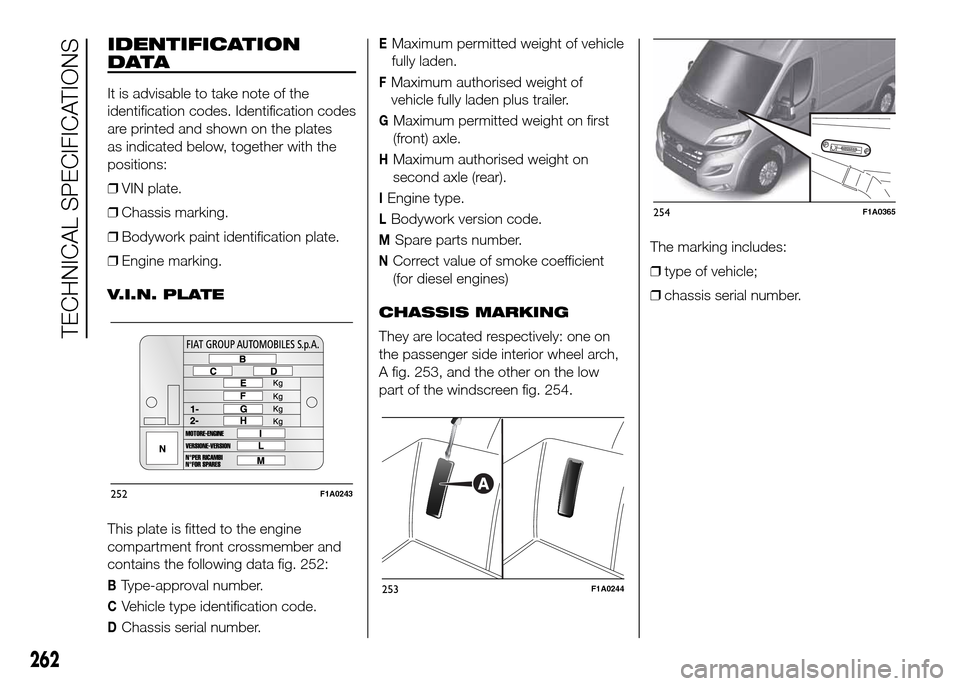
This plate is fitted to the engine
compartment front crossmember and
contains the following data fig. 252:
BType-approval number.
CVehicle type identification code.
DChassis serial number.
EMaximum permitted weight of vehicle
fully laden.
FMaximum authorised weight of
vehicle fully laden plus trailer.
GMaximum permitted weight on first
(front) axle.
HMaximum authorised weight on
second axle (rear).
IEngine type.
LBodywork version code.
MSpare parts number.
NCorrect value of smoke coefficient
(for diesel engines)
CHASSIS MARKING
They are located respectively: one on
the passenger side interior wheel arch,
A fig. 253, and the other on the low
part of the windscreen fig. 254.The marking includes:
❒type of vehicle;
❒chassis serial number.
252F1A0243
253F1A0244
254F1A0365
262
TECHNICAL SPECIFICATIONS
Page 269 of 387
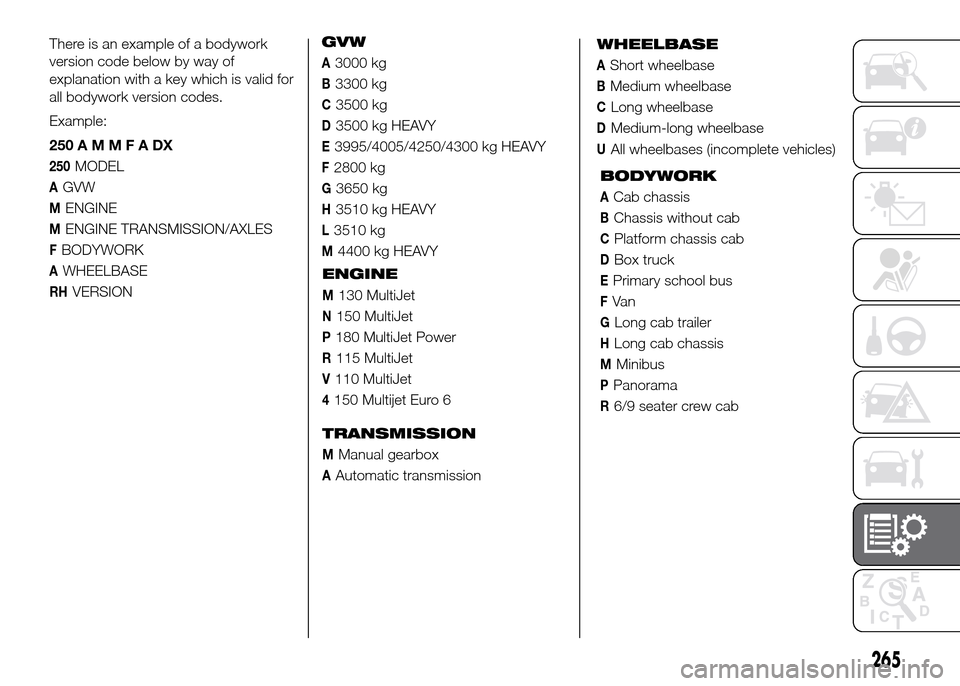
WHEELBASE
AShort wheelbase
BMedium wheelbase
CLong wheelbase
DMedium-long wheelbase
UAll wheelbases (incomplete vehicles)
BODYWORK
ACab chassis
BChassis without cab
CPlatform chassis cab
DBox truck
EPrimary school bus
FVa n
GLong cab trailer
HLong cab chassis
MMinibus
PPanorama
R6/9 seater crew cab
265
ENGINE
M130 MultiJet
N150 MultiJet
P180 MultiJet Power
R115 MultiJet
V110 MultiJet
4150 Multijet Euro 6
TRANSMISSION
MManual gearbox
AAutomatic transmission GVW
A3000 kg
B3300 kg
C3500 kg
D3500 kg HEAVY
E3995/4005/4250/4300 kg HEAVY
F2800 kg
G3650 kg
H3510 kg HEAVY
L3510 kg
M4400 kg HEAVY There is an example of a bodywork
version code below by way of
explanation with a key which is valid for
all bodywork version codes.
Example:
250AMMFADX
250MODEL
AGVW
MENGINE
MENGINE TRANSMISSION/AXLES
FBODYWORK
AWHEELBASE
RHVERSION
Page 272 of 387
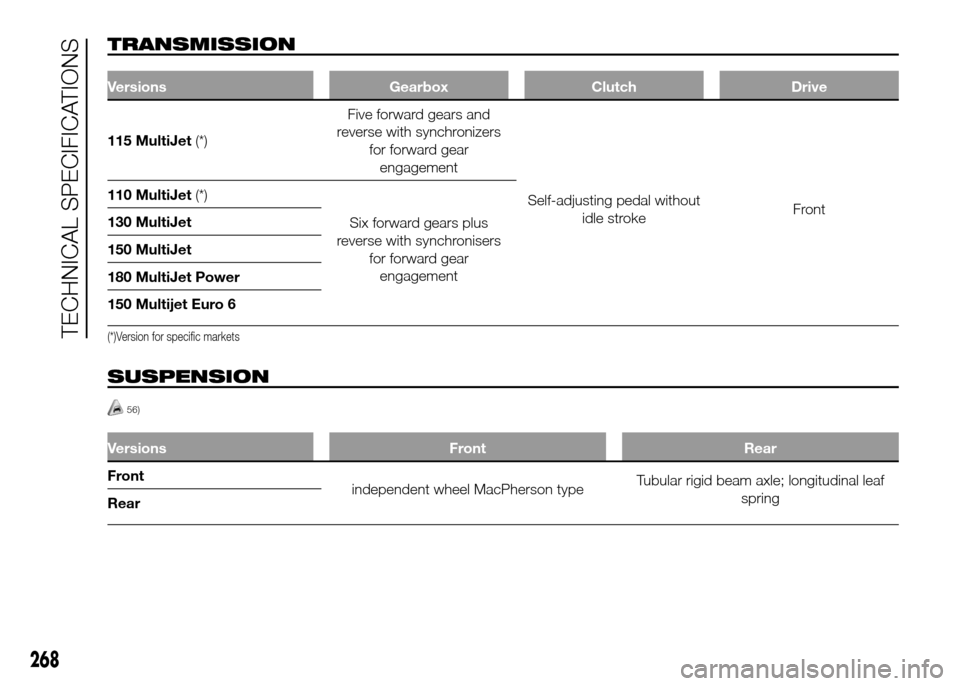
TRANSMISSION
Versions Gearbox Clutch Drive
115 MultiJet(*)Five
forward gears and
reverse with synchronizers
for forward gear
engagement
Self-adjusting pedal without
idle strokeFront 110 MultiJet(*)
Six forward gears plus
reverse with synchronisers
for forward gear
engagement 130 MultiJet
150 MultiJet
180 MultiJet Power
150 Multijet Euro 6
(*)Version for specific markets
SUSPENSION
56)
Versions Front Rear
Front
independentwheel MacPherson typeTubular rigid beam axle; longitudinal leaf
spring
Rear
268
TECHNICAL SPECIFICATIONS
Page 273 of 387
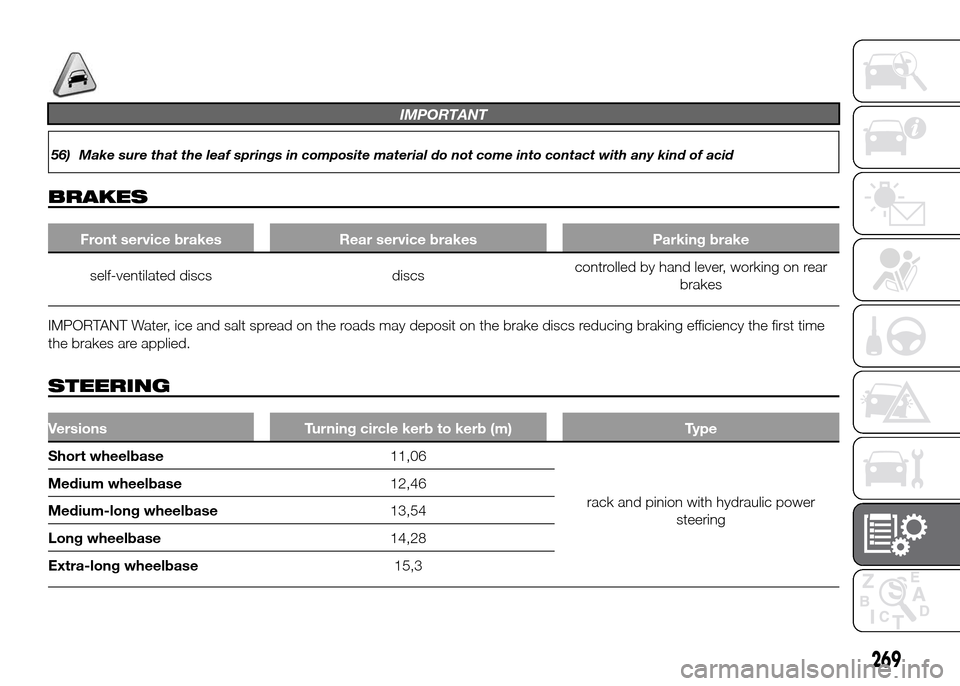
IMPORTANT
56) Make sure that the leaf springs in composite material do not come into contact with any kind of acid
BRAKES
Front service brakes Rear service brakes Parking brake
self-ventilated discs discscontrolled by hand lever, working on rear
brakes
IMPORTANT Water, ice and salt spread on the roads may deposit on the brake discs reducing braking efficiency the first time
the brakes are applied.
STEERING
Versions Turning circle kerb to kerb (m) Type
Short wheelbase11,06
rackand pinion with hydraulic power
steering Medium wheelbase12,46
Medium-long wheelbase13,54
Long wheelbase14,28
Extra-long wheelbase15,3
269
Page 274 of 387
WHEELS
RIMS AND TYRES
Pressed steel or alloy rims. Tubeless
radial carcass tyres. All approved tyres
are listed in the registration document.
IMPORTANT If there are any
discrepancies between the "Owner
Handbook" and the "Registration
document", take the information from
the latter.
To ensure driving safety, ensure that
tyres of the same make and type are
fitted on all wheels.
IMPORTANT Do not use air chambers
with tubeless tyres.
SPARE WHEEL
Pressed steel rim. Tubeless tyre.
WHEEL GEOMETRY
Front wheel toe-in measured from rim
to rim: -1±1mm.
The values refer to the vehicle in
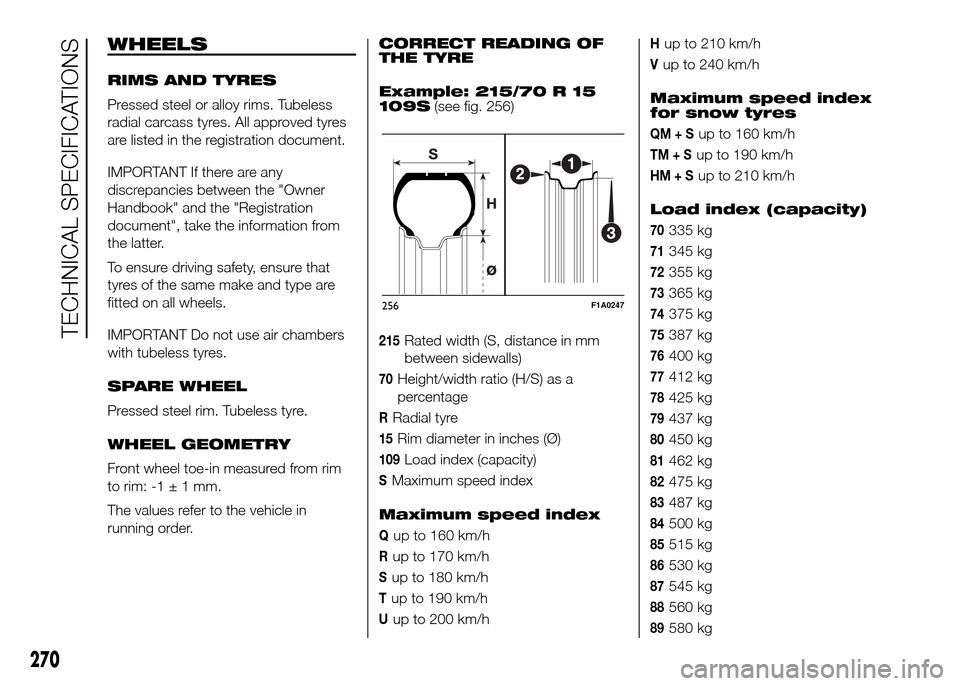
running order.CORRECT READING OF
THE TYRE
Example: 215/70 R 15
109S(see fig. 256)
215Rated width (S, distance in mm
between sidewalls)
70Height/width ratio (H/S) as a
percentage
RRadial tyre
15Rim diameter in inches (Ø)
109Load index (capacity)
SMaximum speed index
Maximum speed index
Qup to 160 km/h
Rup to 170 km/h
Sup to 180 km/h
Tup to 190 km/h
Uup to 200 km/h
Hup to 210 km/h
Vup to 240 km/h
Maximum speed index
for snow tyres
QM+Sup to 160 km/h
TM+Sup to 190 km/h
HM+Sup to 210 km/h
Load index (capacity)
70335 kg
71345 kg
72355 kg
73365 kg
74375 kg
75387 kg
76400 kg
77412 kg
78425 kg
79437 kg
80450 kg
81462 kg
82475 kg
83487 kg
84500 kg
85515 kg
86530 kg
87545 kg
88560 kg
89580 kg
256F1A0247
270
TECHNICAL SPECIFICATIONS
Page 275 of 387
90600 kg
91615 kg
92630 kg
93650 kg
94670 kg
95690 kg
96710 kg
97730 kg
98750 kg
99775 kg
100800 kg
101825 kg
102850 kg
103875 kg
104900 kg
105925 kg
106950 kg
107975 kg
1081000 kg
1091030 kg
1101060 kg
1111090 kg
1121120 kg
1131150 kg
1141180 kg
1151215 kg
1161250 kg
1171285 kg
1181320 kg
1191360 kg
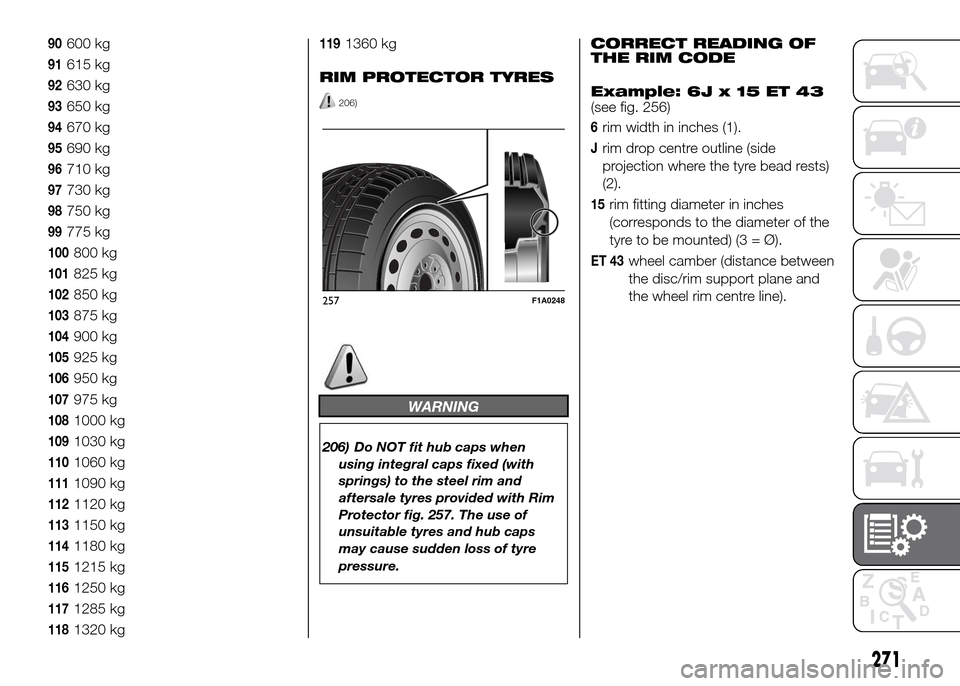
RIM PROTECTOR TYRES
206)
WARNING
206) Do NOT fit hub caps when
using integral caps fixed (with
springs) to the steel rim and
aftersale tyres provided with Rim
Protector fig. 257. The use of
unsuitable tyres and hub caps
may cause sudden loss of tyre
pressure.
CORRECT READING OF
THE RIM CODE
Example: 6J x 15 ET 43
(see fig. 256)
6rim width in inches (1).
Jrim drop centre outline (side
projection where the tyre bead rests)
(2).
15rim fitting diameter in inches
(corresponds to the diameter of the
tyre to be mounted) (3 = Ø).
ET 43wheel camber (distance between
the disc/rim support plane and
the wheel rim centre line).
257F1A0248
271
Page 276 of 387
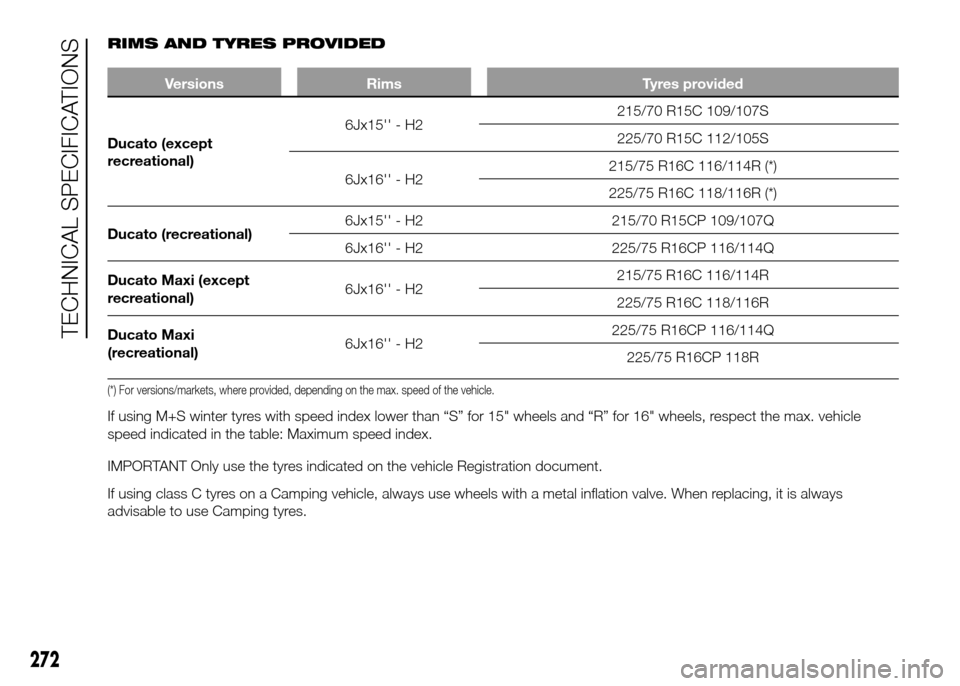
RIMS AND TYRES PROVIDED
Versions Rims Tyres provided
Ducato (except
r
ecreational)6Jx15'' - H2215/70 R15C 109/107S
225/70 R15C 112/105S
6Jx16'' - H2215/75 R16C 116/114R (*)
225/75 R16C 118/116R (*)
Ducato (recreational)6Jx15'' - H2 215/70 R15CP 109/107Q
6Jx16'' - H2 225/75 R16CP 116/114Q
Ducato Maxi (except
recreational)6Jx16'' - H2215/75 R16C 116/114R
225/75 R16C 118/116R
Ducato Maxi
(recreational)6Jx16'' - H2225/75 R16CP 116/114Q
225/75 R16CP 118R
(*) For versions/markets, where provided, depending on the max. speed of the vehicle..
If using M+S winter tyres with speed index lower than “S” for 15" wheels and “R” for 16" wheels, respect the max. vehicle
speed indicated in the table: Maximum speed index.
IMPORTANT Only use the tyres indicated on the vehicle Registration document.
If using class C tyres on a Camping vehicle, always use wheels with a metal inflation valve. When replacing, it is always
advisable to use Camping tyres.
272
TECHNICAL SPECIFICATIONS